Sim’s Corner

Articles by Sim Branaghan, author of British Film Posters: An Illustrated History. These articles originally appeared on SMGuariento.com.

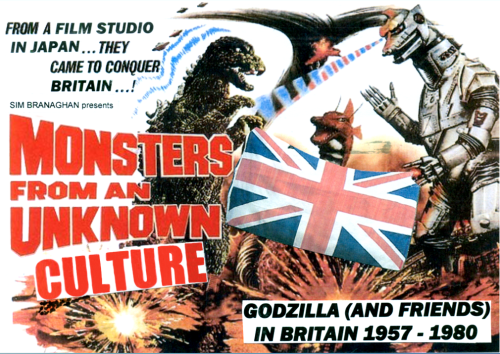
Monsters From An Unknown Culture: Godzilla (and friends) in Britain 1957-1980 by Sim Branaghan – Part 1

13.07.18

Monsters From An Unknown Culture: Godzilla (and friends) in Britain 1957-1980 by Sim Branaghan – Part 1

INTRODUCTION:  The ATV Thursday Picture Show

Let’s start with a time and place.

It is Thursday 3rd February 1977, another grey day in the already grey West Midlands.  Your writer (just three weeks past his 10th birthday, and utterly obsessed with monsters) is stuck at home with a Cold, being looked after by his Gran.  In an effort to cheer him up (then as now a near-impossible task) she consults her newspaper to see what’s on telly.  “Here Sim, this sounds like something we could watch—a monster film on at teatime”.  [Adjusting her glasses] “Twenty past four, ‘The ATV Thursday Picture Show—Ebirah Terror of the Deep’.  How d’you like the sound of that?”

Despite feeling sniffly, I perked up a bit—I had no idea what this was, but anything involving a Terror from the Deep was probably worth a try. 85 minutes later, as the News began at 5.45pm (Hattersley’s…

Continue reading

Invitation To Terror—Horror Films on British Television in the 1970s & 80s by Sim Branaghan [Updated and Revised]

12.10.17

Invitation To Terror—Horror Films on British Television in the 1970s & 80s by Sim Branaghan [Updated and Revised]

***The following research is heavily indebted to the pioneering work of both Sheldon Hall (2014) and Wayne Kinsey (2016)***

Introduction: Did you see that bit where he chopped her head off with a shovel?

Well, did you?  It was dead good wasn’t it?  Don’t you wish you were ten years old again, and nervously staying up late for the very first time?  I know I do.

The ever-shifting generational experience of popular culture is beset by pitfalls as a research topic, one perennial hazard being sweeping generalisations which can reflect less the researcher’s penetrating insight than (i) his age (typically advanced), and (ii) his resulting prejudices (typically irrational). On the other hand, the underlying timelines involved—the rise and fall of a particular movement—are in contrast often fixed and objective. If, for example, you are a UK horror film fan, then a central pillar of your appreciation is likely to be…

Continue reading

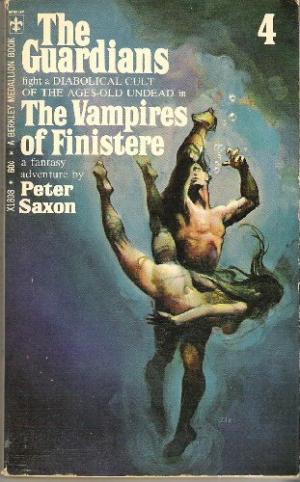
The Guardians #6: The Vampires of Finistere by Rex Dolphin

09.07.16

The Guardians #6: The Vampires of Finistere by Rex Dolphin

Synopsis

The Guardians are approached by Nicholas Brooke, a young London clerk recently returned from a picturesque driving holiday in rural Brittany.  The problem is, Nick went out there with his Welsh fiancée Margot Prys but was forced to return to England alone—Margot simply vanished en-route in the most incredible circumstances.  The local police were hopeless, and no Private Detective agencies over here are interested.  Somebody mentioned that the Guardians handle unusual cases, and they’re his last hope…

The couple were driving through the Finistere coastal district, and stopped off at a pleasantly remote spot for a picnic. Margot impulsively announced she wanted to walk to the sea, even though it was clearly some miles distant. They left the car and set off, but the further they walked the more confusing the route became. Dusk set in, and the light began to fade… Nick started to get worried and wanted…

Continue reading

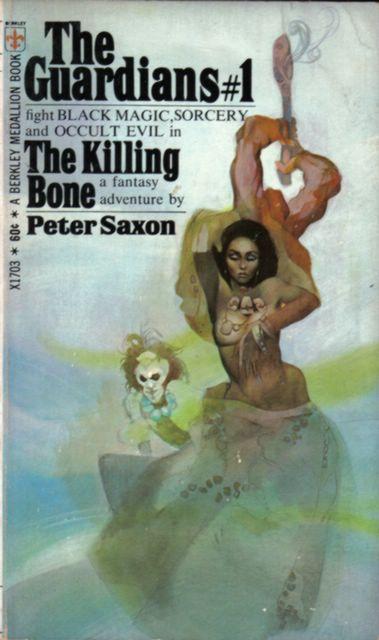
The Guardians #5: The Killing Bone by W.H. Baker

09.07.16

The Guardians #5: The Killing Bone by W.H. Baker

Synopsis

One of Father Dyball’s clerical duties is to occasionally attend sick or dying patients in St Botolph’s Hospital in the East End.  The Registrar has asked him over to visit a new arrival—a mystery-man who appears to have no identity whatsoever.  He was found collapsed on a nearby street, carrying no identification, unable to speak and apparently unaware of his surroundings.  He seems in a permanent catatonic trance, though Dyball is edgily aware of a hideous tormented suffering behind the man’s eyes, and also a sense of a simultaneous malevolent alien presence, mockingly looking out at him, calculatingly aware of his interest…  The Registrar admits the man is slowly dying, and yet desperately fighting this, fighting to live…

He appears in his mid-30s, tough, muscular and deeply tanned, as though having spent years under a hot sun. Other than that there are no clues, though the doorman notes he…

Continue reading

The Guardians #4: Through the Dark Curtain by Ross Richards

09.07.16

The Guardians #4: Through the Dark Curtain by Ross Richards

Synopsis

The Guardians are approached by plain-speaking Northern industrialist Sir Giles Offord, on behalf of his son and daughter-in-law John and Mavis, who have undergone a Terrifying Experience. They were driving home from a party in rural Suffolk a couple of nights ago, got lost, then ran out of petrol in the middle of nowhere during a torrential downpour. A dripping signpost pointed to a village named Frenton just a couple of miles further down the lane, so John reluctantly plodded off in his raincoat to go and get help, while Mavis stayed in the car. By the time John returned an hour or so later with a can of petrol, Mavis was huddled under a nearby bush gibbering incoherently. She had seen or encountered something that had driven her clean out of her wits, and is currently sedated in an Essex nursing home in a permanent catatonic state. Sir…

Continue reading

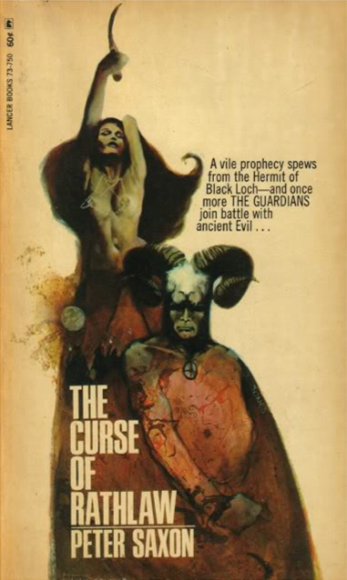
The Guardians #3: The Curse of Rathlaw by Martin Thomas

09.07.16

The Guardians #3: The Curse of Rathlaw by Martin Thomas

Synopsis

The Guardians are approached by Sir Alastair Rathlaw, Laird of Rathlaw Castle and its lonely Highland estates.  One of Sir Alastair’s more unwelcome tenants is Fergus ‘The Hermit’ Trayle, a depraved occultist who squats in a filthy ruined Bothy on the desolate shores of the Black Loch.  When Fergus is caught attempting to rape one of the Rathlaw maids (unwisely out walking alone near the loch), he is dragged back to the castle and whipped under the orders of the Laird, before being banished from his land.  But as he staggers away, Fergus grimly curses the Rathlawswith a three-fold prediction—the Laird’s brother Malcolm will be struck blind, a water-kelpie (supernatural Highland pony) will then be seen emerging from the Black Loch, and its appearance will be an omen that the Laird’s only son, Donald, will die without issue soon after his upcoming wedding. The Rathlaws are doomed!

Of course, Sir Alastair admits, I initially dismissed this as so much…

Continue reading

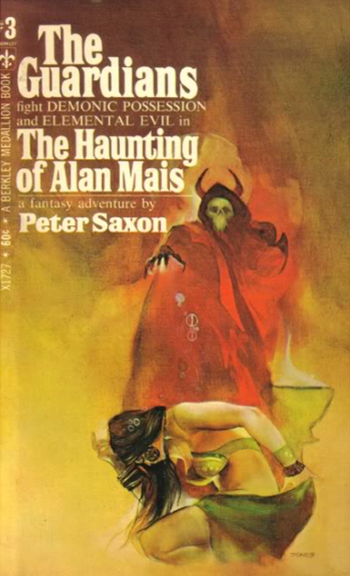
The Guardians #2: The Haunting of Alan Mais by Wilfred McNeilly

09.07.16

The Guardians #2: The Haunting of Alan Mais by Wilfred McNeilly

Synopsis

Whilst researching an earlier case in the British Museum, Steven Kane accidentally uncovers an intriguing reference to a 1652 witch-trial which took place in Maidstone, Kent.  A young local woman allegedly first corrupted and then poisoned a virtuous army officer “by the Devilish wiles lent to her by her master, Satan, enticed and seduced this true and godly Colonel of the army of the Commonwealth into the sweats of her adulterous bed”.  The woman indignantly protested she had in fact been blackmailed into sex, and eventually poisoned her persecutor purely in order to escape his gross demands, later burying his body in the woods in a crude attempt to conceal the crime.  The Court was unsympathetic, and she was burned as a witch in Maidstone town square, dying in agony while cursing her judges.

Nothing too remarkable there. Except for one thing. The woman was named Mistress Anne Ashby,…

Continue reading

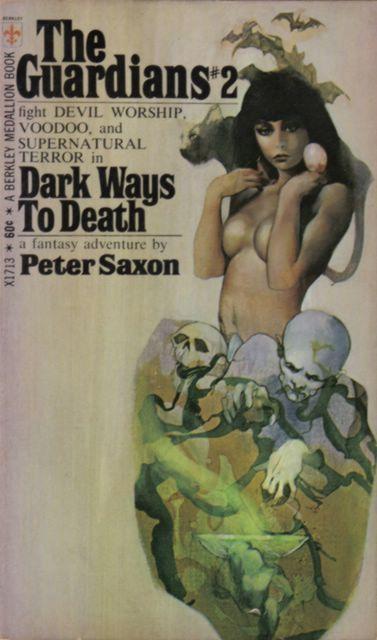
The Guardians #1: Dark Ways to Death by Wilfred McNeilly

09.07.16

The Guardians #1: Dark Ways to Death by Wilfred McNeilly

Synopsis

Introducing the principal cast (plus various supporting players, some utterly superfluous) takes up practically half this opening novel’s length, and the actual plotline is rudimentary at best.  Through a series of linked coincidences the Guardians are made aware of a sinister character, Dr Obadiah Duval, superficially a pillar of the Black Community who runs a rather unconventional health shop / consultancy in Notting Hill.  But is Dr Duval all that he seems?  No Sah, he is an insidious agent of the Left Hand Path, a ruthless Voodoo Practitioner who apparently has half West London’s immigrant population under his malevolent spell via a systematic web of terror and blackmail.

The Guardians are introduced to him from several angles simultaneously. Father Dyball is approached by Jack Johnson, a frightened young black ticket-collector on the Underground in some sort of unspecified trouble. Johnson reluctantly visits Half Moon Street on Dyball’s urging, but…

Continue reading

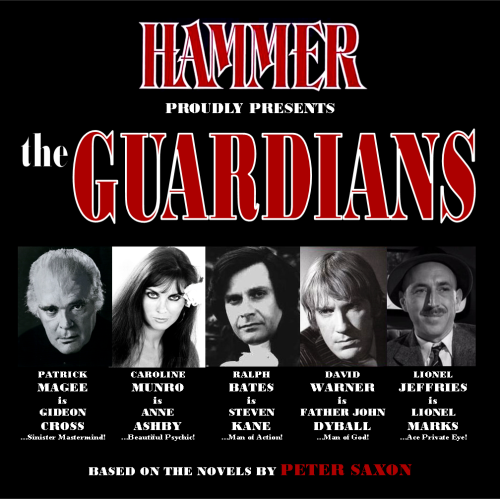
Hammer Presents…The Guardians! Feature Article by Sim Branaghan

09.07.16

Hammer Presents…The Guardians! Feature Article by Sim Branaghan

DATELINE: 1971…… HAMMER IN CRISIS…… FRESH IDEAS NEEDED…… WHO YA GONNA CALL?  MEET……THE GUARDIANS!

Hammer’s decline and fall is now so well-documented that it barely needs rehashing: by 1971 original creative head Tony Hinds was gone, CEO James Carreras had (reluctantly) brought estranged son Michael back into the fold as MD, but—sensing the end was finally in sight—was simultaneously trying to offload the company behind his back. The money was drying up, the market was shrinking, and nobody really knew what to make any more. Interviewed for a BBC doc in 1987, critic David Pirie argued “The fact is that Hammer were making the wrong films at the wrong time in the 1970s. They should have been making Night of the Living Dead, they should have been making Halloween… If they’d found that low-budget formula, they could have gone on for another decade. There was one chance, a film called…

Continue reading

The Giallo in Britain 1965-1983: Feature Article by Sim Branaghan

24.11.15

The Giallo in Britain 1965-1983: Feature Article by Sim Branaghan

The Giallo in Britain: 1965-1983

Let’s start with the basics—just what is a ‘giallo’?  The term is a popular nickname for a specific genre of Italian murder-mystery crime-thriller that flourished for about twenty years, c.1963-83. Like their contemporary cousin the Spaghetti Western, the gialli also achieved a notable overseas success despite (or perhaps because of) their uniquely stylised national identity. With their controversial mix of heavily-fetishised sex and violence they have since gone on to enjoy much enthusiastic attention from such well-known UK film buffs as the Metropolitan Police’s Obscene Publications Squad.

The first officially-recognised giallo is Mario Bava’s The Girl Who Knew Too Much (1963), while the last to achieve a decent international release was Dario Argento’s Tenebrae (1982). In between these two landmarks (depending upon how tightly one applies the qualifying criteria) is a sequence of about 140 steadily more lurid melodramas. This essay however is concerned with…

Continue reading