


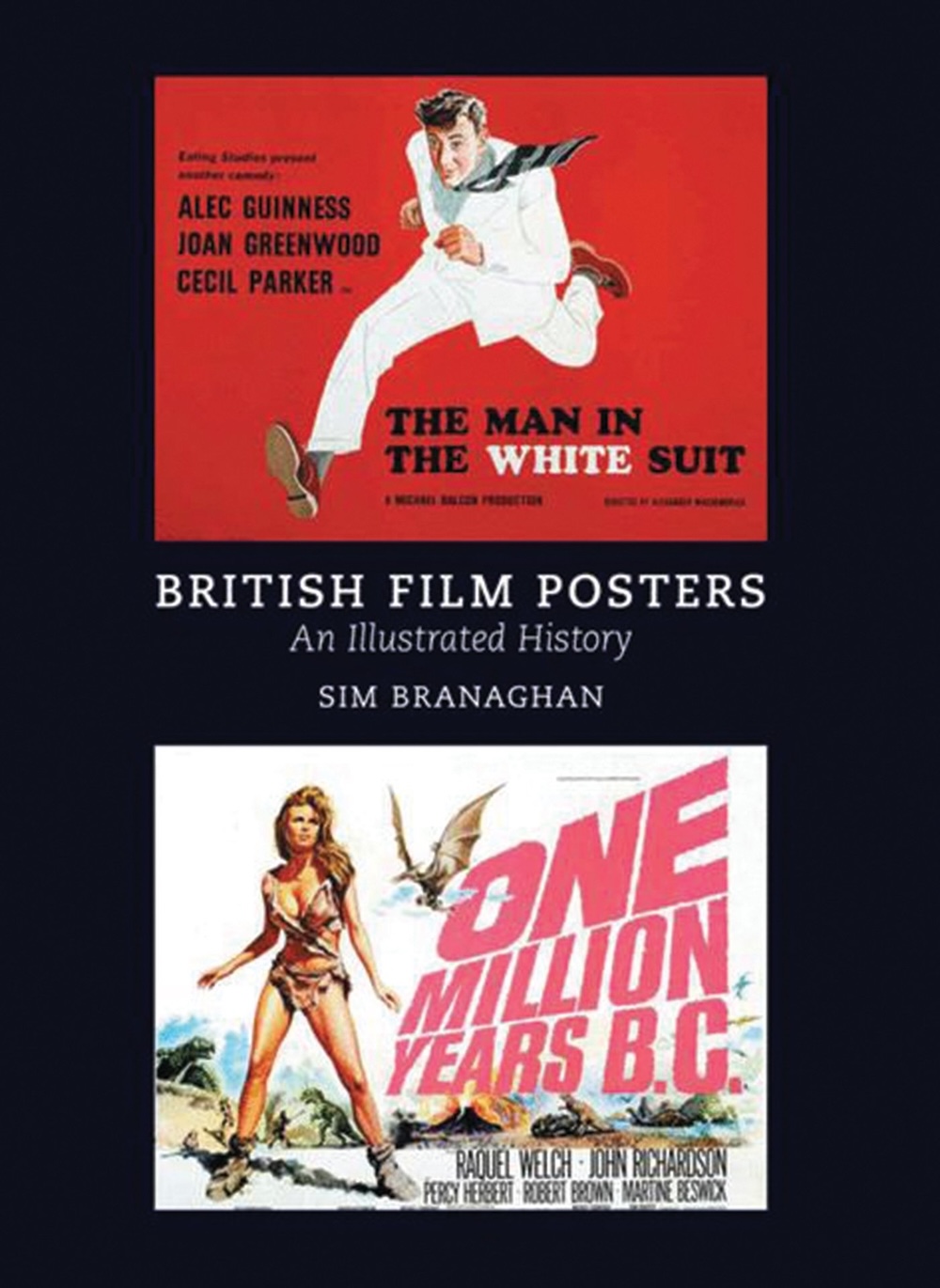
 I started work on my book British Film Posters: An Illustrated History in Jan 2002, largely prompted by the death of Tom Chantrell in July 2001 and the sense that there was an unexplored history there worth investigating. The first draft was completed in July 2003 and I then spent the next two years trying to persuade someone to publish it, finally getting lucky when Rebecca Barden arrived at the BFI in June 2005 (our first meeting was just a week after the 7/7 bombings and travelling into town still felt distinctly edgy). The final edit was approved in Nov 2005, and was as up-to-date as I could then make it, containing details like WE Berry’s collapse in Dec 2003, Eric Pulford’s death in July 2005, and the (prophetic) contemporary closure of Fred Zentner’s Cinema Bookshop etc etc. So what else has been lost in the two decades since I (quite literally) closed the book on this story? Twenty years on, it’s time to finally draw a line under the whole thing. Who will survive and what will be left of them? Let’s find out.

WE Berry’s original printing works, 63 Nesfield Street, Manningham in July 2024—now a tuition / childcare centre
My book’s Acknowledgements page lists about sixty interviewees 2001-2003, and it is a sad fact that of these less than ten now remain—I spent the following years attending a depressingly regular series of funerals. With most of the major artists I tried to get an obituary published in the press if possible, and a few of these are still available online. Running through the key losses alphabetically, we have:
Chris Achilleos (died Dec 2021)
Fred Atkins (Oct 2010)
Tom Beauvais (April 2024)
Vic Fair (Feb 2017)
Mike Francis (June 2023)
Roger Hall (Dec 2006)
Peter Lee (Printer – July 2014)
Brian McIlmail (Publicist – May 2021)
Sam Peffer (March 2014)
Arnaldo Putzu (Sept 2012)
Alan Wheatley (Publicist – Aug 2023)
Mike Wheeler (Publicist – May 2012)
… there are of course many, many others less celebrated (but no less significant) who all deserve a mention, but we need to keep this essay to a reasonable length. Having said that, three notable names who contrived to completely pass me by at the time are Guy Peeters, Jack Hubbard and Ted Verrum. Peeters attended Somerset College of Art 1958-60, so was presumably born c.1940. He worked at UK Advertising in the 1960s illustrating MGM quads like Cincinnati Kid (1965) and The Comedians (1967), then later seems to have specialised in girls’ comic illustration for DC Thompson / IPC 1977-81, eg Jinty, Nikki, Mandy, Bunty, Misty, Debbie etc etc. But any further detail is currently lacking, and it seems highly unlikely he’s still alive.
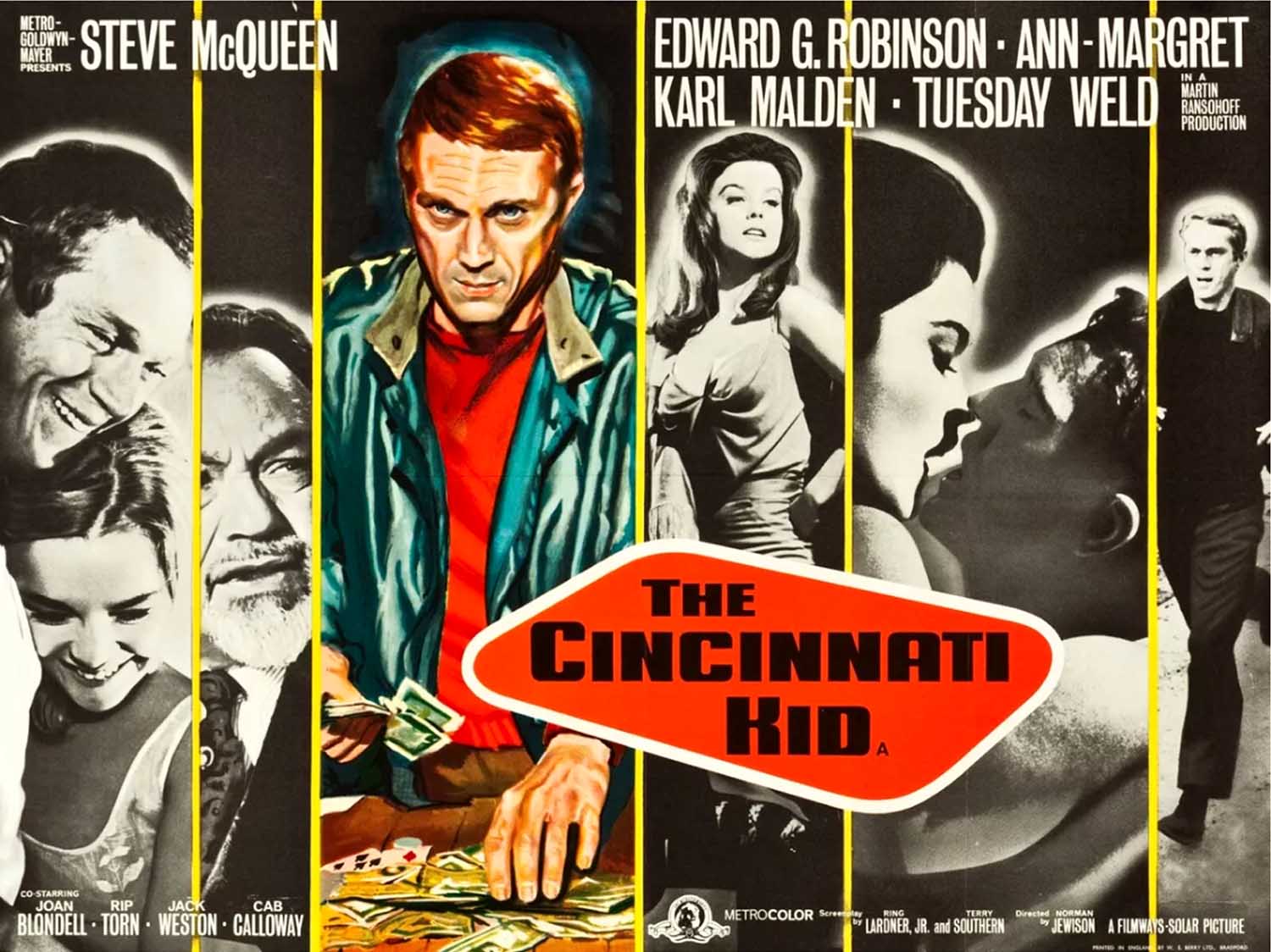
The Cincinnati Kid (1965) Printed by WE Berry. Design and illustration by Guy Peeters
Jack Hubbard (1913-1985) apparently worked for a host of British distributors including Fox, Gala, Eros, New Realm and British Lion, though very rarely signed his illustrations—Alyse and Chloe (1970) is one of the few boasting his signature. He began his career as a cartographer in the Royal Artillery while stationed in India, beginning to work in film publicity after the War initially for Fox (he allegedly came up with the Cinemascope logo) alongside Tom Chantrell and Andrew “Jock” Hinchliffe. Hopefully more biographical detail will emerge over time, as he was clearly prolific (I was initially misattributing some of his work to his freelance contemporary Fred Payne).
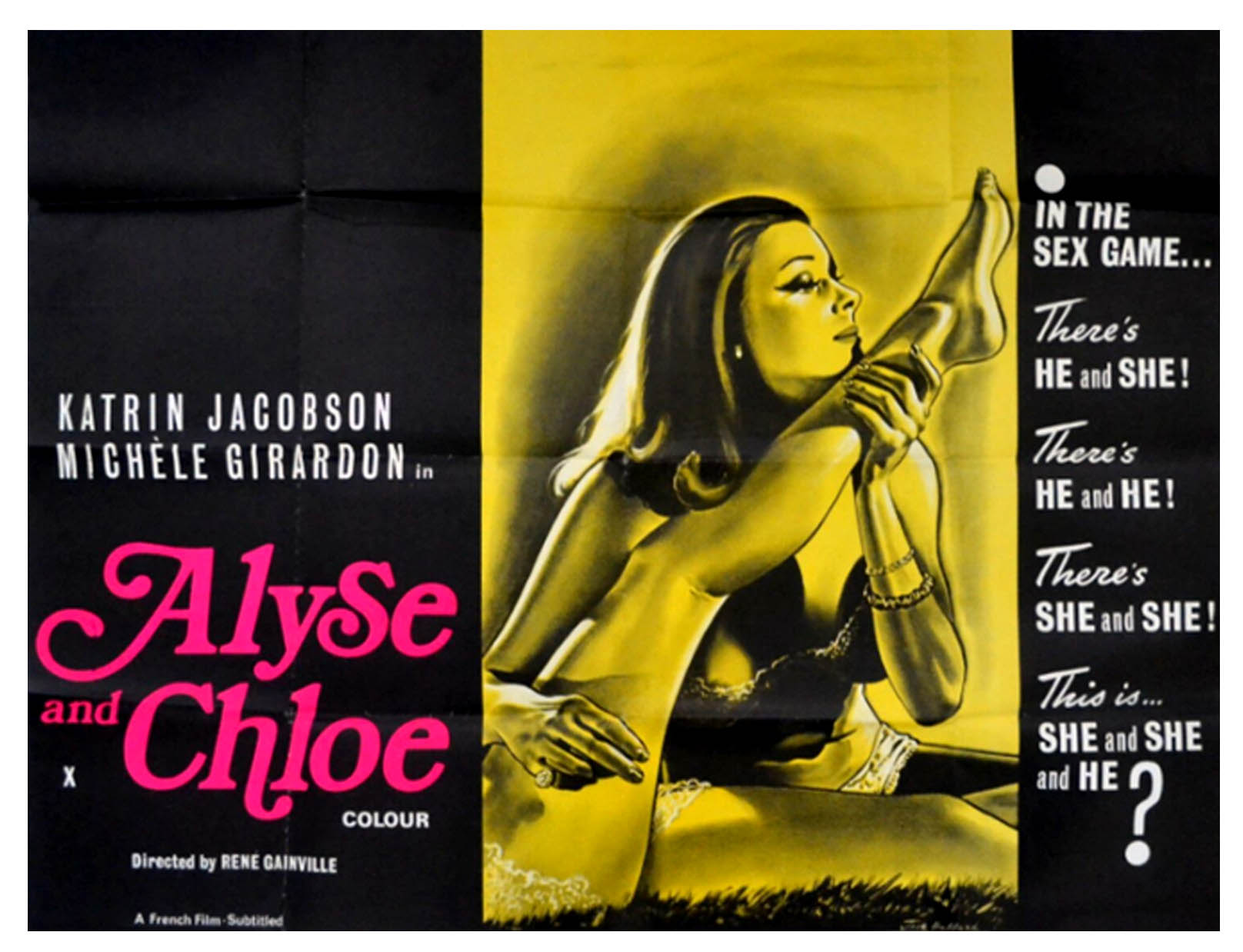
Alyse and Chloe (1970) No printer credited, but probably Broomhead Litho. Design and illustration by Jack Hubbard
Edward “Ted” Verrum was a contemporary of Pulford and Chantrell, and thus likely born c.1915. He apparently died in 1975, though—as with every other biographical detail—this is currently unconfirmed. He worked for Rex Publicity over the 1950s-60s (based in their New Bond Street offices), and is now chiefly remembered for painting the ABC circuit’s straplined double-bill posters (which typically adapted existing Chantrell designs, though Verrum does seem to have occasionally put together his own unique illustrations, e.g. Saturday Night and Sunday Morning). But he otherwise remains a tantalising blank, and—as with Peeters—further dedicated research is now badly overdue.
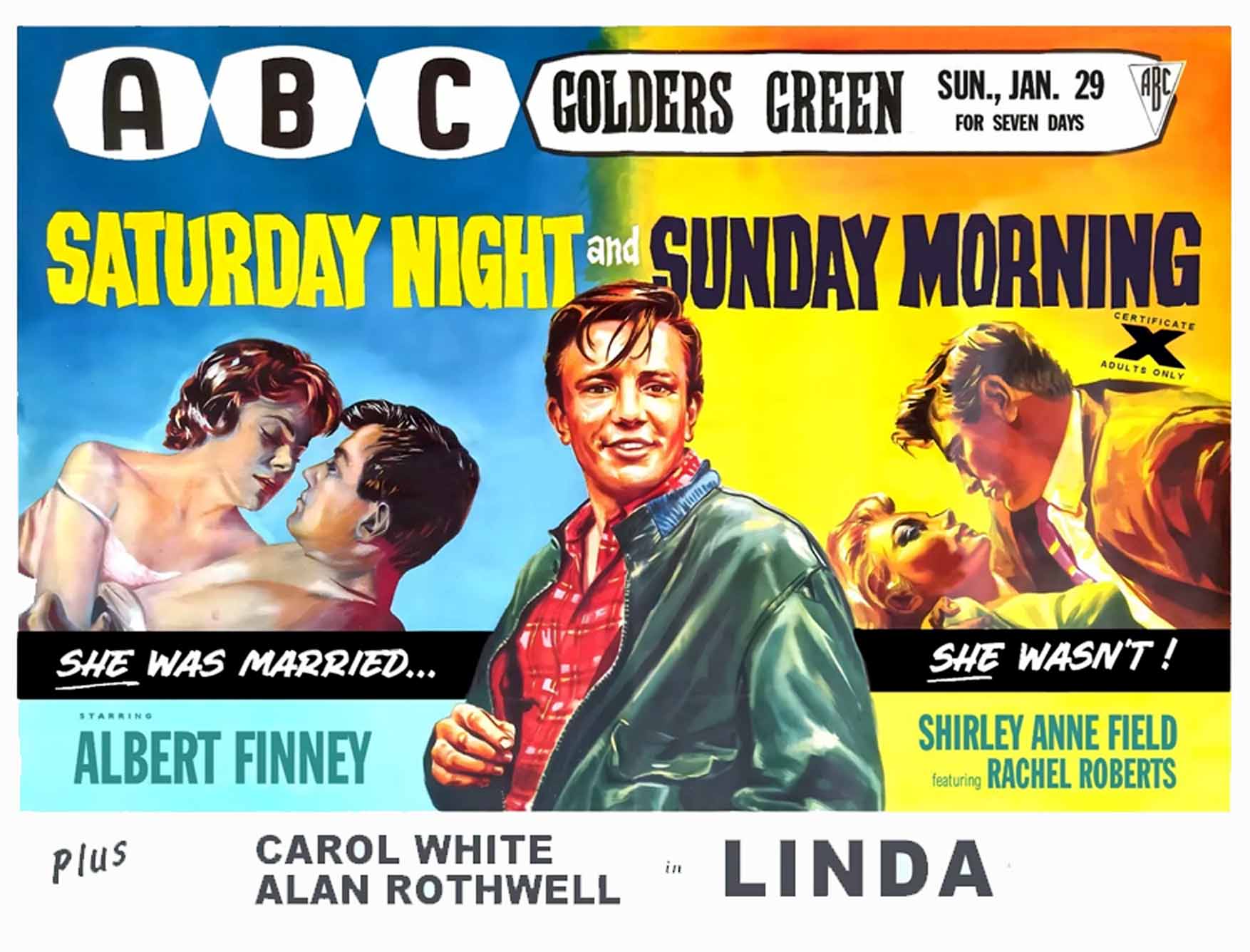
Saturday Night and Sunday Morning (1960) Printed By Leonard Ripley. Design and illustration by Ted Verrum
Moving on to the the key companies involved, we can usefully start with National Screen Service. In late 1986 the US parent-company was bought-out by senior executive Peter Koplik, and as a direct result the UK wing was ALSO quickly sold (in Dec) to a management buyout. Undoubtedly influenced by this downsizing and its implications, both NSS’s two established printers—Lonsdale & Bartholomew and WE Berry—jointly abandoned film posters at the end of the year. (We’ll get to their replacements in a moment).
Media-giant Carlton bought NSS-UK in June 1998, closing the company’s old Wadsworth Road office (to move just around the corner to Horsenden Lane) and installing new MD Paul Logan (ex-Carlton Screen Advertising), who ran the firm for ten more years until it ceased trading in Dec 2008 (formally dissolved Nov 2010). Logan cannily used half his redundancy cash to cheaply purchase some of the abandoned office equipment and (together with two colleagues) set up the wittily-named Logan’s Run Print Management, doing exactly the same thing (on an even MORE reduced scale) until liquidation in Nov 2018.
[Carlton had—via its 1988 subsidiary Technicolor Inc—similarly bought out the US NSS in Sept 2000, apparently shutting it down within months though precise dates here are elusive].
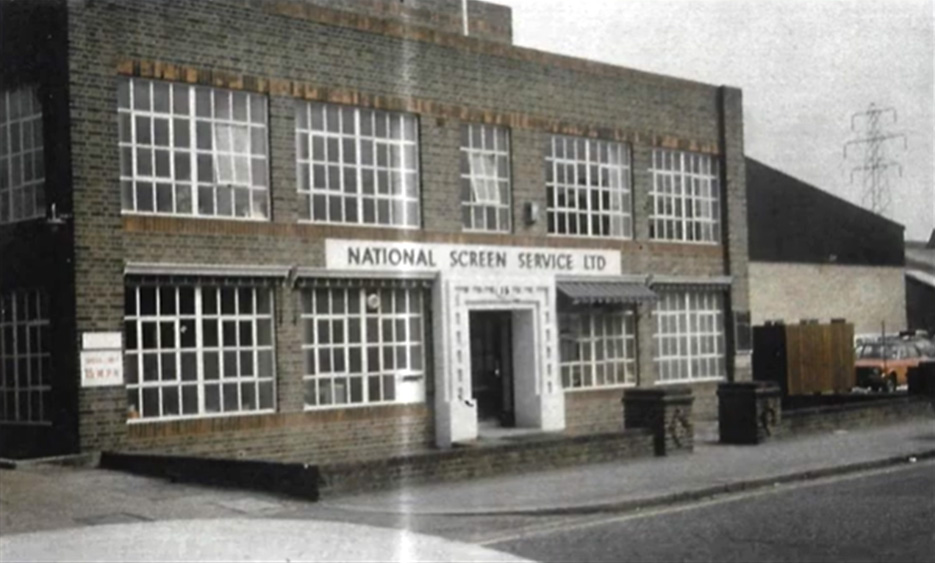
National Screen Service’s original offices, 15 Wadsworth Road, Perivale c.1972…

…and fifty years later in July 2024—now carved up into private flats and increasingly decrepit…
Printing. When my book hit the shops in Dec 2006, three of its older printers were still (just about) in business: Kent Art, Bovince and Broomhead Litho.
Kent Art of Chatham merged with Marstan Press (of Bexleyheath) in June 2007, ceased trading that Nov, and were dissolved in April 2010. Bovince in Walthamstow similarly went into administration in July 2008 (with 34 job losses) and were dissolved in Nov 2009. The original Broomhead Litho had been dissolved back in 1993, but Alan Broomhead’s offshoot repro-outfit Laserscan continued (at the old Lytham address) until it too went into administration in Aug 2015, dissolving June 2017.
Meanwhile, in 1986 NSS’s new print-buyer Graham Rowsell had to swiftly find replacements for the departing Lonsdale & Bartholomew and WE Berry, and told me he chiefly used two newer firms: Mills & Allen Printing (litho) and Capital Print & Display (silkscreen).
Mills & Allen Printing had a rather convoluted history. They were established in 1972 (initially purely as a holding company for Leonard Ripley & Co in Vauxhall), becoming active and opening their own purpose-built works in West Drayton in 1983 after Ripleys shut down. In 1993 they were bought out by Christian Huggonet’s expanding ‘Affiche Europeenne’ conglomerate, changing their name to Kingsway Press (an old M&A subsidiary) as part of the takeover. In June 2006 (in line with the whole group) they were rebranded Impression UK Ltd, but went into administration in Nov 2016, dissolving Jan 2020. The works site (backing onto the Grand Union Canal at Colham Bridge) was cleared in 2017, and replaced by the new Millstream House / Otter Way housing development.
Capital Print & Display were even more controversial, established in 1984 and opening their main Stratford works on Marshgate Lane four years later. This ironically ended up directly under the proposed footprint of the 2012 Olympic Stadium, and the London Development Agency (LDA) bought the site from Capital’s owner David Gill in 2006 for approx £12m (including compensation). CP&D relocated to Brentwood in July 2007, with the final LDA payments being handed over in June 2008. Mere weeks later Capital were declared insolvent and went into liquidation in March 2009. Multiple lawsuits to recover the missing money began, and in July 2009 Gill (no doubt reluctantly) settled out of court. Presumably due to all the ensuing legal back-and-forth, CP&D itself was not finally dissolved until Sept 2018.
The joint-exit of Lonsdales and Berrys in 1986 also marked the end of an era in which printers formally identified their posters by discreetly adding their name somewhere along the lower-border. Broomhead doggedly carried on with the tradition right up to the end of 1990, but following their departure all film posters printed in the UK became totally anonymous, and yet another element of their distinctive character was quietly lost.
[To be quite fair, one obvious point to make here is that rapidly-changing technology required major investment which many of the older firms were understandably reluctant to risk. Double-sided printing—where the back features a pale mirror-image of the front at 30% saturation for HD lightbox display—arrived in 1988 and required specially-coated Silk papers to be fully effective. At the same time, posters destined for pasting-up outdoors (a tiny percentage of any run nowadays) began to be printed on so-called ‘Blue Back’ stock, where the reverse is coated with an opaque blue dye to prevent older displays underneath from showing through when it rains.]
Collecting. Turning now to the dedicated Collecting-scene, this too has inevitably seen dramatic changes. Looking at the traditional forums of (A) Fairs and (B) Shops (and solely dealing with London, to try and keep things manageable):
(A) London Fairs
(i) Camden Electric Ballroom. Run 1989-2008 by Philip Nevitsky (b.1942), who sold them on his retirement to Paul Brown of Midnight Media. In 2017 Brown switched their location to Conway Hall on Red Lion Square in Holborn where they ran until final closure in July 2022. There’s a fun video of Phil’s final (May 2010) Manchester fair here:
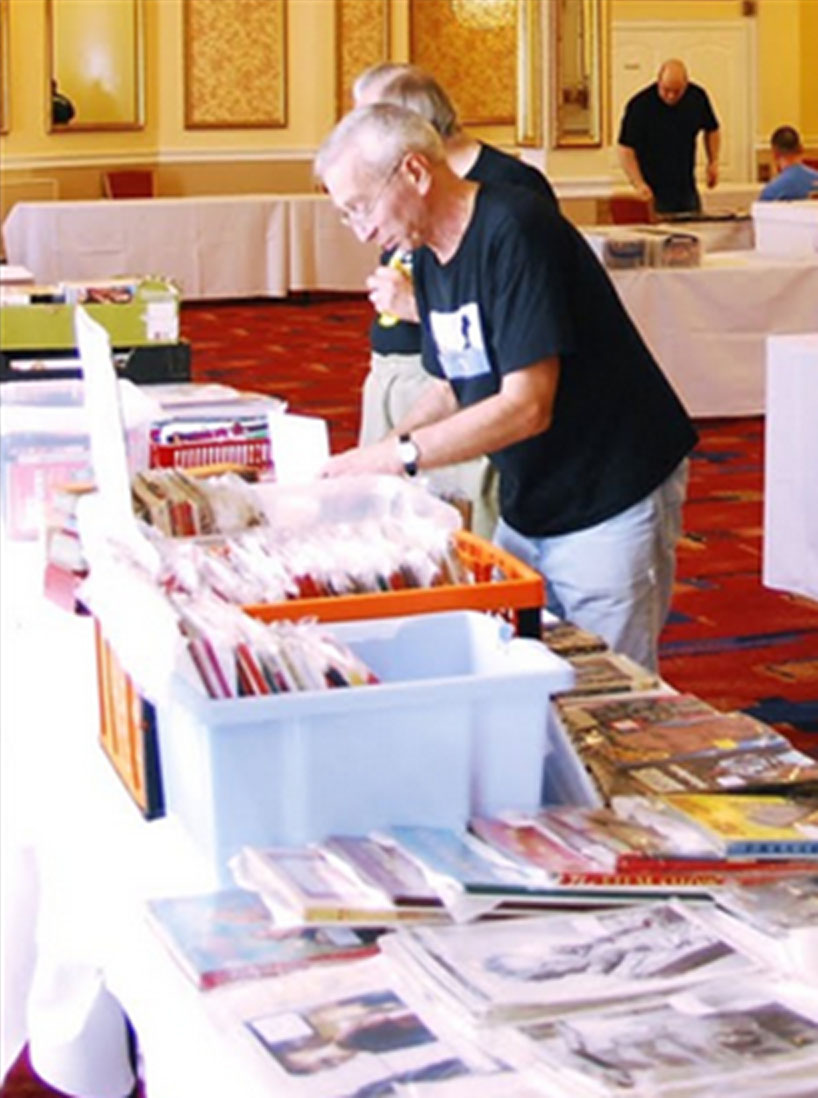
Philip Nevitsky at his last Manchester Fair, May 2010

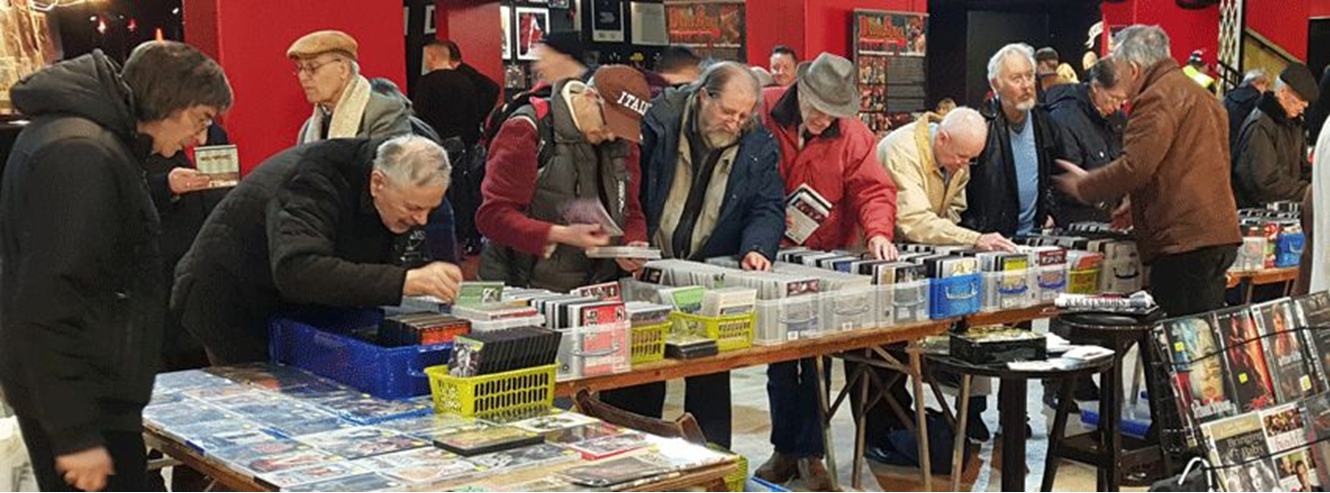
Old men looking at things in boxes, Camden Electric Ballroom c.2015
(ii) Westminster Central Hall. Run 1990-2012 by Ed Mason (d.2016) who sold them on his retirement to Thomas Bowington of Bowington Management (a small actors’ agency). In 2018 Bowington switched their location to the Royal National Hotel (off Russell Square), where they essentially became themed Autograph events for his agency’s elderly client-list.

Ed Mason at his final Westminster Fair, Sept 2012
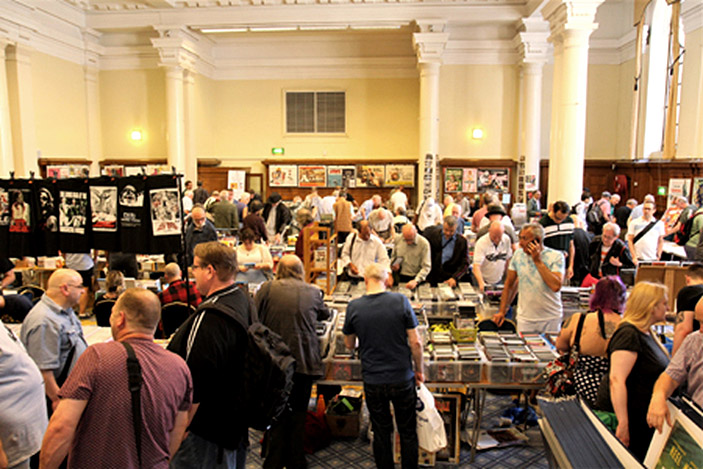
(B) London Shops (six in total, listed in order of closure)
(i) Cinema Bookshop, 13-14 Great Russell Street. An institution. Run 1969 – July 2005 by Fred Zentner, and closing just in time for its disappearance to be noted in my book (the unheralded beginning of a domino trend).

Fred Zentner in his Cinema Bookshop, July 2005
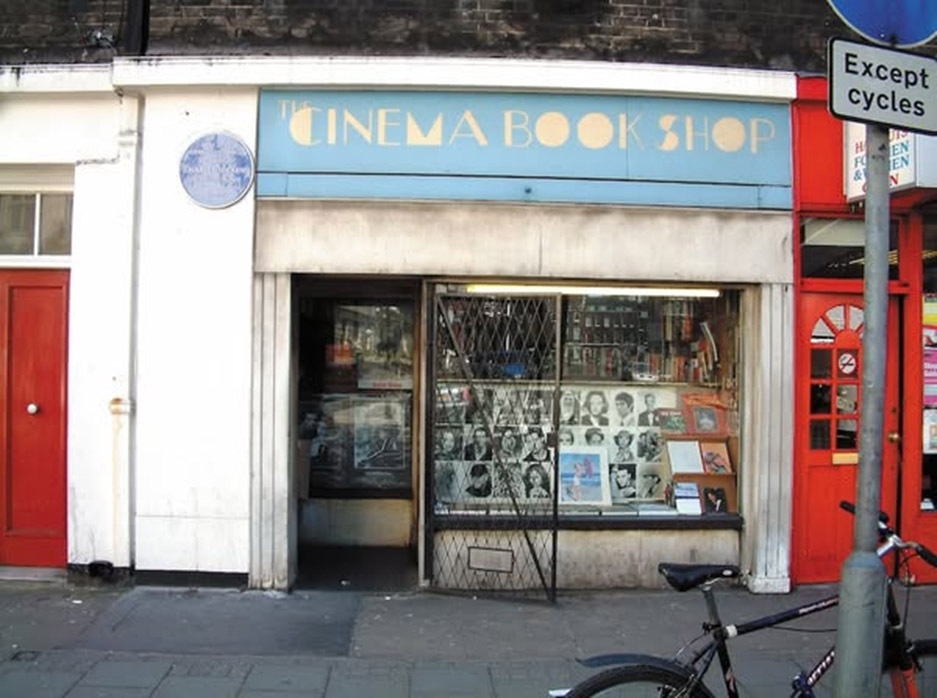
The Cinema Bookshop. Its unique art-deco signboard was designed by Cary, Fred’s girlfriend of the time…
(ii) Rare Discs, 18 Bloomsbury Street. Originally (c.1970-1996) “58 Dean Street Records” and specialising in soundtrack LPs / mixed film memorabilia. Between 1980 – July 2005 the two shops were sequentially run by twins Philip & Martin Masheter, well-known faces on the London scene. Rare Discs seems to have closed within a week or so of the Cinema Bookshop, with both proprietors simultaneously citing that month’s Congestion Charge-hike (from £5 up to £8) as the final nail in the coffin:
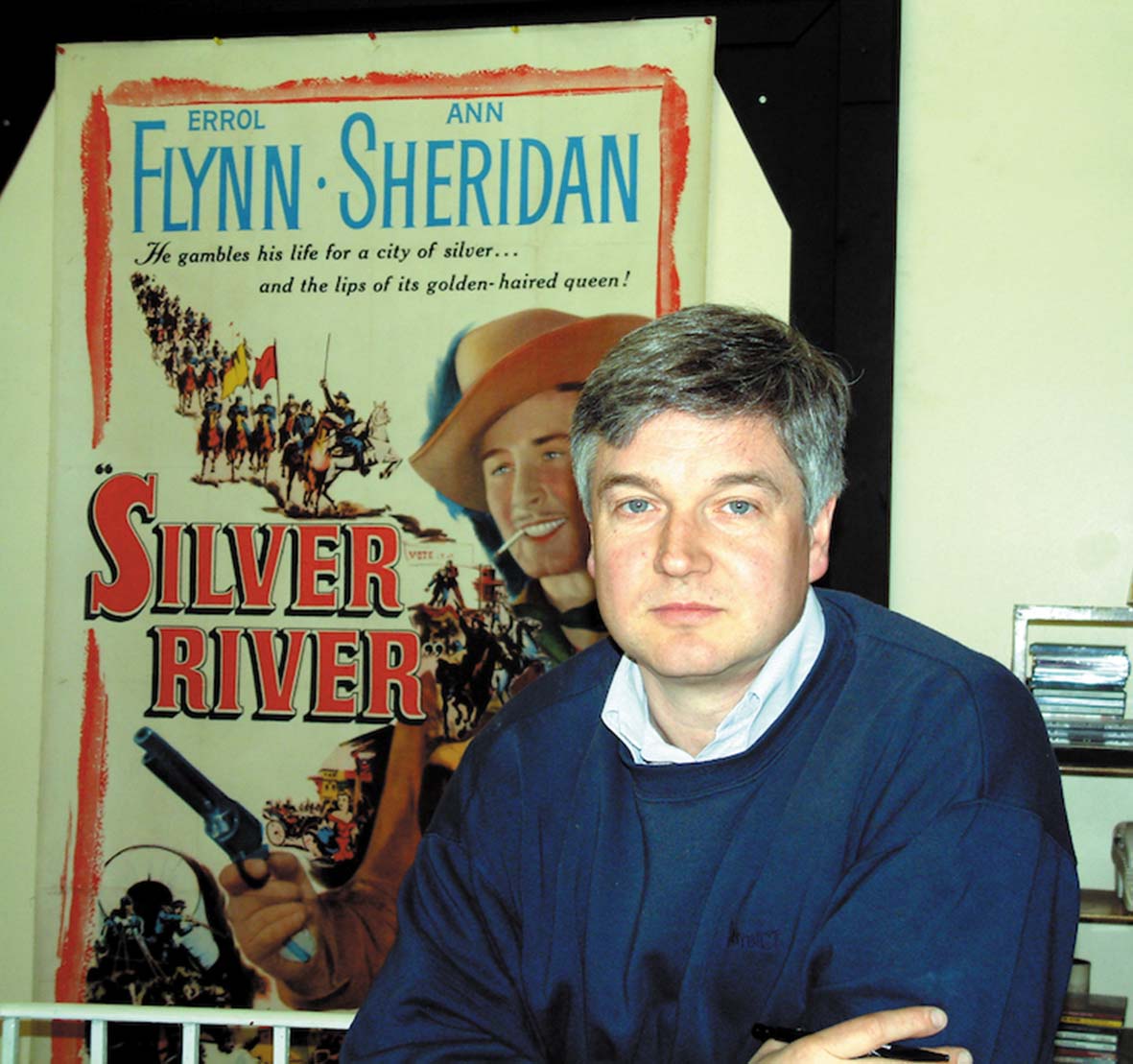
Martin Masheter in Rare Discs, July 2005
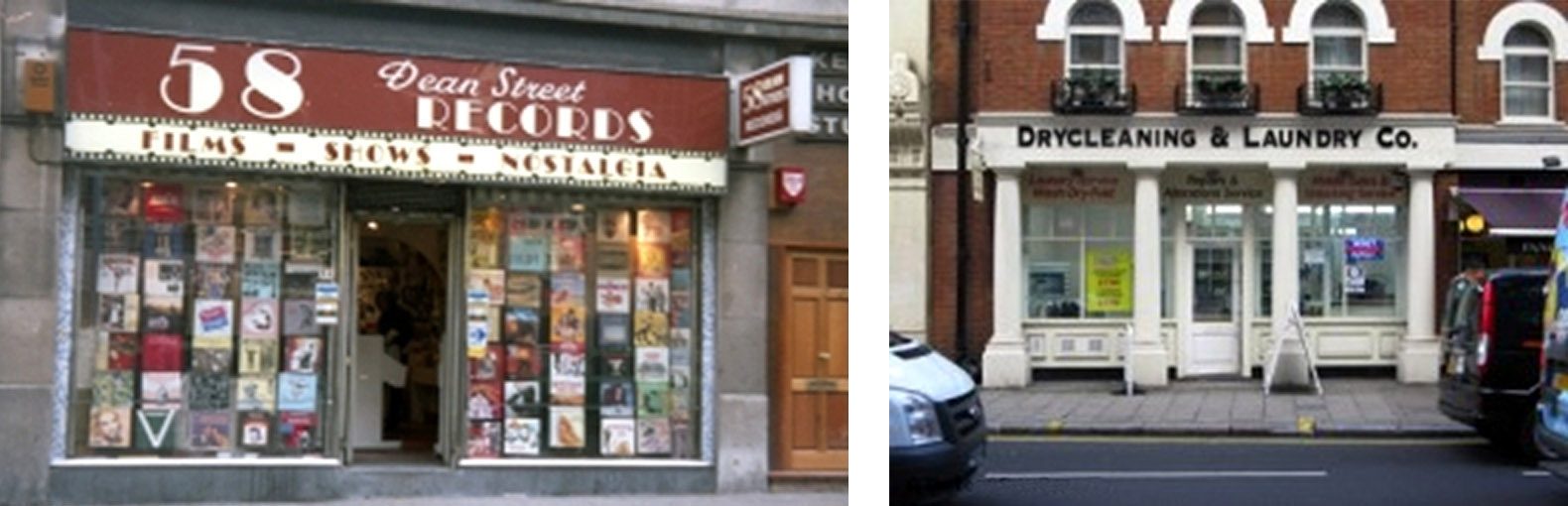
Left: The original Dean Street shop c.1994. Right: The Bloomsbury shop (under new ownership)
(iii) Flashbacks, 6 Silver Place, Soho. Run 1986 – Feb 2007 by Richard Dacre. Discussed in my book and ironically closing just ten weeks after publication. There’s a lively insider-account of its demise here:
https://chrisnthat.blogspot.com/2007_02_01_archive.html (opens in a new tab)

Richard Dacre in typically cheerful mood

Flashbacks c. 2005
(iv) Stage and Screen, 34 Notting Hill. 1998-2008. Part of Brian Abrams ‘Music and Goods Exchange Ltd’ W11 empire (est. 1967). Film memorabilia was previously sold upstairs in the old Music and Video Exchange (round the corner at 14 Pembridge Road). Various characters ran S&S for Abrams during the decade it was open, including Guy, Rob and Andy. Following closure, the posters were briefly transferred to the Berwick Street MVE for about a year, but had vanished entirely by the end of 2009.
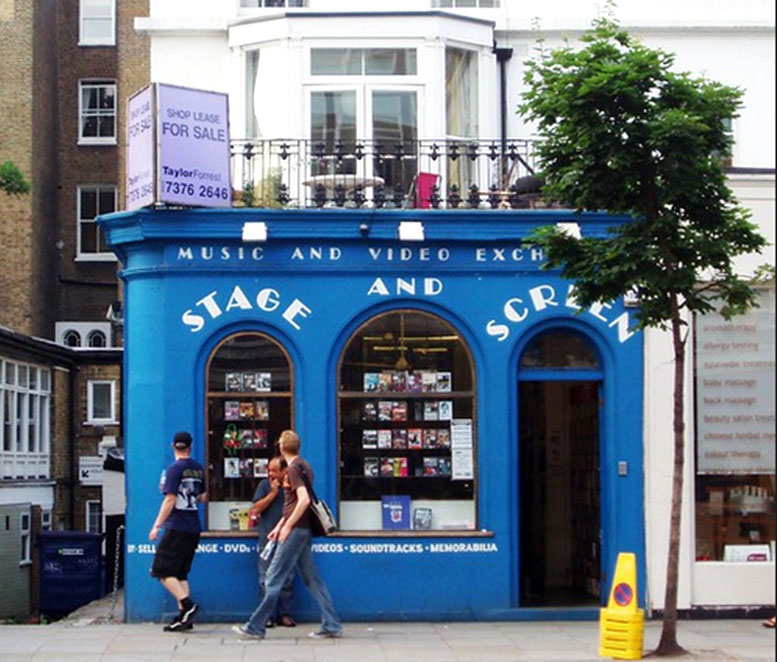
Stage and Screen, just just about to bite the dust in August 2008 (and already up for sale)
(v) The Cinema Store, 4B Upper St Martin’s Lane. Originally a smaller shop (on Monmouth Street in Covent Garden) and run 1994 – Jan 2016 by Neil Palmer.
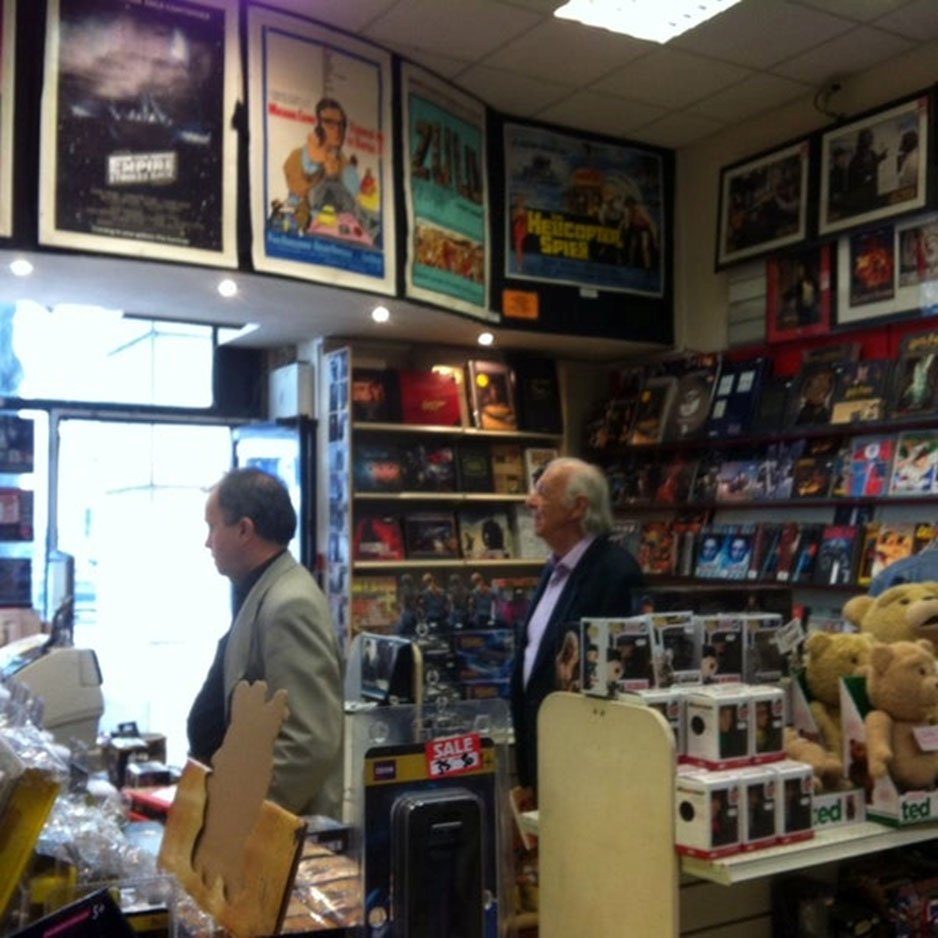
Neil Palmer in the Cinema Store c.2014
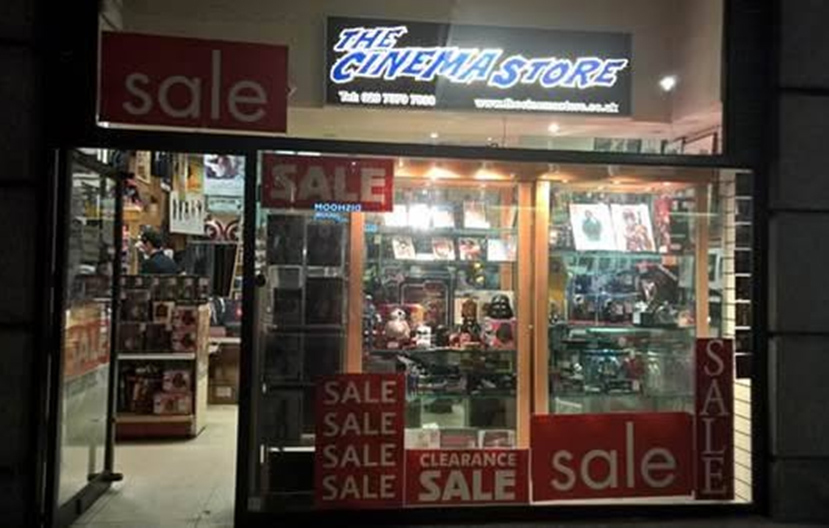
The Cinema Store, similarly about to bite the dust in Jan 2016
(vi) The Vintage Magazine Shop, 39-43 Brewer Street. Another institution. Run 1980 – Sept 2016 by Danny Posner (1931 – 2018) and his partner Angela Maguire. The loss of Vinmag was, in particular, felt to be symbolic of the decline of Olde Soho.

Danny Posner and Angela Maguire c.2014
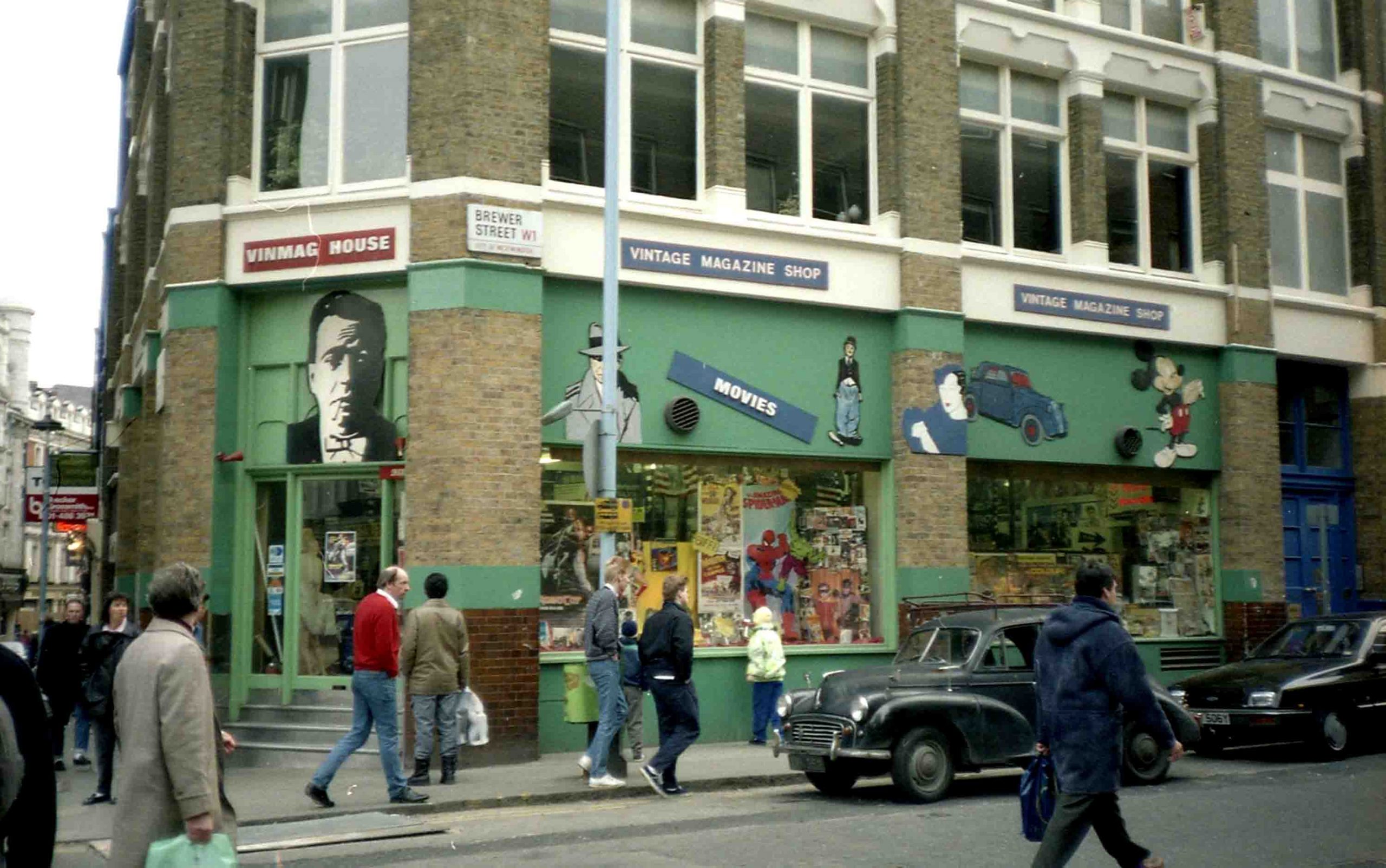
Vinmag in its majestic 1988 heyday
One obvious point to make here is that the original fairs and shops—all of which have now definitively gone forever—were operating on a quite different level to what came later. They were neither fashionable nor expensive, and were run by a group of grouchy veterans who frequently turned surly misanthropy into a virtual art form. The internet briefly popularised—and then rapidly crushed—their respective businesses, at a point when all were fast approaching retirement anyway. A collecting era really is finally over, and older fans will feel increasingly lucky to have been part of it. The unique thrill of visiting PLACES and meeting PEOPLE can never be matched by anonymously sniping stuff online, though the latter admittedly involves far less effort. Which is perhaps the point.
So, in finally drawing a line under this story, how can we sum all this up? What is the long-term significance of the era in question, and is it possible to coherently summarise it? I believe it is, and will now attempt to do so. Pay attention, I will say this only once.
It is obviously unfashionable to assess the cinema purely as an INDUSTRY, but that is surely the only meaningful approach when considering its advertising. That being the case, what are the key stages in cinema’s industrial development here in the UK? Well, the projection of moving images via celluloid film is mastered in 1896, but it takes a further thirty years for what we might term Modern Cinema (ie feature-length, 70mins+ narrative films featuring synchronised sound) to emerge. 1927 is thus a key date, not just for the technical breakthrough of Sound, but also our accompanying Quota Act which at a stroke creates a stable commercial base within which ambitious entrepreneurs can operate—i.e. we are obliged to start making our own films to show in our own purpose-built cinemas, and simple supply and demand rapidly takes over. By about 1931 all the Hollywood majors have (reluctantly) set up UK subsidiaries and are buying into the emerging British combines. By about 1936 a distinctive UK advertising style (based on our unique “landscape quad” poster format) is emerging.
But then the War intervenes. Paper Rationing is introduced in April 1940 (and not fully repealed until March 1949), with any old posters that happen to have been stored away methodically gathered together to be taken to the pulping mills for recycling. Very, very few British film posters from before 1945 thus survive, and the end of the War essentially marks the basic starting-point for collectors. 1946 also ironically marks the absolute height of British cinema-going, with 1,635m admissions to the country’s 4,723 cinemas. This means that on average everyone is visiting the cinema once a week, and there is one cinema for every 8,600 customers. It is vital to appreciate the overall history of British cinema from this point as a steady, inexorable decline, with the absolute nadir being reached forty years later.

Before and After. Top: Lonsdale & Bartholomew’s historic Netherfield works on Forester Street in 1977 – the modern (1973) frontage had been added after L&B bought out Stafford & Co in 1961. Middle: Demolition in early 1992, with the original Victorian works visible to the rear. Bottom: The same view in May 2023, with a small housing estate – Caxton Close & Staffords Court – now occupying the site.
The period 1945-1985 is thus remarkably stable overall, marked chiefly by progressive retrenchment and a stubbornly conservative reaction to the apparently irreversible slide by the (atrophying) vested interests controlling the business. There is little new investment and critically no new ideas to combat the emerging competition from both television (ITV launches in 1956) and subsequently home-video (VHS launches in 1978). The only major landmark occurs in 1970 with the loosening of censorship (via raising the “X” age-bar from 16 to 18) and simultaneous tripling of most remaining circuit cinemas, which jointly creates both a fresh exploitation market AND a convenient dedicated venue (i.e. the tiny resulting Screen Threes) in which to promote it. But by this stage everything is transparently on its last legs, with most cinemas surviving on one or two hits a year and running at a loss the rest of the time.
And by 1984-85 the gig is finally up. Admissions have dropped to 54m with only 660 cinemas still open. On average everyone is now visiting the cinema just once a year and there is one cinema for every 85,000 customers. In the space of just four decades admissions have dropped by a staggering 95% and six out of every seven cinemas have closed. The Quota Act is finally abolished as redundant, and with it the statutory controls which at least provided some long-term stability. In terms of the advertising aspect, 1985 also sees the debut of Desktop Publishing and the means to commercially print large-format computer design work. It takes a few years for this to gain traction in the equally conservative advertising world, but by the launch of Photoshop in 1990 the use of old-skool hand-assembled artwork on British film posters (or what we might loosely characterise as a traditional Craft-based approach) is effectively dead.
But in a peculiar irony, at its absolute lowest point green shoots of rebirth appear. The UK’s first Multiplex cinema (the ten-screen Point complex in Milton Keynes) opens in Nov 1985 and is an immediate success, sparking a wave of competitive building across the country which by 2000 means an astonishing 75% of British screens are new-build, encouraging the audience to rapidly return. The final stage in this process of reinvention is the introduction of digital projection, which races in even faster than the multiplex boom—in just eight years, 2005-2013, UK cinemas go from 100% film to 100% digital. The loss of celluloid (whilst effectively invisible) is hugely symbolic, as it represents the last physical element that made cinemas unique. The concurrent introduction of Home Streaming over 2011-12 (Amazon Lovefilm, Netflix UK and Sky NowTV all launched within eighteen months) allows immediate private access to what was once solely available in a controlled social context, and the whole notion of cinemas as dedicated palaces of film—home of the great popular art-form of the last century—has been further (and now perhaps irreversibly) eroded.
So, what does all this MEAN? That there is a clearly-defined forty-year period 1945-85 in which British film posters form a coherent and important artistic tradition. The starting-point is 1945 simply because almost nothing any earlier survives, and the end point is 1985 because a pivotal industry-crisis finally sweeps away all that has gone before. The combined effect of the loss of the Quota and apparently terminal audience-decline creates a perfect storm in which key participants decide it is time to finally bail out. NSS is sold-off in 1986 and its two veteran printers Lonsdales & Berrys accordingly cut their losses (“no prospect for growth” as Peter Lee put it to me) and quietly exit. Advertising budgets have been so reduced that bespoke British campaigns can no longer be afforded and the top UK illustrators have largely priced themselves out of a contracting market. Everyone—Chantrell, Pulford, Peffer, Paul, Putzu etc etc—either retire (Tom, Eric & Sam), die (Eddie), or fly home (Arnaldo) within a few months of each other in 1985.

Broomhead Litho’s old works on the Lidun Park Industrial Estate, Boundary Road, Lytham in Oct 2022. Once home to Zombie Flesh Eaters, currently a flooring warehouse. The boat can leave now—tell the crew…
So, forty years 1945-85. Not all that long really, with an identical length of time having now passed since it ended. Considered in this light, it’s helpful to try and assess the precise volume of material we’re talking about, and these two tables:
https://terramedia.co.uk/reference/statistics/film/film_registrations.htm (opens in a new tab)
https://terramedia.co.uk/reference/statistics/film/film_registrations_2.htm (opens in a new tab)
… are invaluable. Being based on Quota figures, they divide the stats into the three basic Registration-categories: First Features (72 mins+), Second Features (34-71 mins) and Shorts (under 33 mins). Shorts can be ignored as the figures are misleadingly inflated by the endless “cinemagazine” series (Pathe Pictorial + Rank’s Look at Life etc etc) which were churned out weekly until 1969. Second features are also tricky to evaluate, as only some would have had dedicated posters printed—many (likely the majority) would have gone out unadvertised. So—to keep things simple—in terms of posters it’s really only First Features that count from our point of view.
If we look at the figures from this angle they’re really remarkably consistent. Immediately after the War we’re in the low 200s, but from 1949 onwards we’re screening 300+ films a year, and stay at that general level until 1978, when the rot begins to set in and we drop back down into the 200s again. The full forty-year total 1945-85 is c.12,500 films, or an average of about 312 a year—i.e. around six a week.
[It’s instructive to compared this to the current situation, where since 2000 the digital revolution outlined above has pushed annual totals up to a staggering 821 films released in 2016, despite audiences stubbornly flatlining over the same period at a level roughly equivalent to that of 1972].
So there we have it. This isn’t about promoting any kind of supposed Golden Age—good and bad films have always been around, and always will be. But what the cinema in this country had 1945-85 was a quite unique period of unchanging commercial stability which is why I believe the posters from that era are so important as a visual reflection of it. They were designed and printed by a small group of traditionally-skilled artisans (Chantrell / Pulford / WE Berry / Lonsdale & Bartholomew etc etc), who—due to that very stability—in many cases spent practically their entire careers doing little else, and thus critically invested their resulting work with real personality and character. And that world has now definitively gone forever, although many of us have lived through at least the tail-end of it. Lucky us, eh?
Postscript: Value
And there, on a note of characteristically wistful nostalgia, the original version of this essay ended. But, on further reflection, is that entirely adequate for a piece theoretically aiming to be the final word on its subject? What about the more tricky notion of Value, which is of such transparent fascination to so many collectors (though not, admittedly, your contrarian author himself). Is there anything useful we can add concerning this controversial topic from a similarly cool historical perspective?
Film posters have no intrinsic value whatsoever – they’re just big sheets of paper with coloured ink squashed onto them. In the UK, redundant examples were quite regularly used as kindling to help light cinema furnaces in the winter, and in the US were even more sensibly deployed to insulate the cavity-walls of otherwise chilly 1930s housing. In this pragmatic spirit we can perhaps most usefully begin by considering posters in their original manufacturing / retail context. For their printers, unit-cost depended entirely on the size of the run, as once the plates had been made and the presses were rolling all the customer was effectively paying for was more paper and ink. Broomhead Litho’s quad prices for July 1979 (as recorded in one of Alan Wheatley’s old job-books) thus rise incrementally from £695 for 500 copies, to just £915 for 2000. So, for example, Zombies (Dawn of the Dead) that Nov cost Wheatley £795 for its initial 1,500 copy-run (or 53p each) – the subsequent pressbook price was 75p, a decent return for their print-buyer of about 140% (minus distribution etc costs). During the NSS-era in question (ie 1958-86), the pressbook price for new quads rose from 3/- (15p) all the way up to £1, though the contemporary inflation-adjusted equivalent throughout is a fairly consistent £2 each. So it is perfectly possible to argue that – as a mass-produced disposable advertising accessory – £2 is all these things are really worth.
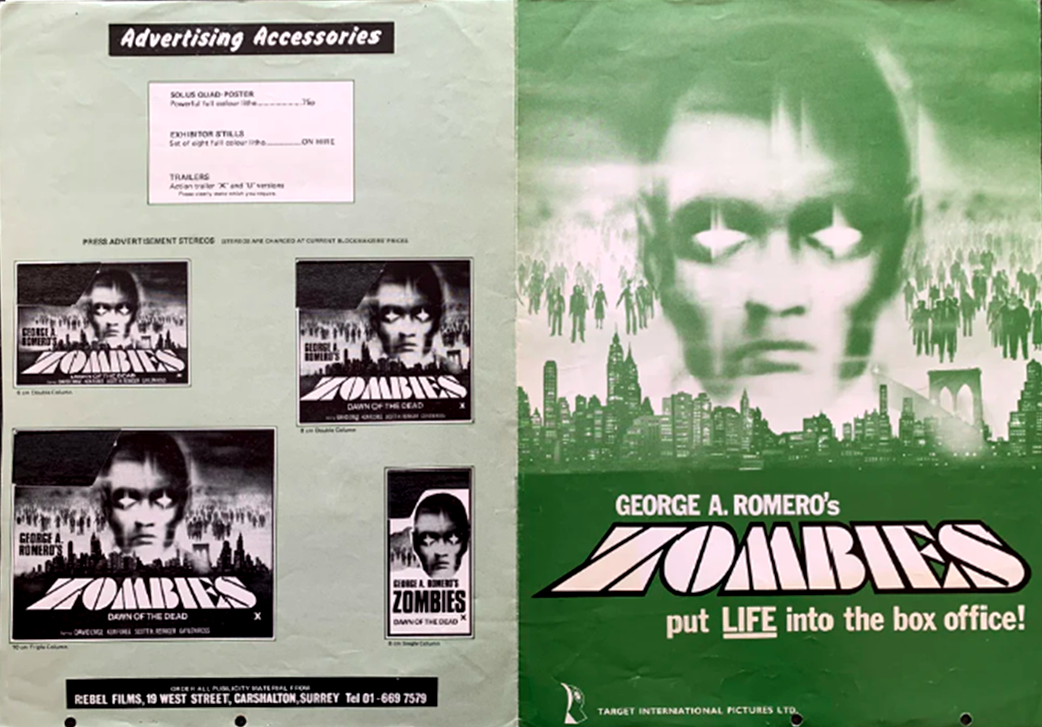
And indeed in those days it was generally all you needed to pay if you wanted to collect them. Throughout the 1980s, most ‘new’ (ie post-1970) quads were £1 – £2 each at the fairs, with ’60s titles rising to perhaps £5 – £10 depending on the featured star. This began to change very rapidly after 1995, with the near-simultaneous advent of (i) dedicated auction-house sales (initially Christies), (ii) dedicated High St galleries (initially Reelposter), and (iii) dedicated online retailing platforms (initially eBay). But at this point we inevitably crash into a new (and highly unpredictable) variable – the slippery notion of fashionability.
There are really only two factors that jointly determine the market-value of any vintage collectable: Desirability and Scarcity. But the latter element has very little (almost no) impact in the world of film posters, as demand in this arena is almost exclusively driven by fashion. The present writer owns plenty of extremely scarce posters that are worth little or nothing as the films concerned are all anonymous / long-forgotten potboilers. On the other hand, any poster featuring Audrey Hepburn will now command very Big Bucks indeed, as Hepburn has (in the thirty years since her death) acquired the unassailable status of Icon – the stylish epitome of feminine poise / sophistication. This has led to the peculiar (though by no means uncommon) situation where many well-heeled if undiscriminating collectors will pay vast amounts for her posters simply because they feature her (rather than because, say, they happen to like her as an actress).
Twas ever thus. But the simple fact remains that film posters today – three decades after they abruptly became hip – are still collected almost solely on the basis of the particular films (read: stars) they advertise rather than what they can more generally tell us about the history of popular cinema itself, or indeed the ever-shifting trends in post-war graphic design they so memorably showcase. As Tom Chantrell used to grin, Do you want it Good or Tuesday?
But hey, if you really want to drop £ (opens in a new tab)16,500 on a Breakfast at Tiffany’s quad, don’t let me stop you – it’s your money. Just keep in mind it cost cinema managers precisely 15p back in Oct 1961, and most copies either went into landfill or ended up as firelighters. It’s what Audrey would have wanted.
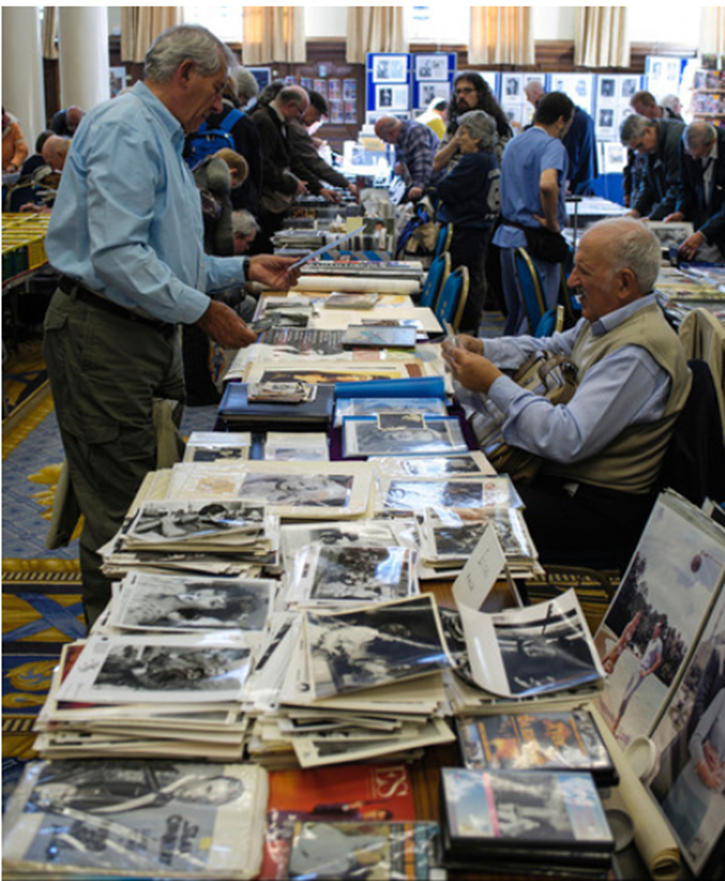
Al Reuter (in the waistcoat) manning his stall at the Sept 2012 Westminster Fair—at this point he was 82 and had been dealing professionally for 47 years.

Your author on the evening of Saturday 9th February 1980, having just bought his very first film poster at one of Philip Nevitsky’s early Birmingham fairs. The seller was—who else—Al Reuter.
© Sim Branaghan February 2025
Appendix: British Film Distributors and Poster Printers – the Quota Years
A further addition to this ever-expanding essay. Although much of the information assembled below appears scattered throughout my book, this is the first time it has been coherently organised / formally tied together. This seems to me important, as it documents the two vital (but largely overlooked) groups who actually create film publicity in the first place: the Distributors who commission it and the Printers who manufacture it. Understanding the shifting relationship between these two (and their later intermediary NSS) is key to a good working grasp of British poster history, and – further – is an integral part of their resulting provenance, as accurately dating vintage posters often relies on cross-checking their precise distributor-credit / printer-tag. And – as we shall see below – distributor credits were continually changing as the various companies involved erratically merged / separated / changed hands, while printer credits simply disappeared altogether after 1986 (when the handful of remaining original firms finally withdrew from the market). But let’s begin at the beginning….
Part (i): Film Distribution
Prologue: 1896-1926
Prior to 1927, with the industry still in its infancy, film distribution in Britain was not systematically organised and a plethora of speculative companies came and went. Originally the “Open Market” system was in operation, and renting was carried out on a fairly casual basis between rival exhibitors who had built up extensive stocks of films – the first company established specifically for this purpose was Walturdaw in 1897. “Exclusivity”, by which particular films were rented only to particular exhibitors, began to develop around 1910, concurrent with the appearance of the earliest cinema chains. Significant early renters included the French companies Gaumont (from 1898) and Pathe (from 1902) – with films still silent, it was initially a real international market – while other notable British firms established by the early 20s included Jurys (which eventually became part of MGM), Ideal, W&F (Woolf and Freedman), Butcher’s and Wardour. American companies began to open British offices from 1912, the first two being Essanay and Vitagraph.
Part One: 1927-45
The progressive dominance of the industry by these American concerns after the War eventually resulted in the passing of the 1927 Cinematograph Films Act, obliging UK distributors and exhibitors to handle a rising minimum quota of British films every year. This quickly led not only to the rapid expansion of British production (the infamous Quota Quickies), but also to the effective streamlining of distribution into a stable structure still recognisable sixty years later. Additionally, the near-simultaneous appearance of sound (also in 1927) abruptly ended the import of almost all European films, and the market from this point on was effectively carved up between Britain and America.
The two major British combines (ie also running their own extensive cinema chains) to emerge in the wake of the Quota Act were Gaumont British (absorbing distributors Ideal and W&F), and Associated British (absorbing Wardour and Pathé). However Gaumont quickly floundered following heavy production losses and its distribution wing was itself taken over in 1937 by what would become the Rank Organisation. Rank thus emerged practically overnight as the second British major, renting as General Film Distributors (GFD) between 1935-55 (and thereafter simply as Rank) before acquiring the Odeon and Gaumont cinema chains in 1941. Associated British-Pathé (including its own ABC cinema chain) was itself registered in 1937. The third British distributor of long-term stature to appear during this period – though technically always an independent with no cinema chain of its own – was British Lion, established (like the original combines) in 1927.
The eight American ‘Majors’ had all arrived in a recognisable form by 1931, with most also establishing UK production subsidiaries by the end of the year for Quota purposes. These eight are usually historically divided into the “Big Five” – MGM, Paramount, RKO, Fox and Warners (who controlled their own US cinema chains), and the “Little Three” – Columbia, United Artists and Universal (who did not, and relied solely on production and distribution). Universal hit financial difficulties in the mid-30s, and as a result its films were distributed exclusively by Rank between 1936-69. Similarly, Warners owned a subsidiary called First National during this period, and distributed many of its films through them between 1929-39. The four smaller American studios all distributed through one or other of the majors – Disney was handled by RKO between 1936-54, Republic by British Lion between 1935-50, Monogram (which became Allied Artists in the 50s) by Associated British-Pathé between 1935-69, and PRC also by AB-P between 1940-47. About ten significant independent distributors were established during the 1930s, mostly handling British Quota material or reissues, of which only Anglo-American Film Corp (1937-46) failed to survive the end of the period.
Part Two: 1946-69
Independent distribution began to expand after the War. This was due to a variety of factors – the abandonment of the Distributors’ Quota in 1948 meant the American majors became only small handlers of British films, while the US anti-trust “divorcement” decrees of the same year forced the Big Five to sell off their cinema chains at home, leading directly to the closure of RKO in 1957 and a substantial cutting-back of production by the others. Censorship was liberalised in 1951 with the introduction of the Adults Only “X” certificate, and as the ‘family audience’ fragmented, smaller firms like Miracle and Gala began appearing to import ‘spicy’ dubbed Continental films. An even more prolific independent, Eros, dominated the 1950s with a mix of US reissues and cheaper British programmers.
Of the American ‘minors’, Republic left British Lion to set up its own distribution outfit in 1950 (before closing altogether in 1959), and Disney left RKO to do the same in 1954, effectively replacing the latter as the eighth Major. The only new US company to make an impact in this period was celebrated exploiteer American International Pictures (AIP), distributed by well-connected British independent Anglo-Amalgamated between 1956-69. The other two principal ‘indies’ to appear in the 1960s were Tony Tenser’s overlapping Compton and Tigon companies. As audiences began their precipitous decline in the mid-50s, two significant mergers occurred – Warners and Associated British-Pathé (Warner-Pathé) between 1959-69 (also taking in Anglo-Amalgamated from 1962), and British Lion and Columbia (BLC) between 1961-67. The end of this period was marked in 1969 by two major events – the splitting of Universal from Rank after more than thirty years association, and the takeover of Associated British (including its ABC cinema chain) by EMI.
Part Three: 1970-85
In an attempt to accommodate the rapidly shrinking audience most of the remaining profitable cinemas were “tripled” in the early 70s (ie divided internally into three individual screens). The smaller of these new units were generally programmed with cheap international exploitation supplied by a fresh wave of vigorous independent distributors – more than twice as many new companies were established during the 1970s as in any previous decade. The Majors, in contrast, adapted by entering into a lengthy sequence of ever-more concentrated mergers:
1970 Paramount-Universal (CIC)
1970 MGM-EMI (splitting 1973)
1971 Columbia-Warner
1972 Fox-Rank (splitting 1977)
1973 MGM joins CIC (which begins UK operations)
1978 Columbia-EMI-Warner (splitting 1987)
1981 United Artists joins CIC (UIP – splitting 2006)
1982 Fox-Disney (UKFD – splitting 1987)
This period of distribution – and indeed a whole era of British cinema – effectively drew to a close over the mid-1980s. As audiences dropped to an all-time low in 1984, and with local cinemas by then closing on a weekly basis, most of the surviving independents either shifted their business over to the rapidly expanding video market, or simply withdrew altogether. The landmark 1985 Films Act not only wound up the two principal avenues of State subsidy (the NFFC and Eady Levy), but also finally abolished the Quota, thus removing the obligation on exhibitors to actually show any British films at all.
Last, but certainly not least, the encroaching revolution in British exhibition saw both the dismantling of the original ‘big two’ combines, and the simultaneous arrival of sleek new Multiplex cinemas. In 1986, Cannon, a maverick but increasingly ambitious independent, briefly gained control of EMI, only to collapse less than three years later causing the inevitable dissolution of both EMI’s distribution wing and ABC cinema chain. (Rank in contrast withdrew more cautiously, separately disposing of its distribution outfit in 1997 and remaining Odeon cinemas in 2000). Purpose-built “Multiplex” cinemas began to appear from 1985 onwards, heralding a completely new phase in British exhibition, dominated for the first time by US concerns. With the exception of the now-mighty Entertainment, none of the grungy 1970s indie distributors survived beyond the end of the 80s (the crunch year for most being 1983), and – for better or worse – British cinema is now a far more corporate business altogether.
Part Four: Independent Distributors
The following is a chronological list of the fifty or so principal independent distributors active in Britain between the 1927 and 1985 Films Acts, together with their approximate dates of operation and chief Managing Director. Deliberate omissions include: (i) Minor early firms that failed to survive the end of the War, (ii) Short-lived companies active for less than five years and/or handling fewer than thirty films in total, (iii) Non-commercial ‘Arthouse’ outfits either exclusively programming particular independent cinemas (Academy, Curzon, Cinegate, Cinecenta) or specializing in subtitled foreign material for limited release only (Contemporary, Connoisseur). The sequence is organised by date of original appearance, and it should be borne in mind that some names took many years to reach their busiest periods.
Registered Name Dates of Operation Managing Director
1930s (and earlier)
Butcher’s Film Dist Ltd 1910-76 John Philips [from 1954]
British Lion Films Ltd 1927-76 David Kingsley [from 1954] (BLC 1961-67)
Equity British Films Ltd 1931-54 John Argyle
Associated British Film Dist Ltd 1932-54 Leslie Baker (a/k/a “Ealing Dist” 1943-47)
Mancunian Film Corp Ltd 1934-54 John Blakeley (sometimes via Butcher’s)
Exclusive Films Ltd 1935-58 James Carreras
Ambassador Film Prods Ltd 1936-52 Gilbert Church
International Film Renters Ltd 1938-53 David Griffiths
Grand National Pictures Ltd 1939-81 Maurice Wilson
Renown Pictures Corp Ltd 1939-60 George Minter
New Realm Pictures Ltd 1939-85 Edwin Fancey (also DUK, EJF & SF Ltd)*
*(DUK Films Ltd 1947-71 ; EJ Fancey Prods Ltd 1951-72 ; SF Films Dist Ltd 1961-73)
1940s
Anglo Amalgamated Film Dist Ltd 1945-69 Nat Cohen (via Warner-Pathé 1962-69)
Eros Films Ltd 1947-60 Phil Hyams
Monarch Film Corp Ltd 1947-76 William Gell
Adelphi Films Ltd 1947-57 Arthur Dent
Independent Film Dist Ltd 1949-59 John Woolf
1950s
Archway Film Dist Ltd 1950-61 Sydney Goodman
Republic Pictures Corp Ltd 1950-59 Herbert Yates (via British Lion 1935-50)
Miracle Films Ltd 1953-86 Michael Myers
Border Film Prods Ltd 1957-77 Olive Negus-Fancey
Orb Films Ltd 1957-71 Nat Miller
Gala Film Dist Ltd 1958-85 Kenneth Rive
Regal Films Int Ltd 1958-65 Victor Hoare (via Fox 1956-58)
1960s
Golden Era Film Dist Ltd 1961-82 Leslie Greenspan
Planet Film Dist Ltd 1961-71 Tom Blakeley
Compton-Cameo Films Ltd 1961-69 Tony Tenser
Eagle Films Ltd 1962-83 Barry Jacobs
Antony Balch Films Ltd 1963-77 Antony Balch
Amanda Films Ltd 1965-83 Michael Chivers
Avco-Embassy Prods Ltd 1967-75 Joseph Levine
Tigon Pictures Ltd 1967-83 Tony Tenser
Cinerama Releasing (UK) Ltd 1968-74 Ron Lee
1970s
Target Int Pictures Ltd 1970-80 Neil Agran
Scotia-Barber Dist Ltd 1970-82 Arnold Barber (later “Barber Int”)
Ember Film Dist Ltd 1970-79 Jeffrey Kruger
GTO Films Ltd 1971-83 Laurence Myers
Hemdale Int Films Ltd 1971-81 John Daly
English Film Co Ltd 1971-82 Bachoo Sen
Oppidan Ents Ltd 1972-80 David Grant
Cathay Films Ltd 1973-76 Raymond Chow (Golden Harvest)
Variety Film Dist Ltd 1973-77 Michael Green
ITC Film Dist Ltd 1974-83 Lew Grade
Brent Walker Film Dist Ltd 1974-83 George Walker (originally “Focus”)
Intercontinental Film Dist Ltd 1974-82 Terry Lai
Alpha Films Ltd 1976-83 Stanley Long
Sunn-Classic Prods (UK) Ltd 1977-83 Michael Swingler
Enterprise Pictures Ltd 1977-90 John Hogarth
Premier Releasing Ltd 1977-91 Kent Walwin
Entertainment Film Dist Ltd 1978-current Michael Green
Cannon Dist (UK) Ltd 1979-89 Menachem Golan
Epilogue: 1985 onwards
A handful of expanding video firms (notably Guild, Vipco and Videoform) briefly tried their luck in theatrical distribution during the early 80s, but only Guild made a lasting impact, eventually merging with ‘Pathé’ (actually the remains of Cannon) in 1997. A more significant arrival was Palace (1982-92), though the company’s artier aspirations immediately distinguished them from the 70s indies, and over-ambition had in any case sunk them by the end of the decade. Music-label Virgin similarly dabbled during the mid-late 80s (even moving briefly into exhibition) before withdrawing again. Following the termination of UKFD, Disney distributed via Warners 1987-92 before re-establishing themselves solo as Buena Vista Int in 1992. The final splitting of UIP in 2006 marked the end of the lengthy ‘merger’ phase for the Majors, with Disney eventually buying Fox outright in 2019 and Amazon similarly acquiring MGM/UA in 2022. At the time of writing the Big Five are thus now Warners, Universal, Disney, Paramount and Columbia (the latter Sony from 1989), with Nigel Green’s Entertainment the sole surviving ‘original’ indie holding a comparable market-share.
[STOP PRESS: It now appears that the Big Five may soon become the Big Four. Following an aggressive bidding-war with Netflix, as of April 2026 Paramount look set to acquire Warners despite widespread concern about the deal’s impact on competition. With various international Regulators already involved, the deal seems unlikely to be approved before the end of 2026 at the earliest].
Part (ii): Poster Printing
Victorian advertising posters were (following the 1869 Newspapers, Printers and Reading Rooms Repeal Act) originally obliged to feature their printer’s name and address, though this requirement was relaxed a century later with the 1961 Printer’s Imprint Act, which exempted purely ‘decorative’ (ie non-political) posters. Post-1961, the chief advantage of continuing to add a credit from the printers’ point of view was that it promoted their work to other potential clients… but that inevitably relied on there actually being other competing clients to attract in the first place. What might happen if a single company gradually gained monopoly-control of an already specialist market?
National Screen Service began handling film posters in Britain in 1958 (via Russ Cradick), and over the next twelve years all the major UK distributors gradually signed-up as the film business continued to shrink. The approximate sequence was:
1958: MGM
1961: Paramount
1962: Fox
1963: Columbia
1969: EMI and Warners (on the termination of Warner-Pathé)
1971: Disney, Rank, Universal and United Artists
As NSS steadily gained dominance, many of the older printers (who had often historically worked for one distributor only) began to withdraw as NSS deliberately divided the remaining work between Lonsdales and WE Berry. With silkscreen techniques improving, a small group of newer screen-printers were also taken on from about 1967, including RJ Wallman, Kent Art and Bovince.
The following is a list of the fourteen major credited printers in operation during the original (1958-86) NSS era arranged by date of withdrawal. Note that at least two (Bovince and Kent Art) were later obliged to stop crediting their work as a condition of retaining the business – the NSS office-politics behind this remain obscure (and will probably now never be satisfactorily explained).
1) Display Productions 1962 …. probably withdrew when Anglo Amalgamated joined Warner- Pathé
2) Haycock Press 1965 …… probably withdrew when Rank began cutting back production
3) Charles and Read 1969 ….. probably withdrew when Universal split from Rank
4) Electric (Modern) 1969 …. according to Alan Broomhead, his firm was by then poaching much of Electric’s work
5) RJ Wallman 1972 ….. possibly printing uncredited for a few more years
6) Progressive Publicity 1972 …. possibly printing uncredited for a few more years
7) Sales and Display Services (S&DS) 1975 ….see Tintern Press below
8) Tintern Press (TP) 1977 …. according to Peter Lee, both TP and S&DS’s posters were printed by WE Berry (via Harry Price)
9) Kent Art 1977 …. uncredited from 1970
10) Leonard Ripley 1980 …. Ripley’s management set up the new (uncredited) firm Mills and Allen Printing in 1983
11) Bovince 1986 …. uncredited from 1974 – probably withdrew following the sale (via a management buyout) of NSS
12) WE Berry 1986 ….. as above – withdrew following the NSS sale
13) Lonsdale & Bartholomew 1986 …. as above – withdrew following the NSS sale
14) Broomhead Litho 1990 … folded on Derek Broomhead’s retirement
Following the NSS-buyout in Dec 1986, their veteran print buyer Ian Hedger left to be replaced by Graham Rowsell and all the old contracts / agreements ended. Rowsell told me he chiefly used two newer firms – Mills and Allen Printing (basically Leonard Ripley’s management transferred to a new works in West Drayton) and Capital Print and Display in Stratford. But both of these companies were printing anonymously right from the start – Broomhead Litho were the very last firm to print credited quads in the UK, and they closed at the end of 1990 when founder Derek Broomhead retired (on his 65th birthday, March 1991).
Why does all this matter? Because the historical value of any vintage artifact is obviously enhanced if it features integral provenance of its origin. Although educated guesses can be made, it will be impossible for future historians to confidently say who printed ANY British film posters after 1990. The presence of a printing-credit is a tangible link not just to our industrial past, but also – by extension – to an era when craftsmen created popular commercial art by hand. As this prehistoric period slips ever-further behind us, it seems to me increasingly vital to try and formally document it – hopefully others will later feel the same, and perhaps continue the work…
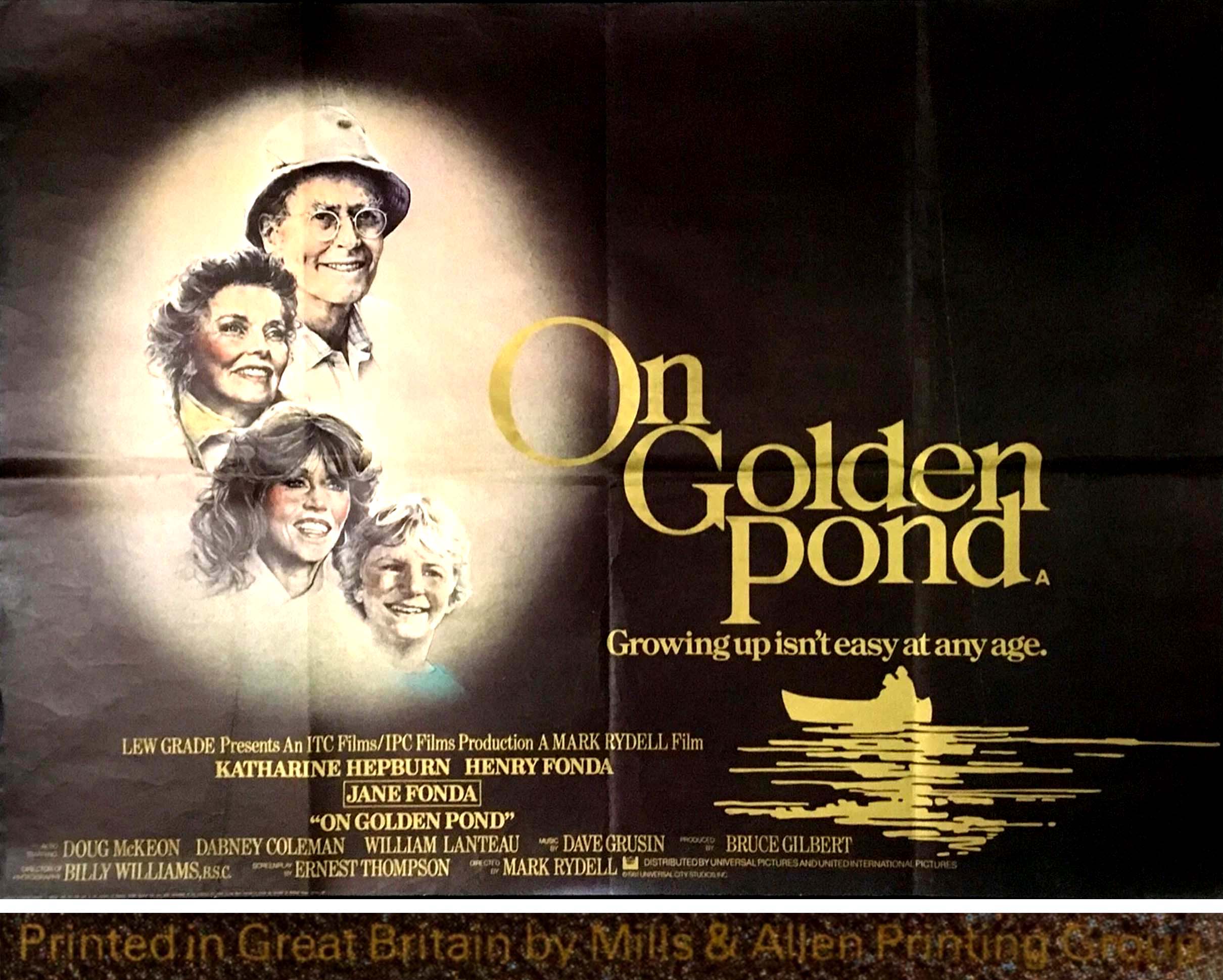
On Golden Pond (1982) Illustration by Morgan Kane from a design by Bill Gold. Historically notable as apparently the sole British film poster to actually feature a dedicated Mills & Allen printing credit (prior to their immediate and permanent disappearance).
© Sim Branaghan June 2026
