


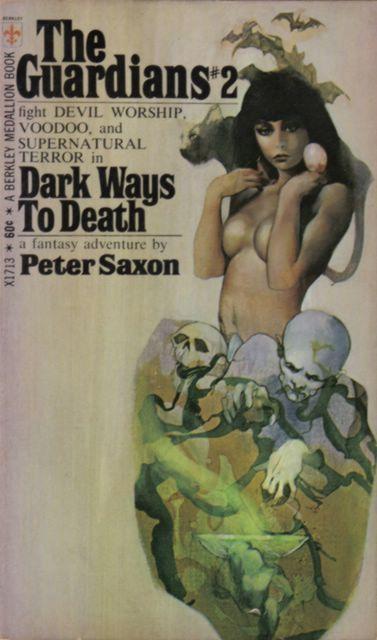
 Synopsis
Introducing the principal cast (plus various supporting players, some utterly superfluous) takes up practically half this opening novel’s length, and the actual plotline is rudimentary at best. Through a series of linked coincidences the Guardians are made aware of a sinister character, Dr Obadiah Duval, superficially a pillar of the Black Community who runs a rather unconventional health shop / consultancy in Notting Hill. But is Dr Duval all that he seems? No Sah, he is an insidious agent of the Left Hand Path, a ruthless Voodoo Practitioner who apparently has half West London’s immigrant population under his malevolent spell via a systematic web of terror and blackmail.
The Guardians are introduced to him from several angles simultaneously. Father Dyball is approached by Jack Johnson, a frightened young black ticket-collector on the Underground in some sort of unspecified trouble. Johnson reluctantly visits Half Moon Street on Dyball’s urging, but is intimidated by the frosty Anne and sneaks out again without explaining his problem. Meanwhile, on the morning bus into work, hypochondriac Lionel chats with his old friend Nelson, the Jamaican conductor. If Lionel’s bad back is really that bad, smiles Nelson, he should go and visit Dr Duval—here’s his card—he can work Miracles. Mention my name, I get 10% on new custom…
Later that same morning the assembled group have a high-profile visitor, Sir Bartley Squires, a rich and abrasive businessman who wants to hire them to save his errant teenage daughter Caroline from this appalling Black Magic mess she’s got herself tangled up in. Tangled up how? Well, Caroline is, ahem, involved with a young negro feller named Johnson, who works on the Tube. And Johnson is being threatened somehow by this character—Squires slaps down a tatty business card that proves a duplicate of the one Lionel collected on the bus! The Rule of Three is at work!
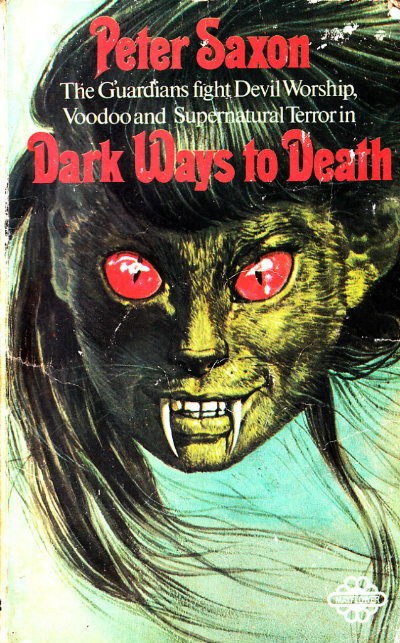 Gideon Cross decides—apropos of nothing—that Duval is deliberately challenging the Guardians to a mammoth high-stakes psychic duel for magical domination of London. To reinforce his agenda, Duval callously kidnaps Bubastis (Kane’s pet Egyptian cat, and the group’s unofficial mascot), planning to sadistically sacrifice the beast to his Voodoo god Dambalawedo. An outraged Anne storms over to Notting Hill to save the cat, gets captured by Duval’s thuggish henchmen, but is rescued in the nick of time by Kane. Caroline is less fortunate, and (while attempting to protect hapless boyfriend Jack from being abducted as the next sacrifice) is brutally assaulted. Lionel manages to track her down and she gives him the vital clue to Duval’s secret hideout—a disused tube-tunnel accessed via a hidden trapdoor in the back of the Notting Hill shop. Kane, Lionel and Anne (plus Scotland Yard, belatedly alerted by Dyball, who is conveniently pally with the Assistant Commissioner) then all converge on the gloomy tunnels for the bonkers climax.
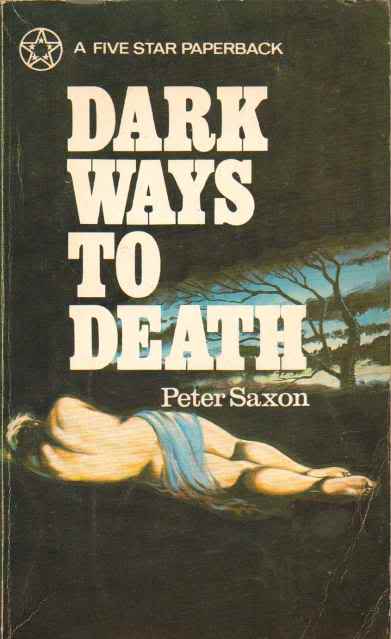 A full-scale Voodoo ceremony is in progress, attended by what seems half of London’s black population (presumably bringing the capital’s transport infrastructure grinding to a halt). Bubastis is on the point of being sacrificed (followed by the kidnapped Jack) but when Anne again attempts to intervene, Duval—clothed as Baron Samedi—summons the spirit of Dambalawedo in the form of the dreaded Winged Serpent, writhing in mid-air above the crowd who understandably cower in terror. Lionel, trapped at the back, in desperation shoots at Duval, who collapses in a heap with half his head blown off. But Dambalawedo has now gained independent life and resurrects the corpse, which nightmarishly staggers back to its feet like a limp string puppet. Just when all seems lost, Anne channels the spirit of Bubastis, and manifests as the giant Egyptian cat-goddess, fighting the venomous Dambalawedo above the crowd, flashing claw against dripping fang. But Anne is visibly weakening from the struggle, and just as the Flying Serpent is poised to strike the death-blow, Kane manages to hurl a magical amulet straight down its throat. Dambalawedo vanishes in a puff of smoke, Duval once more collapses to the floor, and the coppers burst in to arrest everyone (though most of the crowd contrive to escape in the smoky confusion).
Commentary
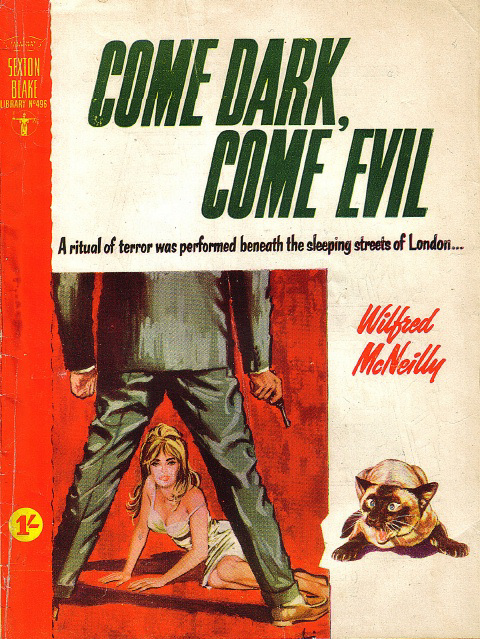 Dark Ways To Death is a really scrappy read. The above summary deliberately omits two irrelevant sub-plots (involving sleazy investigative journalist Negley Prescott and his snooty quarry, dissolute aristo the Duchess of Derwentwater) as they have no real bearing on the story at all, and are principally there simply as (unfunny) comic-relief filler. The climax is admittedly lively, but takes up the entire final third of the novel, and the preceding set-up gives every indication of having been written very hastily—motivation and indeed basic coherence are all over the shop (the Guardians seem more preoccupied with rescuing their cat than combatting the Voodoo threat). This confusion, however, is hardly surprising when Dark Ways To Death is appreciated for what it actually is—a chaotic rewrite of McNeilly’s earlier Sexton Blake adventure, Come Dark, Come Evil, expanded from a terse 64 pages to a badly-overstretched 176. It is just about redeemed by its hallucinatory climax, which will nevertheless push Hammer’s special effects to the limit (though Les Bowie could probably improvise something with a couple of glove-puppets and some string).
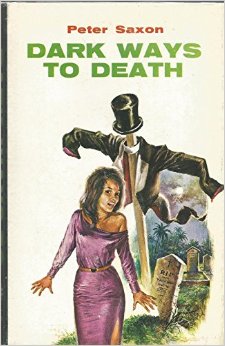 But—problematically for the modern-day reader—the unavoidable dominant theme at the heart of Dark Ways To Death is essentially a permanent belligerent racism. Even the heroes are subject to this—talking to journalist Prescott, Stephen Kane describes colleague Lionel as a “tough little Jew”, and author McNeilly’s preoccupation with everyone’s racial origin is nothing less than obsessive. Anne describes her fleeting encounter with Jack Johnson thus: “A West Indian I think. A negro certainly, but with more of the West Indian than a native African. A fairly respectable railway clerk I’d guess…” Meanwhile on the bus Lionel chats amiably with Nelson: “We Jews have been bottom of the league so long it’s nice to have someone under us” he explained to the Jamaican, “Makes me feel magnanimous”. “Ah,” Nelson riposted, “but would you let your daughter marry a darkie?” On and on and on. Of course, objecting to casual racism in a 1968 pulp paperback novel must be one of the more pointless uses of anyone’s time, but that doesn’t make it any more palatable. Fortunately it did not resurface (at least, not so dominantly) in the ensuing series.
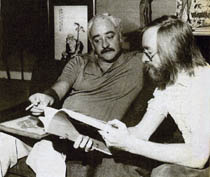
Michael Carreras and screenwriter Christopher Wicking
Chis Wicking would have had his hands full restructuring this one. Dyball’s role needs to be dramatically beefed-up, and a much more complex and intriguing initial threat progressively established. The opportunity for a colourfully energetic portrait of West London’s immigrant communities—shooting via handheld cameras on location around Notting Hill etc—would have provided plenty of flavour (and latterday socio-historical interest) and—in the parallel-universe we are here describing—fortunately Hessler and Wicking jointly treat this angle with appropriate tact and sympathy. Yes they do, stop sniggering. Hammer haven’t made Love Thy Neighbour yet, and in this version of history they never have to. Dark Ways To Death is a solid hit, and immediately leads to Carreras ordering a more sophisticated sequel…
The Guardians #2: The Haunting of Alan Mais by Wilfrid McNeilly