


DATELINE: 1971…… HAMMER IN CRISIS…… FRESH IDEAS NEEDED…… WHO YA GONNA CALL? MEET……THE GUARDIANS!
Hammer’s decline and fall is now so well-documented that it barely needs rehashing: by 1971 original creative head Tony Hinds was gone, CEO James Carreras had (reluctantly) brought estranged son Michael back into the fold as MD, but—sensing the end was finally in sight—was simultaneously trying to offload the company behind his back. The money was drying up, the market was shrinking, and nobody really knew what to make any more. Interviewed for a BBC doc in 1987, critic David Pirie argued “The fact is that Hammer were making the wrong films at the wrong time in the 1970s. They should have been making Night of the Living Dead, they should have been making Halloween… If they’d found that low-budget formula, they could have gone on for another decade. There was one chance, a film called The Devil Rides Out… that could have taken off, could have been a series—if Hammer had just got hold of a series, it would have saved them….”
However, whatever the merits ofThe Devil Rides Out, a series of flabby Dennis Wheatley adaptations was clearly not going to save anyone by this point—as the messy failure of To the Devil… a Daughter (1975) demonstrated all-too painfully. So what other overlooked possibilities might have been available to a beleaguered Michael Carreras?
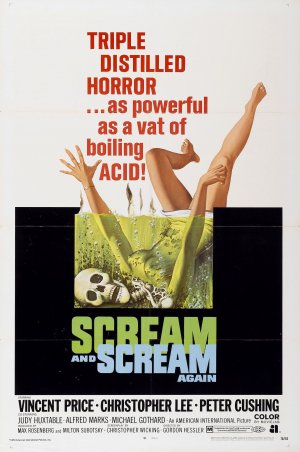 One of the big Brit-horror successes of 1970 was the Amicus/AIP collaboration Scream and Scream Again, which took good money both here and in the States. A fresh and iconoclastic (not to say incoherent) sci-fi action-thriller, it featured hip modern-day stylings, lively direction from Gordon Hessler, and a challengingly fragmented screenplay from Christopher Wicking (later to become Hammer’s last script-editor). Young audiences loved it, to the bemusement of its producer Milton Subotsky: “Strangely enough it made a lot of money and was different to any film we’ve ever done. I don’t know why, it wasn’t all that good… It might have been because we used three top horror stars and had a very good title”. Writing in 2008, Pirie acidly observed “…It certainly seemed there was a niche for modern, subversive British horror thrillers of this kind, and Hessler and Wicking would have been the perfect pair to make them…. In this respect it is a great pity Scream and Scream Again was not made by Hammer. James Carreras had many faults, but myopia about success was not one of them. There would certainly have been more”. But what might the follow-ups have been?
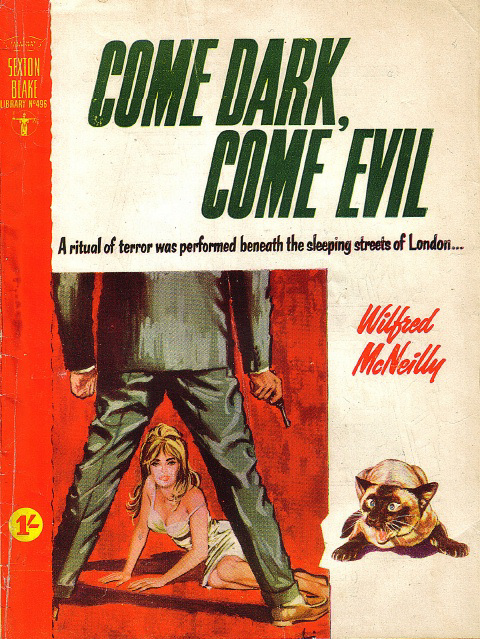
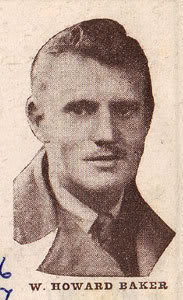 Scream and Scream Again was not an original screenplay. It was based—remarkably faithfully—on an equally incoherent 1966 paperback potboiler, The Disorientated Man, by prolific pulp hack Peter Saxon. But Saxon—like the duplicitous protagonists of many of his novels—didn’t actually exist. He was a house-pseudonym invented by Irish author / editor / publisher / wheeler-dealer William Howard Baker (1925-1991), who in the mid-50s had taken control of Amalgamated Press’s Sexton Blake Library (detailing the adventures of this ‘poor man’s Sherlock Holmes’) and reinvented it, adding in punchier action and a clear American-pulp influence. Together with associate-editor George Mann, Baker also introduced occasional occult-themed Blake adventures, like Assignment Doomsday (1961) by Martin Thomas (which features Gideon Ashley, “financier, philanthropist and occult Adept” and climaxes in fights with “phantom figures and ectoplasm”), Come Dark, Come Evil (1962) by Wilfred McNeilly (which details an alarming mass-outbreak of voodoo amongst London Underground’s West Indian staff), and Laird of Evil (1965) by Martin Thomas (Black Magic Terror in a remote Highlands Castle). These all appeared under a bewildering web of pseudonyms which researchers are still trying to unpick. (Probably without total success—contemporaries suggest even Baker himself often lost track of who was who. By the early 60s he was smoking like a chimney, spent much of his time boozing in Fleet Street’s packed pubs, and employed distinctly Creative Accounting at the end of every month to divvy up his writers’ fees.)
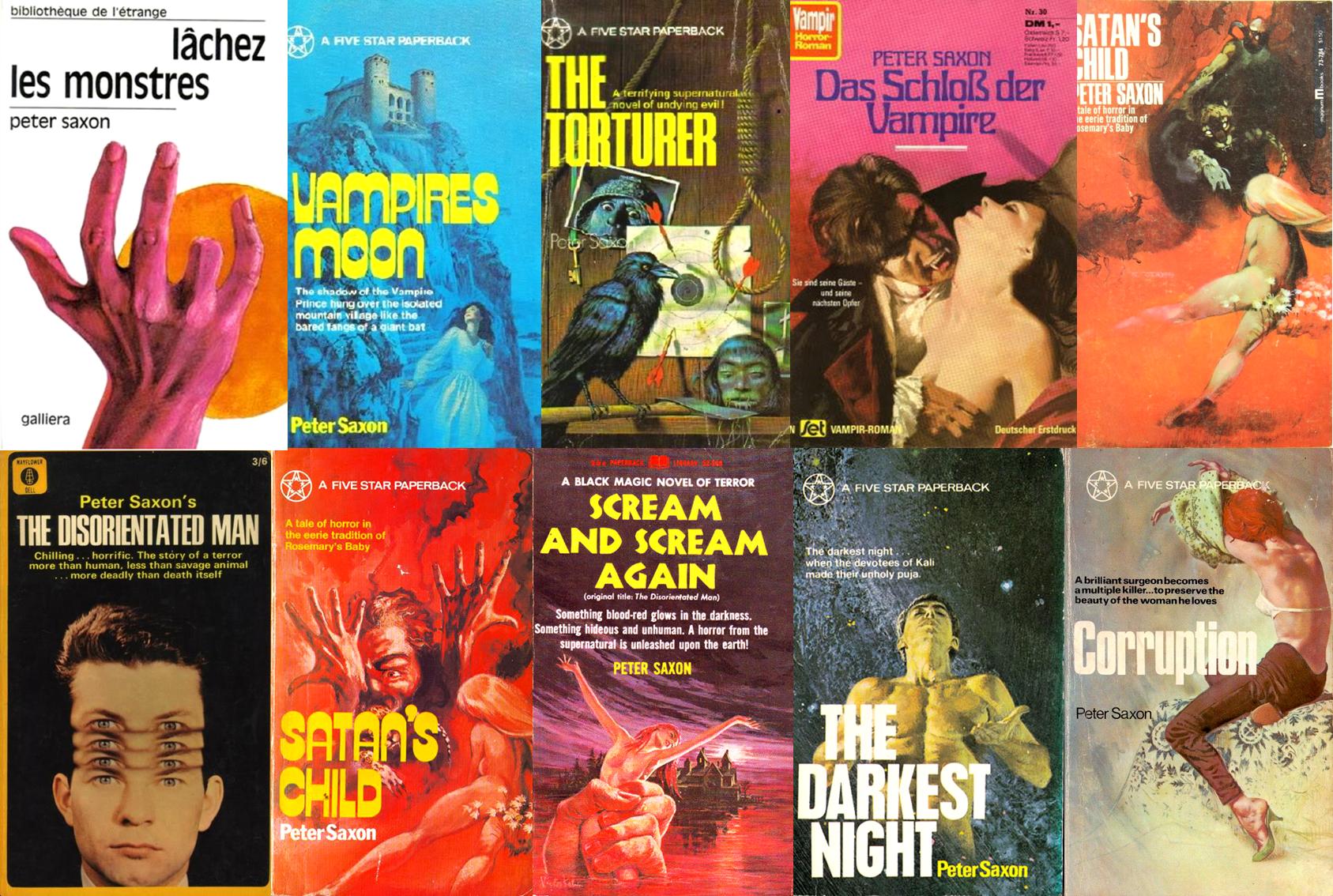
In the mid-60s Baker set up his own imprint Howard Baker Publishers, and resurrected the Peter Saxon pseudonym for a series of fourteen original fantasy novels 1966-70. Eight of these (including The Disorientated Man) were stand-alones, but six were deliberately conceived and packaged as a self-contained series, featuring a modern-day team of London-based Occult Investigators dedicated to fighting outbreaks of Black Magic wherever it appears. Although practically forgotten today, it is possible to build a case that this wild sextet of adventures starring The Guardians was the concept that—with the right (Hessler/Wicking) handling—might just have saved Hammer in 1971.
All fourteen Saxon books were roughly plotted-out by Baker and Mann, then their synopses handed over to a regular team of SBL hacks to expand into full-length (150-200 page) manuscripts. Aside from Baker himself, ‘Peter Saxon’ in this incarnation was in fact five individual writers: Stephen Frances (1917-89, who contributed The Disorientated Man only), Wilfred McNeilly (1921-83), Martin Thomas (1913-85, actually Thomas Hector Martin), Ross Richards (?—?) and Rex Dolphin (1915-90). Matching the mix of authors, the Saxon books appeared under a confusing variety of imprints (Baker seems to have been a genius at selling and re-selling his back-catalogue): most were originally published here as a mix of HBP hardbacks and Mayflower paperbacks, and all were later reprinted (in 1972) by Five Star. In the US they first appeared under the Berkley-Medallion label (with terrific Jeff Jones cover-art), then were later reprinted by Lancer, Magnum and others.
The six Guardians titles 1968-70 were:
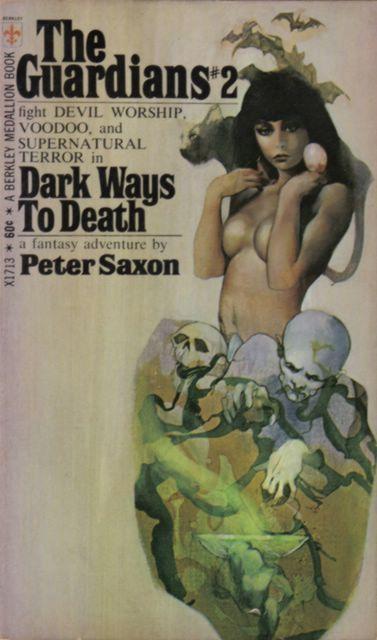 1) Dark Ways to Death by Wilfred McNeilly
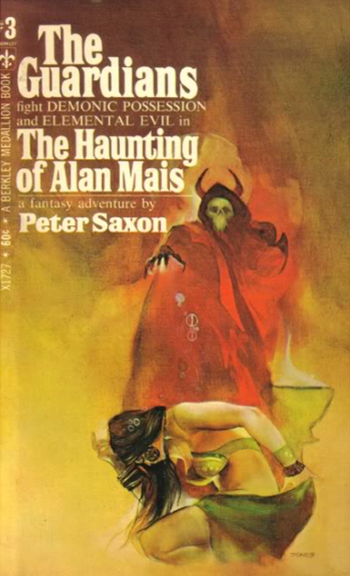 2) The Haunting of Alan Mais by Wilfred McNeilly
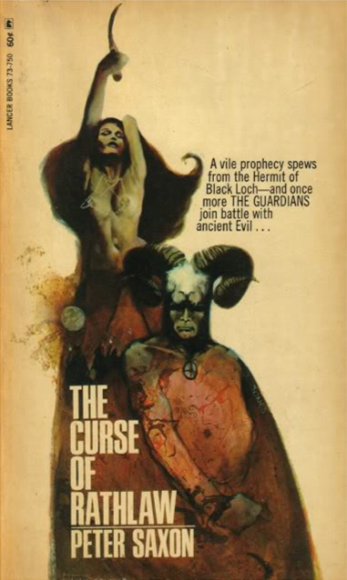 3) The Curse of Rathlaw by Martin Thomas
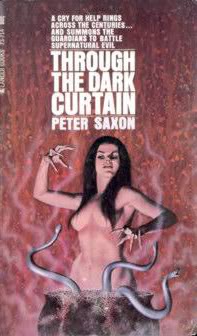 4) Through the Dark Curtain by Ross Richards
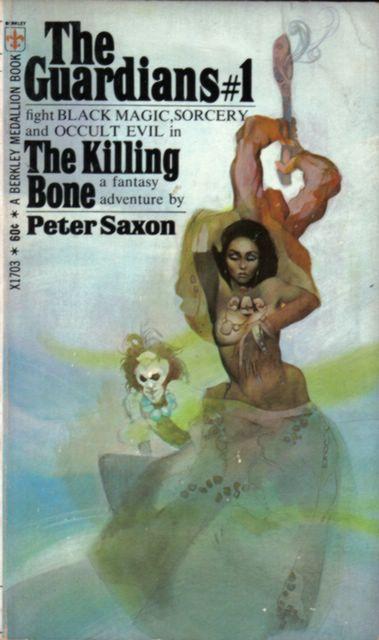 5) The Killing Bone by W.H. Baker
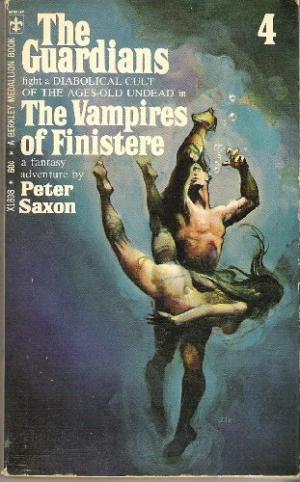 6) The Vampires of Finistere by Rex Dolphin
To address one minor controversy first, the order given above is undoubtedly the best sequence in which to read them. (The American Berkley editions are actually prominently numbered 1—6 on their covers, but this US annotation makes no sense at all—for a start, #1 clearly refers back to #6!) The quoted sequence seems the most logical because:
1) Dark Ways to Death. Obviously intended as the introduction. A scrappily expanded rewrite of an earlier Sexton Blake adventure, this spends much longer than any of the others introducing the characters (presumably to help pad-out an otherwise slender narrative).
2) The Haunting of Alan Mais. Refers directly back to Dark Ways to Death (its client has been introduced to the Guardians by the heroine of Dark Ways). Also, being the second book by Dark Ways author McNeilly, it has a clear stylistic link.
3) The Curse of Rathlaw. This one could really go anywhere, but—being only an average entry—is best placed mid-series.
4) Through the Dark Curtain. This one has to precede Killing Bone because…
5) The Killing Bone. Refers directly back to Through the Dark Curtain (the grateful ex-client of Dark Curtain repays the group a favour at the climax).
6) The Vampires of Finistere. Again could really go anywhere, but—being arguably the most effective entry—is best placed as the series-punchline.
Introducing THE GUARDIANS
The Guardians are a loose group of five specifically-talented individuals with a (creepy) office on Half Moon Street, off London’s Piccadilly. They are, in their different ways, all supremely hip. They confidently inhabit the never-neverland of Swinging London, sporting groovy outfits, zooming around in natty sports cars, and are able to handle themselves in a scrap (sometimes via obscure Martial Arts). They have powerful sexual chemistry—both with each other and outsiders—and often tend to communicate with wryly witty banter. If any of this is bringing to mind The Avengers, you might not be a million miles off the mark. To add edgy internal drama however, some members of the team are occasionally dubious about certain colleagues’ darkly opaque motives / backgrounds. The Guardians acquire most of their cases either via referrals from previous clients, or, in contrast, from desperate individuals who simply don’t know where else to turn.
As mentioned, there are five members:
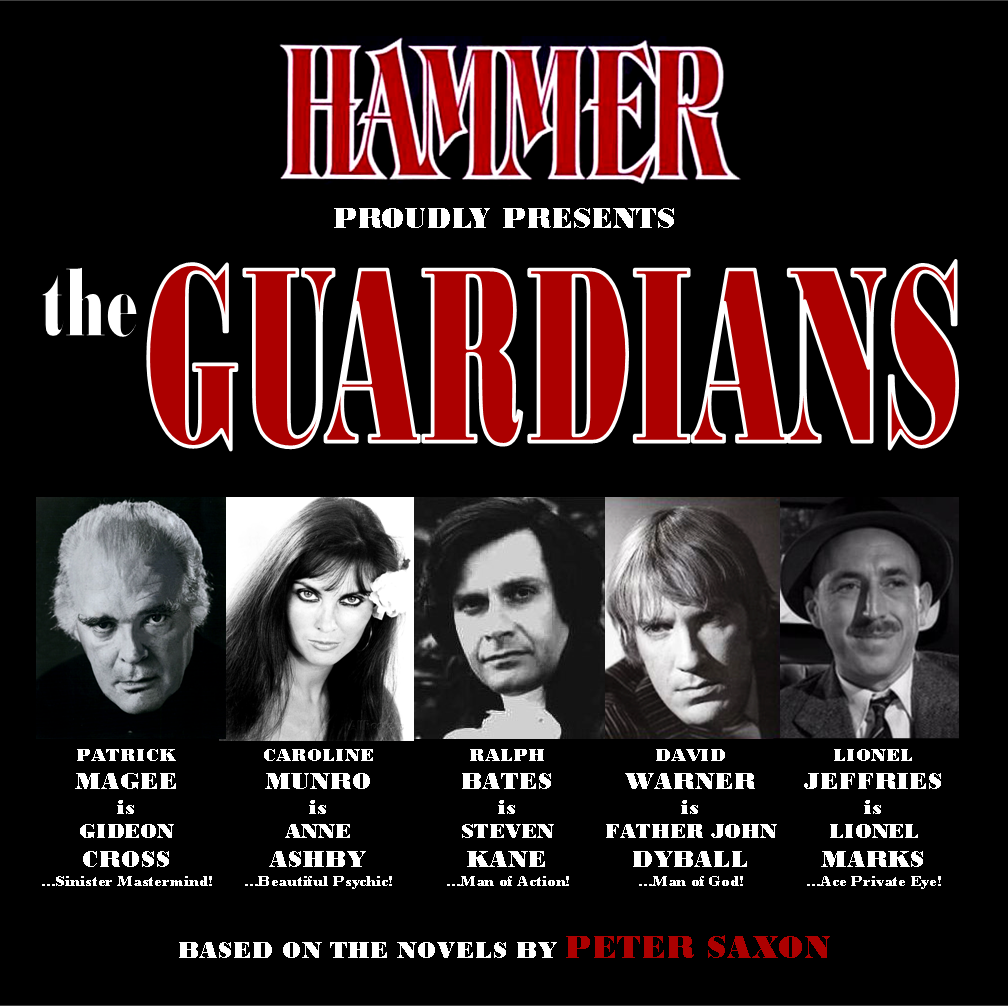
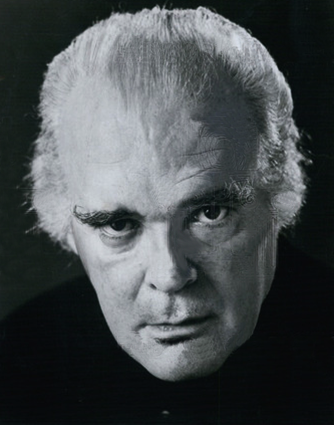 Their founder and leader is GIDEON CROSS, a rich and mysterious recluse with highly advanced psychic powers (but somewhat vague motives). He is described as slightly sinister, and it is hinted that his formation of the team may in fact mask some dark double-game. Cross is elderly, medium-height, urbane and sardonic, terse in conversation, with white hair, a trim grey goatee, and tufted eyebrows that sweep up into horns at the Curse of Rathlawners. He occupies a luxurious private suite on their haunted office’s top floor, and tends to appear only to either personally interview well-heeled clients, or directly intervene when a crisis is at hand (on the Astral Plane or otherwise). He takes an active role in just one adventure (KILLING BONE), though it is a truly show-stopping appearance. His character would probably need some cautious expansion in the proposed film series. After careful consideration, Hammer have decided to cast Patrick Magee in the part, thanks to his gloweringly dominating presence and effortless ability to project beady-eyed menace. (Magee’s peculiar drawled cadences could make the London phonebook sound worryingly sinister).
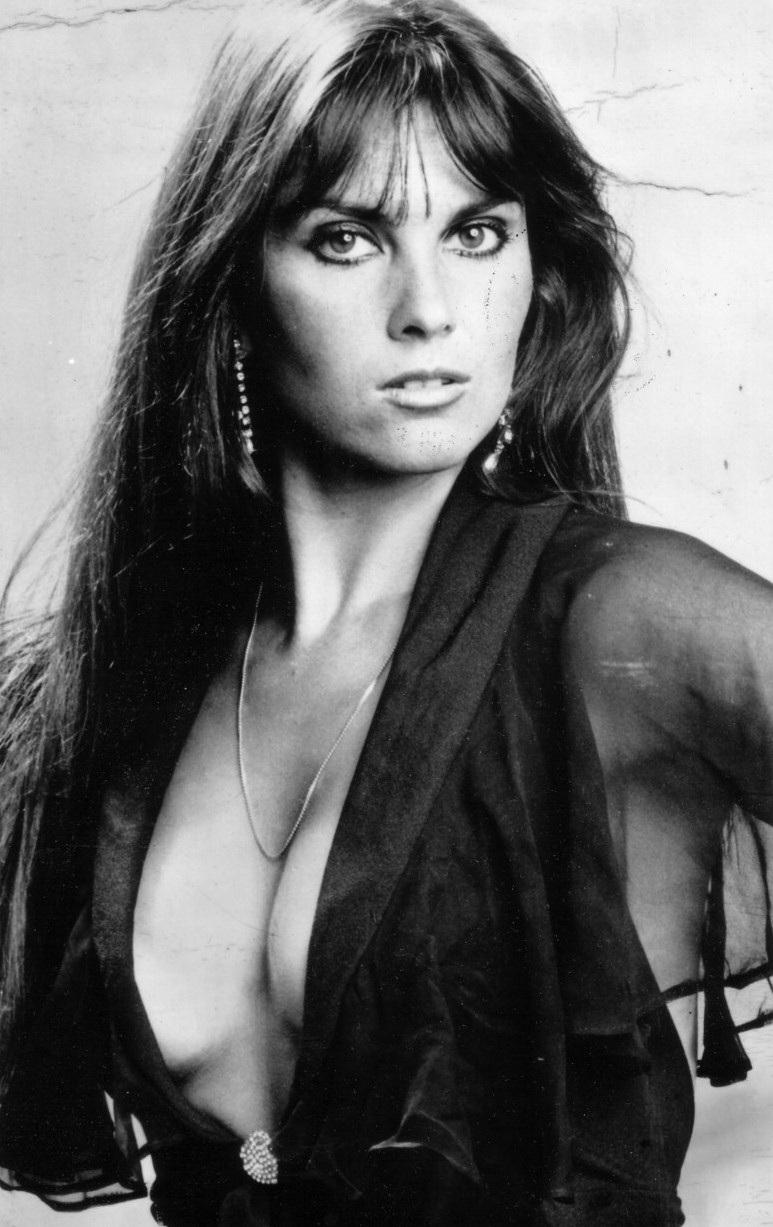 Cross’s personal assistant / secretary is ANNE ASHBY, a tall, voluptuous, coolly self-possessed sexpot in her mid-20s with long jet-black hair and dark flashing eyes. She also has highly advanced psychic powers, and a similarly murky background / connection to Cross. It is hinted that she may do more for him than just make the tea, though their relationship seems a complex love/hate one. She’s effectively a classic femme-fatale, but is again somewhat underdeveloped (though not physically, ahem), being most dramatically showcased in the wild climax of Dark Ways to Death, and throughout Haunting of Alan Mais, where some of her (reincarnated?) back-story is tantalisingly revealed. Otherwise her remarkable abilities are remarkably under-utilised, and she often only turns up to be kidnapped and subsequently rescued by the fellas. This would have to be addressed in the filmed adaptations, where her feisty independence and frosty hands-off sexuality need to be reinforced. After thinking carefully for twenty seconds, Hammer have decided to cast Caroline Munro in the role, and Carreras is already enthusiastically splashing her all over the papers in her lingerie.
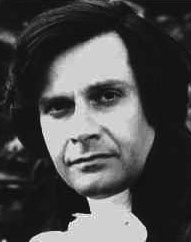 STEVEN KANE is the day-to-day leader of the group, a handy all-purpose action-man (essentially James Bond to Cross’s M), who reliably provides most of the gung-ho heroics. He was previously a university lecturer (a Professor of Anthropology with a particular interest in magic) and has well-developed hypnotic skills and minor psychic abilities (he can dowse with a map and pendulum to locate missing people for example). He’s in his mid-30s, tall, slim and athletic, with a bit of an unrequited crush on Anne, and privately mixed feelings about Cross. As the effective Leading Man, Hammer have decided to cast Ralph Bates in the part, who has just the right blend of dry charisma and darkly-handsome good looks.
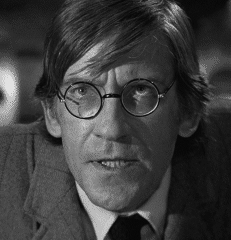 Father JOHN DYBALL is an independent middle-aged Anglo-Catholic priest of a small Kensington parish, whose contacts within the local community often lead the Guardians into their most dangerous cases. To be honest, Dyball is really a bit of a damp squib—his (sub Van Helsing) character is never properly defined, and indeed fairly confused: he’s variously described as being in his early-30s / late-40s, with a muddled back-story which may include military service (Navy or Paratroops, take your pick). In some adventures he’s reticently withdrawn, in others tediously verbose. His arcane prayers and exorcisms are, once finally delivered, almost always spectacularly effective (which becomes risibly predictable), and his surprise reduction to helpless puppet-victim in Killing Bone is actually quite refreshing. Serious attention to strengthening these weaknesses is required for the upcoming films, and Hammer have boldly gone for heavyweight casting—David Warner (in the steel granny-glasses recently popularised by John Lennon) is taking the role, giving it just the intense, broodingly-haunted introspection it needs.
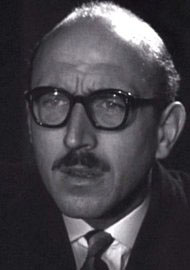 Finally, there is LIONEL MARKS, an ex-private detective who handles the more routine (but still vital) legwork of the group’s investigations. He’s a lugubrious everyman gumshoe with no psychic abilities whatsoever, but still tough, shrewd and resourceful, with a likeably down-to-earth deadpan wit. He limps from an old war-wound and is a bit of a hypochondriac, providing some much-needed comic-relief. His star-turn is probably Curse of Rathlaw when he gets hypnotised into working for the Other Side, but he turns up in some capacity in most of the books (even if only to make a key revelatory phone-call etc). His nonchalantly matey presence (he casually calls Kane ‘Steve’ and Dyball ‘Johnny’ etc) is also a necessary counterweight to the often portentous conduct of his colleagues. Recognising his importance in this respect, Hammer have decided to cast Lionel Jeffries in the role, utilising both his fine comic timing and formidable physical presence.
And now, onto the Adventures themselves—starting with: