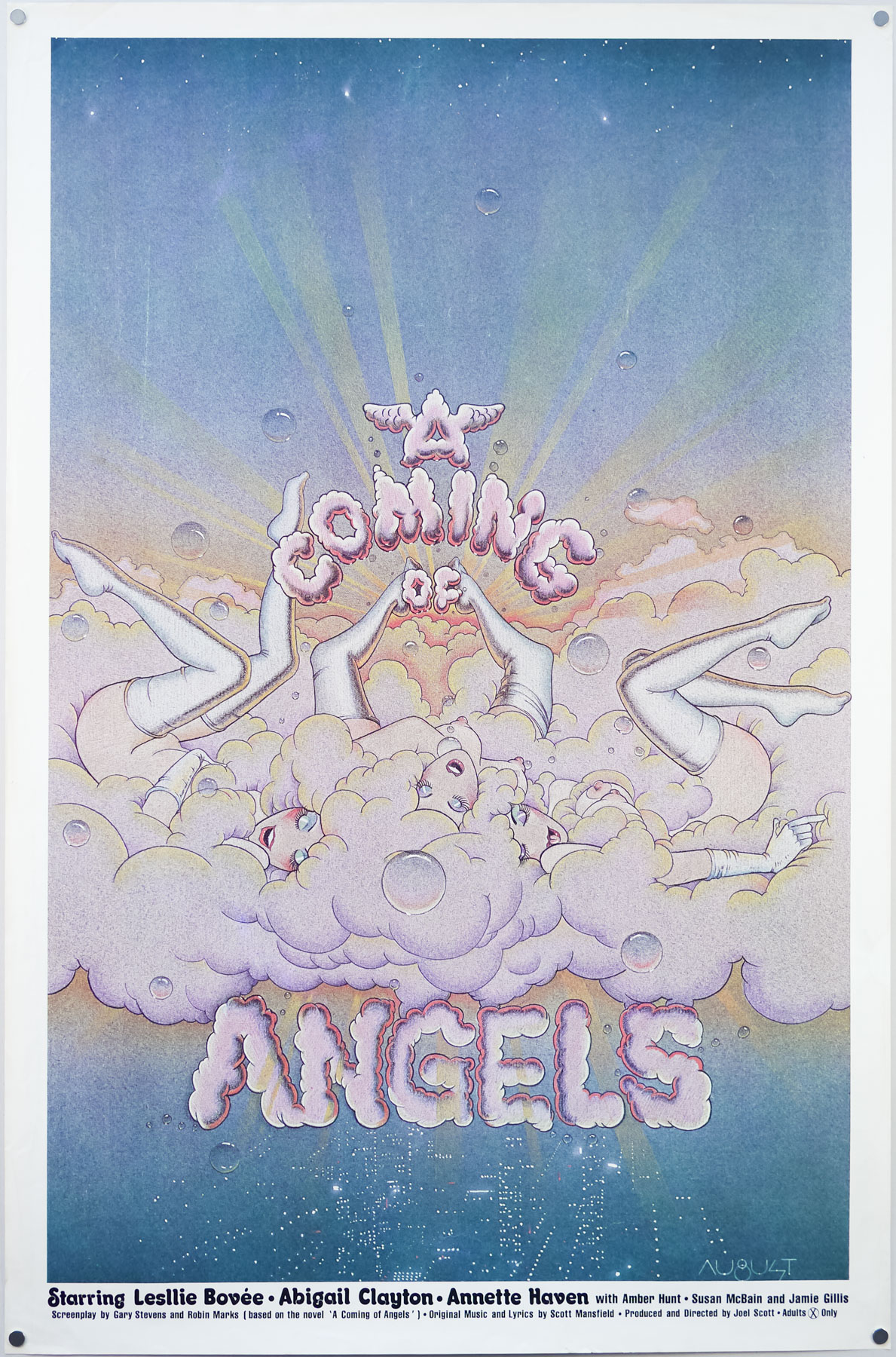
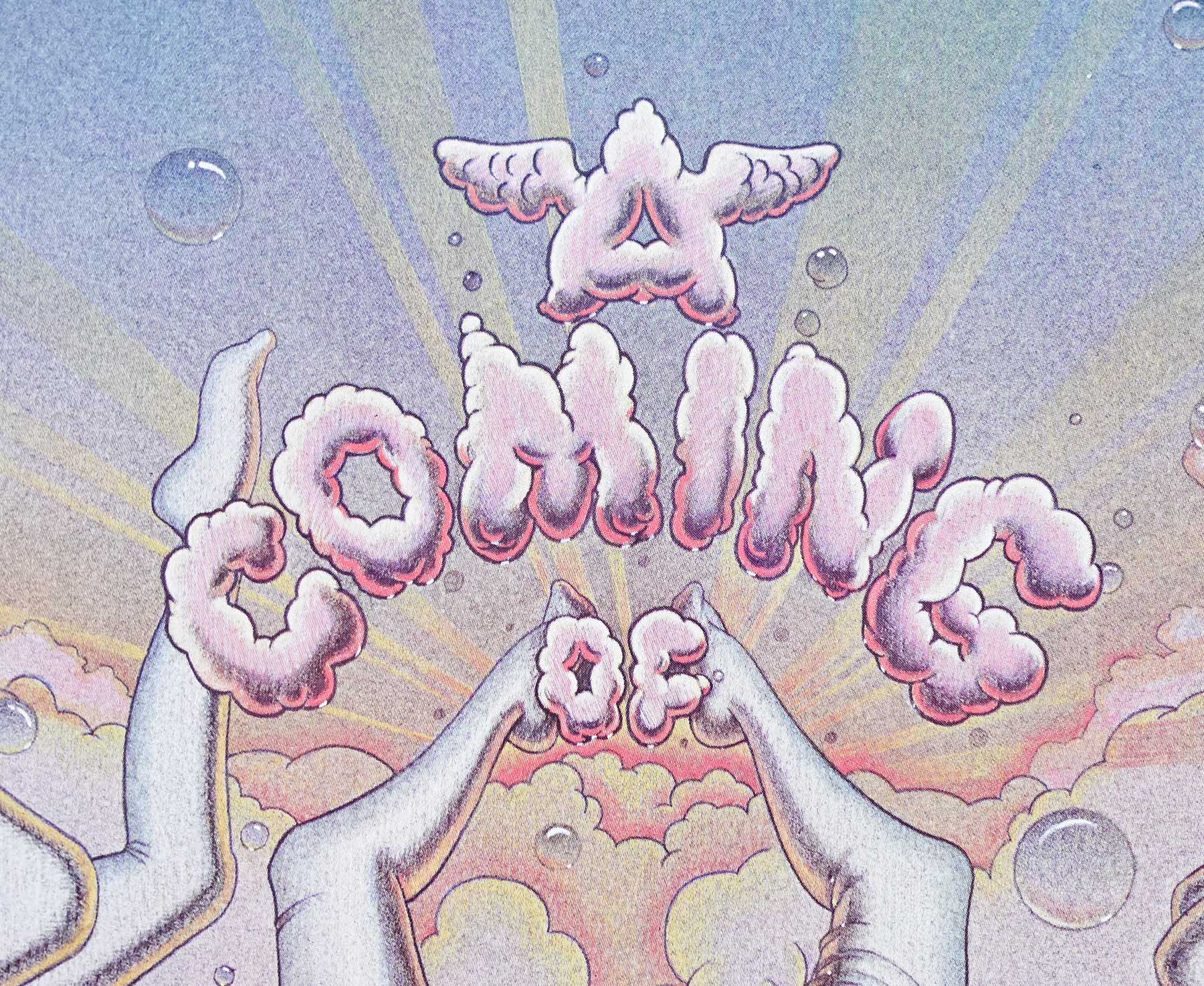
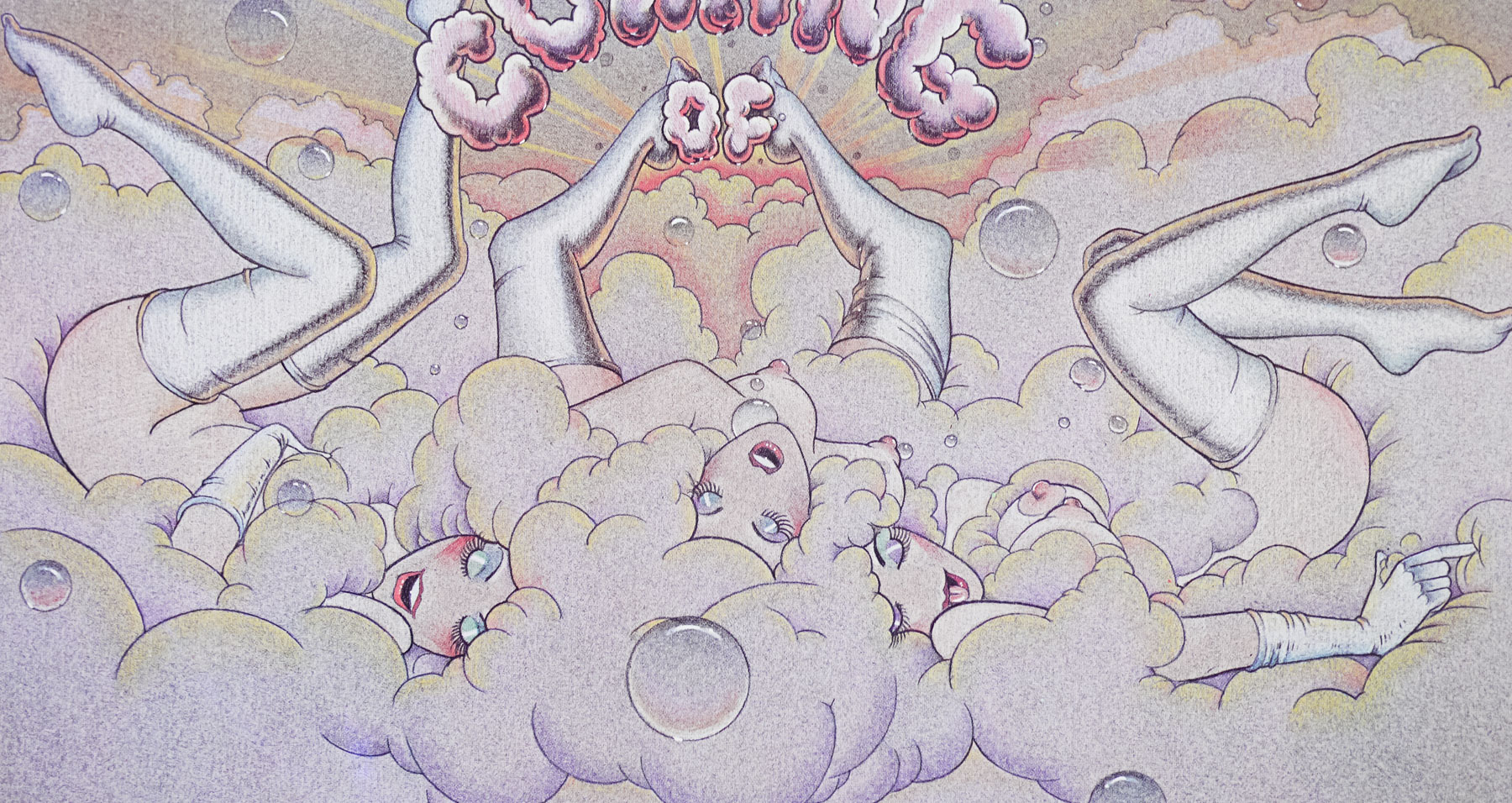
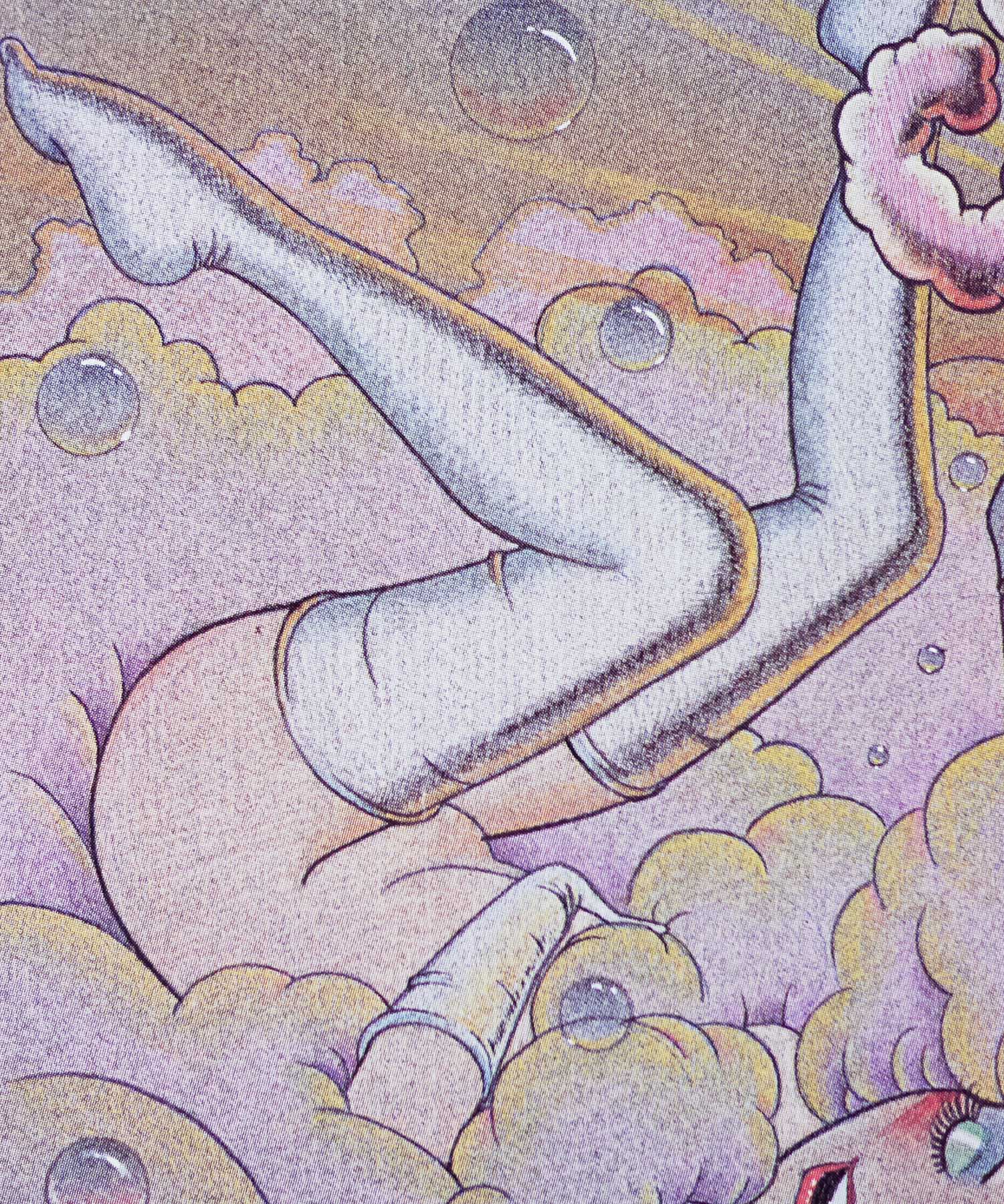
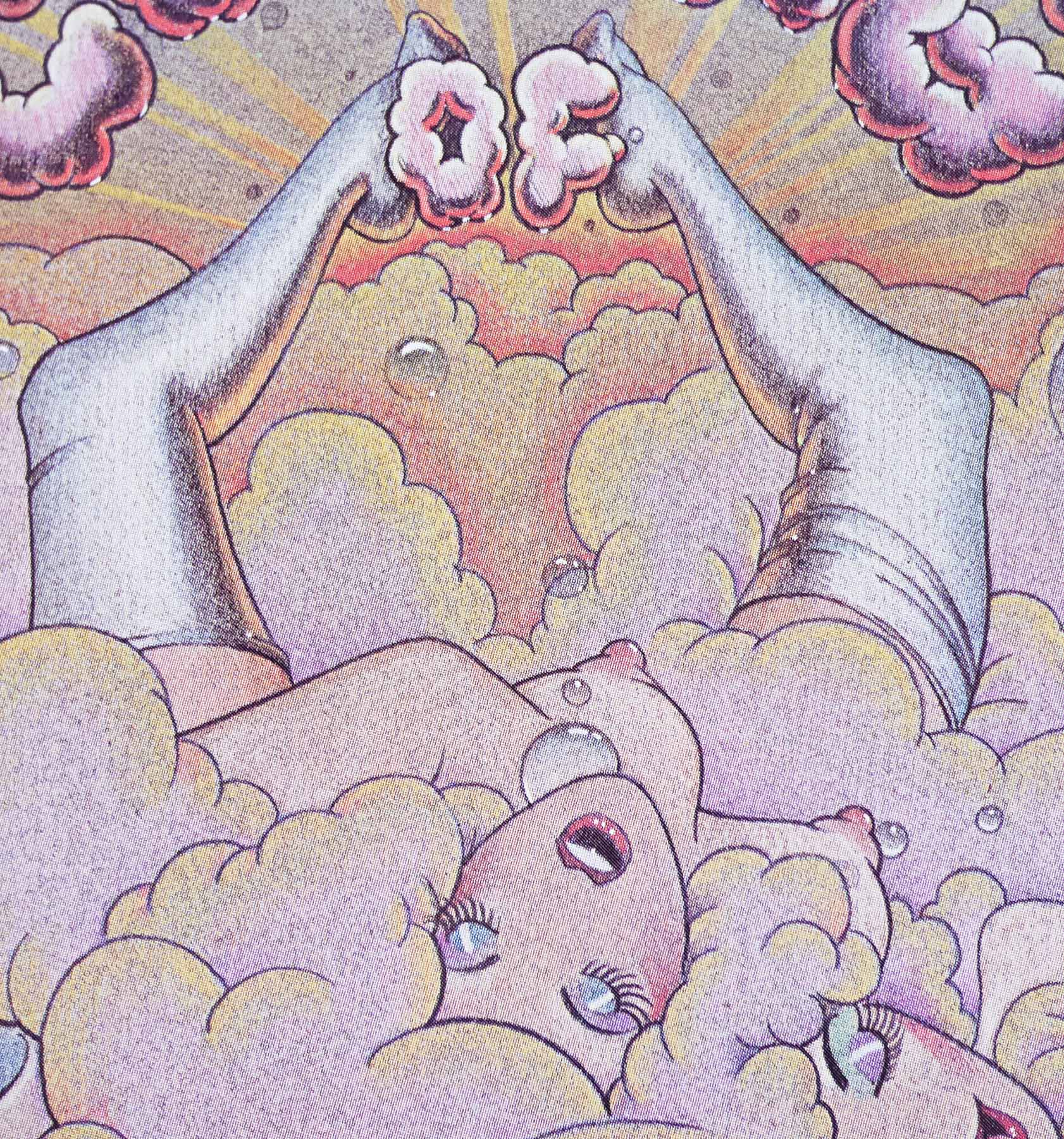
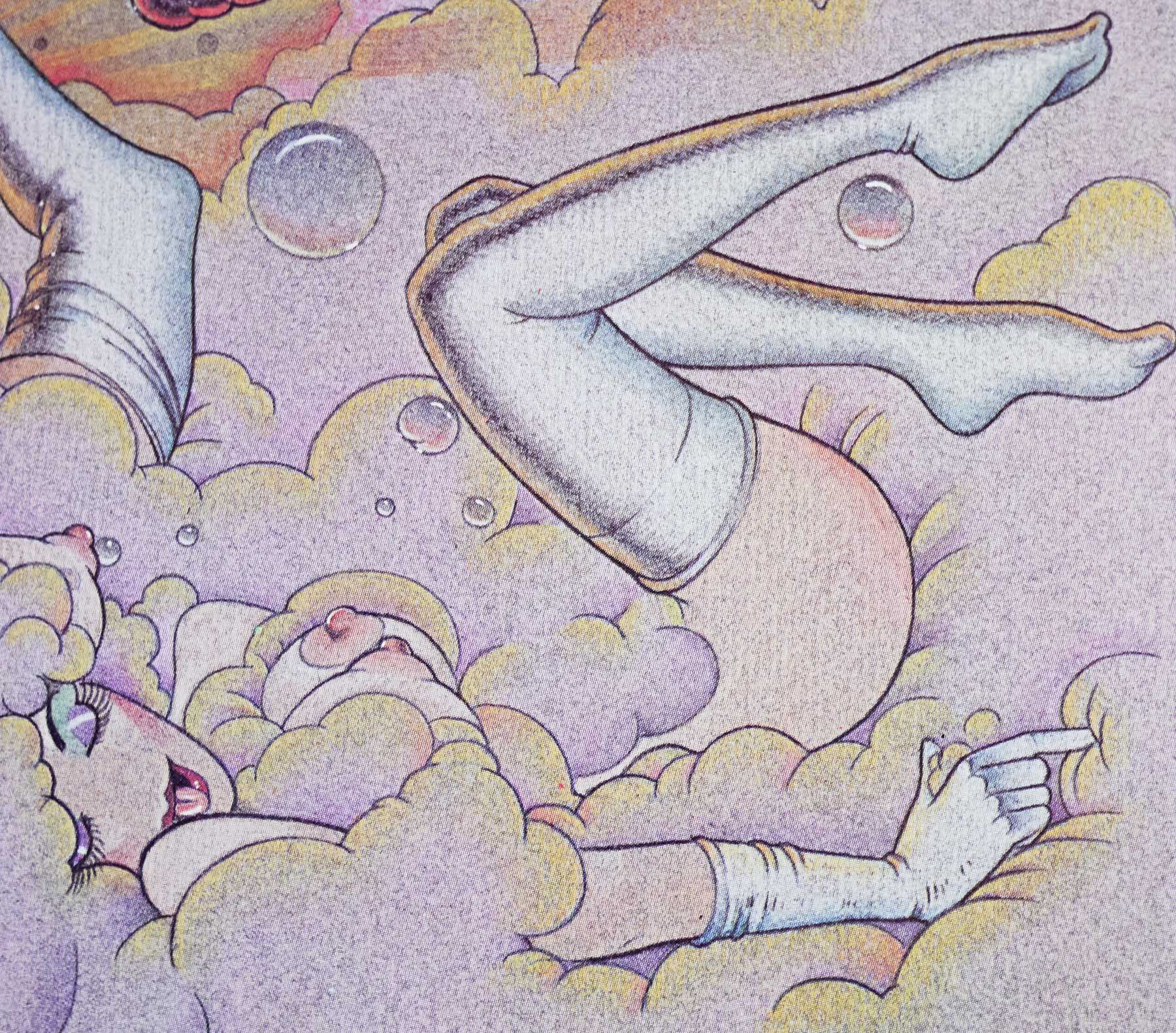
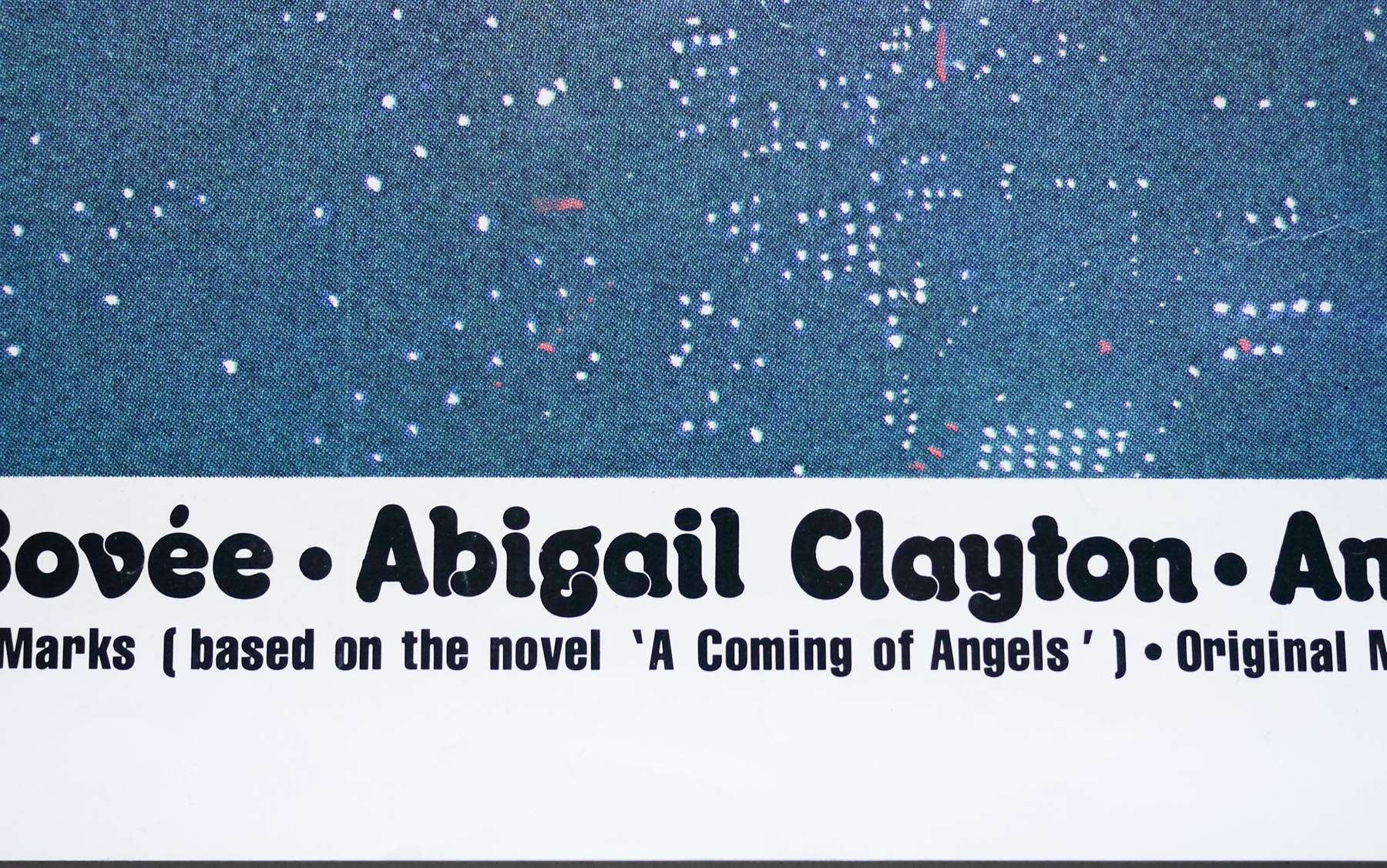
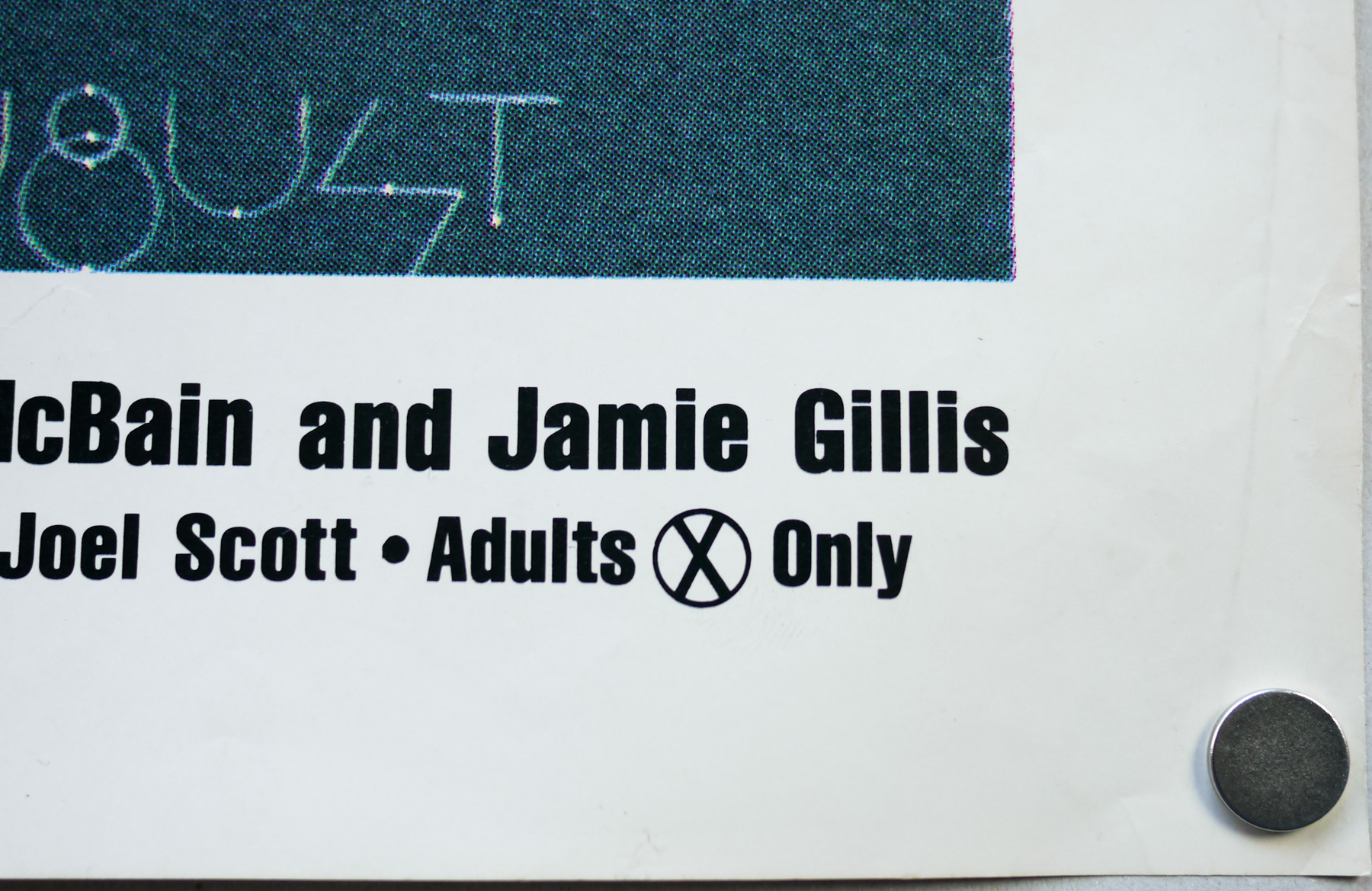
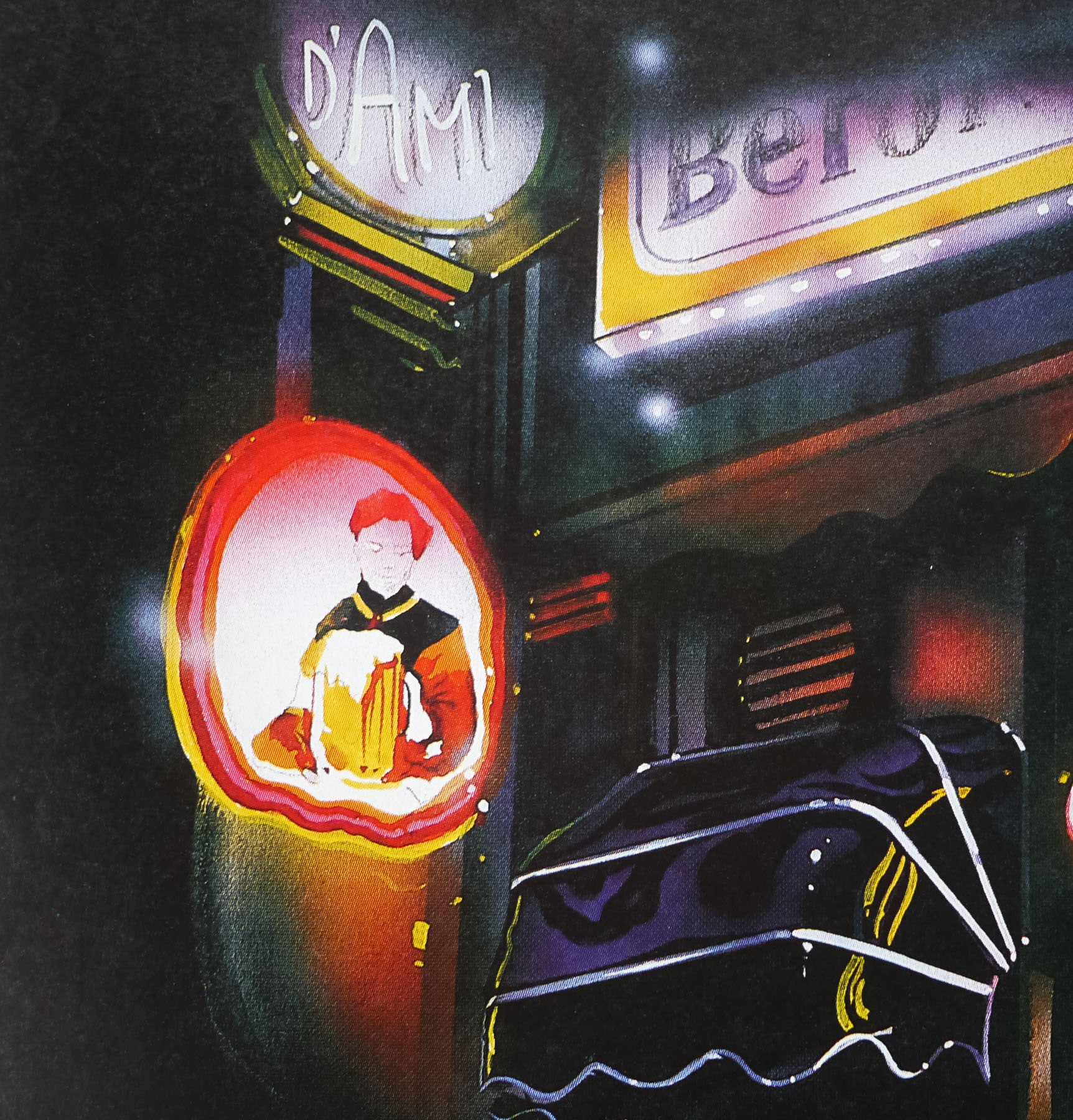
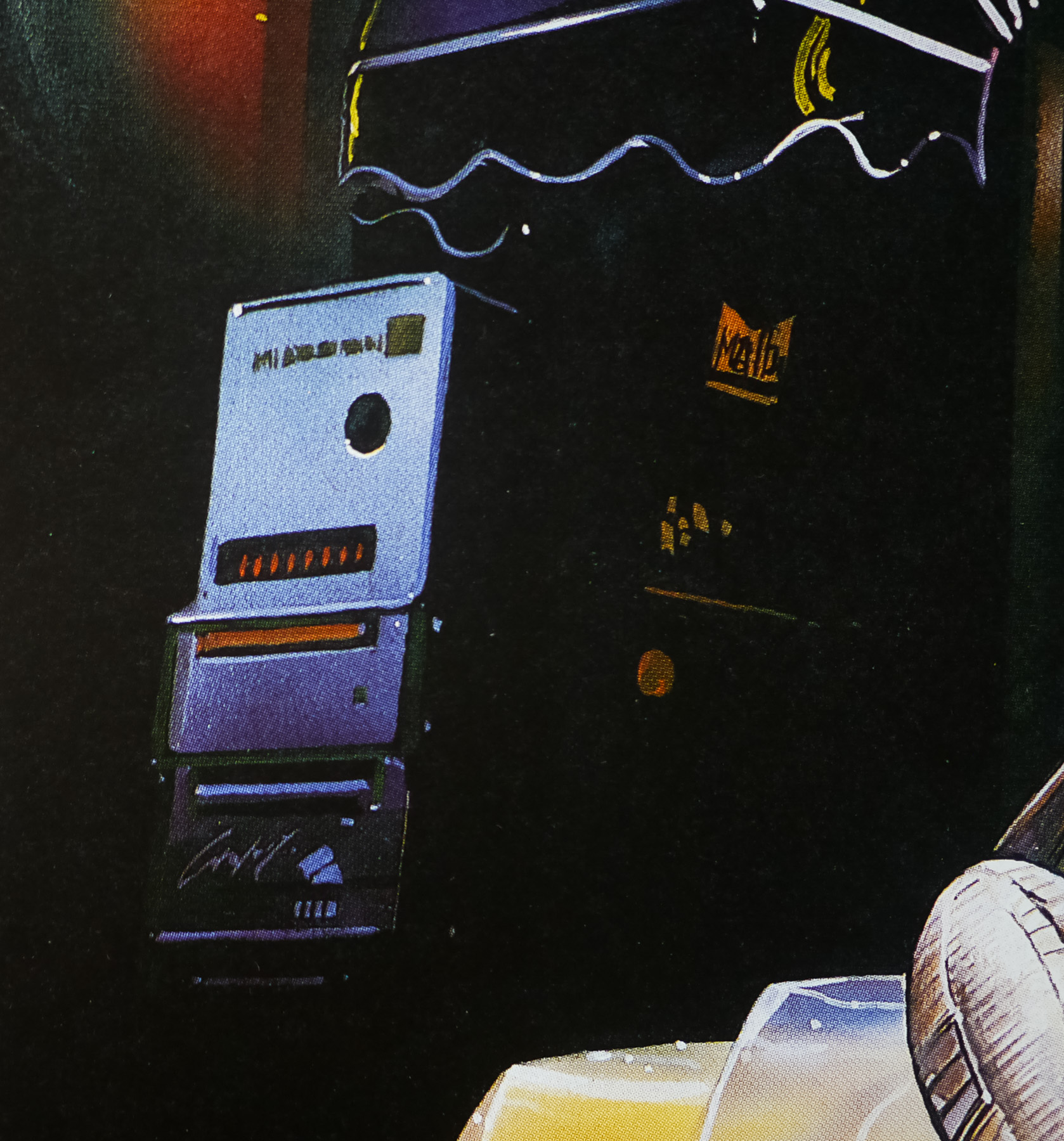
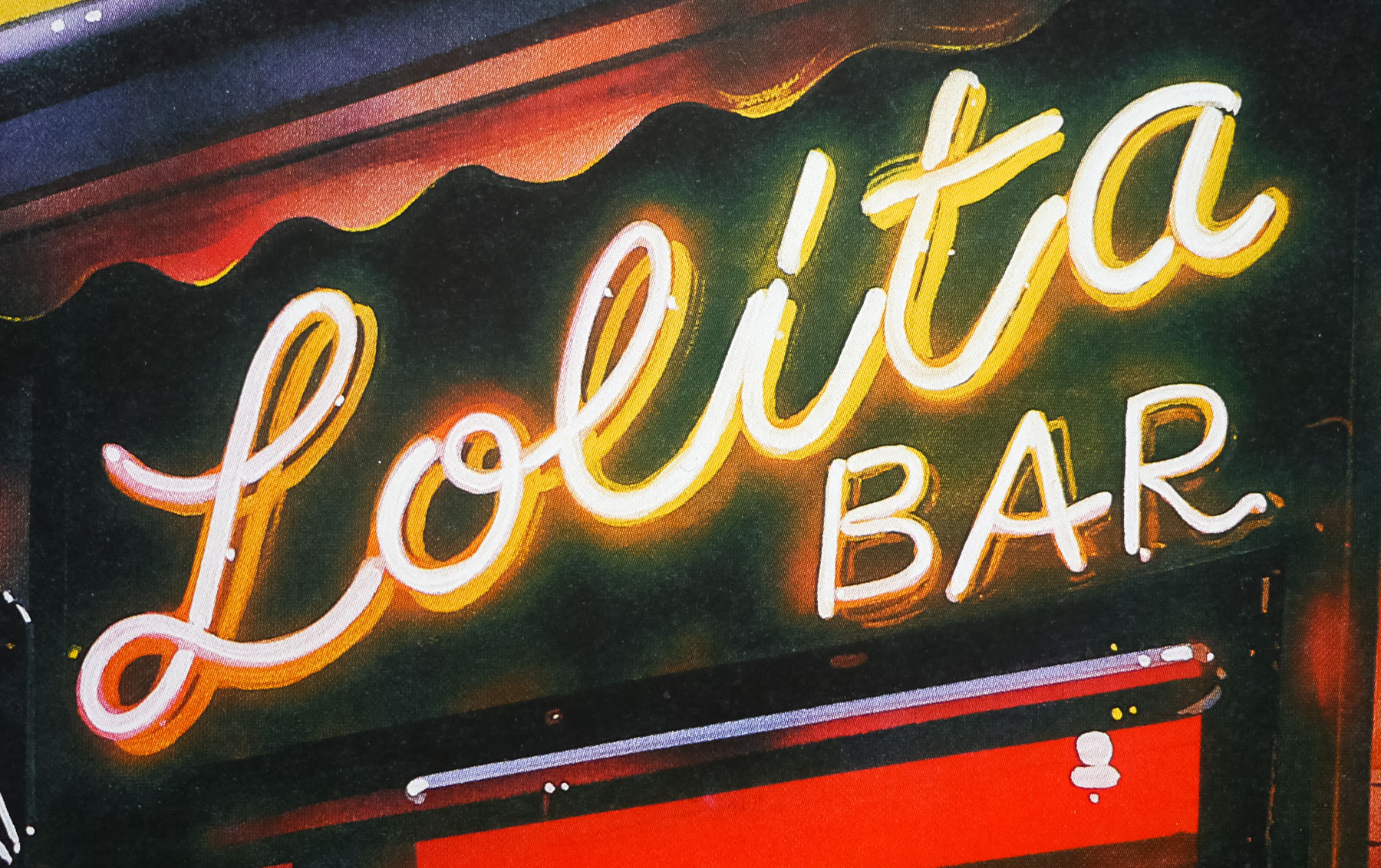
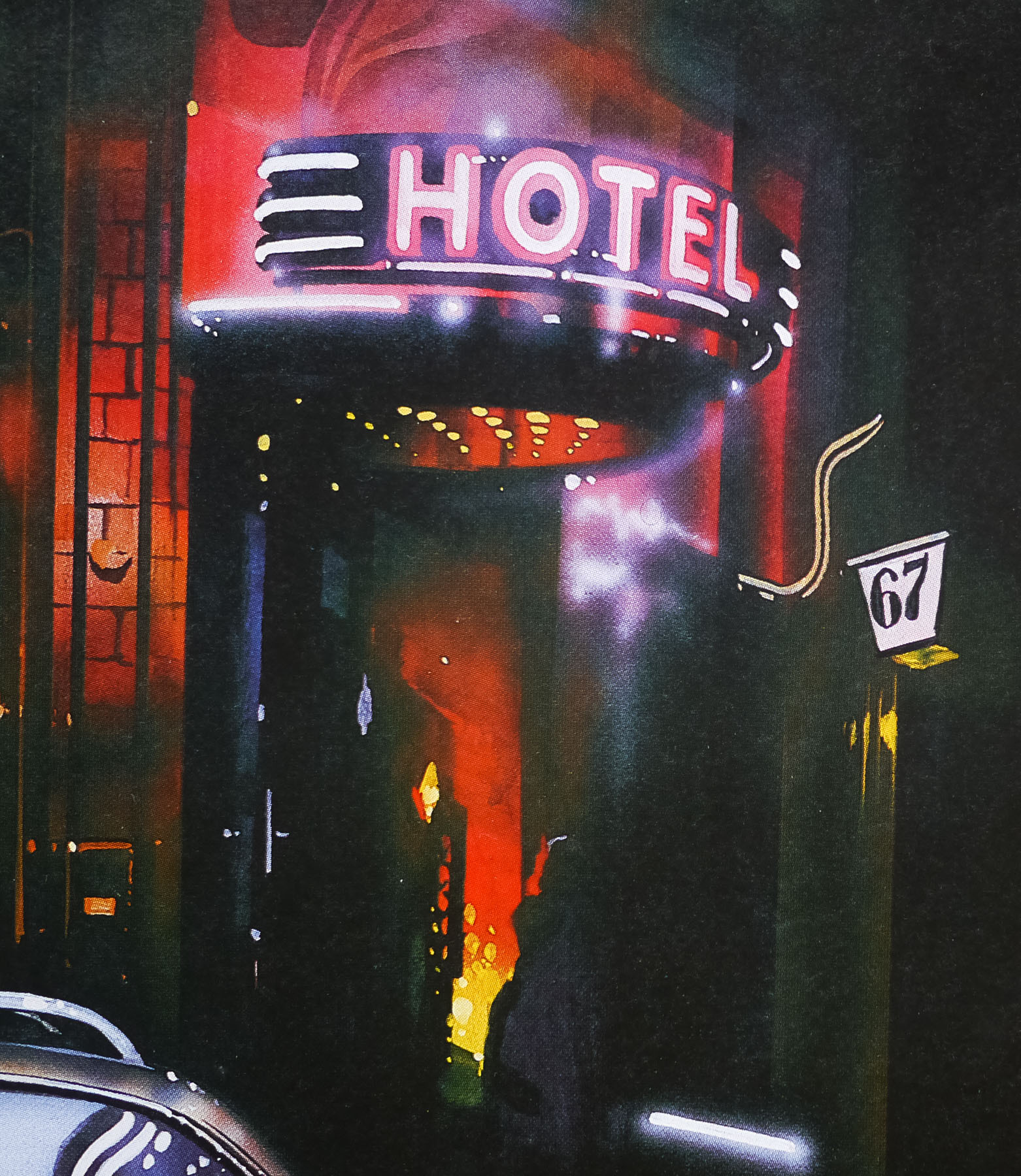
A Coming of Angels / one sheet / USA

22.07.15

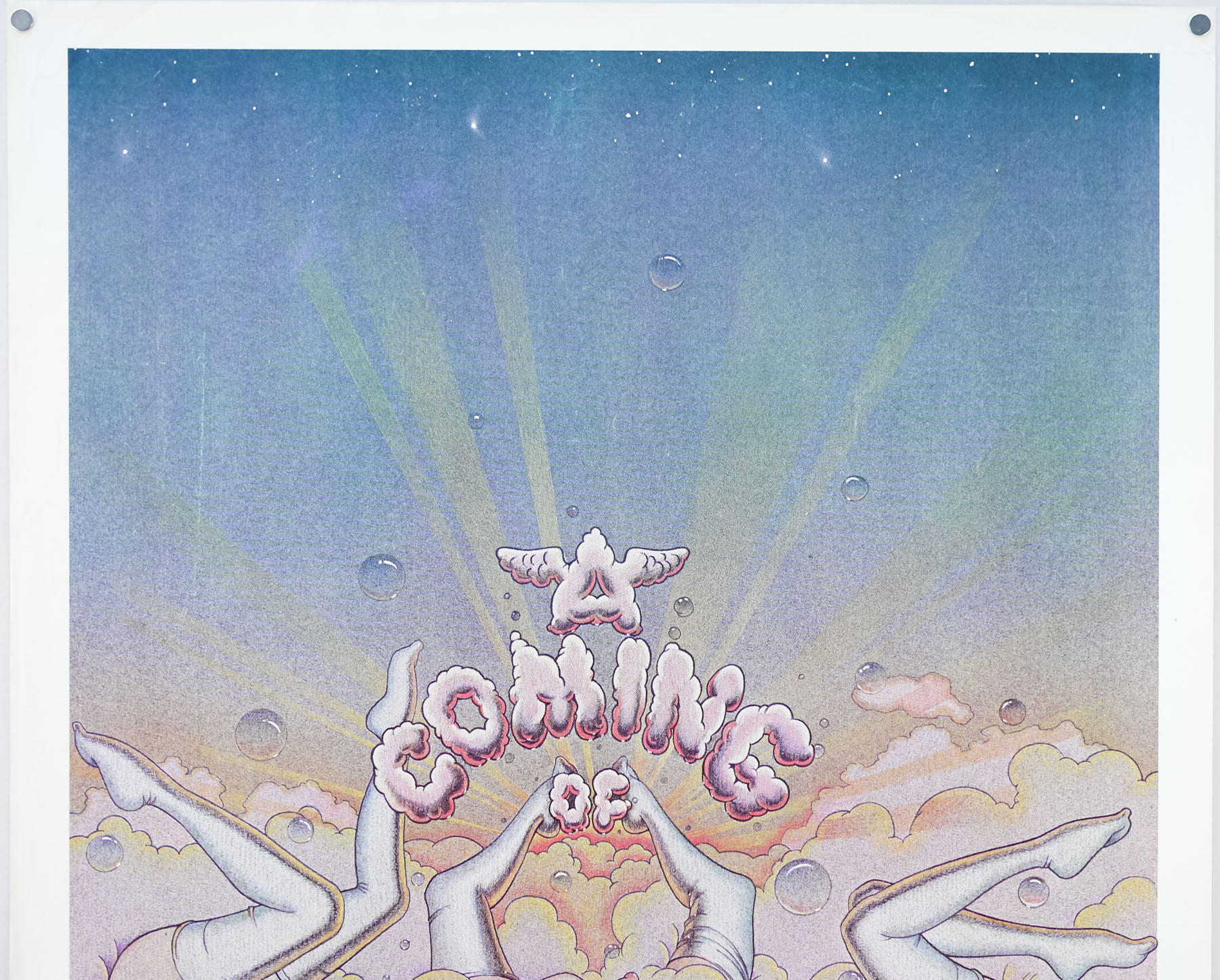
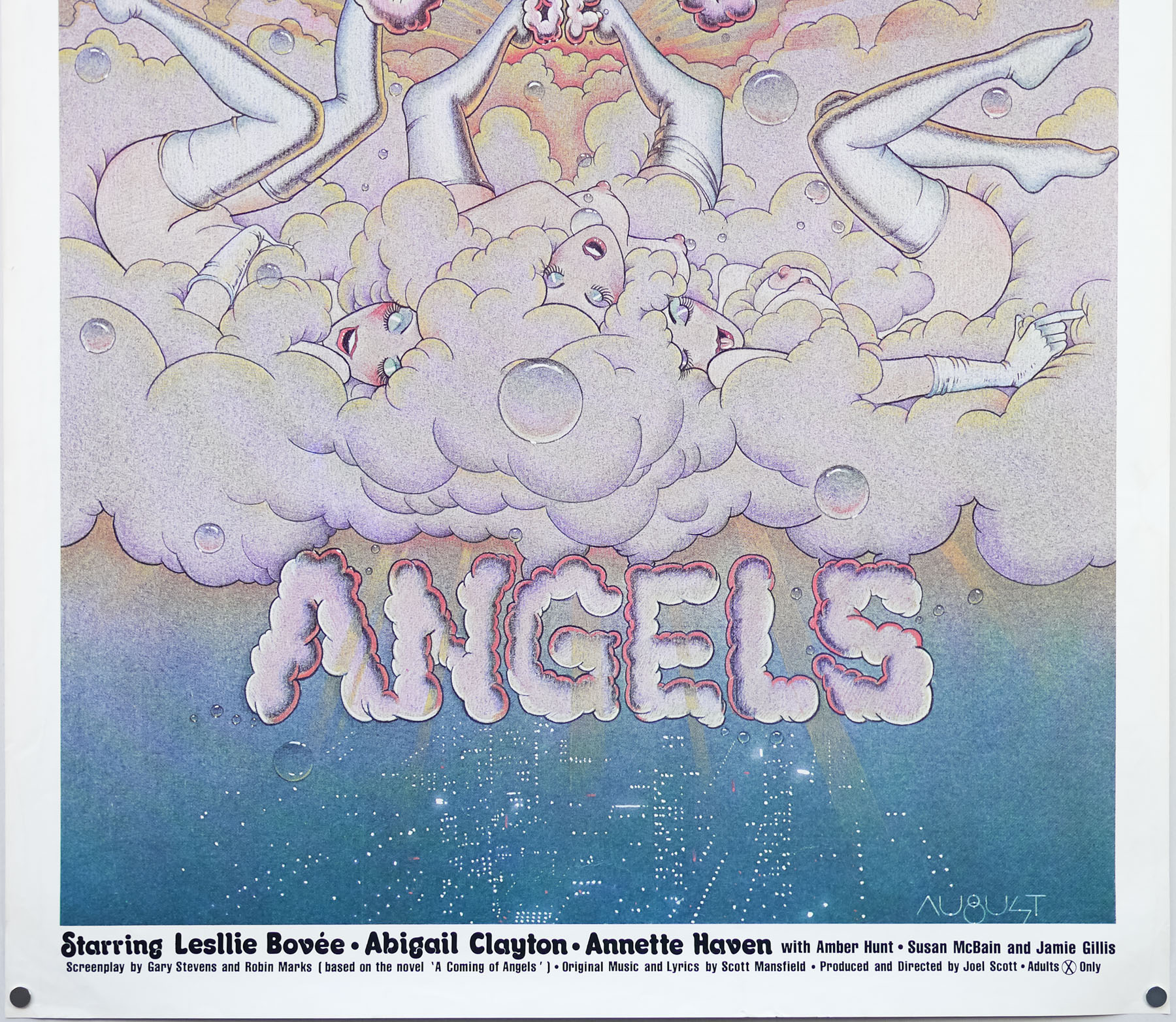
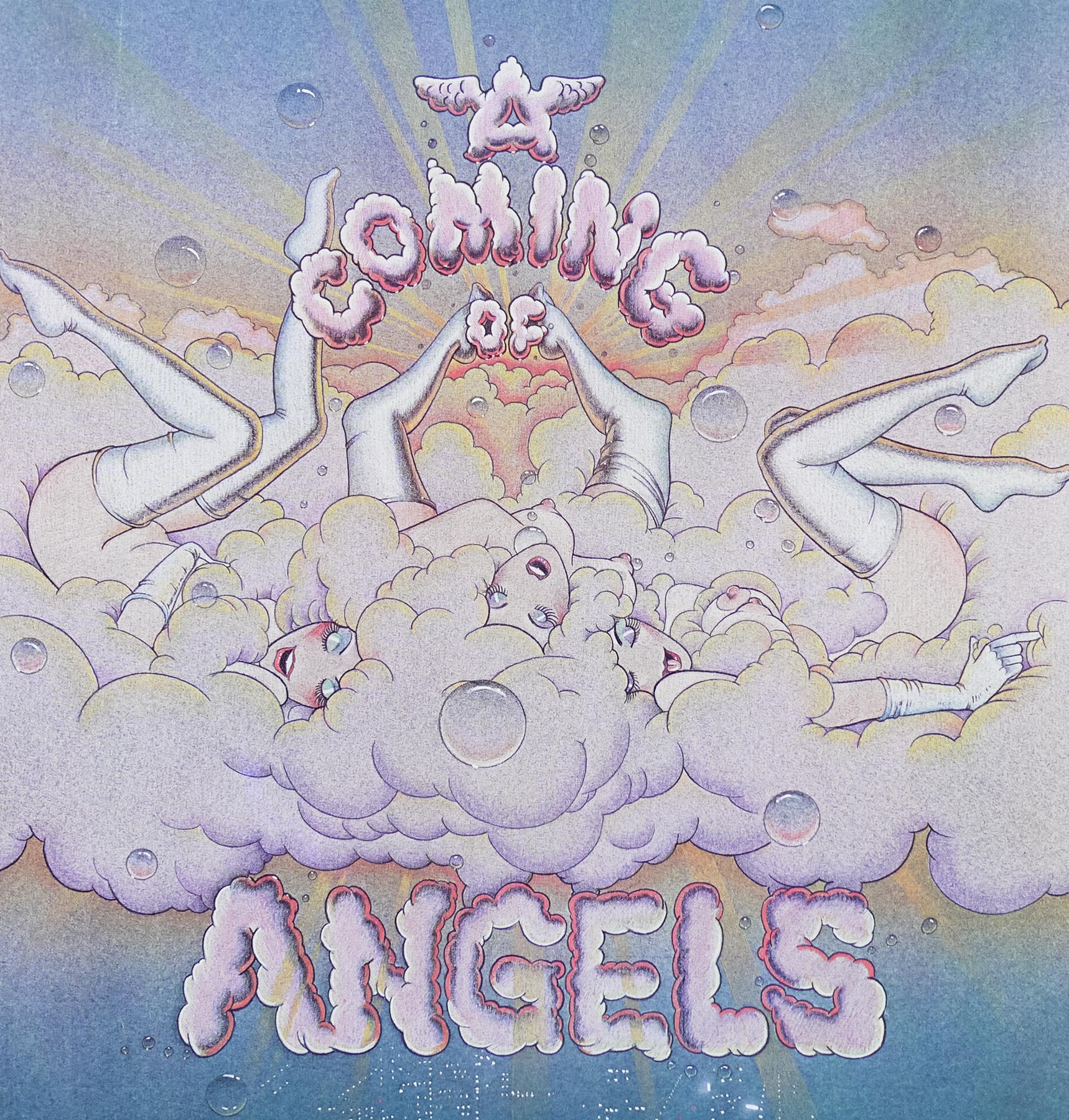
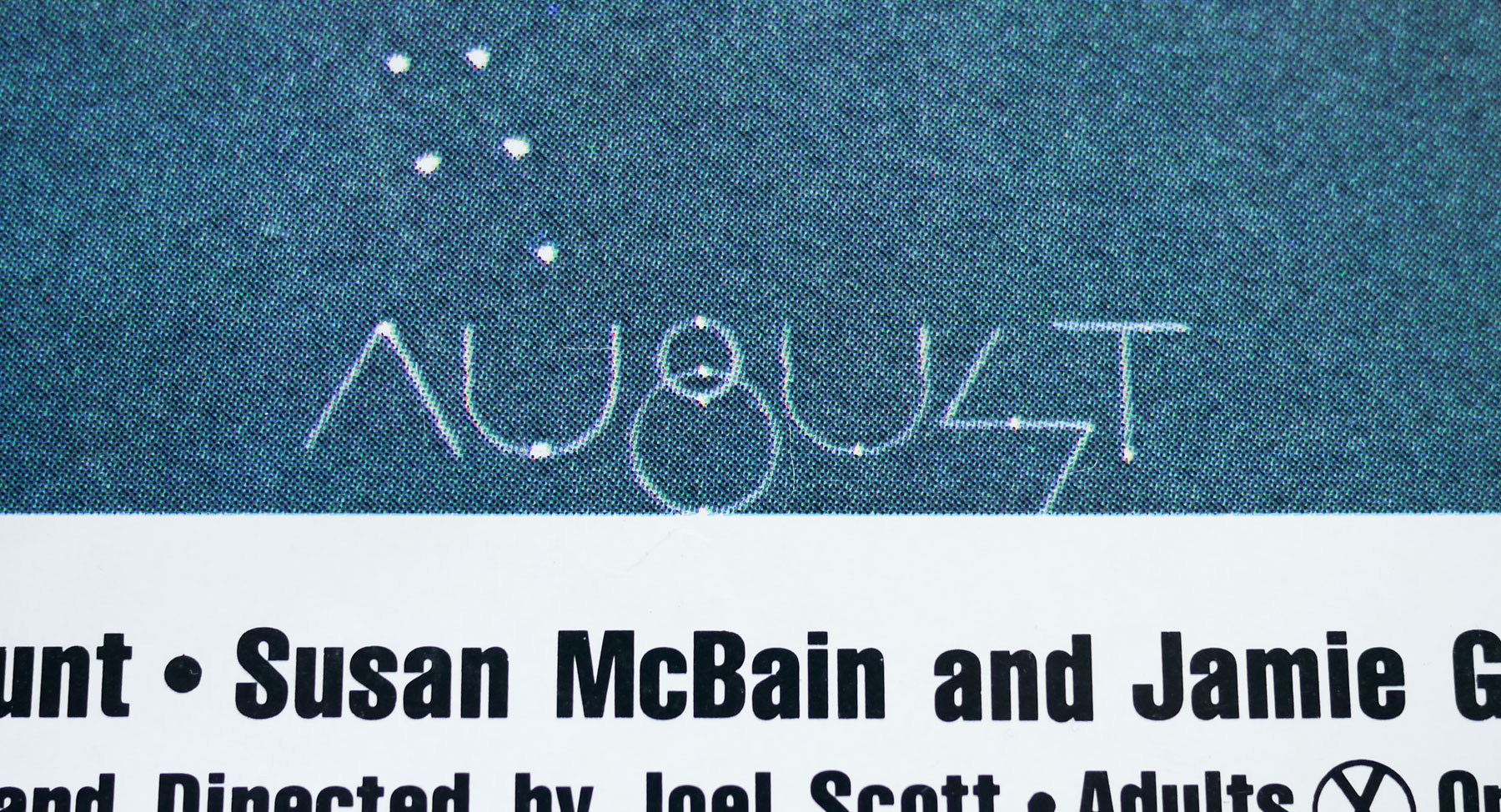
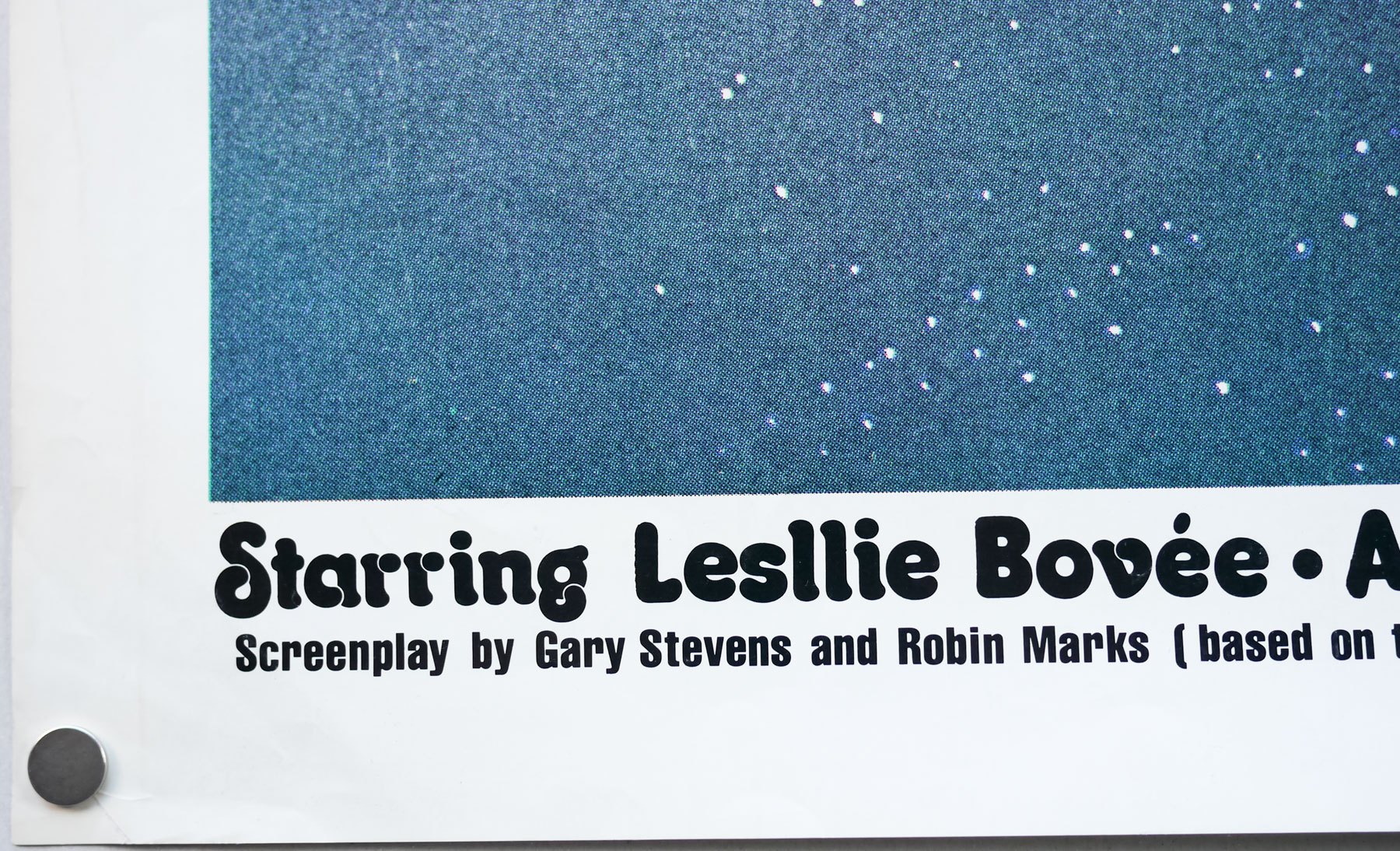
US one sheet poster for A Coming of Angels (1977). Artwork by AugustUS one sheet poster for A Coming of Angels (1977). Artwork by August, image 2US one sheet poster for A Coming of Angels (1977). Artwork by August, image 3US one sheet poster for A Coming of Angels (1977). Artwork by August, image 4US one sheet poster for A Coming of Angels (1977). Artwork by August, image 5
Title
A Coming of Angels
AKA
Momento Supremo (Brazil)
Year of Film
1977
Director
Joel Scott
Starring
Lesllie Bovee, Abigail Clayton, Annette Haven, Jamie Gillis, Amber Hunt, Susan McBain, John Leslie, Eric Edwards
Origin of Film
USA
Genre(s) of Film
Adult
Type of Poster
One sheet
Origin of Poster
USA
Year of Poster
1977
Designer
Unknown
Artist
August
Size (inches)
27 1/16" x 41 1/16"
SS or DS
SS

A Coming of Angels (opens in a new tab), released in select US cinemas in 1977, is an X-rated homage to the original Charlie’s Angels TV show and proves that pornographic spoofs of popular films and TV series is not a recent phenomenon. This is the only film that Joel Scott (opens in a new tab) ever directed but he managed to assemble a cast of now legendary adult stars, including the late Jamie Gillis (opens in a new tab) who starred in over 400 adult pictures as well as John Leslie (opens in a new tab) and Eric Edwards (opens in a new tab) who were actors in over 300 titles each. There are only 6 reviews for the title on IMDb (opens in a new tab), but there’s a lengthy one by someone called Dries Vermeulen who goes into detail about the background of the film and the action it contains.

The artwork features the signature ‘August’ but I’ve been unable to determine who this belongs to and Robin Bougie, the author of the excellent Graphic Thrills (opens in a new tab) (a book about adult movie posters) was also unable to track the artist down. If anyone has any ideas please get in touch.

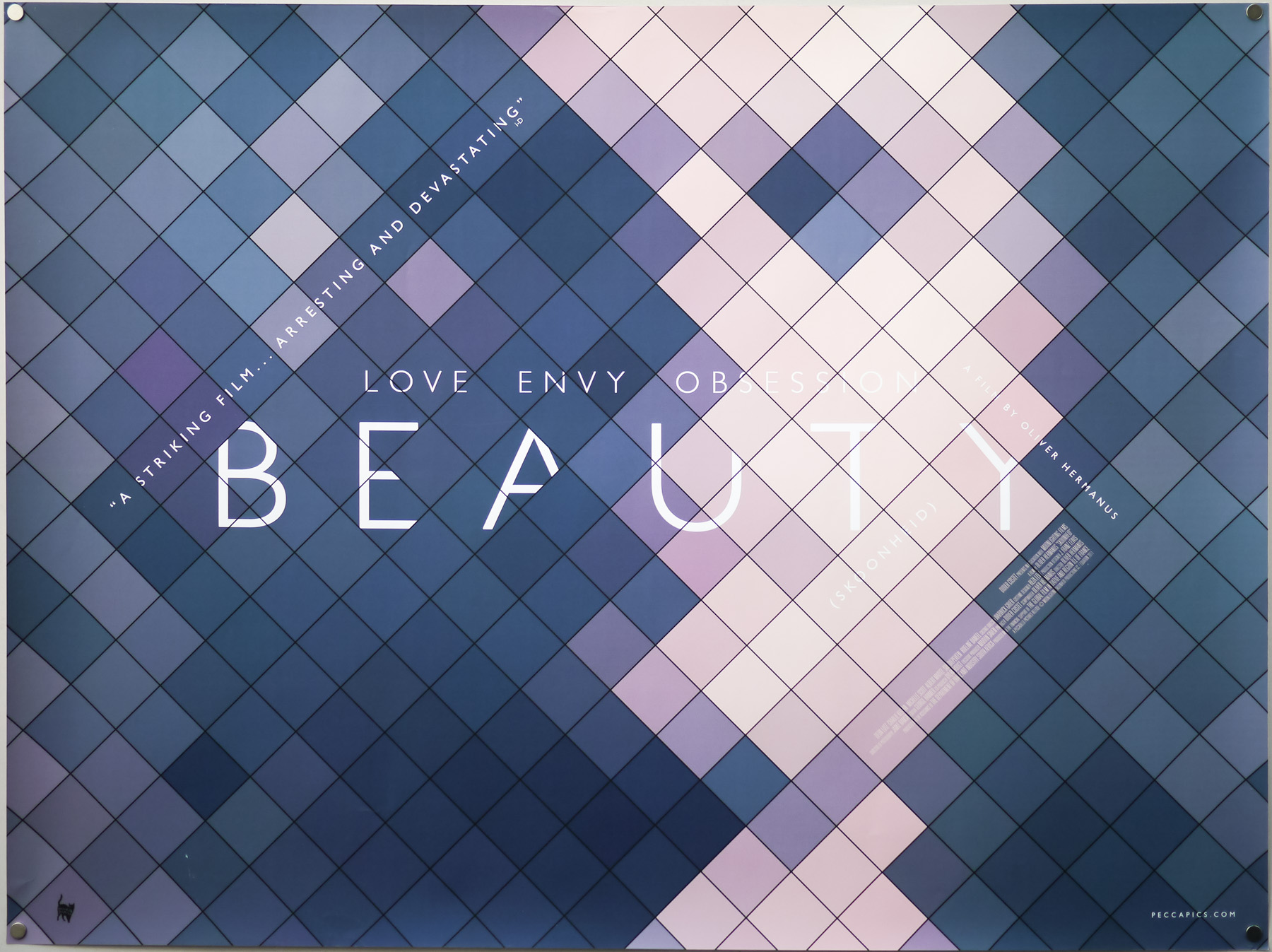
Beauty / quad / advance / UK

20.07.15

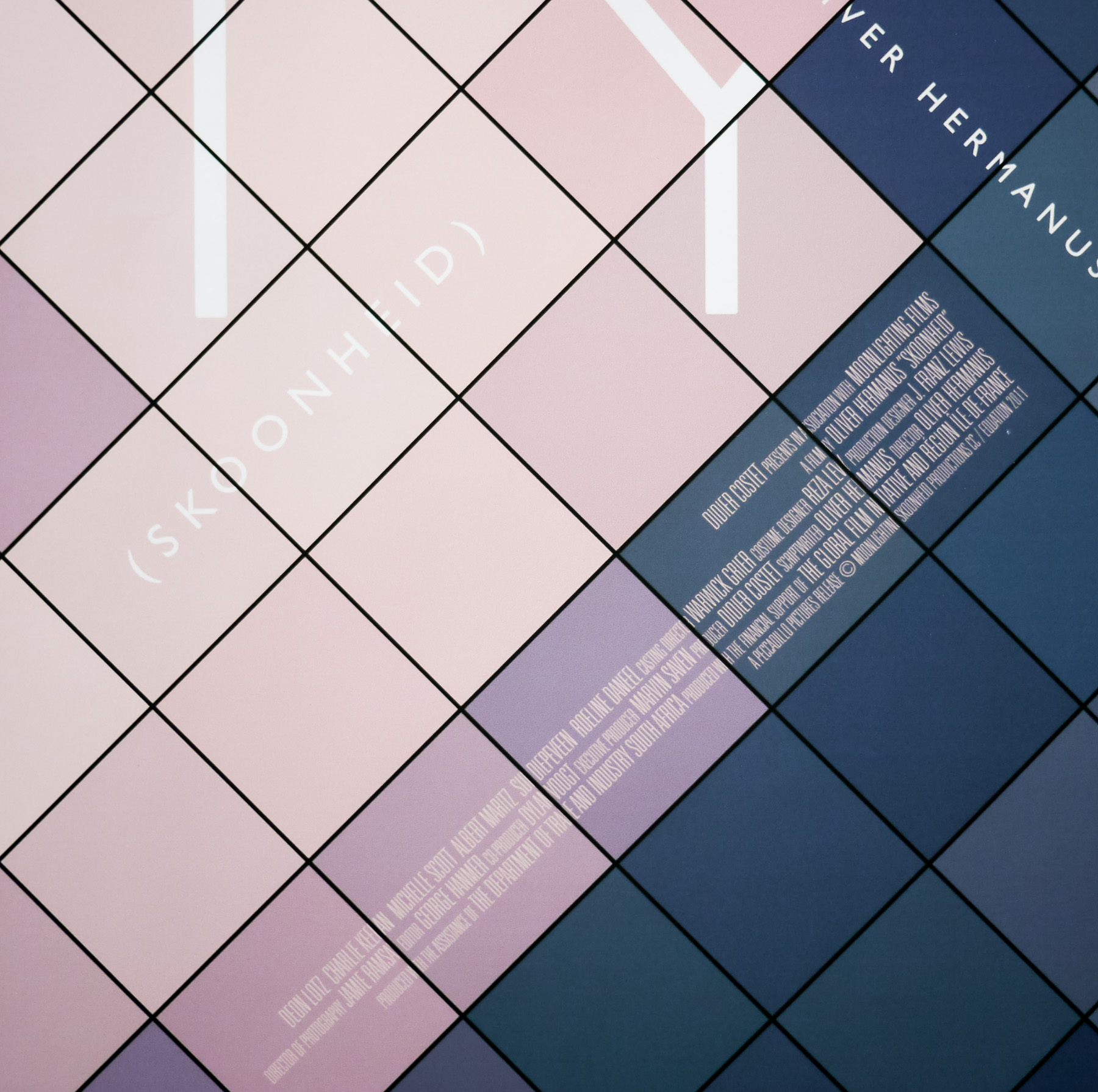
British quad poster (advance, 2012) for Beauty (2011). Artwork by Sam AshbyBritish quad poster (advance, 2012) for Beauty (2011). Artwork by Sam Ashby, image 2British quad poster (advance, 2012) for Beauty (2011). Artwork by Sam Ashby, image 3
Title
Beauty
AKA
Skoonheid (South Africa)
Year of Film
2011
Director
Oliver Hermanus
Starring
Deon Lotz, Charlie Keegan, Michelle Scott, Albert Maritz, Sue Diepeveen, Roeline Daneel, Drikus Volschenk
Origin of Film
South Africa | France | Germany
Genre(s) of Film
Drama
Type of Poster
Quad
Style of Poster
Advance
Origin of Poster
UK
Year of Poster
2012
Designer
Sam Ashby
Artist
Sam Ashby
Size (inches)
30" x 39 7/8"
SS or DS
SS
Tagline
Love - Envy - Obsession

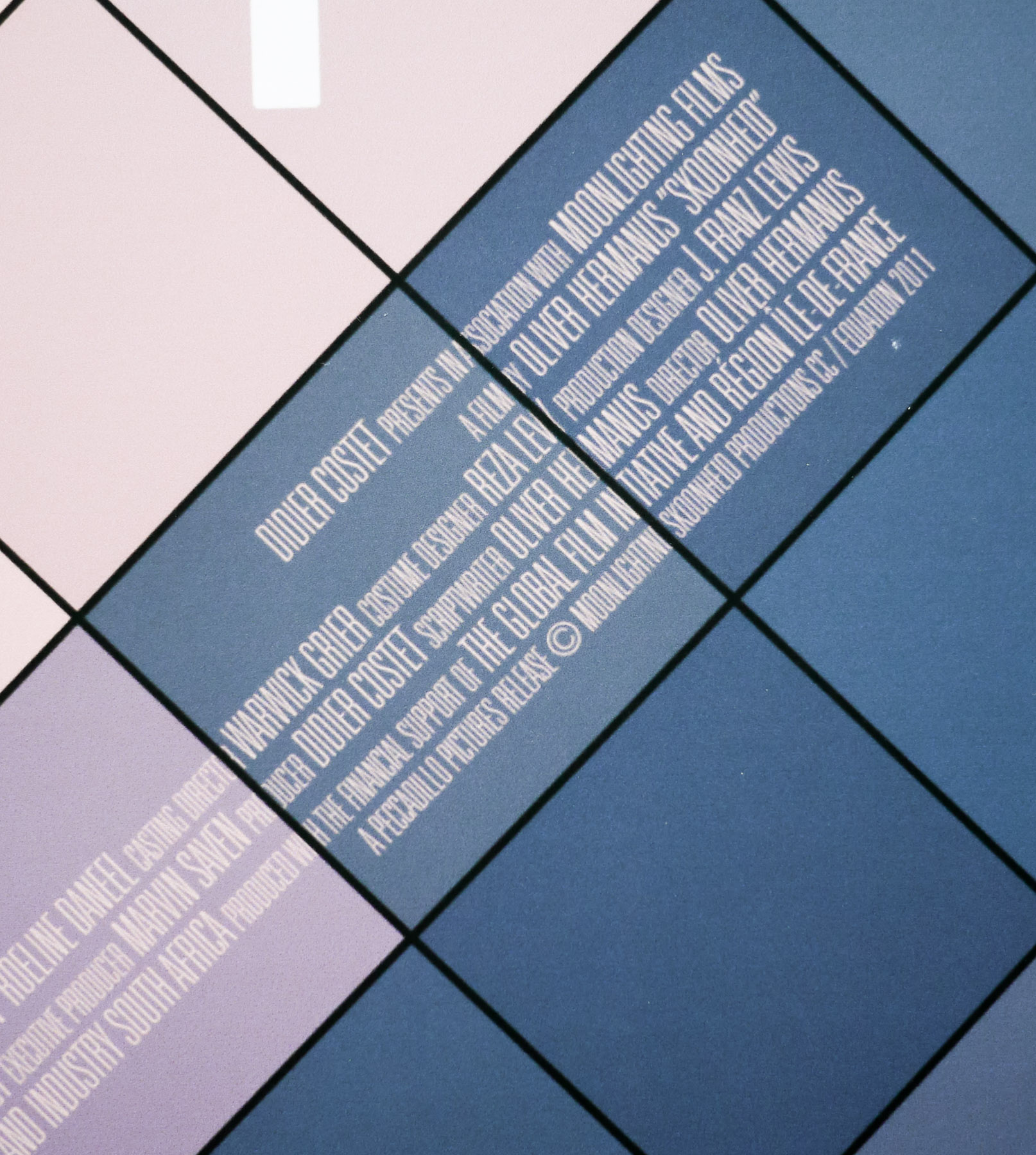
This is the advance quad poster for the UK release of the first Afrikaans-language film to be shown at the Cannes Film Festival, 2011’s Beauty (opens in a new tab), which was directed by Oliver Hermanus (opens in a new tab). Set in Bloemfontein and Cape Town, the film is a drama that is intended to highlight the bigoted attitudes towards homosexuality in South Africa, which forces men like François van Heerden (Deon Lotz (opens in a new tab)) to lead a closeted life. François has become bored with his marriage to wife Elena Michelle Scott (opens in a new tab), is frustrated with his daughter’s behaviour, and is bored of his job at a local sawmill. He is shown to be regularly meeting a group of gay men at a remote farm where they engage in sexual activities and then return to their families.

After meeting Christian Roodt (Charlie Keegan (opens in a new tab)), the handsome son of an old friend, at a wedding he becomes obsessed with him and begins to fake reasons to travel to Cape Town where Christian lives with his family. When he sees his daughter relaxing on the beach with Christian, François starts to descend even deeper into his dangerous obsession. After spending a drunken evening out in Cape Town, he calls Christian asking him to pick him up and when the pair drive back to François’ hotel an incident occurs that neither are prepared for. The ending is fairly ambiguous but we’re led to believe that life will be no happier for the married man.

This fantastic UK quad was created by Sam Ashby, a London-based graphic designer who has worked on a number of film posters, including quads for films like Weekend (2011). According to this interview (opens in a new tab), Sam used to work at the poster design firm AllCity (opens in a new tab) as Head of Design before leaving to set up his own studio in 2010. His website hasn’t been updated in a number of months so I’m not sure if he’s still active as a film poster designer.

It’s worth noting that I bought this poster directly from the UK distributor Pecadillo Pictures (opens in a new tab) and it’s printed on thicker paper than standard quads. The printing quality is not as high as would usually be expected.

Helsinki Napoli All Night Long / A1 / Germany

17.07.15

German A1 poster for Helsinki Napoli All Night Long (1987). Artwork by Renato CasaroGerman A1 poster for Helsinki Napoli All Night Long (1987). Artwork by Renato Casaro, image 2German A1 poster for Helsinki Napoli All Night Long (1987). Artwork by Renato Casaro, image 3German A1 poster for Helsinki Napoli All Night Long (1987). Artwork by Renato Casaro, image 4
Title
Helsinki Napoli All Night Long
AKA
Helsinki-Naples All Night Long (alt. title)
Year of Film
1987
Director
Mika Kaurismäki
Starring
Kari Väänänen, Roberta Manfredi, Jean-Pierre Castaldi, Margi Clarke, Nino Manfredi, Mélanie Robeson, Samuel Fuller, Eddie Constantine, Sakari Kuosmanen
Origin of Film
Finland | Switzerland | West Germany
Genre(s) of Film
Comedy | Thriller
Type of Poster
A1
Origin of Poster
Germany
Year of Poster
1987
Designer
Renato Casaro
Artist
Renato Casaro
Size (inches)
23 7/16" x 33 1/16"
SS or DS
SS

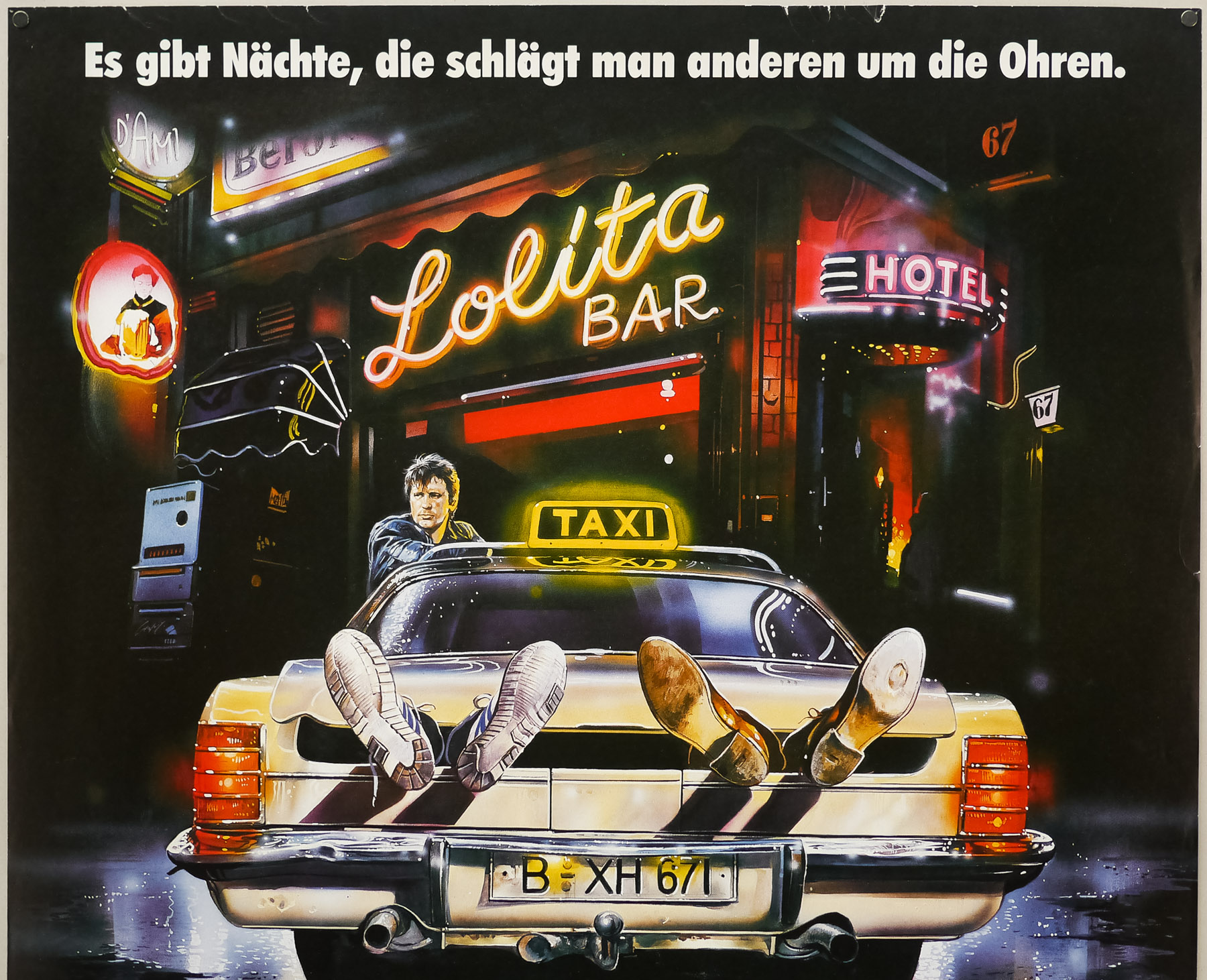
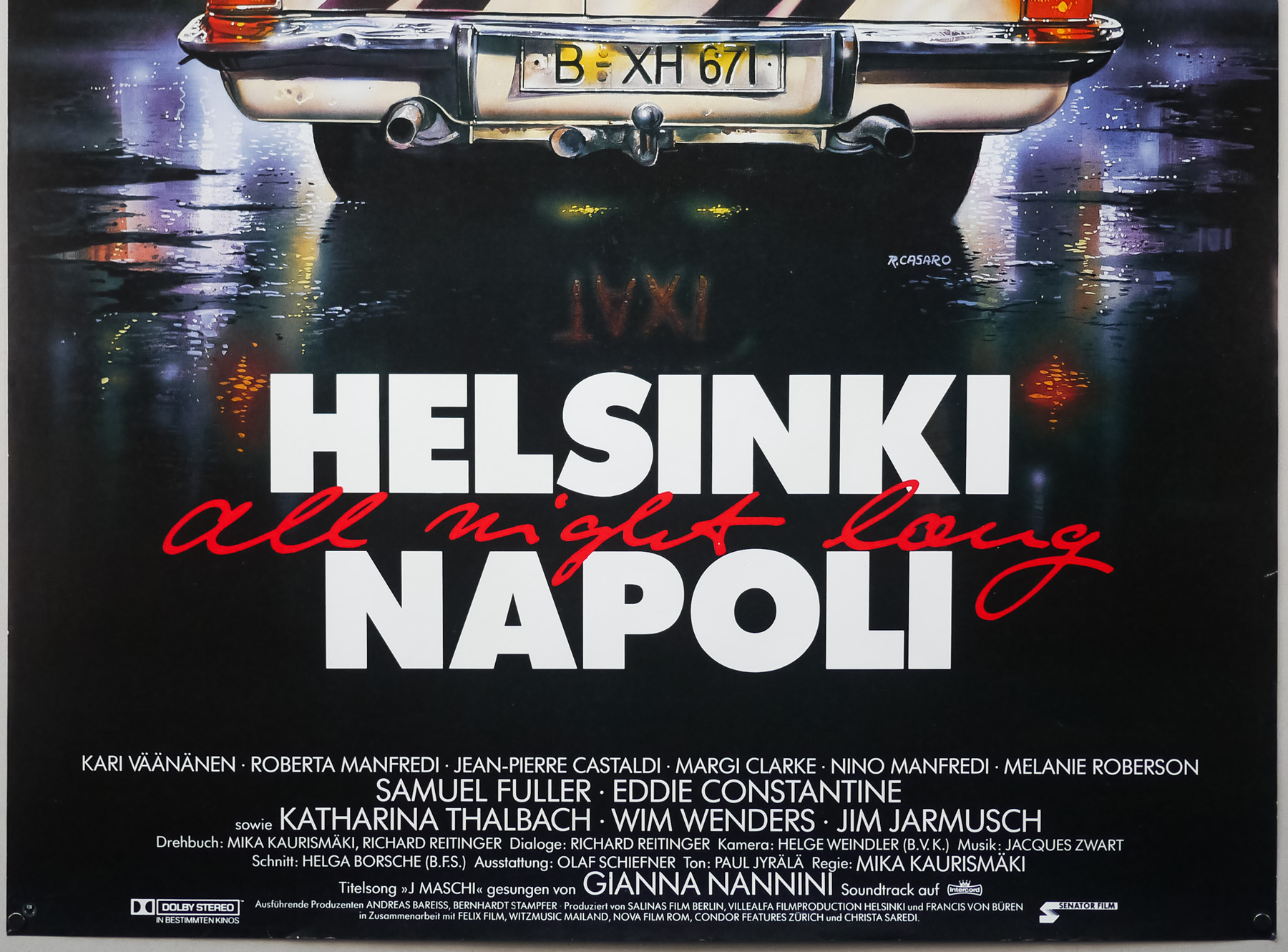
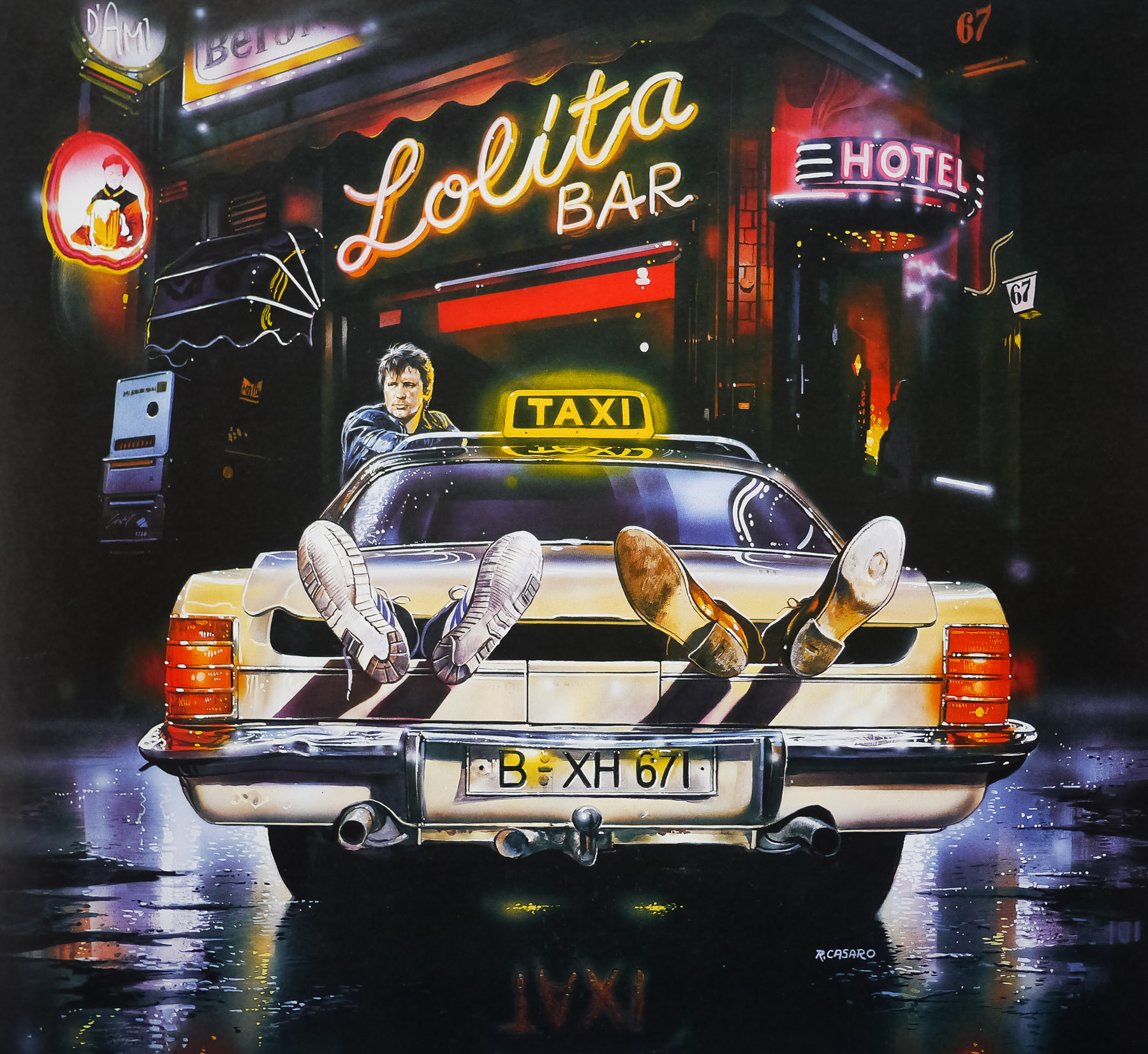
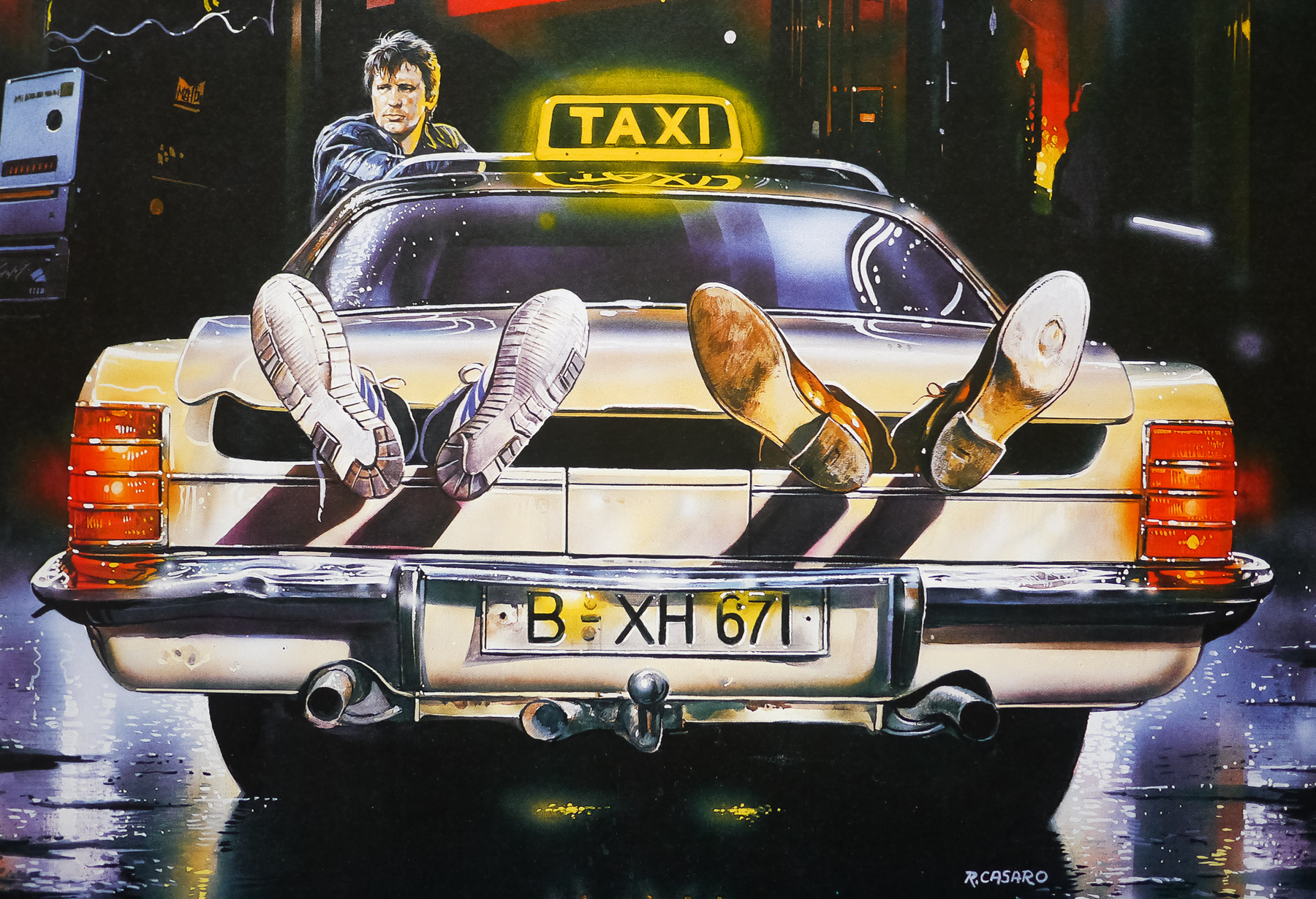
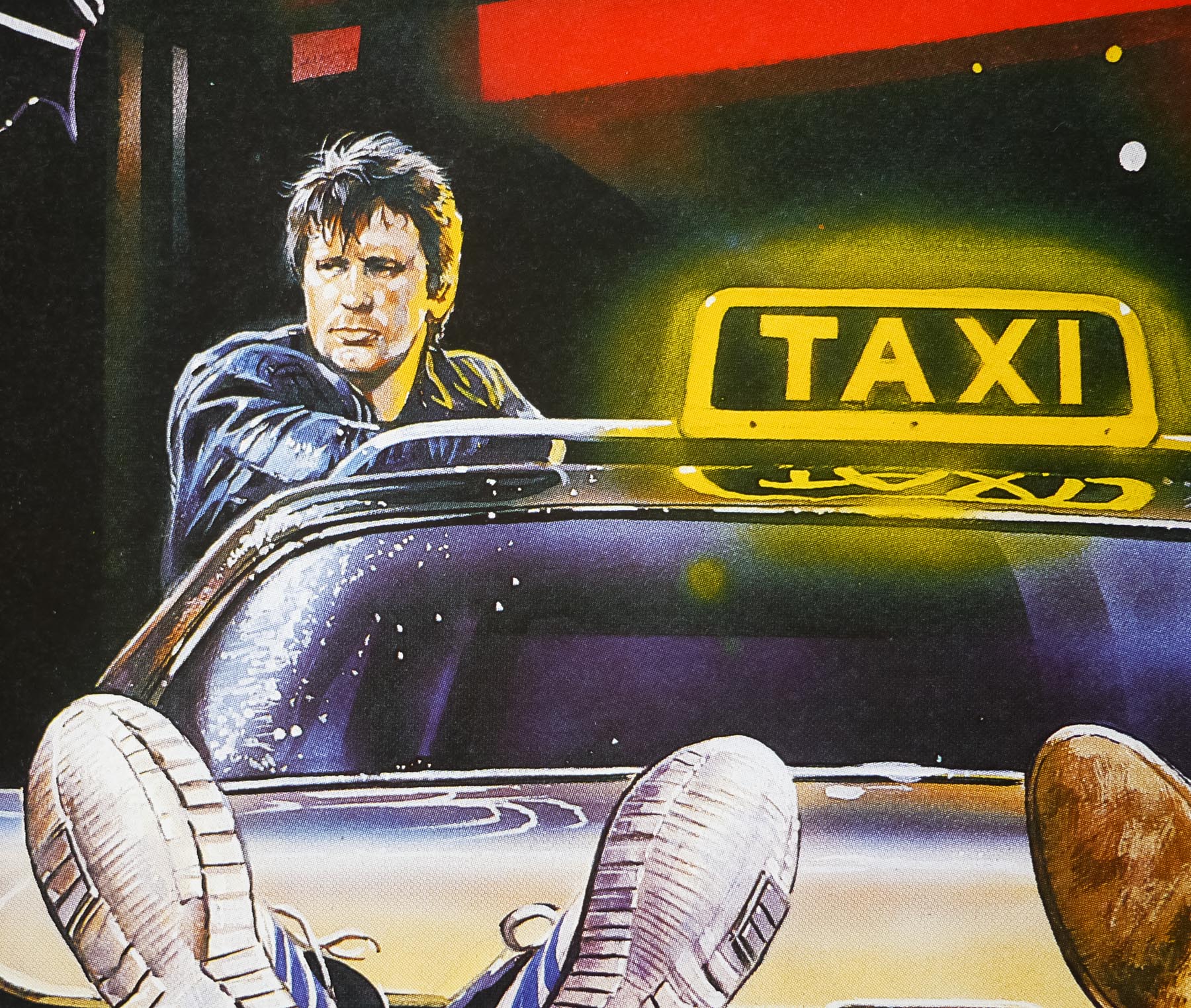
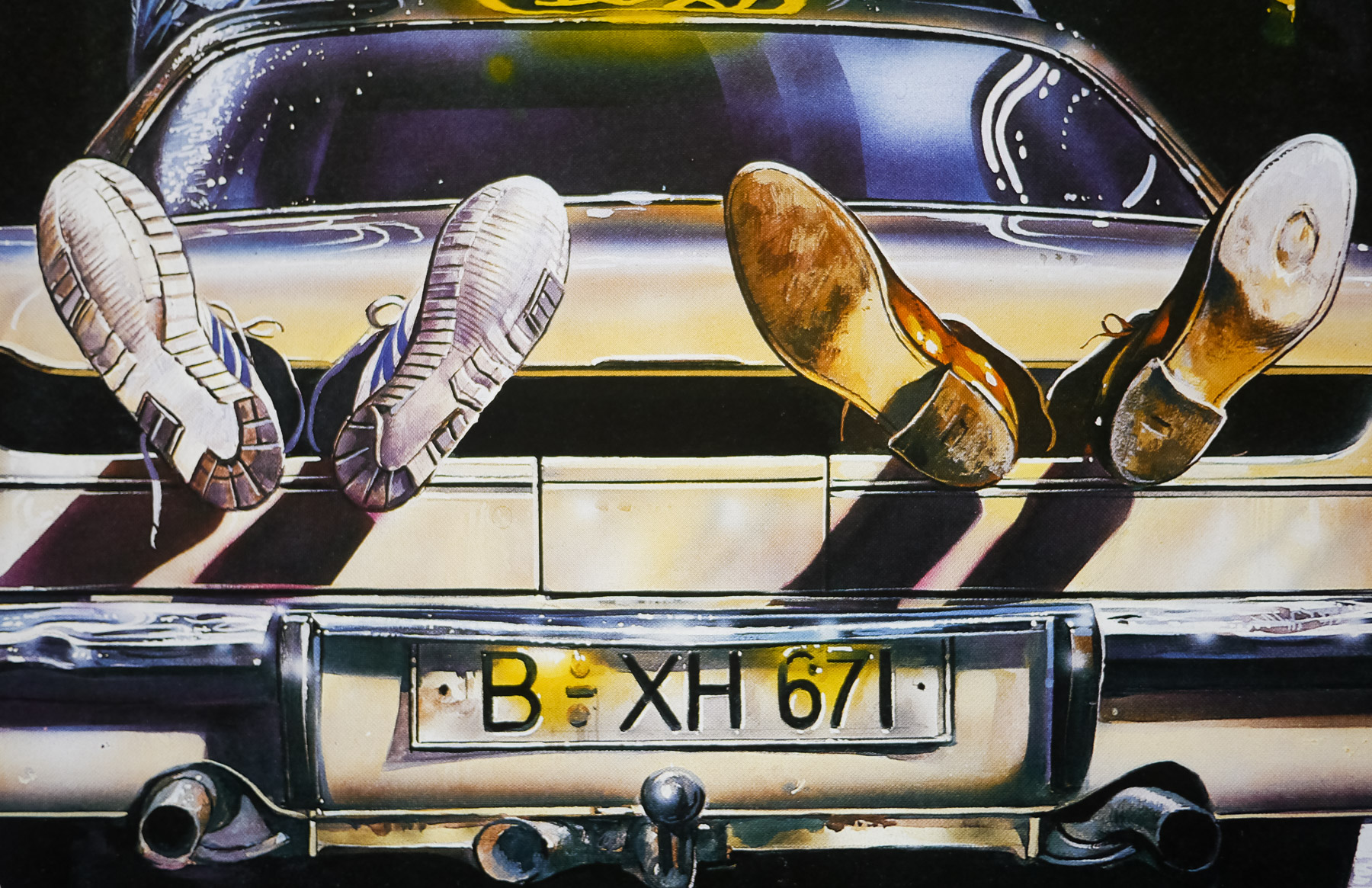
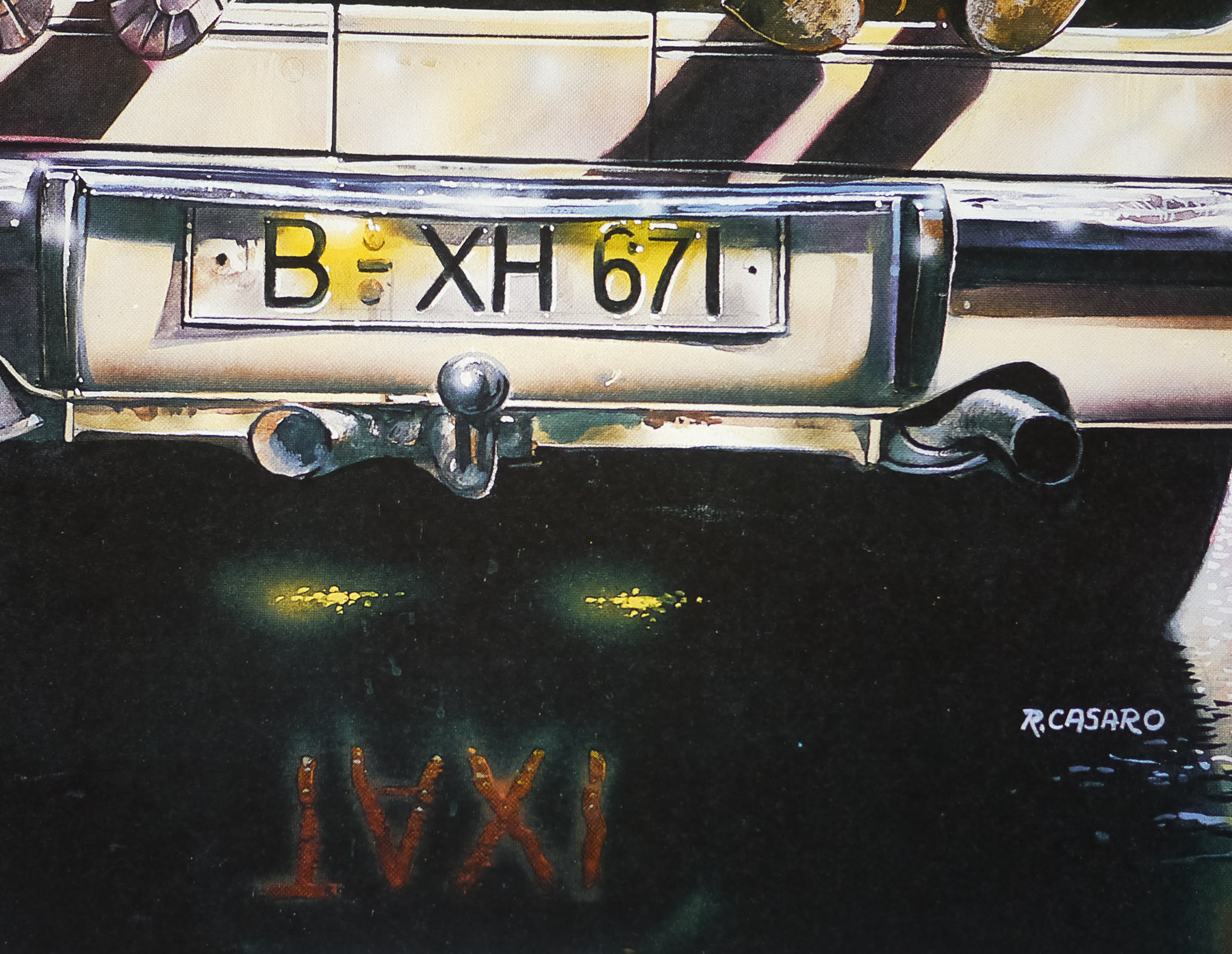
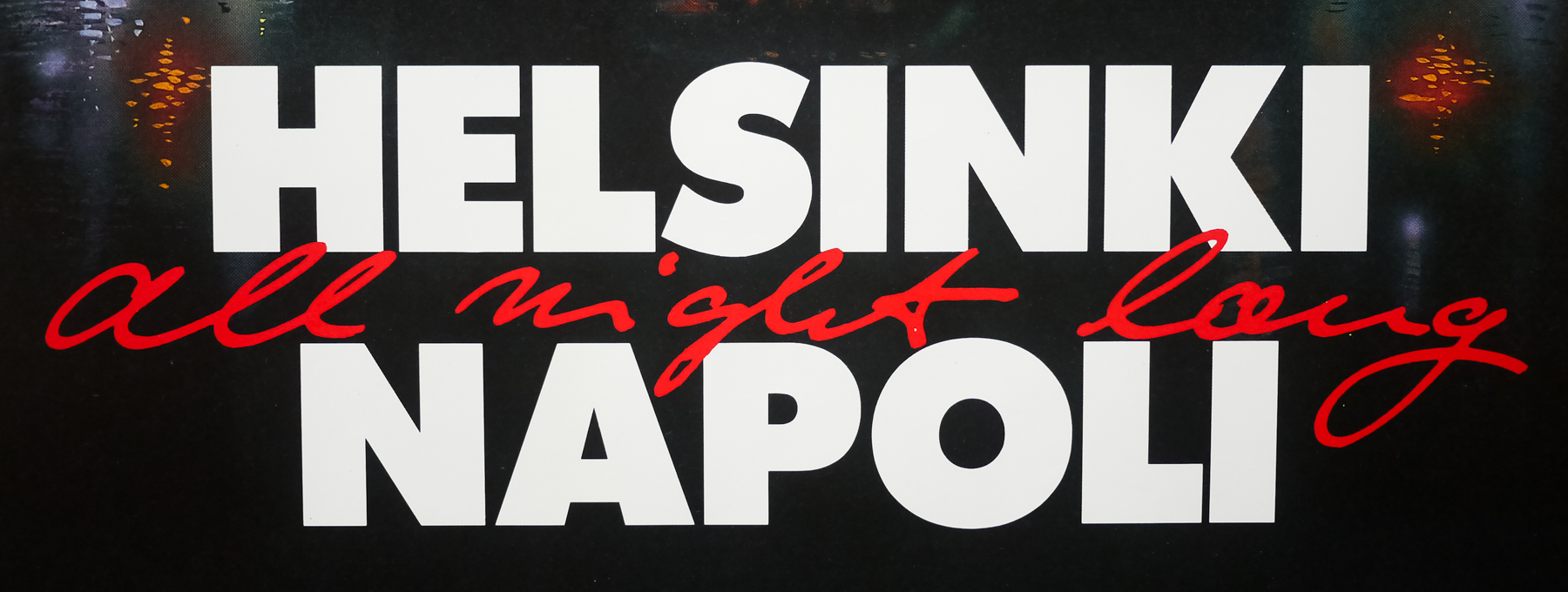
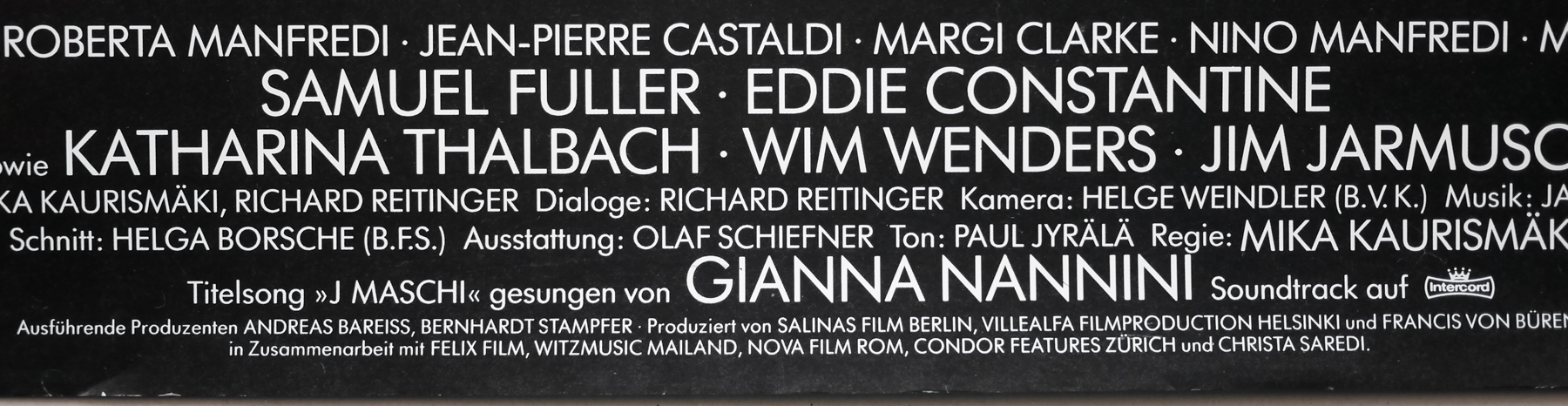
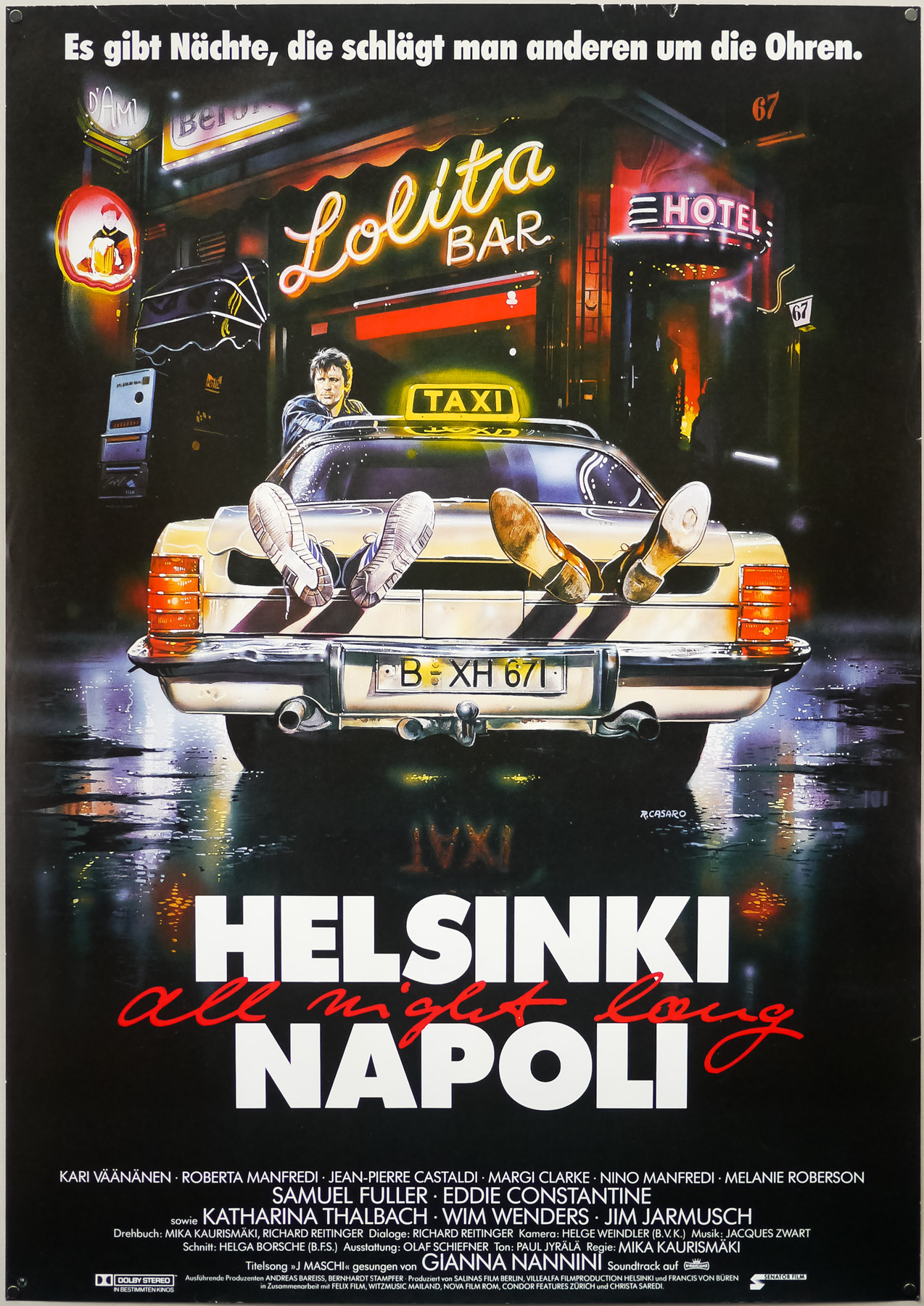
Great artwork by Renato Casaro on this German A1 poster for the release of Mika Kaurismäki (opens in a new tab)‘s (older brother of Aki) little-seen, comedy-thriller Helsinki Napoli All Night Long (opens in a new tab). A Finnish-German-Swiss production the film focuses on Alex (Kari Väänänen (opens in a new tab)) a Finnish taxi driver working in Berlin who is married to an Italian woman called Stella (Roberta Manfredi (opens in a new tab)). One night, he picks up a pair of French thugs who ask to hire his cab for the whole night. Unfortunately for Alex the pair are being chased by a pair of mobsters (Samuel Fuller (opens in a new tab) and Eddie Constantine (opens in a new tab)) and after the thugs are shot and killed, he is left with two bodies and a briefcase full of money. So begins the long distance trip alluded to in the title with plenty more violence and black comedy along the way.

One of my favourite artists, Renato Casaro (opens in a new tab) is an Italian with a prolific movie poster output that lasted over 35 years. He began his career in 1953, aged 19, at the famous Studio Favalli in Rome and would go on to design and paint posters for many of the biggest directors in the world. His skill at accurately portraying actors and his brilliant use of colour and composition saw him much in demand from studios and actors alike. His artwork has featured on posters used in multiple countries, including Japan, Germany, USA as well as in his native Italy.

Check out the incredible amount of work on his official website (opens in a new tab). In March 2014 I published an exclusive interview with Renato. See also the other posters I’ve collected by Renato Casaro.
Red Scorpion / one sheet / USA

15.07.15

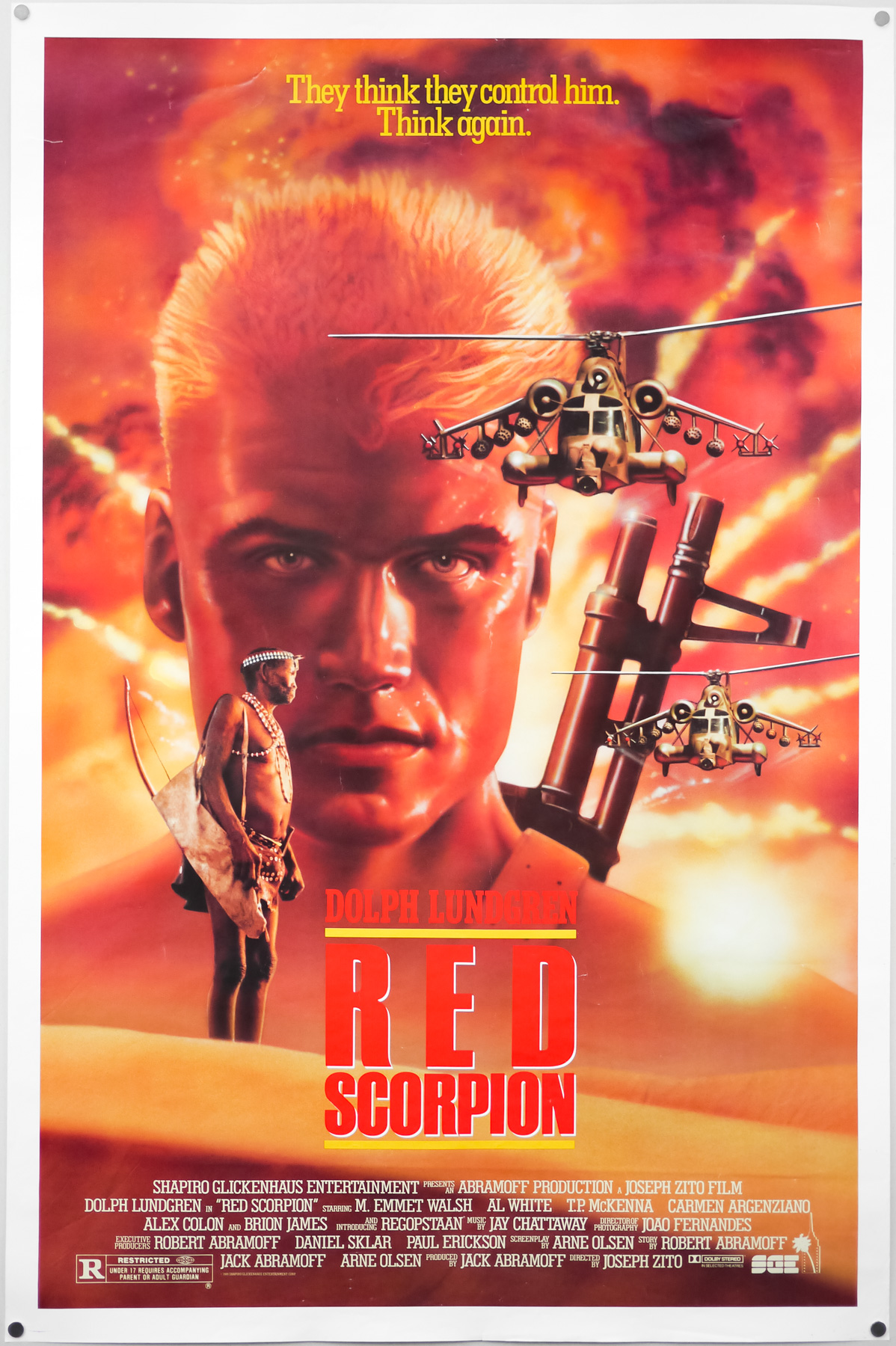
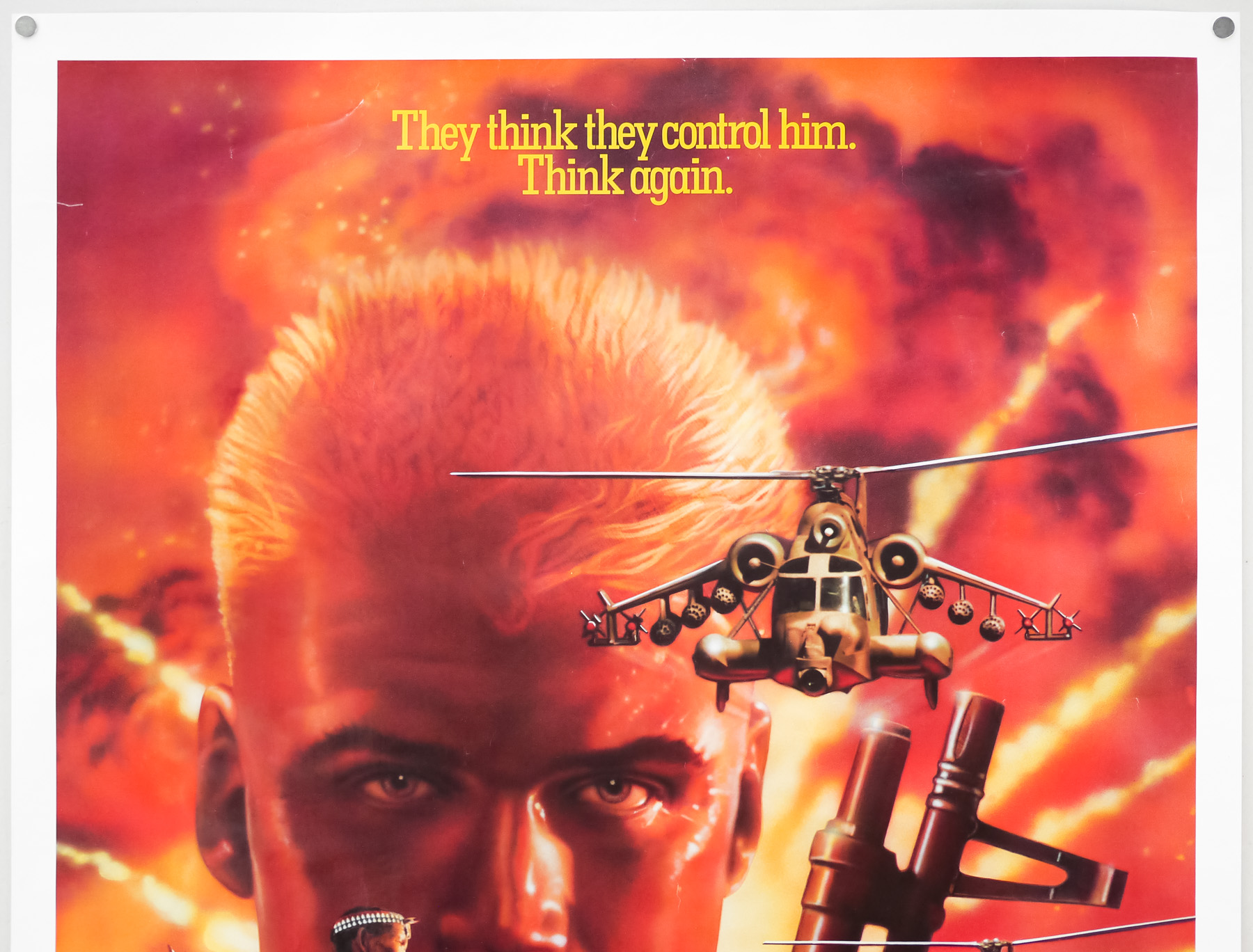
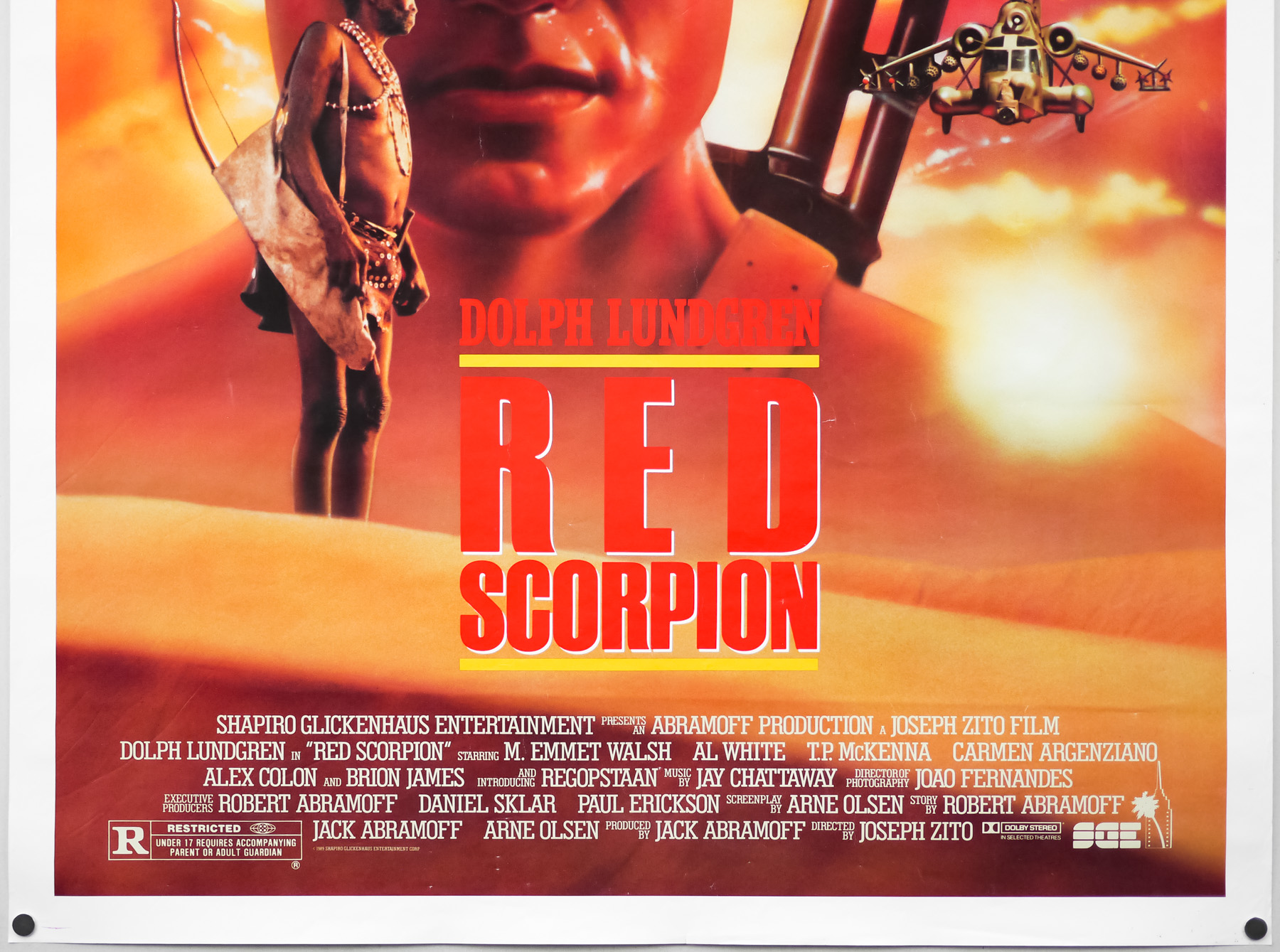
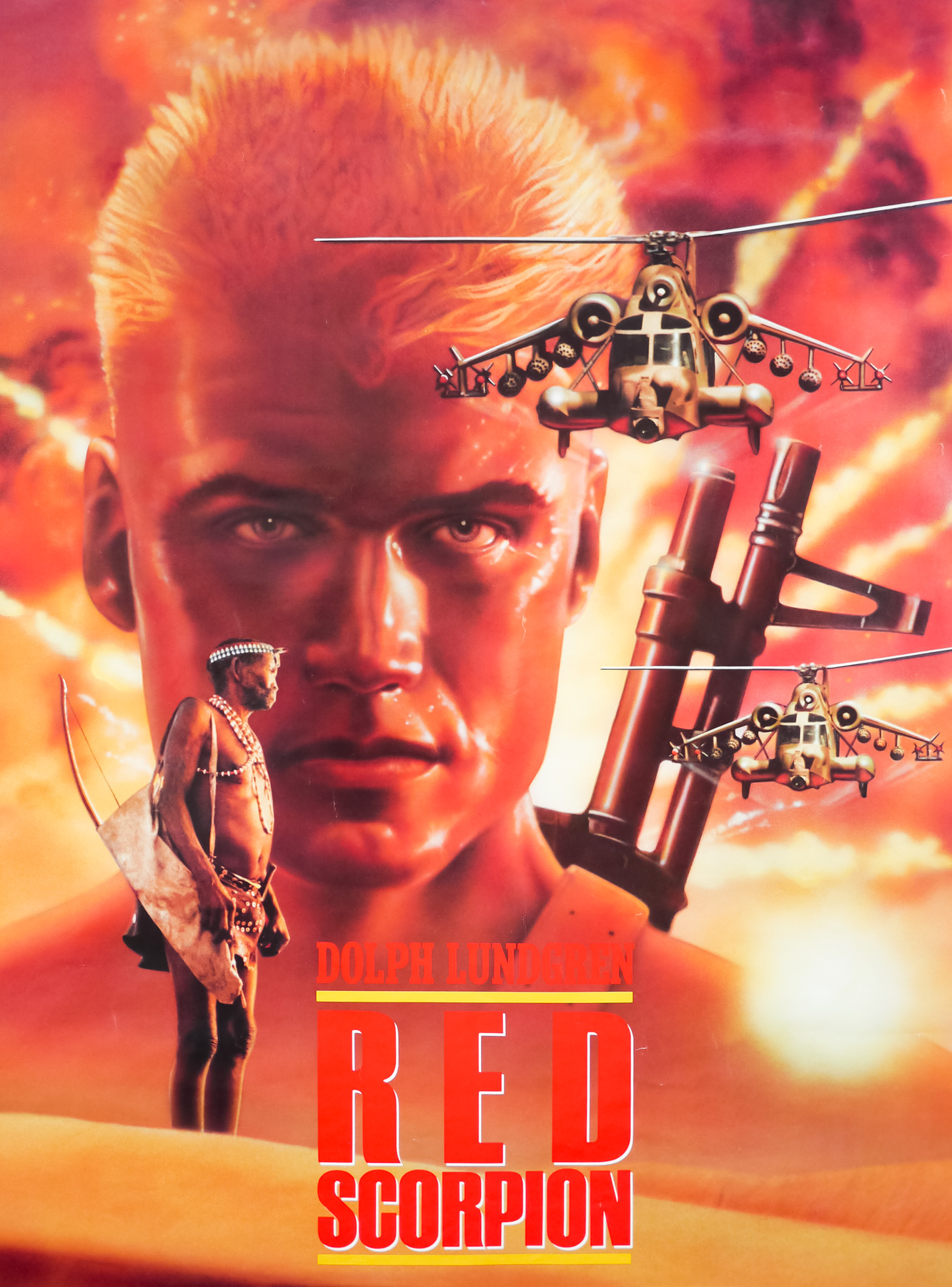
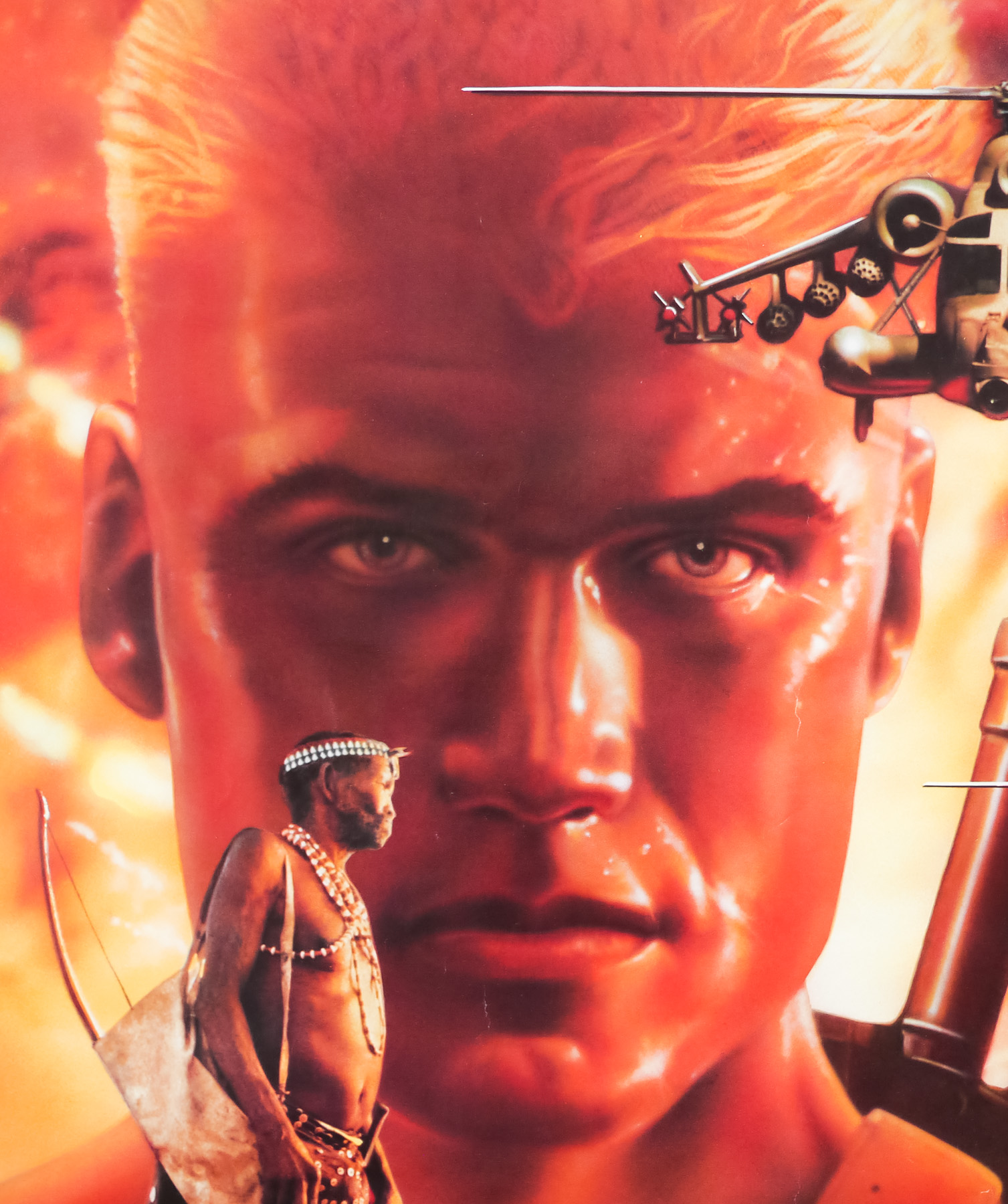
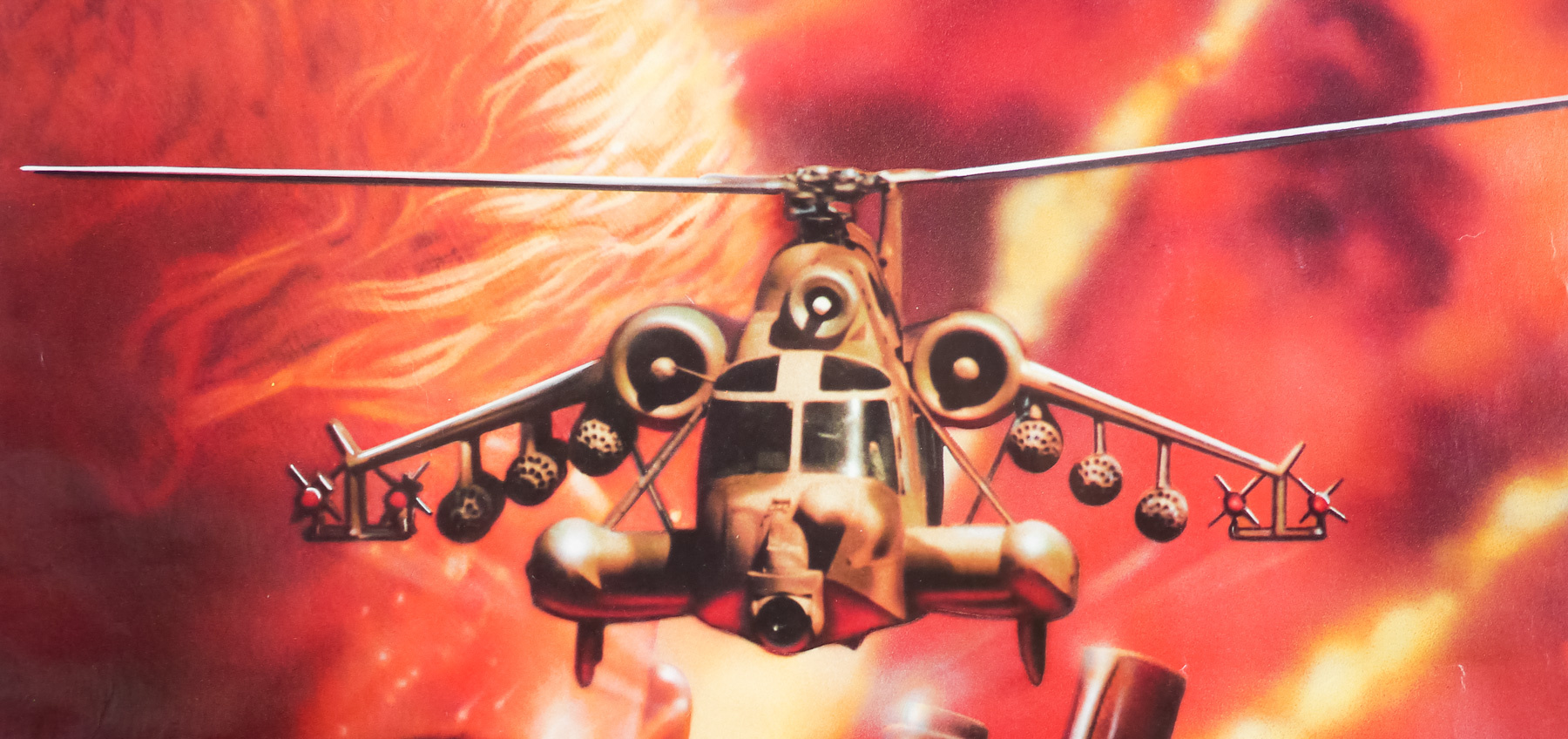
US one sheet poster for Red Scorpion (1988). Designed by Kaiser CreativeUS one sheet poster for Red Scorpion (1988). Designed by Kaiser Creative, image 2US one sheet poster for Red Scorpion (1988). Designed by Kaiser Creative, image 3US one sheet poster for Red Scorpion (1988). Designed by Kaiser Creative, image 4
Title
Red Scorpion
Year of Film
1988
Director
Joseph Zito
Starring
Dolph Lundgren, M. Emmet Walsh, Al White, T.P. McKenna, Carmen Argenziano, Alex Colon, Brion James, Ruben Nthodi
Origin of Film
South Africa | USA | Namibia
Genre(s) of Film
Action | Adventure
Type of Poster
One sheet
Origin of Poster
USA
Year of Poster
1988
Designer
Kaiser Creative
Artist
Unknown
Size (inches)
27 1/16" x 40 7/8"
SS or DS
SS
Tagline
They think they control him. Think again.

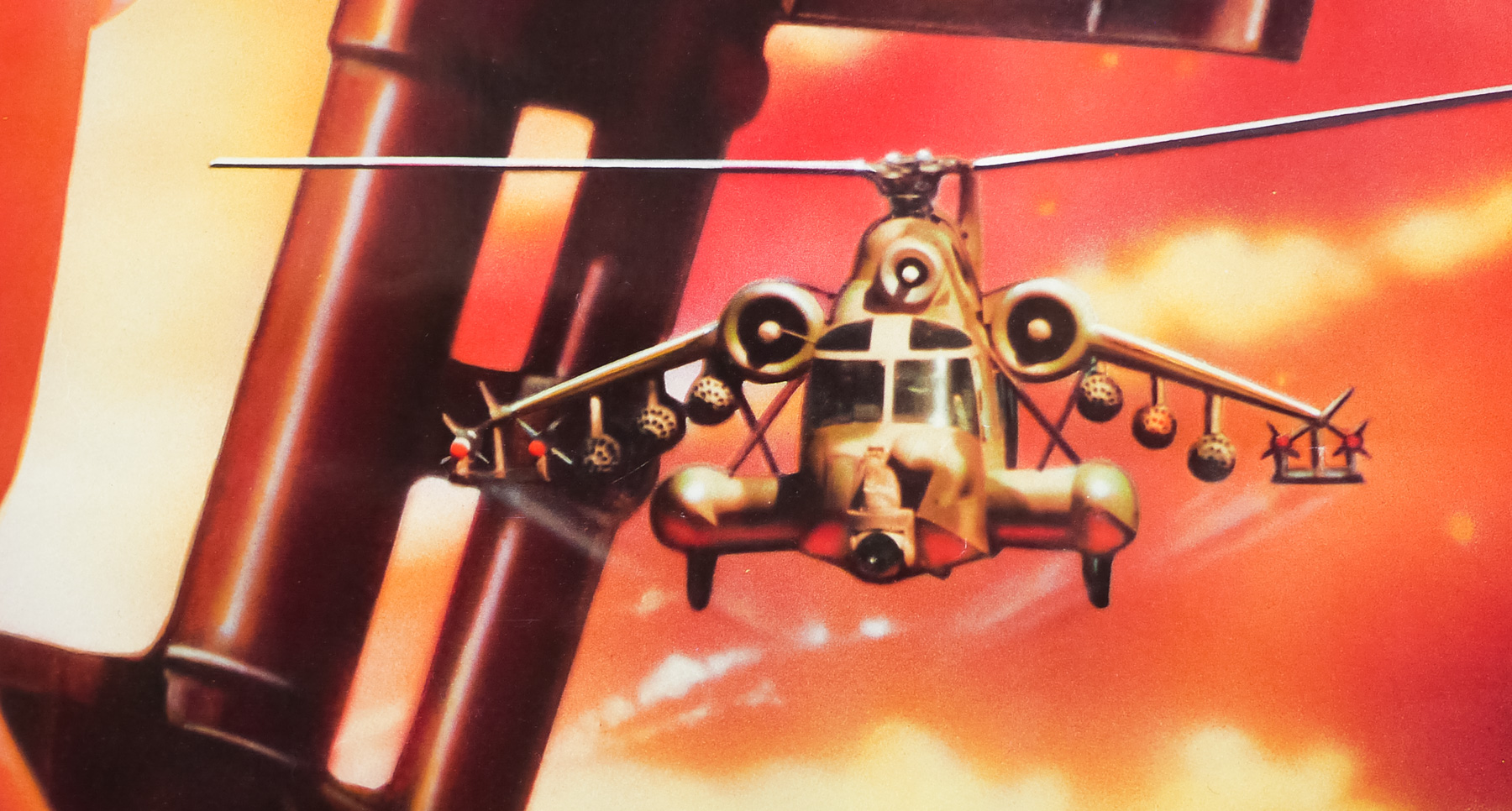
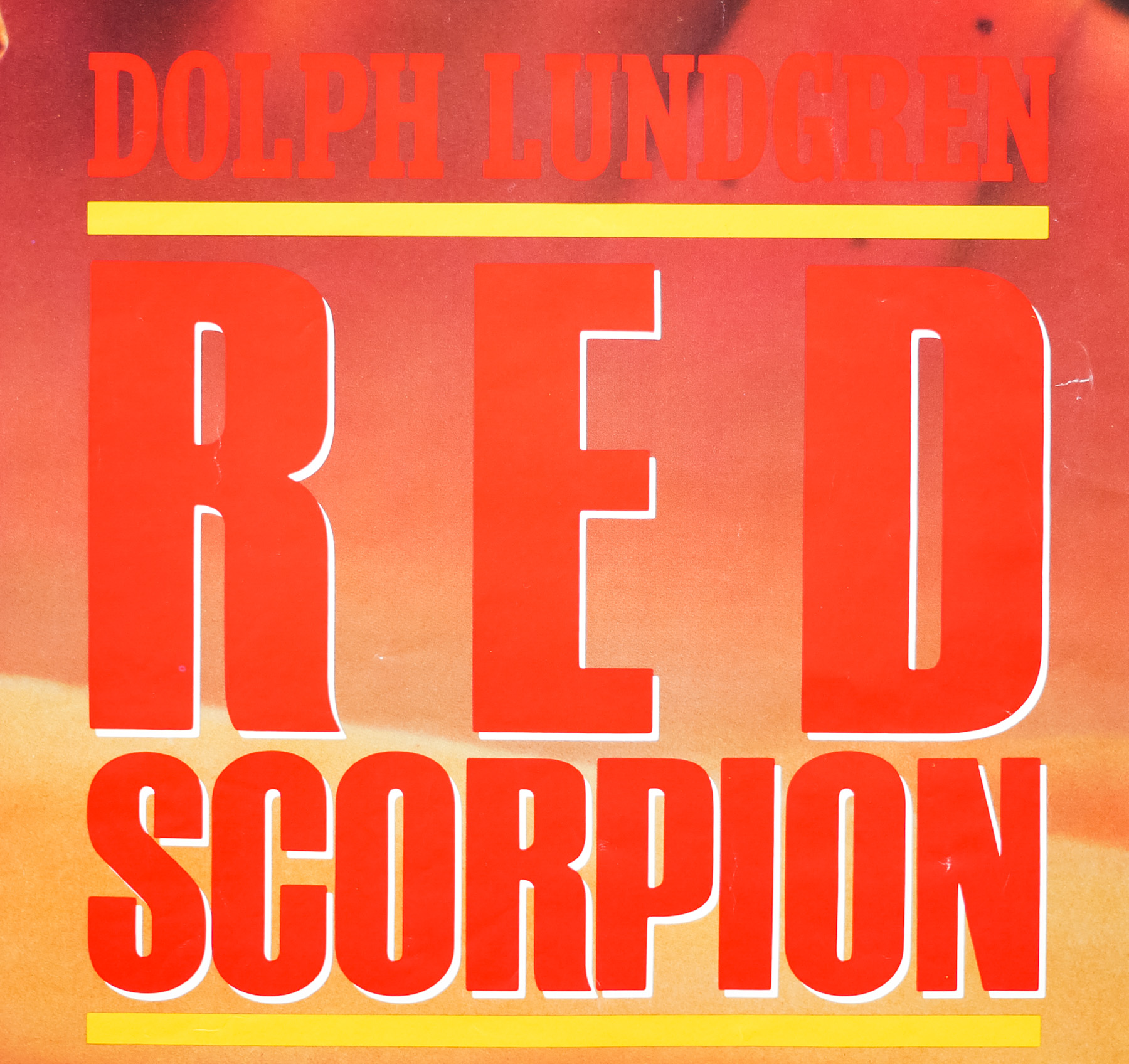
Directed by Joseph Zito (opens in a new tab), a man with only 9 films under his belt, including a couple of Chuck Norris titles and the notorious slasher The Prowler, Red Scorpion (opens in a new tab) was the second film to be headlined by the Swedish action star Dolph Lundgren (opens in a new tab). After earning degrees in chemical engineering, Lundgren won a couple of European championships in the martial art of Karate and eventually landed a job as a bodyguard for the singer and actress Grace Jones (opens in a new tab). The pair soon began a relationship and when he accompanied Jones during the filming of A View to a Kill she suggested he try out for a minor role in the film. This appearance helped him land the memorable role of the Russian boxer Ivan Drago (opens in a new tab) in Rocky IV and then in 1987 he played He-Man in the ill-advised live-action film Masters of the Universe (opens in a new tab). Since then he has featured in over 60 films, mostly in the action genre.

Red Scorpion was produced by the disgraced former American lobbyist Jack Abramoff (opens in a new tab) who was sentenced to jail in 2006 for mail fraud, conspiracy to bribe public officials, and tax evasion, all related to his involvement in lobbying for American Indian tribes and casinos. Before his career as a lobbyist, Abramoff spent 10 years in Hollywood as a producer and developed the screenplay for Red Scorpion along with his brother Robert (opens in a new tab), a more prolific producer who is still working in the industry today. Red Scorpion was filmed in Swaziland and the production became embroiled in the South African apartheid situation at the time, allegedly receiving some funding from the government as part of efforts to undermine the movement. The film suffered multiple delays and ultimately ended up about 8 million dollars over budget.

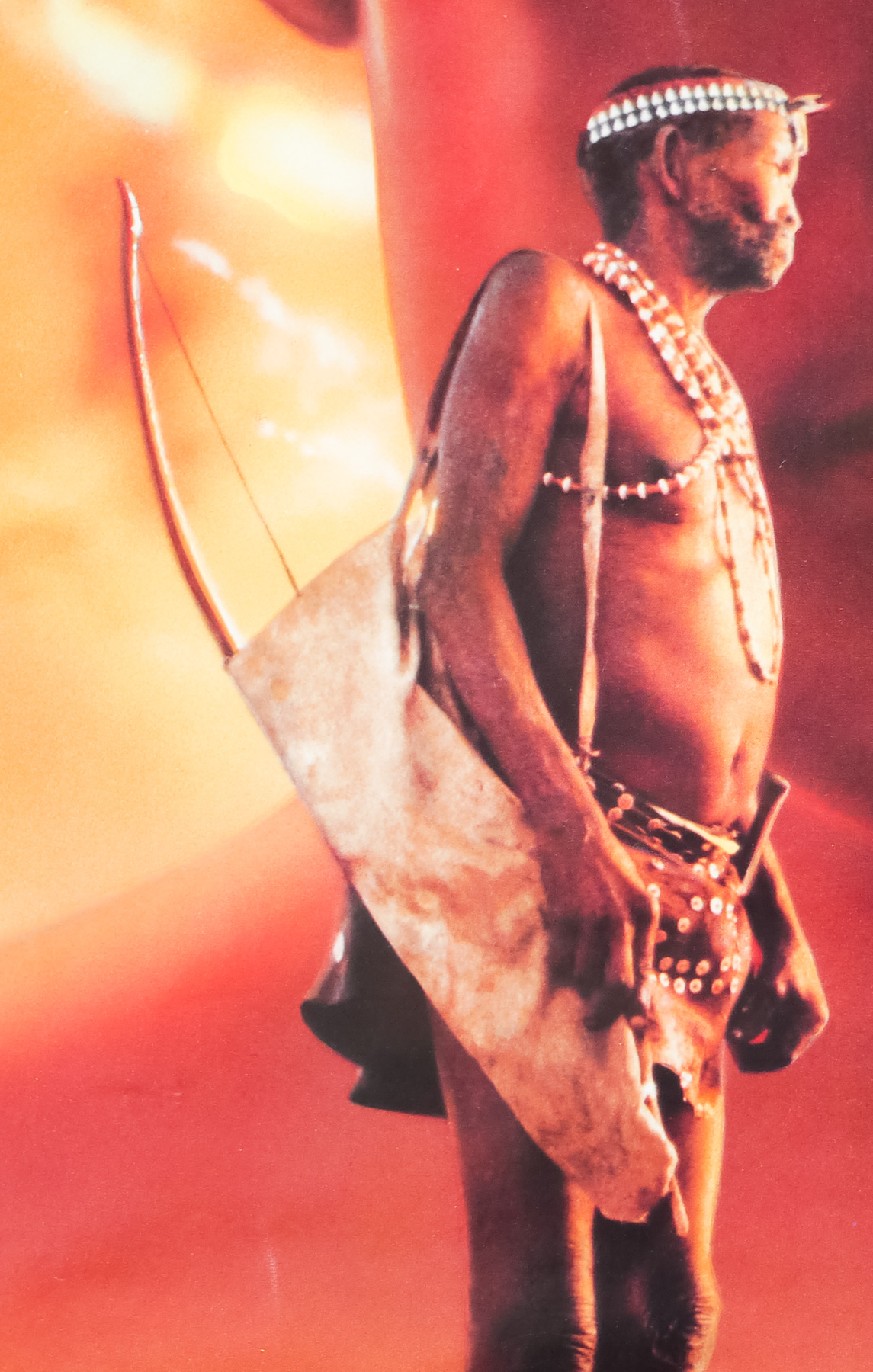
Dolph appears as Nikolai Petrovitch Radchenko, a Soviet Spetsnaz (opens in a new tab) agent who is sent to a fictional African country to assassinate the leader of a large anti-communist rebel group. In order to get near to his target he gets involved in a bar brawl and is arrested and placed in a cell with a rebel commander. After gaining the man’s trust, the pair escape and end up at the rebel’s main hideout. He is met with distrust by most of the group and his attempt to assassinate the leader during the night results in his capture. After he ends up back in Soviet hands he is tortured and disgraced by his commanders, but manages to escape from an interrogation chamber and ends up in the desert where he is rescued by native bushmen. He learns about their customs and way of life, discovering that the peaceful tribe continues to be attacked by the Soviet forces. Radchenko is later given a ceremonial brand in the shape of a scorpion. Eventually he joins the rebel forces for an attack on the base where the corrupt Soviet commanders are based.

This poster was designed by the Los Angeles-based Kaiser Creative who worked on a number of film posters over the years. IMPAwards has a gallery of many of their posters (opens in a new tab). I’ve been unable to determine who is responsible for the artwork so if anyone has any ideas please get in touch.

Cannonball / B2 / Japan

13.07.15

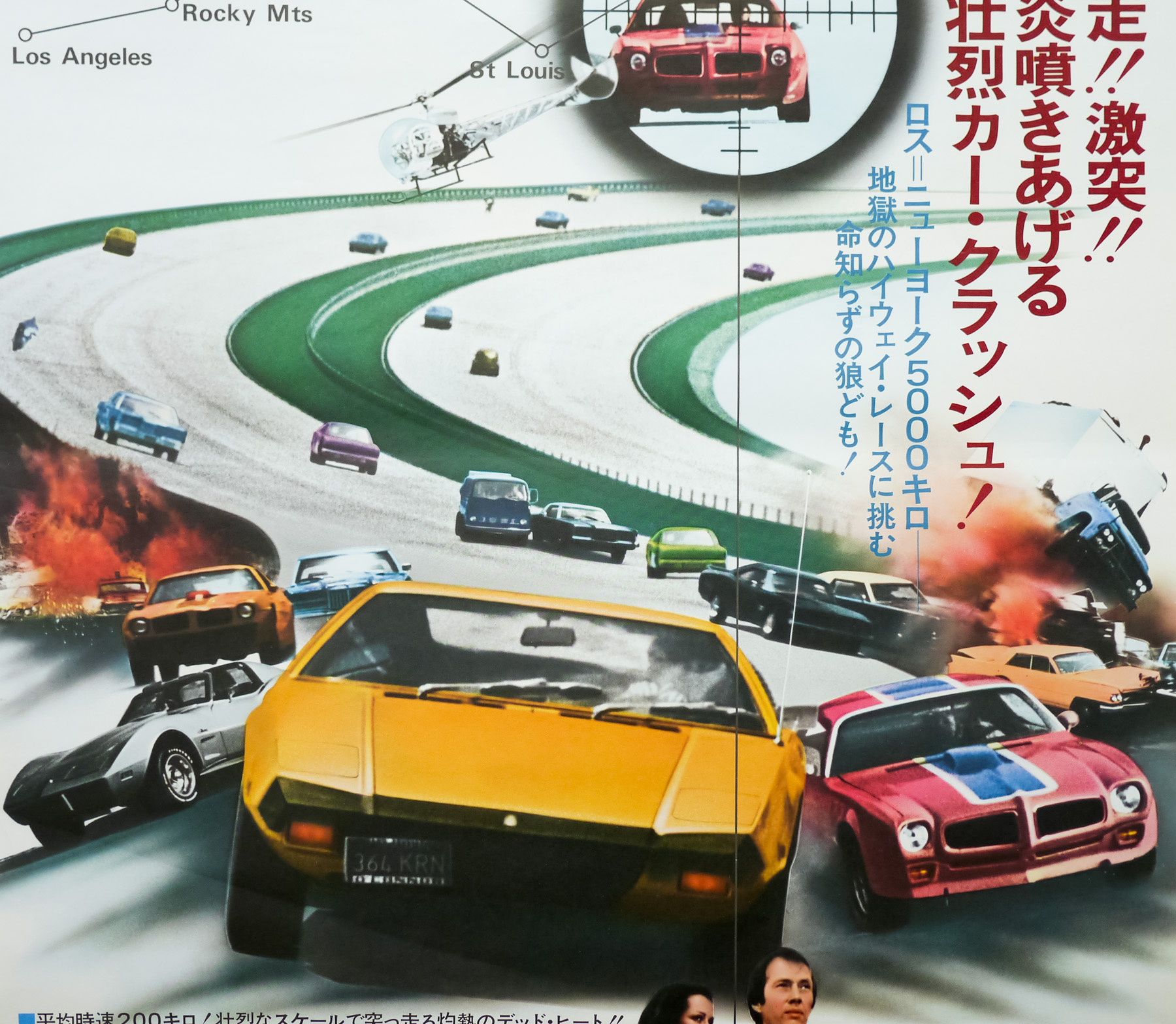
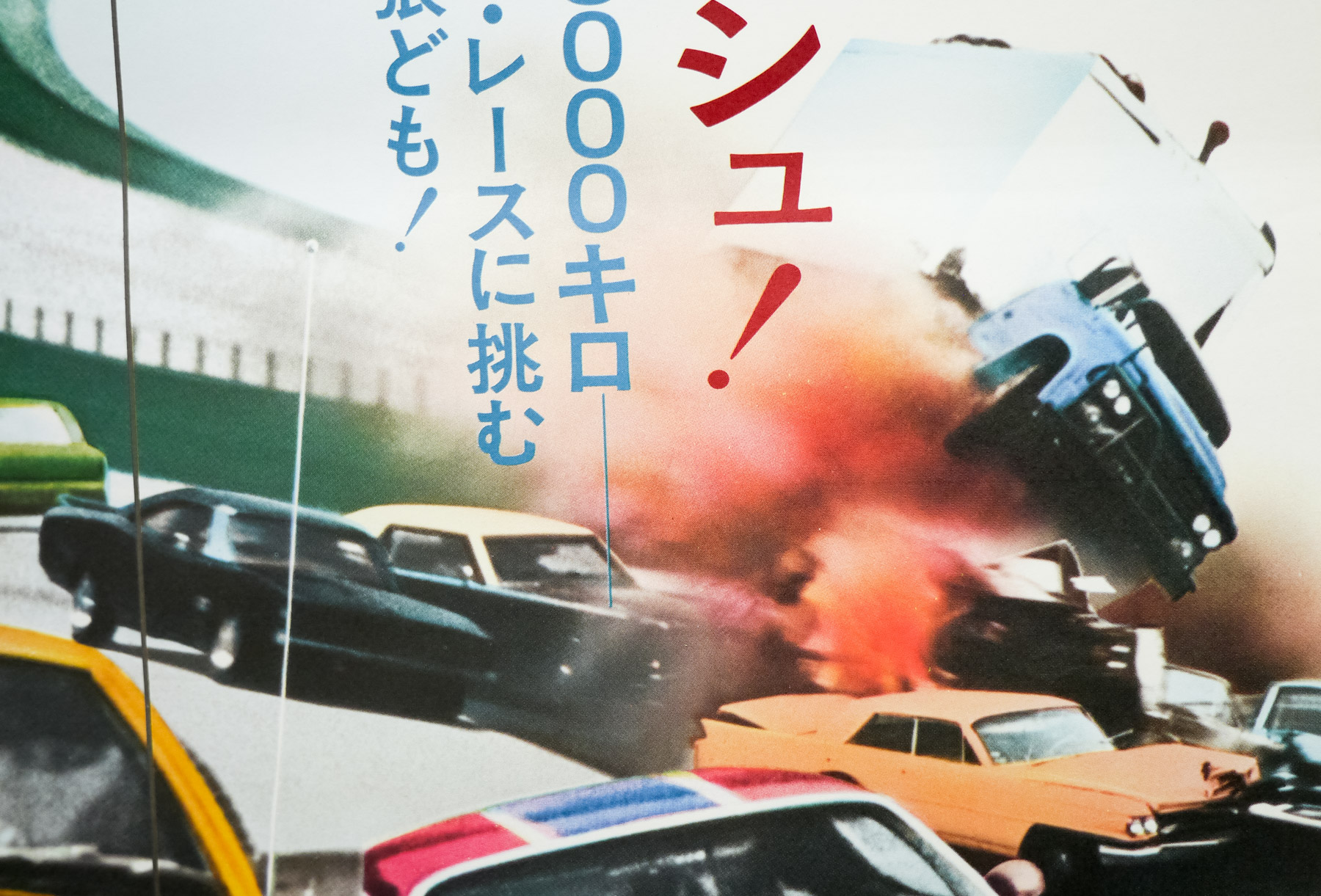
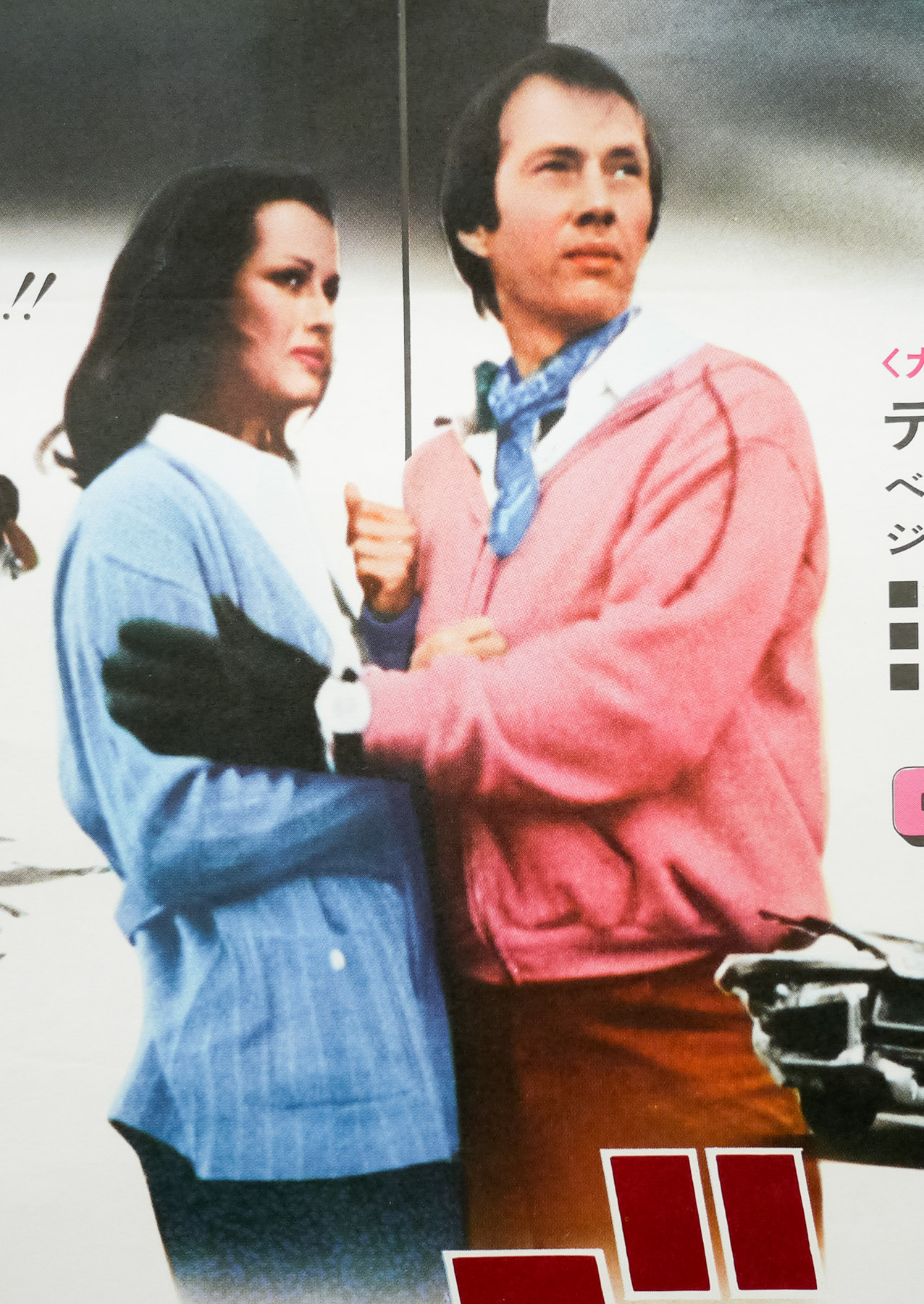
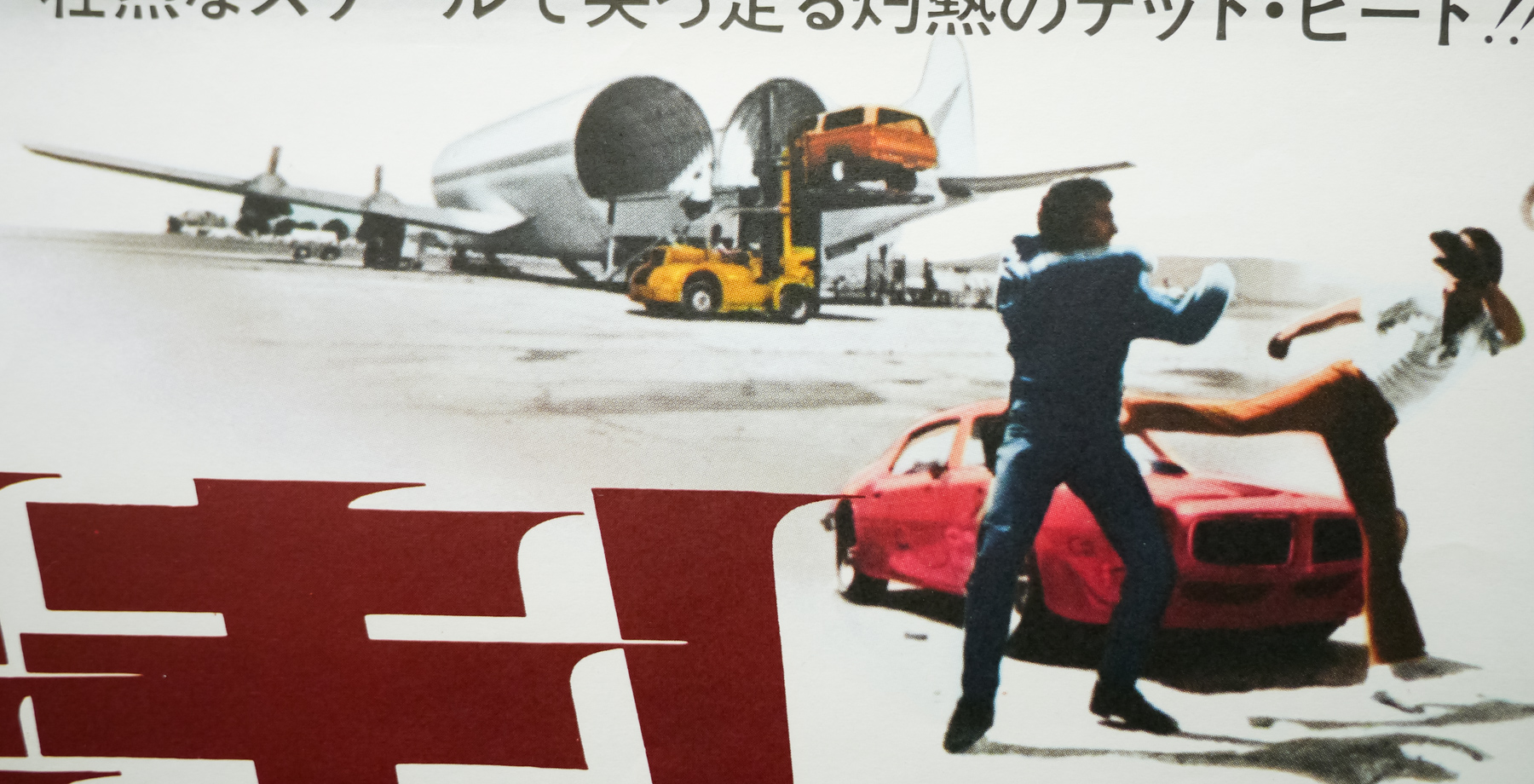
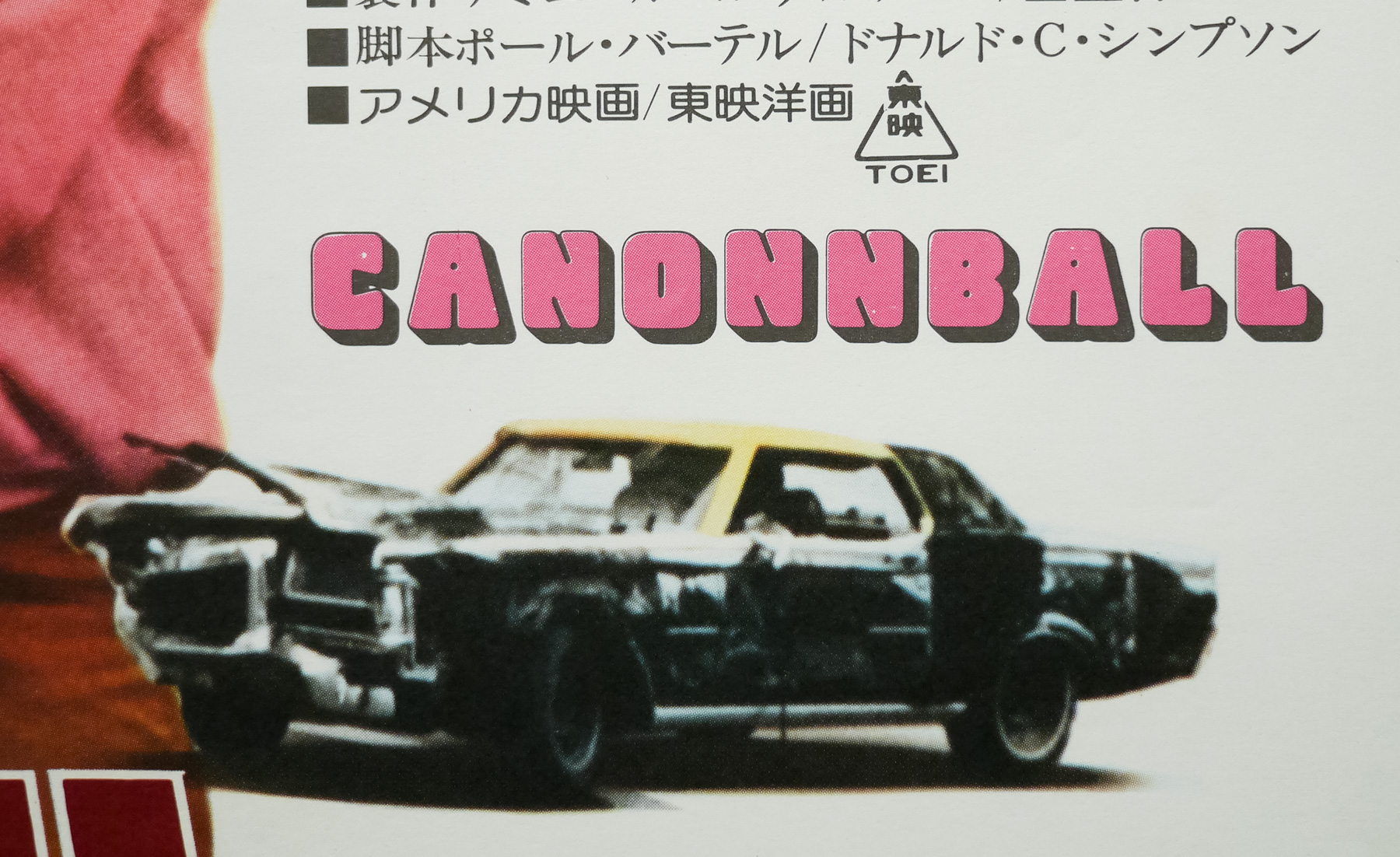
Japanese B2 poster (1977) for Cannonball (1976)Japanese B2 poster (1977) for Cannonball (1976), image 2Japanese B2 poster (1977) for Cannonball (1976), image 3Japanese B2 poster (1977) for Cannonball (1976), image 4Japanese B2 poster (1977) for Cannonball (1976), image 5
Title
Cannonball
AKA
Carquake (UK) | Cannonball! (alt. title)
Year of Film
1976
Director
Paul Bartel
Starring
David Carradine, Bill McKinney, Veronica Hamel, Gerrit Graham, Robert Carradine, Belinda Balaski, Judy Canova, Archie Hahn, Carl Gottlieb, Dick Miller
Origin of Film
USA | Hong Kong
Genre(s) of Film
Action | Comedy | Crime | Drama | Thriller
Type of Poster
B2
Origin of Poster
Japan
Year of Poster
1977
Designer
Unknown
Size (inches)
20 1/4" x 28 13/16"
SS or DS
SS

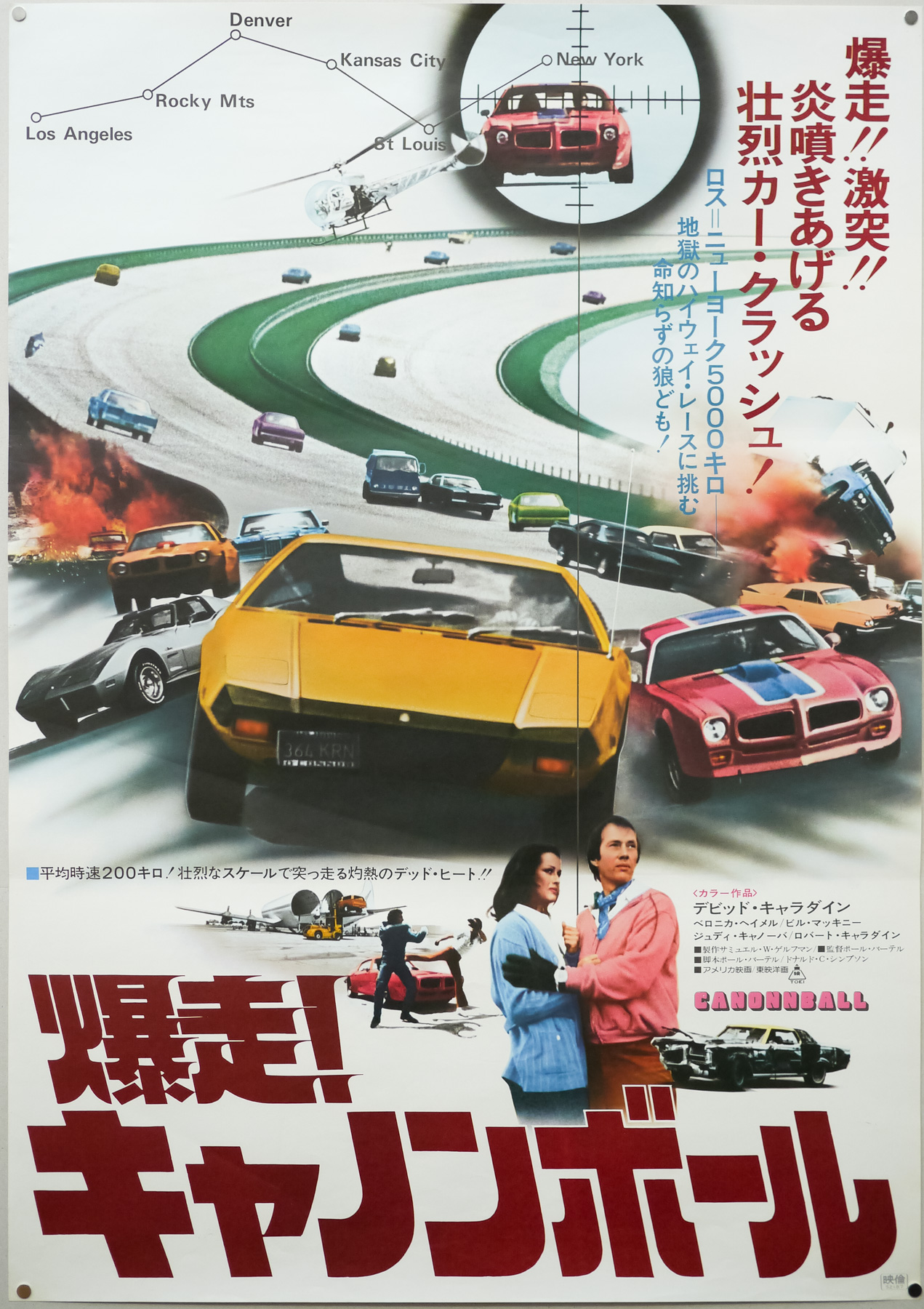
Paul Bartel (opens in a new tab), the late actor/director who was at the helm of the cult b-movie Death Race 2000 (released a year earlier), stuck with the cross-country car chase theme with this 1976 flick Cannonball (opens in a new tab), though he removed most of the gore that gave the former film its notoriety. The film and title are based on the exploits of Erwin G. “Cannon Ball” Baker (opens in a new tab), a legendary bike and car racer who made over 140 cross-country speed runs during his career and put his name to the Sea to Shining Sea Memorial Trophy Dash (opens in a new tab), an illegal cross-country race that was run five times during the 1970s. This was the first in a series of films that was based on the idea of illegal long-distance races, with The Gumball Rally (opens in a new tab) seeing release the same year, and the more successful Cannonball Run (opens in a new tab) and its sequel being released at the start of the 1980s.

Whilst perhaps not as star-studded as the later films, Cannonball still has a large ensemble cast with several cameos that are both credited and un-credited, including Martin Scorsese, Sylvester Stallone, Don Simpson and Roger Corman. David Carradine (opens in a new tab) appears as Coy ‘Cannonball’ Buckman, a race driver who has recently been released from jail where he was sent for killing someone whilst driving drunk. He decides to enter the Trans-America Grand Prix, an illegal road race that travels between Los Angeles and New York City. The racing team Modern Motors has promised a contract to either Coy or his arch-rival Cade Redman (Bill McKinney (opens in a new tab)) so he is determined to win.

Because the race crosses state lines Coy will be in violation of his parole conditions, his parole officer (Veronica Hamel (opens in a new tab)) attempts to stop him and ends up being forced to come along for the ride. Two people who have offered to pay his race expenses are also passengers in his Dodge Charger and there are several other racers in the competition, including a surfer dude played by David’s brother Robert (opens in a new tab) and his girlfriend (played by Belinda Balaski (opens in a new tab)). The race soon descends into a violent destruction derby with many of the competitors meeting grizzly ends. Coy will be challenged in more ways than one and the first to cross the finish line isn’t who you might think. Later films in the genre would tone down the violence and deaths considerably.

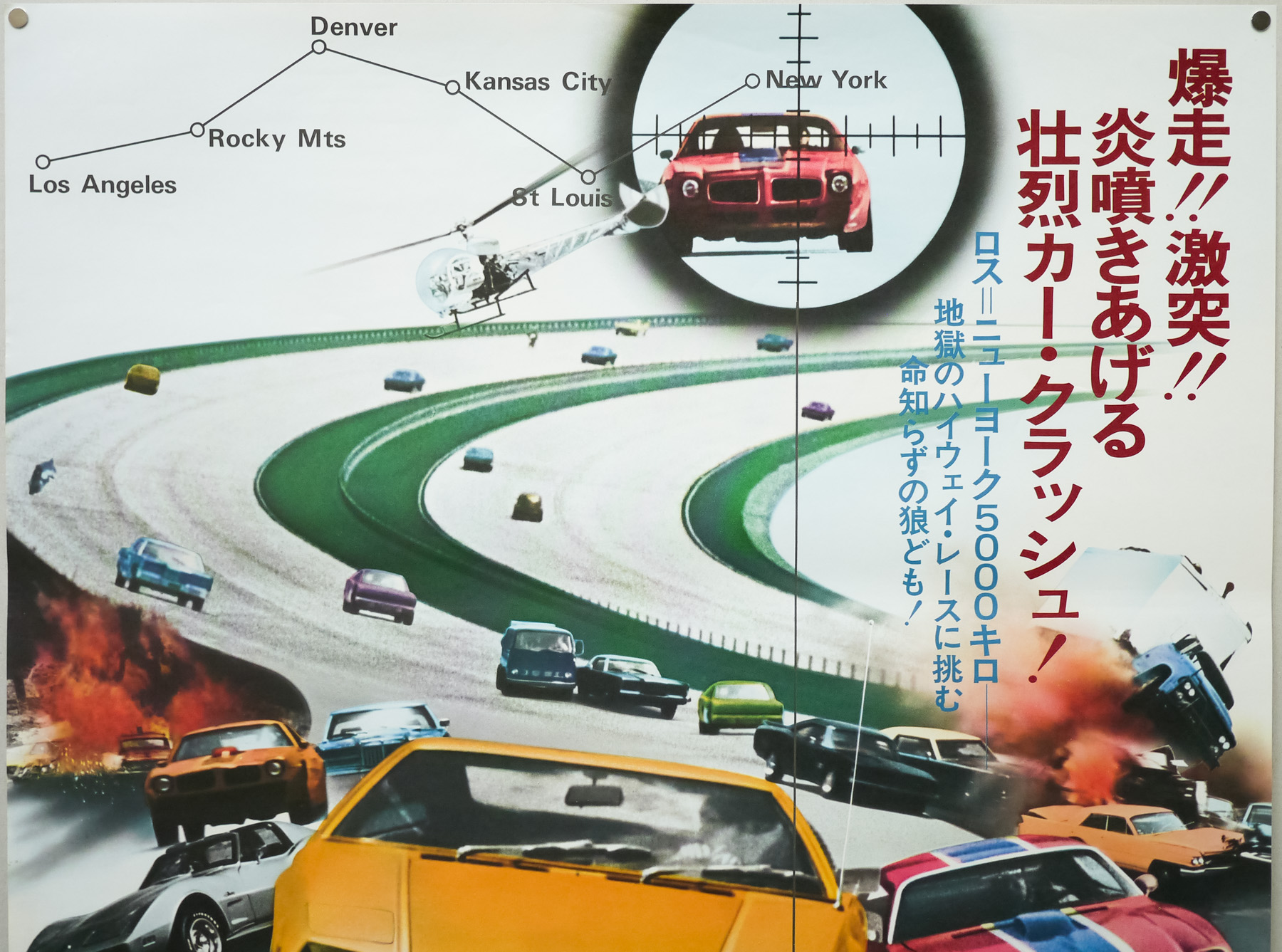
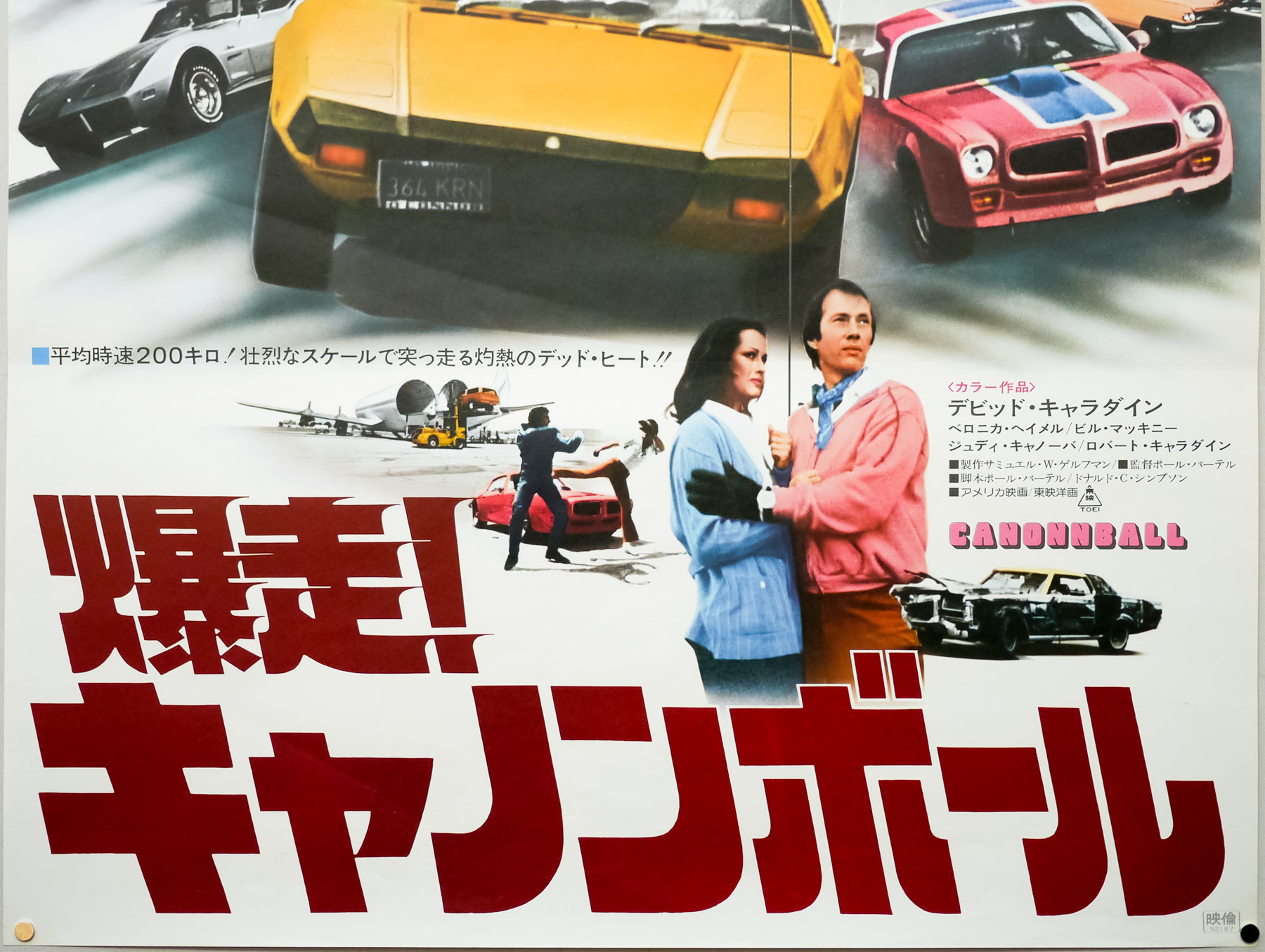
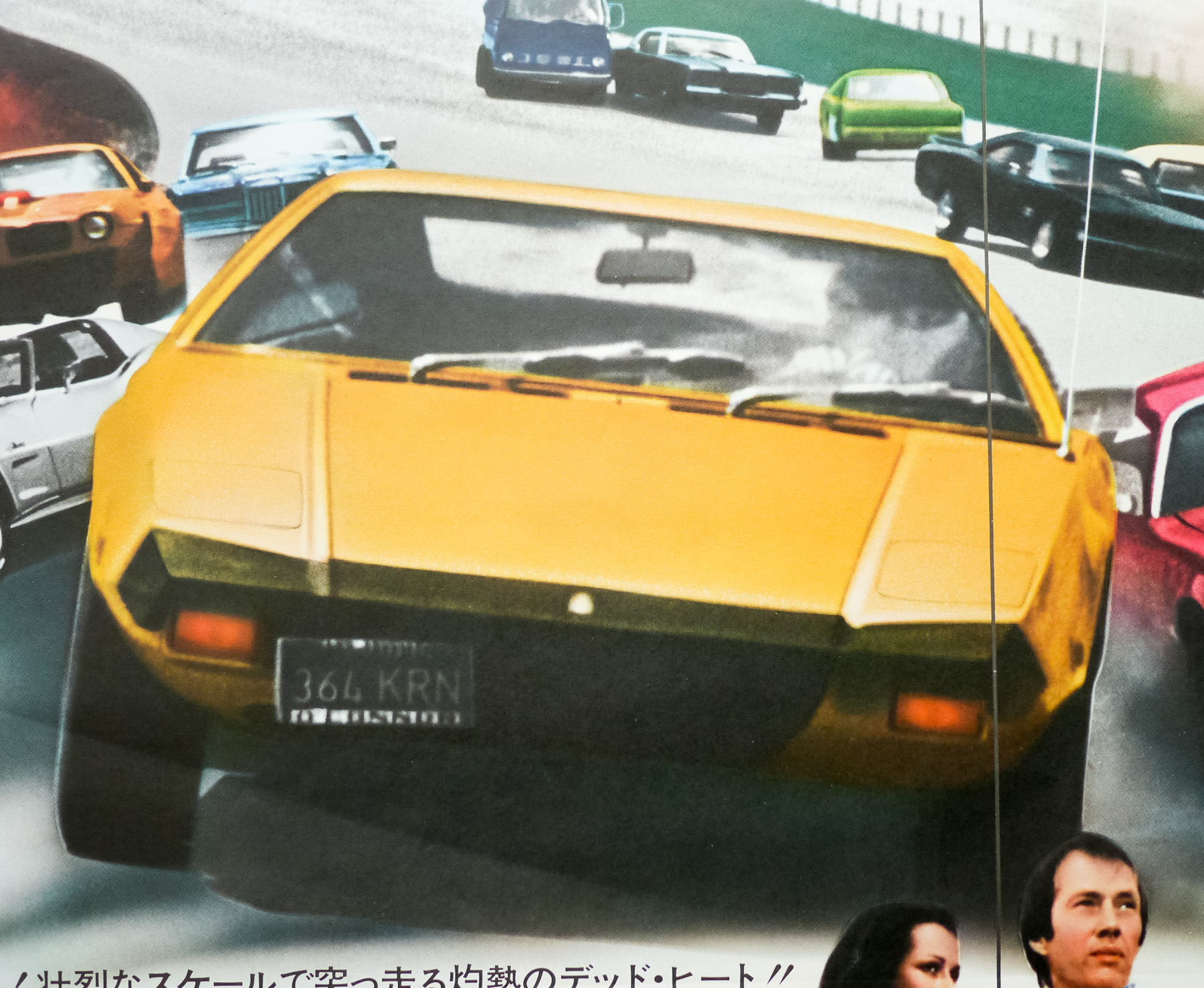
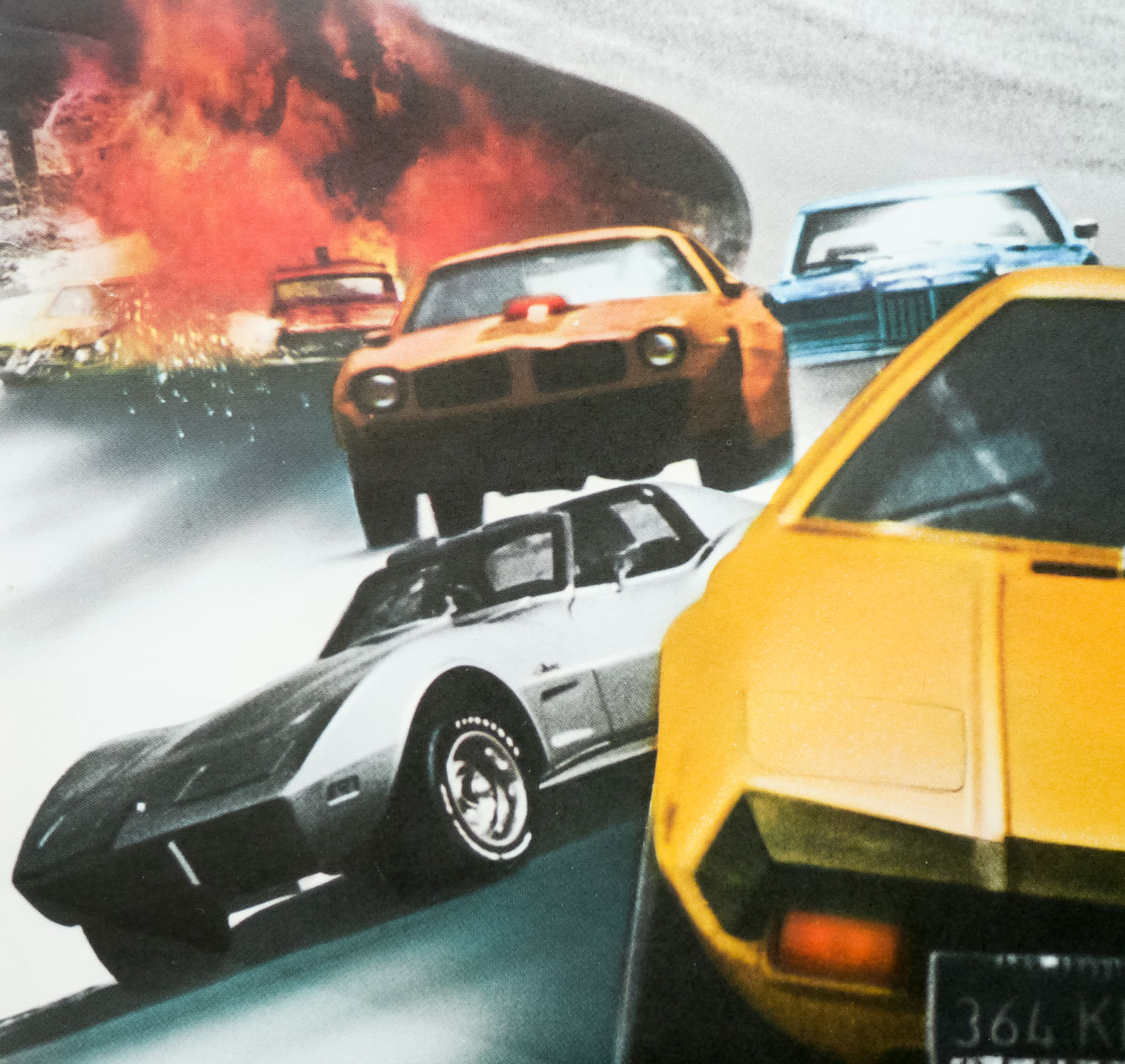
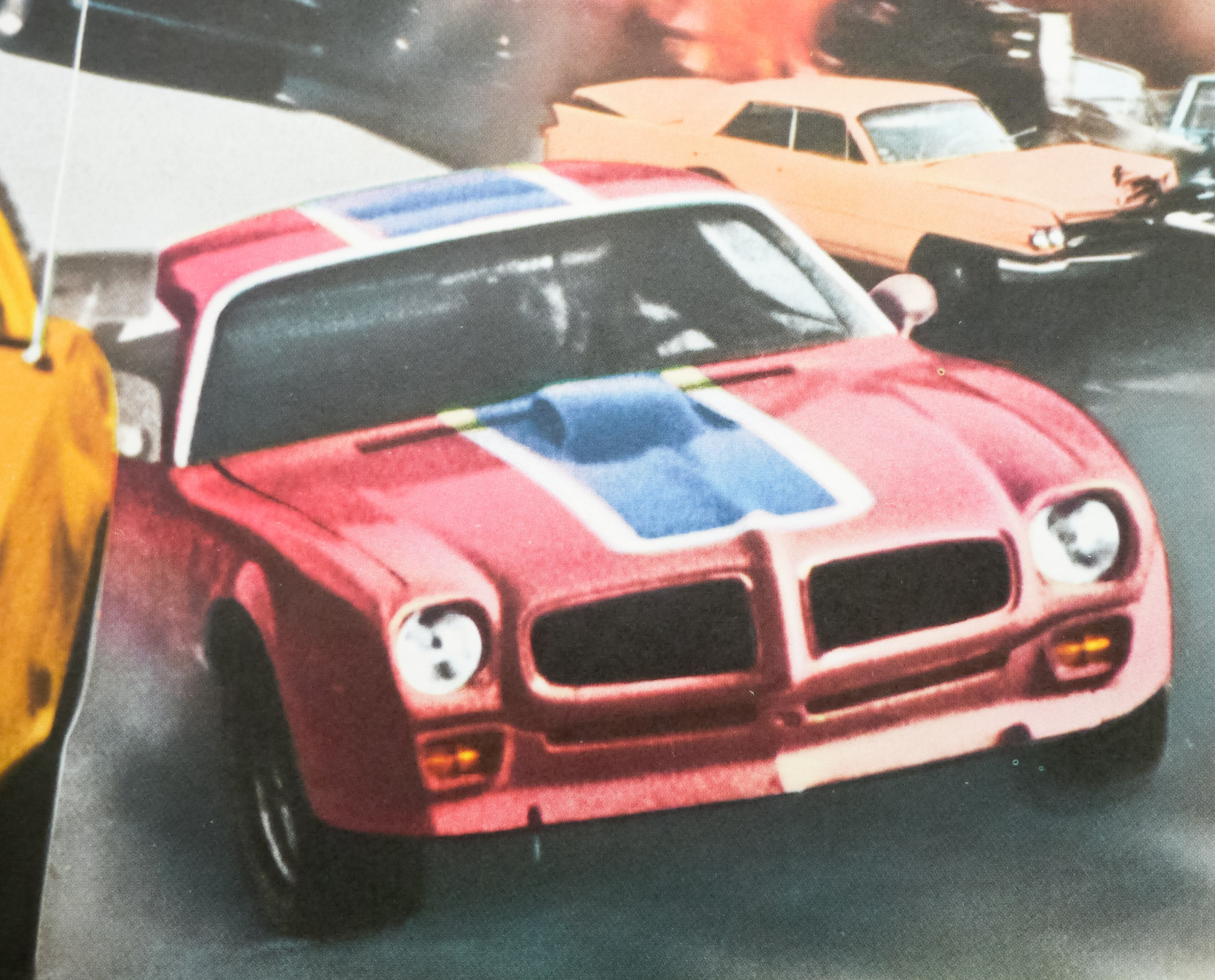
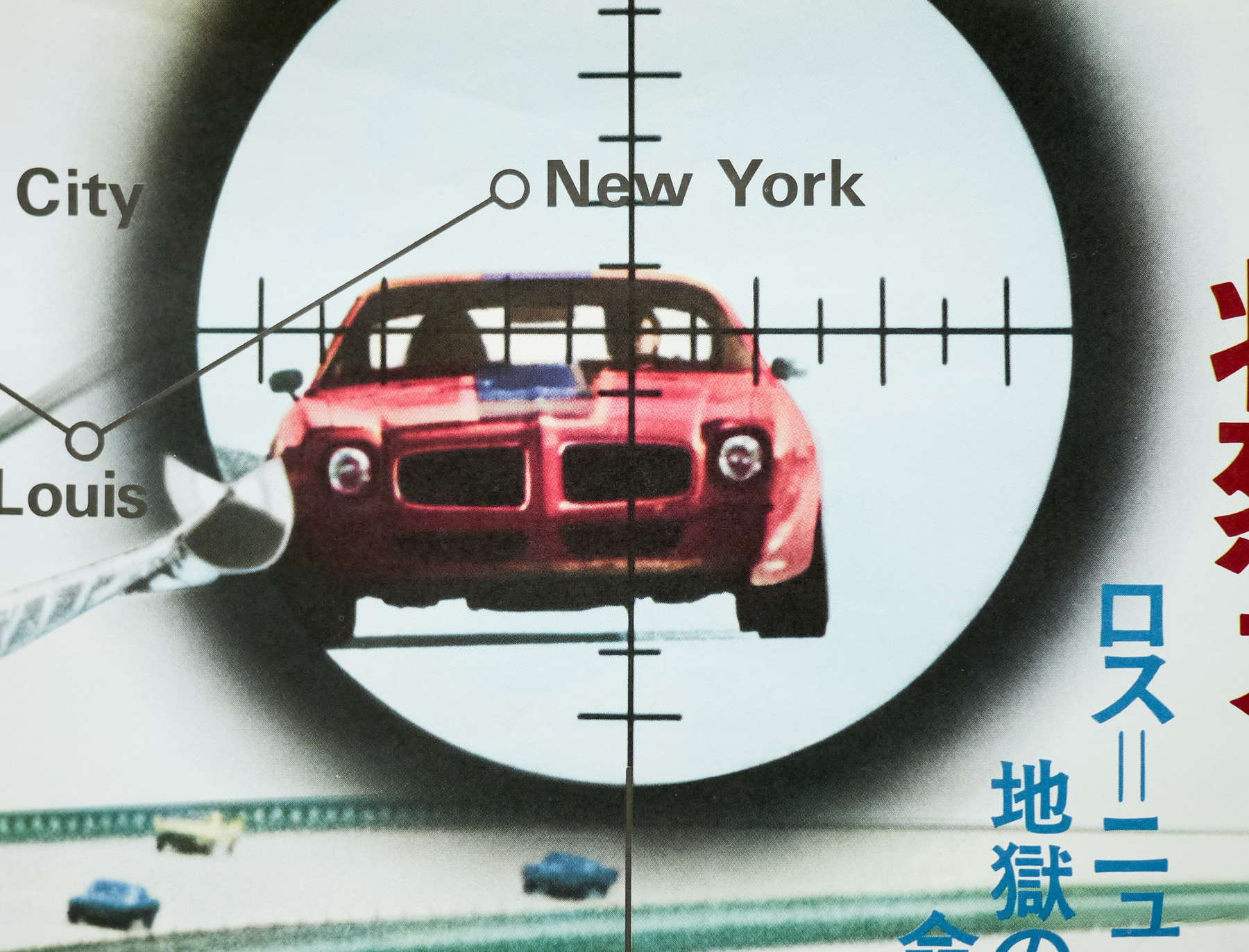
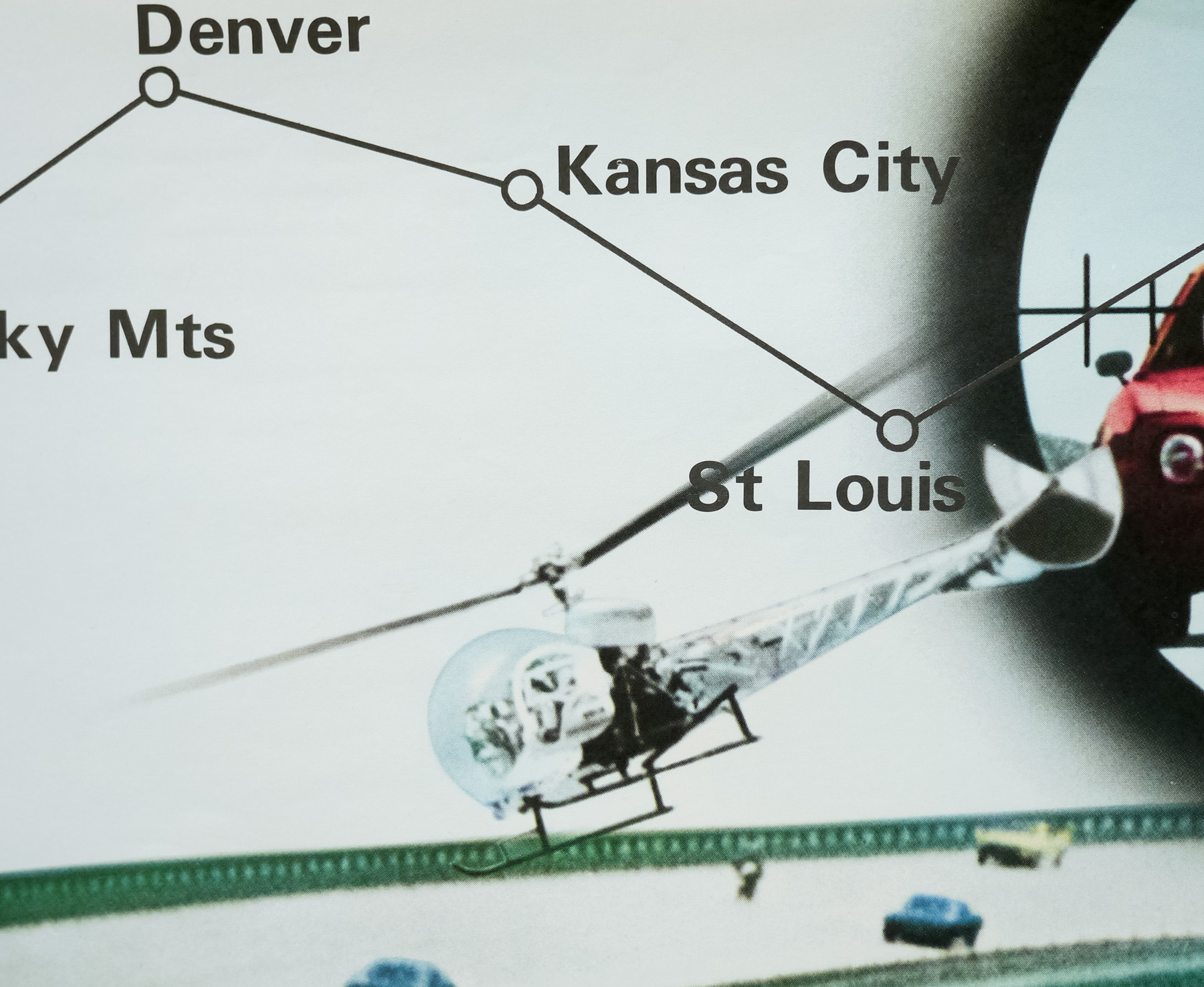
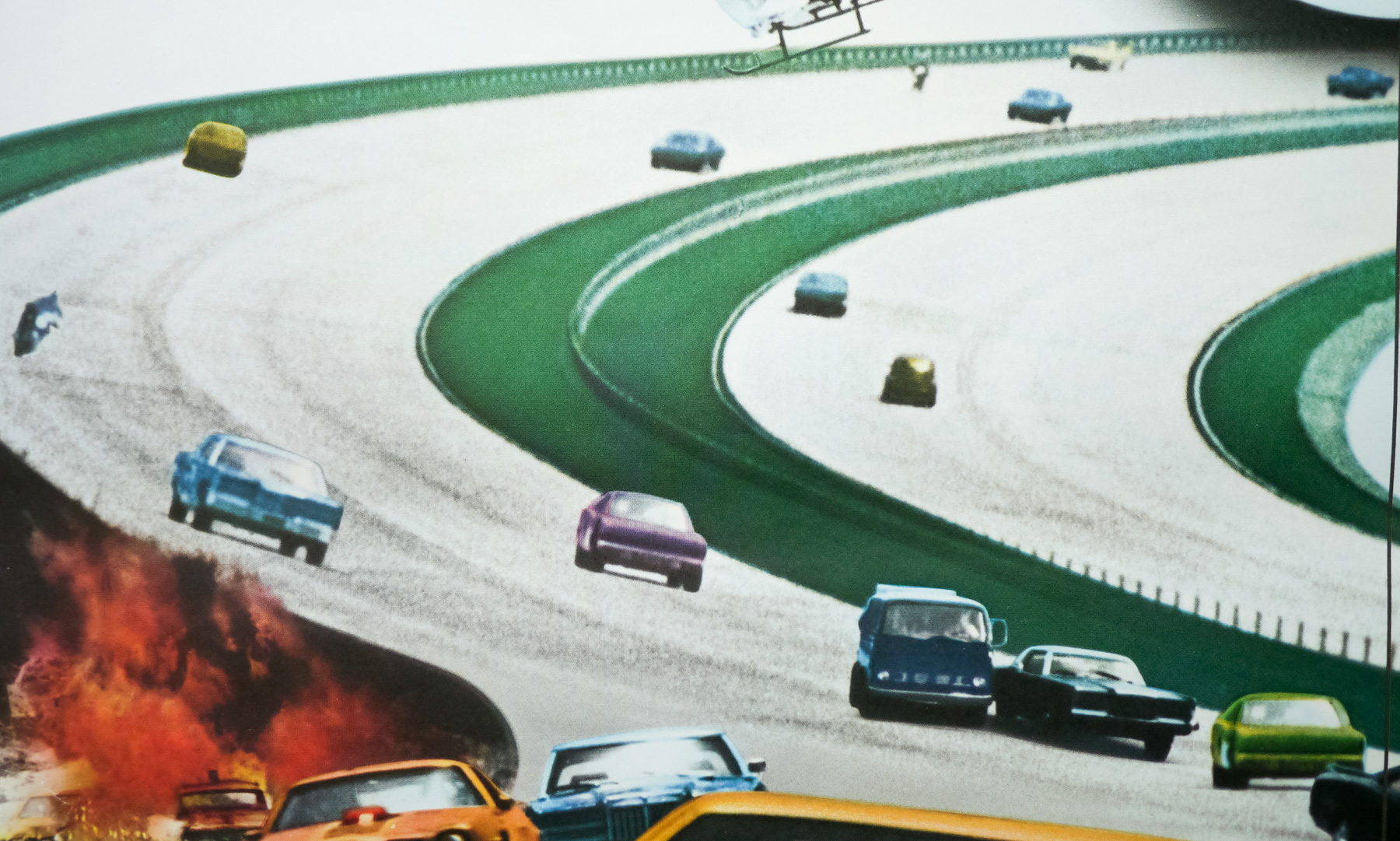
This Japanese B2 poster features a unique montage design and was printed for the film’s first release in the country in 1977. Note the miss-spelling of the title as ‘Canonnball’.


Platoon / one sheet / international

10.07.15

International one sheet poster (1986) for Platoon (1987). Artwork by Mike BryanInternational one sheet poster (1986) for Platoon (1987). Artwork by Mike Bryan, image 2International one sheet poster (1986) for Platoon (1987). Artwork by Mike Bryan, image 3International one sheet poster (1986) for Platoon (1987). Artwork by Mike Bryan, image 4International one sheet poster (1986) for Platoon (1987). Artwork by Mike Bryan, image 5
Title
Platoon
Year of Film
1987
Director
Oliver Stone
Starring
Charlie Sheen, Willem Dafoe, Tom Berenger, Richard Edson, Keith David, Forest Whitaker, Kevin Dillon, Johnny Depp
Origin of Film
USA
Genre(s) of Film
Drama | War
Type of Poster
One sheet
Origin of Poster
International
Year of Poster
1986
Designer
Unknown
Artist
Mike Bryan
Size (inches)
27 1/8" x 41"
SS or DS
SS

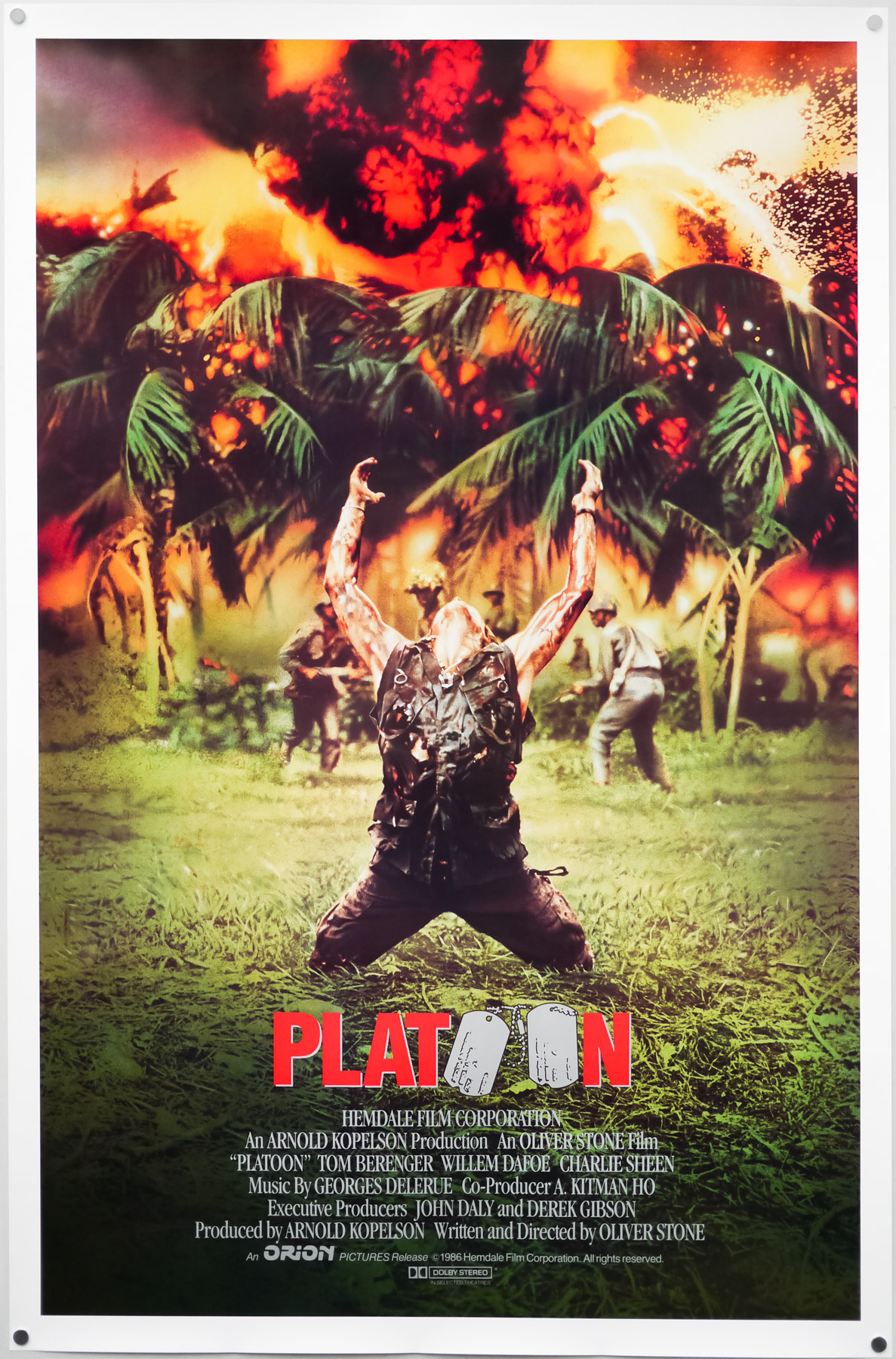
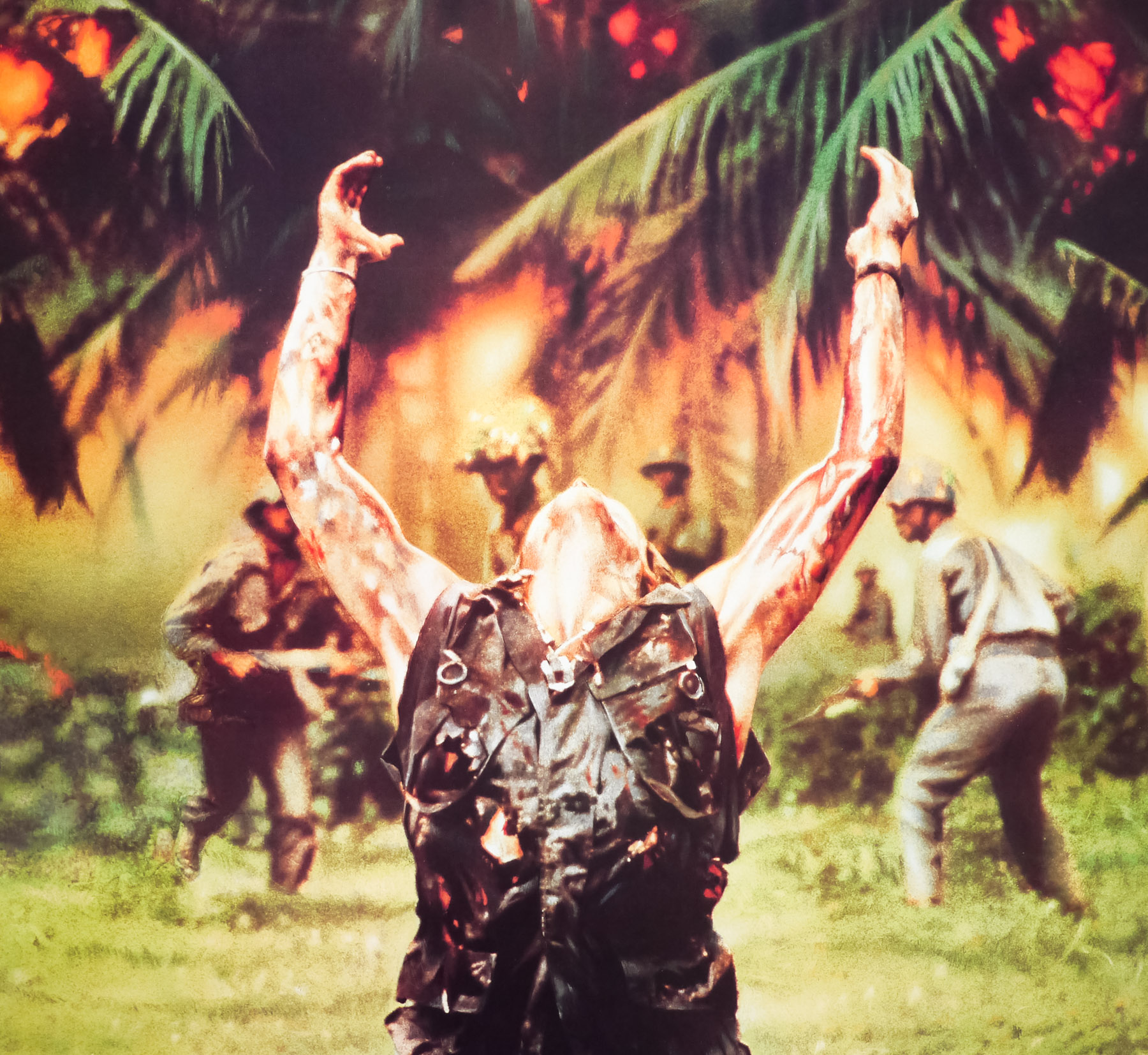
An iconic image on this one sheet for the release of Oliver Stone (opens in a new tab)‘s Academy Award-winning Vietnam war classic, Platoon (opens in a new tab), one of a three films that the director made on the subject (the others being Born on the Fourth of July (opens in a new tab) and Heaven & Earth (opens in a new tab)). The script, which was written by Stone, is based on his own experiences as an infantryman who served in tours of duty during the Vietnam war (opens in a new tab). He had signed up in 1967 after dropping out of Yale University and specifically requested to see combat in the war that had seen the first ground troops sent to the country two years earlier. Stone served in two different divisions for over a year and was wounded twice,  receiving several medals, including a Purple Heart.

The film follows Charlie Sheen (opens in a new tab)‘s army grunt Chris Taylor (a proxy for Stone) who is serving as part of Bravo Company, 25th Infantry Division near the Cambodian Border. Taylor is fresh into the field and is treated with disdain by the more experienced soldiers (an incredible ensemble of acting talent, including Willem Dafoe, Tom Berenger, Keith David and Forest Whitaker) who have all been in country for months, and he is quickly made aware that his presence is inconsequential. After a few skirmishes in which some members of the division are killed, Taylor is eventually accepted into the group and discovers the grinding boredom and rampant drug use amongst his fellow soldiers. Tensions between two sergeants, the ill-tempered, battle-scarred Barnes (Berenger) and the pleasant, more reasonable Elias (Dafoe) reach breaking point following an incident involving innocent villagers. Upon returning to base, the issue of a court-martial for illegal killing is raised and when the division is sent out on their next patrol, things reach boiling point, leaving Taylor fighting to survive against the enemy as well as members of his own team.

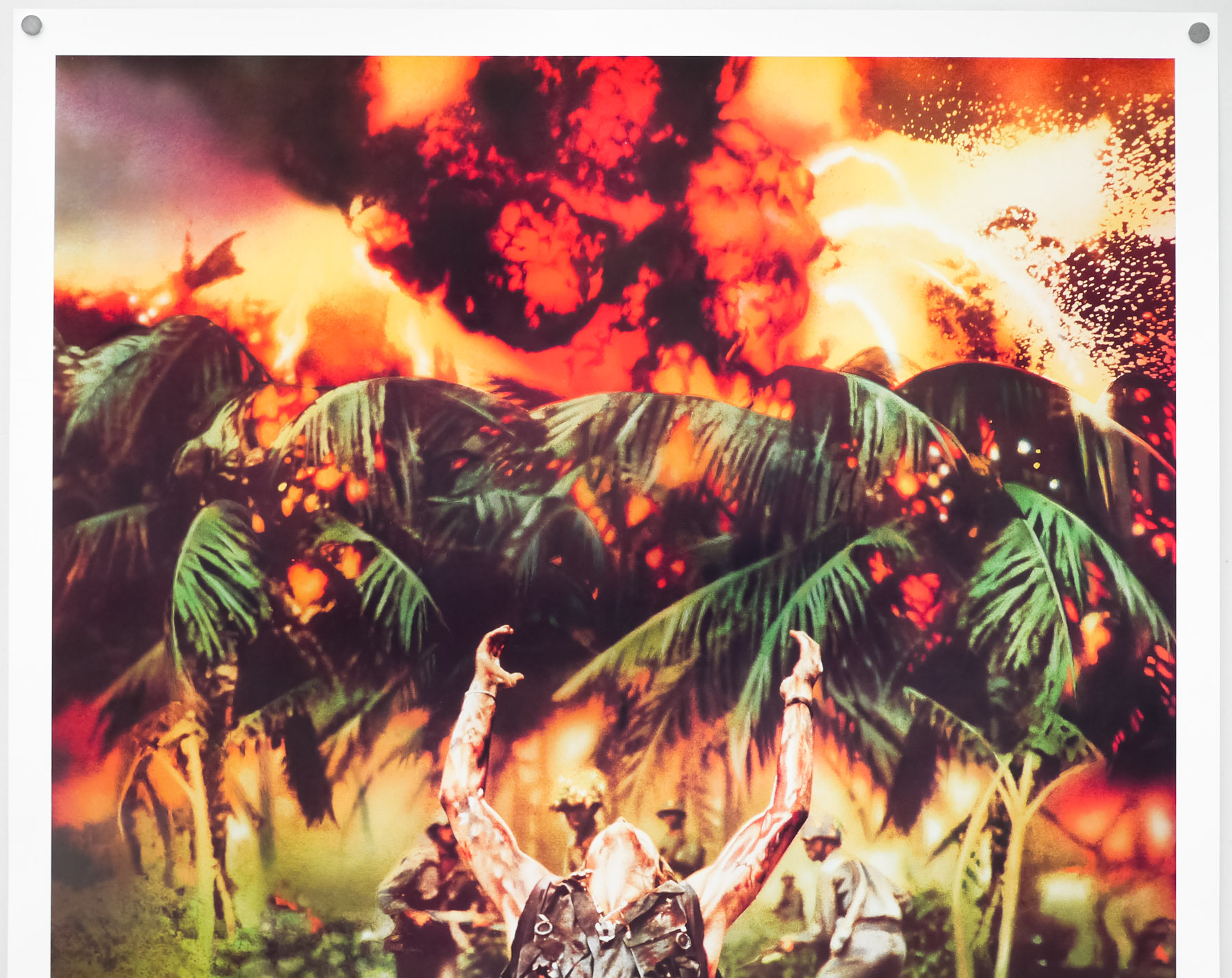
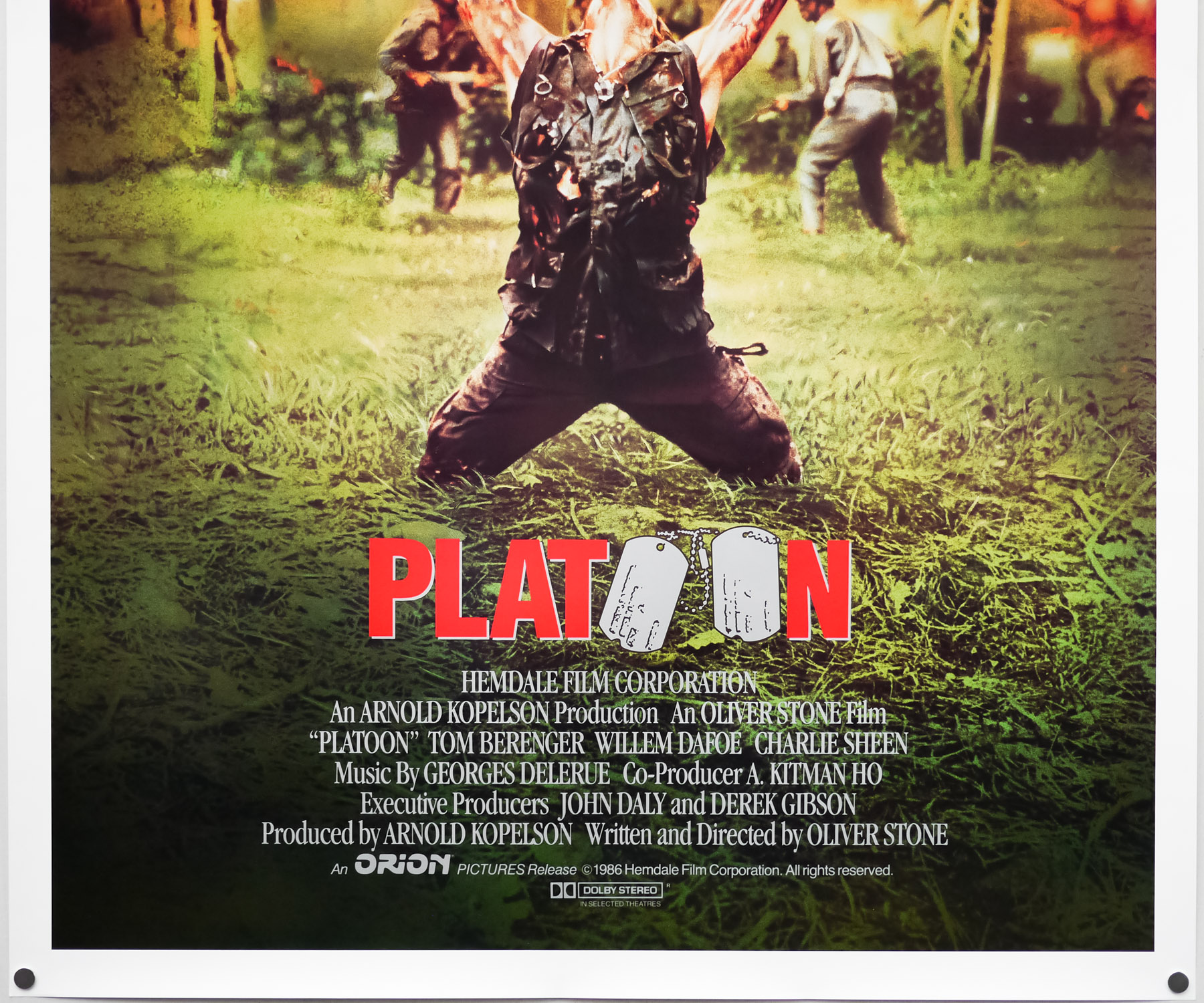
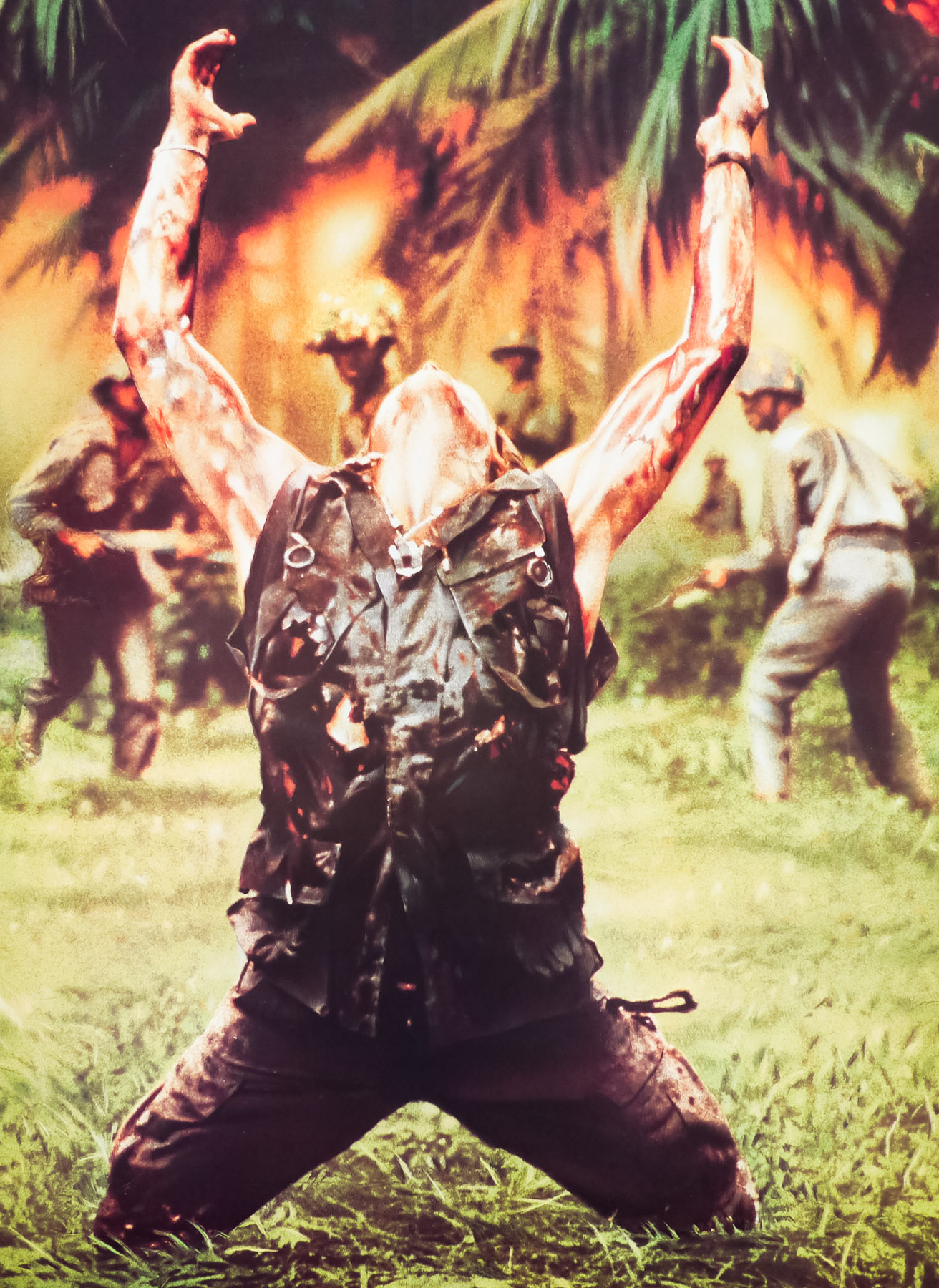
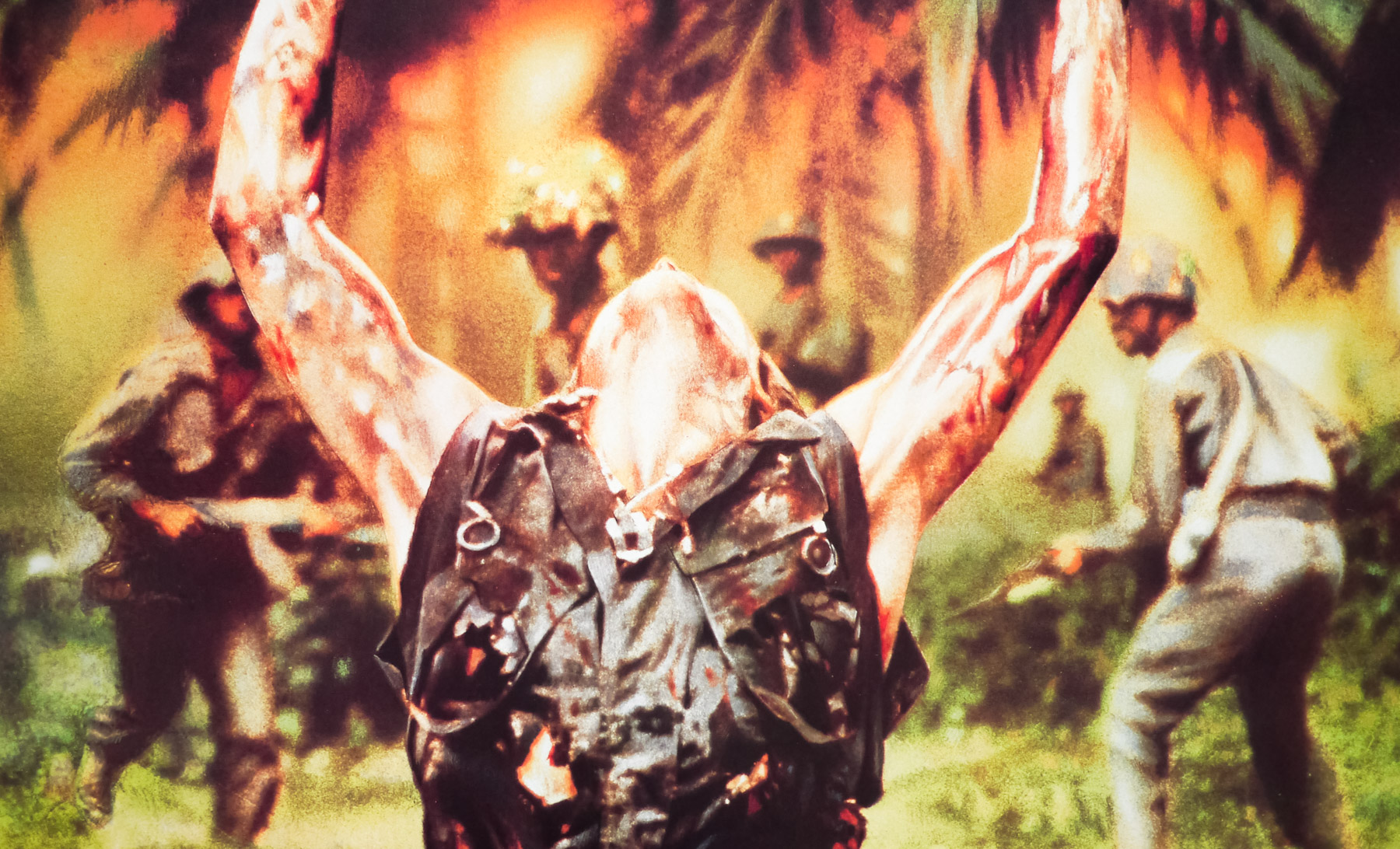
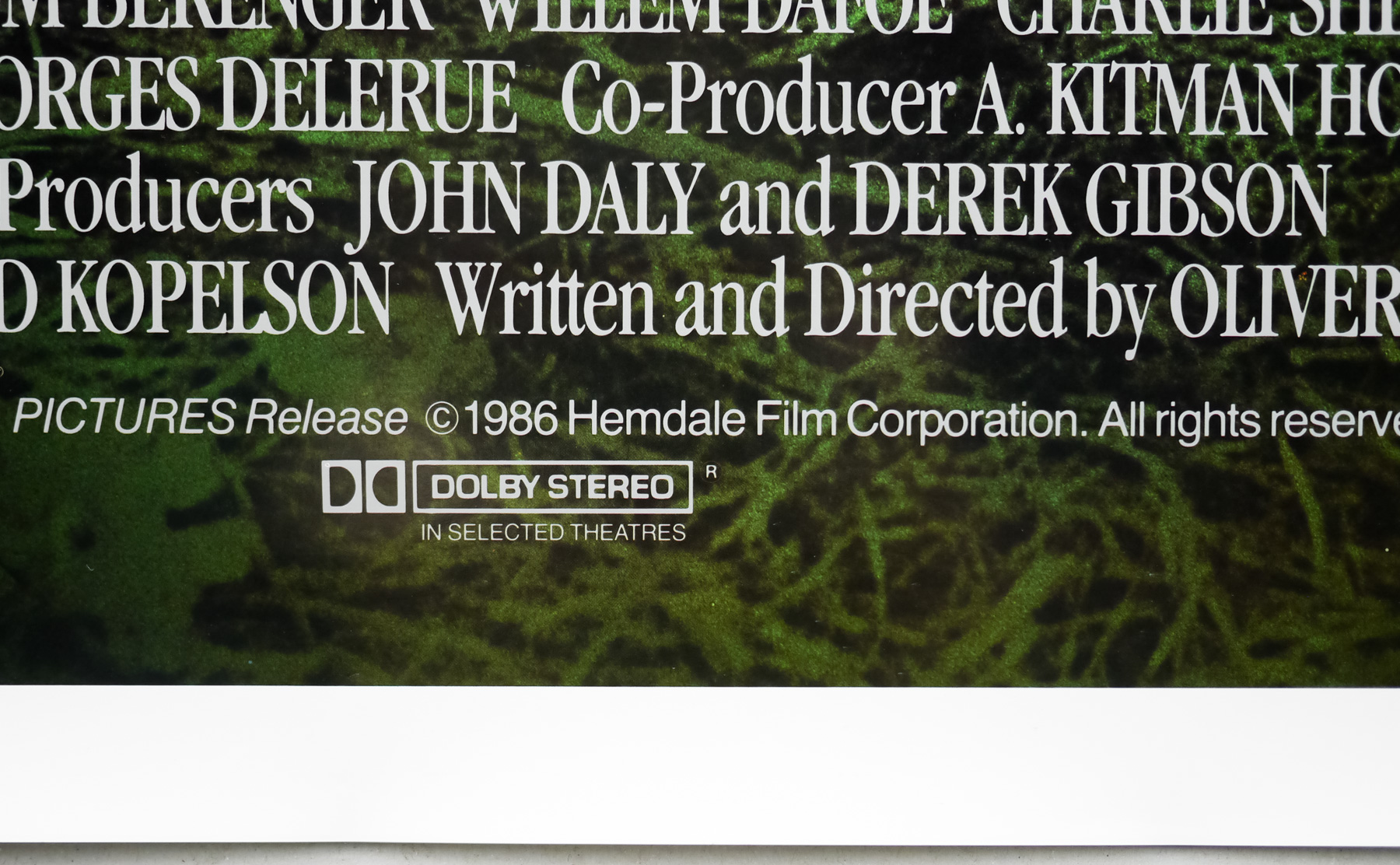
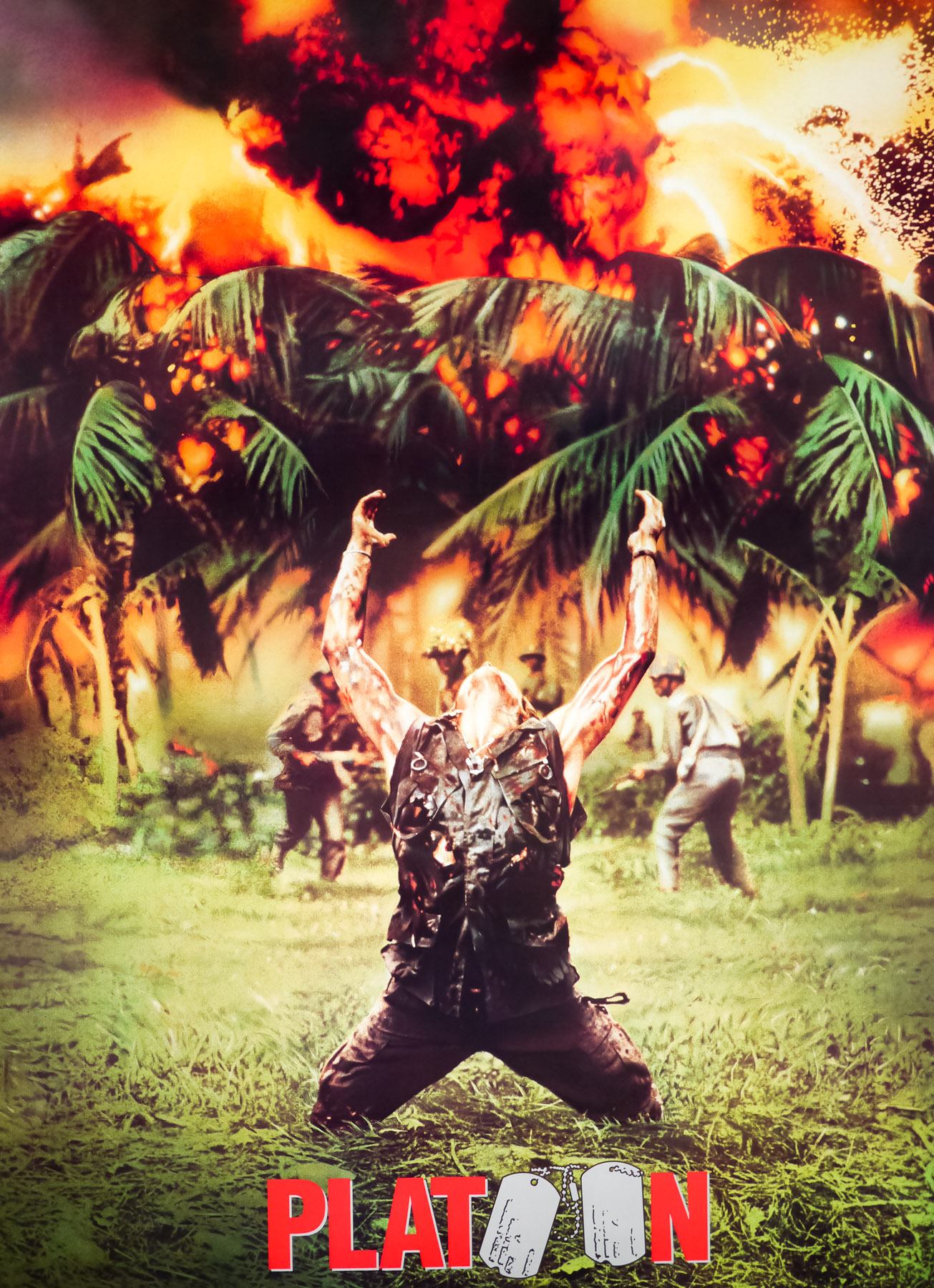
This one sheet features a shot from a pivotal scene in the film where Elias is left behind during an evacuation to escape from advancing Vietcong troops. The shot was used on most posters for the film’s release across the board, but not on the US one sheet. This poster is in fact a one sheet printed for use in English-speaking international countries (note the lack of MPAA rating). It most commonly appears without the white border and measuring 25″ x 39″ but this is the full-size 27″ x 41″ bordered version.

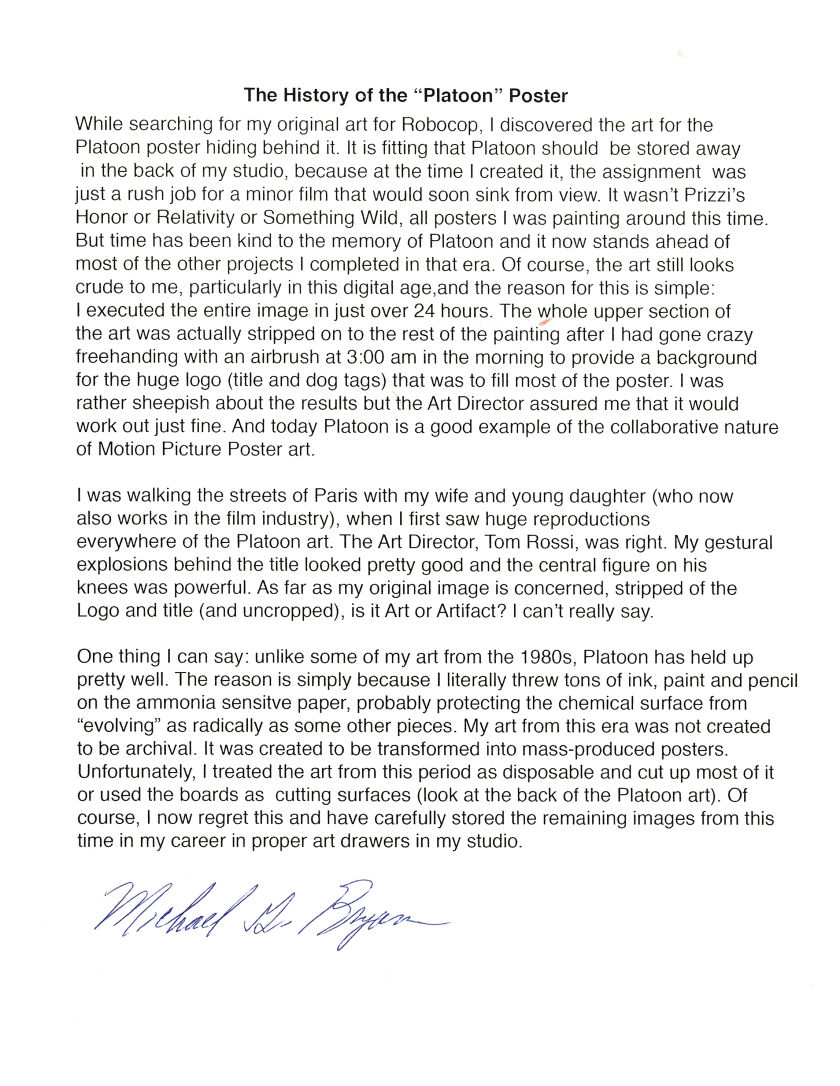
I had always assumed the image was a photograph but I only recently discovered it’s the work of the American artist Mike Bryan who also painted the fantastic and iconic Robocop one sheet. Heritage auction house sold the original paintings (opens in a new tab) for both posters in March 2014 and included with each was a note from Bryan himself. I’ve saved a copy of Bryan’s note about the Platoon poster and reproduce the copy here:

While searching for my original art for Robocop, I discovered the art for the Platoon poster hiding behind it. It is fitting that Platoon should be stored away in the back of my studio, because at the time I created it, the assignment was just a rush job for a minor film that would soon sink from view. It wasn’t Prizzi’s Honor or Relativity or Something Wild, all posters I was painting around this time.

But time has been kind to the memory of Platoon and it now stands ahead of most of the other projects I completed in that era. Of course, the art still looks crude to me, particularly in this digital age,and the reason for this is simple:

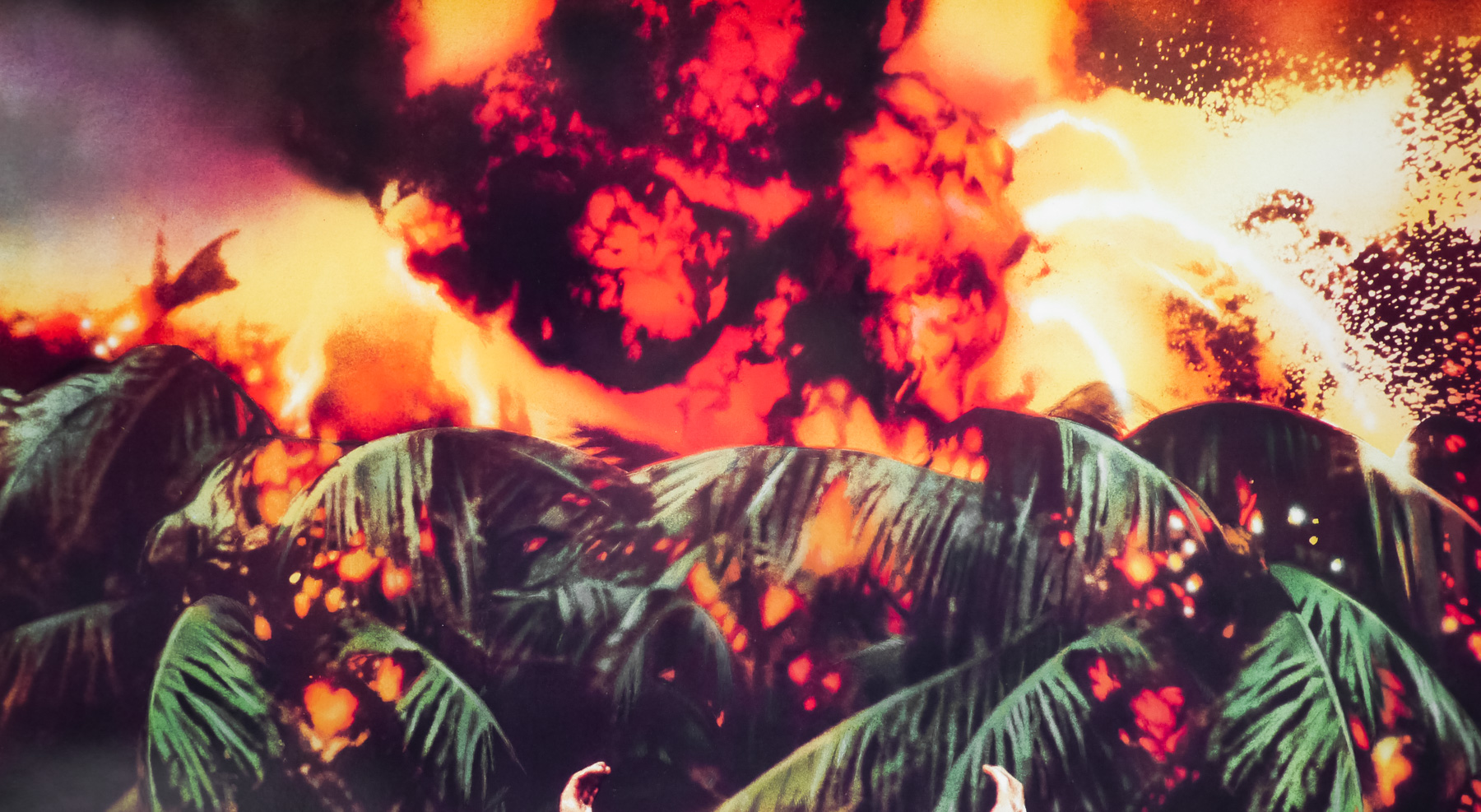
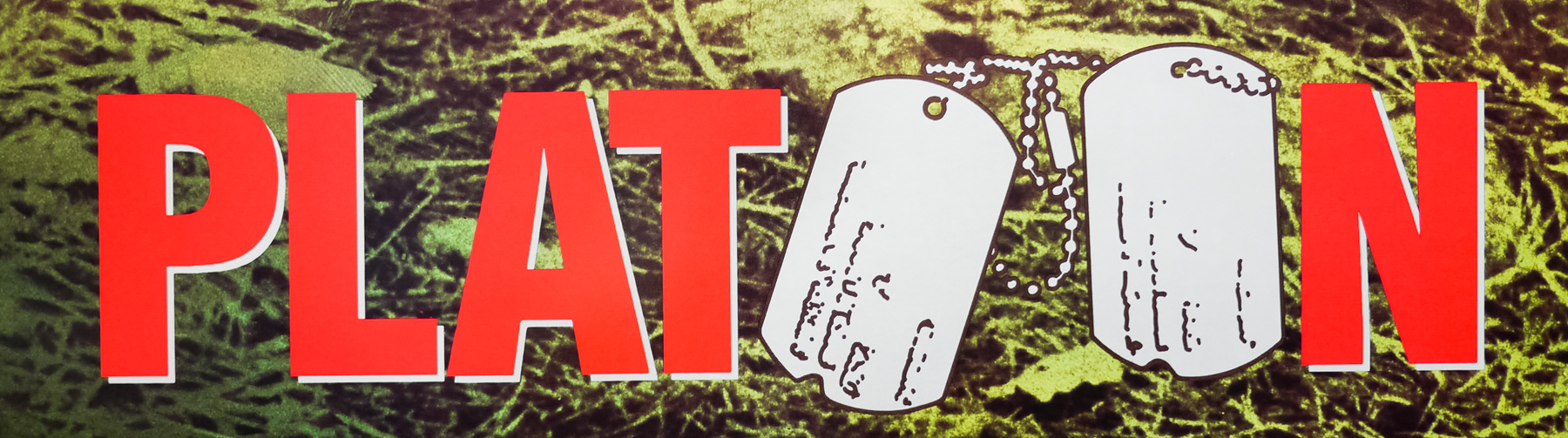
I executed the entire image in just over 24 hours. The whole upper section of the art was actually stripped on to the rest of the painting after I had gone crazy treehanding with an airbrush at 3:00 am in the morning to provide a background for the huge logo (title and dog tags) that was to fill most of the poster. I was rather sheepish about the results but the Art Director assured me that it would work out just fine. And today Platoon is a good example of the collaborative nature of Motion Picture Poster art.

I was walking the streets of Paris with my wife and young daughter (who now also works in the film industry), when I first saw huge reproductions everywhere of the Platoon art. The Art Director, Tom Rossi, was right. My gestural explosions behind the title looked pretty good and the central figure on his knees was powerful. As far as my original image is concerned, stripped of the Logo and title (and uncropped), is it Art or Artifact? I can’t really say.

One thing I can say: unlike some of my art from the 1980s, Platoon has held up pretty well. The reason is simply because I literally threw tons of ink, paint and pencil on the ammonia sensitve paper, probably protecting the chemical surface from

“evolving” as radically as some other pieces. My art from this era was not created to be archival. It was created to be transformed into mass-produced posters.

Unfortunately, I treated the art from this period as disposable and cut up most of it or used the boards as cutting surfaces (look at the back of the Platoon art). Of course, I now regret this and have carefully stored the remaining images from this time in my career in proper art drawers in my studio.