
You searched for: Quad%2520

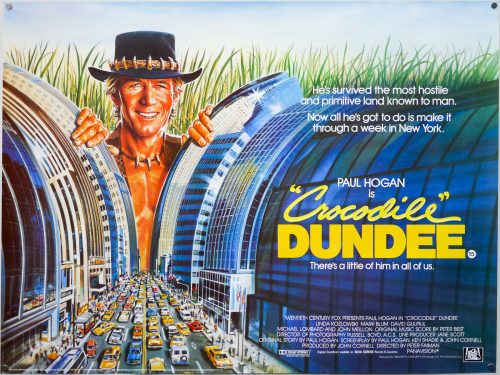
Crocodile Dundee / quad / UK

04.07.14

Poster Poster
Title
Crocodile Dundee
AKA
--
Year of Film
1986
Director
Peter Faiman
Starring
Paul Hogan, Linda Kozlowski, John Meillon, David Gulpilil, Ritchie Singer, Maggie Blinco, Steve Rackman, Gerry Skilton
Origin of Film
Australia
Genre(s) of Film
Paul Hogan, Linda Kozlowski, John Meillon, David Gulpilil, Ritchie Singer, Maggie Blinco, Steve Rackman, Gerry Skilton,
Type of Poster
Quad
Style of Poster
--
Origin of Poster
UK
Year of Poster
1986
Designer
Unknown
Artist
Dan Goozee
Size (inches)
30 1/16" x 40"
SS or DS
SS
Tagline
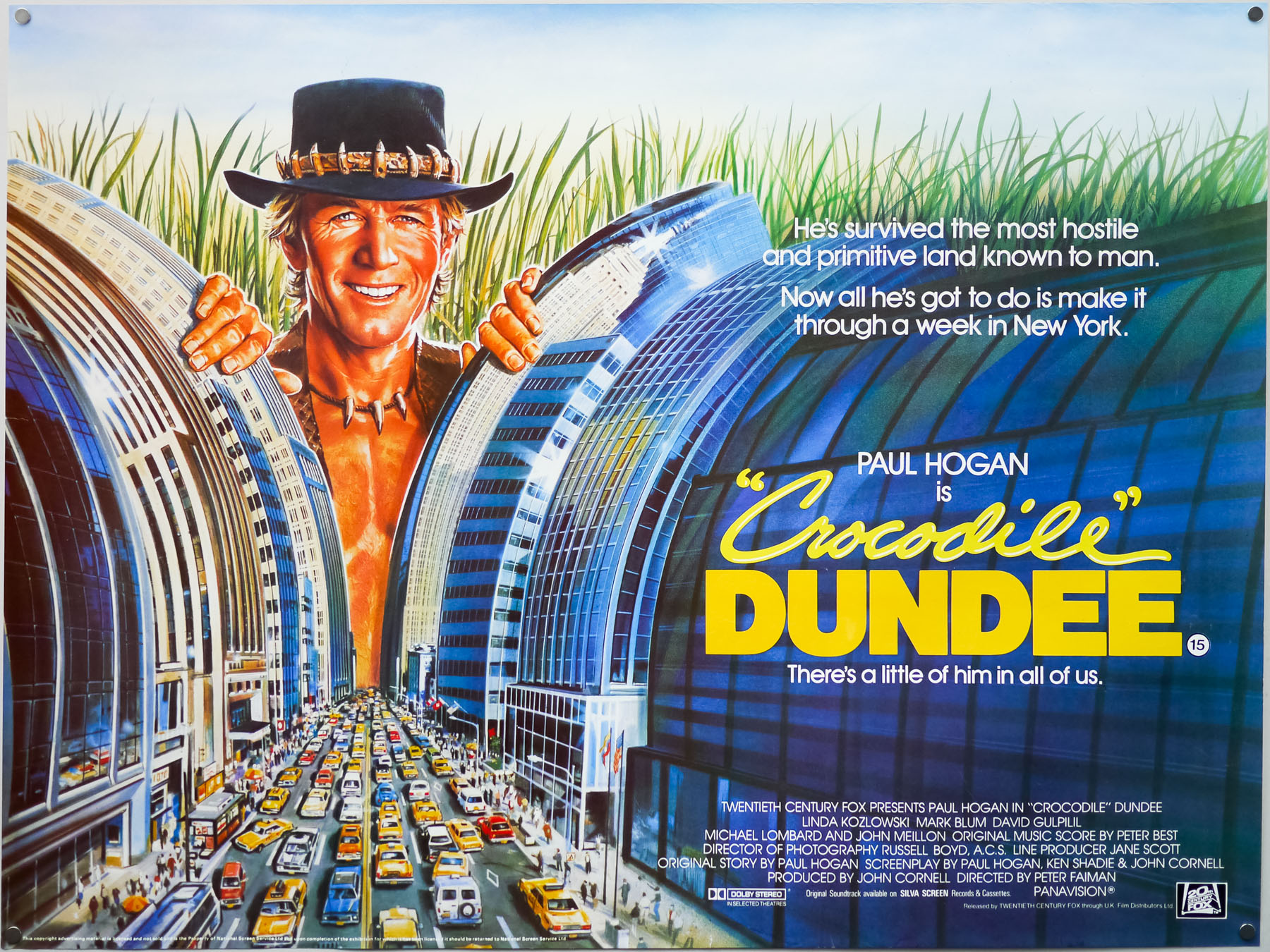
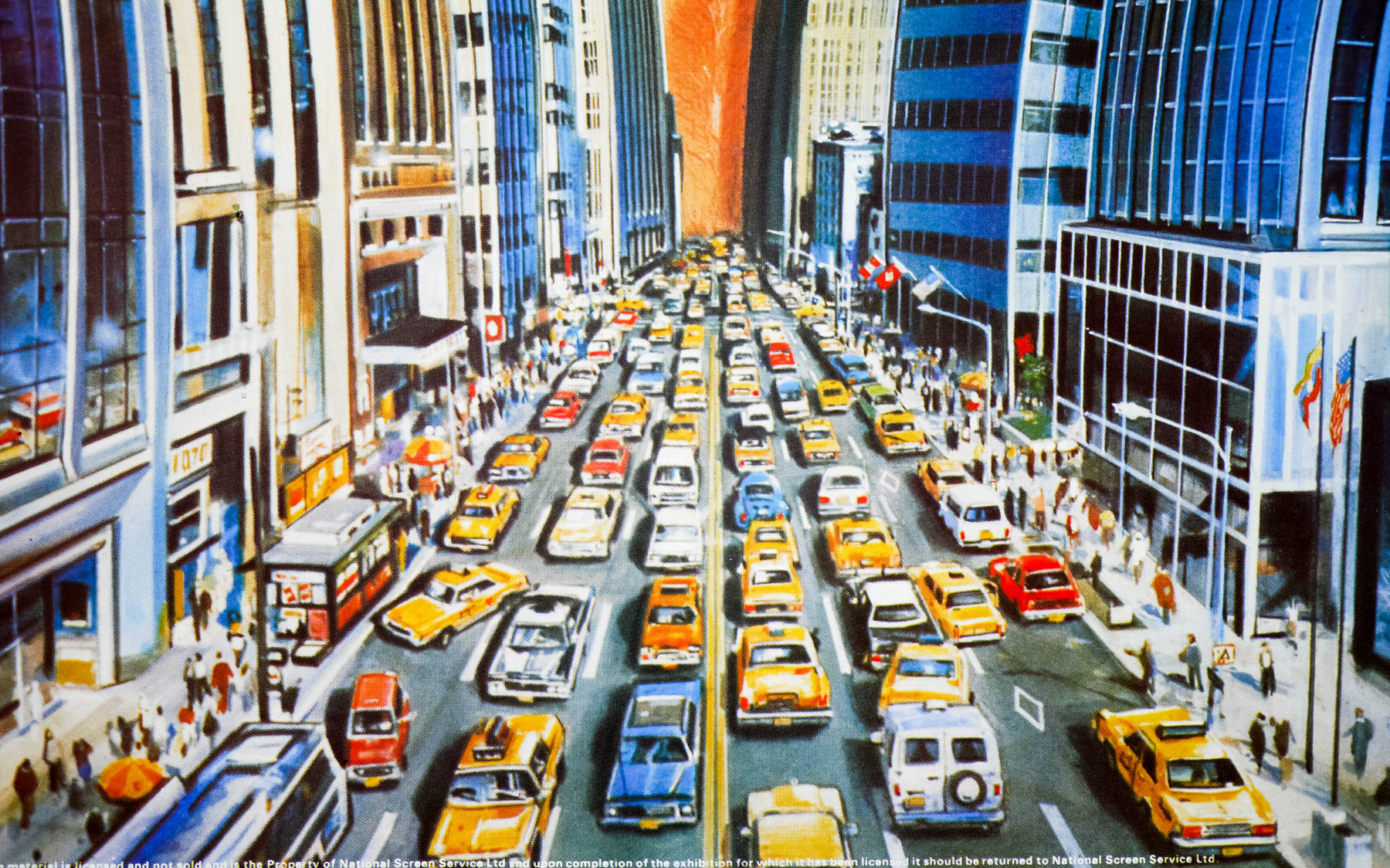
He's survived the most hostile and primitive land known to man. Now all he's got to do is make it through a week in New York. | There's a little of him in all of us.

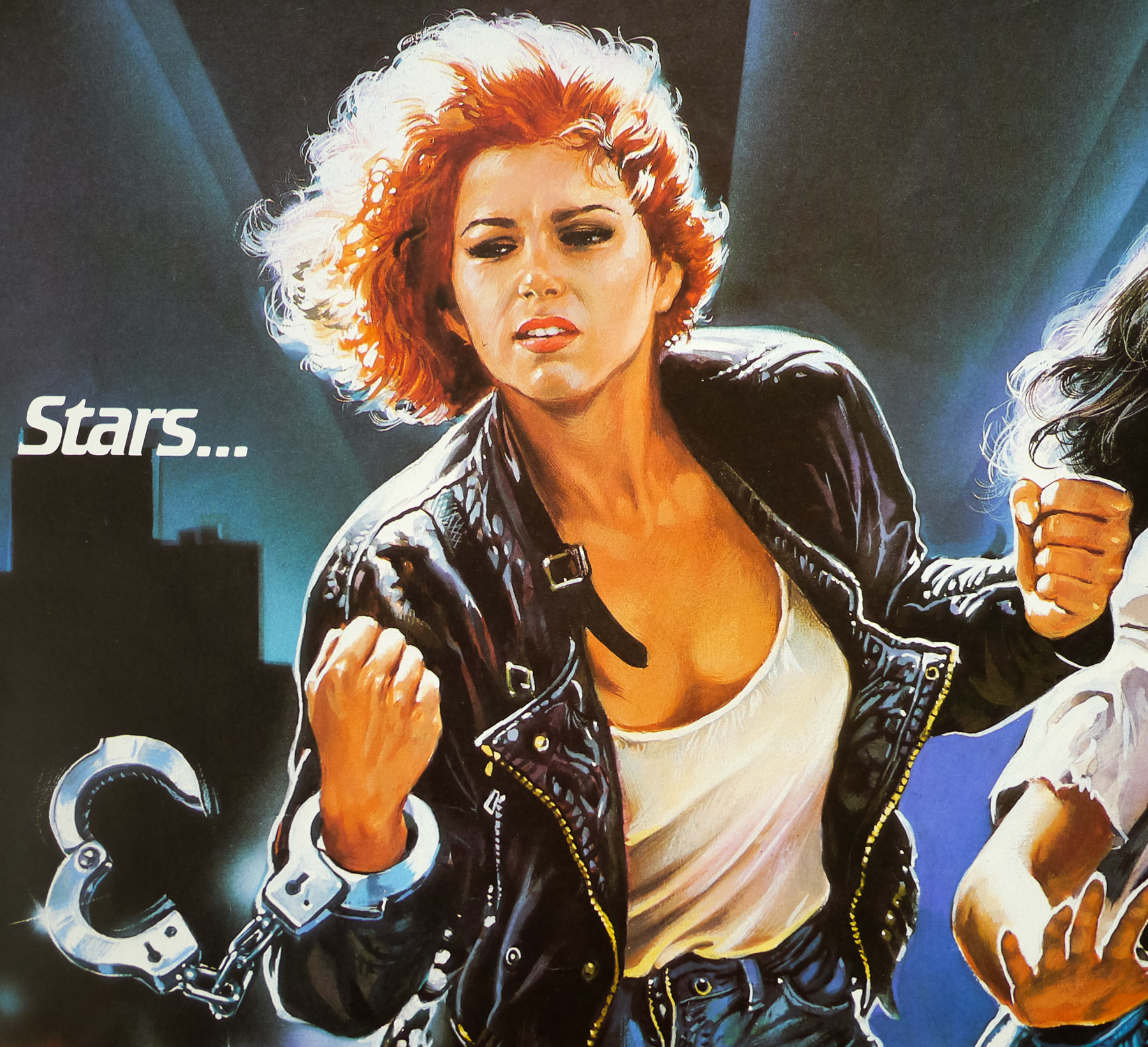
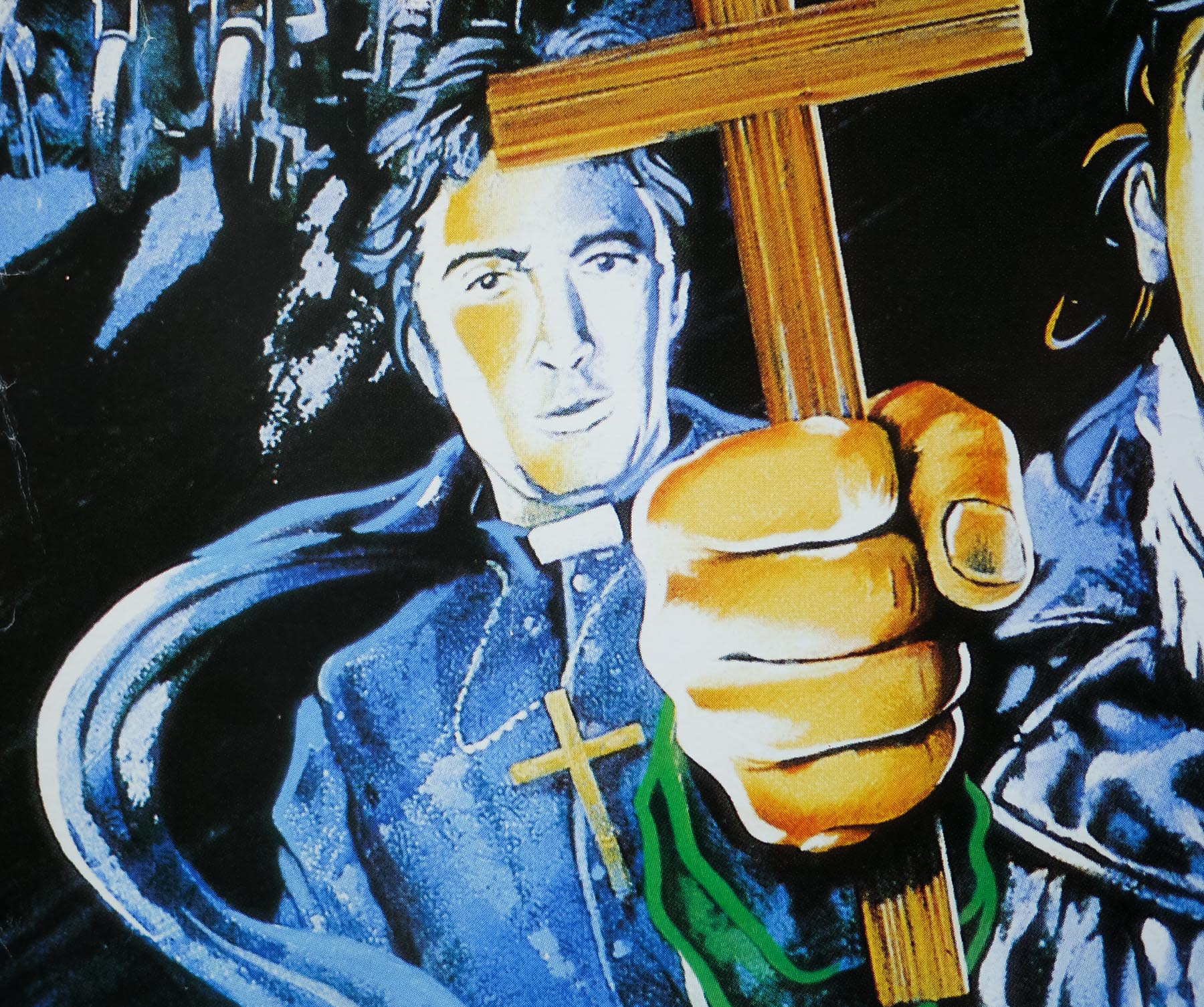
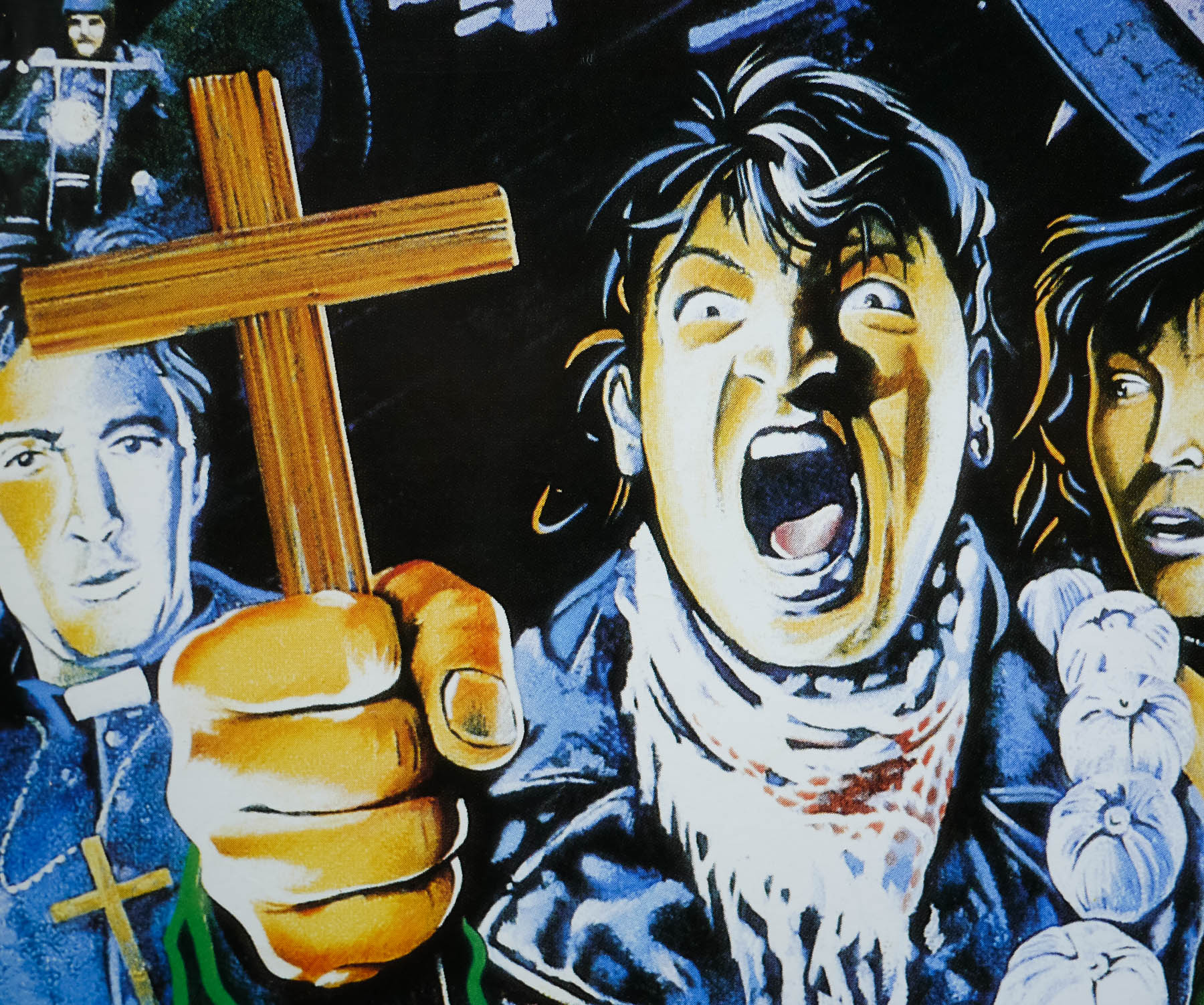
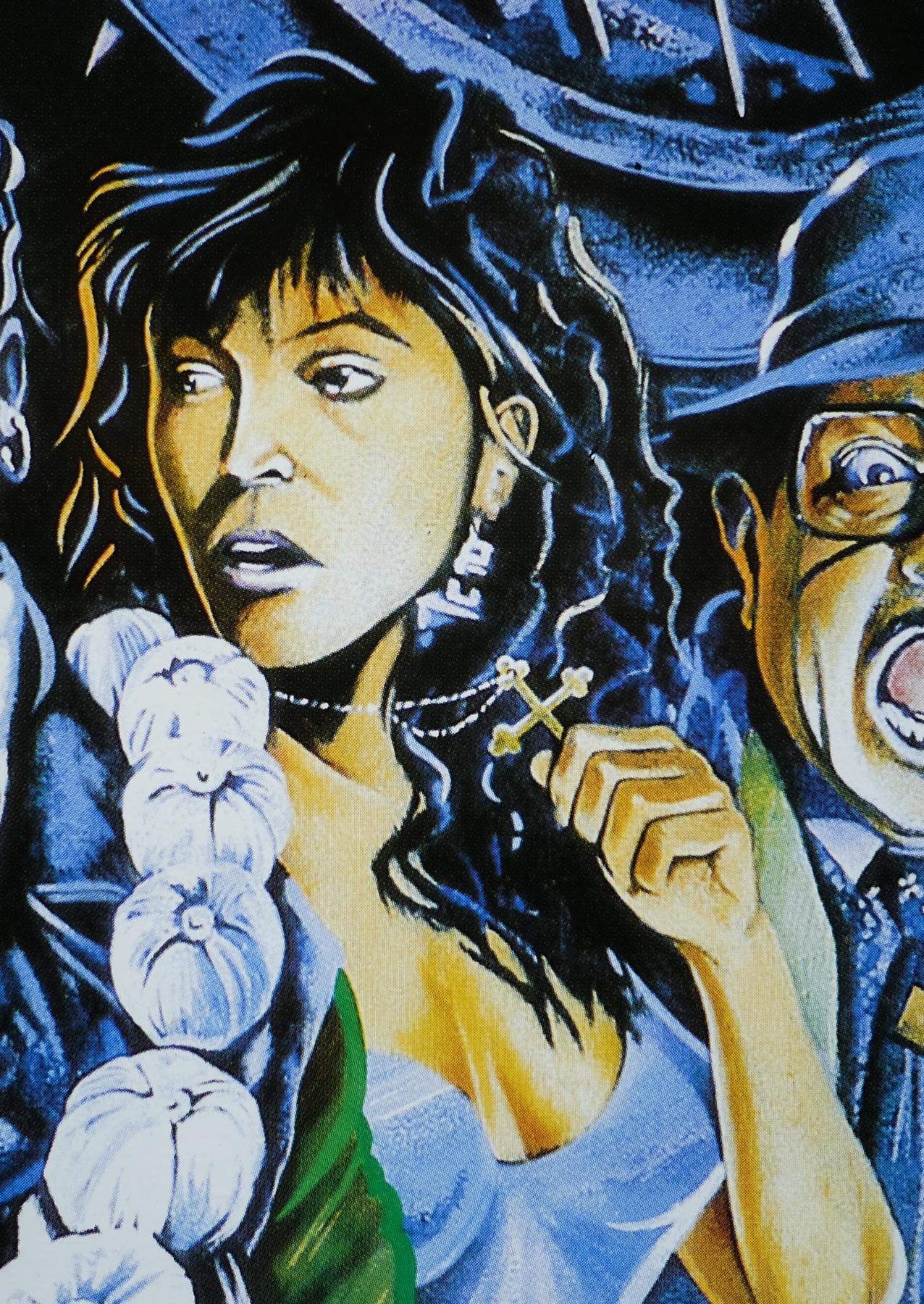
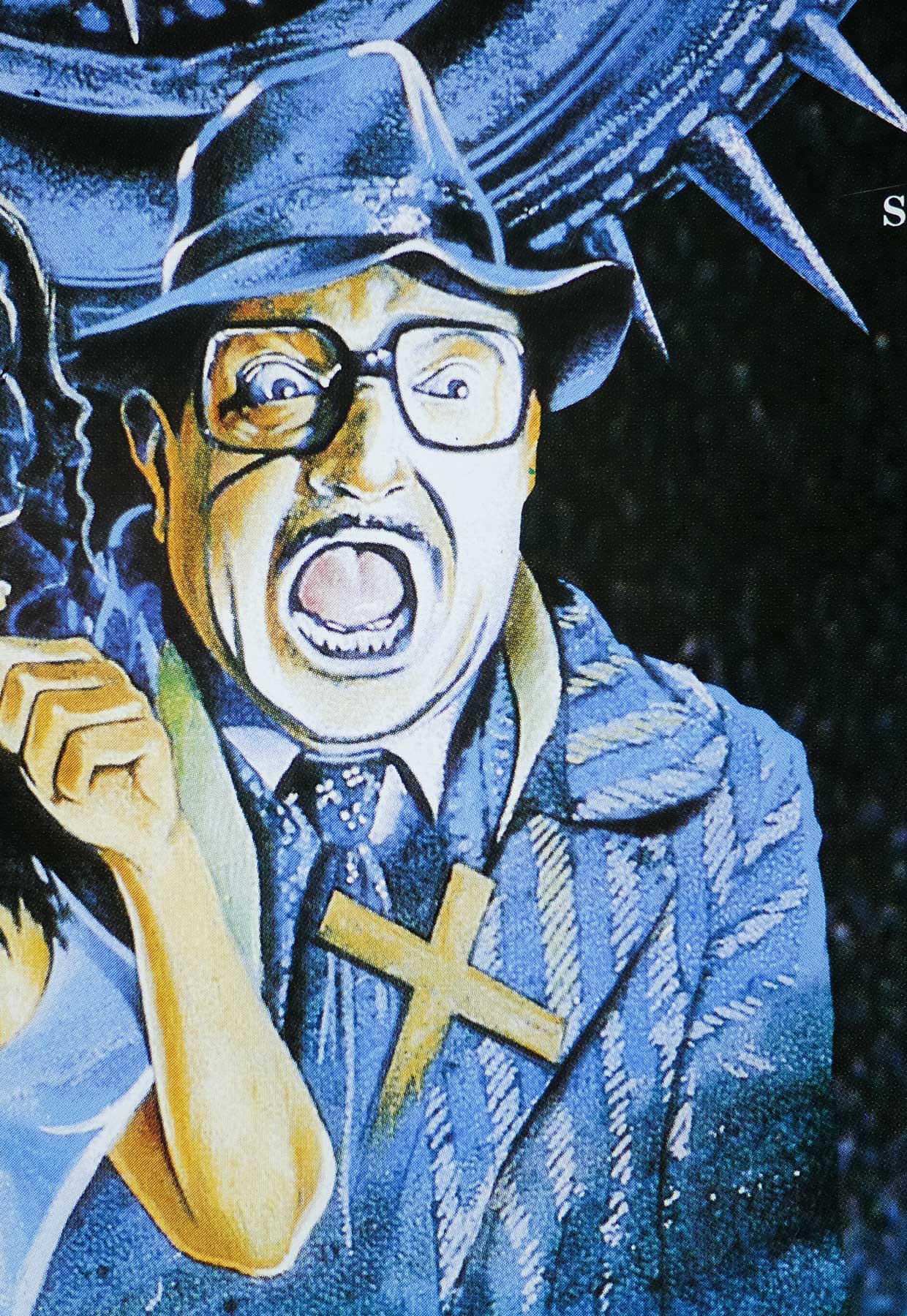
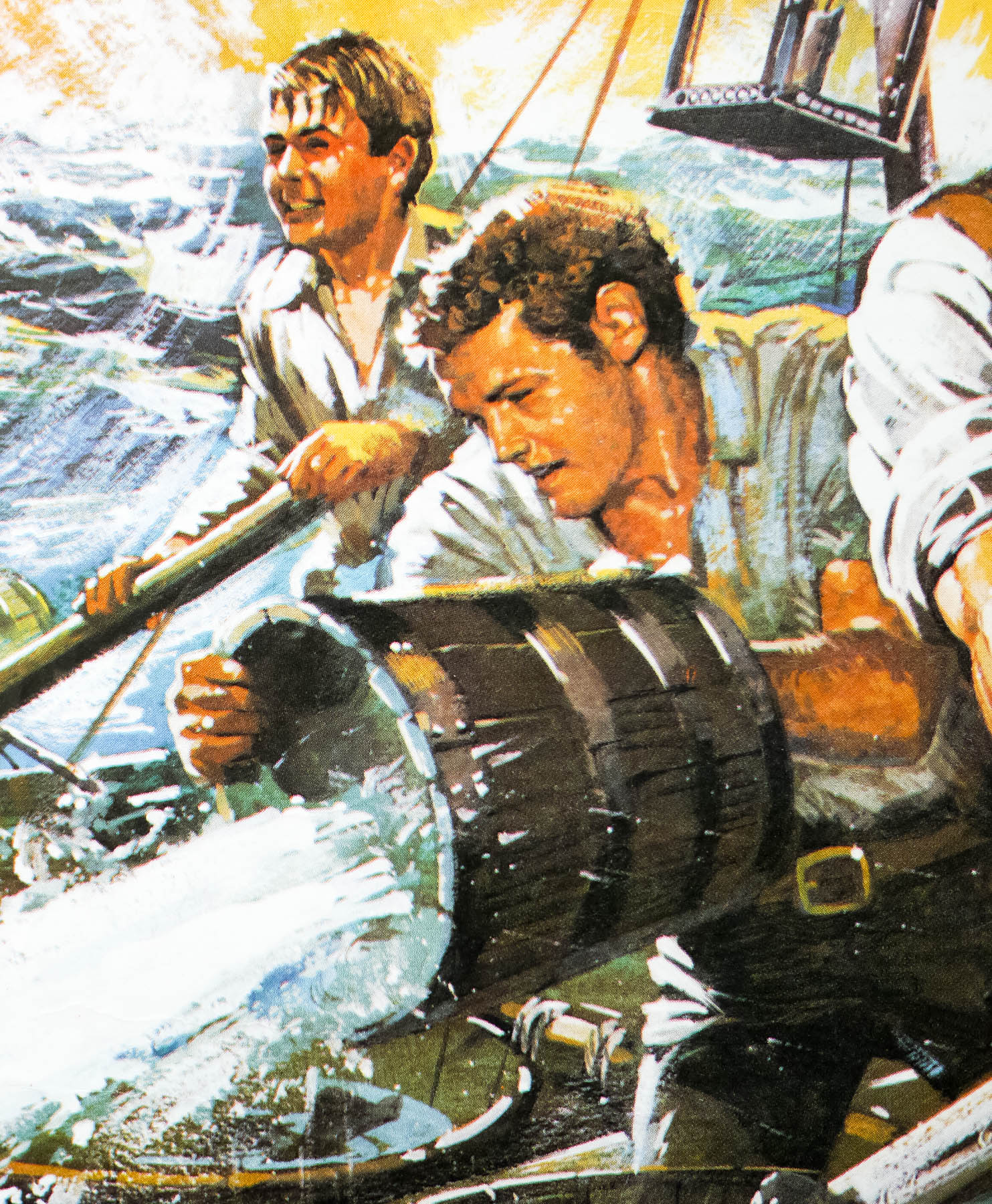
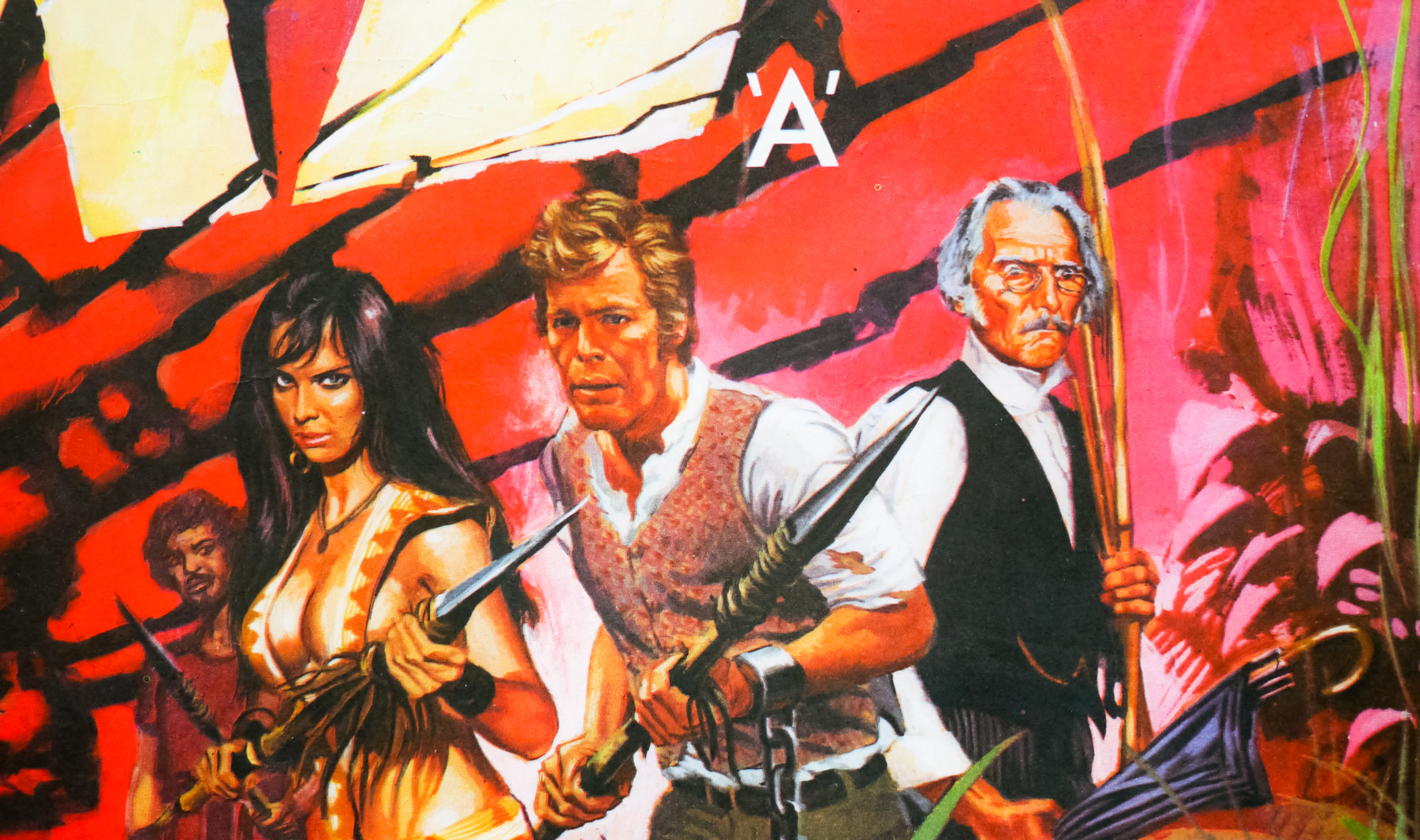
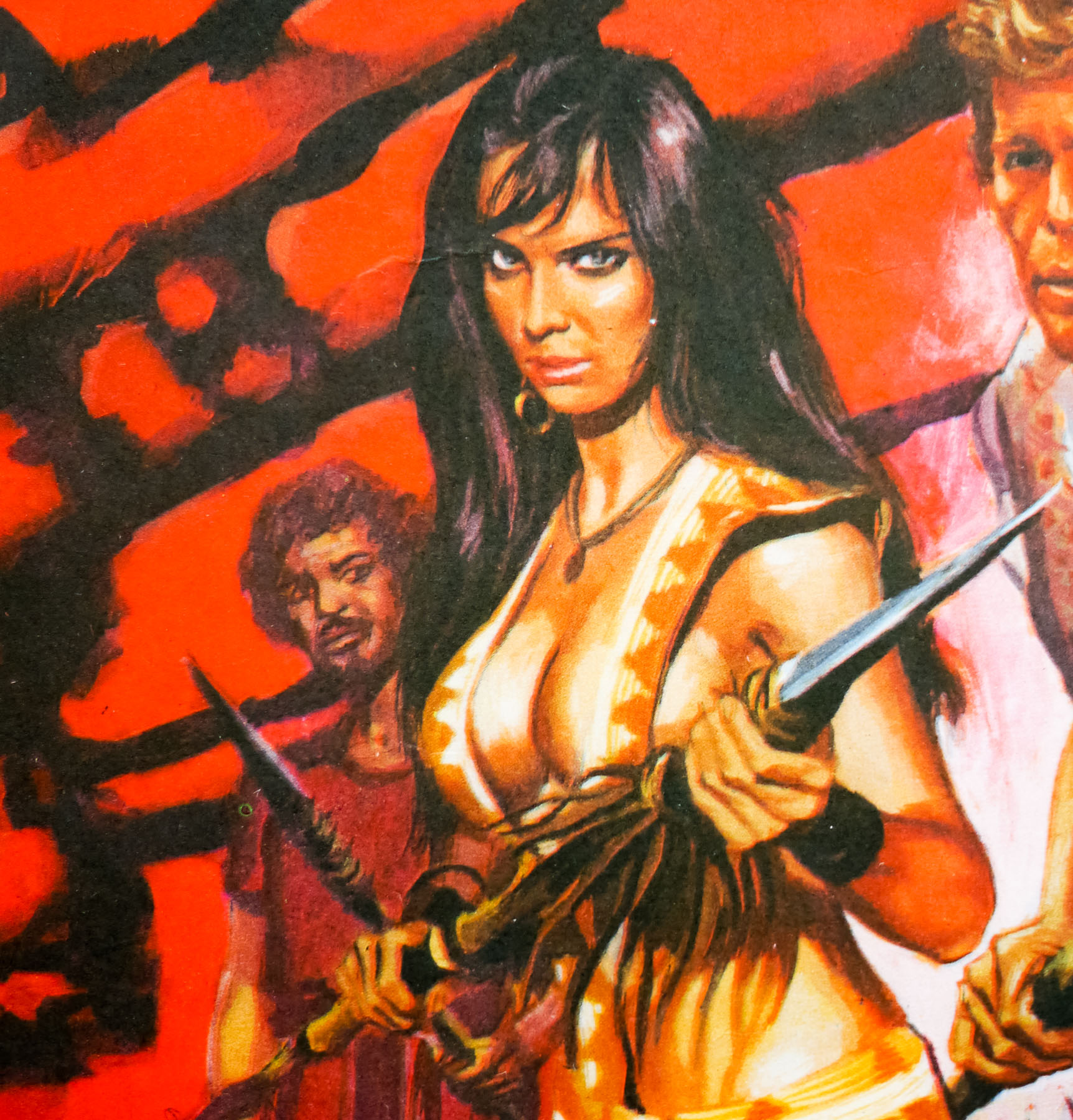
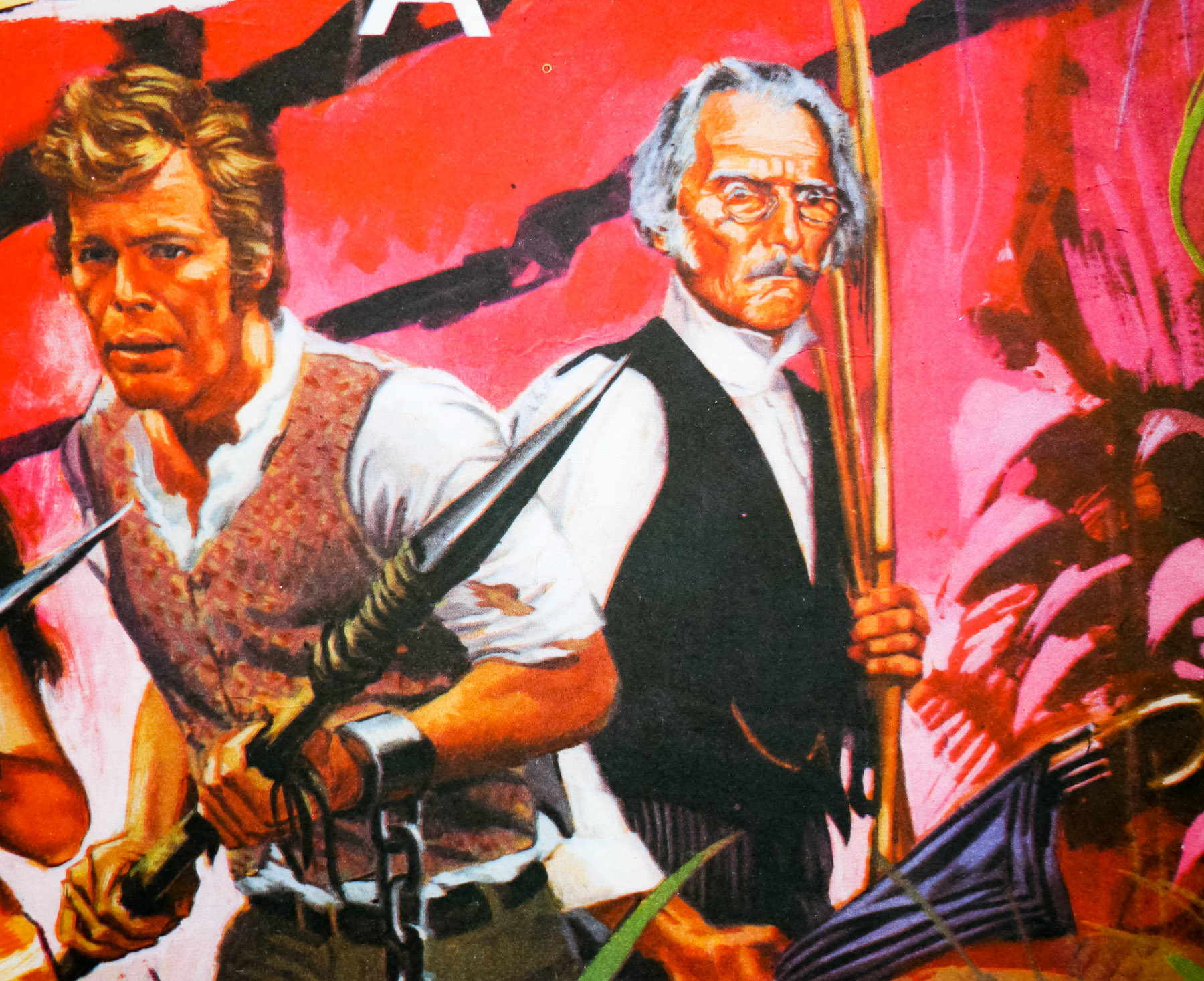
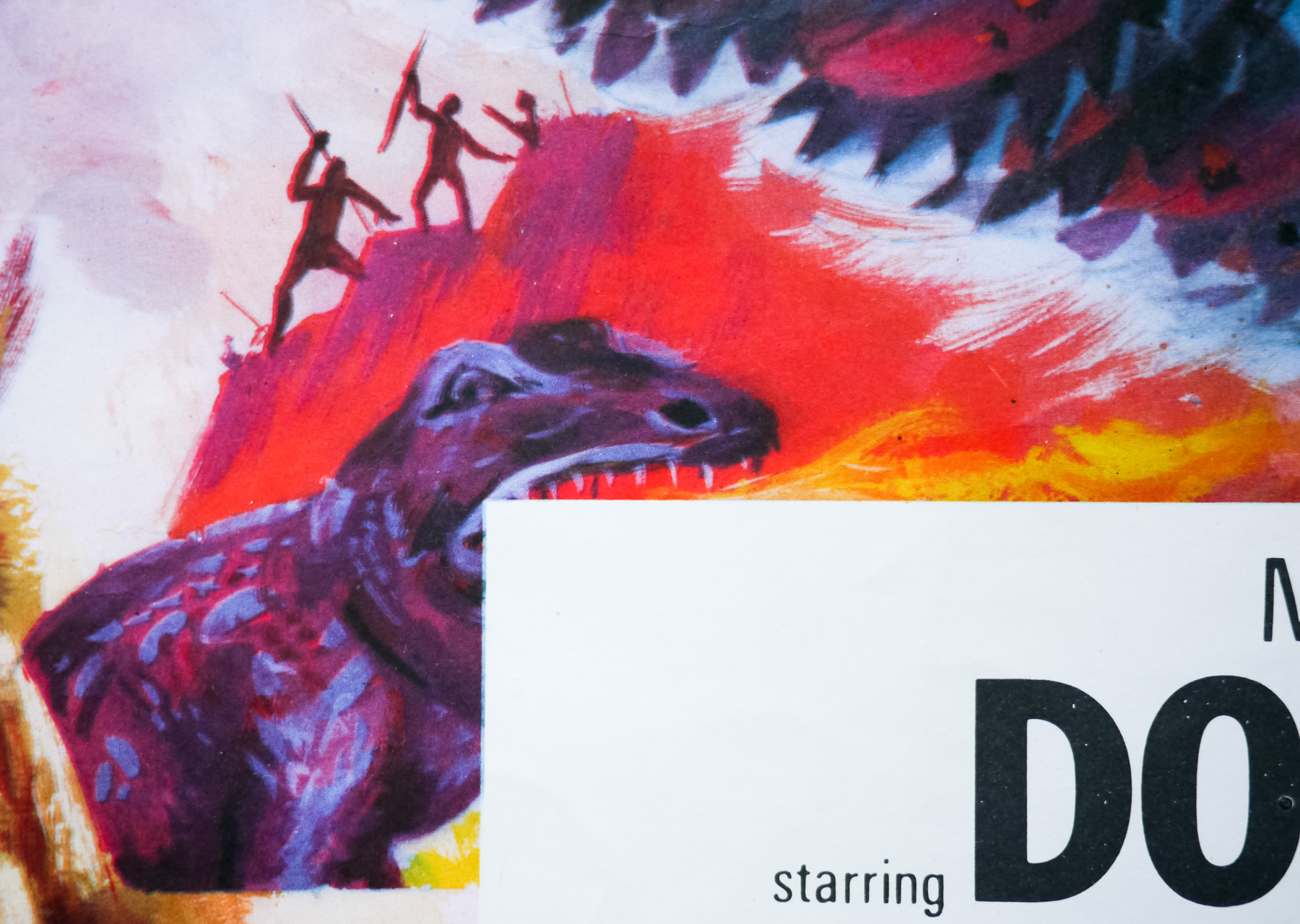
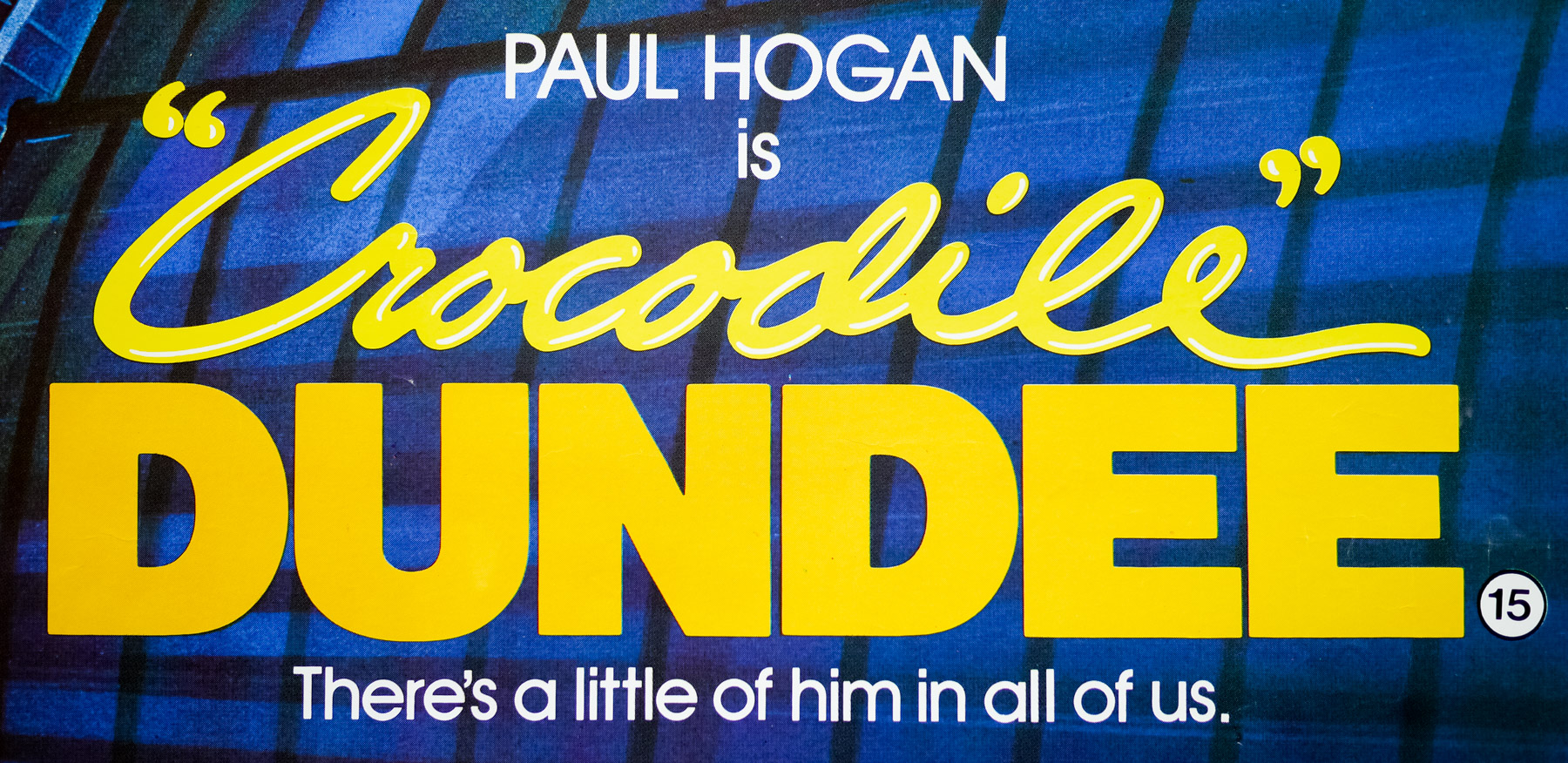
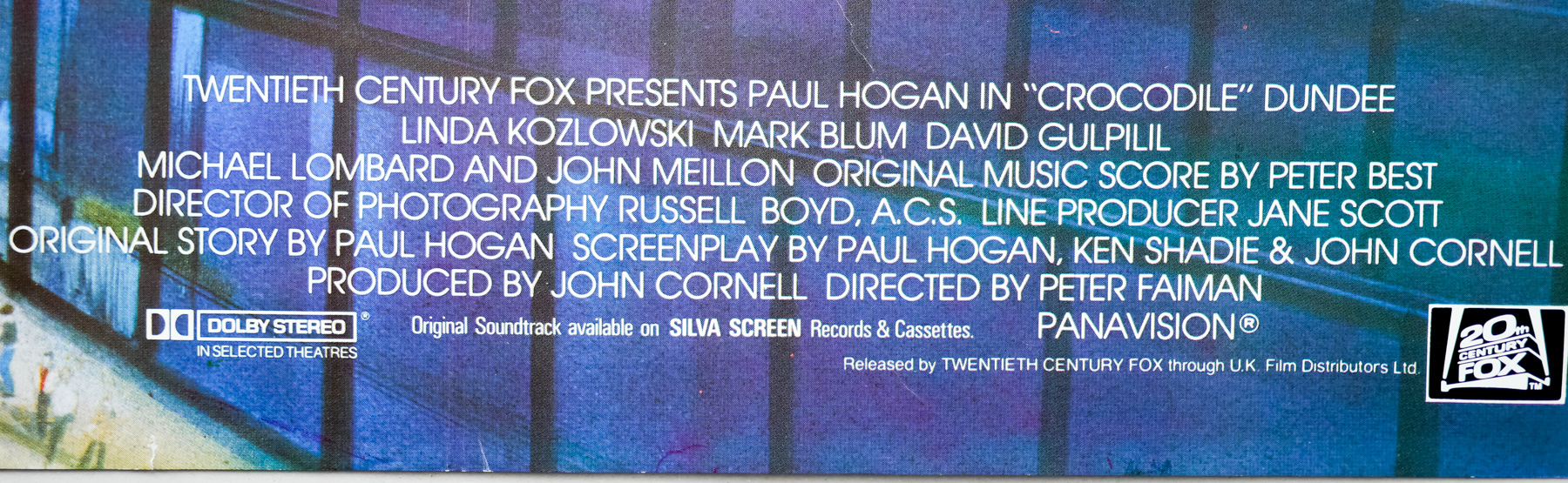
This is the UK quad for the release of arguably the most famous Australian film ever released, Crocodile Dundee. The film took its inspiration from the real life exploits of an Australian hunter called Rodney Ansell who was stranded for 56 days in the remote outback with limited supplies and managed to survive and stay alive by living off the land. The film’s story sees Sue Charlton (Linda Kozlowski), a New York reporter, travel to Australia to try and meet Mick Dundee (a memorable turn by Paul Hogan) a legendary bushman who is reported to have lost his leg in a battle with a crocodile. What she finds is an uncouth, less than legendary figure who makes several clumsy advances towards her. She starts to warm to him as they travel into the wilderness and she witnesses first hand his survival skills, ability to interact with dangerous creatures and his ease with the native aborigines.

When Mick teases her that she’d be unable to survive on her own she sets off to prove him wrong, but is soon almost killed by a crocodile before Mick intervenes. Eventually Sue invites the bushman back to New York under the pretext of continuing the story and comedy ensues as Mick has to adjust to life in one of the busiest cities on earth. The film was made on a relatively low budget, specifically tailored for American audiences and was a runaway success at the box office and ended up as a worldwide phenomenon as the second-highest grossing film of 1986. It spawned another sequel soon afterwards and a third (forgettable) entry in 2001.

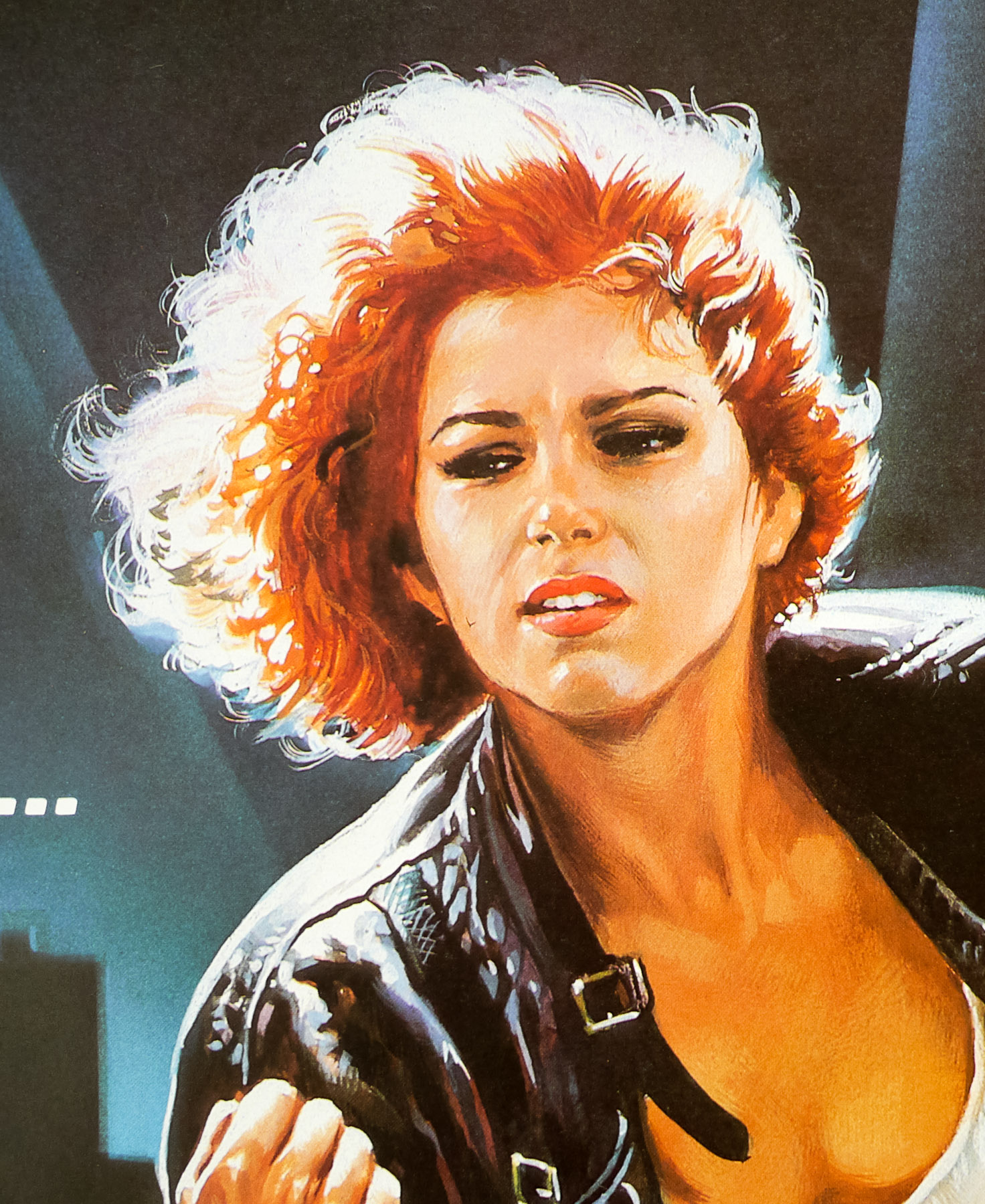
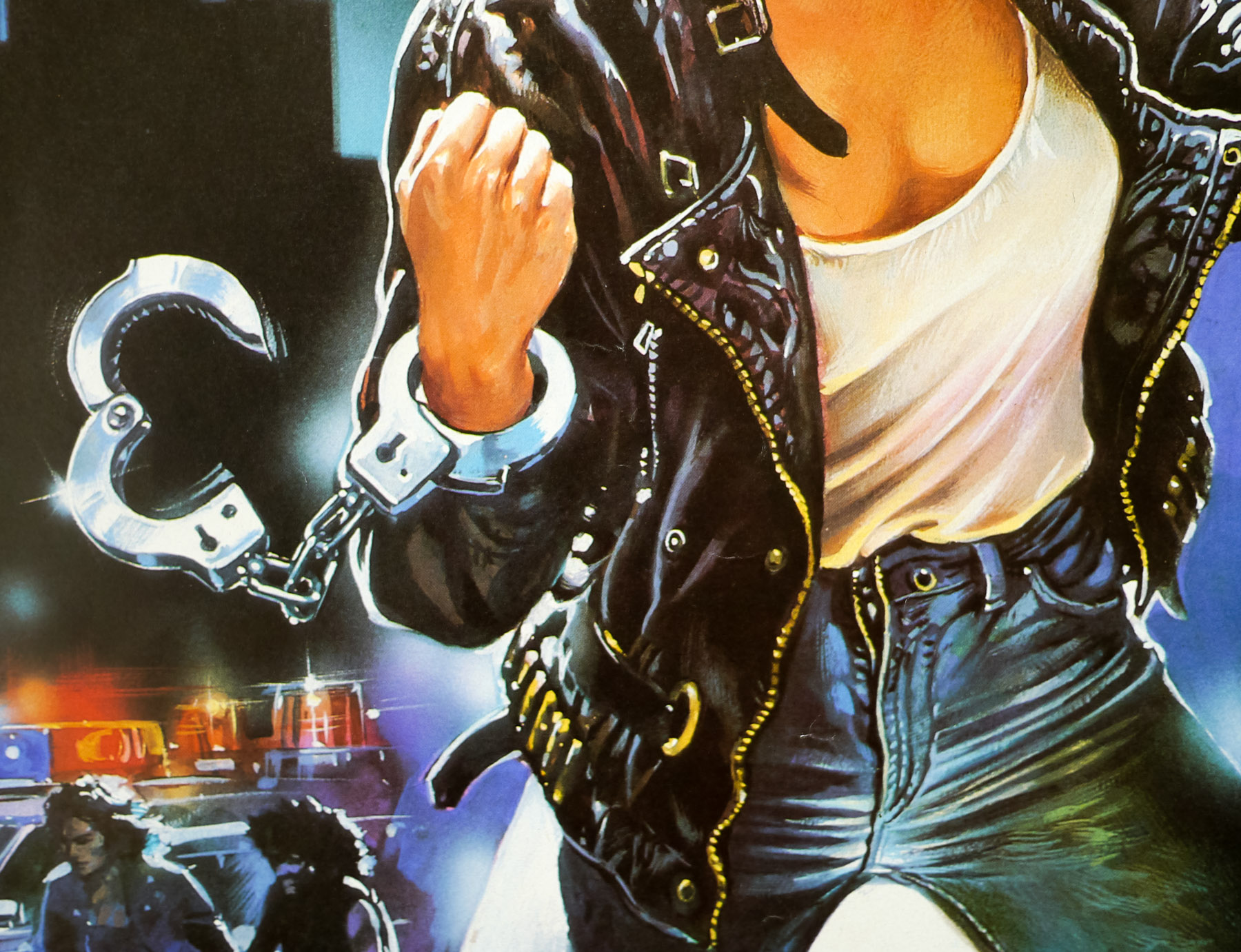
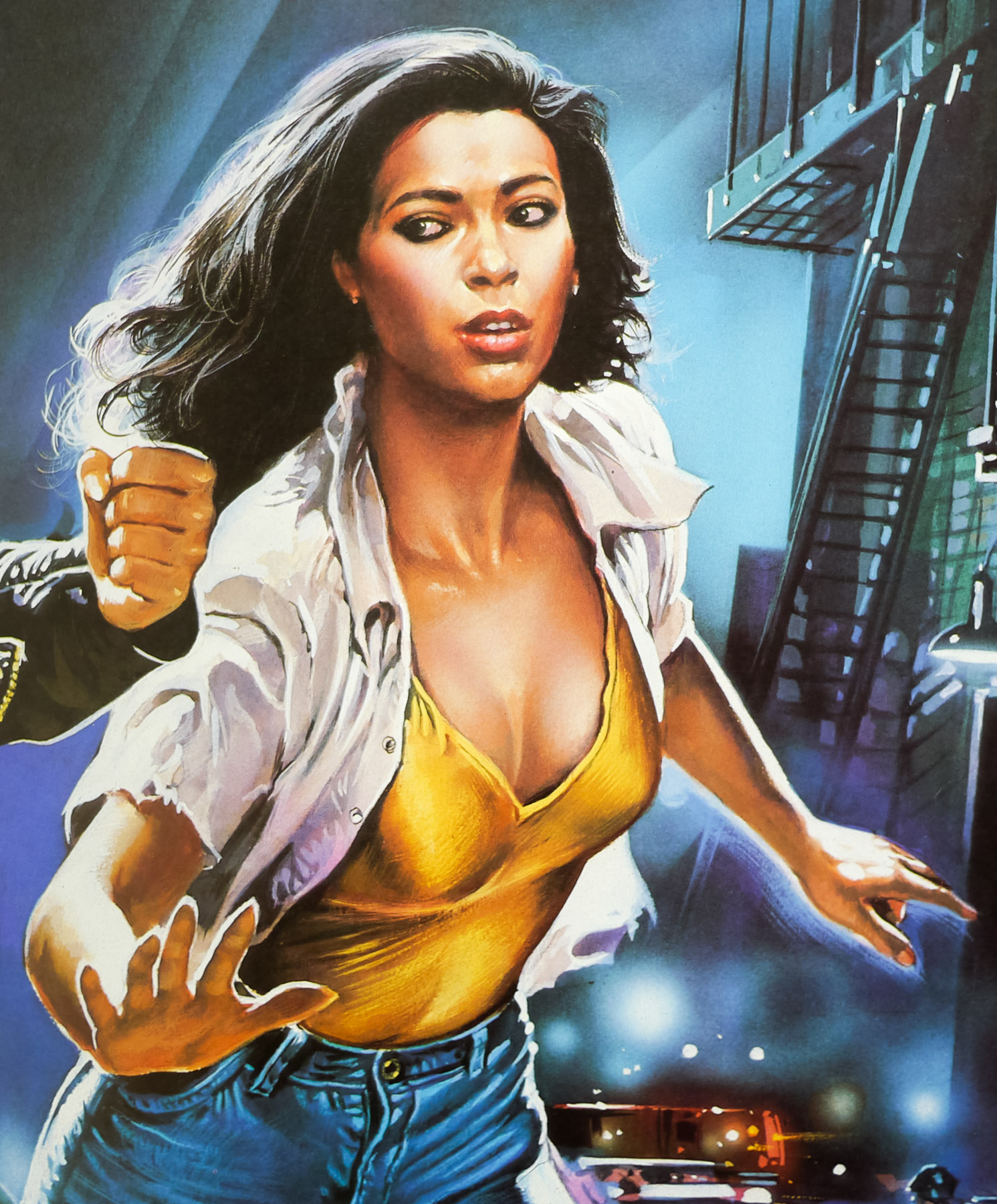
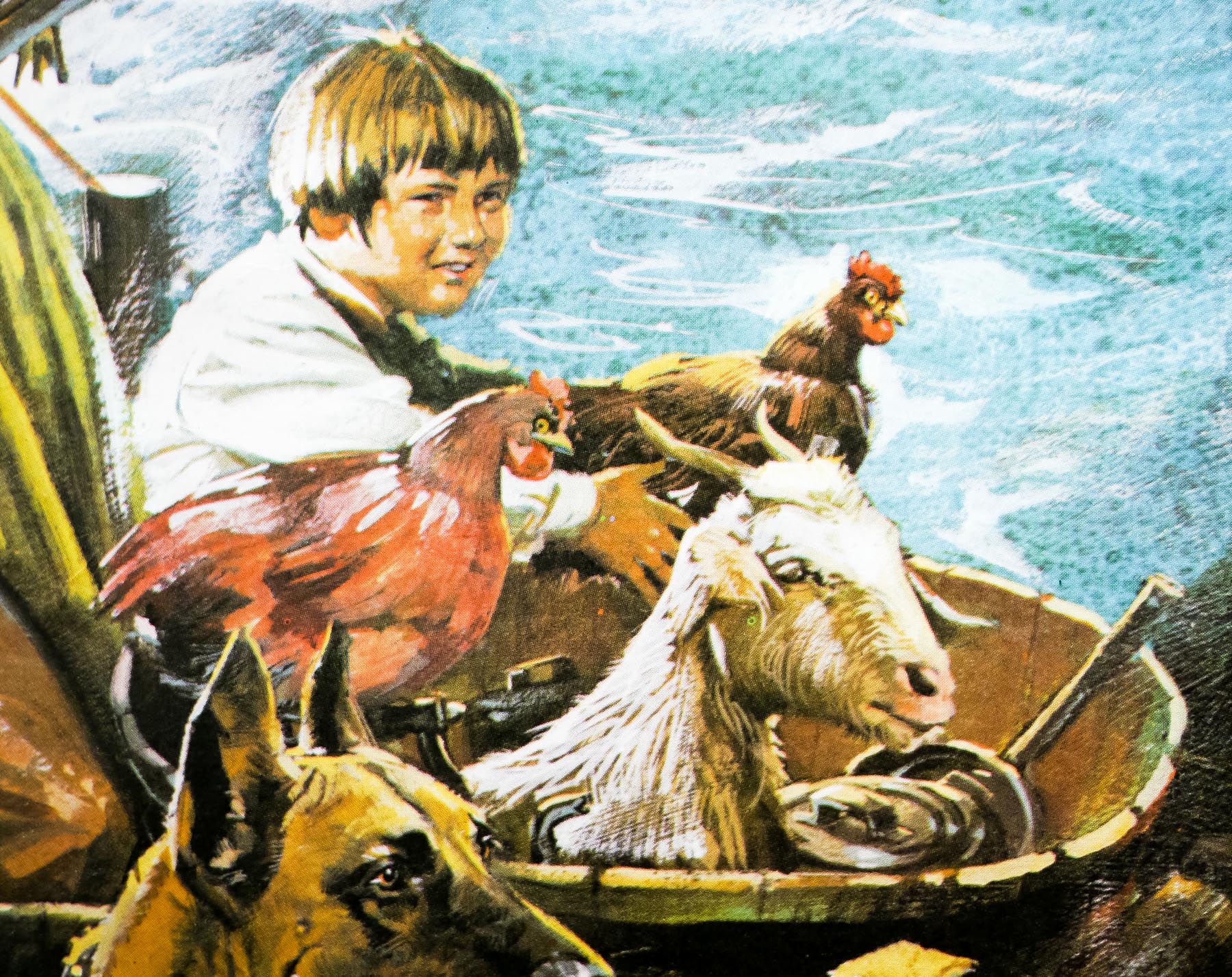
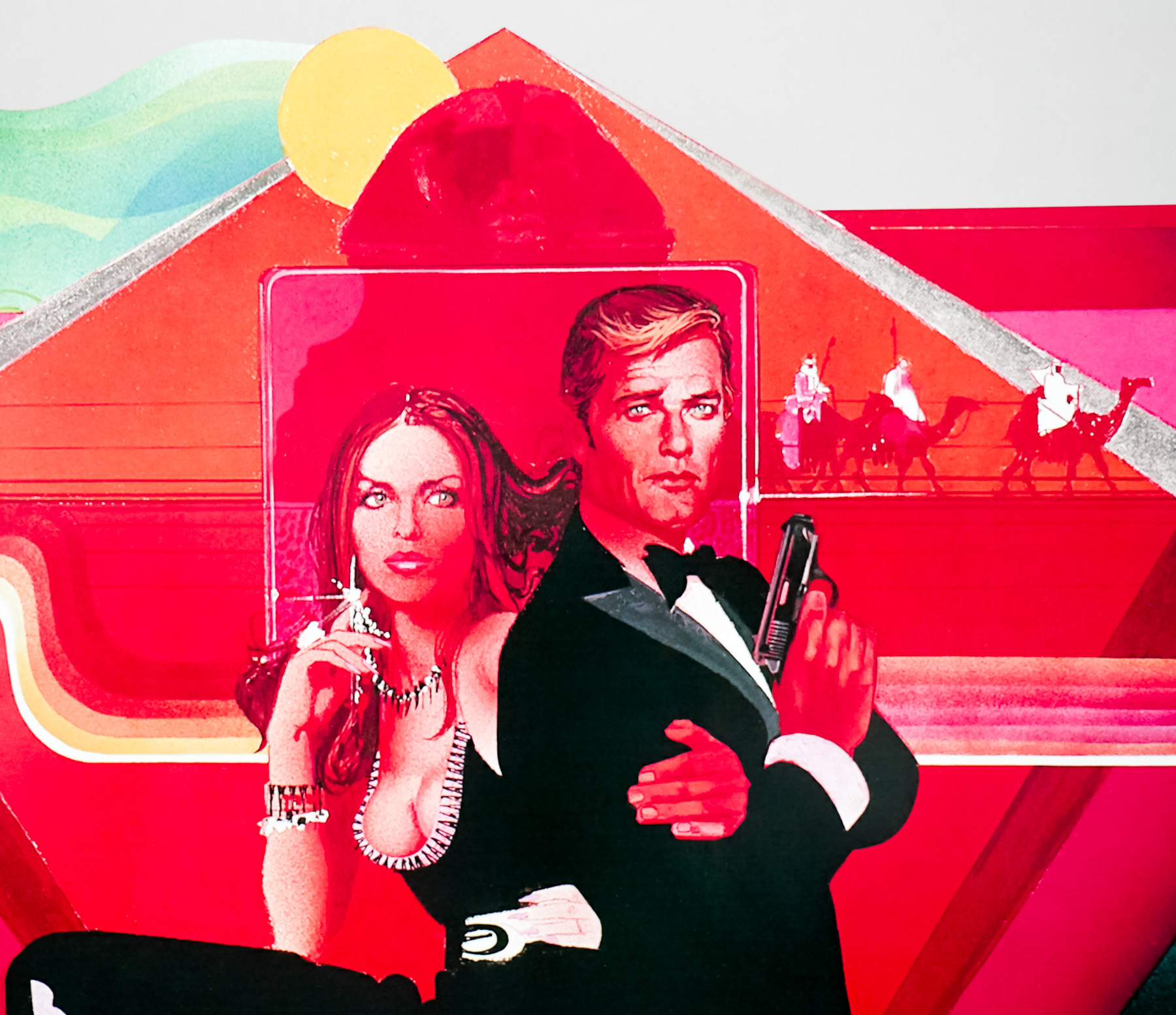
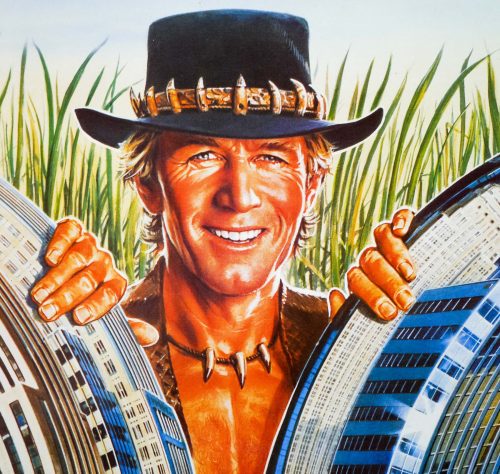
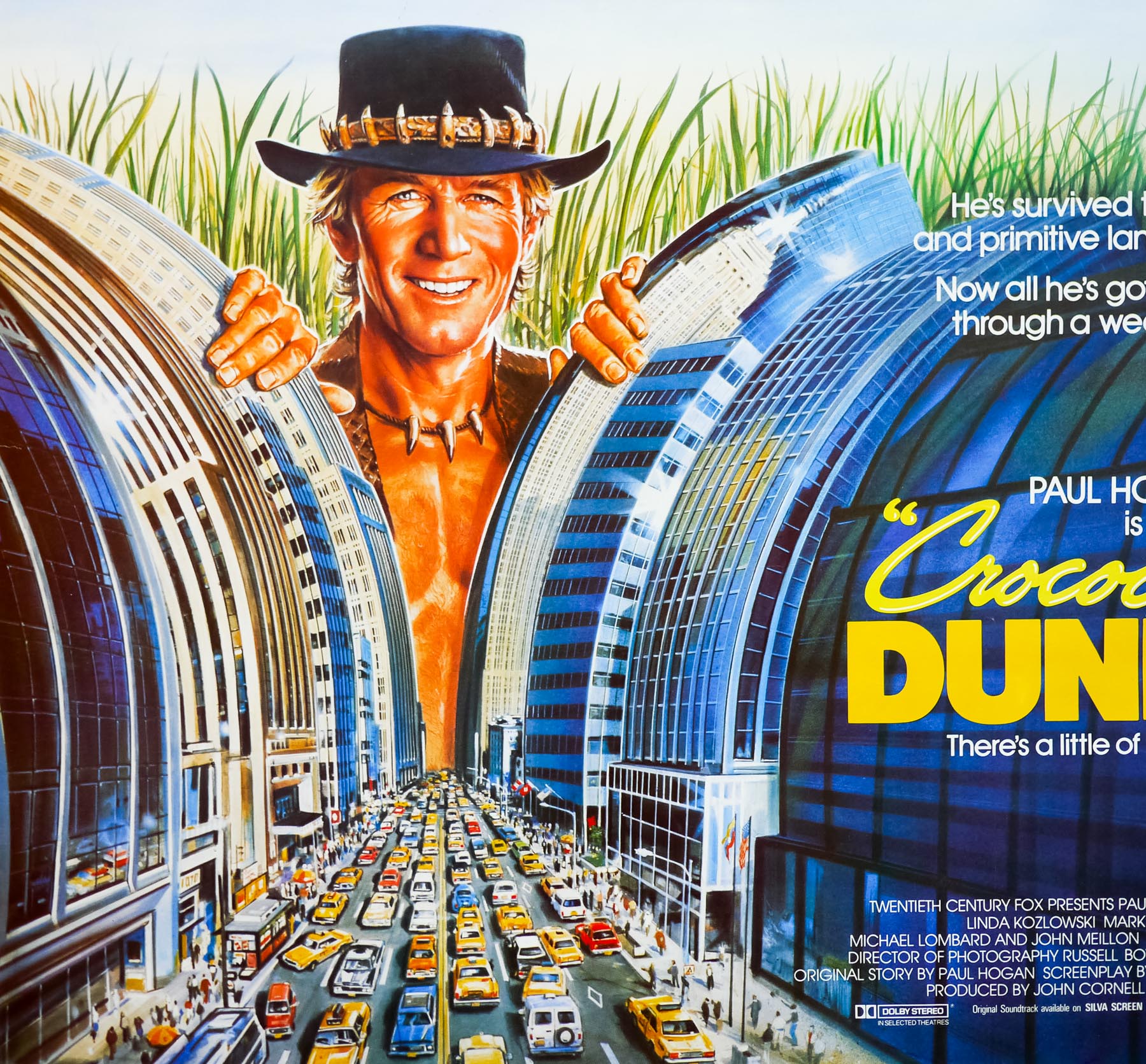
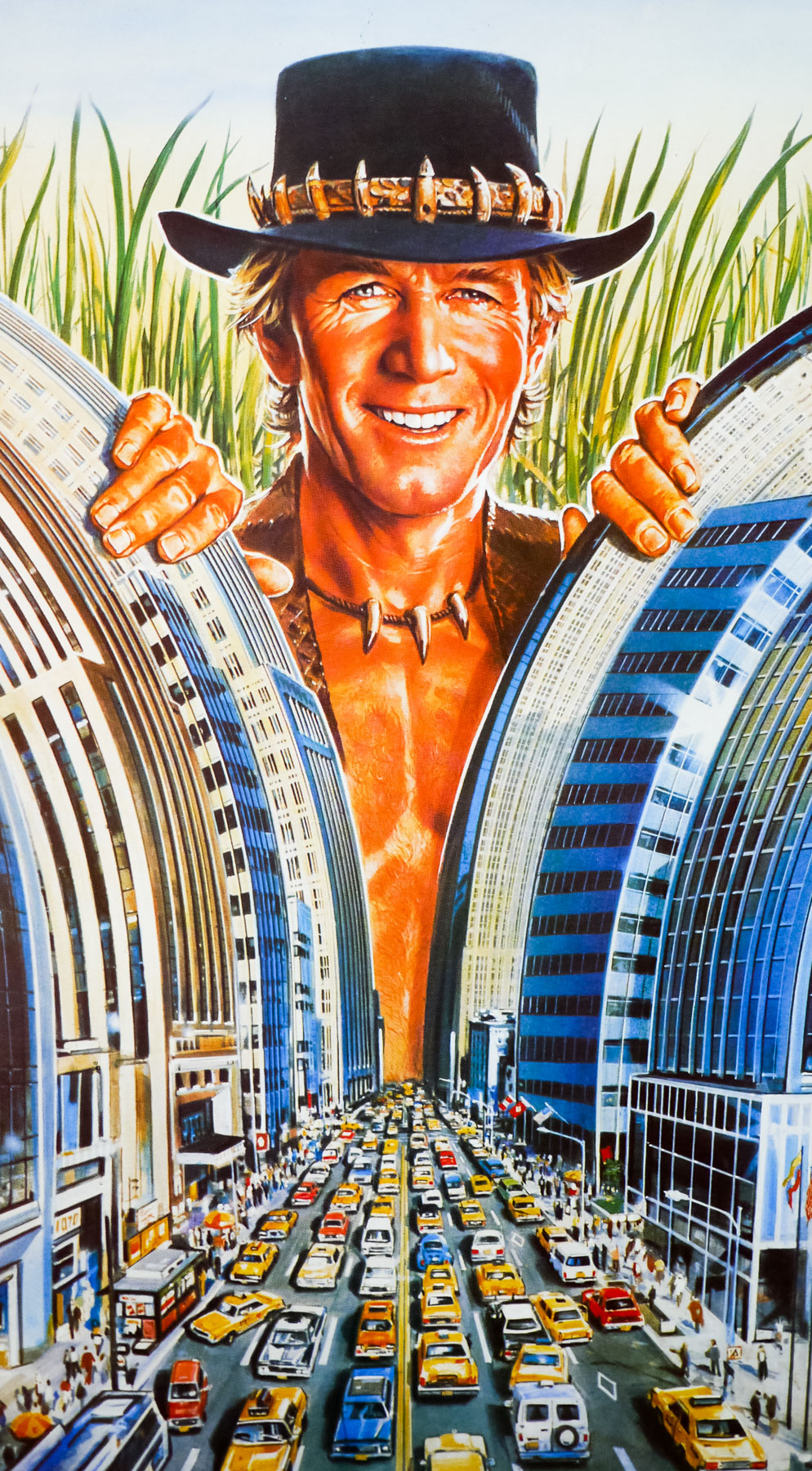
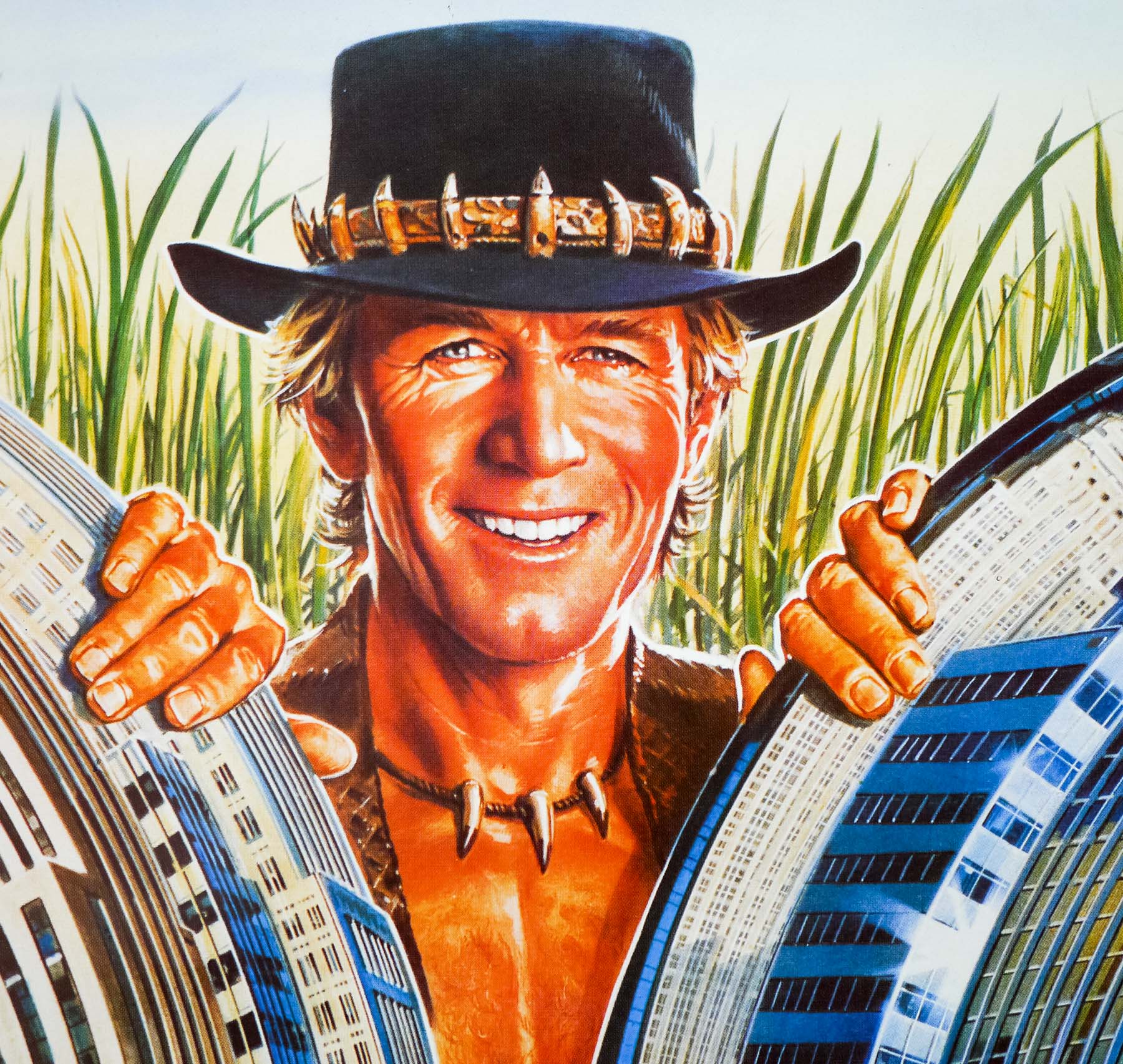
The artwork, which also featured on posters around the world, including the US one sheet, is by American poster artist Dan Goozee. An unknown UK artist is likely to have painted the extra windows on the right side to adapt the artwork to a landscape format. Goozee is perhaps best known for his work on several Bond posters, including Moonraker and Octopussy, as well as several other classic posters from the 1980s. The other designs I’ve collected by him can be seen here.
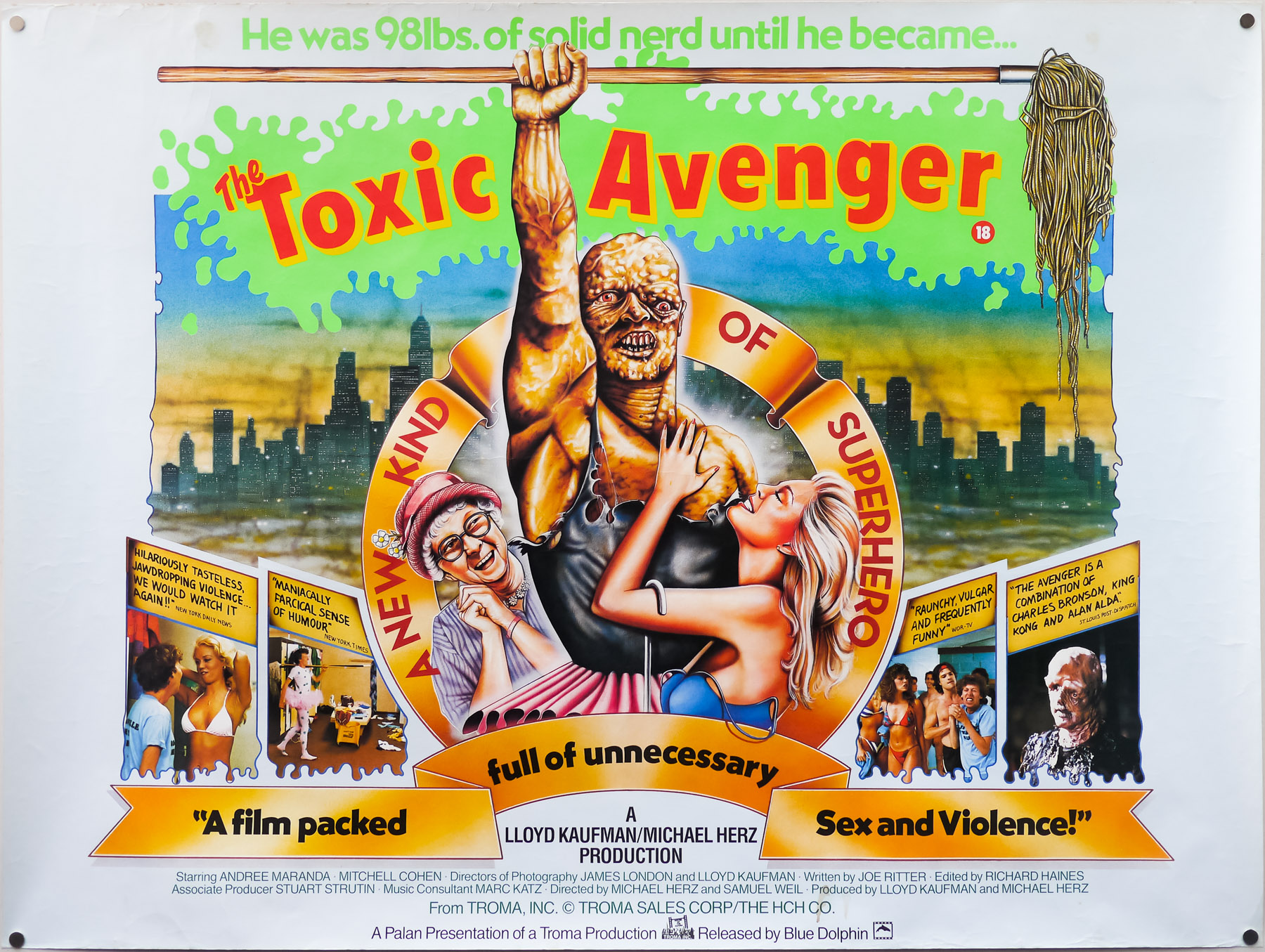
The Toxic Avenger / quad / UK

25.07.14

Poster Poster
Title
The Toxic Avenger
AKA
--
Year of Film
1984
Director
Michael Herz, Lloyd Kaufman
Starring
Andree Maranda, Mitch Cohen, Jennifer Prichard, Cindy Manion, Robert Prichard, Gary Schneider, Pat Ryan, Mark Torgl, Dick Martinsen
Origin of Film
USA
Genre(s) of Film
Andree Maranda, Mitch Cohen, Jennifer Prichard, Cindy Manion, Robert Prichard, Gary Schneider, Pat Ryan, Mark Torgl, Dick Martinsen,
Type of Poster
Quad
Style of Poster
--
Origin of Poster
UK
Year of Poster
1984
Designer
Unknown
Artist
Unknown
Size (inches)
30" x 40"
SS or DS
SS
NSS #
--
Tagline
He was 98 lbs. of solid nerd until he became... | A new kind of super hero

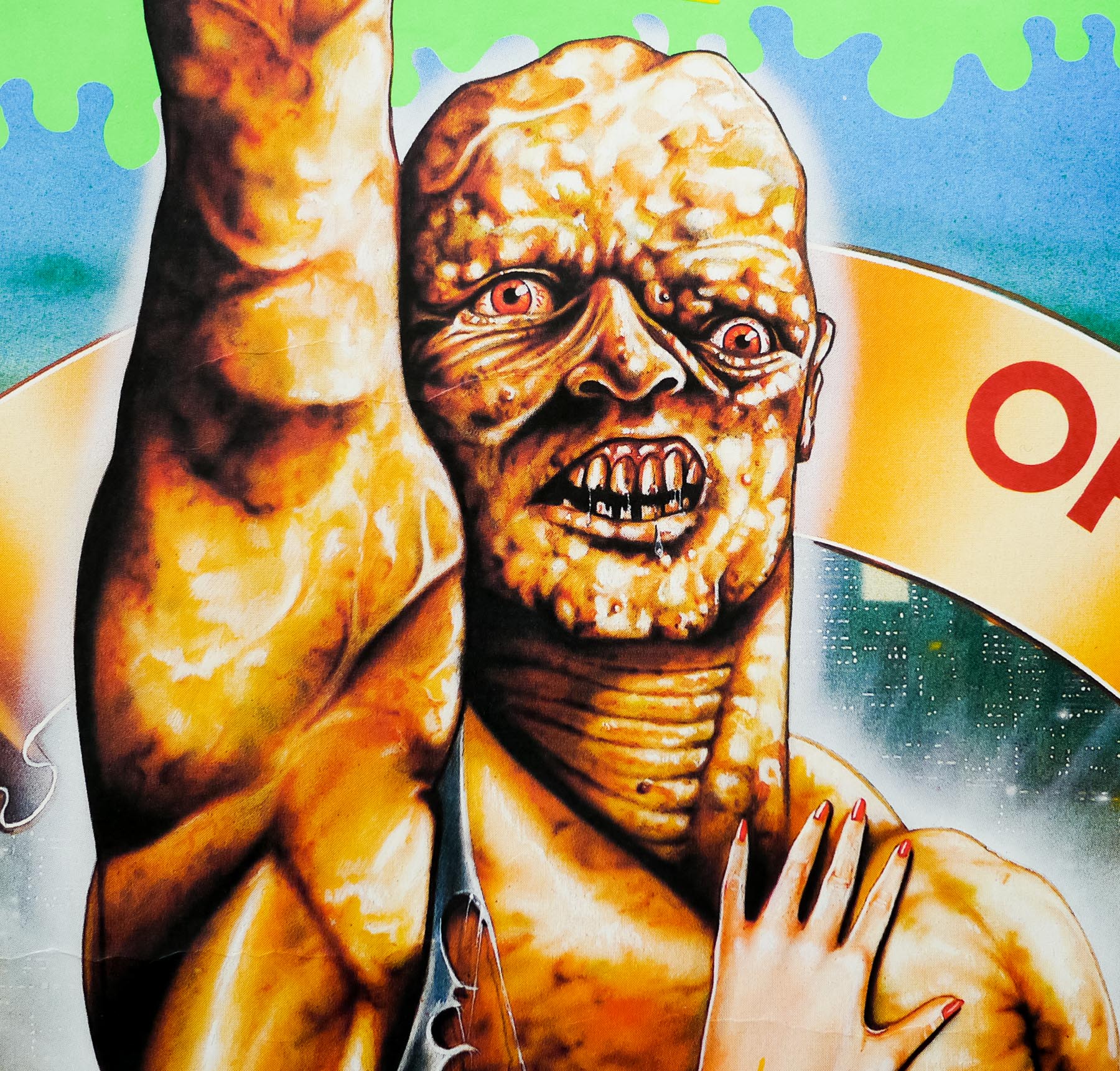
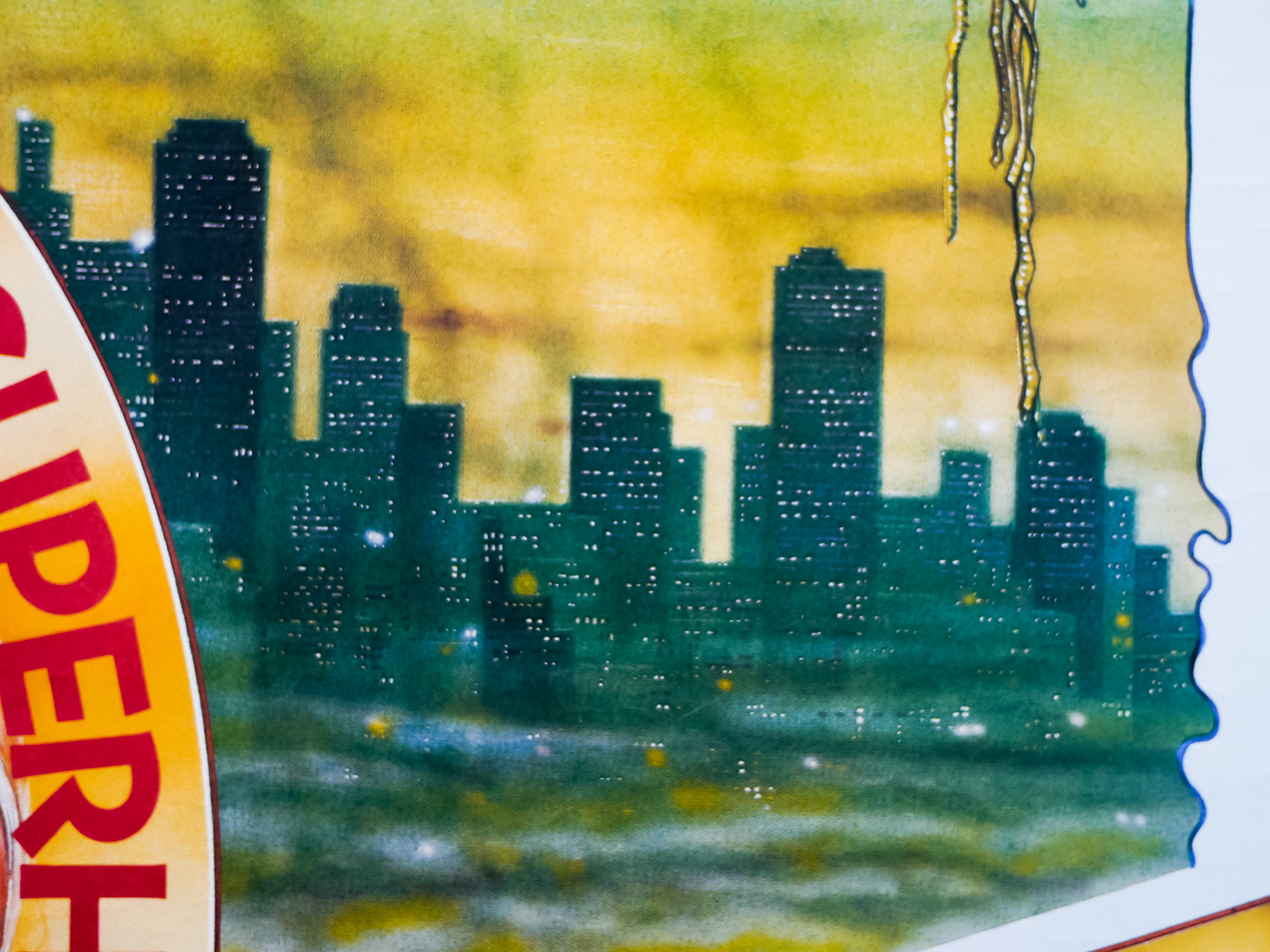
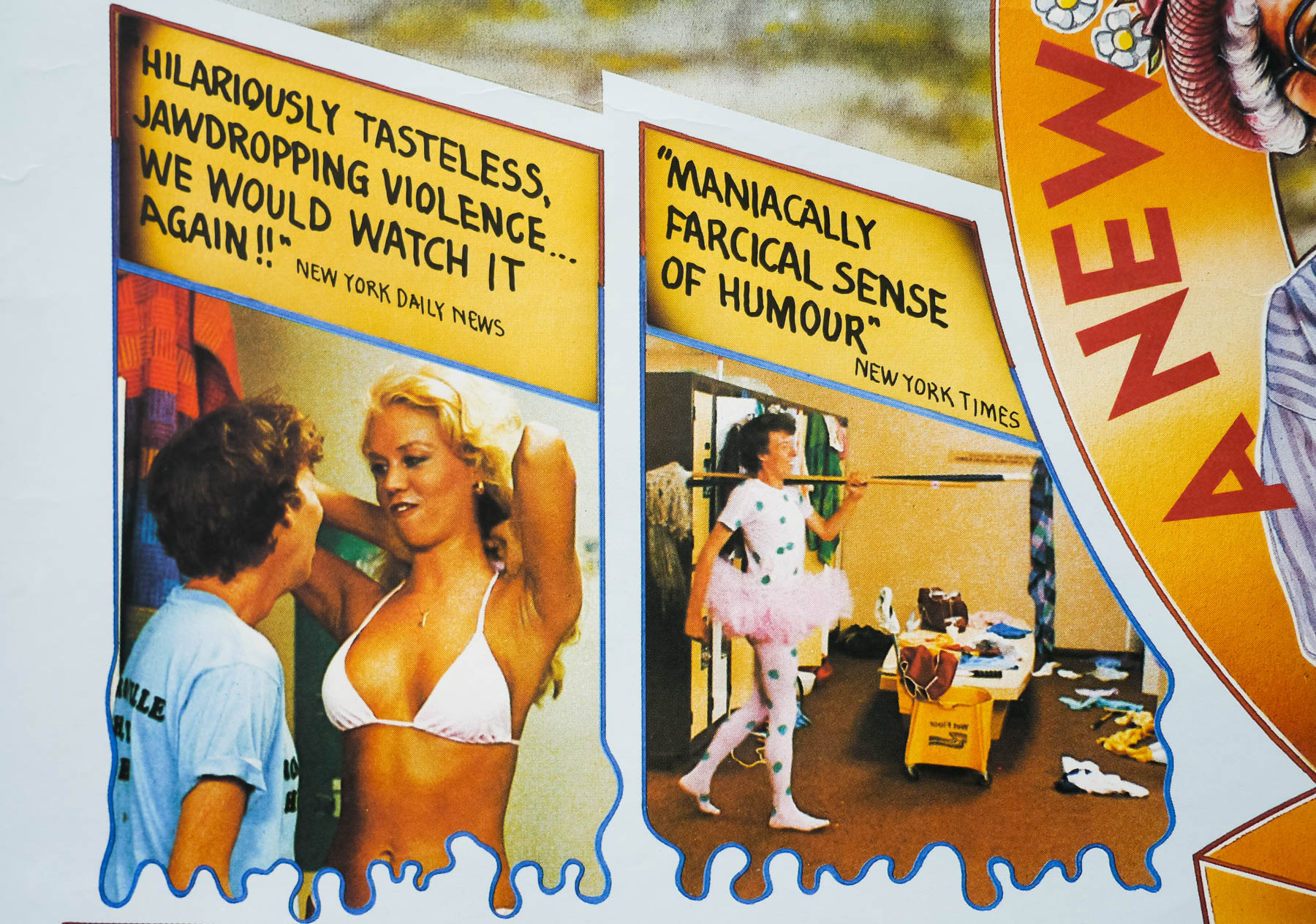
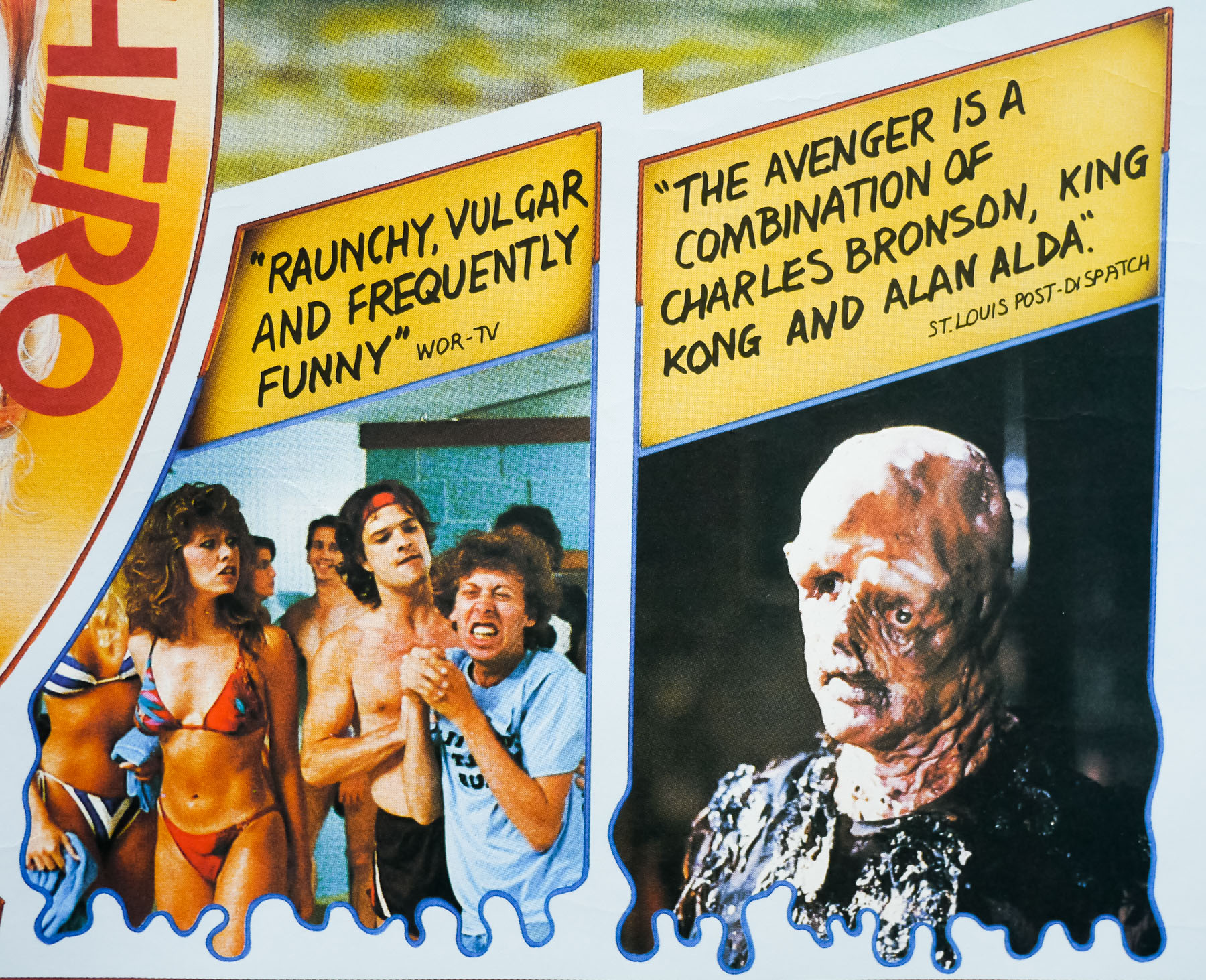
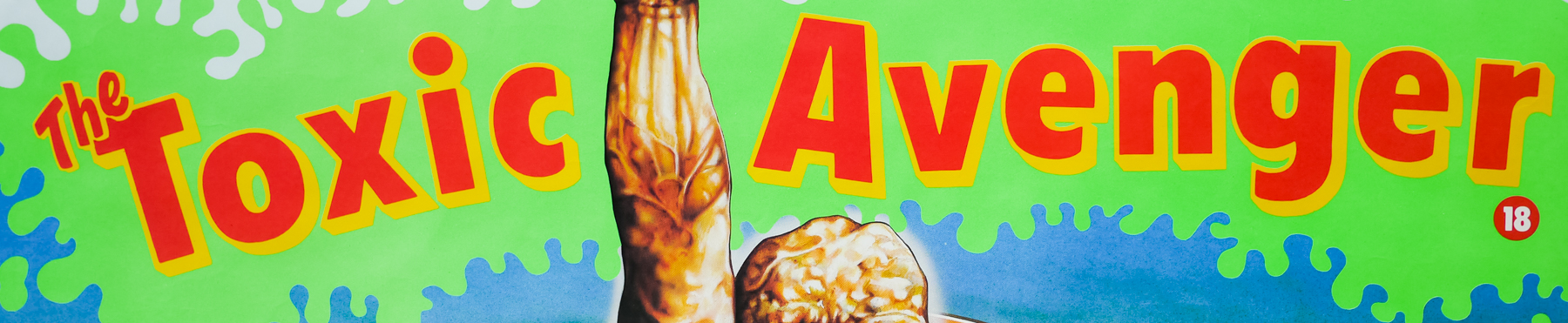
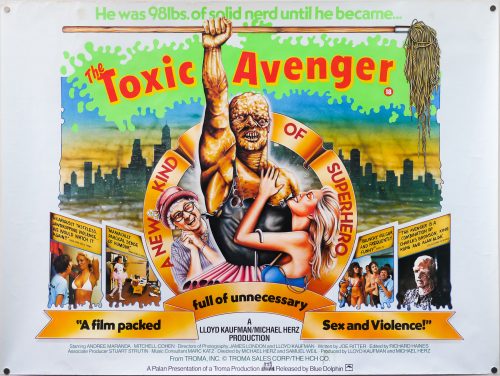
Released by the infamous American production and distribution company Troma, The Toxic Avenger was something of a box-office failure on its first release, but subsequent long-running shows on the midnight movie circuit at the Bleecker Street Cinemas in New York City helped to cement its current reputation as a cult classic. The film would go on to become Troma Studios’ most successful film, spawning numerous sequels, spinoffs and even a stage musical. The Toxic Avenger himself even features as their official mascot and this original entry is seen as the film that ‘built the house of Troma’.

Melvin Junko (Mark Torgl) is a social misfit working at the Tromaville Health Club as a down-trodden mop boy who is often at the receiving end of the cruel pranks of a pair of bullies called Bozo (Gary Schneider) and Slug (Robert Prichard) and their girlfriends. One day whilst being chased through the club Melvin jumps out of a second story window and lands in a vat of toxic waste, which burns his skin and completely disfigures him. After running home and jumping in a bath to try and wash the waste off he finds himself mutating into a creature of superhuman strength. The rest of the film sees Melvin fighting crime in Tromaville as the Toxic Avenger, menacing the corrupt mayor Peter Belgoody (Pat Ryan).

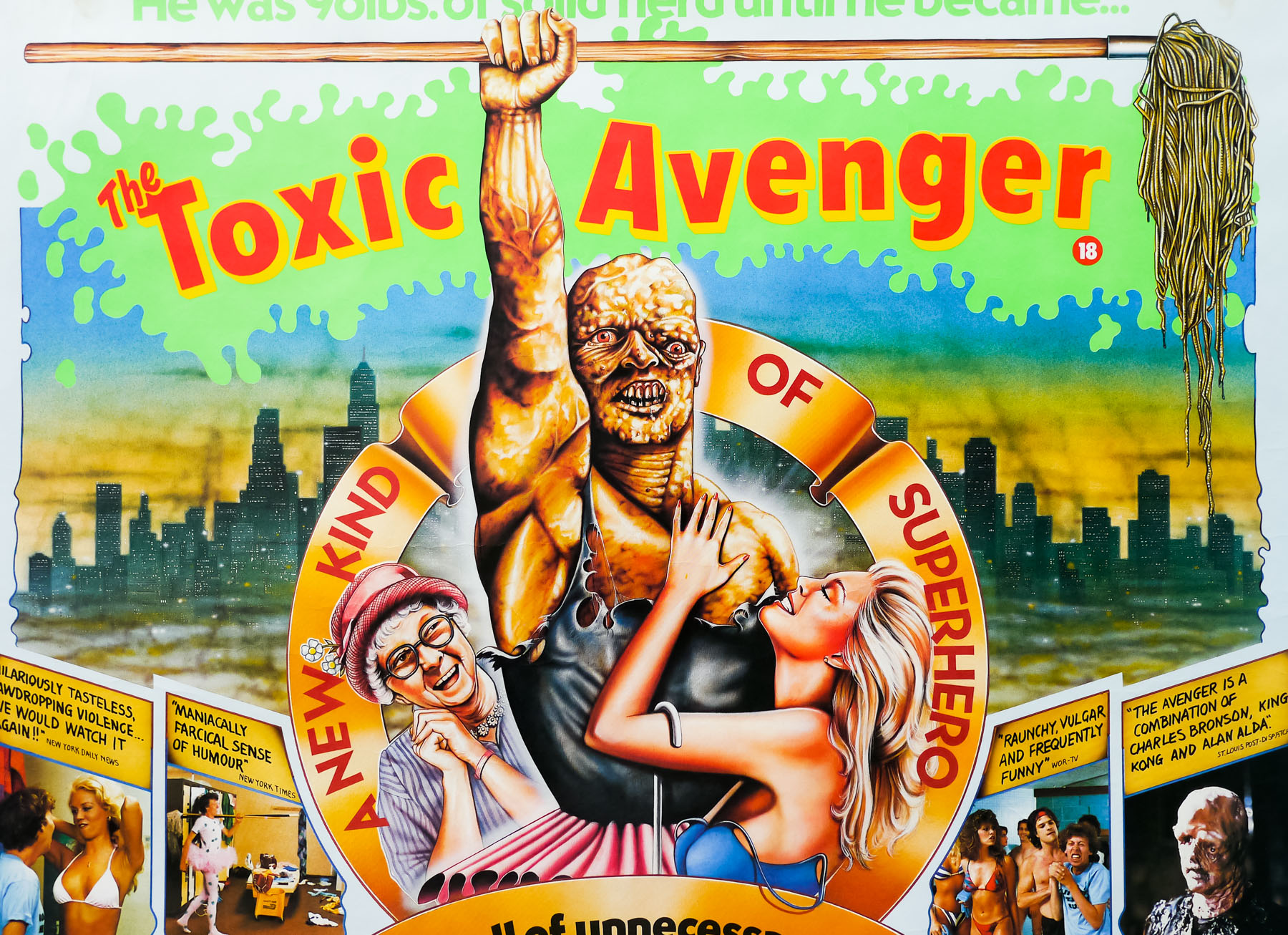
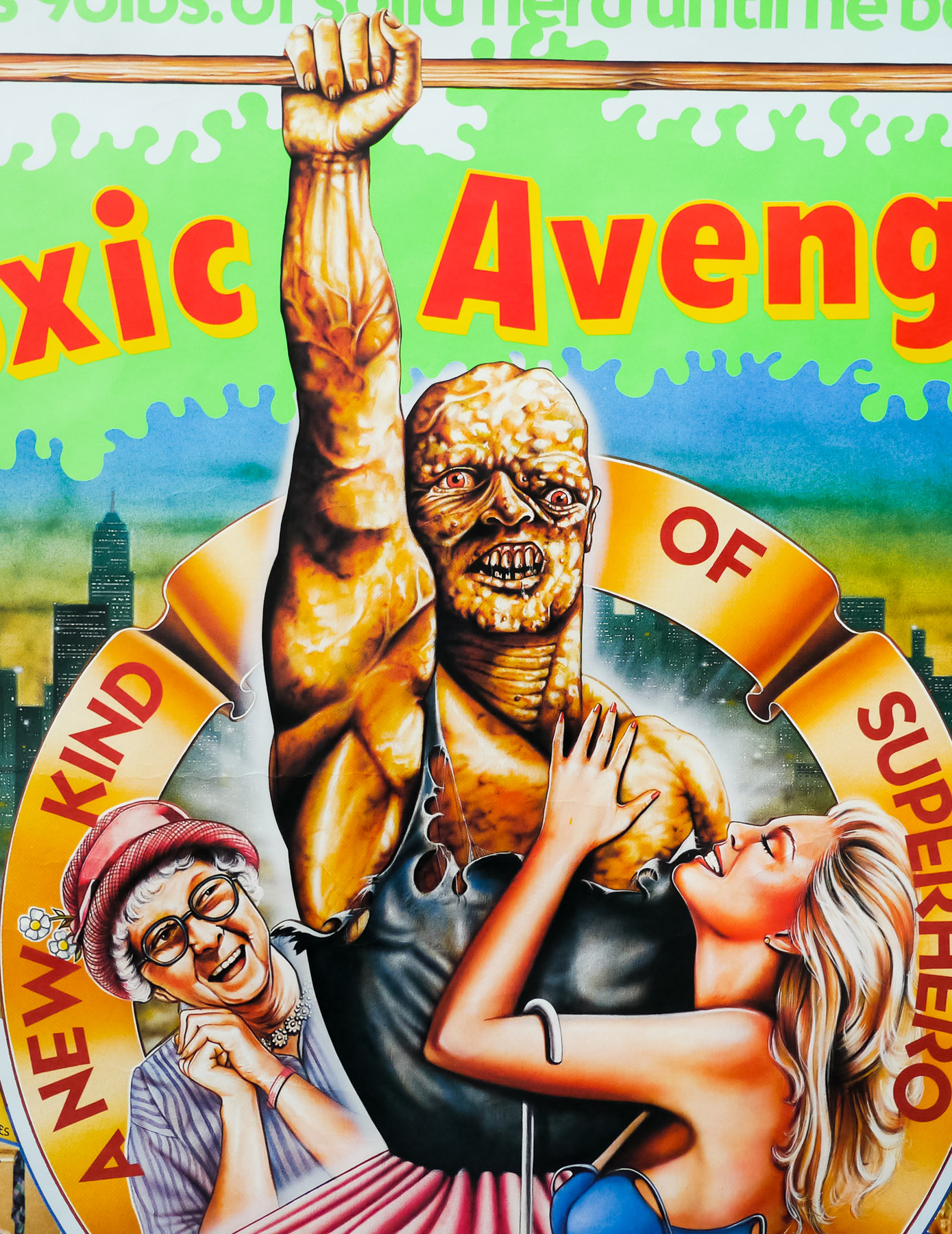
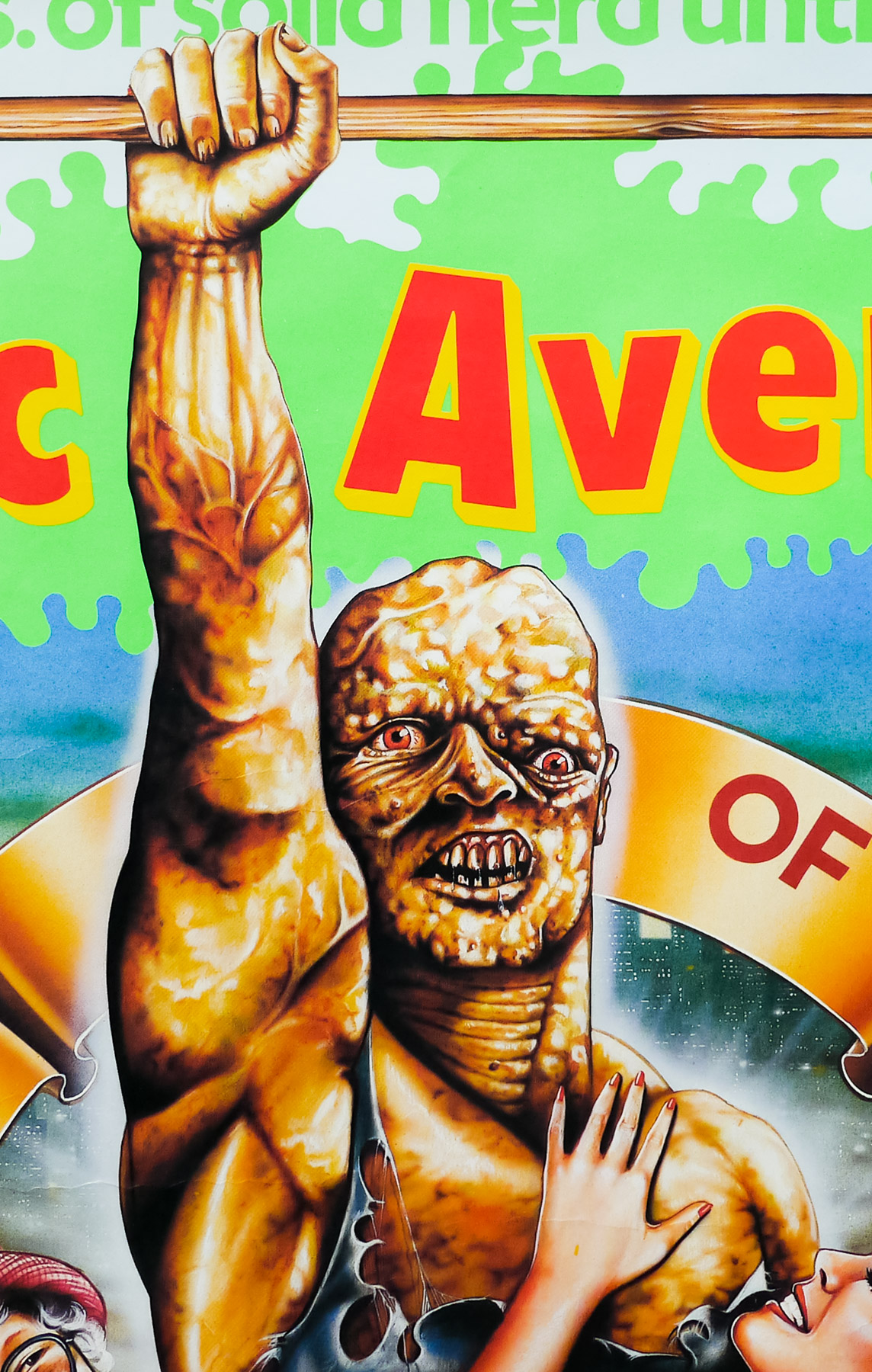
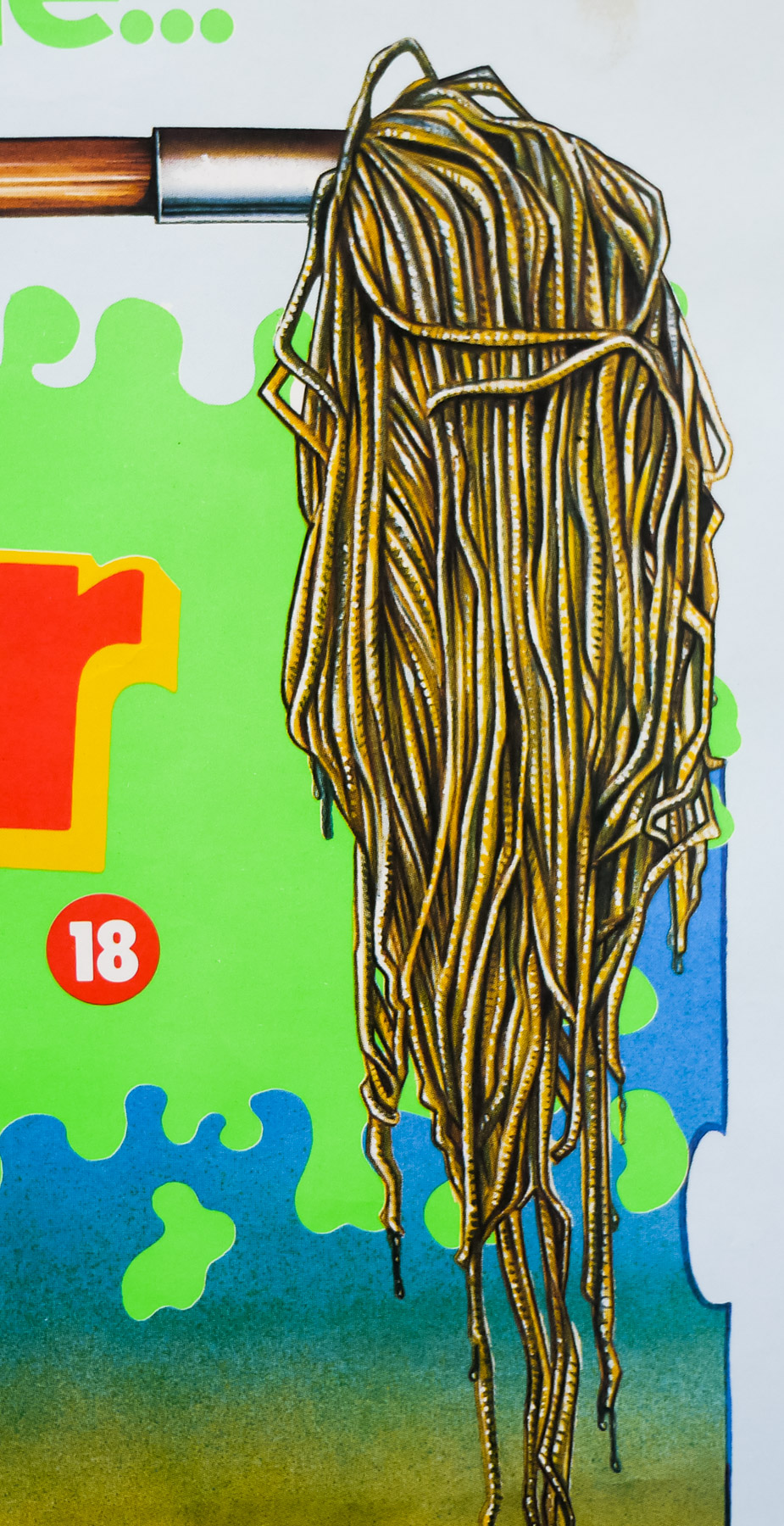
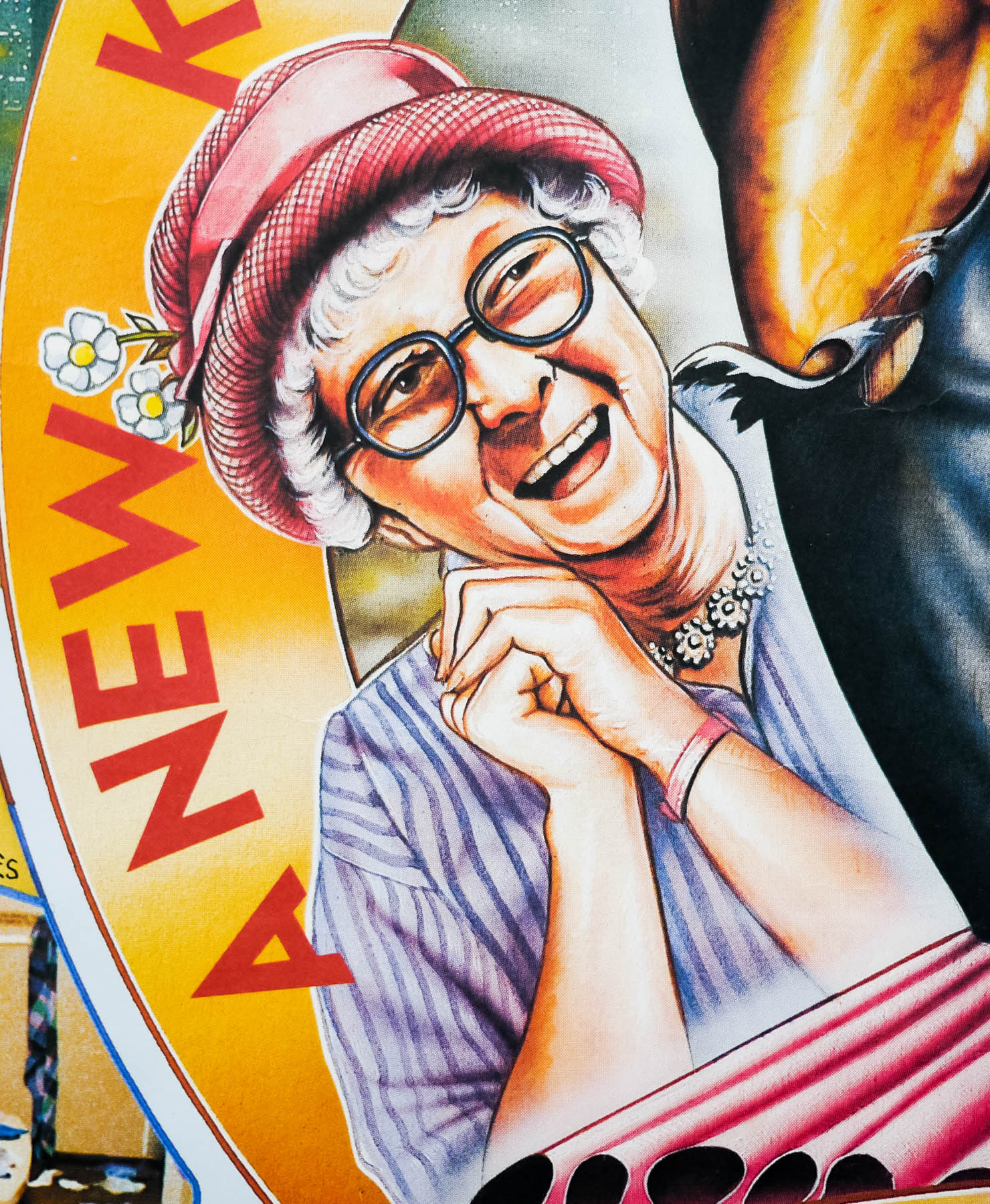
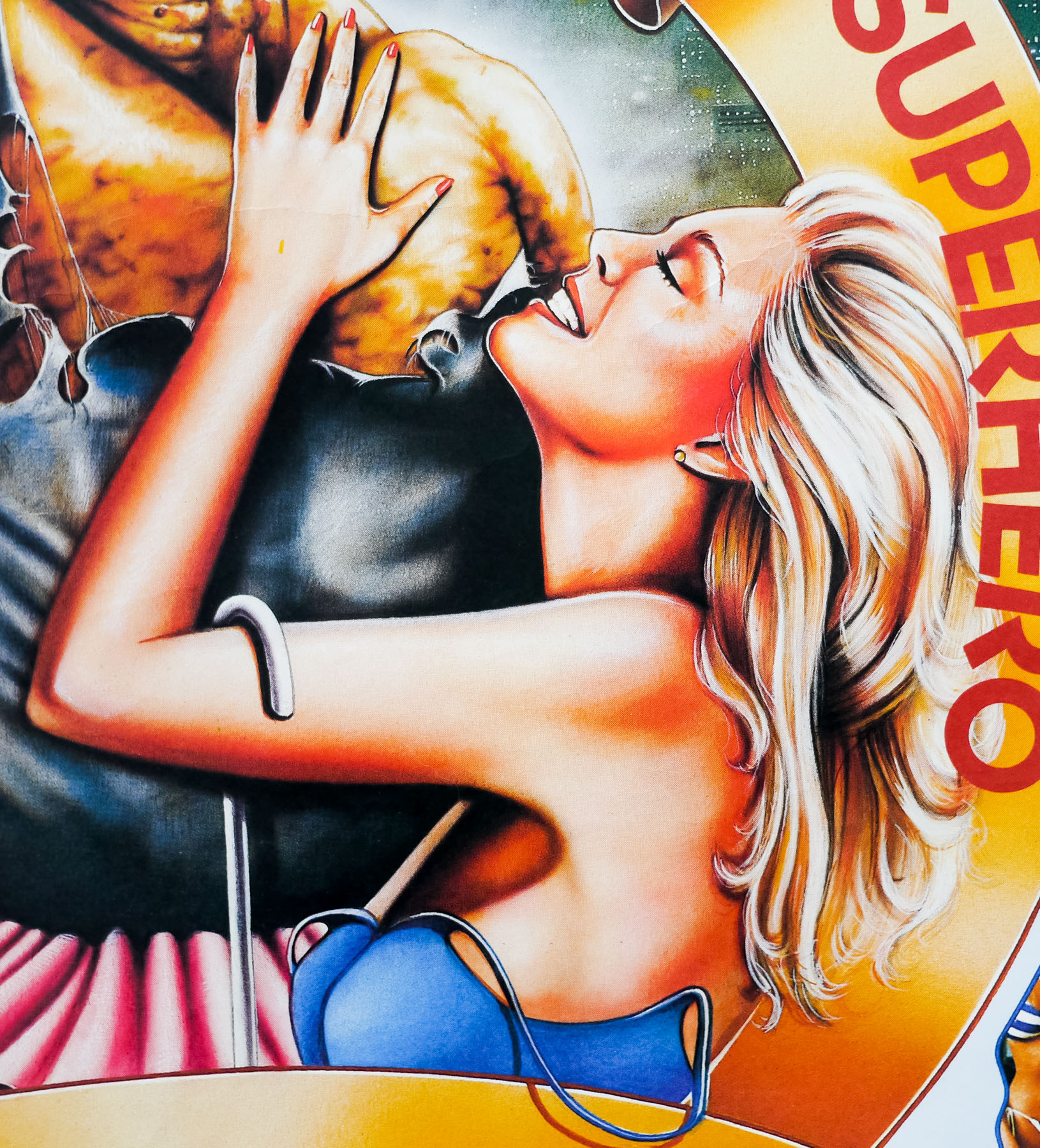
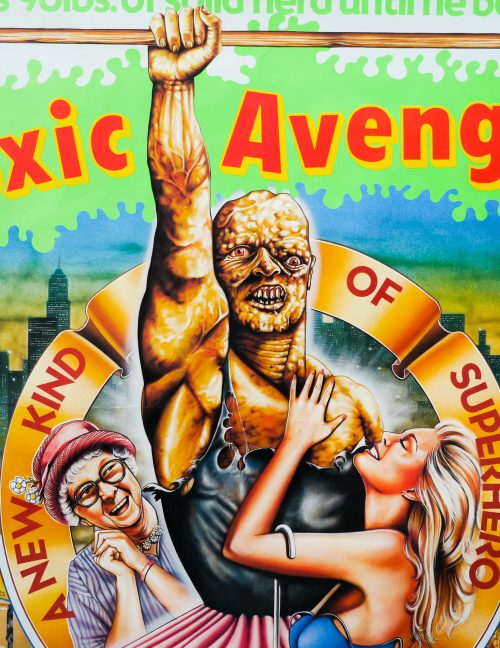
The artwork on this British quad is, as far as I’m aware, unique to the poster. I’ve been unable to discover who the artist responsible is so if you have any ideas please get in touch.

The superb original trailer can be viewed on YouTube.

House of Whipcord / quad / UK

12.12.14

Poster Poster
Title
House of Whipcord
AKA
Stag Model Slaughter (USA - reissue)
Year of Film
1974
Director
Pete Walker
Starring
Barbara Markham, Patrick Barr, Ray Brooks, Ann Michelle, Sheila Keith, Dorothy Gordon, Robert Tayman, Ivor Salter, Karan David, Celia Quicke
Origin of Film
UK
Genre(s) of Film
Barbara Markham, Patrick Barr, Ray Brooks, Ann Michelle, Sheila Keith, Dorothy Gordon, Robert Tayman, Ivor Salter, Karan David, Celia Quicke,
Type of Poster
Quad
Style of Poster
--
Origin of Poster
UK
Year of Poster
1974
Designer
Unknown
Artist
Unknown
Size (inches)
30" x 39 13/16"
SS or DS
SS
Tagline
... and no one escaped...

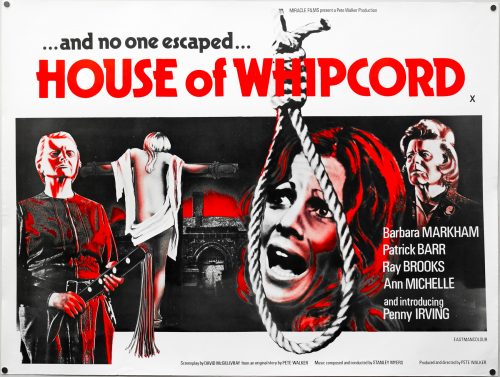
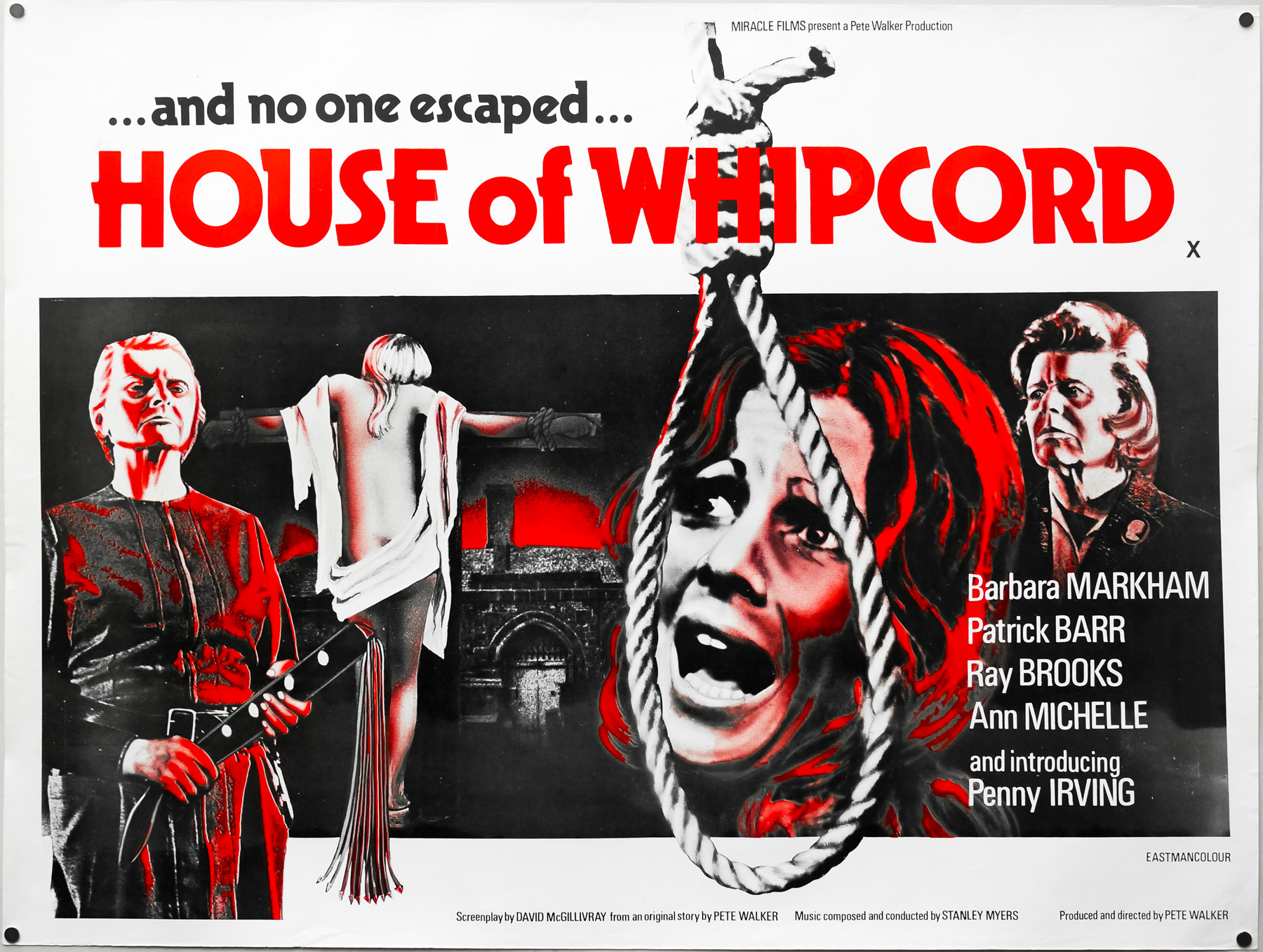
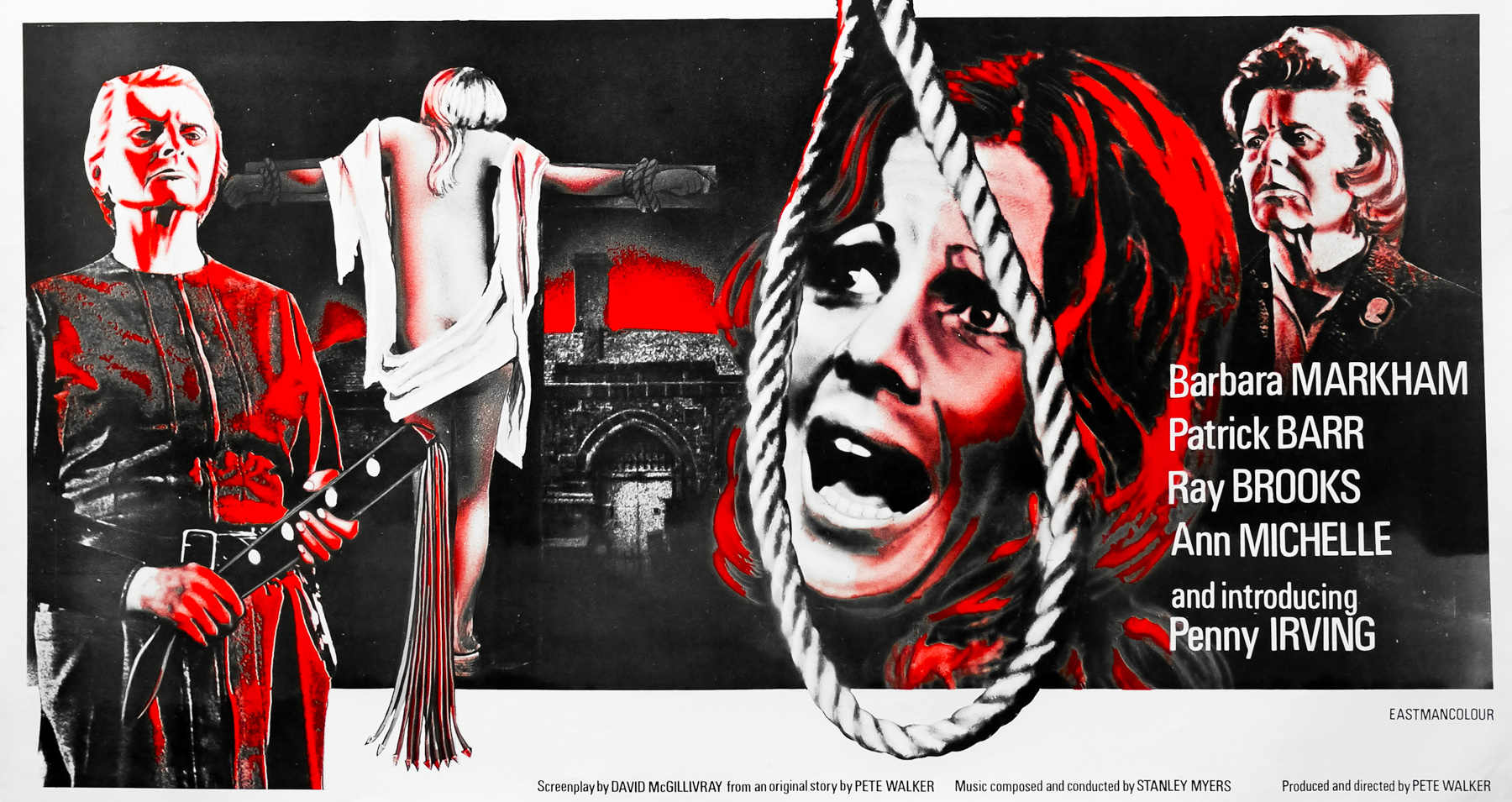
This is the original UK quad for the release of House of Whipcord from the British director, producer and writer Pete Walker, who specialised in exploitation pictures during the 1960s and 1970s. Walker started out making shoestring budget sexploitation pictures, including School for Sex that were often relative hits in the UK, which worked out well for him since his films were almost always self-financed and thus most of the profits were his to keep and plough into the next feature. In the early 1970s, Walker grew tired of feeding the ‘dirty mack brigade’ and turned his hand to horror.

Whipcord is certainly one of the directors most memorable films and had a plot that was all but guaranteed to rile certain sections of the British press at the time of release. The film begins in London and focuses on young French model Ann-Marie Di Verney (Penny Irving) who has moved to the capital and has started to pose in nude photoshoots. One evening she is seduced by a mysterious character named, rather ominously Mark E. Desade (played by Robert Tayman) and a relationship develops between the pair. Sometime later Mark invites Ann-Marie to ‘visit his parents’ who live out in the country and only when she arrives does she realise that it was all a ruse to get Ann-Marie into a secret illegal prison which is being ruled over by his unhinged mother Mrs Wakehurst (Barbara Markham) and three ‘guards’, including the sadistic Walker (a memorable performance from regular collaborator Sheila Keith – note the character name!)

Mrs Wakehurst is a former school mistress whose corrupt regime led one of her charges to commit suicide but, believing she did nothing wrong and that lax morals led to the corruption in the school, she seduced the judge who was trying her, Justice Bailey (Patrick Barr), and managed to escape sentence. She then persuaded him to set up what he believed would be a private correctional institute in which ‘girls with loose morals’ would be ‘reeducated’ properly and then let back into the world. As Ann Marie and other inmates discover, the truth is far more horrifying.

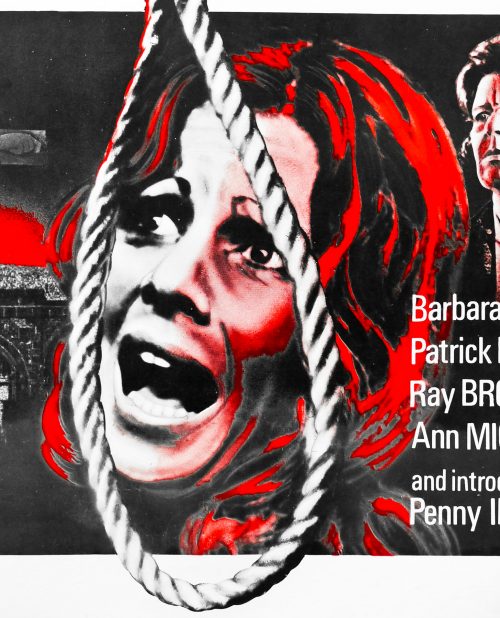
The film was critically mauled over here but did solid business in cinemas and was later released in US cinemas through AIP. I’m unsure who is responsible for the design and artwork on this poster so if you have any ideas please get in touch.

The original trailer can be viewed here.

The Princess Bride / quad / UK

31.03.15

Poster Poster
Title
The Princess Bride
AKA
Princess Bride Story (Japan - English title) | La storia fantastica [The fantastic story] Italy
Year of Film
1987
Director
Rob Reiner
Starring
Cary Elwes, Robin Wright, Mandy Patinkin, Chris Sarandon, André the Giant, Christopher Guest, Peter Falk, Fred Savage, Wallace Shawn, Billy Crystal, Carol Kane
Origin of Film
USA
Genre(s) of Film
Cary Elwes, Robin Wright, Mandy Patinkin, Chris Sarandon, André the Giant, Christopher Guest, Peter Falk, Fred Savage, Wallace Shawn, Billy Crystal, Carol Kane,
Type of Poster
Quad
Style of Poster
--
Origin of Poster
UK
Year of Poster
1988
Designer
Hat Art Ltd.
Artist
Steve Crisp
Size (inches)
30" x 39 15/16"
SS or DS
SS
NSS #
--
Tagline
Heroes. Giants. Villains. Wizards. True Love. Not just your basic, average, everyday, ordinary, run-of-the-mill, ho-hum fairy tale.

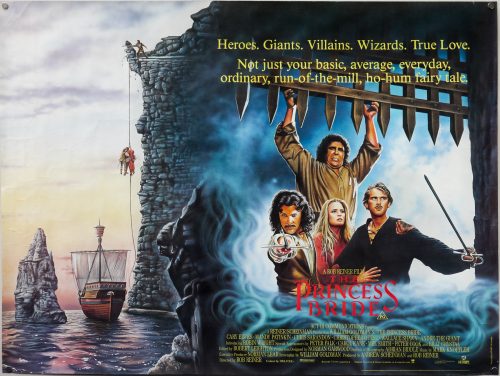
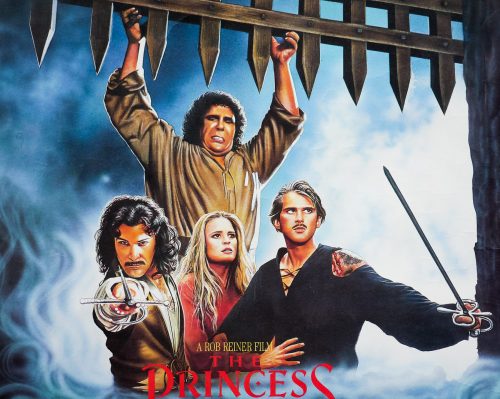
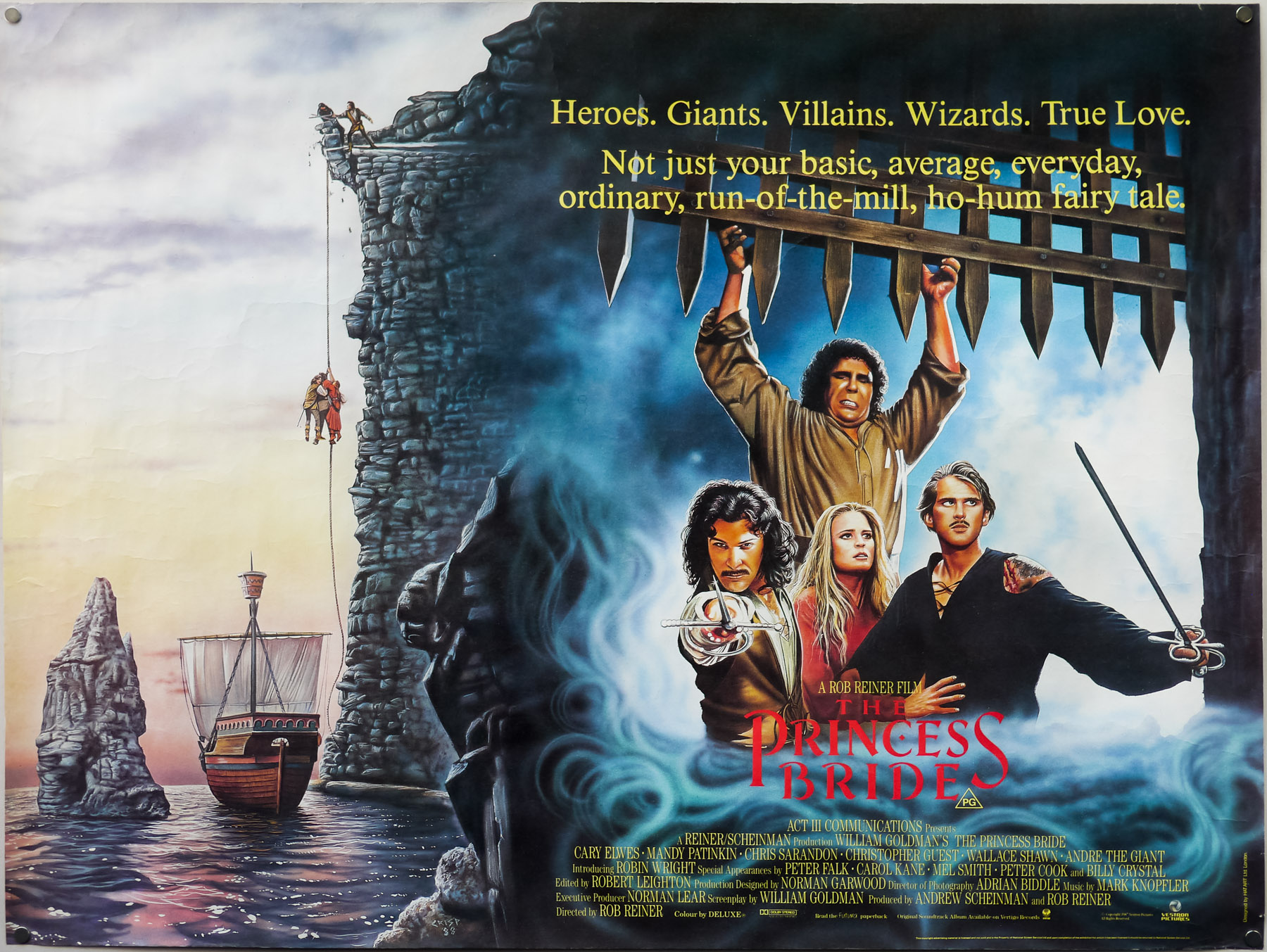
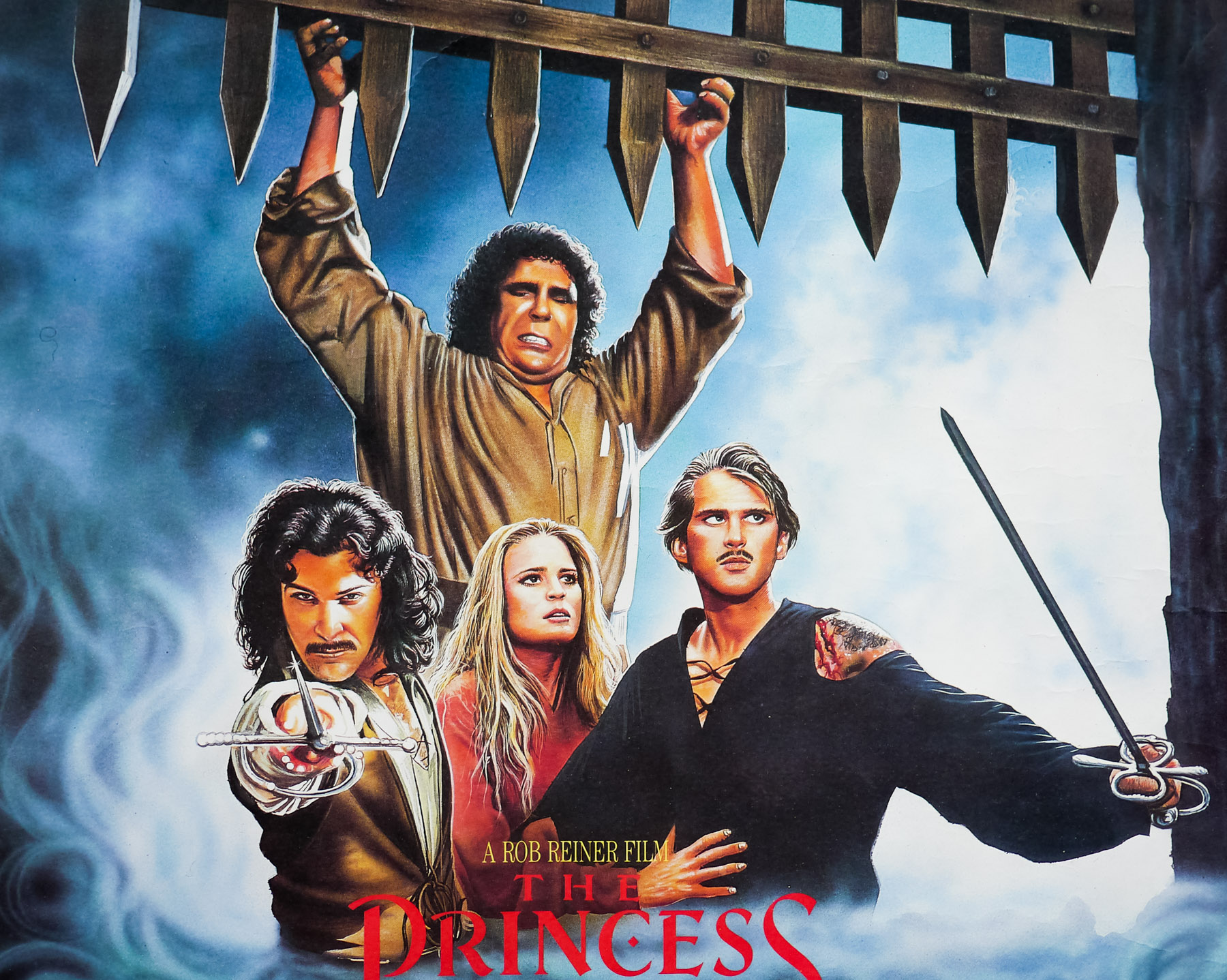
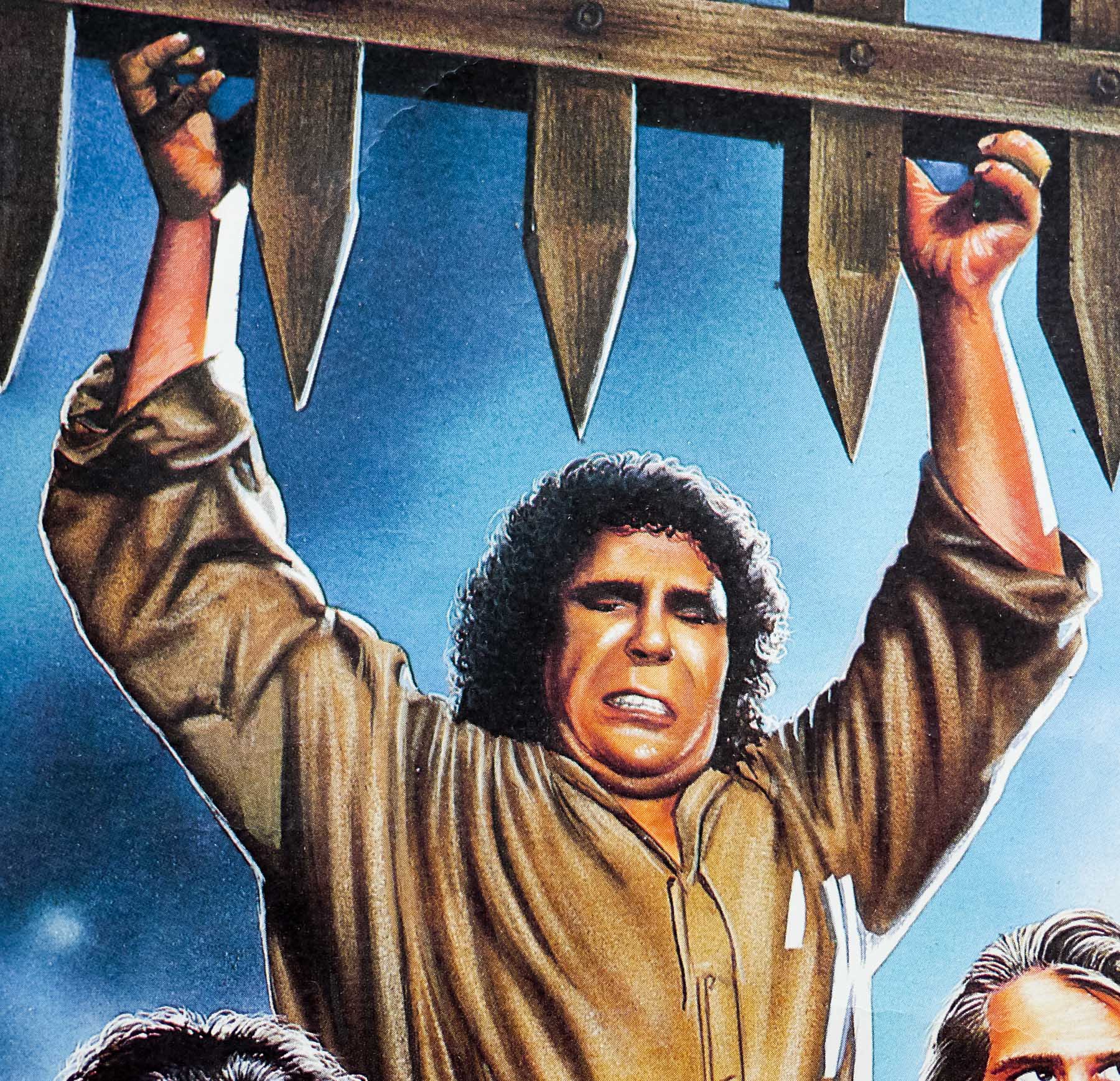
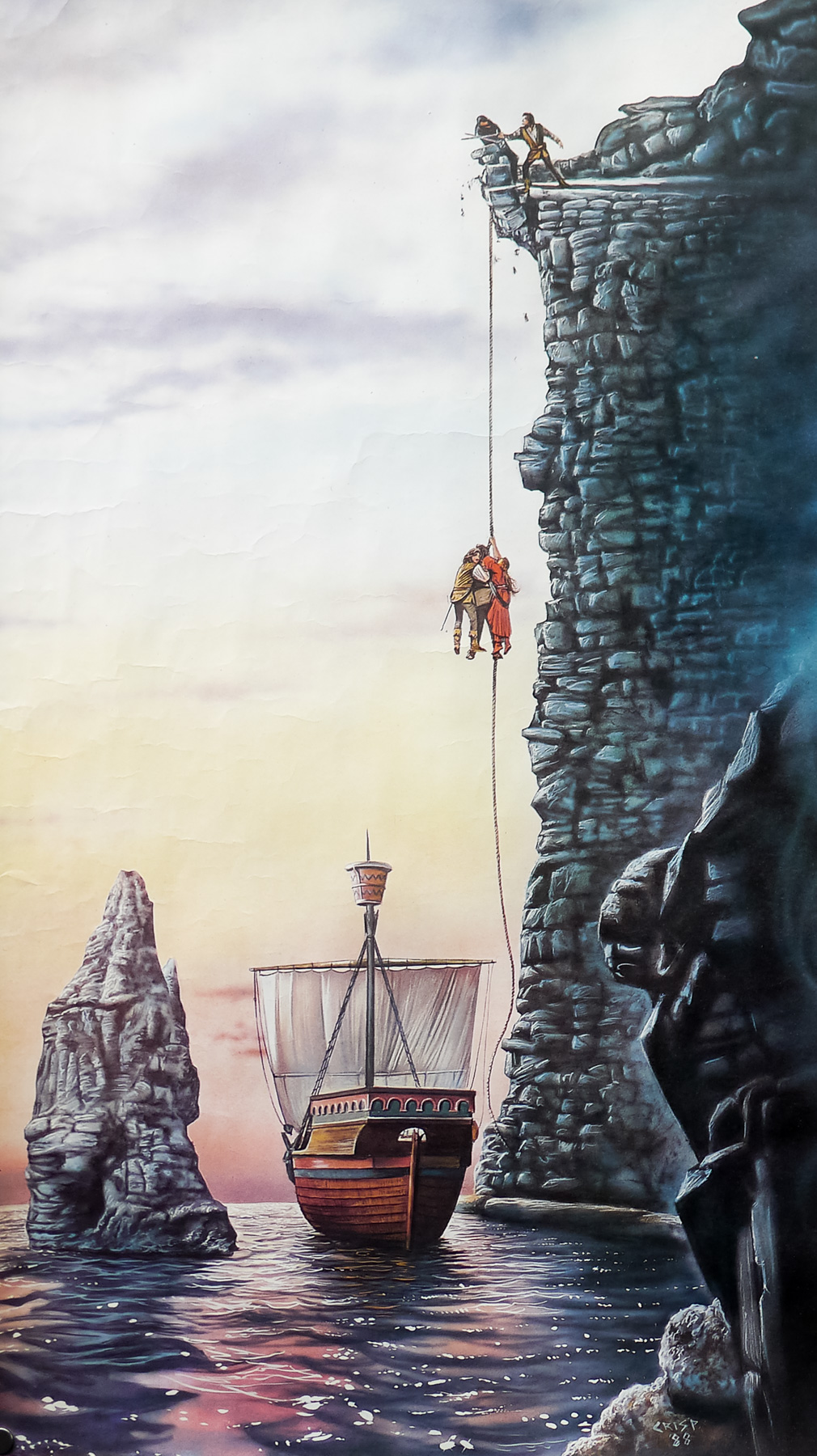
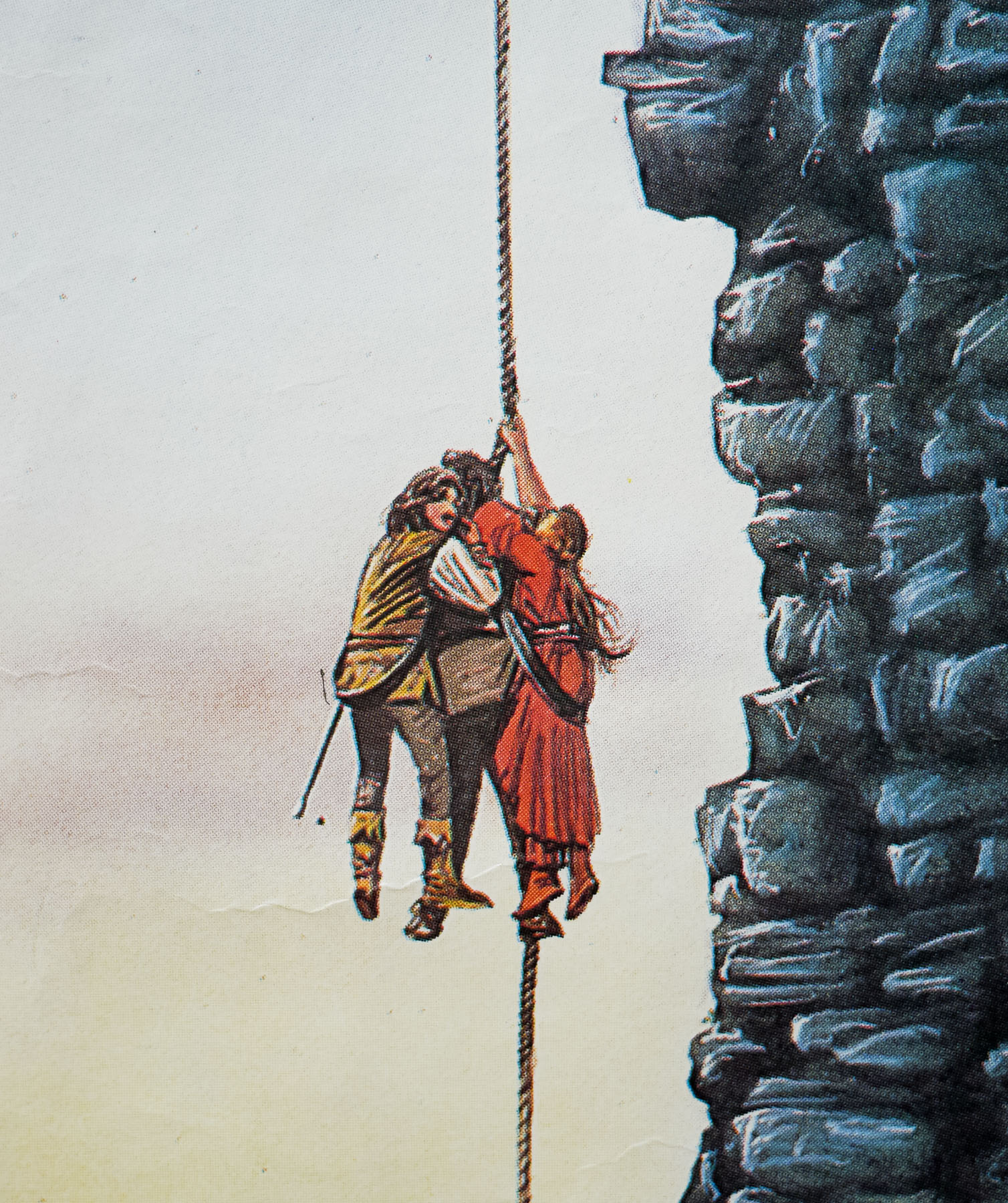
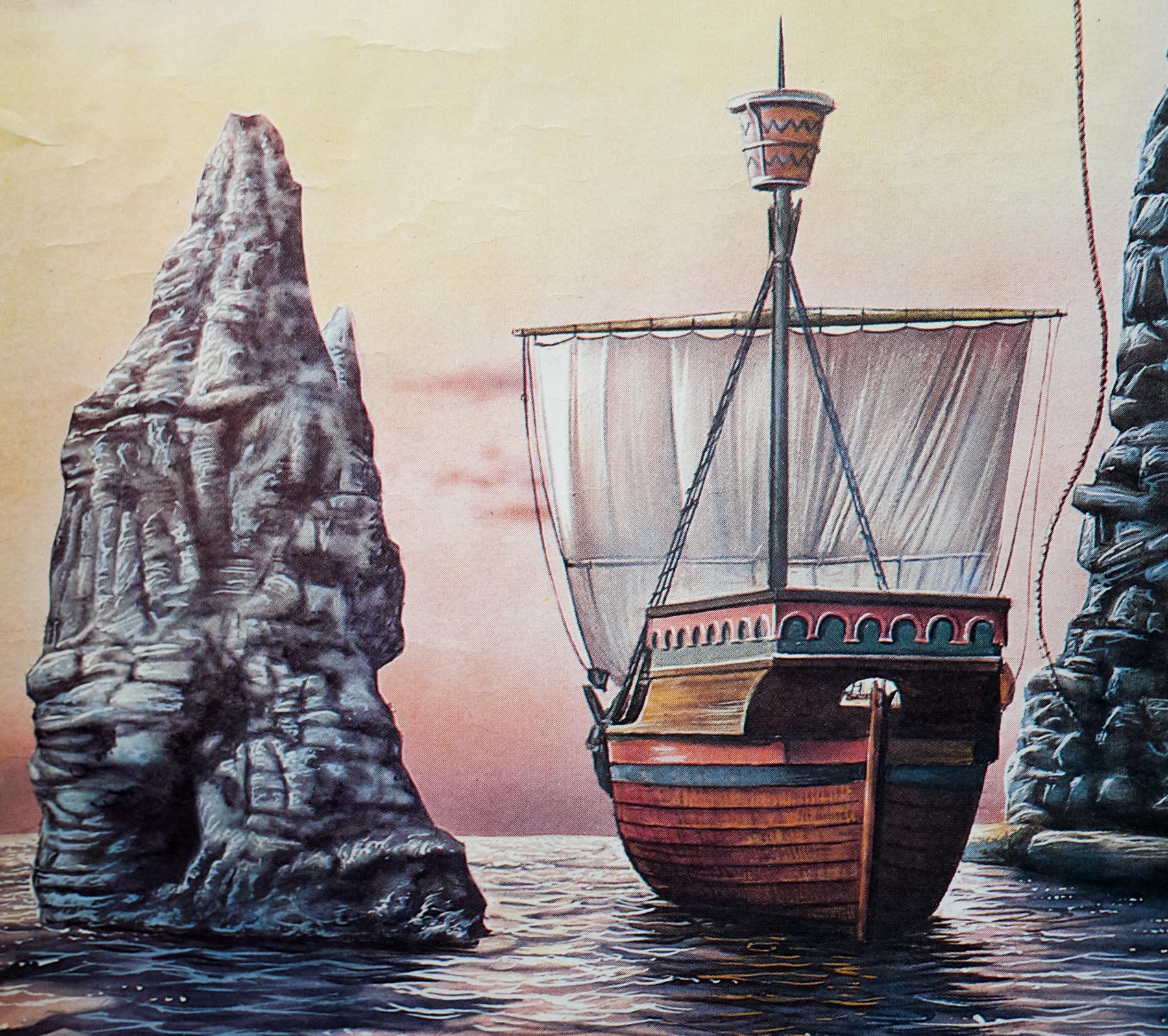
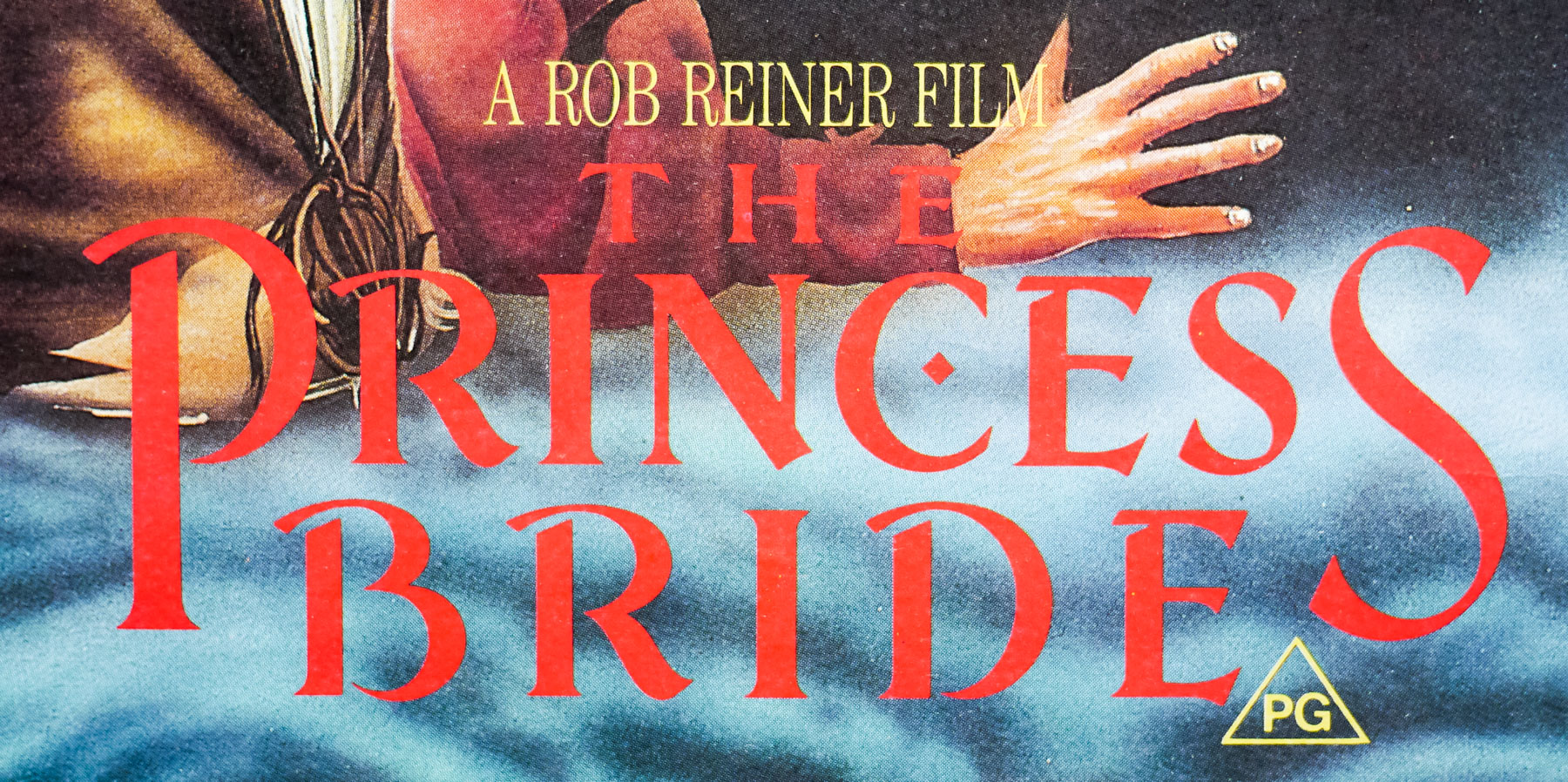
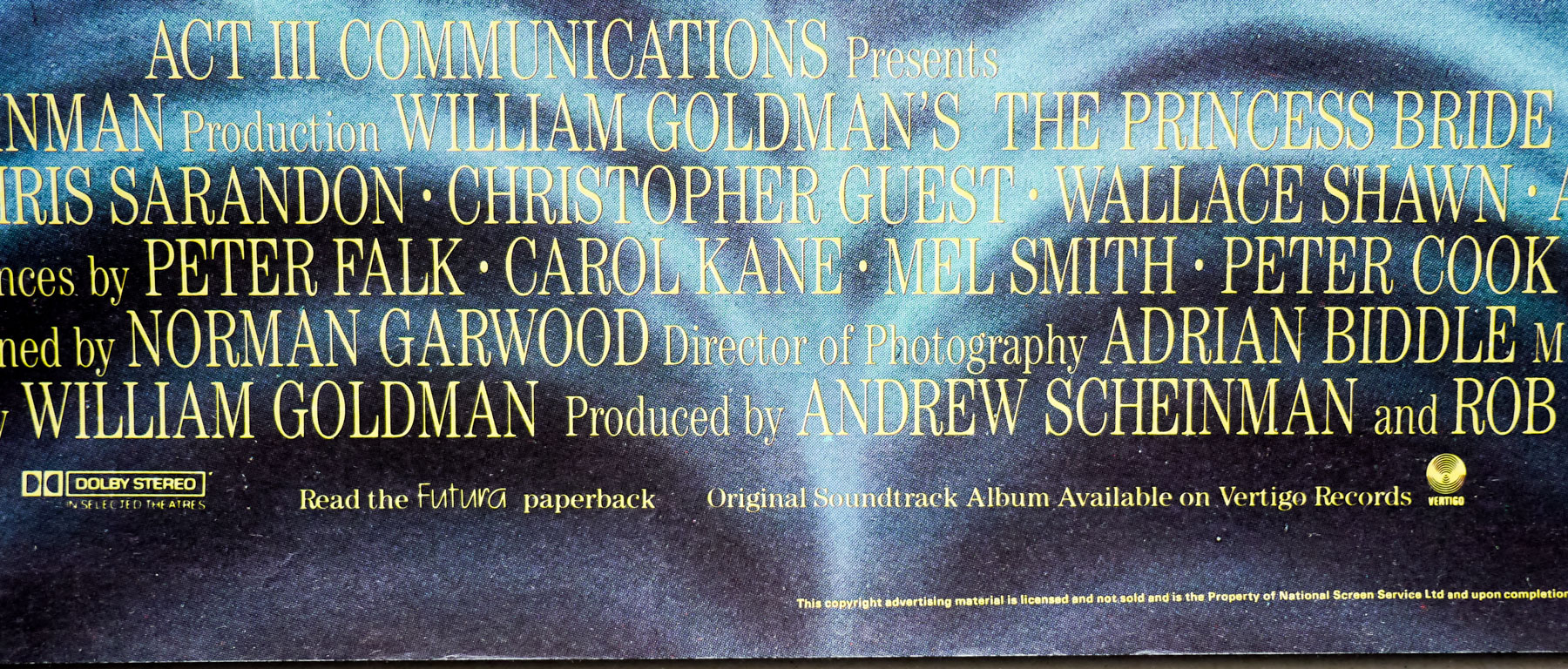
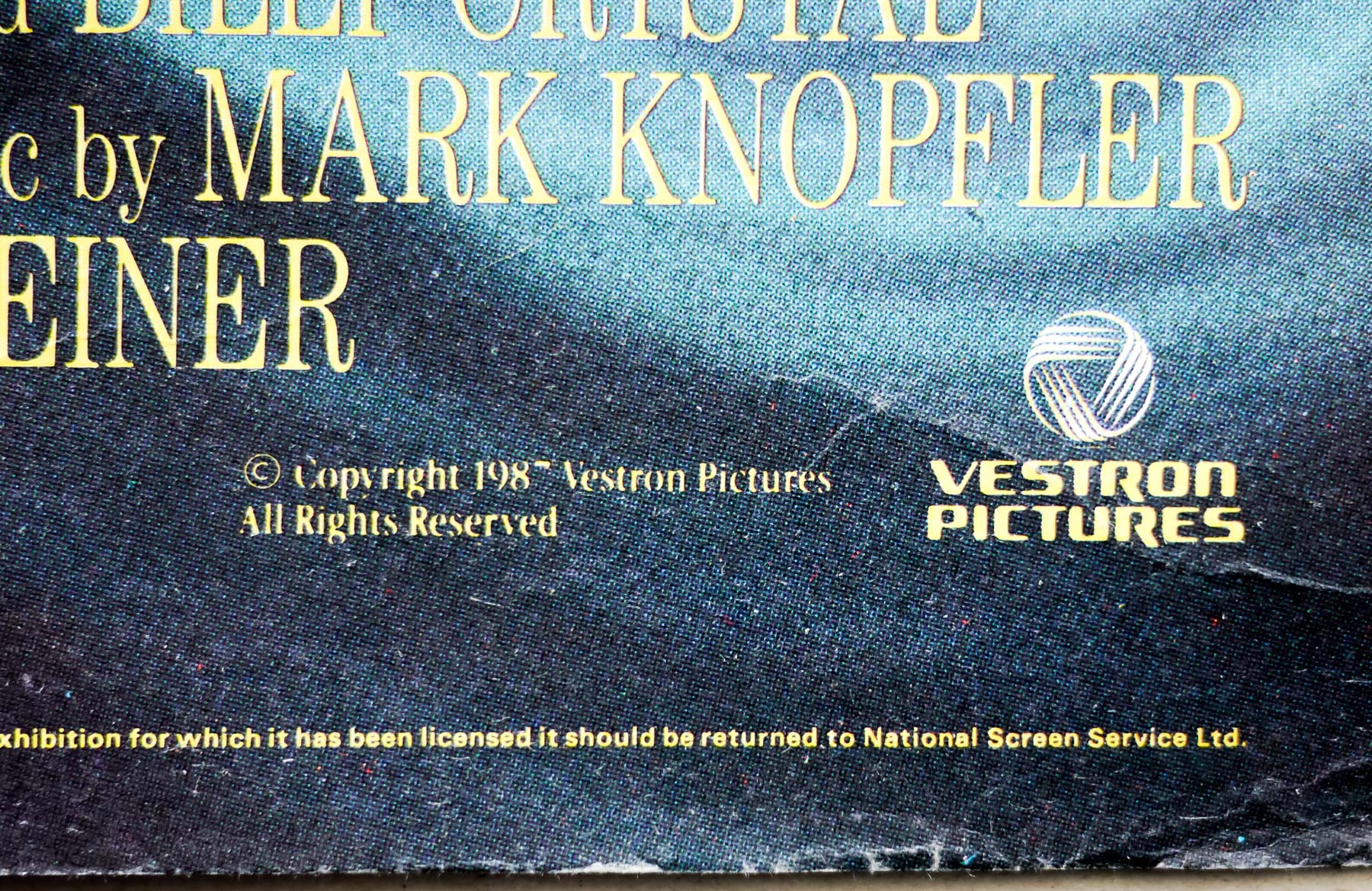
This is the UK quad for the 1987 fantasy-adventure film The Princess Bride, featuring artwork unique to the British advertising campaign. Helmed by actor-director Rob Reiner, who was also behind the 80s classics This is Spinal Tap and Stand By Me, the film is based on the 1973 book by legendary author, playwright and screenwriter William Goldman (who also adapted the screenplay). The main story is framed by present day scenes in which an old grandfather (Peter Falk) reads a book to his Nintendo-playing grandson, who is suspicious of being read an old dusty book at first but soon gets into the story. 

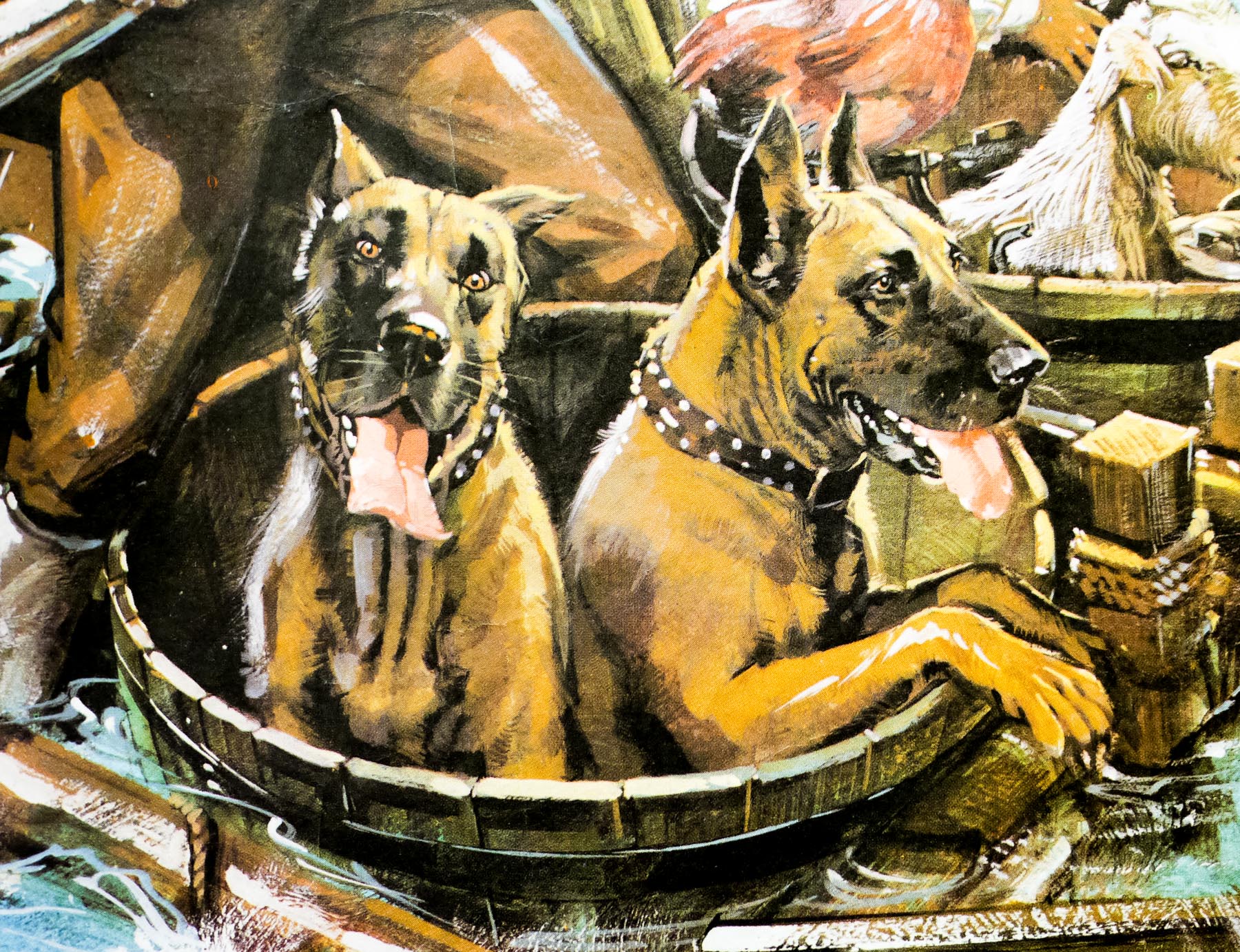
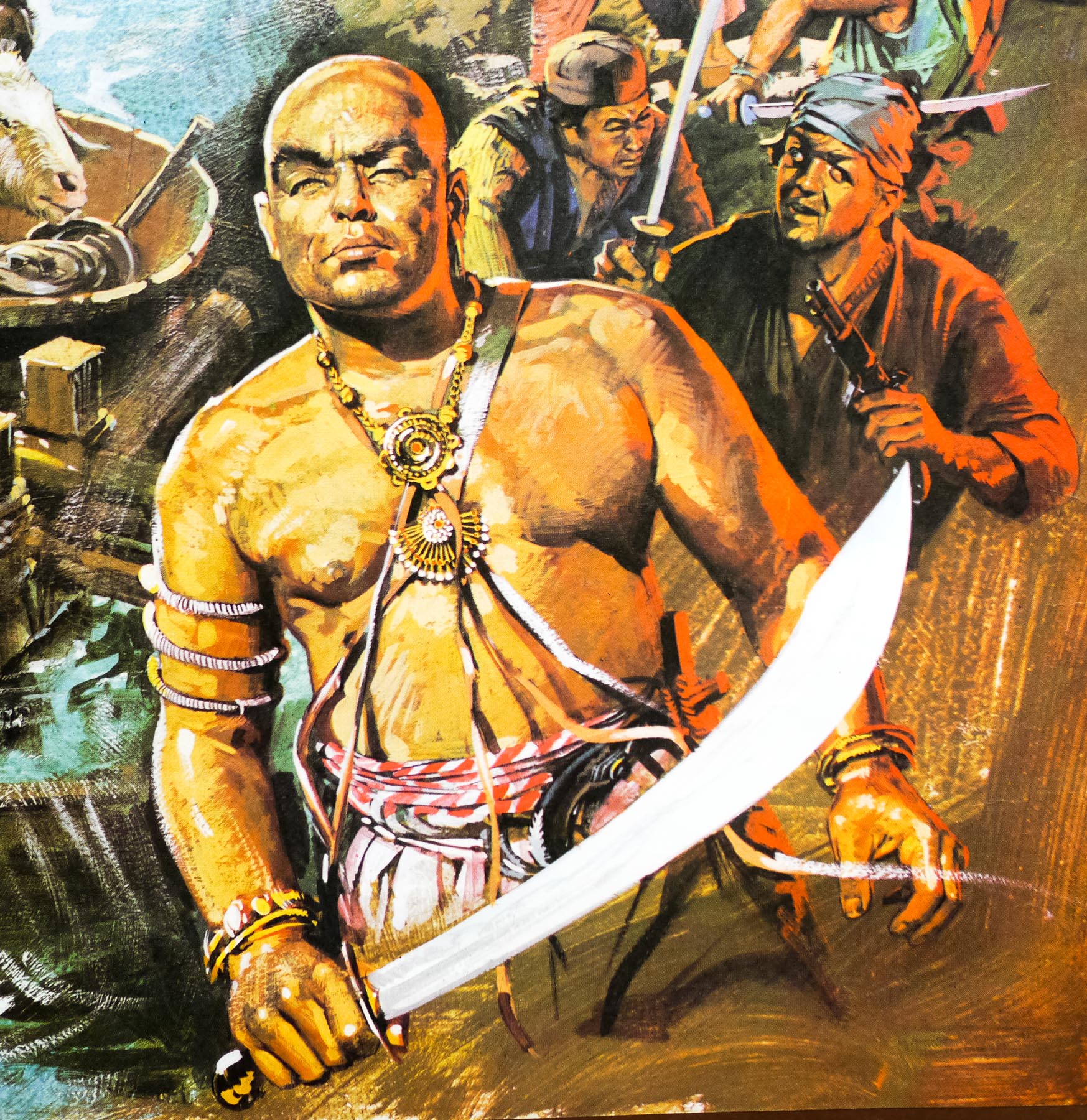
Ostensibly a classic fairy tale adventure, the film is based in the Renaissance-era fictional country of Florin in which a beautiful princess named Buttercup (Robin Wright) is set to marry the odious Prince Humperdinck (Chris Sarandon). One day she is kidnapped by a oddly-matched trio of petty criminals, including diminutive gang boss Vizzini (Wallace Shawn), Spanish master fencer Inigo Montoya (Mandy Patinkin) and the giant Fezzik (legendary wrestler André the Giant) who have been hired to start a war between two nations by killing Buttercup and leaving her body on the shore of rival country Guilder.

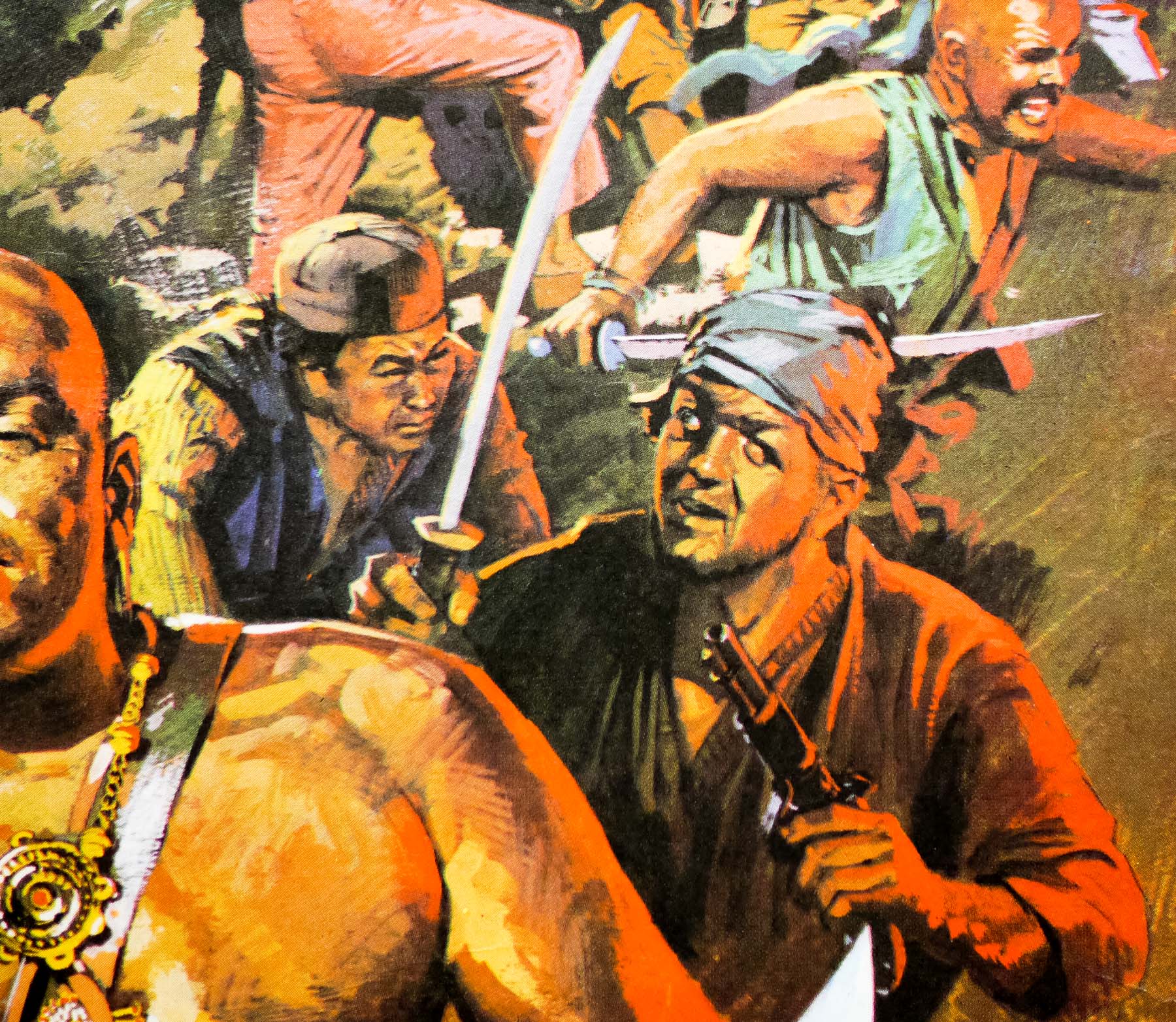
The trio haven’t counted on the actions of the mysterious Dread Pirate Roberts (Cary Elwes) who pursues them across the sea, eventually freeing Buttercup from the gang. Buttercup discovers that the pirate is in fact her long lost love Westley who disappeared five years earlier whilst on a voyage. Before long, Humperdinck and his nefarious, six-fingered sidekick Count Rugen (Christopher Guest) catches up with the lovers and promises Buttercup that he’ll let Westley go if she’ll return to Florin and marry him. She reluctantly agrees but the prince doesn’t stick to his word and Rugen traps Westley in the underground ‘Pit of Despair’. It’s up to Inigo Montoya, who has a grudge to settle with Rugen, and Fezzik to free Westley and break into the prince’s castle before it’s too late.

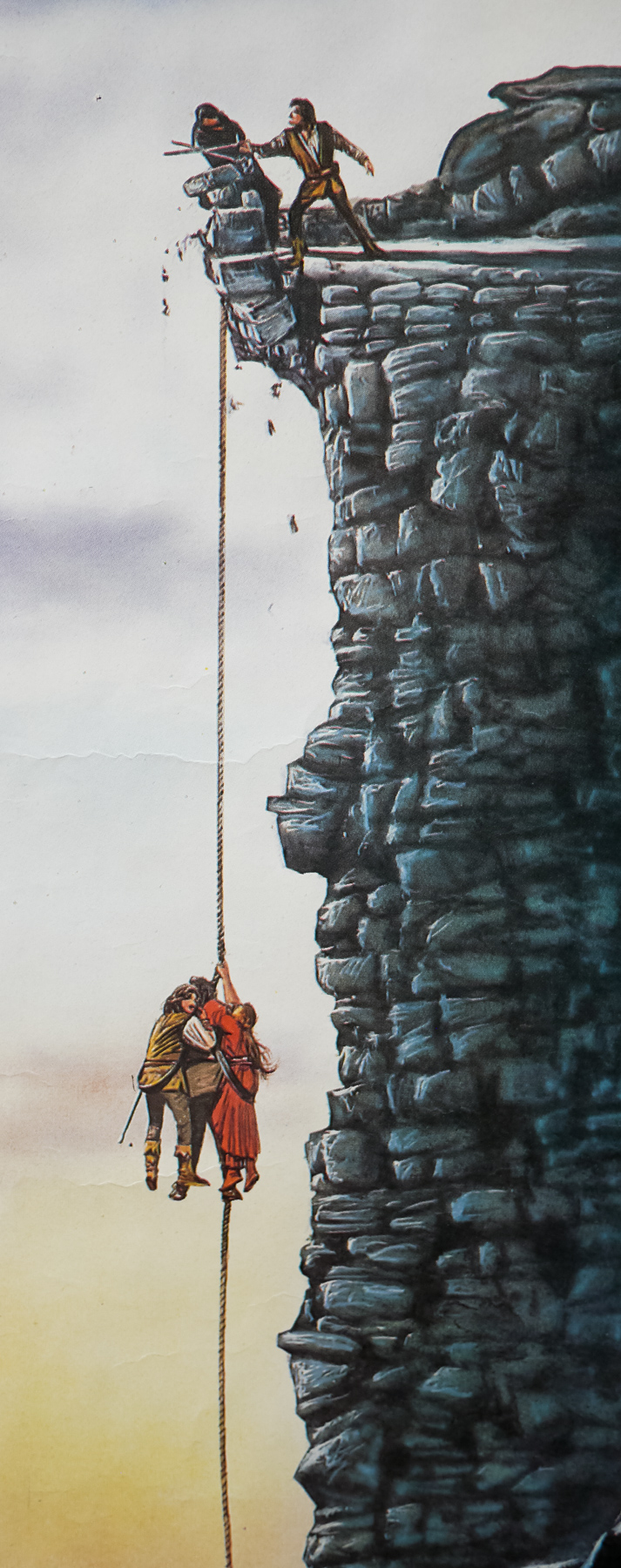
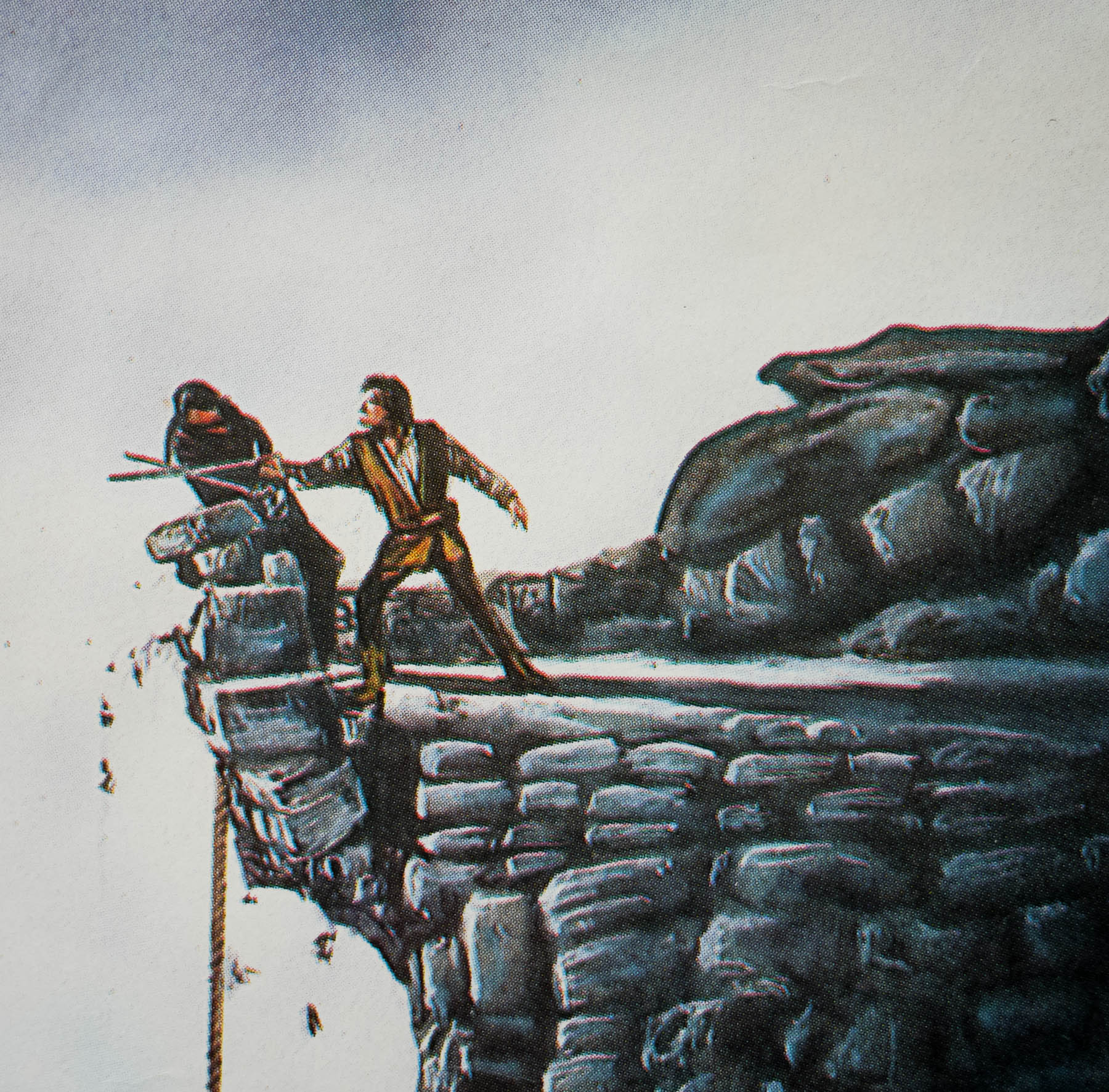
The film has a genuinely funny script that is elevated further by some classic performances from Elwes, Patinkin and Guest, with a brilliant cameo from Billy Crystal. It has a pitch-perfect mix of non-cheesy romance, with exciting action and adventure, including an epic swordfight atop a cliff. The Princess Bride has been embraced by generations of film fans and continues to be loved by audiences of all ages, with several of the most quoted lines entering the cultural lexicon.

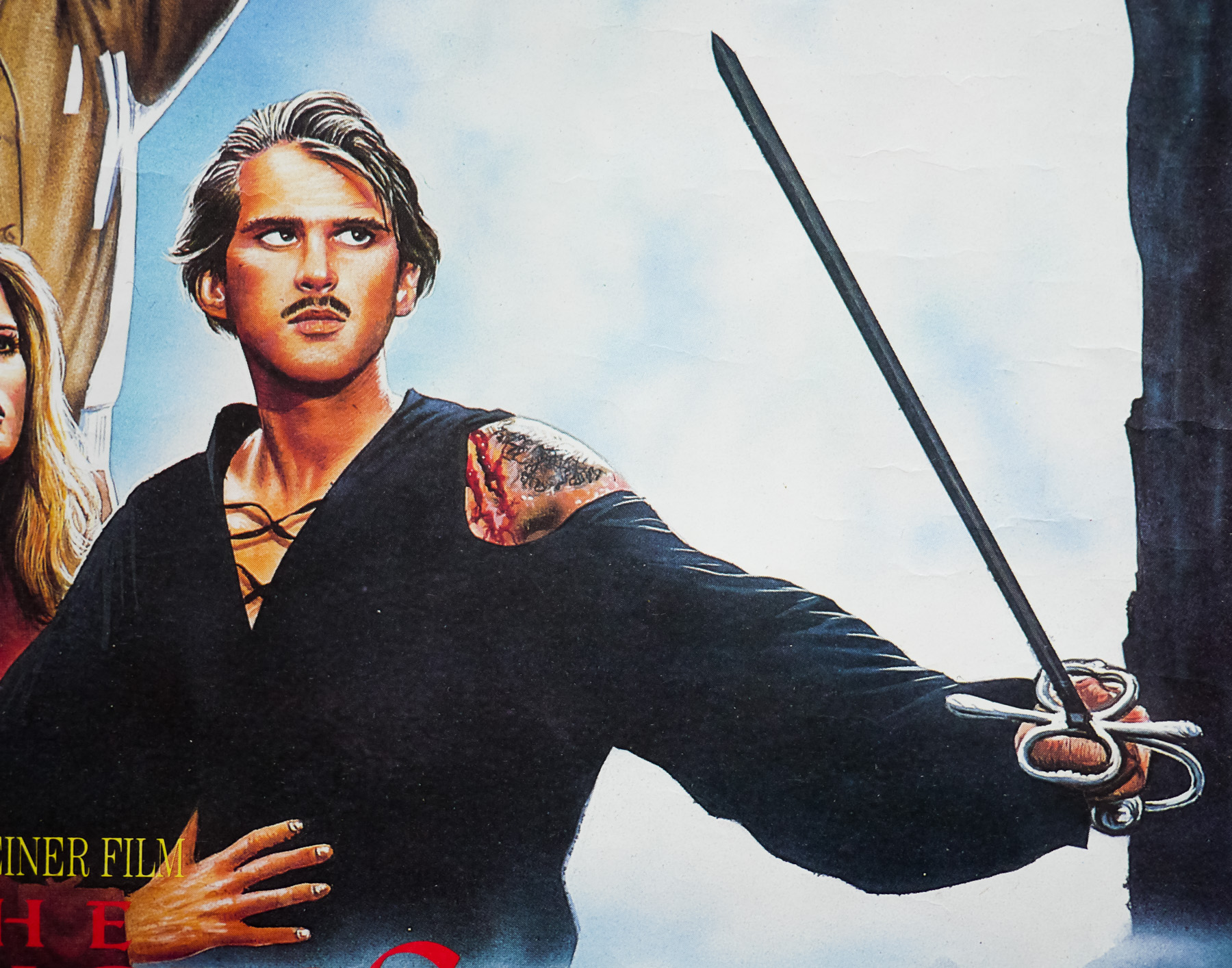
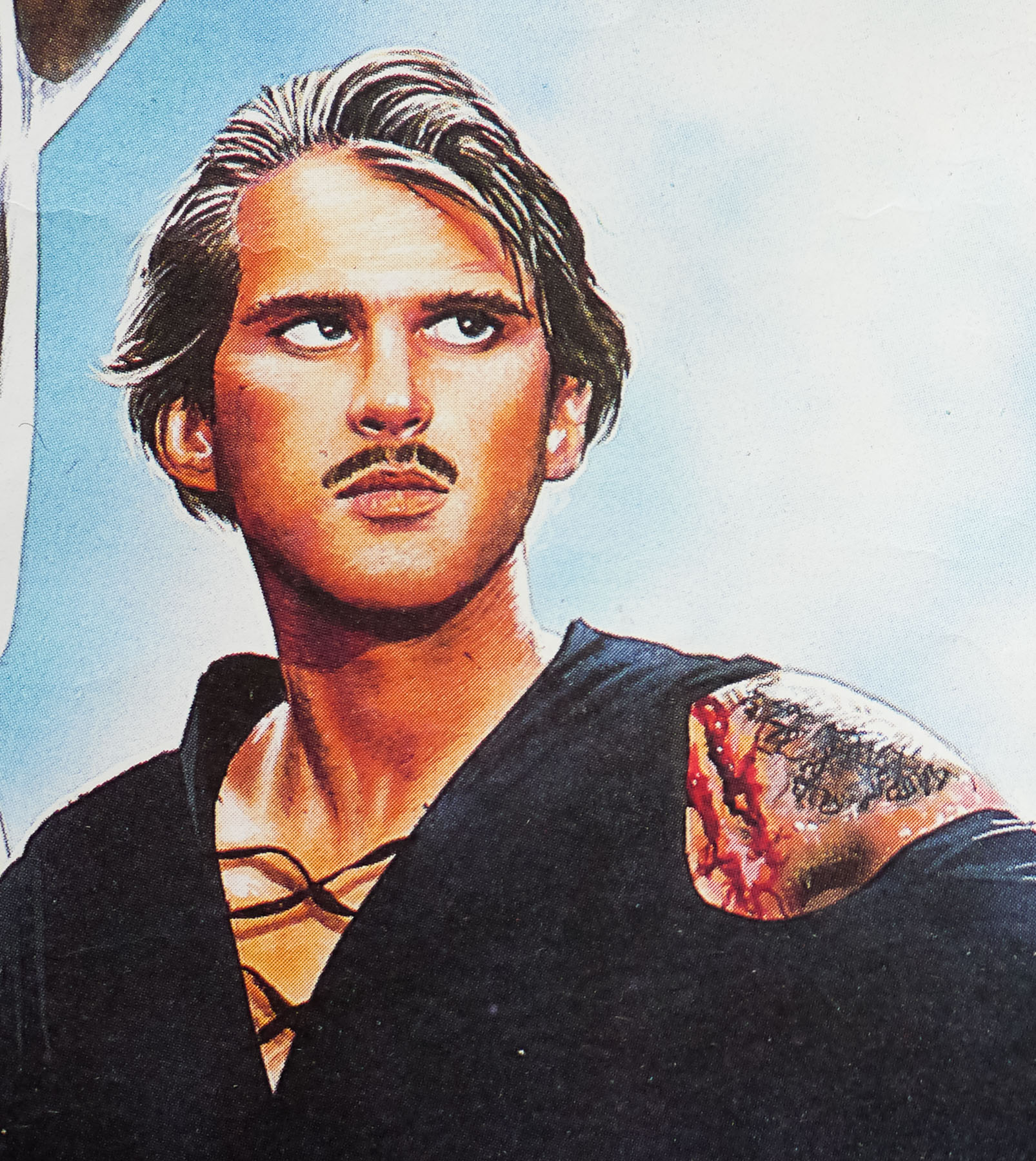
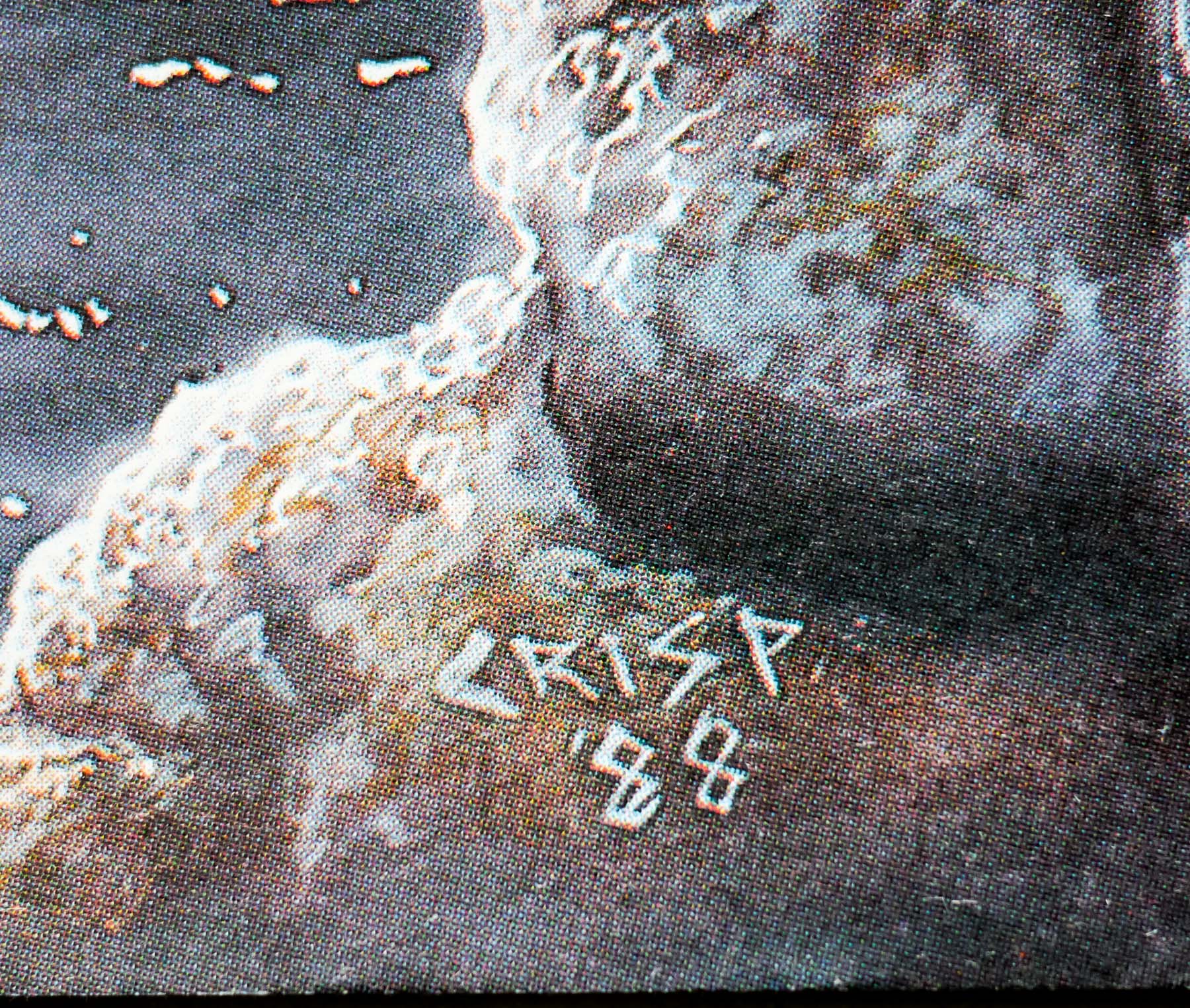
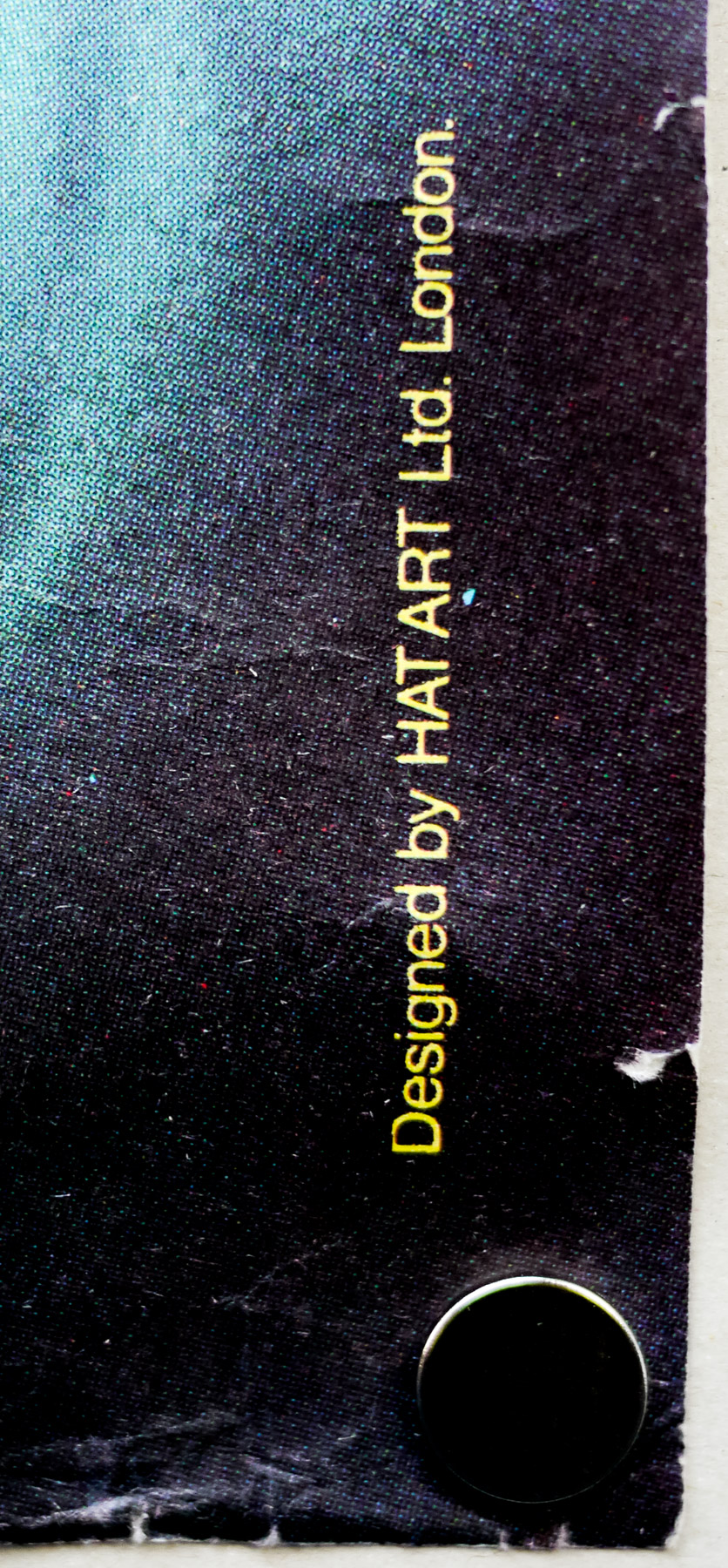
The design of the poster is credited (in the bottom right) to a company called Hat Art Ltd about whom I’ve been able to discover next to nothing, so if anyone has any information about them please get in touch. The artwork bears a signature of ‘Crisp’, which is short for the British artist Steve Crisp. According to the artist’s profile on a now defunct art website, Crisp was born in Kent in 1955 and started painting as early as 5 years old. He studied at the noted St Martins School of Art in London in the 70s and for the past 30 years has worked on book covers for the likes of Stephen King (11 in total), Ray Bradbury and James Herbert, as well as film posters like this one and home video covers for films like Mad Max.

He’s also noted for his work on illustrated jigsaws and the Jigsaw Junkies website interviewed him in 2016. The resultant article can be read here.

Certain Fury / quad / UK

27.05.15

Poster Poster
Title
Certain Fury
AKA
--
Year of Film
1985
Director
Stephen Gyllenhaal
Starring
Tatum O'Neal, Irene Cara, Nicholas Campbell, George Murdock, Moses Gunn, Peter Fonda, Rodney Gage, Jonathon Pallone, David Longworth
Origin of Film
USA
Genre(s) of Film
Tatum O'Neal, Irene Cara, Nicholas Campbell, George Murdock, Moses Gunn, Peter Fonda, Rodney Gage, Jonathon Pallone, David Longworth,
Type of Poster
Quad
Style of Poster
--
Origin of Poster
UK
Year of Poster
1985
Designer
Unknown
Artist
Renato Casaro
Size (inches)
30" x 39 15/16"
SS or DS
SS
Tagline
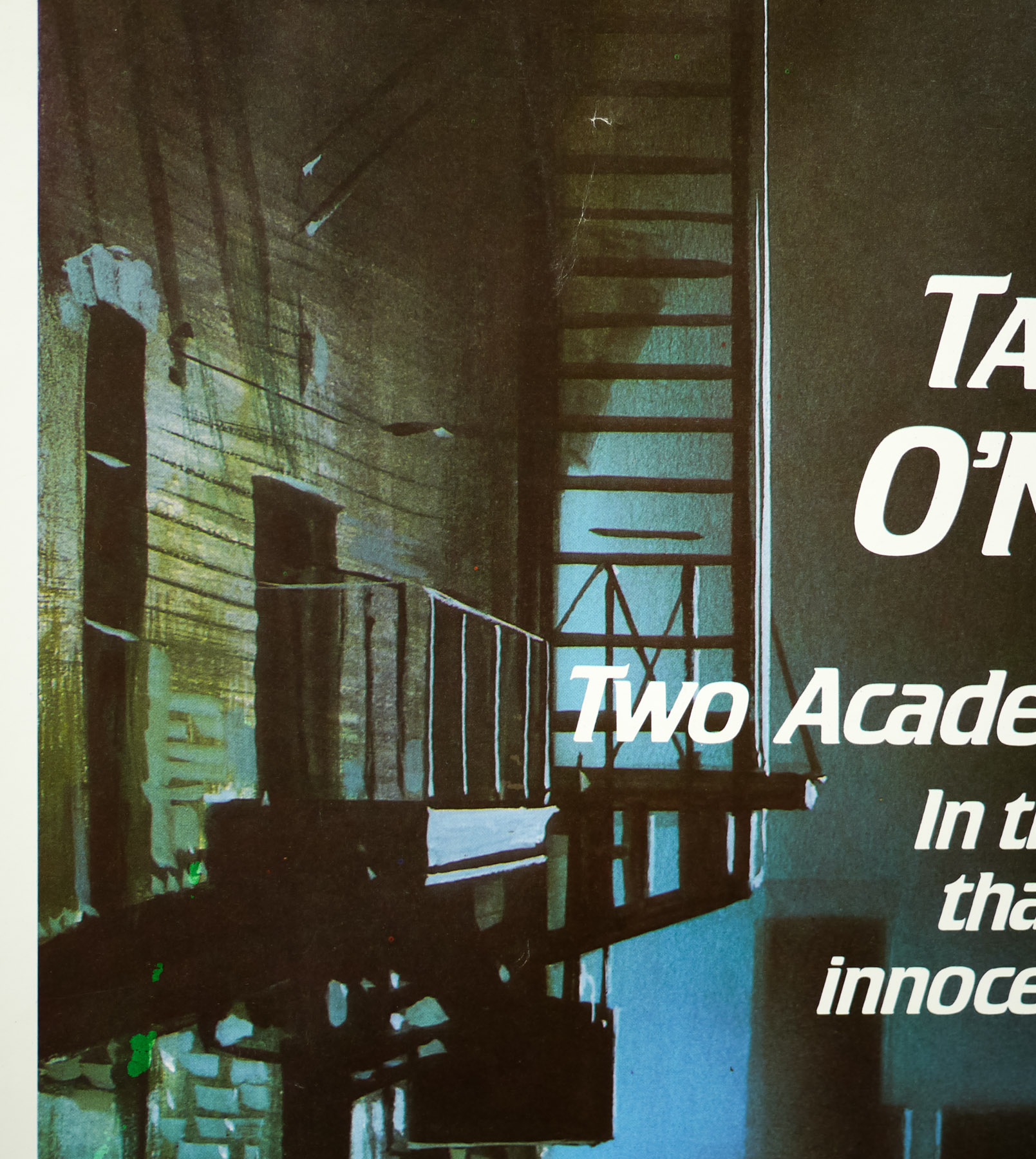
Two Academy Award winning stars... in the one motion picture that hurtles them from innocence - to fear - to rage!

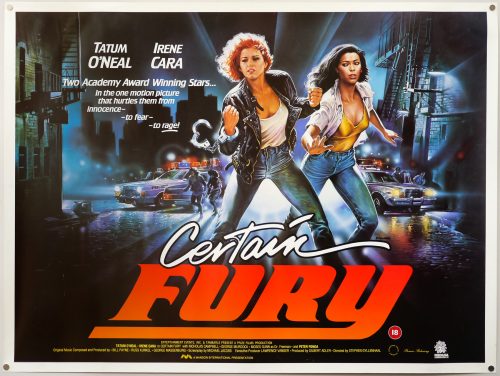
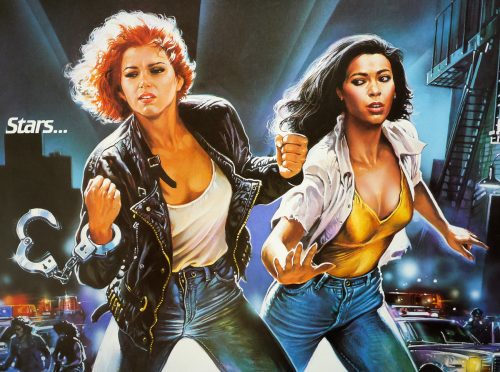
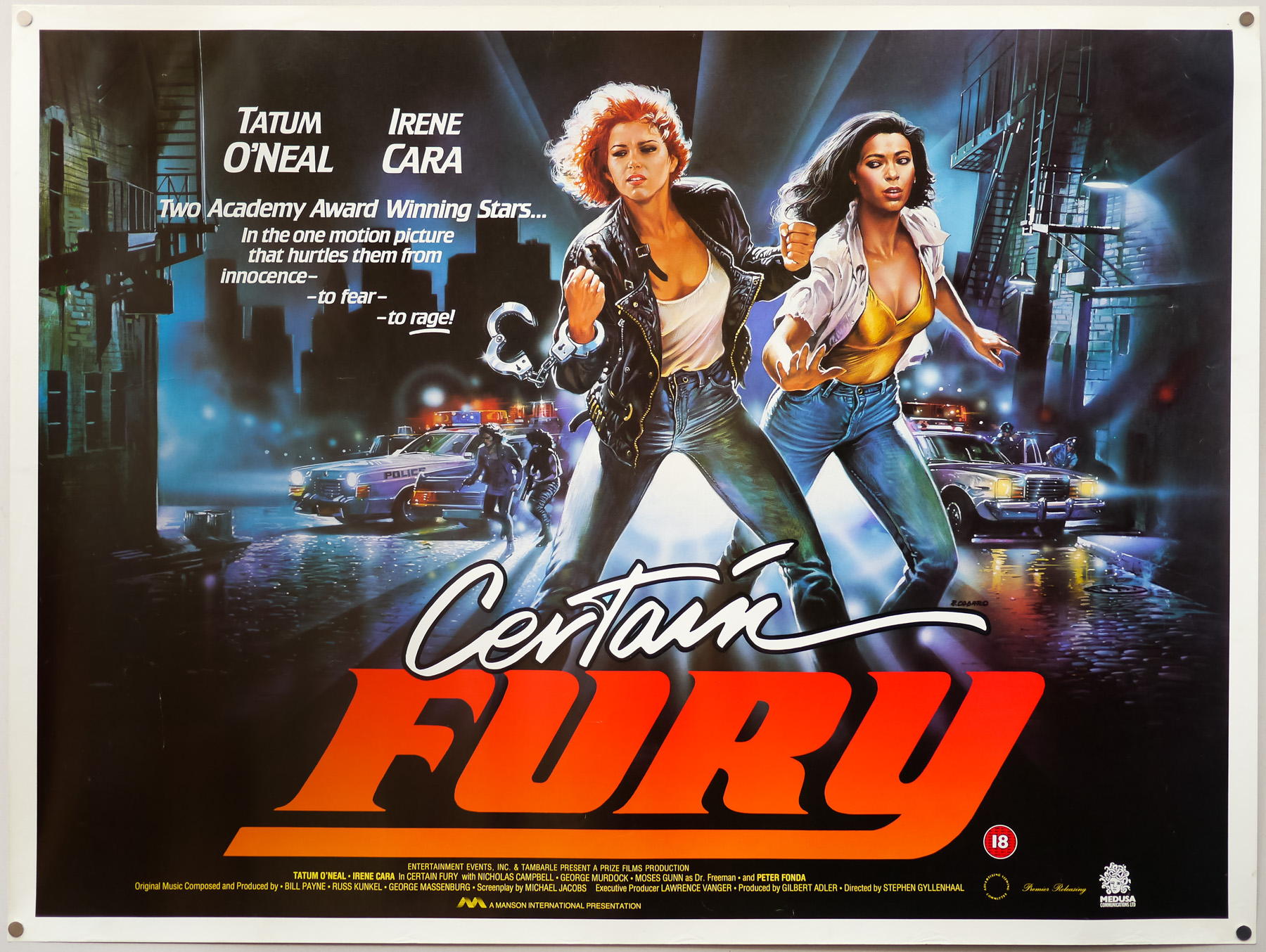
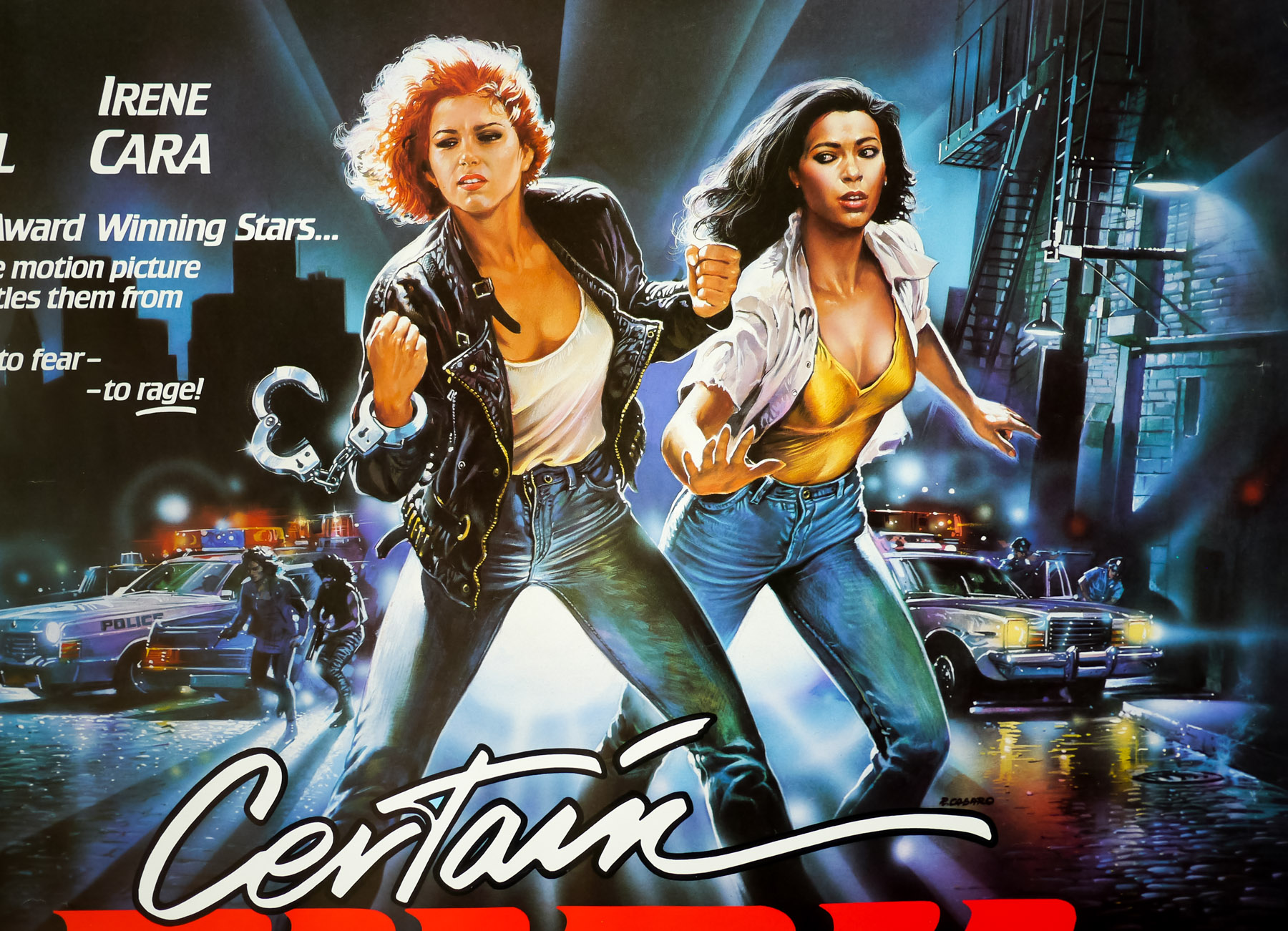
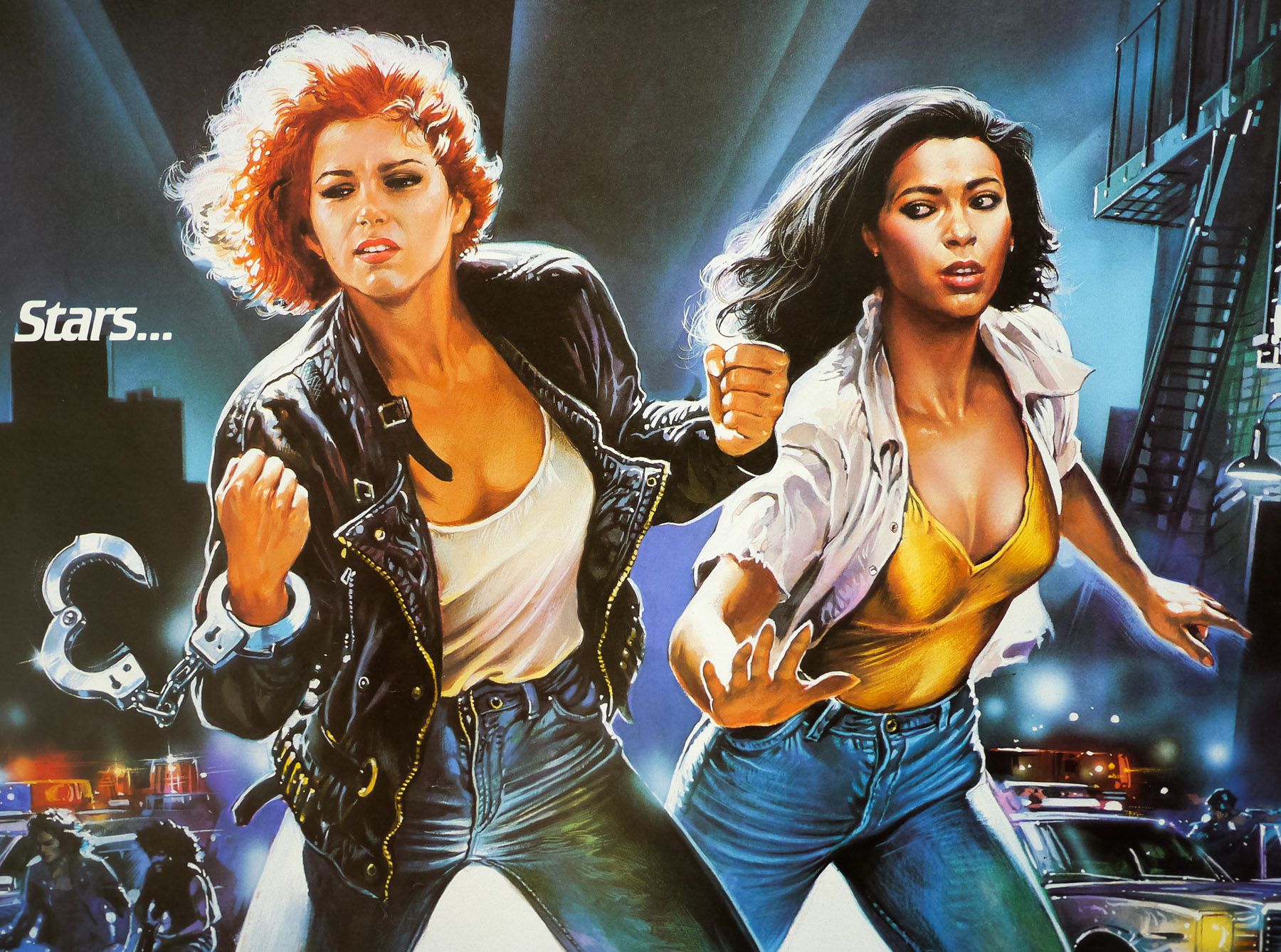
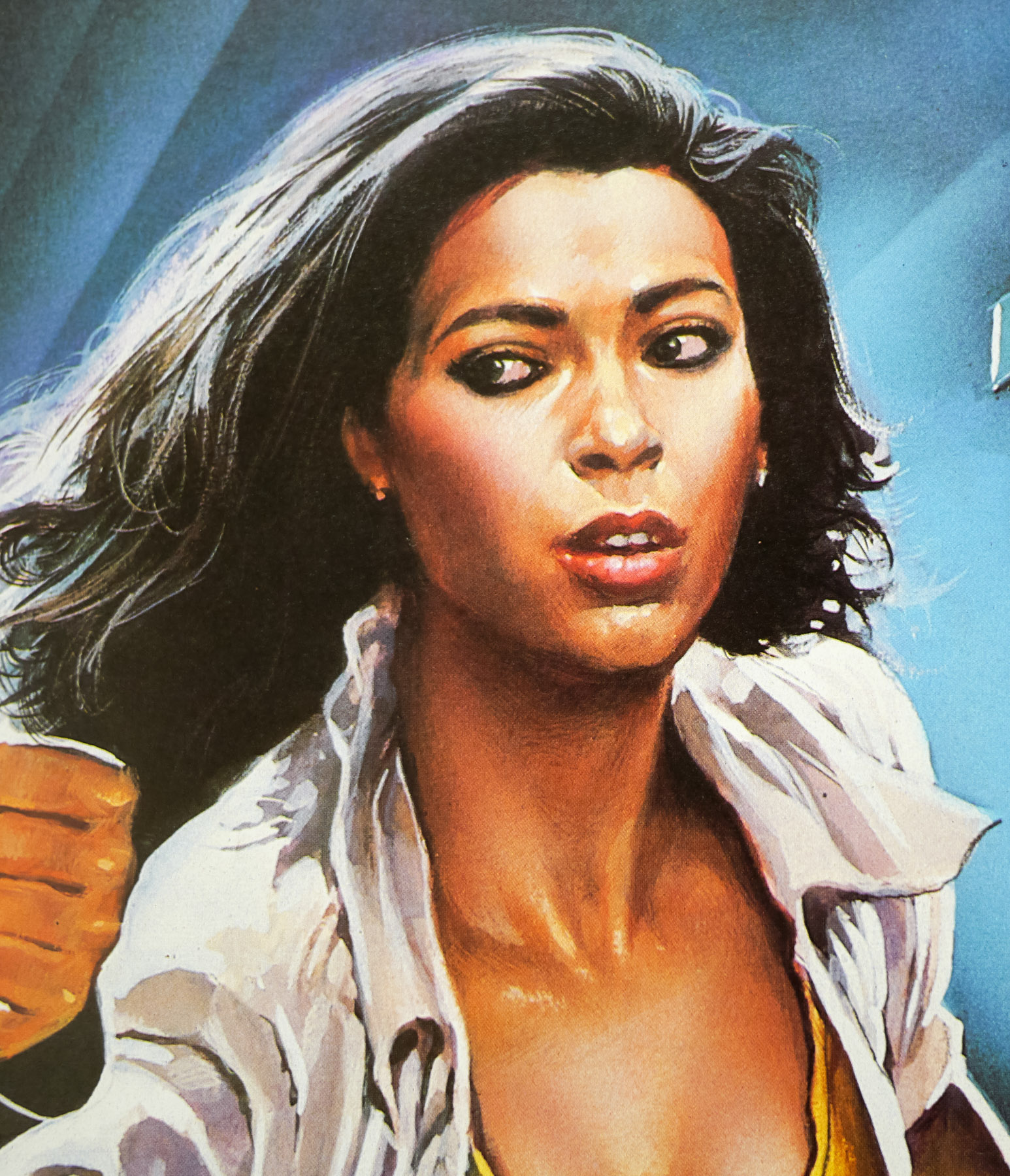
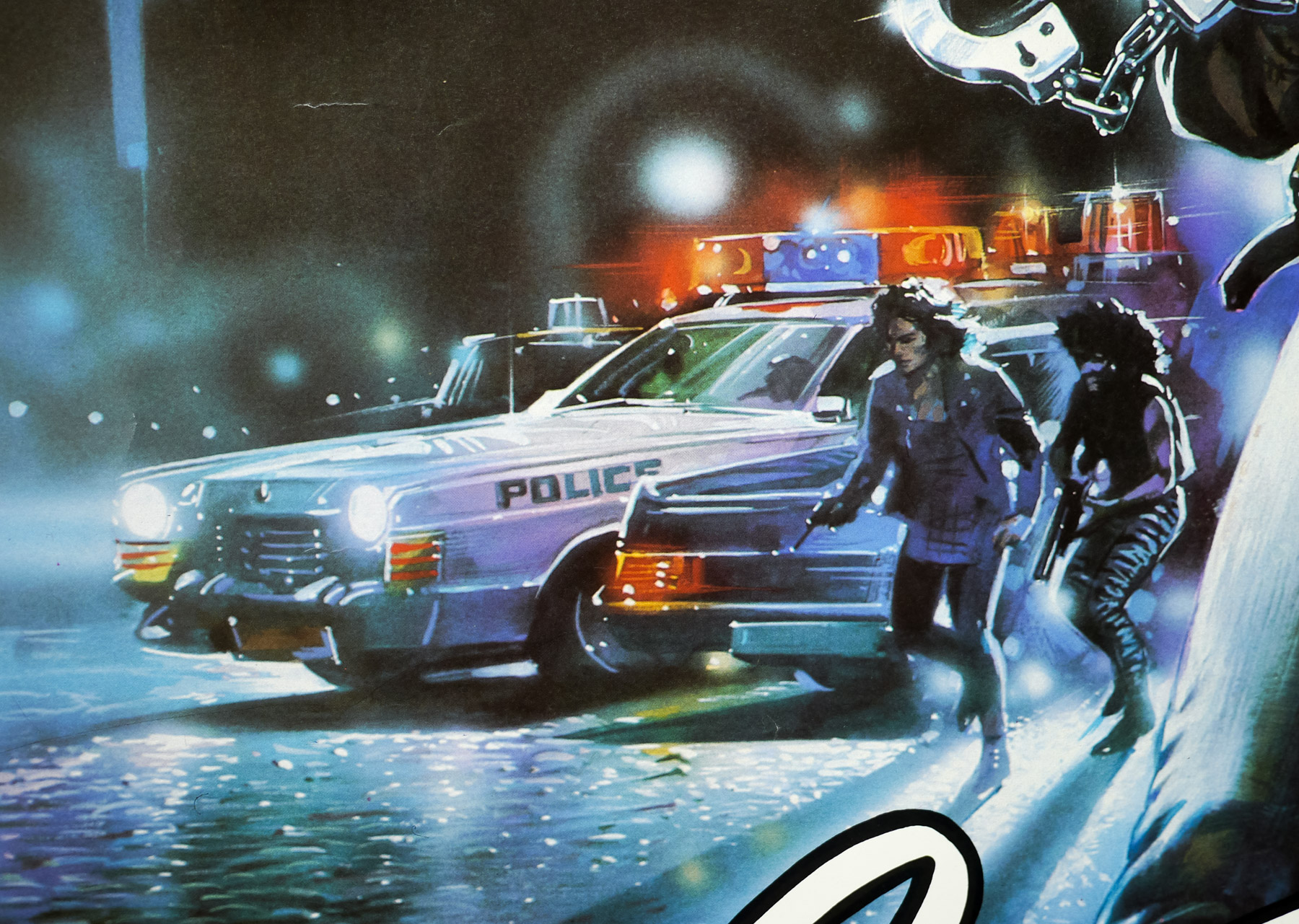
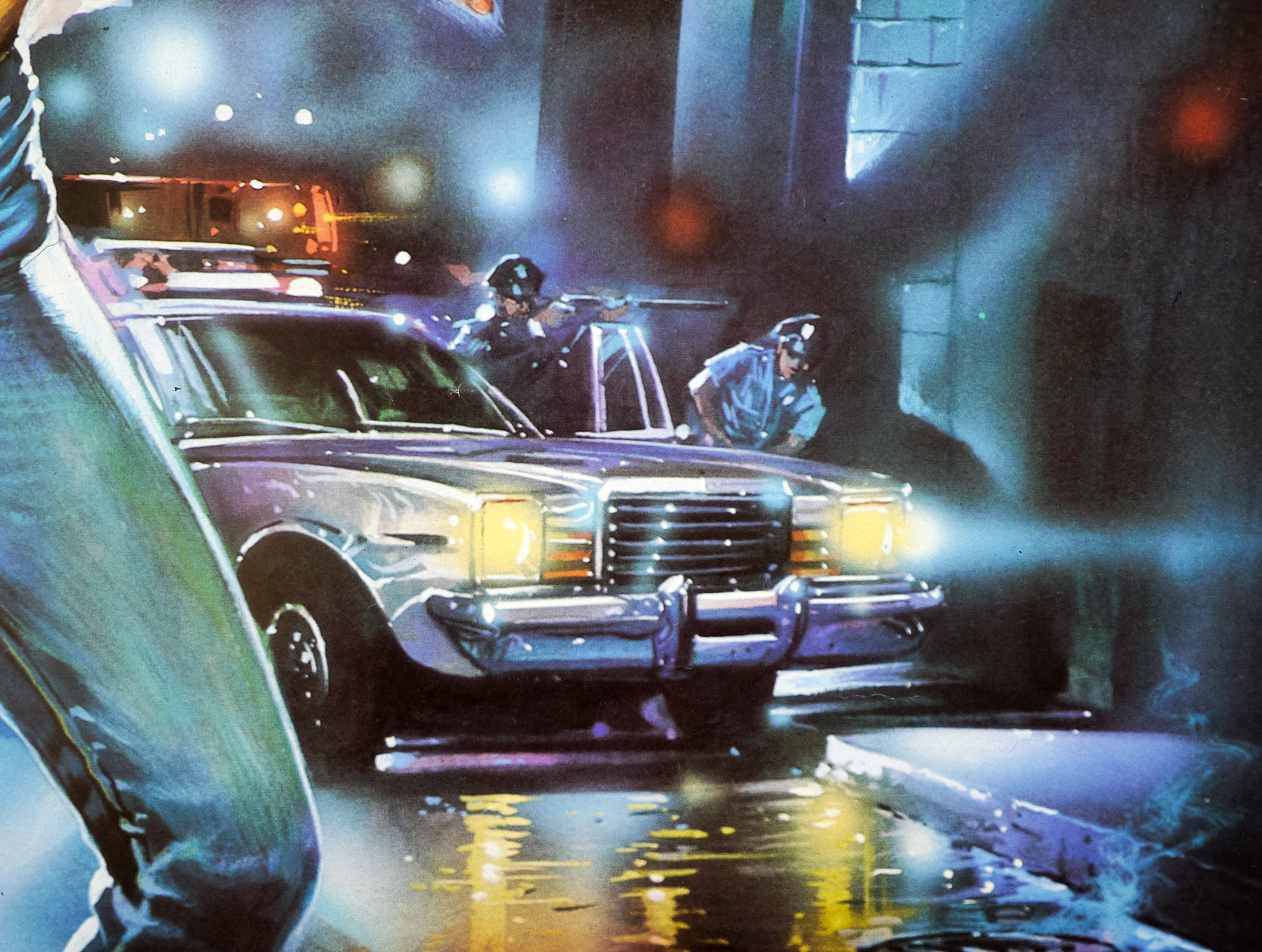
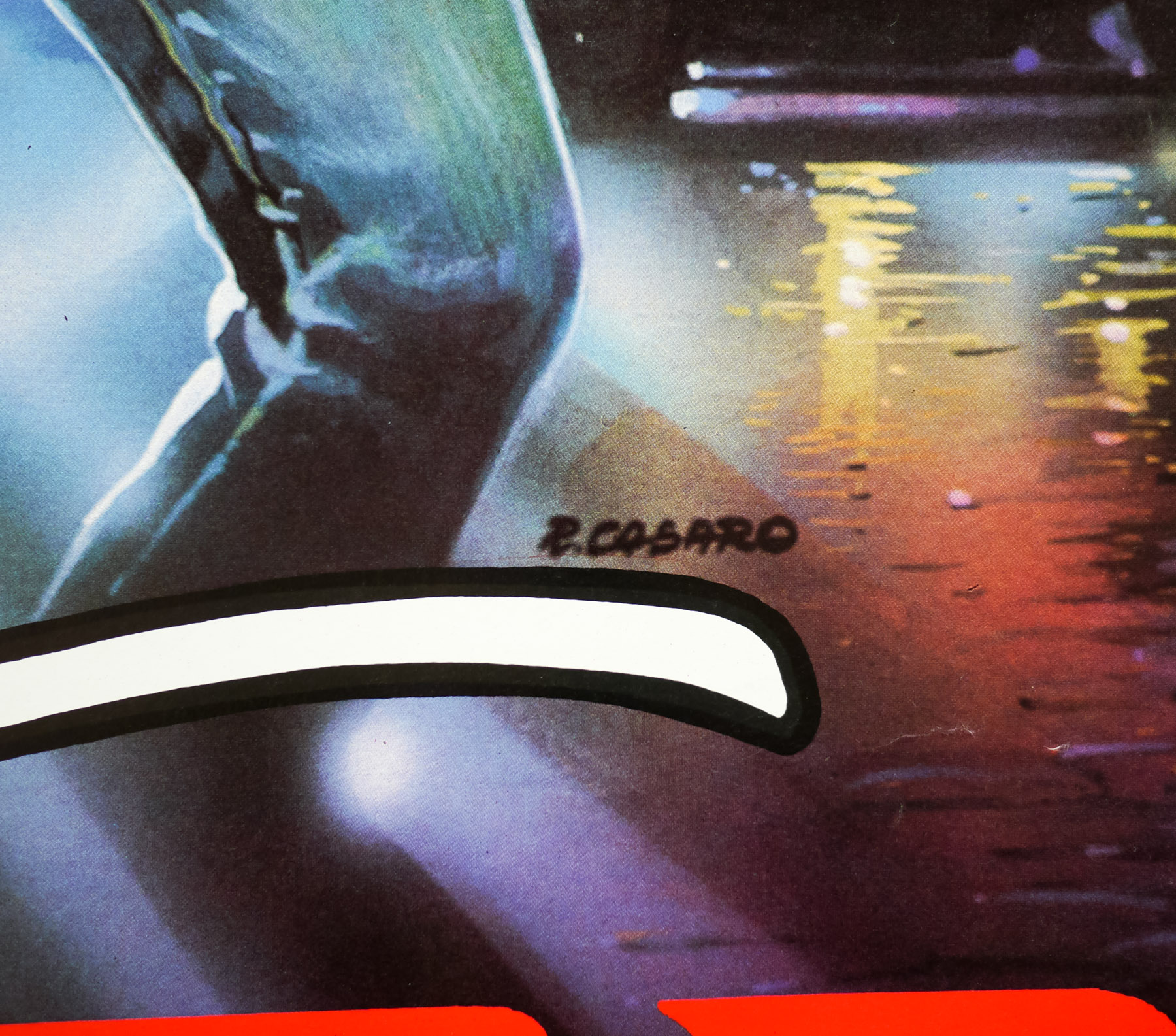
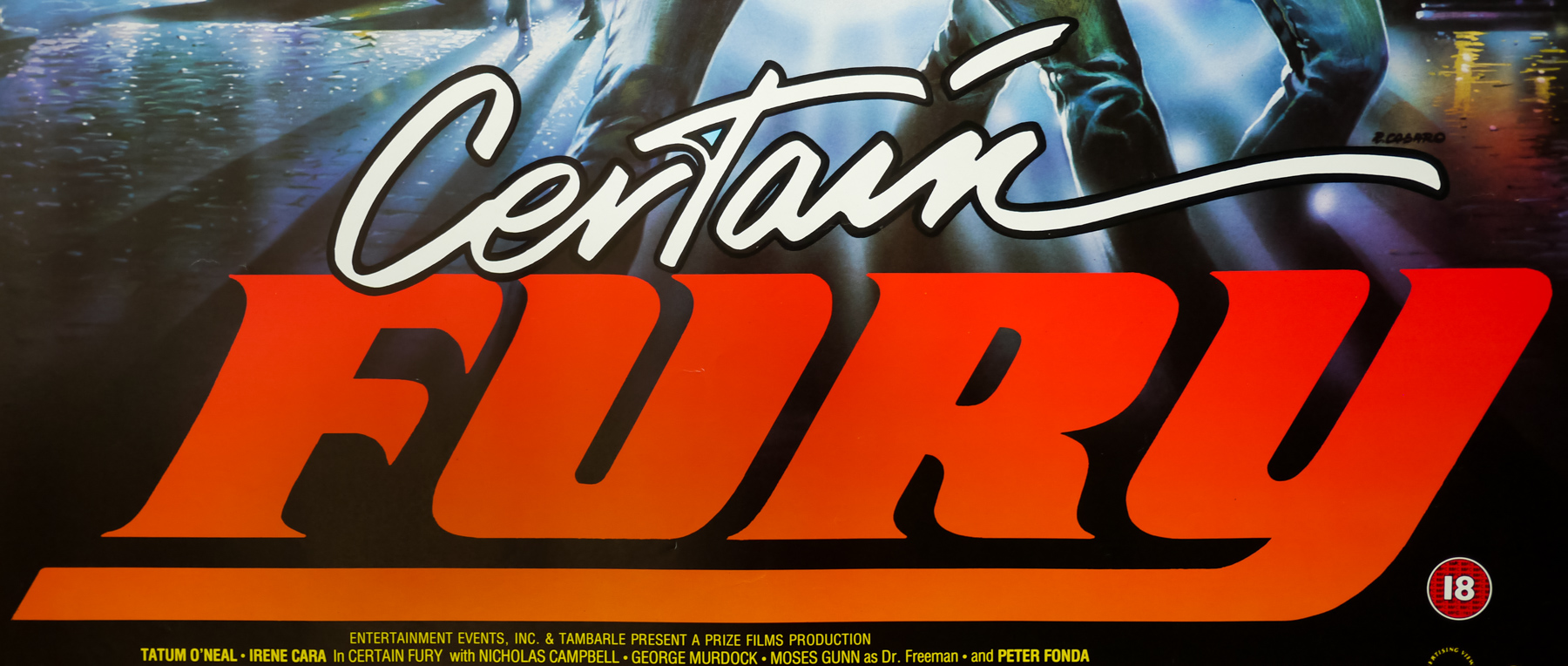
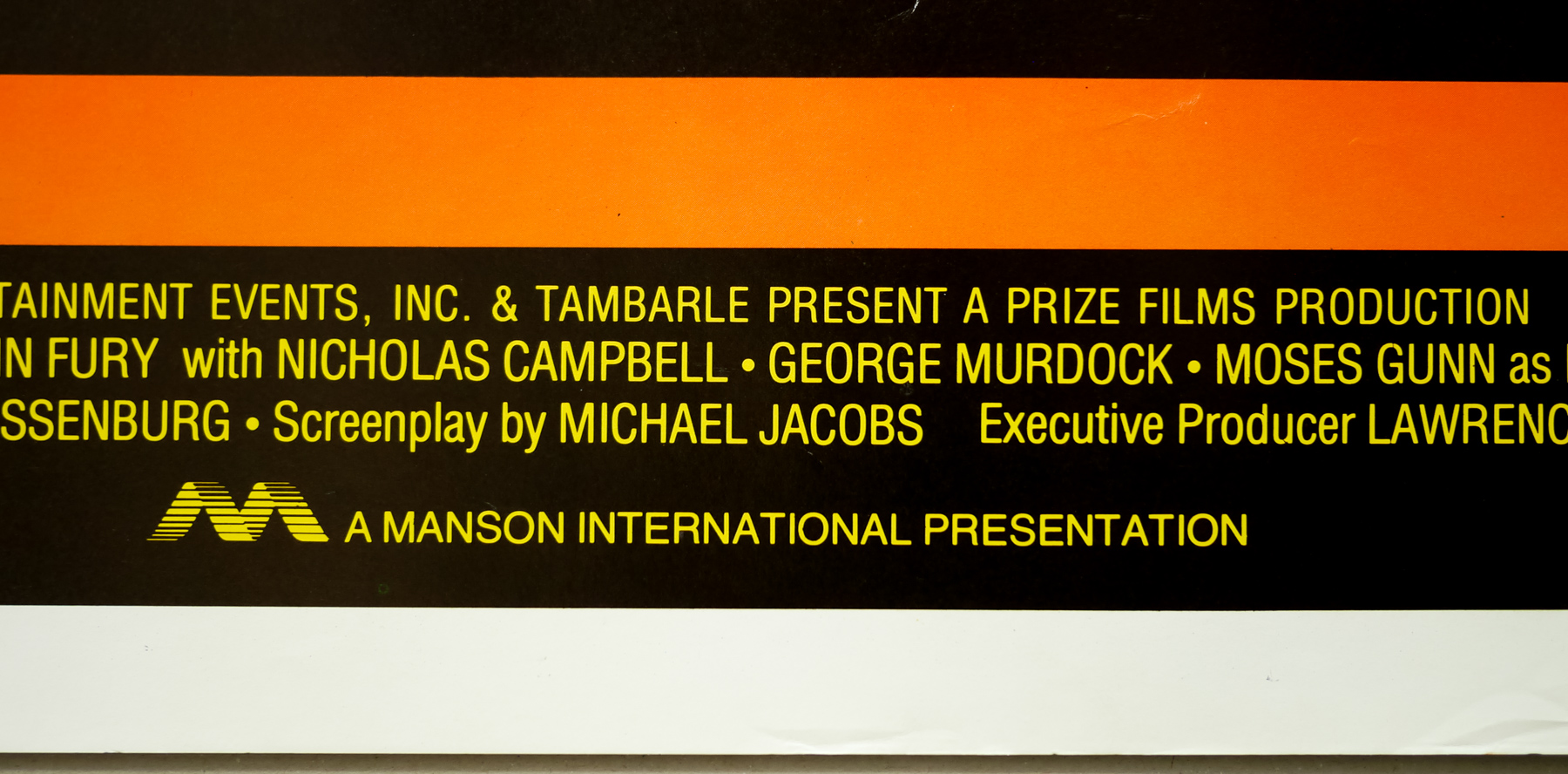
Great artwork by Renato Casaro features on this UK quad for the release of the largely forgotten 1985 b-movie Certain Fury. As this poster is keen to point out, the film stars two young award-winning actresses, Tatum O’Neal (daughter of Ryan) and Irene Cara, a singer-songwriter who had won awards for her work on Fame and Flashdance. Tatum plays Scarlet, a tough, young delinquent who supports herself with prostitution and drug-dealing and Irene is Tracy, the daughter of a doctor, who has been arrested for drug possession and resisting arrest. The pair first meet in a courtroom and are waiting to be seen by the judge when other defendants begin attacking the court staff and police, leading to a deadly shootout. Scarlet and Tracy manage to escape the carnage and enter into the city’s sewers whilst being pursued by the police who believe they were part of the shootout. Soon the accidental death of a policeman is blamed on their actions and they have most of the force after them as well as various criminals who Scarlet asks for help before they turn on her and Tracy.

The film was poorly reviewed at the time and hardly set the box-office on fire. It’s never been released on home video since the days of VHS and, if the IMDb reviews are anything to go by, there’s probably a good reason. It sounds like a film that’s not even ‘so bad it’s good’ and this seems like one of those cases where the poster art is the best thing about the film!

One of my favourite artists, Renato Casaro is an Italian with a prolific movie poster output that lasted over 35 years. He began his career in 1953, aged 19, at the famous Studio Favalli in Rome and would go on to design and paint posters for many of the biggest directors in the world. His skill at accurately portraying actors and his brilliant use of colour and composition saw him much in demand from studios and actors alike. His artwork has featured on posters used in multiple countries, including Japan, Germany, USA as well as in his native Italy.

Check out the incredible amount of work on his official website here, which also features a biography of the artist. In March 2014 I published an exclusive interview with Renato and it can be read by clicking here. The other posters I’ve collected by Renato Casaro are here.

Sex, Lies, and Videotape / quad / UK

09.06.15

Poster Poster
Title
Sex, Lies, and Videotape
AKA
--
Year of Film
1989
Director
Steven Soderbergh
Starring
James Spader, Andie MacDowell, Peter Gallagher, Laura San Giacomo, Ron Vawter, Steven Brill
Origin of Film
USA
Genre(s) of Film
James Spader, Andie MacDowell, Peter Gallagher, Laura San Giacomo, Ron Vawter, Steven Brill,
Type of Poster
Quad
Style of Poster
--
Origin of Poster
UK
Year of Poster
1989
Designer
Unknown
Artist
--
Size (inches)
30" x 40"
SS or DS
SS
Tagline
--

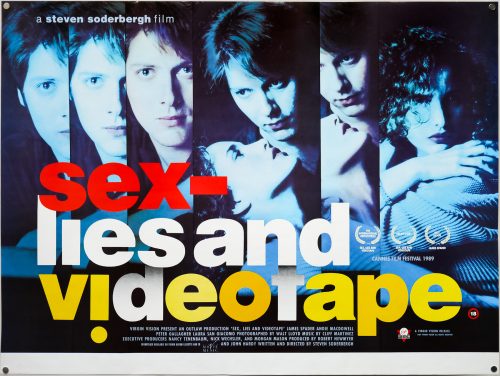
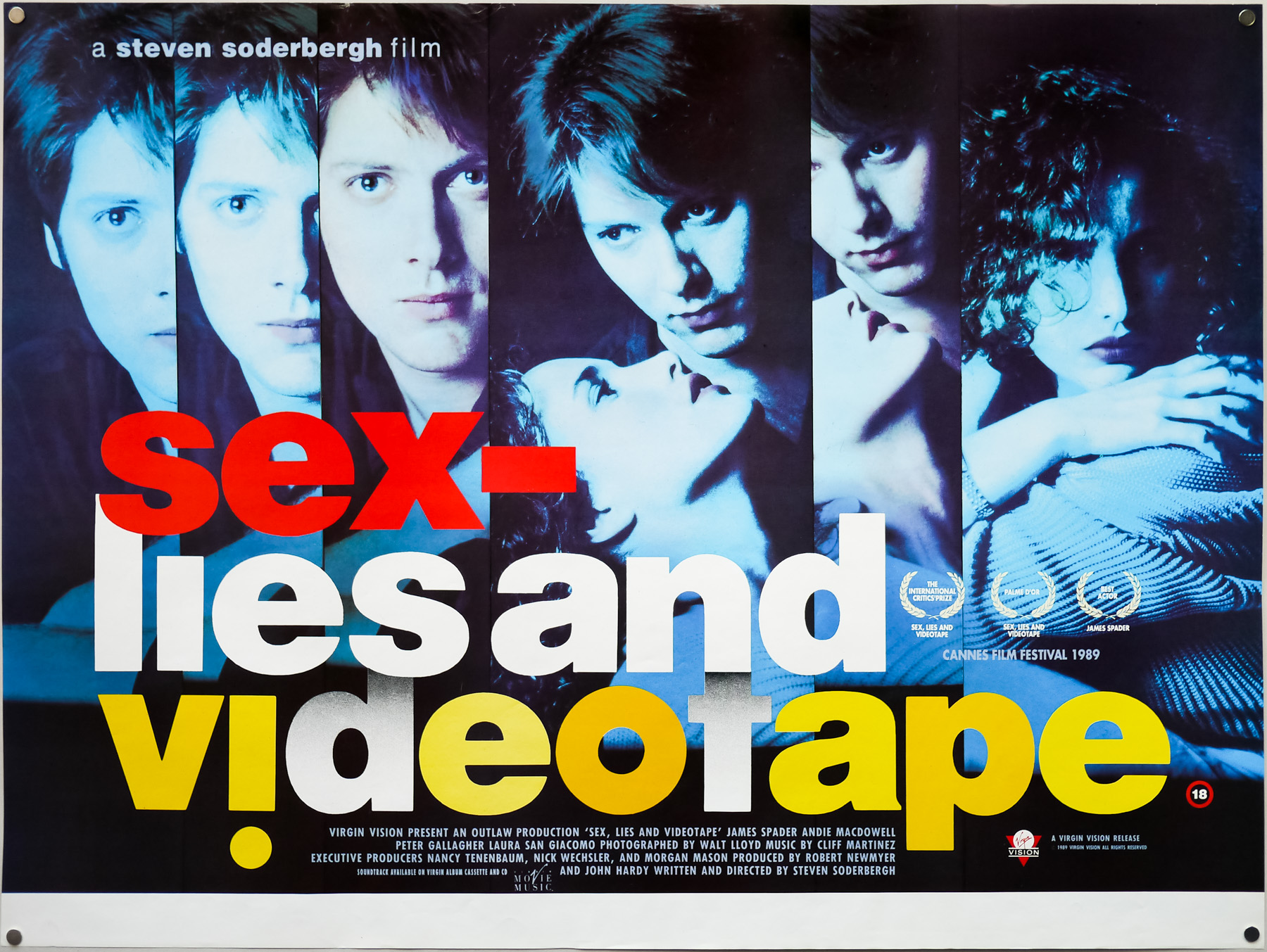
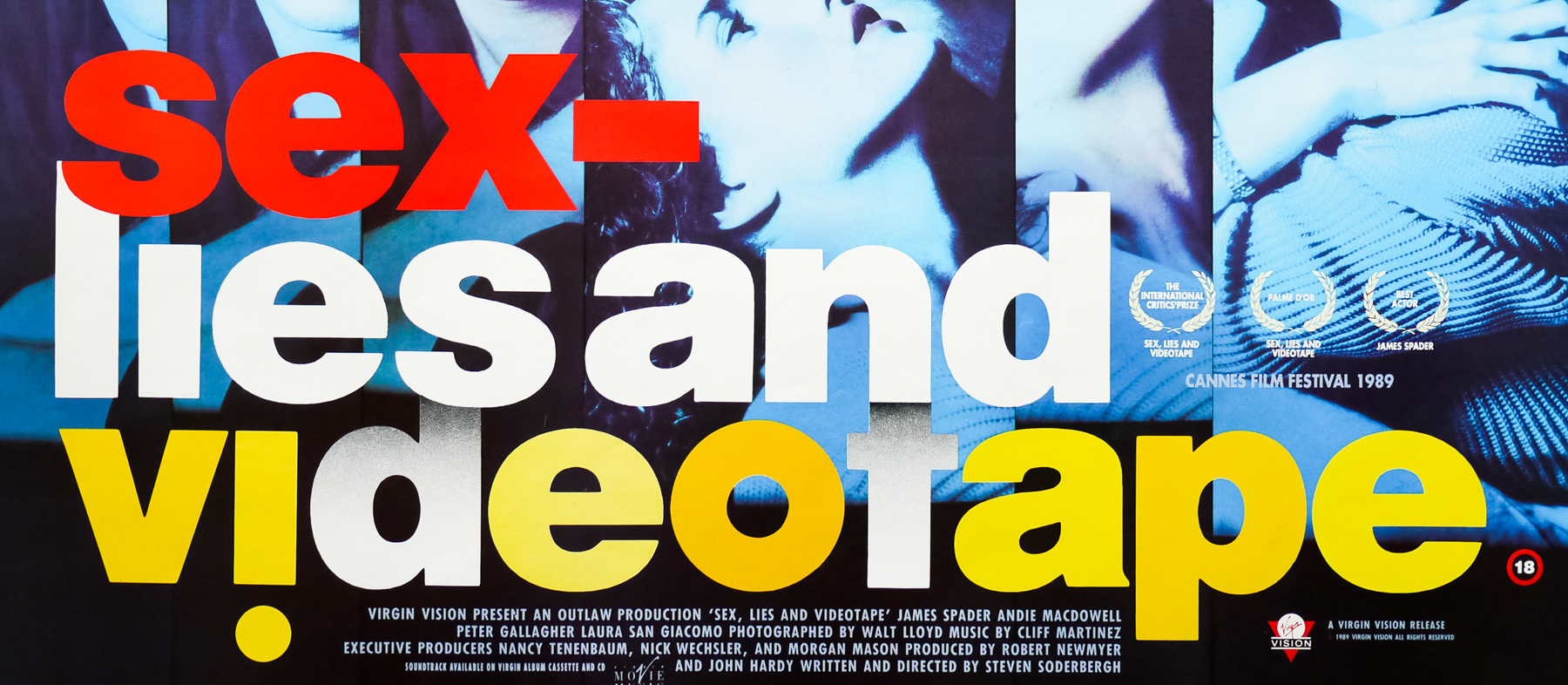
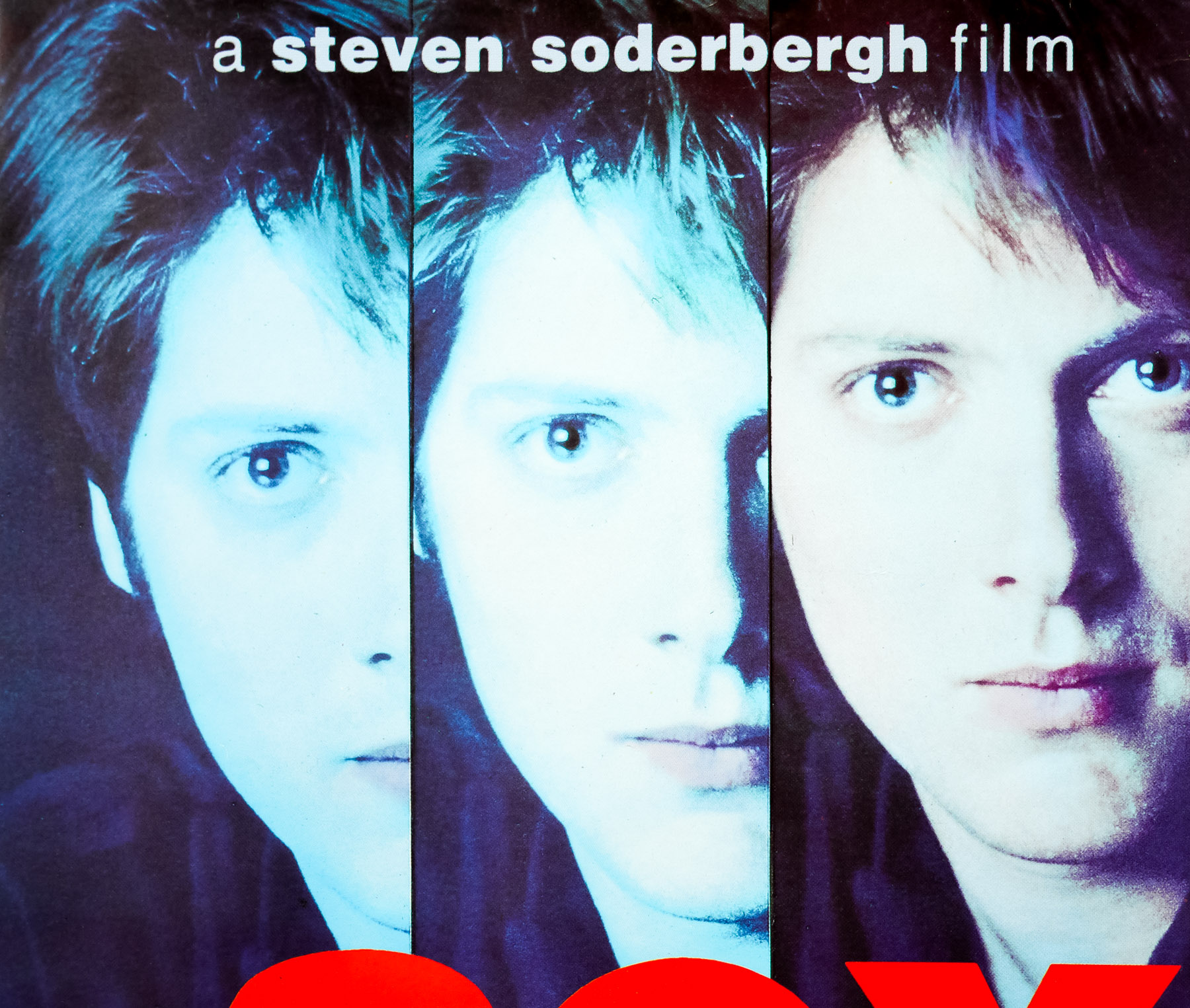
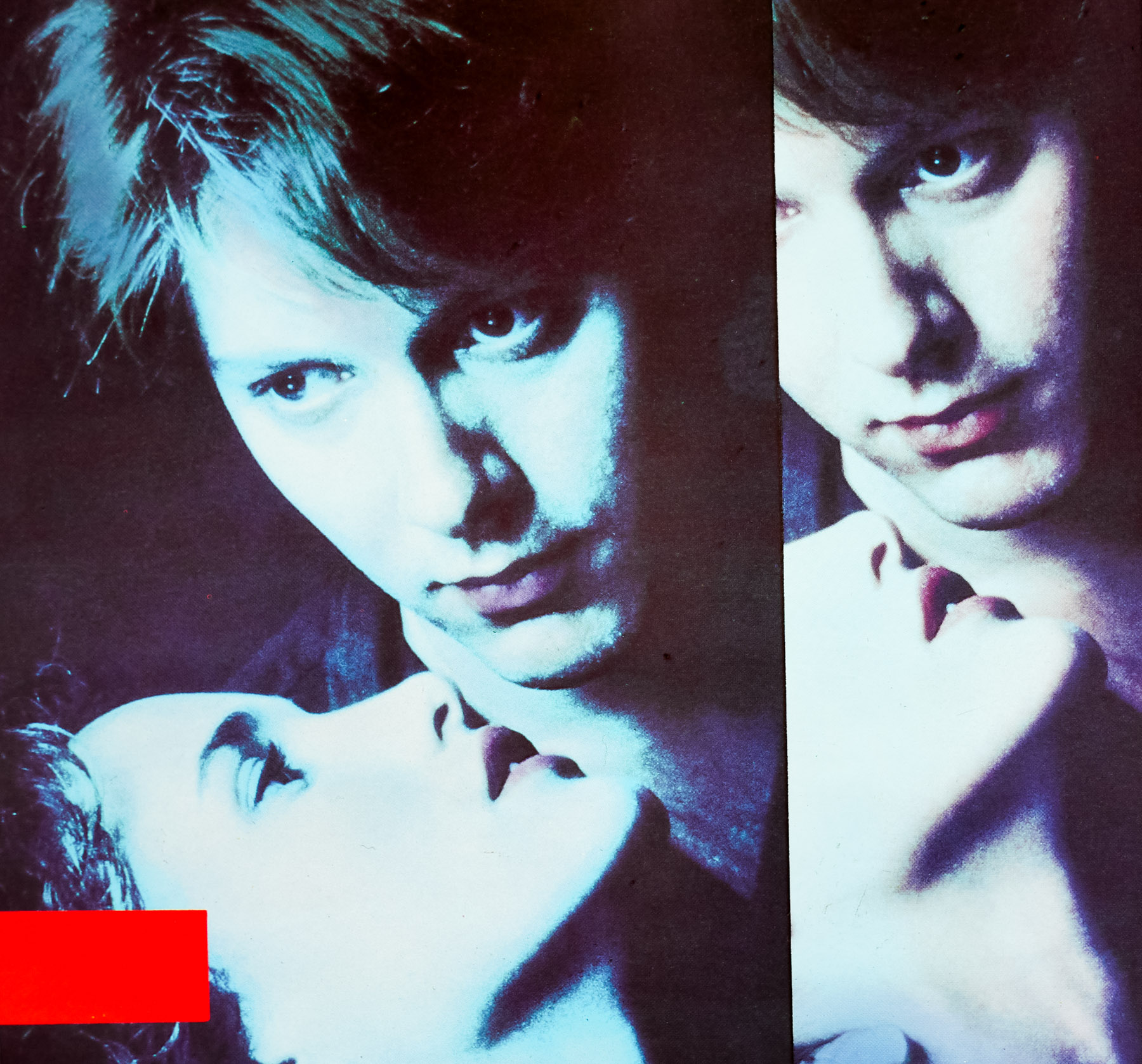
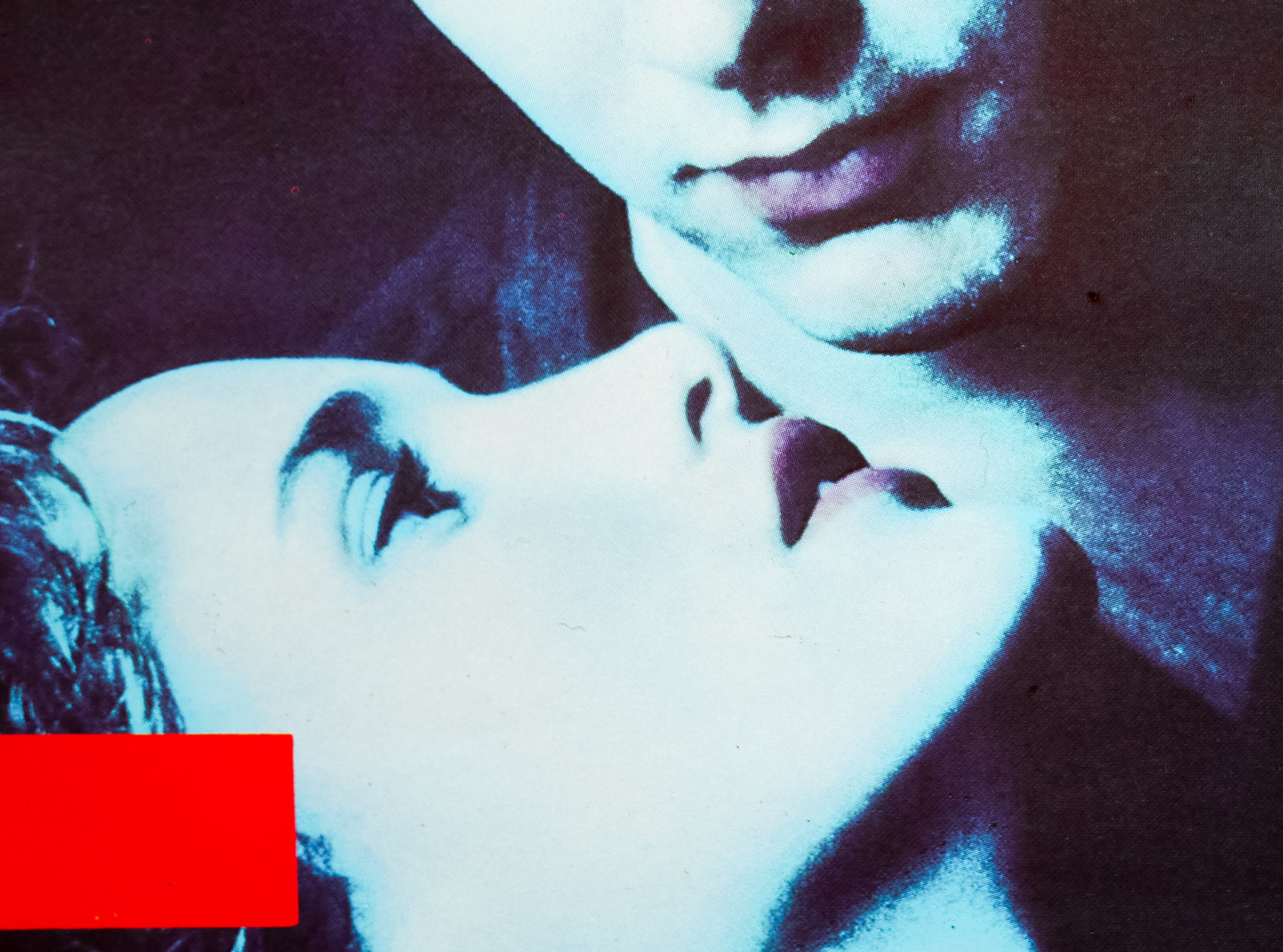
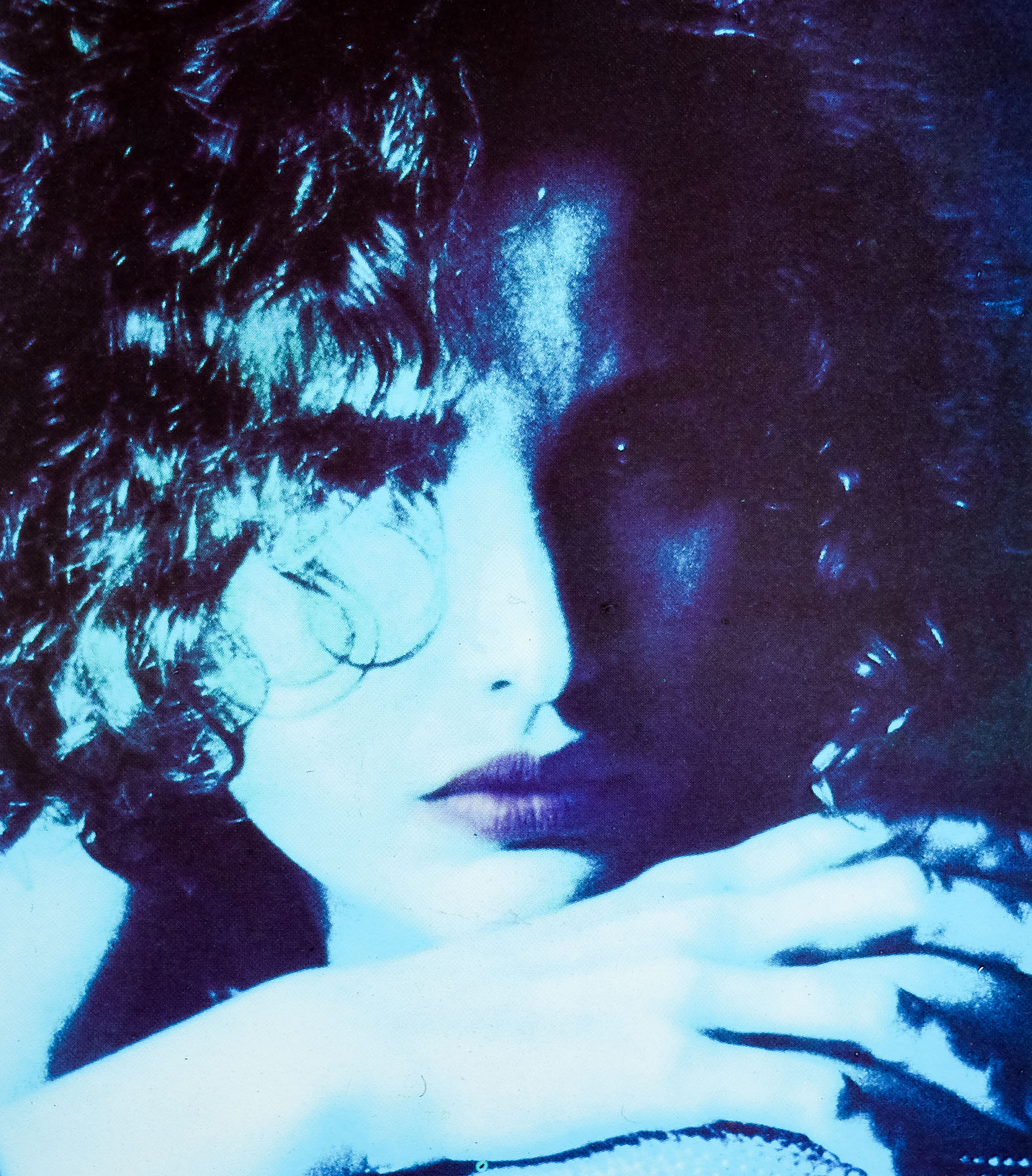
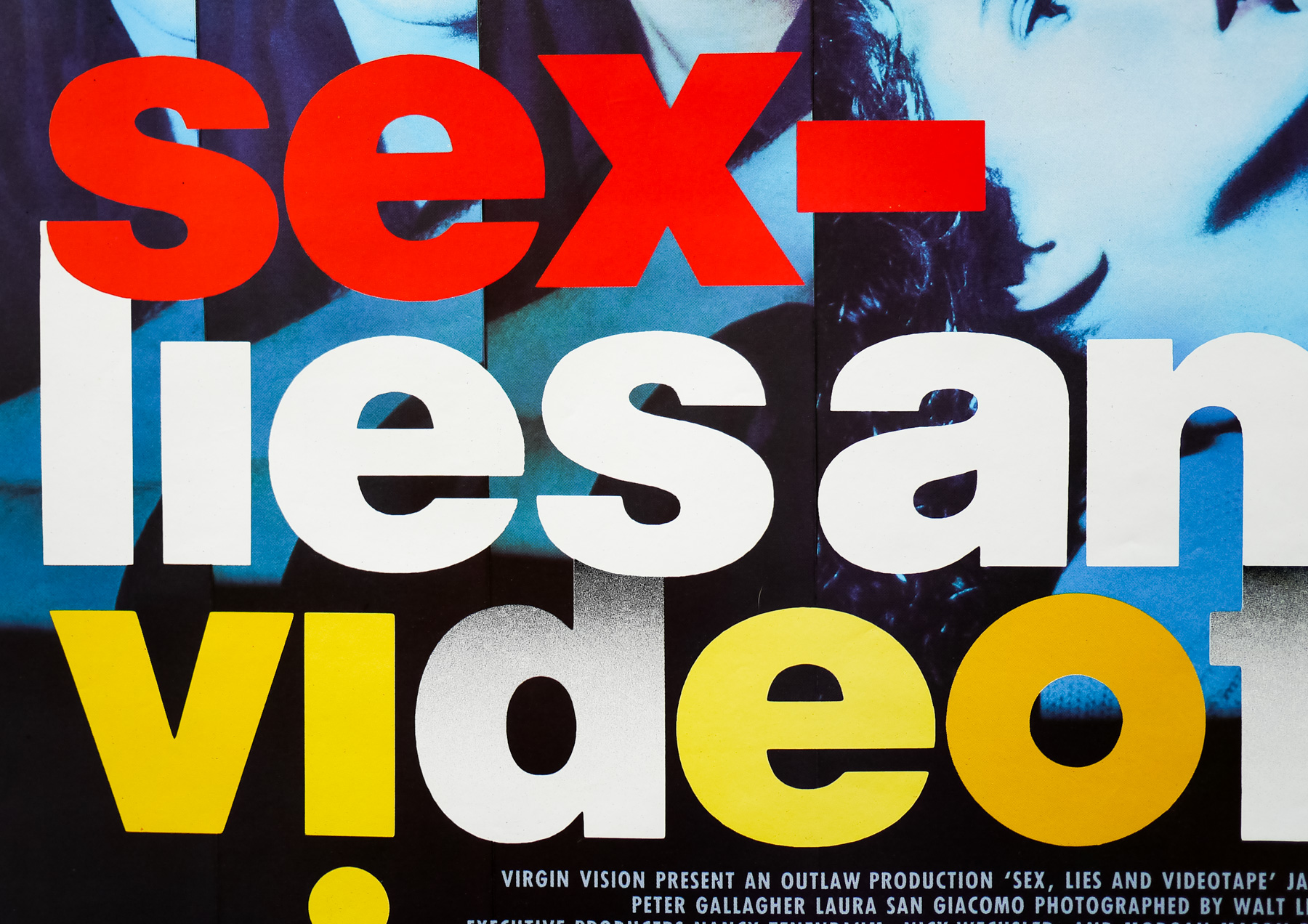
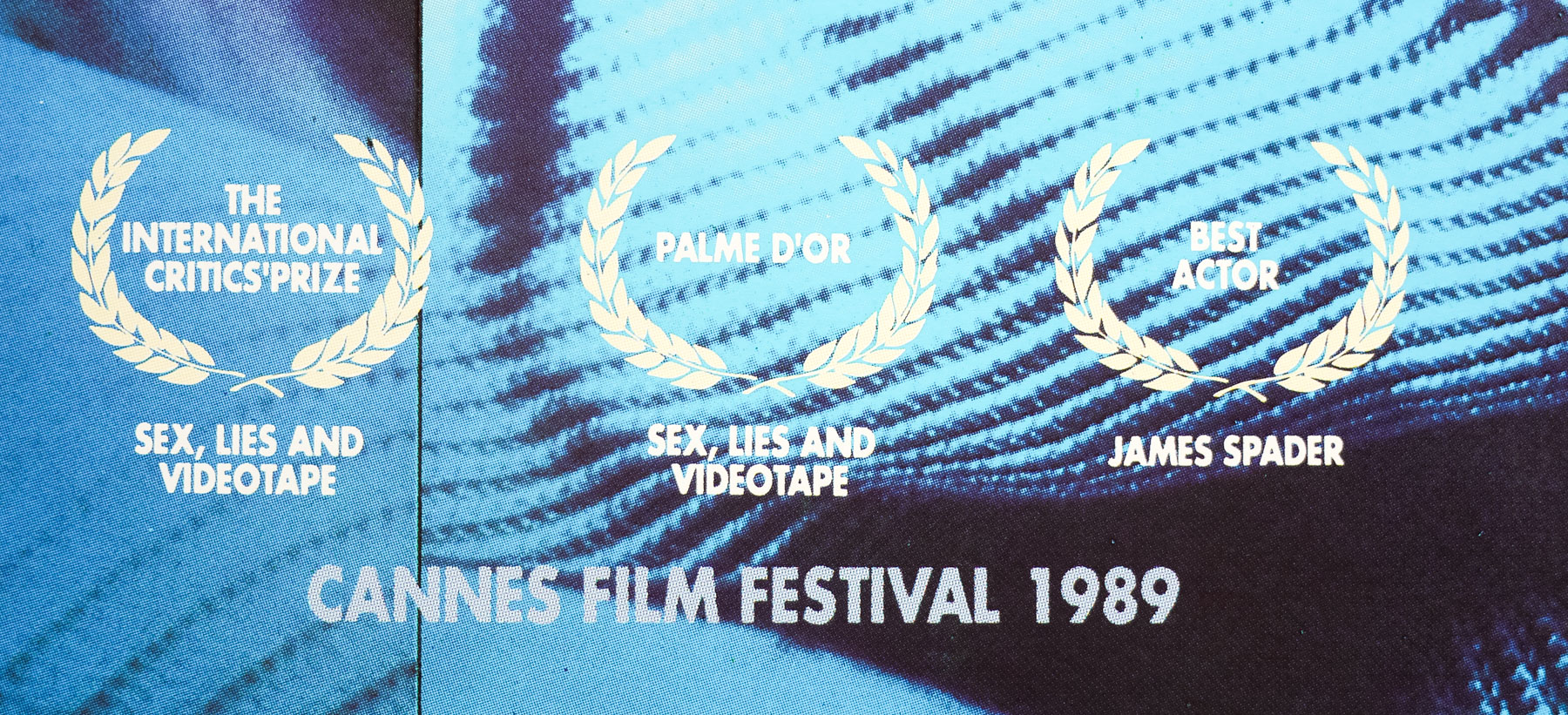
Sex, Lies, and Videotape (the oxford comma was a stylistic choice) is an important film for a number of reasons. It was the directorial debut of Steven Soderbergh, who apparently wrote the script in just eight days during a trip across the States, and the film would go on to win the prestigious Palme d’Or at the Cannes Film Festival, as well as launching Soderbergh’s impressive career (recently potentially ended for good). It was also a defining moment for the independent film movement, particularly since it was met by rave reviews and grossed multiple times its original budget (reported to be around $1.2m). A slew of successful indie pictures would follow during the 1990s and this film is often credited with kickstarting it all.

The film introduced Andie MacDowell and the next decade saw her becoming a hugely successful actress, particularly in the romantic comedy genre. It was also an important role for James Spader who had previously appeared in films like Wall Street and Pretty in Pink, but ‘Sex, Lies…’ gave a great boost to his career. MacDowell plays Ann Bishop Mullany who is living in Baton Rouge and is unhappily married to John (Peter Gallagher), a successful lawyer. Unbeknownst to Ann, her husband has been sleeping with her sister Cynthia (Laura San Giacomo) for some time, using Ann’s disinterest in sex as an excuse. Spader plays Graham, an old friend of John who returns to Baton Rouge after a nine year absence and stays with the Mullanys until he finds an apartment. Graham reveals that he records women talking about their sexual experiences and fantasies, and that its the only way he can receive sexual gratification. This revelation stirs up differing responses from the group and soon all of their lives will be changed for good.

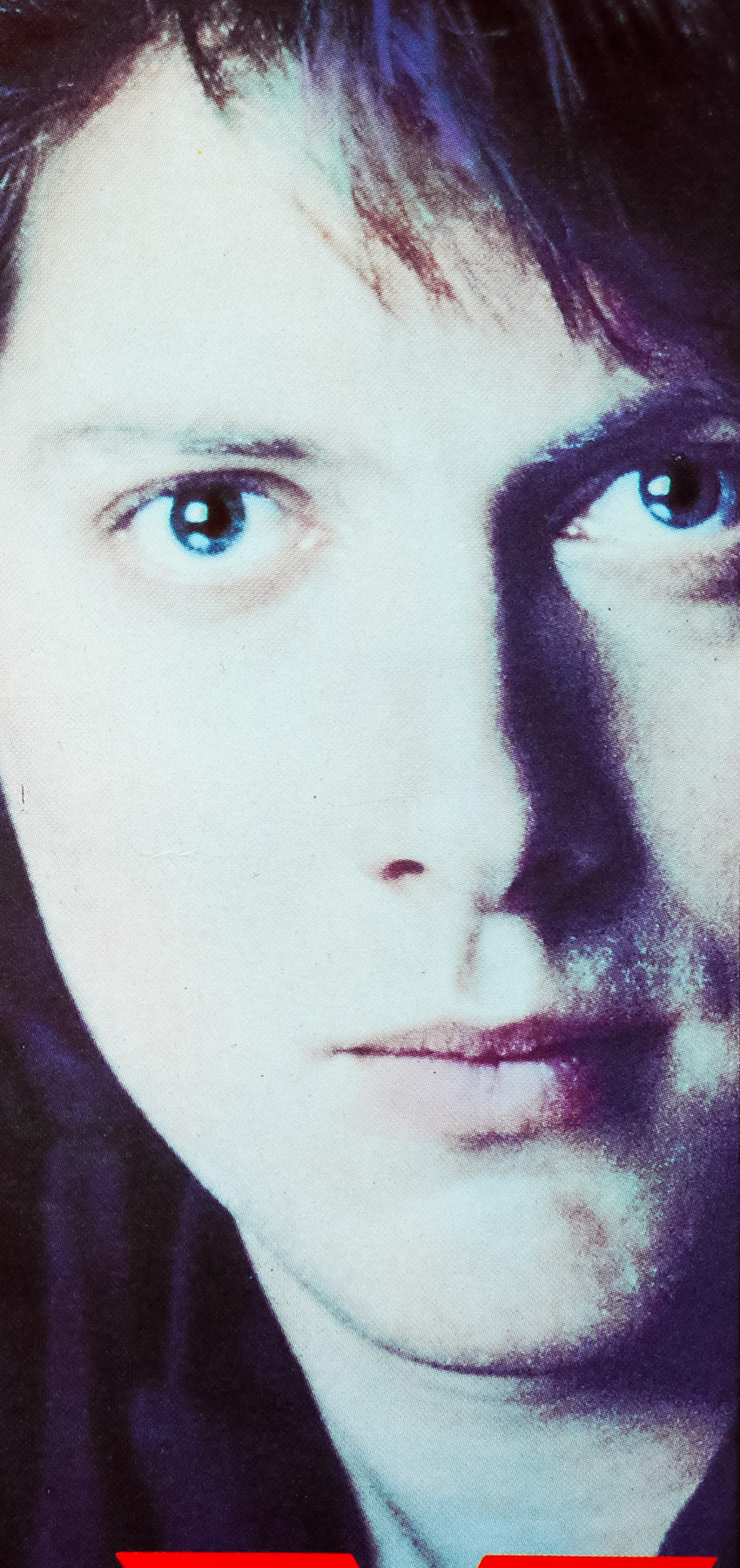
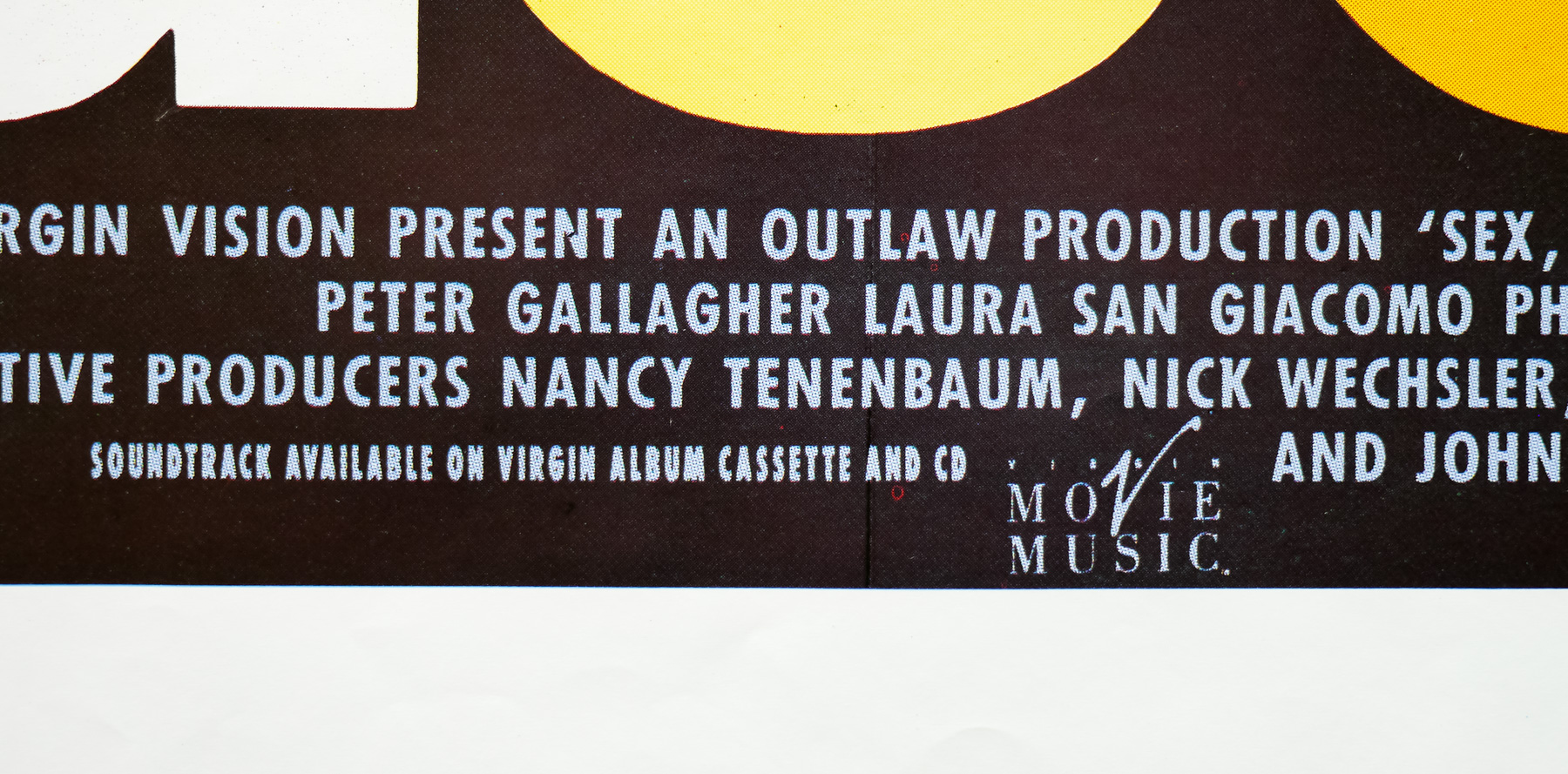
I’m unsure who is responsible for the design on this British quad but it is unique to this particular poster. If anyone has any ideas please get in touch.

Sword of the Valiant / quad / UK

19.06.15

Poster Poster
Title
Sword of the Valiant
AKA
Sword of the Valiant: The Legend of Sir Gawain and the Green Knight (full title - USA)
Year of Film
1984
Director
Stephen Weeks
Starring
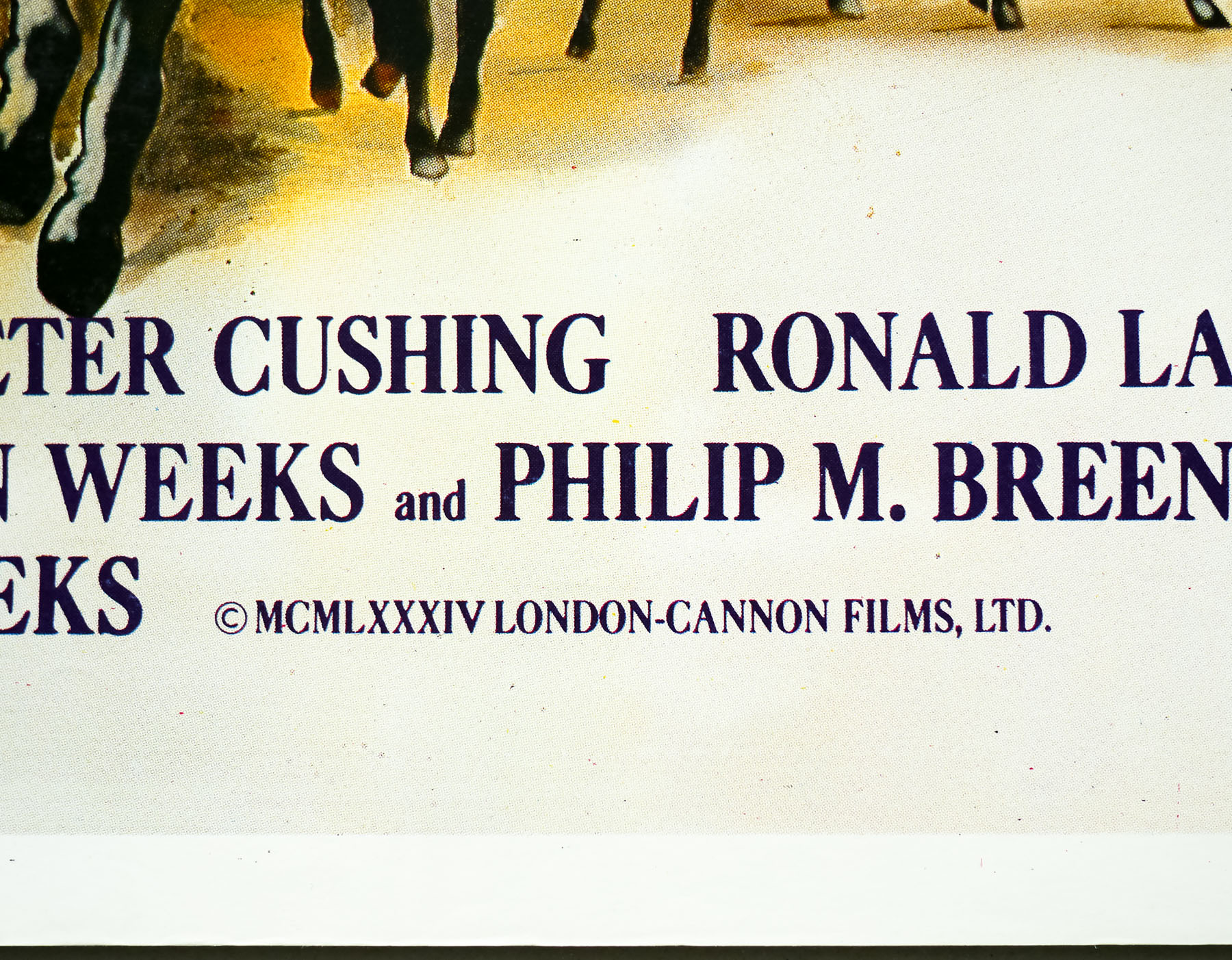
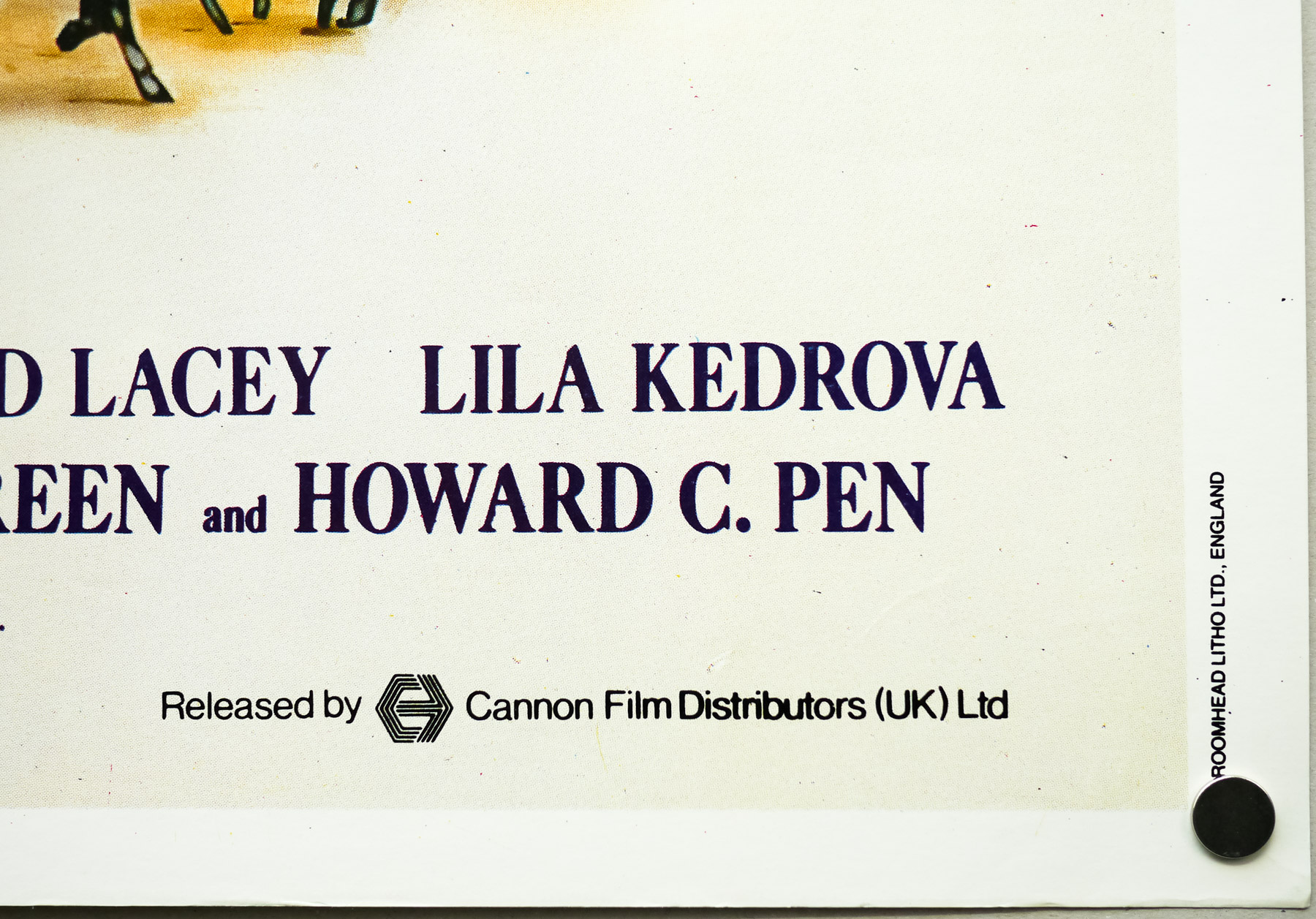
Miles O'Keeffe, Cyrielle Clair, Leigh Lawson, Sean Connery, Trevor Howard, Peter Cushing, Ronald Lacey, Lila Kedrova, John Rhys-Davies
Origin of Film
UK
Genre(s) of Film
Miles O'Keeffe, Cyrielle Clair, Leigh Lawson, Sean Connery, Trevor Howard, Peter Cushing, Ronald Lacey, Lila Kedrova, John Rhys-Davies,
Type of Poster
Quad
Style of Poster
--
Origin of Poster
UK
Year of Poster
1984
Designer
Unknown
Artist
Unknown
Size (inches)
30 1/16" x 40"
SS or DS
SS
Tagline
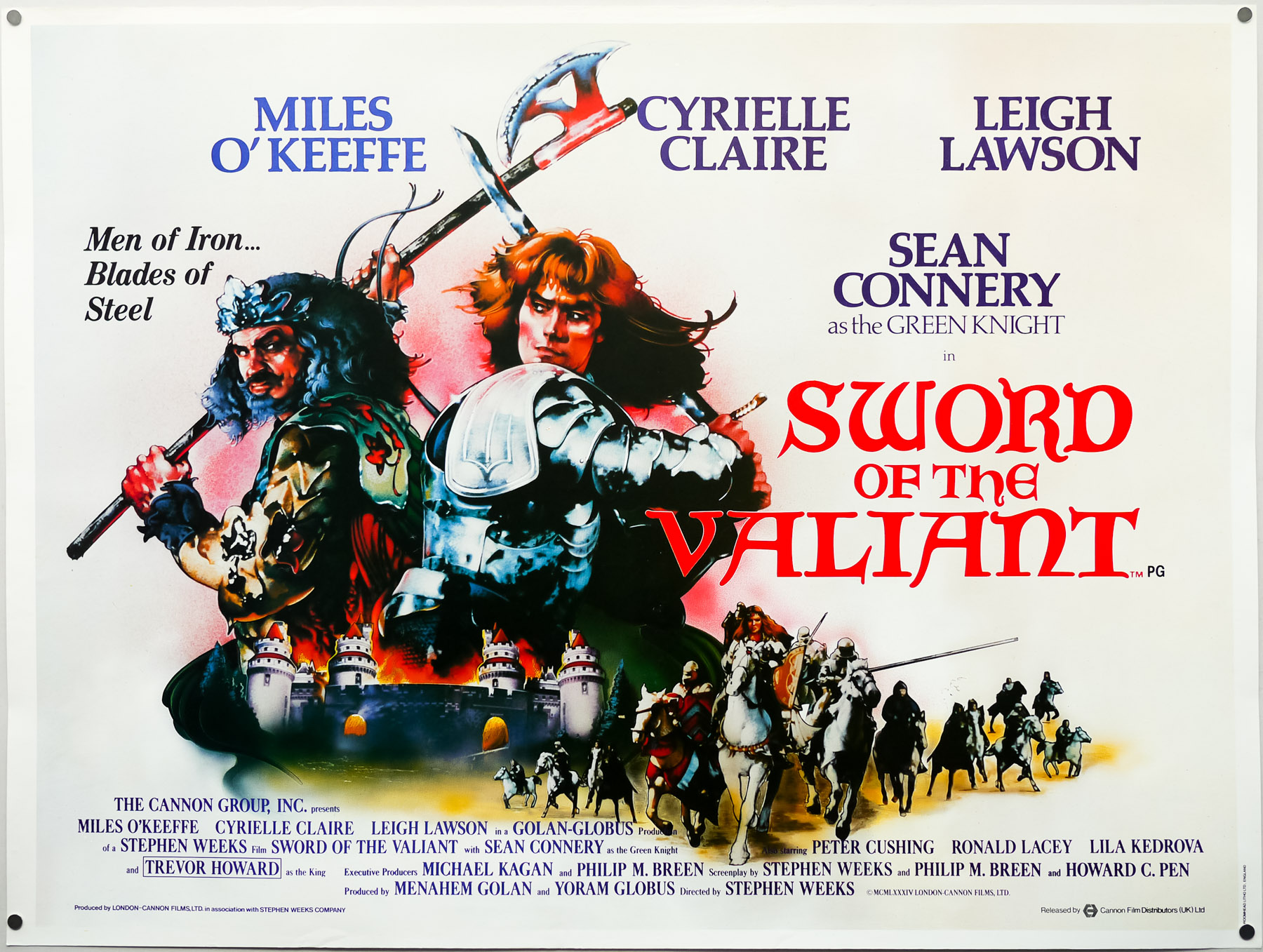
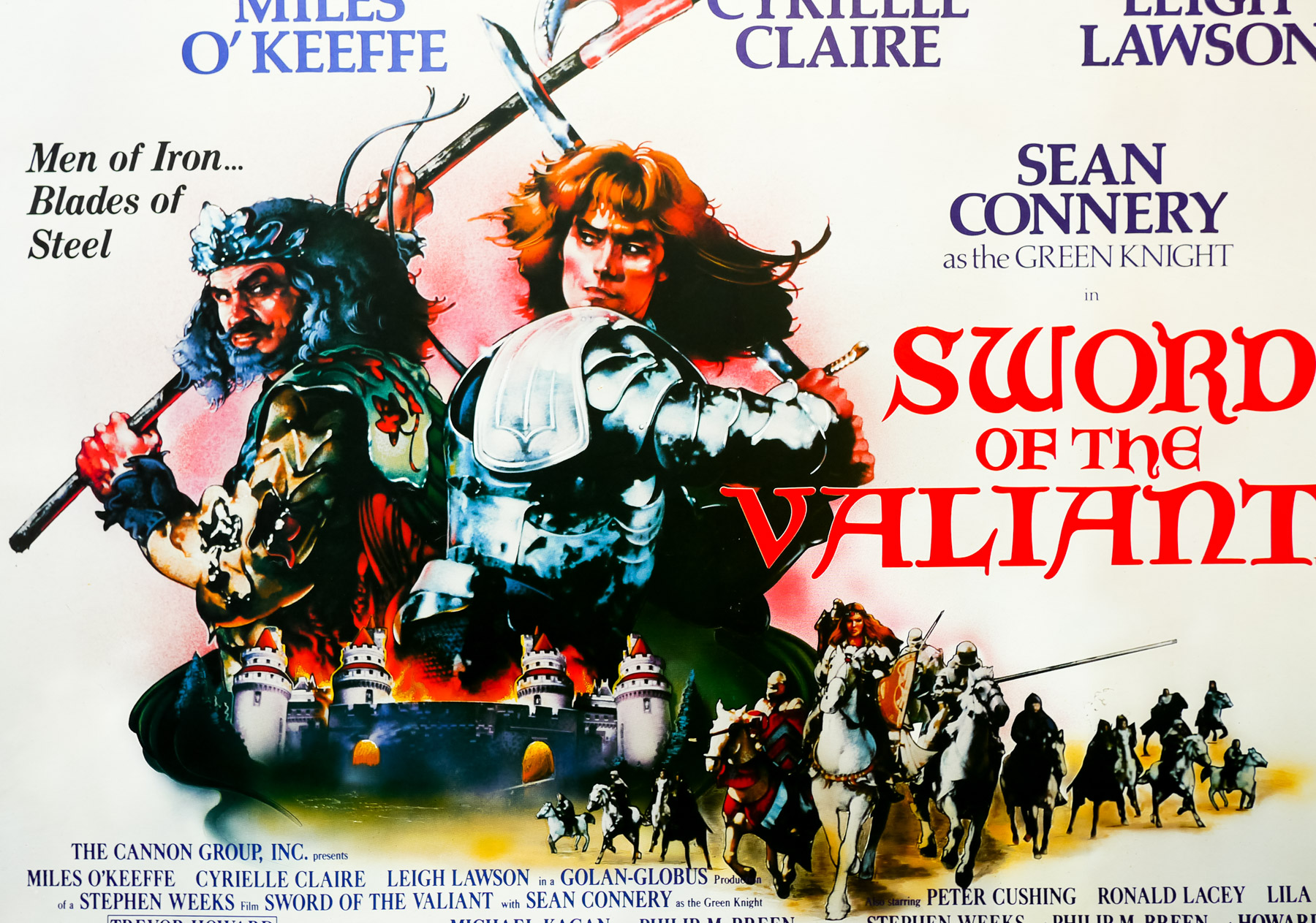
Men of Iron... Blades of Steel

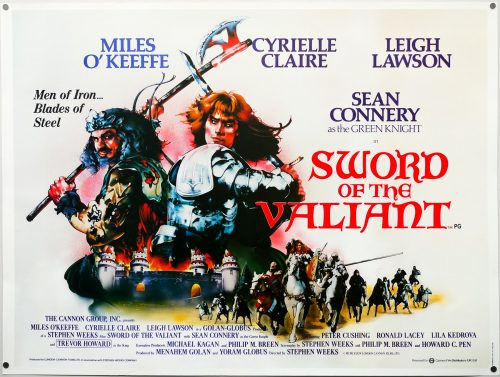
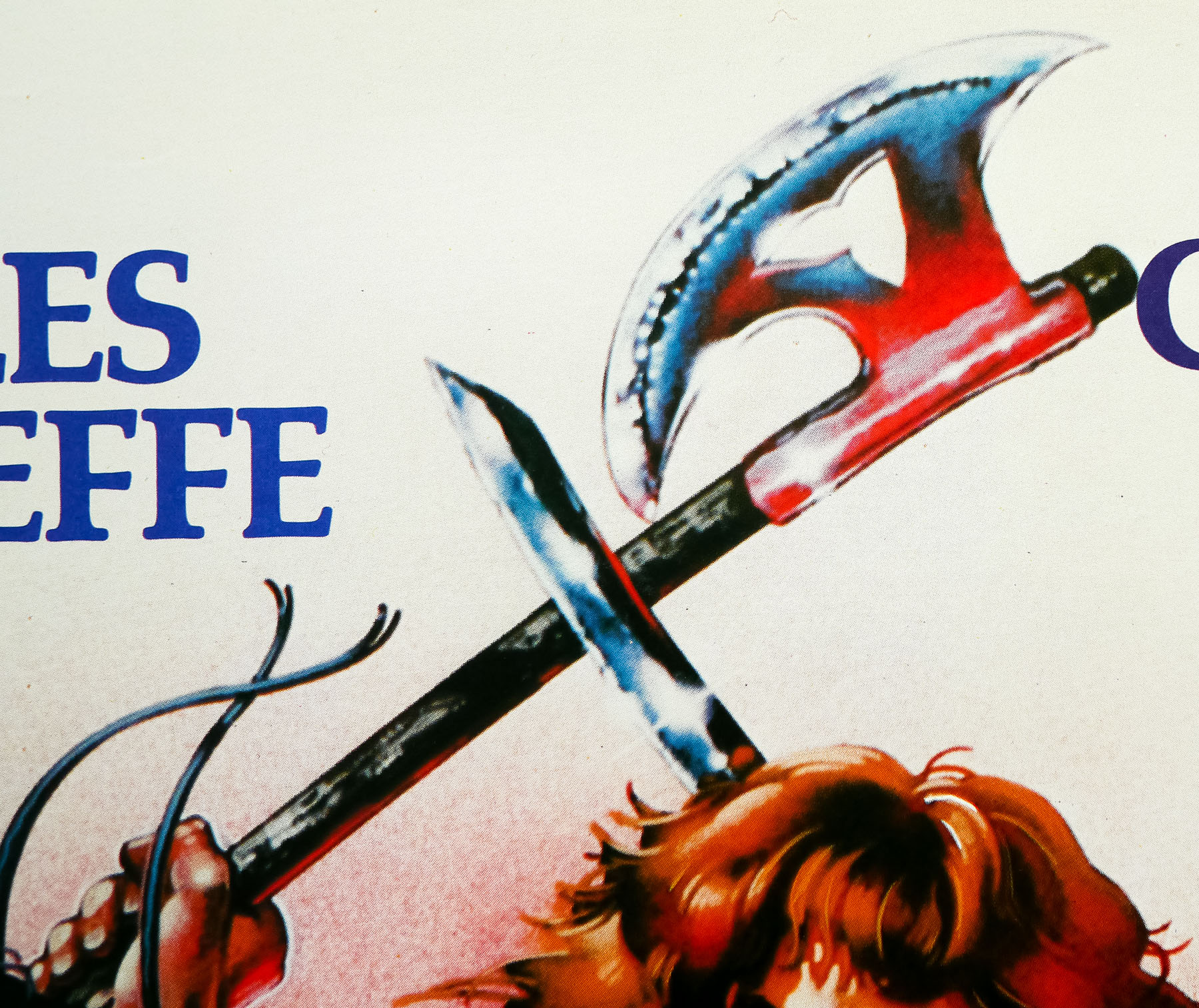
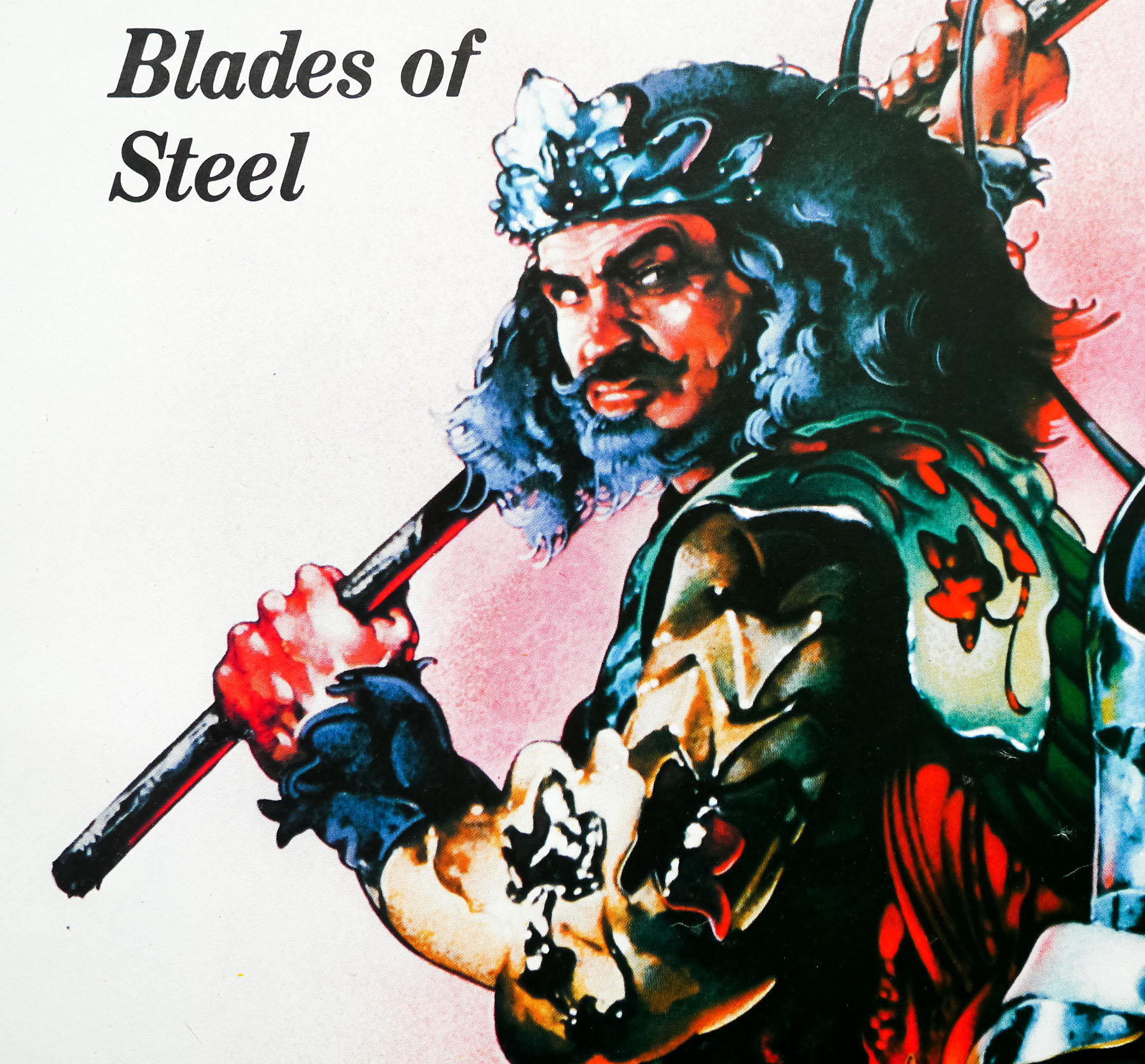
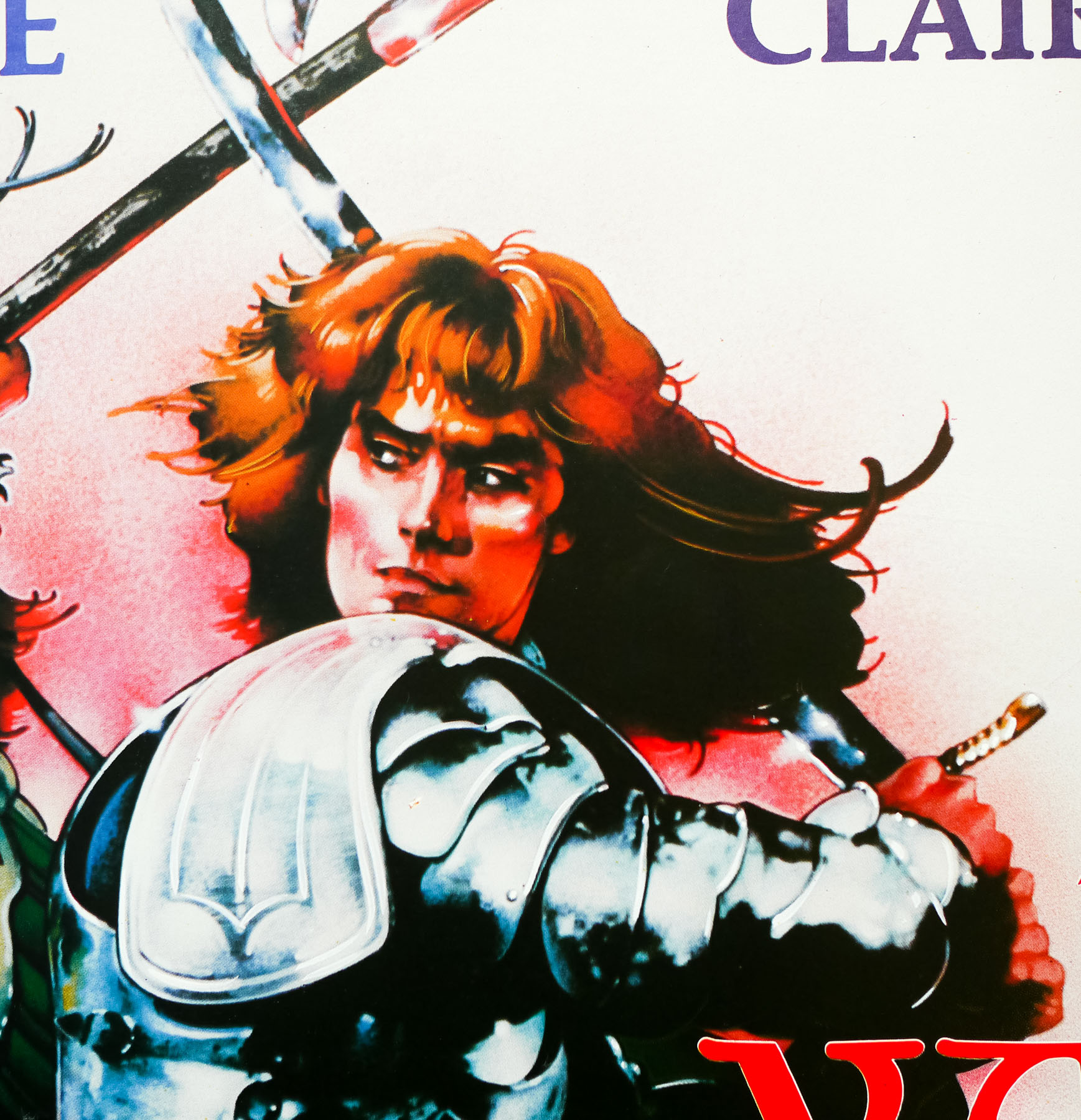
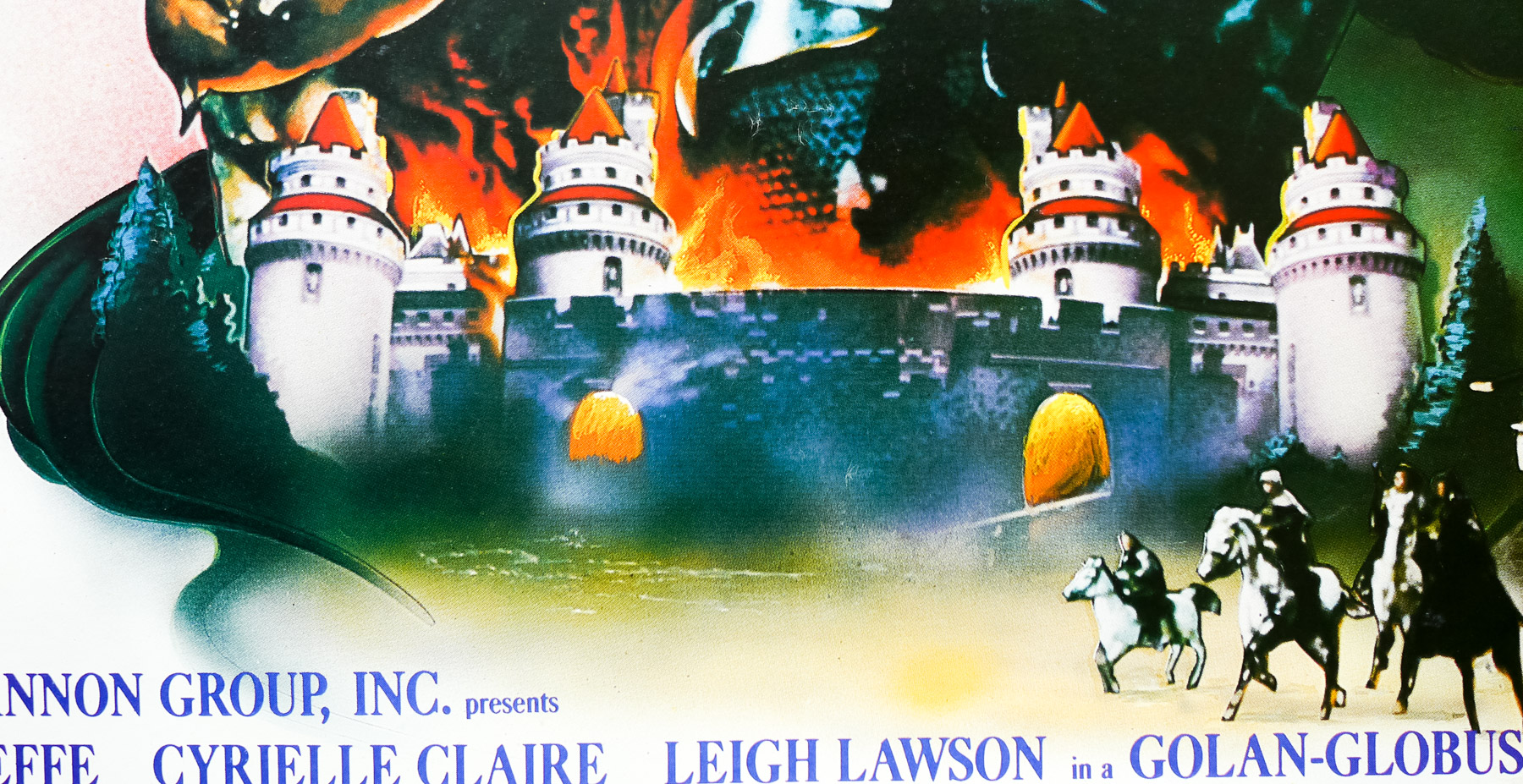
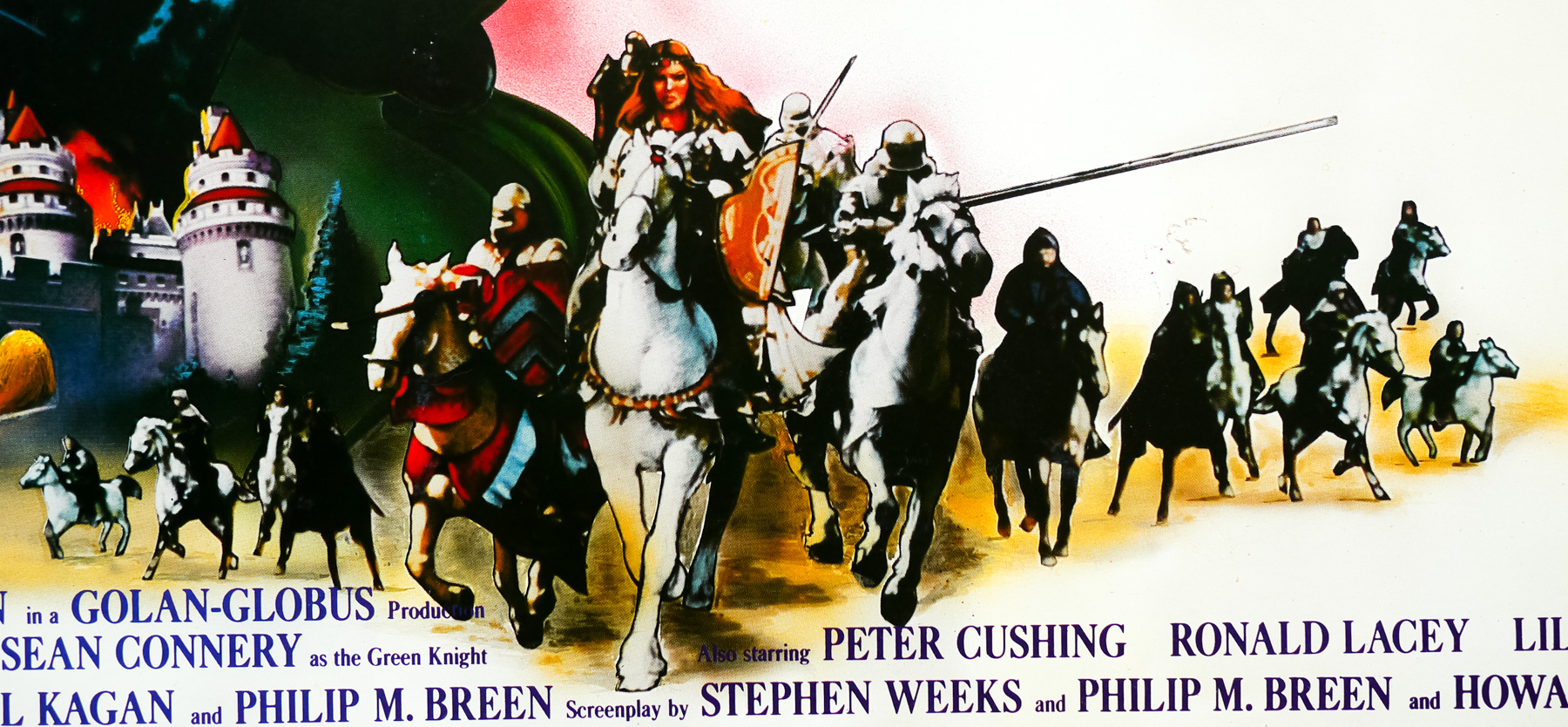
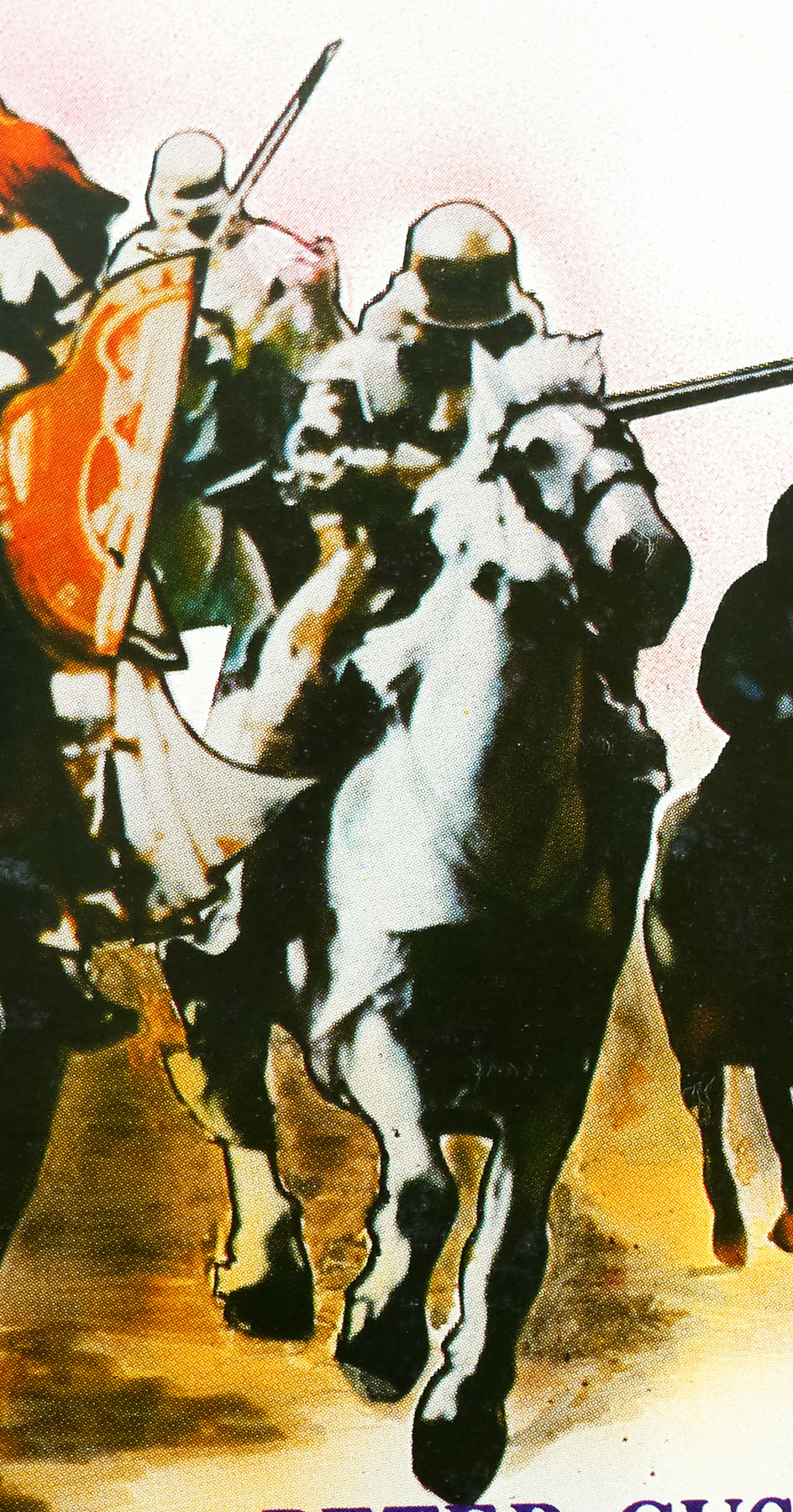
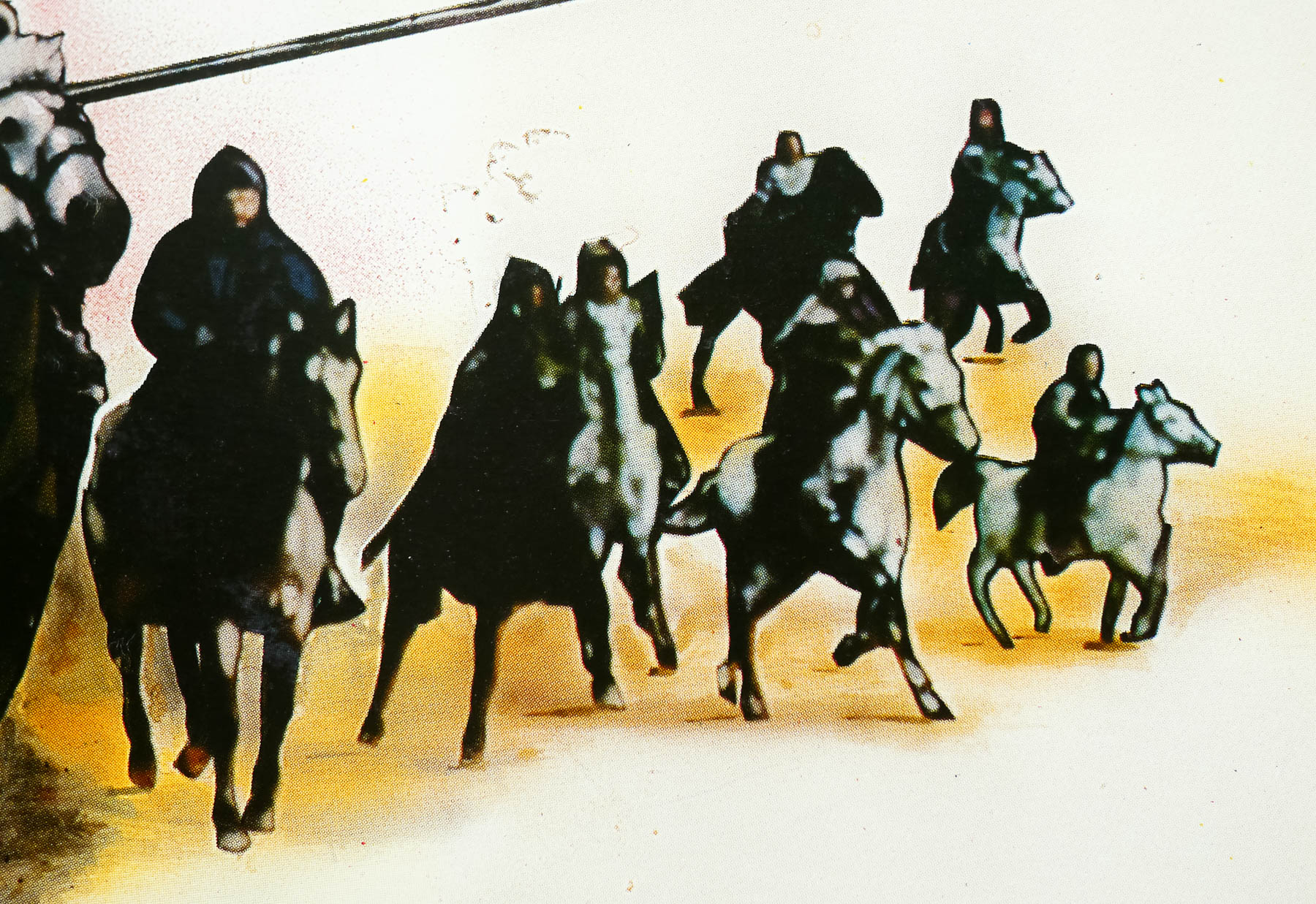
British director Stephen Weeks had already made a film loosely based on the Arthurian poem Sir Gawain and the Green Knight that was released in 1973 as Gawain and the Green Knight and starred the singer Murray Head as Gawain. Unfortunately, a falling out between producer and studio meant that the film was not properly distributed and pretty much disappeared without trace. 10 years later the notorious producers in charge of Cannon Films, Menahem Golan and Yoram Globus, were casting around for a new project and Weeks managed to persuade them to remake his original story with just a handful of tweaks. Quite frankly, everyone involved should have stayed away as the result is a risible mess.

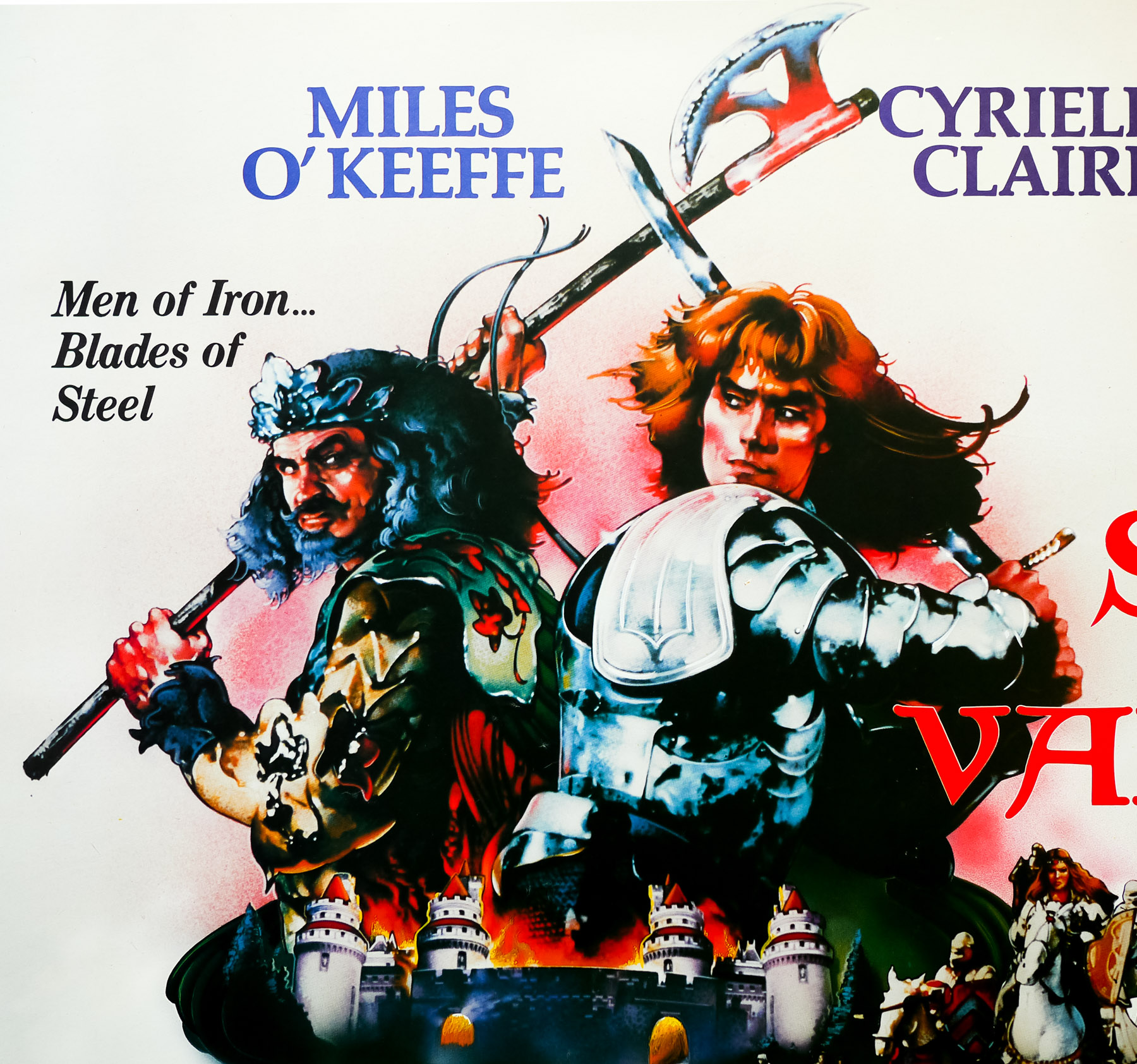
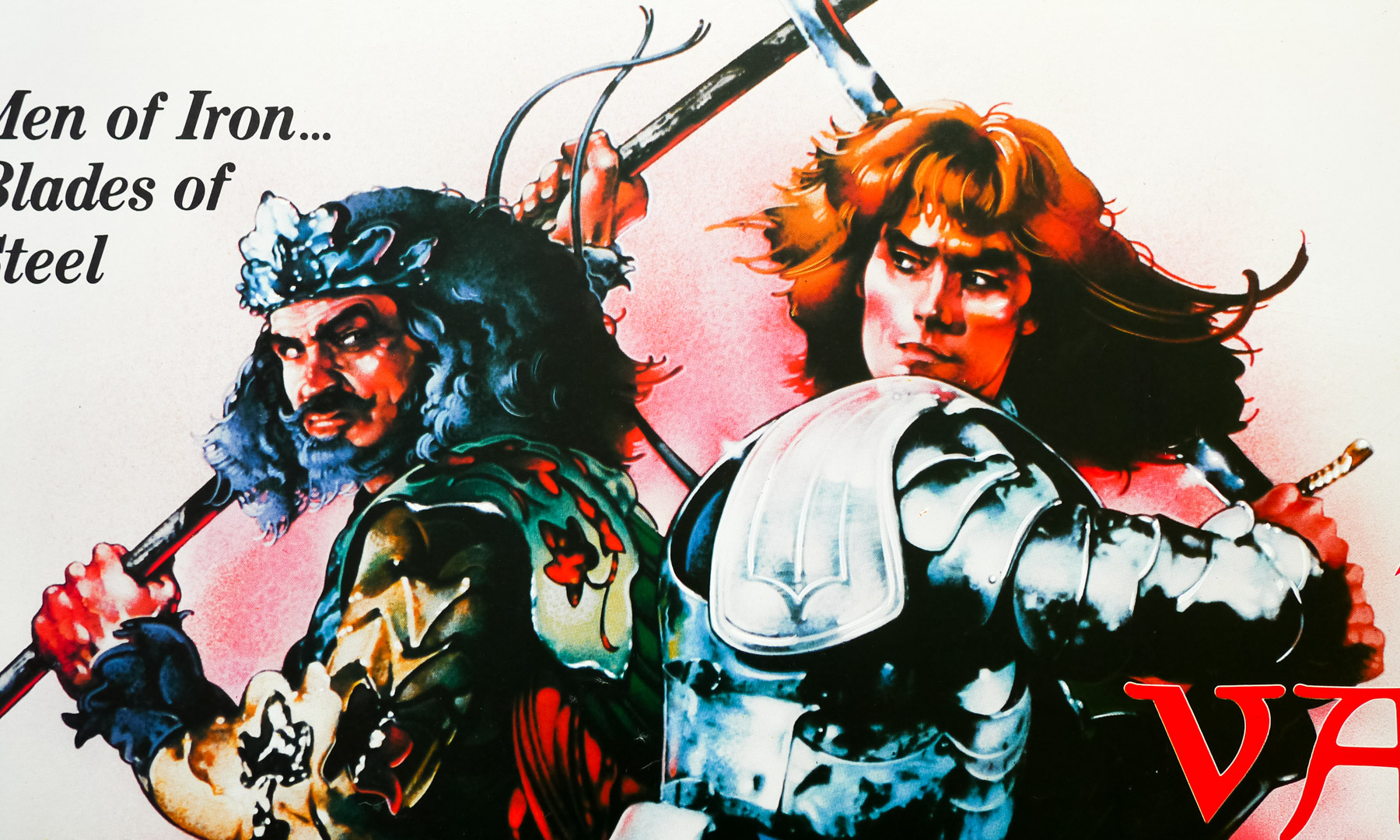
Practically the only thing of note are the actors that the producers managed to persuade to join the cast, which includes the late Peter Cushing (in one of his final appearances) and Trevor Howard, as well as star of the Indiana Jones series John Rhys-Davies. Unquestionably their biggest coup was securing Sean Connery to play the Green Knight, a performance he managed to squeeze around his role in the unofficial Bond film Never Say Never Again, a task made easy by the fact that he only appears in a few scenes. But what an appearance! If you thought his costume in Zardoz was bizarre, just wait until you see him covered in bright green armour, glitter, bare-chested, covered in fake tan and wearing small antlers on his head! He certainly gives it some gusto and seems to enjoy prancing around the sets swinging his giant axe.

The story begins inside a great banqueting hall with an unhappy king (Howard) stopping a planned feast because he’s fed up with the nobles who he feels don’t have much worth. He challenges them all to prove that they’re worthy of eating from his table. Just at that moment Connery’s Green Knight bursts through the door on horseback and proceeds to taunt the people in the hall with a challenge to cut off his head in order to prove their courage. At first no one accepts, but then a plucky young squire called Gawain (a Barbie-haired Miles O’Keeffe) who was delivering the king’s new suit of armour decides to take up the challenge. Gawain swings the axe and the Green Knight’s head is removed but the whole thing is a strange ruse and only a minute later the Knight is whole again and turning the axe on Gawain.

Just before delivering the final blow he decides to spare the squire and offers him a year to solve an odd rhyming riddle. When the Green Knight has gone, the king is thrilled with Gawain’s bravery and immediately knights him and sends him off on a quest to solve the riddle. The rest of the film moves from scene to scene without much urgency and features some dreadful battle scenes and sword-fighting that make it look like an amateur production. The script is truly terrible and it’s clear that whole scenes were truncated heavily as half of it doesn’t make much sense. Perhaps worst of all is the abysmal synthesiser score that warbles in the background of every scene.

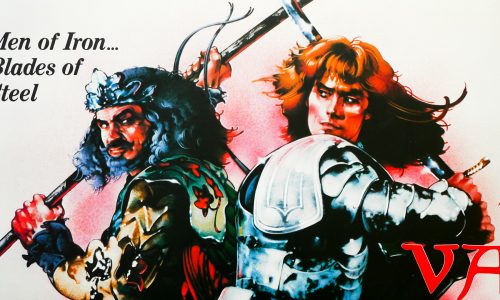
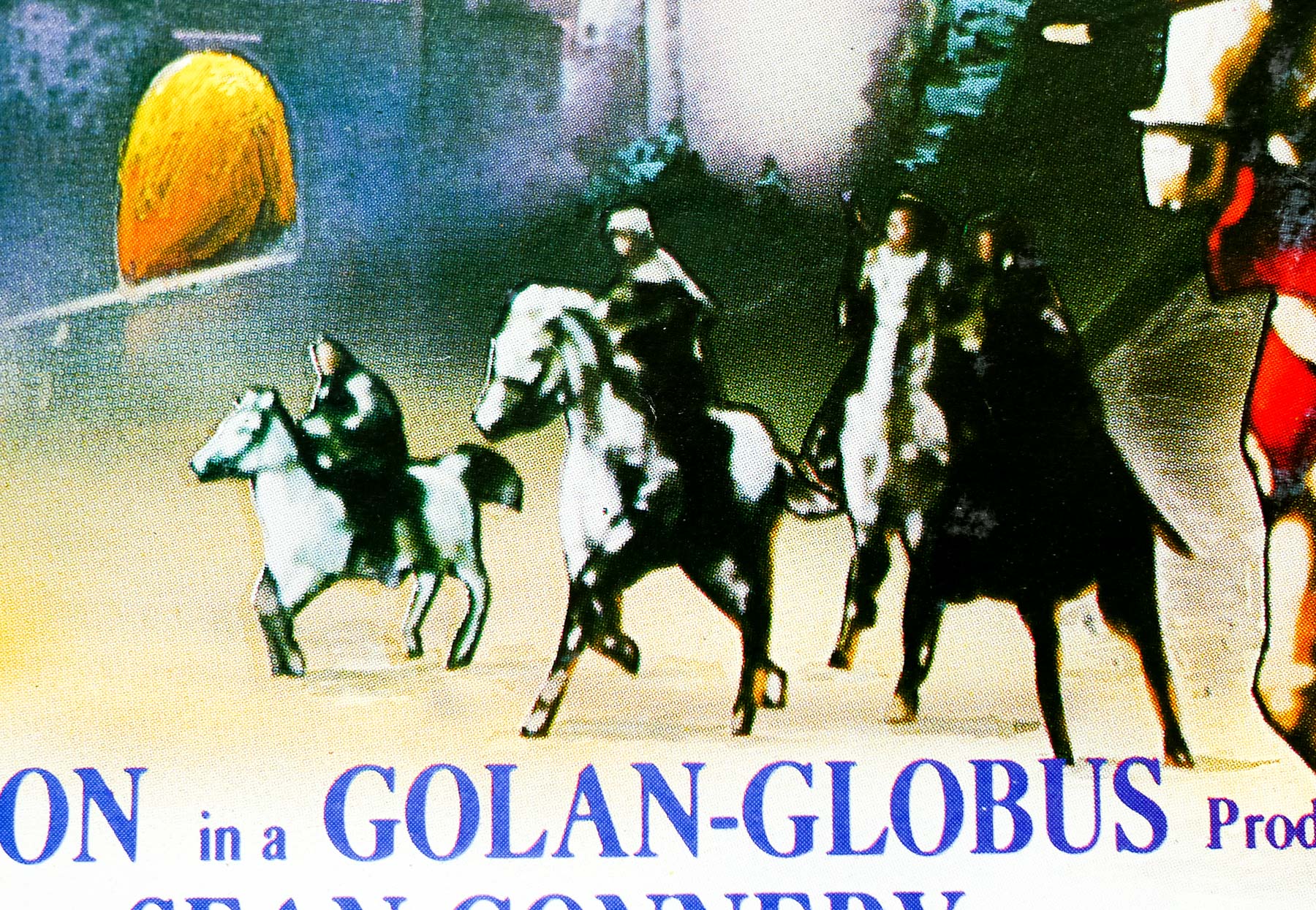
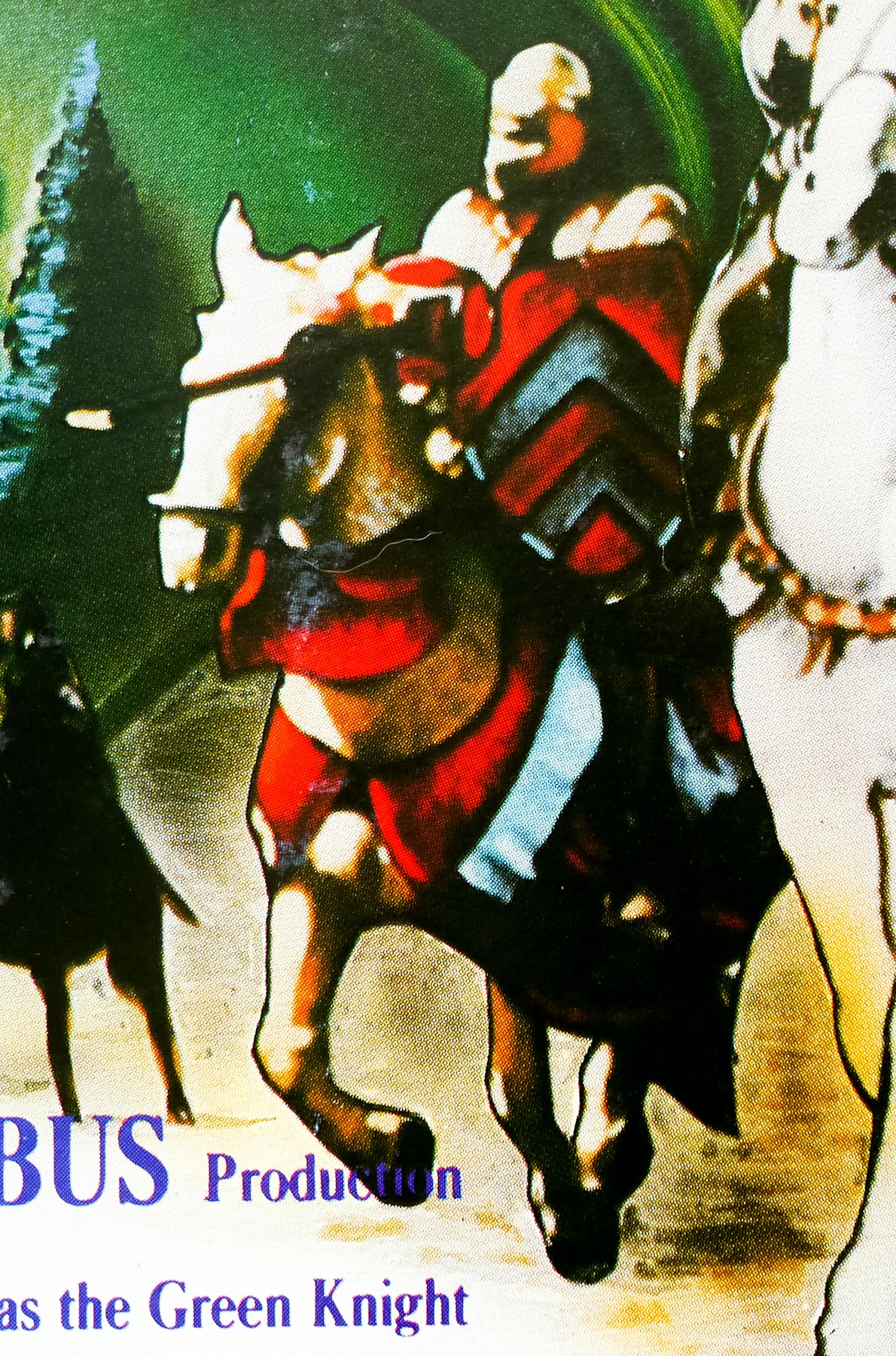
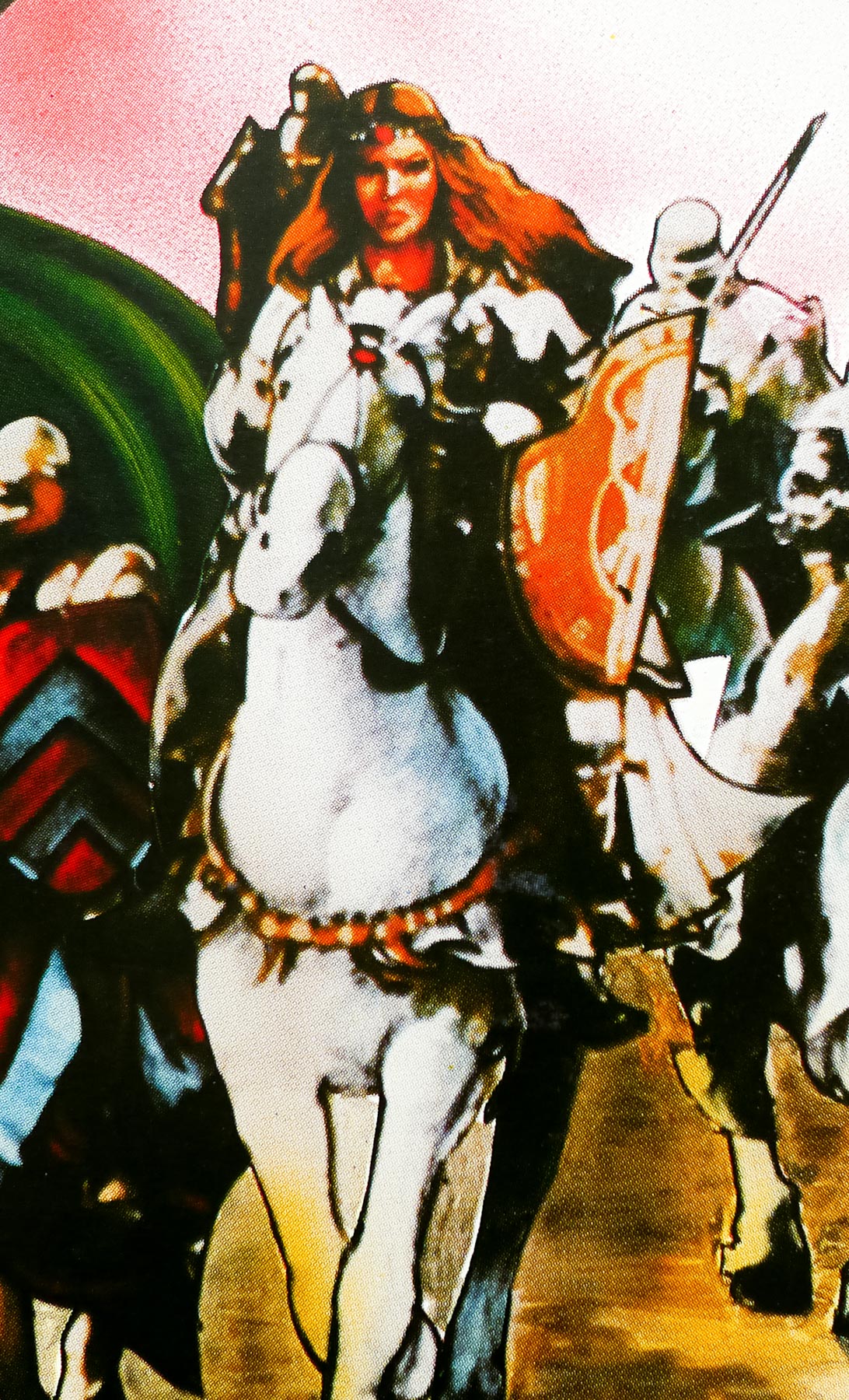
In the end, this film would also fall foul of producer and distributor problems and wasn’t given a proper release and poor reviews didn’t help much at all. Weeks would never direct again. This poster features artwork that I believe to be unique to the British quad and I’ve been unable to find out who is responsible. If anyone has any ideas please get in touch.

Check out the ridiculous trailer on YouTube.

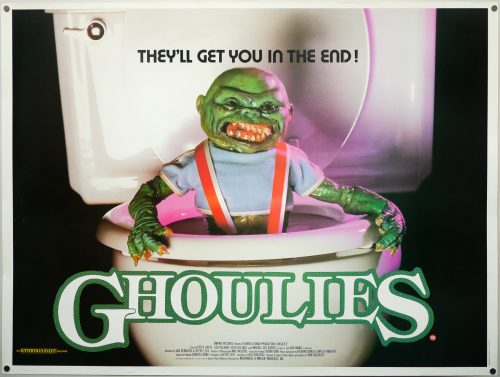
Ghoulies / quad / UK

24.08.15

Poster Poster
Title
Ghoulies
AKA
--
Year of Film
1984
Director
Luca Bercovici
Starring
Peter Liapis, Lisa Pelikan, Michael Des Barres, Jack Nance, Peter Risch, Tamara De Treaux, Scott Thomson, Ralph Seymour, Mariska Hargitay, Keith Joe Dick
Origin of Film
USA
Genre(s) of Film
Peter Liapis, Lisa Pelikan, Michael Des Barres, Jack Nance, Peter Risch, Tamara De Treaux, Scott Thomson, Ralph Seymour, Mariska Hargitay, Keith Joe Dick,
Type of Poster
Quad
Style of Poster
--
Origin of Poster
UK
Year of Poster
1984
Designer
Unknown
Artist
--
Size (inches)
30 1/16" x 40"
SS or DS
SS
Tagline
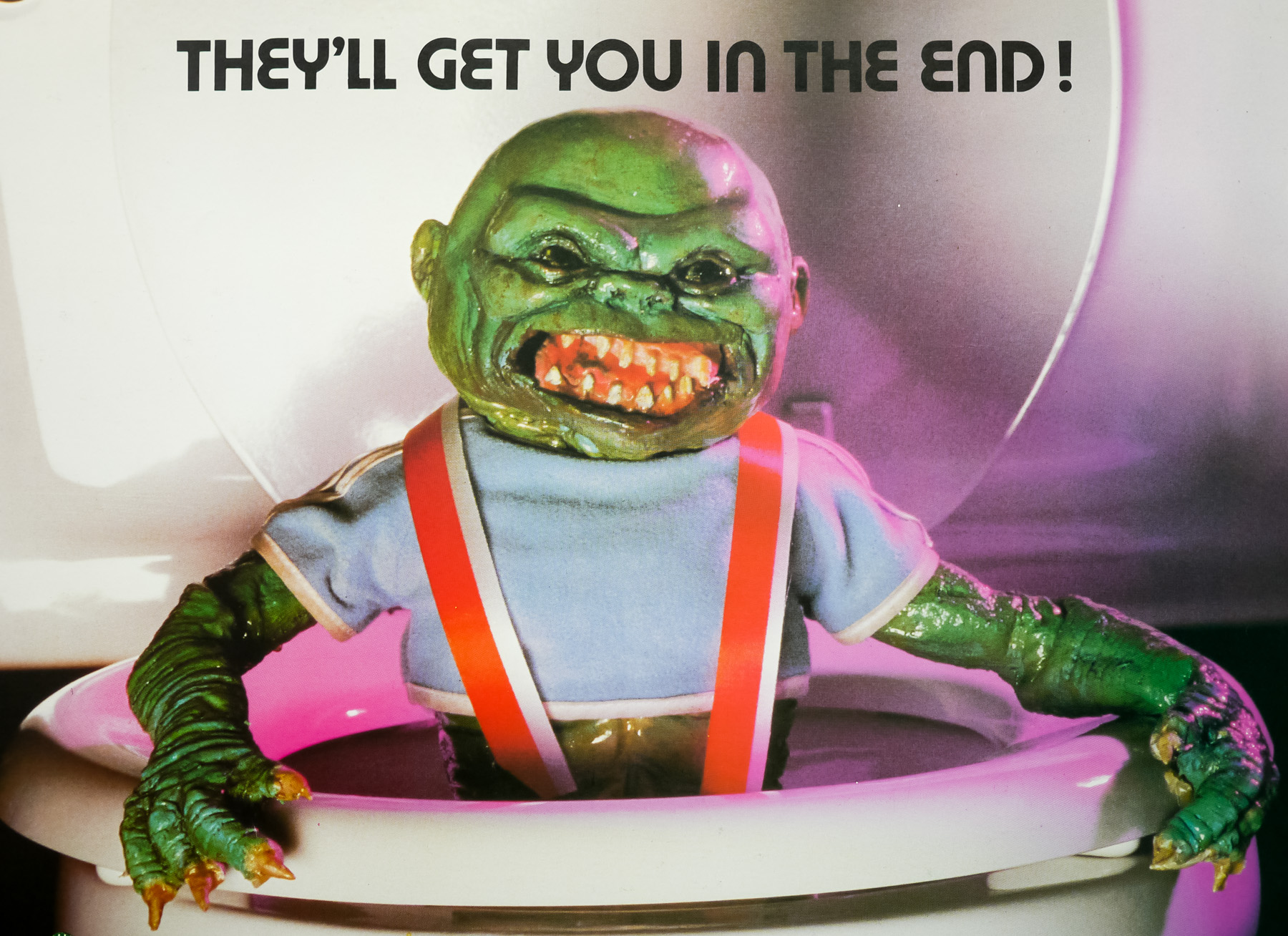
They'll get you in the end!

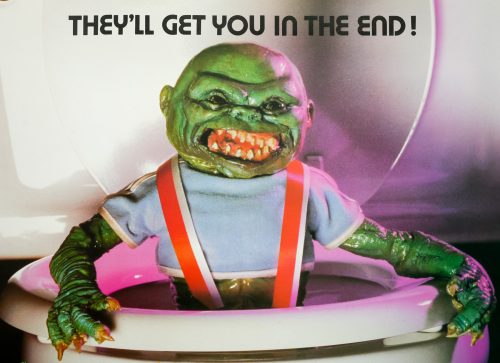
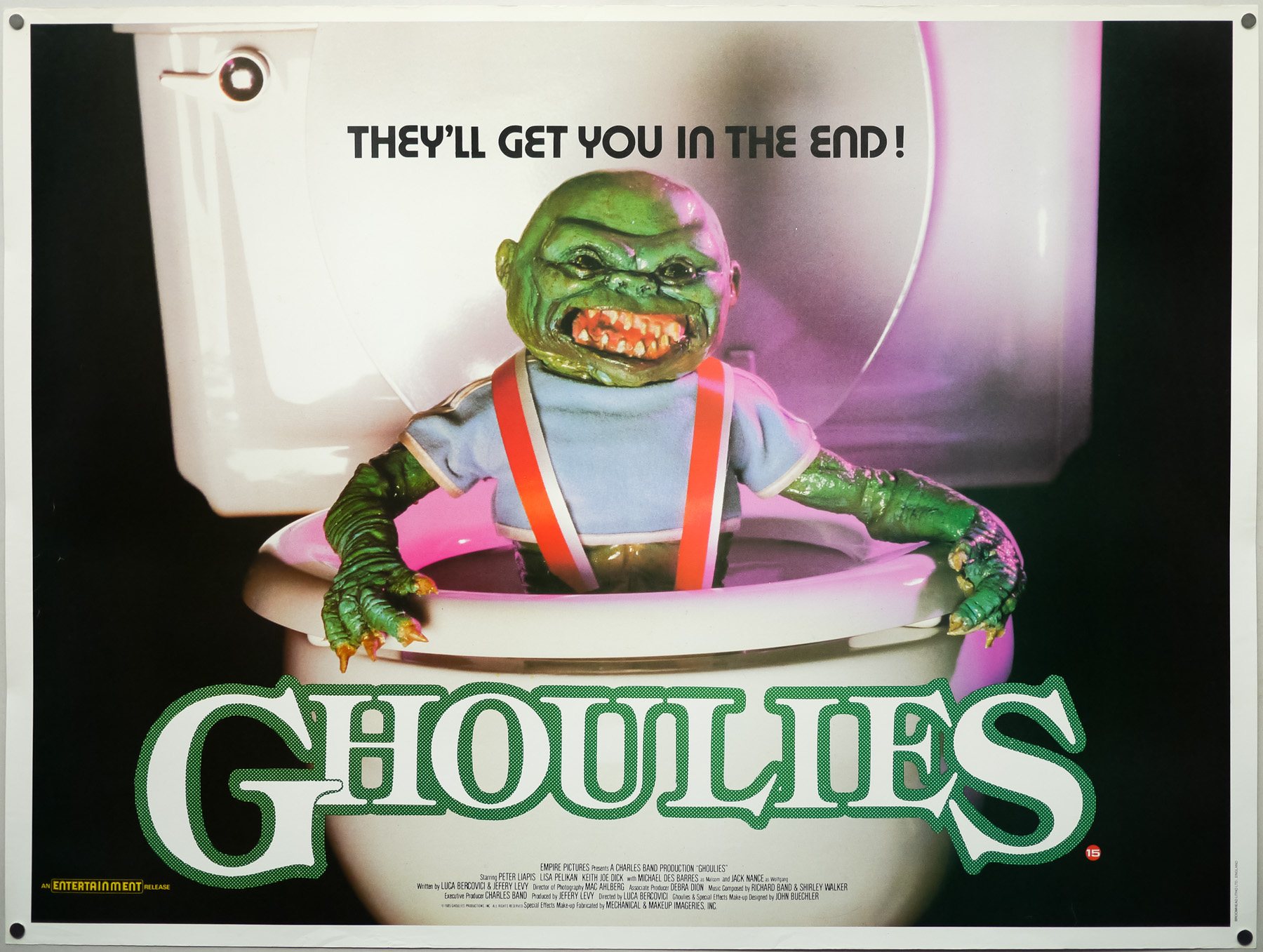
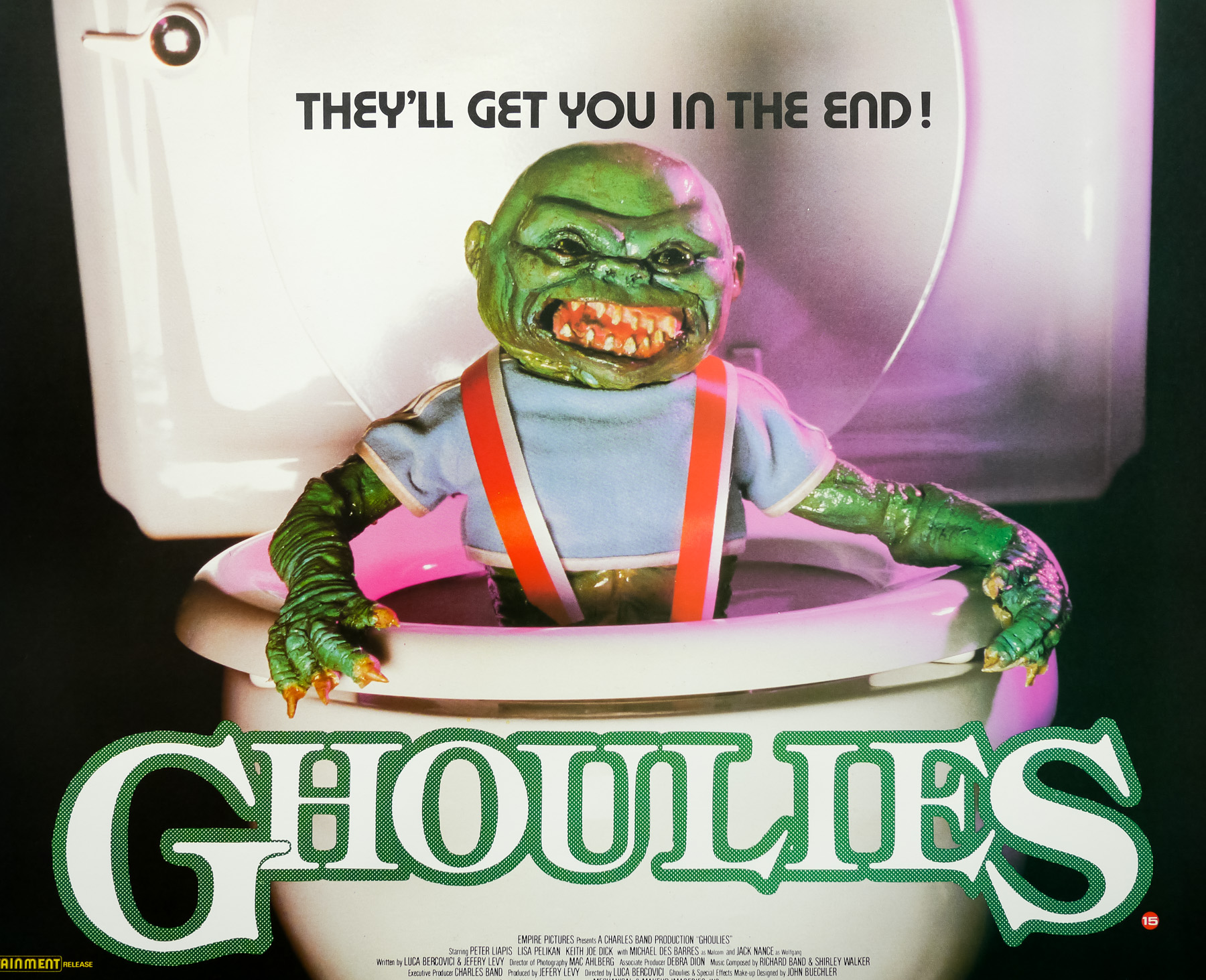
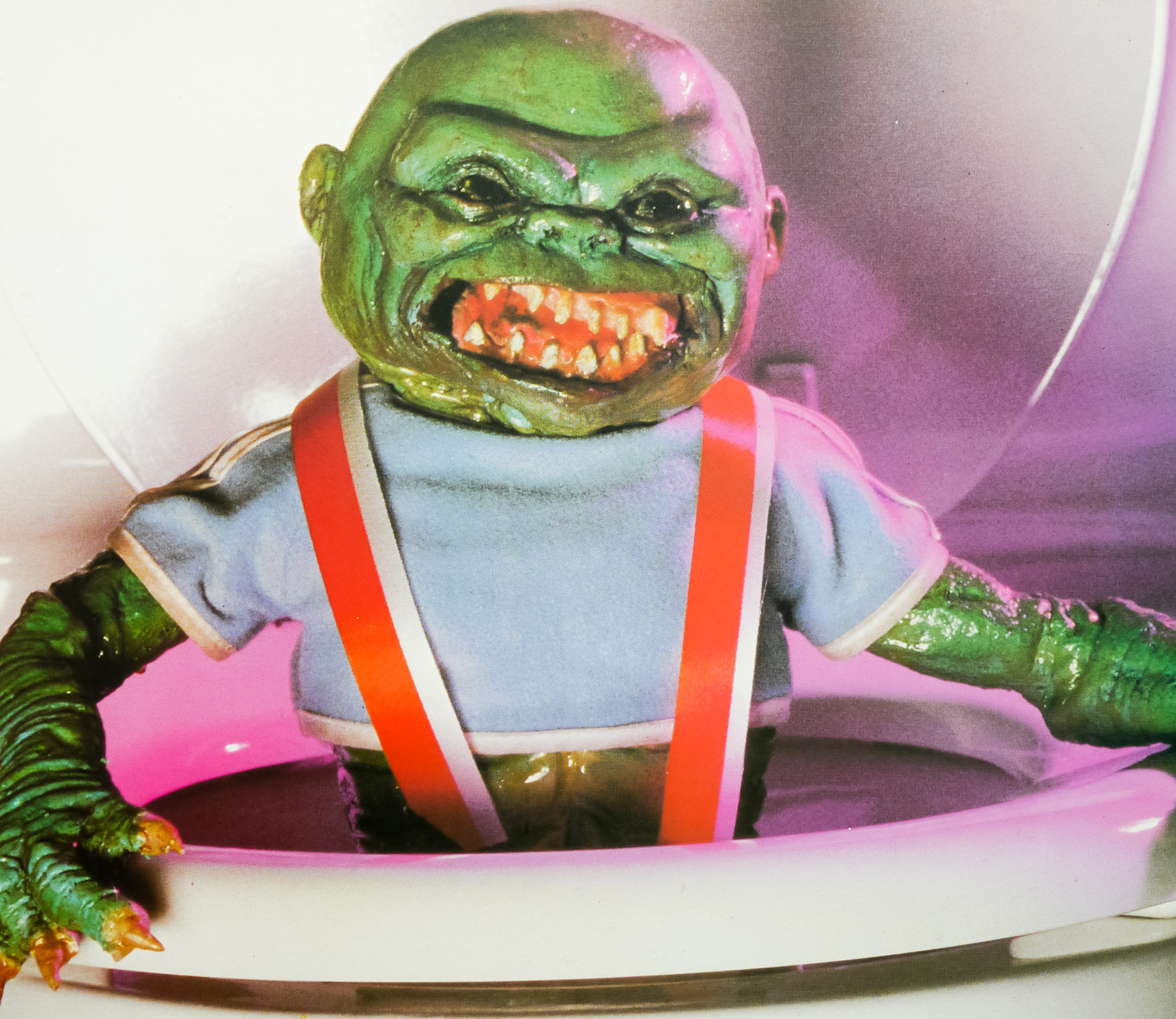
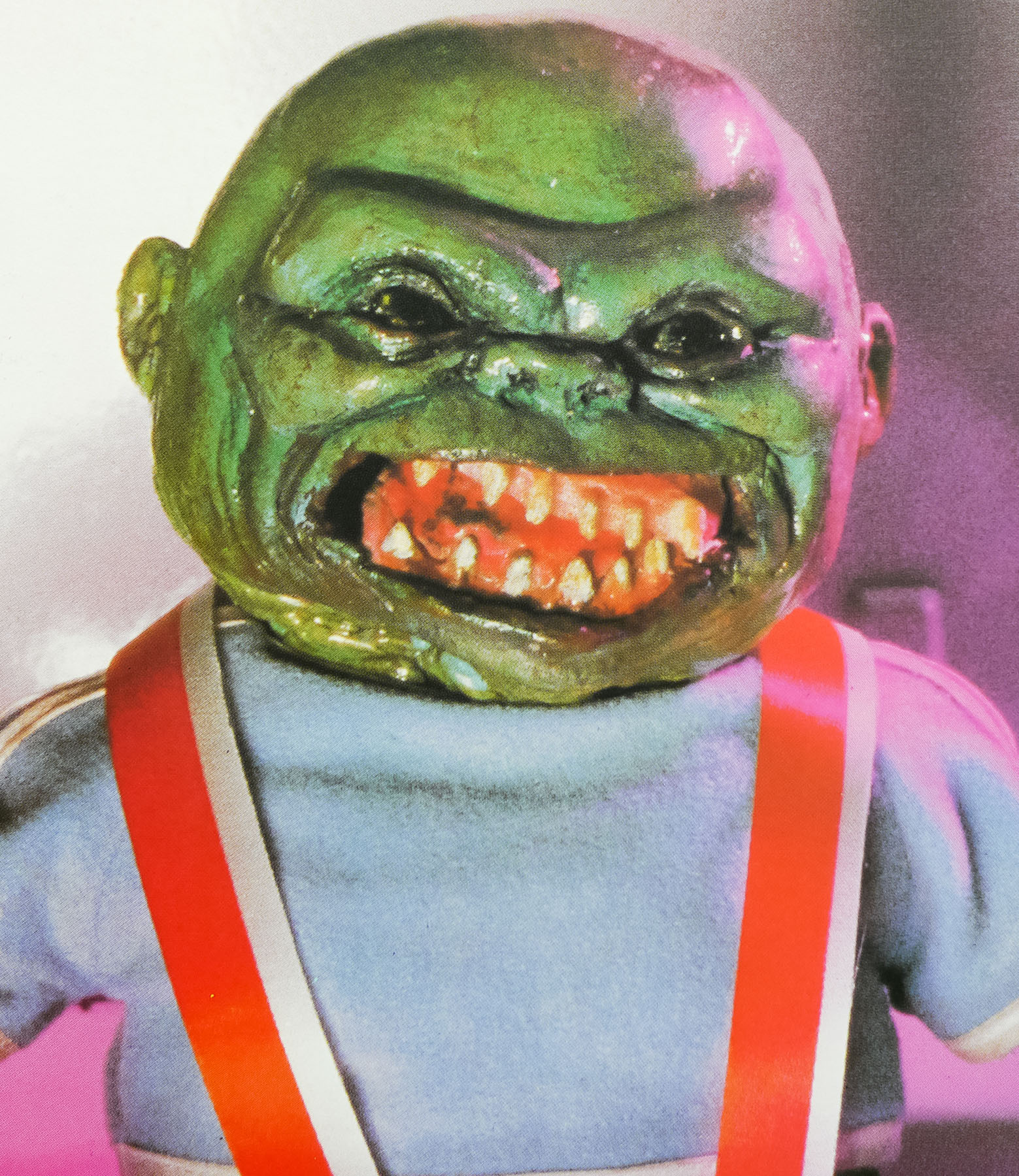
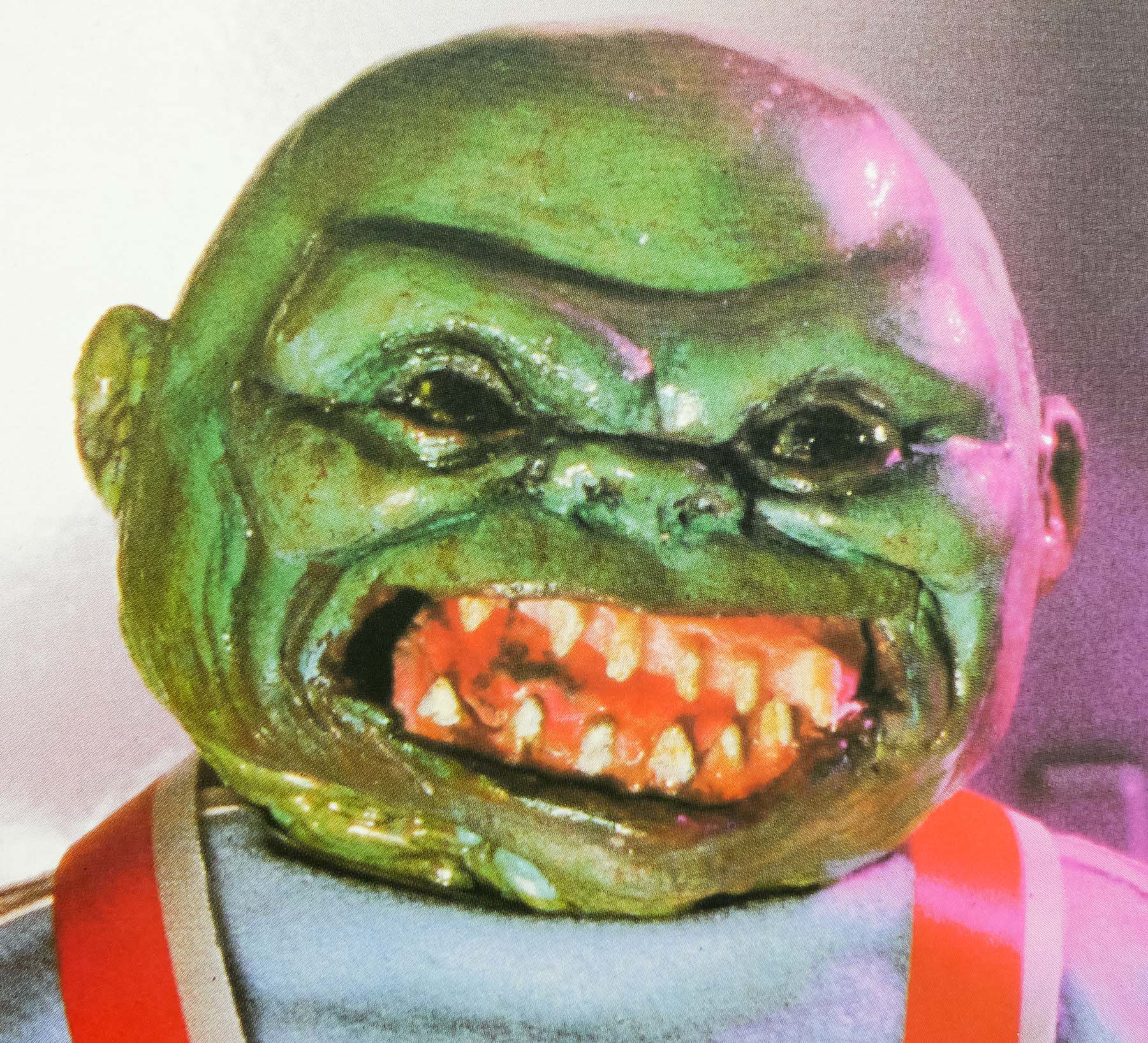
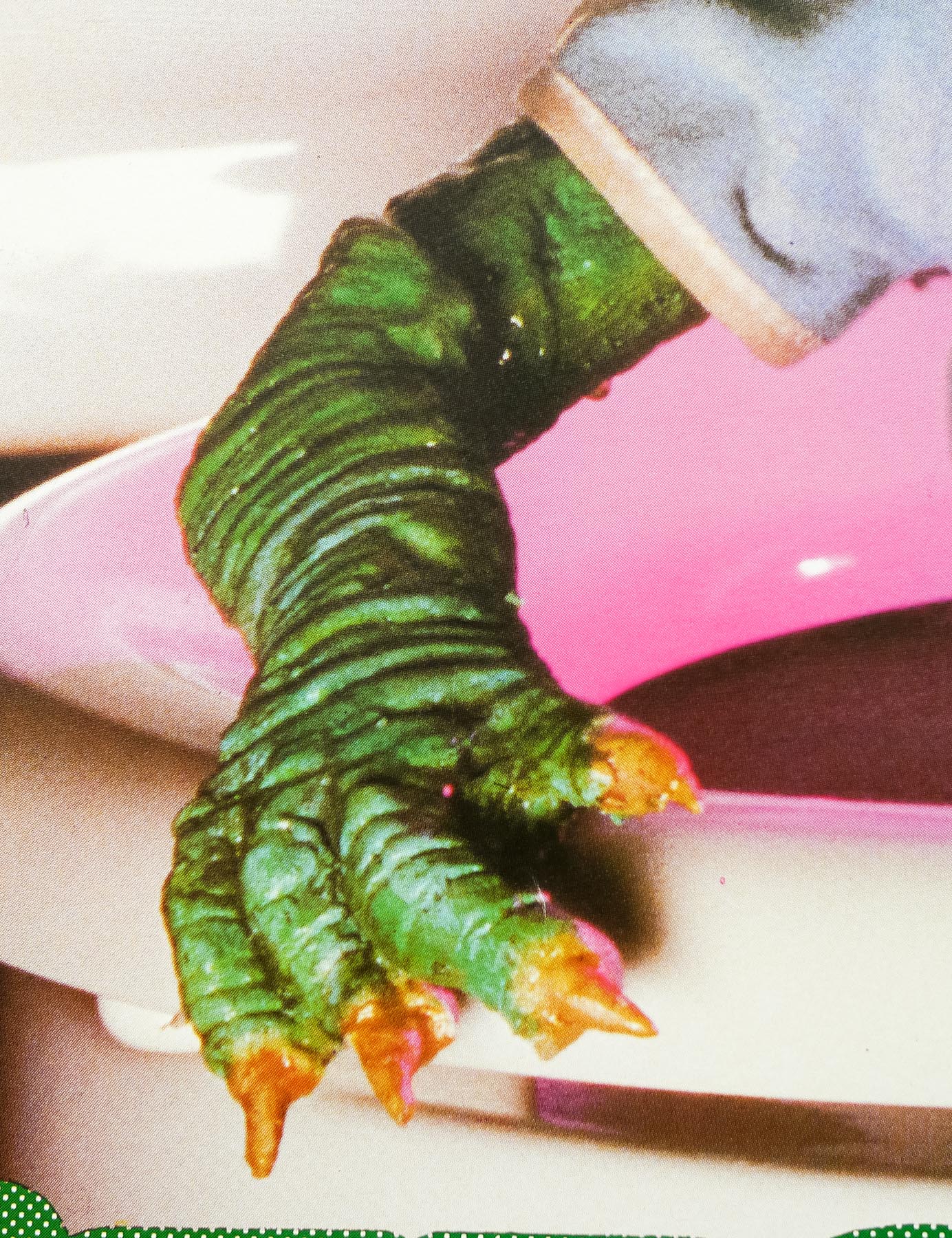
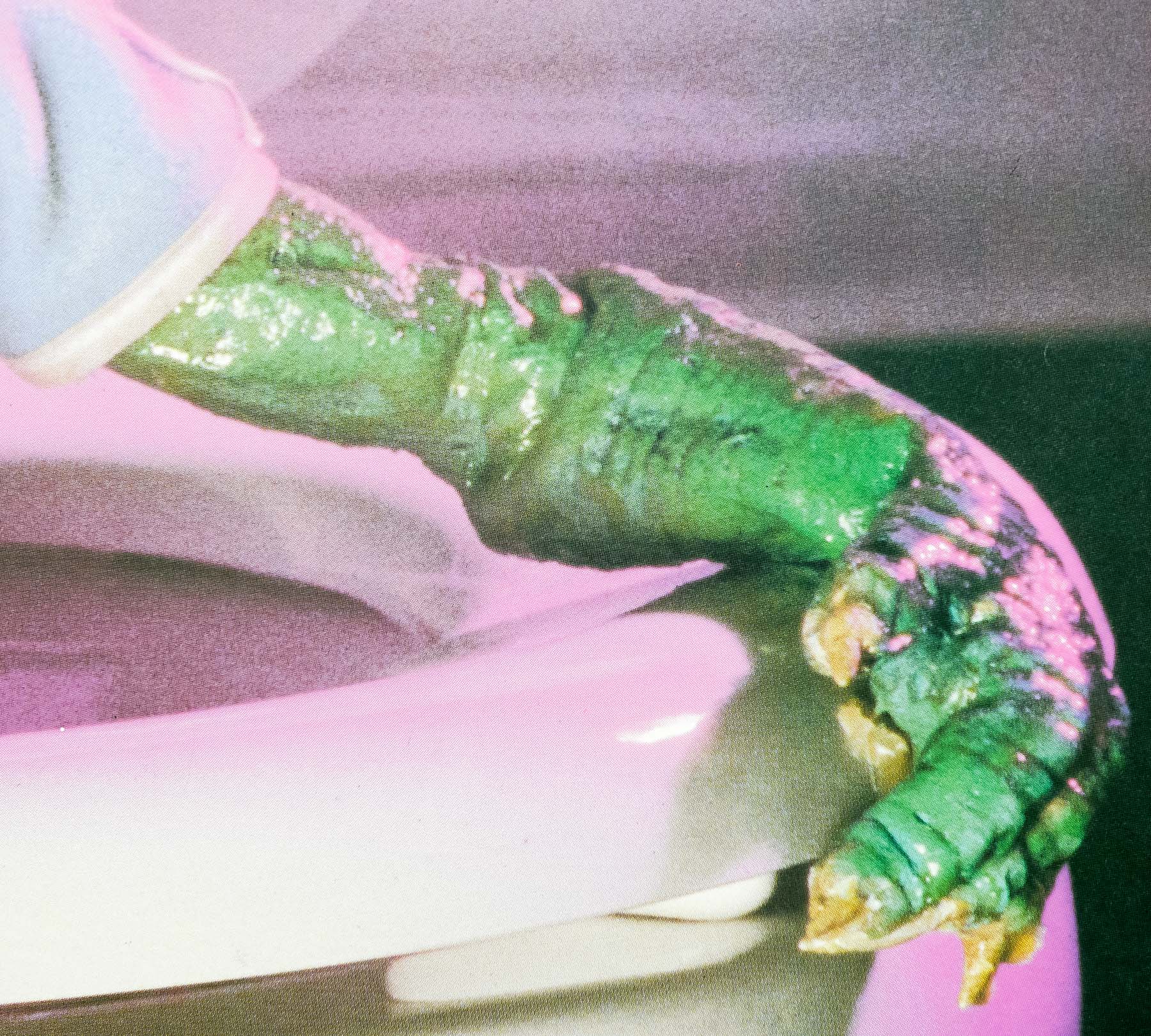
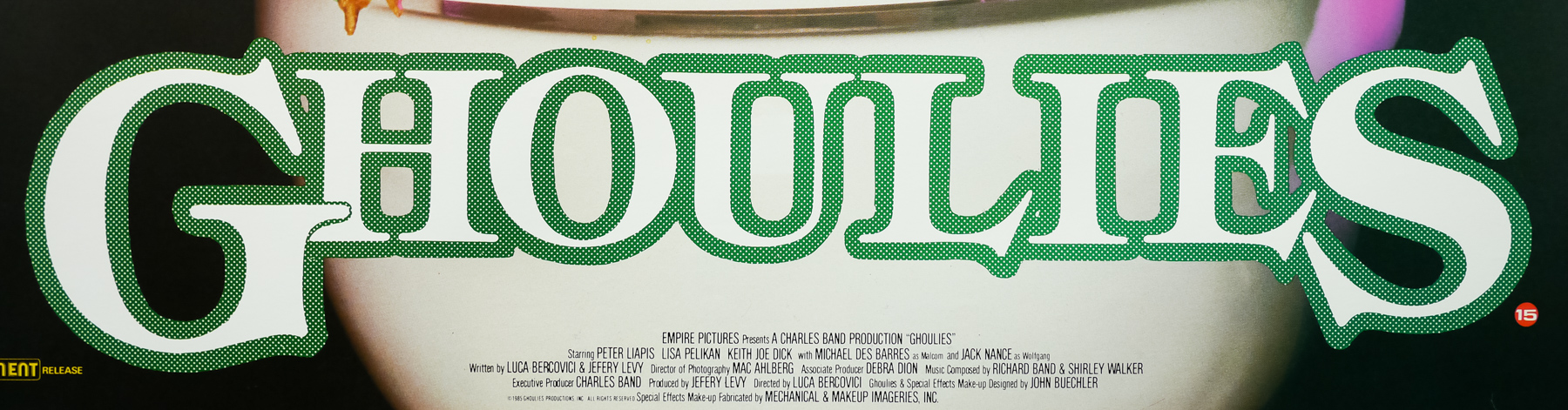
This photographic image advertising the 1984 schlock-horror Ghoulies is absolutely seared into my memory from visits to video rental stores as a youngster where I would see the then forbidden fruits of the horror section. Illustrated covers by artist Graham Humphreys for titles like Evil Dead and Kindred sat alongside photographic designs that hinted at the horrors contained within. This photo of a small green creature bursting out of a toilet, coupled with a title that in UK slang is another word for testicles, sparked plenty of imagined atrocities committed against unsuspecting male victims who’ve just gone for a nice sit down on the porcelain throne.

The reality is that this image was a complete fabrication that was created for the marketing campaign and used around the globe to market the film. The green Ghoulie does pop up from a toilet during the film but it’s a blink and you’ll miss it moment, it’s also not wearing any clothes (as is depicted here), and there’s certainly no obvious harm done to any genitals during the film. According to the Wikipedia article on the film, producer Charles Band had some involvement in creating the image, although it’s a bit confusing:

According to stories Charles Band tells on his Full Moon Horror Road Show, he was tasked to come up with a great campaign to promote the film. During a brainstorming session he came up with the idea to have the Ghoulie popping up from the toilet. The idea was a huge success and the scene was then shot for the film after the fact. According to Band’s 2012 audio commentary for 88Films Blu-ray of Puppetmaster 2, someone else came up with the idea of the Ghoulie popping out of the toilet. Band actually thought it was a bad idea at first.

The film itself is hardly a classic of the genre but it has aged better than some of the other ‘malevolent creature’ films released around the same time. With that said, most of the effects haven’t held up well, particularly the creatures themselves which are poorly put together and unconvincing, especially in comparison to the creatures seen in Joe Dante’s Gremlins that was released the same year. The film is chiefly set in an old mansion that is inherited by student Jonathan Graves (Peter Liapis) after the death of his father Malcolm (Michael Des Barres giving it all he’s got). Unbeknownst to Jonathan, his mother was actually killed during a satanic ritual carried out by his father in which he was meant to be sacrificed as a baby. When a protective amulet prevented the murder being carried out, Malcolm decided to sacrifice his wife instead. Wolfgang (Jack Nance), a member of the cult, takes Jonathan away and raises him so he’s unaware of the situation with his parents.

The film opens with the ritual in which we see the group of small evil creatures (they’re never exactly referred to as Ghoulies in the film) reacting with glee, the film then jumps to a few years later when Jonathan has just moved into the mansion. He soon finds the occult paraphernalia that his father left behind and, for reasons that aren’t clearly explained, decides he wants to continue his father’s satanic practices. His friends and girlfriend Rebecca (Lisa Pelikan) get caught up in the new rituals and before long the Ghoulies have returned and his father has been resurrected from the grave. All does not go exactly to plan for Jonathan, but Wolfgang is still around and his vow to protect the boy holds strong.

I’m unsure who is responsible for the design of this quad so if you have any ideas please get in touch.

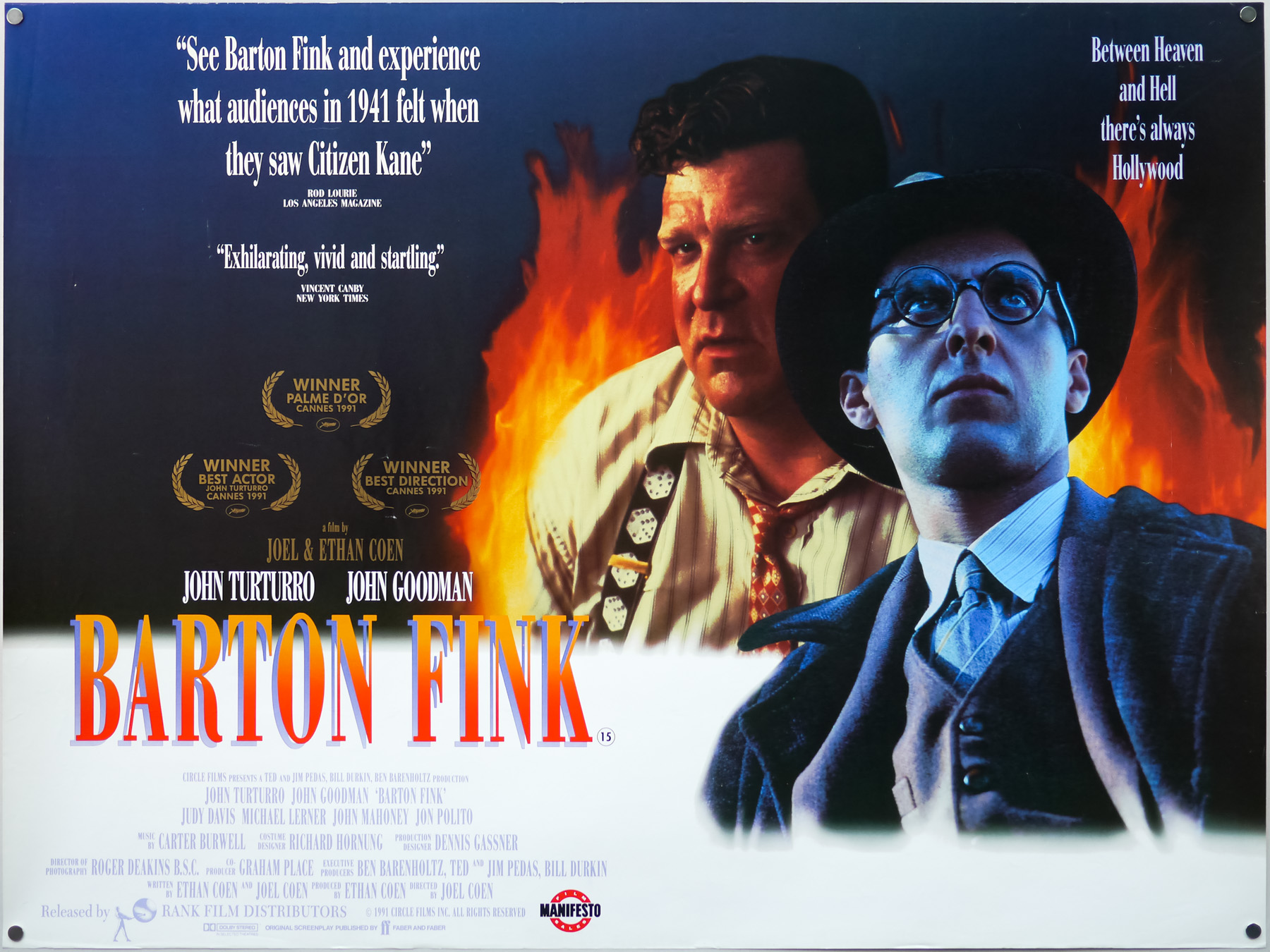
Barton Fink / quad / UK

11.09.15

Poster Poster
Title
Barton Fink
AKA
--
Year of Film
1991
Director
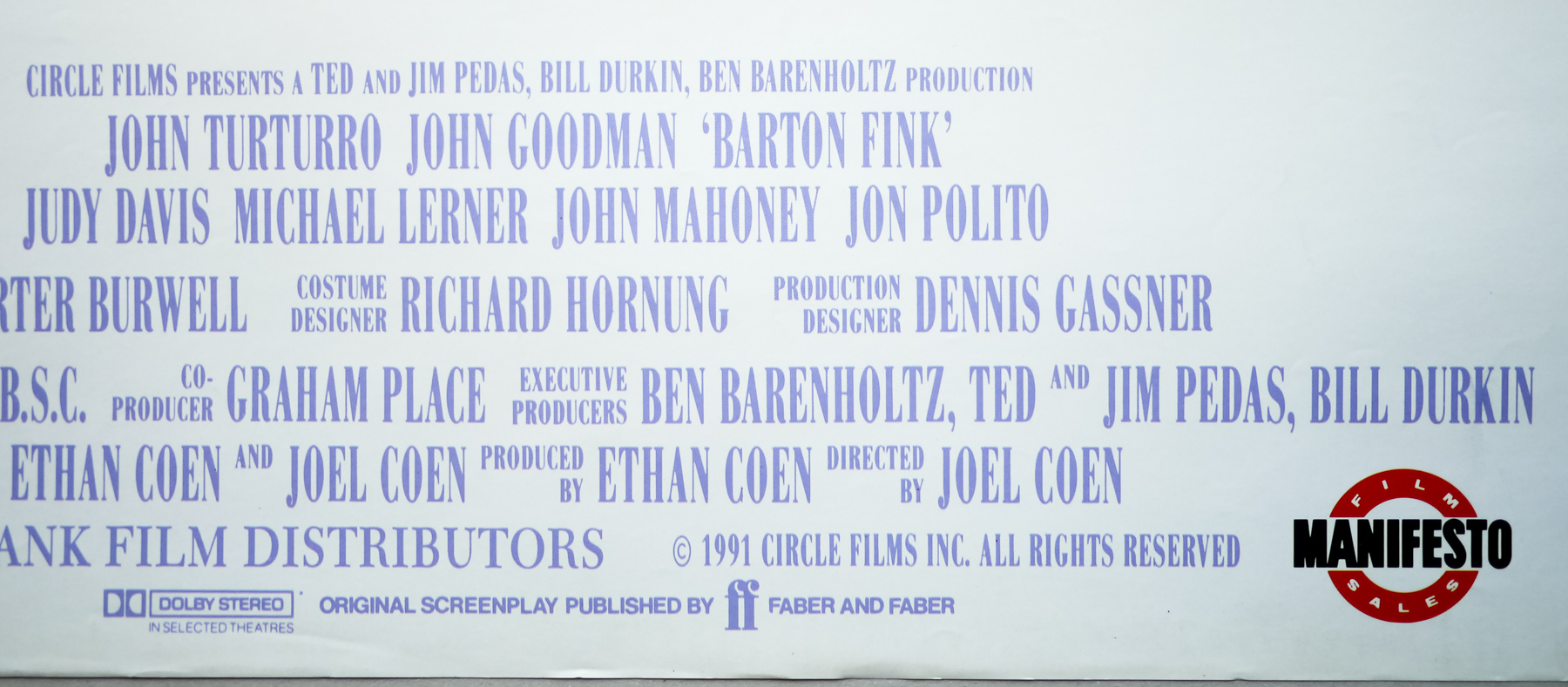
Joel Coen
Starring
John Turturro, John Goodman, Michael Lerner, Judy Davis, John Mahoney
Origin of Film
USA
Genre(s) of Film
John Turturro, John Goodman, Michael Lerner, Judy Davis, John Mahoney,
Type of Poster
Quad
Style of Poster
--
Origin of Poster
UK
Year of Poster
1991
Designer
Unknown
Artist
--
Size (inches)
30 1/16" x 39 15/16"
SS or DS
SS
NSS #
--
Tagline
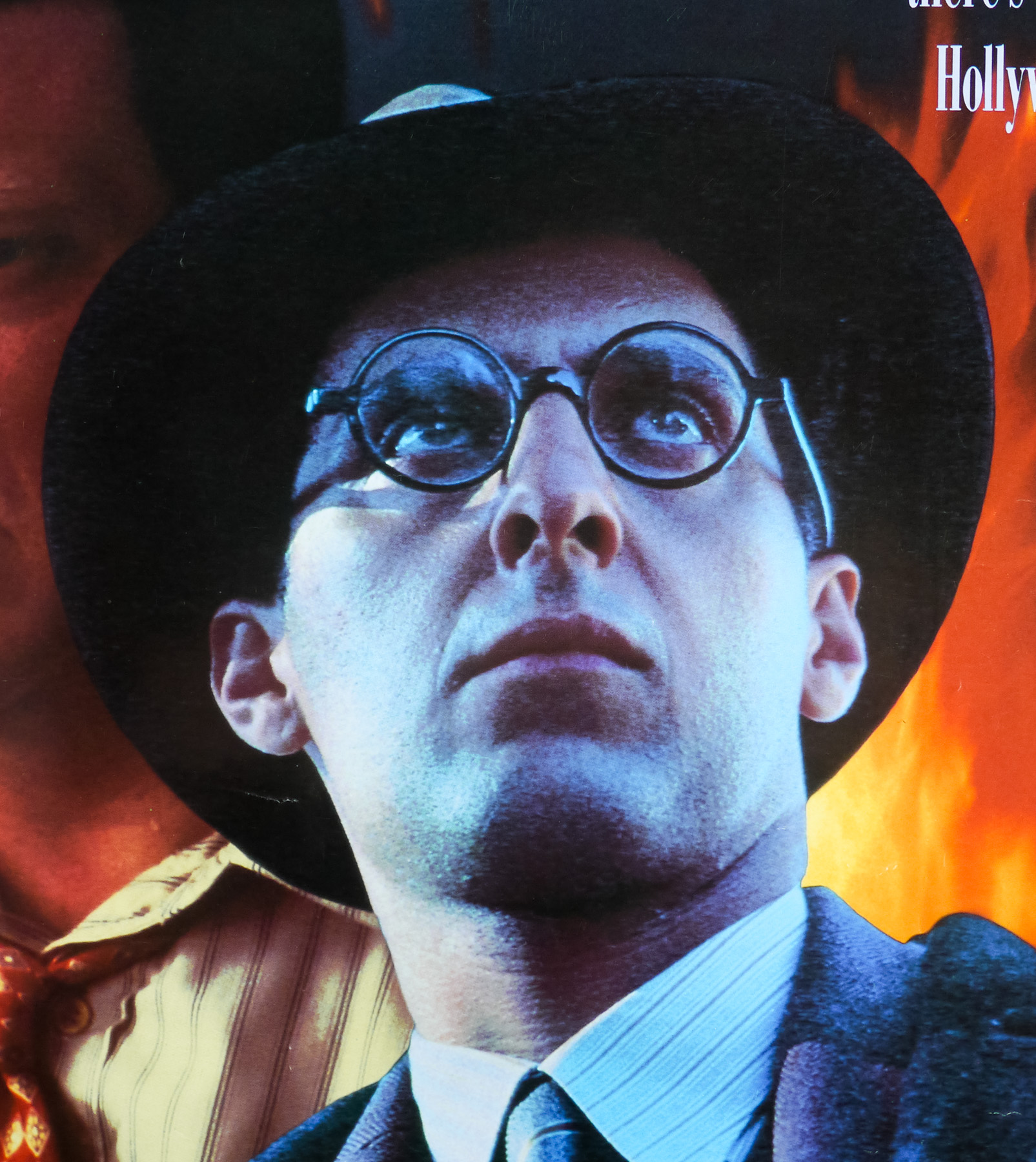
Between Heaven and Hell there's always Hollywood

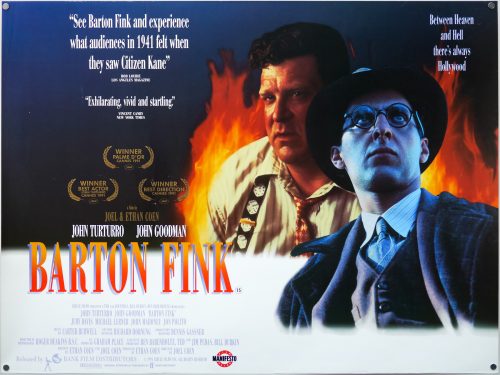
During 1989, after four months of writing, the Coen Brothers experienced a period of difficulty in pulling the story together for their gangster-themed classic Miller’s Crossing and the pair decided to take a break. They traveled to New York from Los Angeles and during their stay there they penned a new script for a film set in a largely abandoned hotel in Los Angeles, with John Turturro in mind for the lead role. Once filming was complete on Miller’s Crossing the pair returned to the script and started to plan the production with the actor.

Set in 1941, the film follows the titular playwright (Turturro) who has seen great success with his recent play on Broadway and is persuaded by his agent that an offer from Capital Studios in Hollywood of a thousand dollars a week to write scripts is too good to pass up. Although Barton is worried that living there will make him lose his connection to the ‘common man’, which is what he feels give his plays their power, he reluctantly agrees and decides to stay at the almost empty Hotel Earle, rather than a more salubrious establishment. His room is dark, drab and devoid of any decoration save for a photograph of a woman in a bikini on a beach looking at the surf, which mesmerises Barton as he imagines the scene come to life.

Soon he meets the boss of Capital, Jack Lipnick (Michael Lerner), who promises him his total support and asks him to start off with writing a wrestling picture. Disappointed with the choice of subject, he returns to the Earle and sits down at his typewriter. Immediately he finds himself suffering writers block, a situation made worse by distracting sounds in the hotel and the appearance of his room neighbour, Charlie Meadows (John Goodman), who introduces himself as a traveling salesman and tries to help Barton to get back on track. Later he meets a famous novelist called W.P. Mayhew (John Mahoney) who moved to Hollywood years before and has been writing scripts ever since, despite suffering from alcoholism and anger management issues. Mayhew’s long-suffering assistant, Audrey Taylor (Judy Davis) agrees to help with his script as the demands from Capitol grow stronger. After visiting his hotel room, Audrey and Barton spend the night together, but when he tries to wake her the next morning he finds that she’s been murdered and soon a pair of belligerent detectives appear in the lobby of the Earle.

The film clearly references a number of real characters from 1940s Hollywood but their characters are skewed just enough that it’s not libellous, and the ‘Sources, inspirations and allusions’ section on the film’s Wikipedia page gives a good rundown of the recipe for the Coens’ script. Barton Fink was a huge critical success and was the first film to win the Palme d’Or, Best Director and Best Actor at the prestigious Cannes Film Festival. Unfortunately, critical success didn’t translate into box-office performance and the film apparently failed to recoup its production budget.

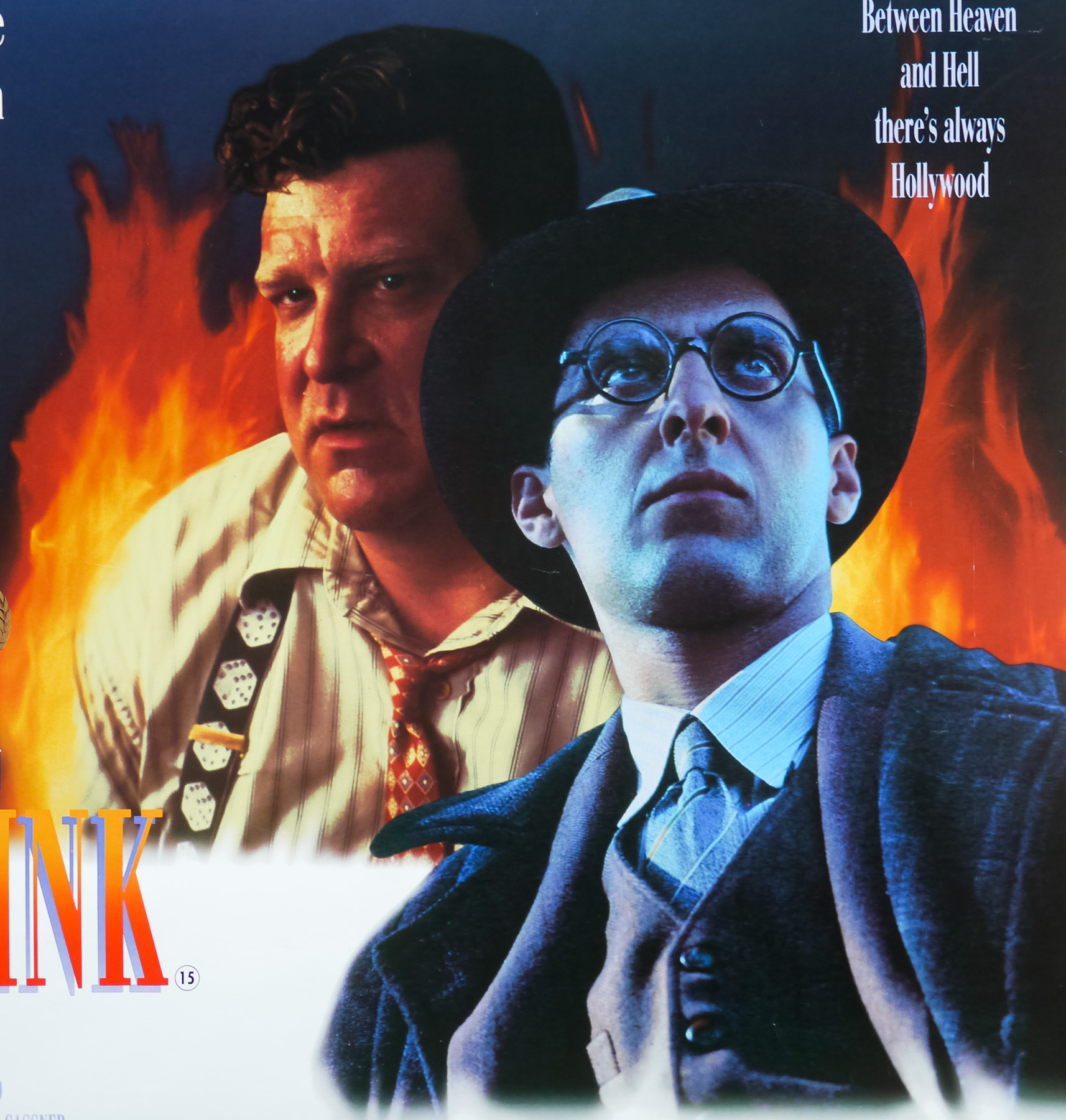
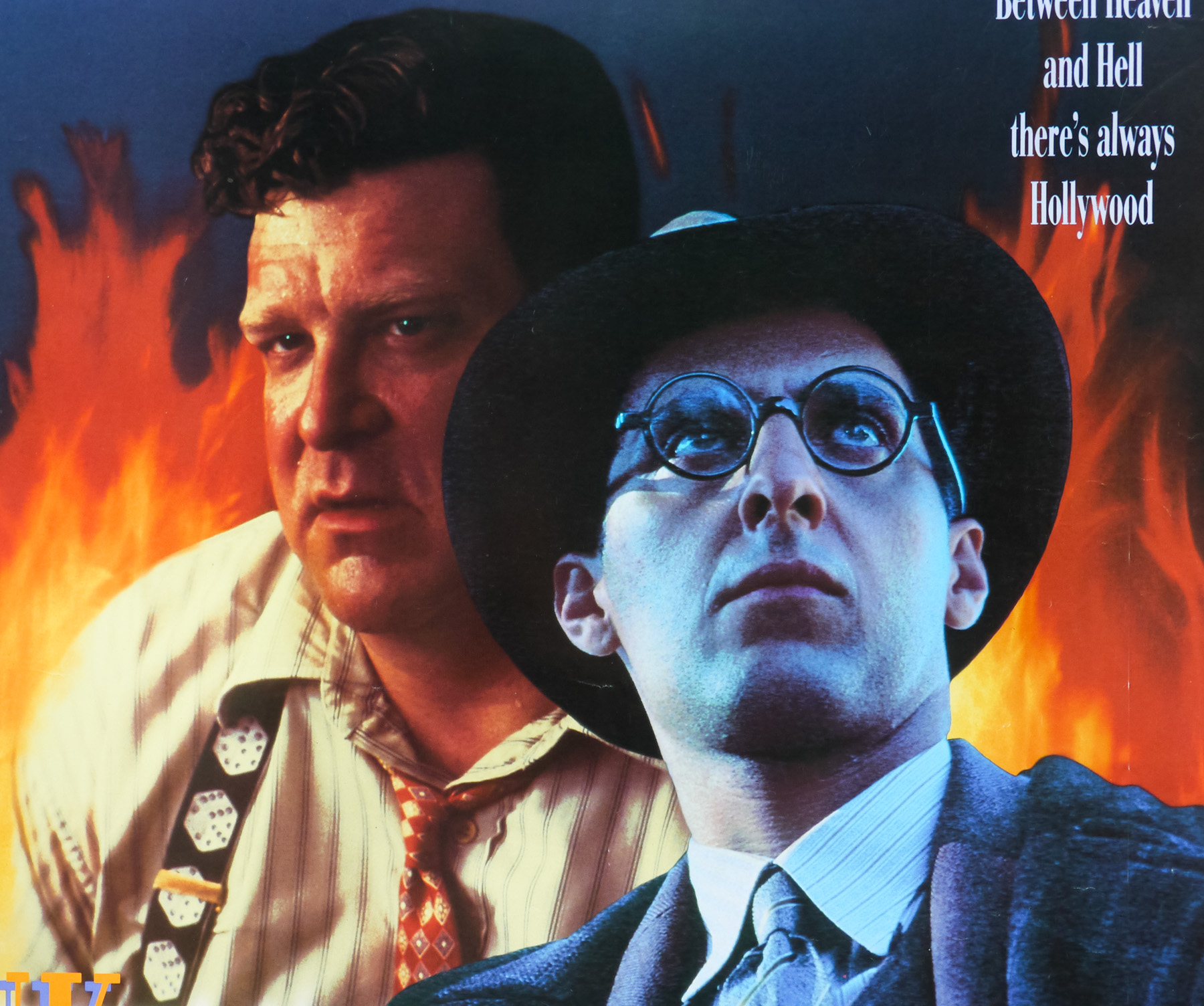
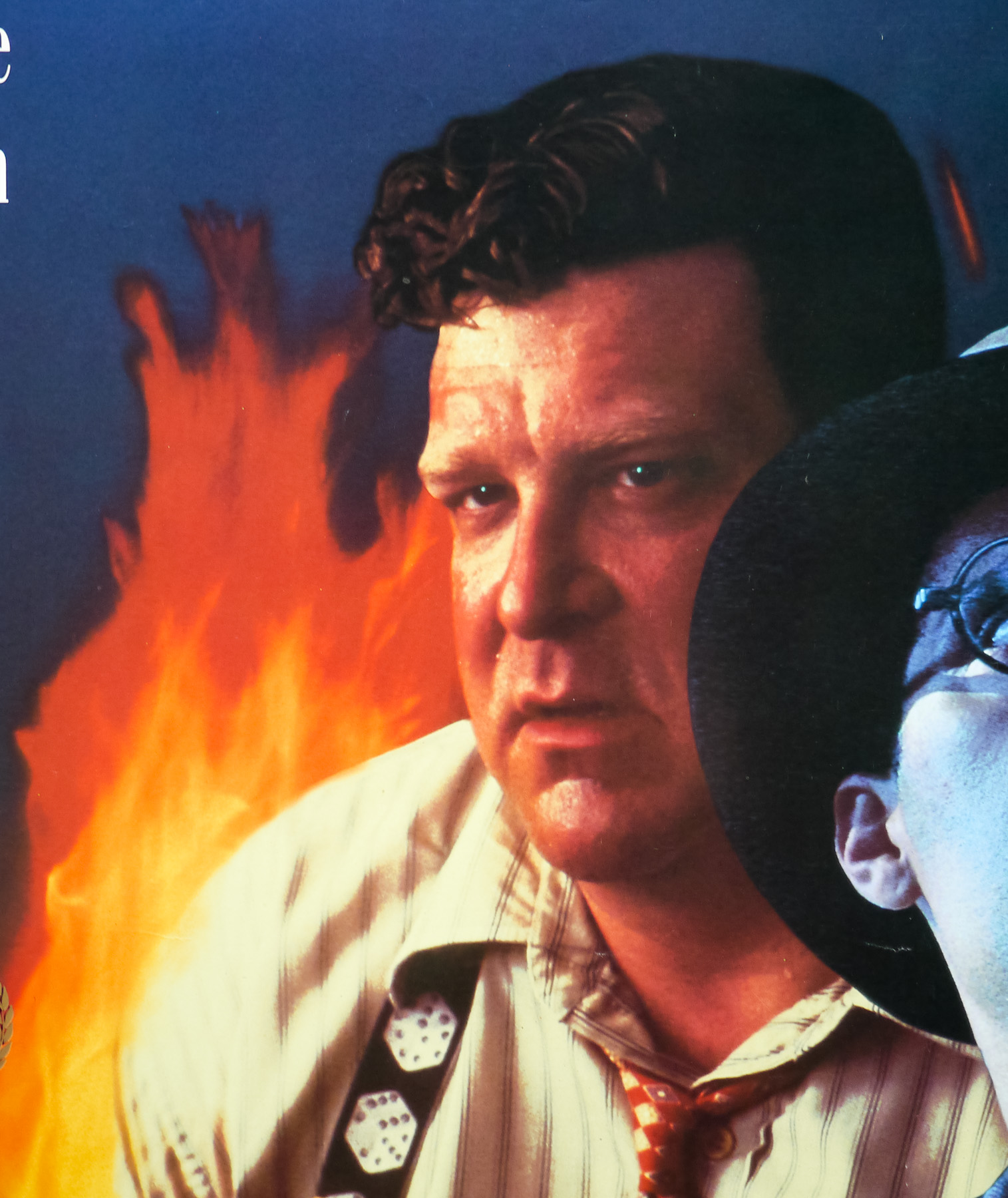
I’m unsure who is responsible for the design of this quad, which is unique to the international campaign (the striking US one sheet looks like this), so if anyone has any ideas please get in touch.

Where the Green Ants Dream / quad / UK

12.09.16

Poster Poster
Title
Where the Green Ants Dream
AKA
Wo die grünen Ameisen träumen (Germany - original title)
Year of Film
1984
Director
Werner Herzog
Starring
Bruce Spence, Wandjuk Marika, Roy Marika, Ray Barrett, Norman Kaye, Ralph Cotterill, Nick Lathouris, Basil Clarke, Ray Marshall
Origin of Film
West Germany | Australia
Genre(s) of Film
Bruce Spence, Wandjuk Marika, Roy Marika, Ray Barrett, Norman Kaye, Ralph Cotterill, Nick Lathouris, Basil Clarke, Ray Marshall,
Type of Poster
Quad
Style of Poster
--
Origin of Poster
UK
Year of Poster
1984
Designer
Paul Derrick
Artist
--
Size (inches)
30 4/16" x 40 2/16"
SS or DS
SS
Tagline
--

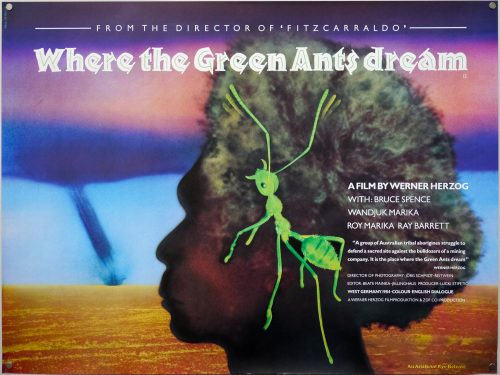
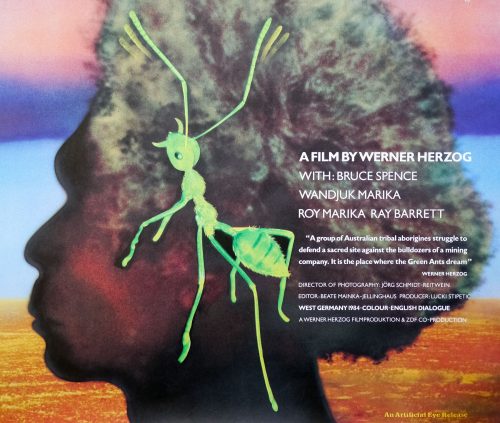
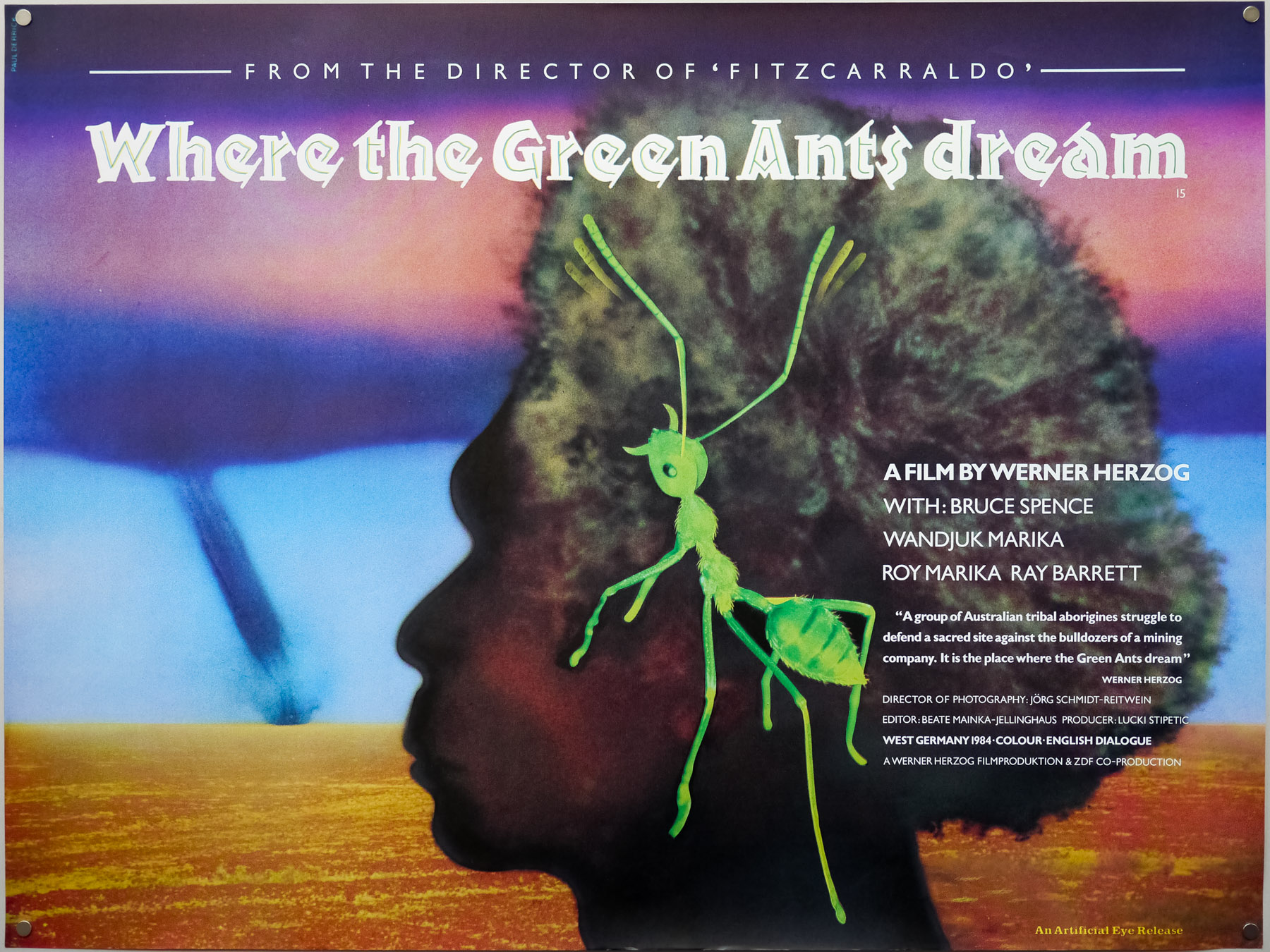
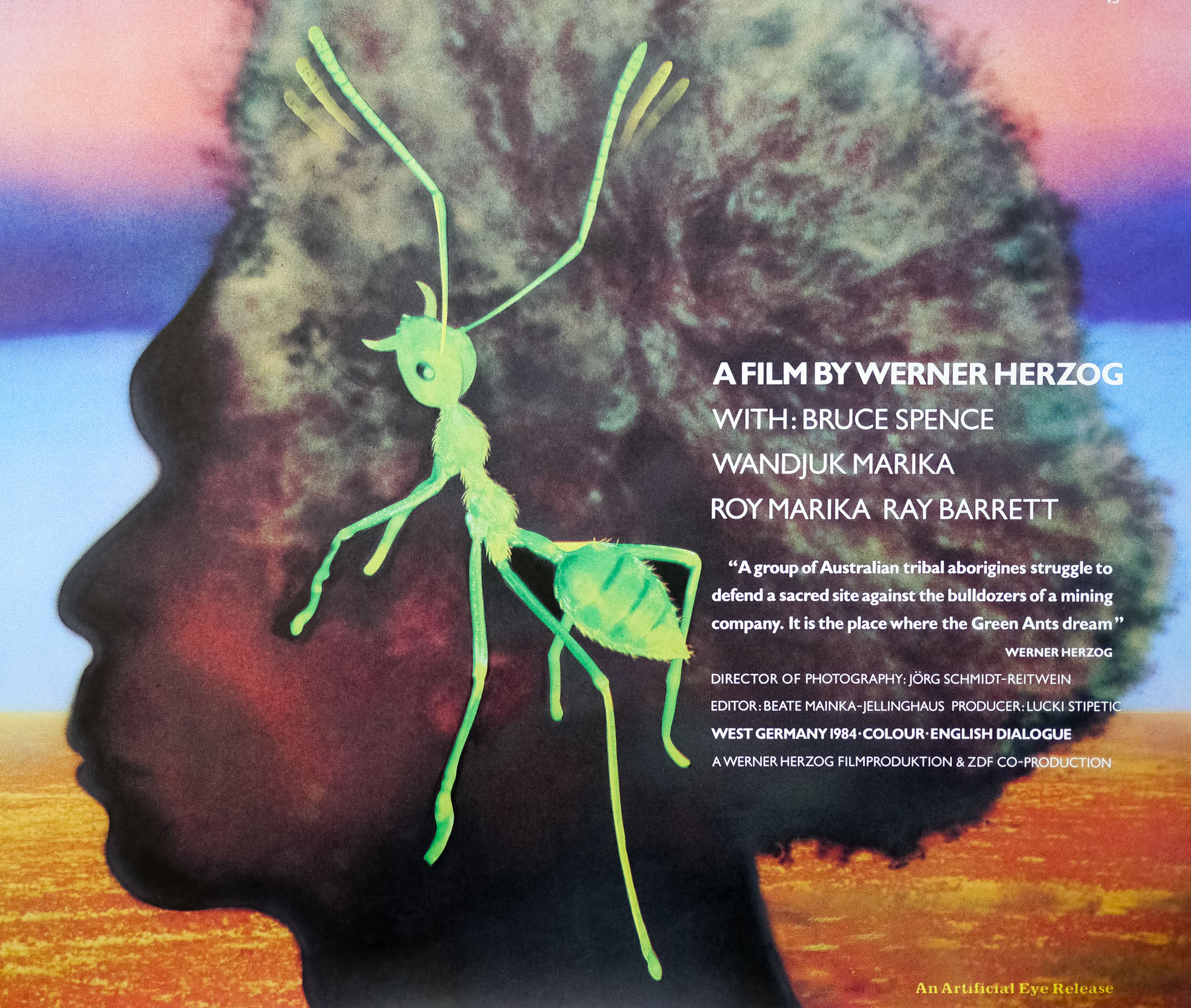
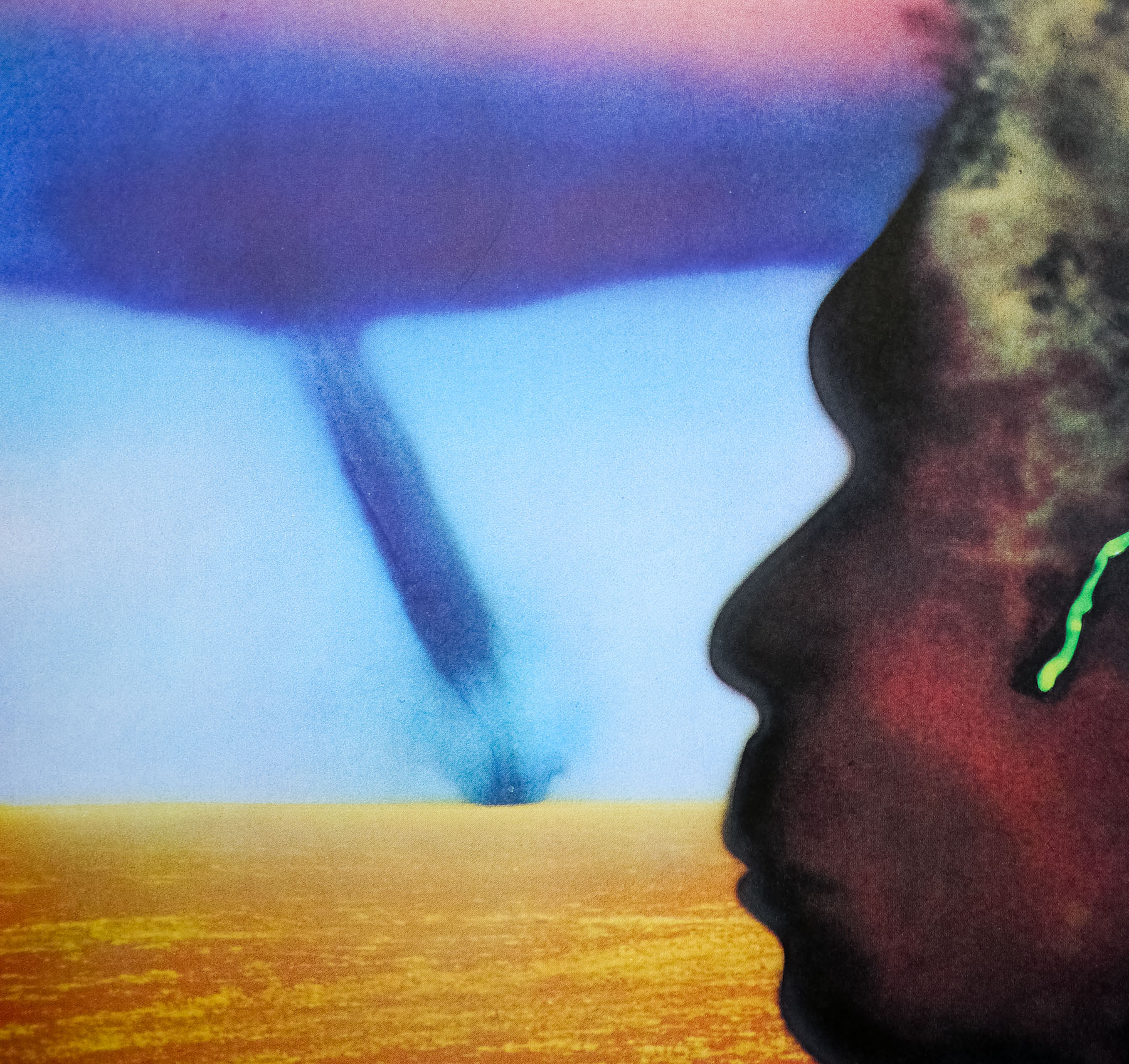
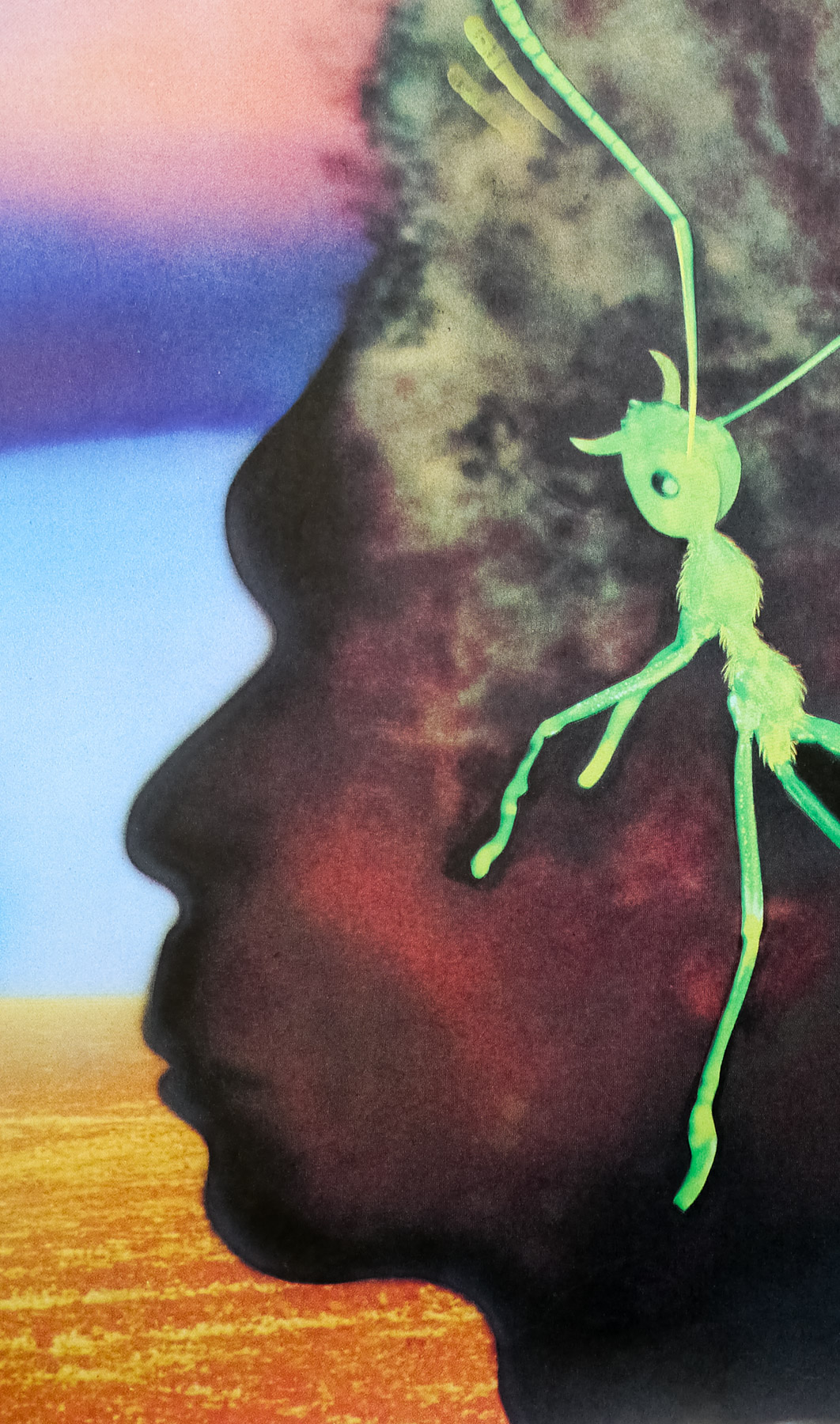
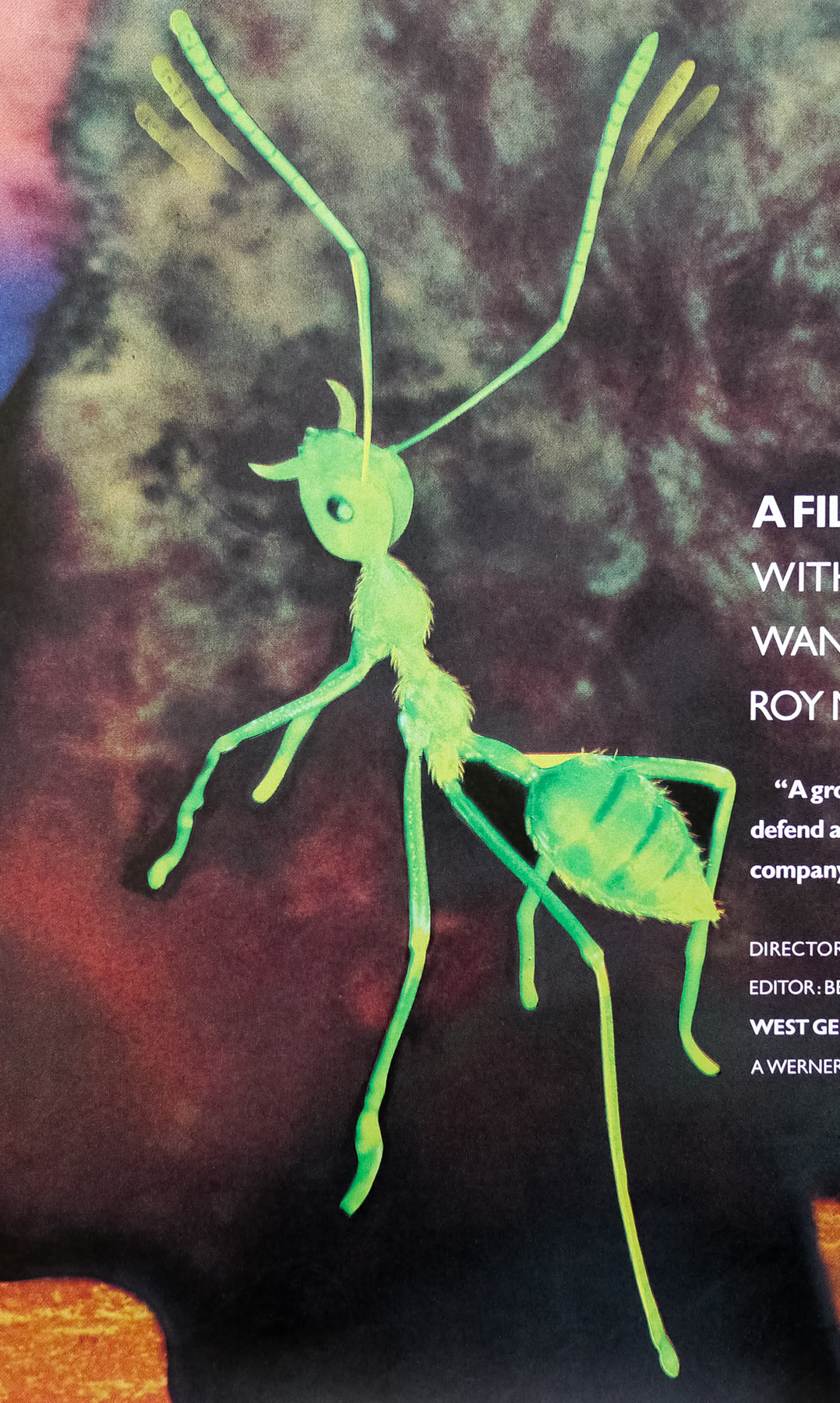
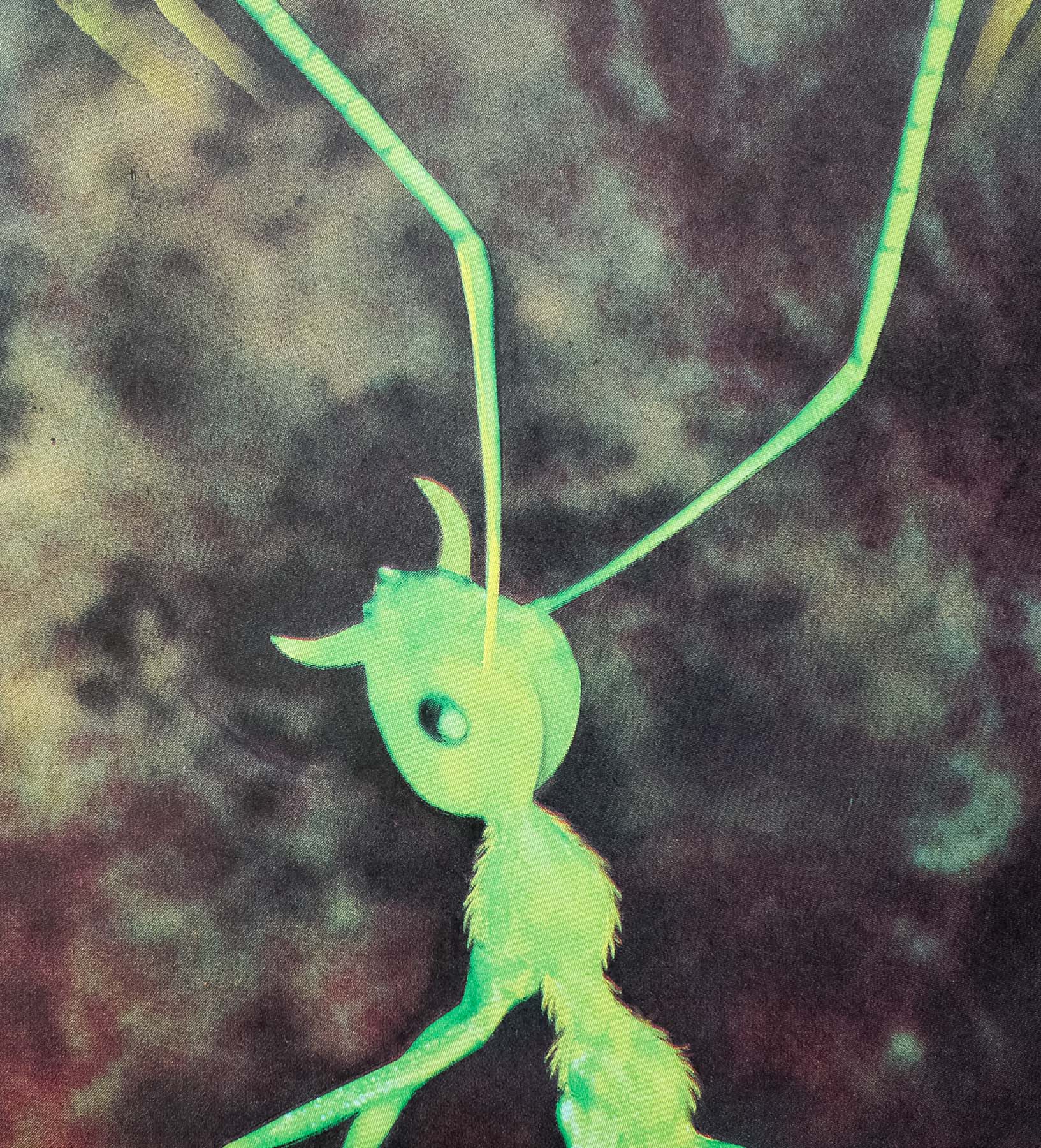
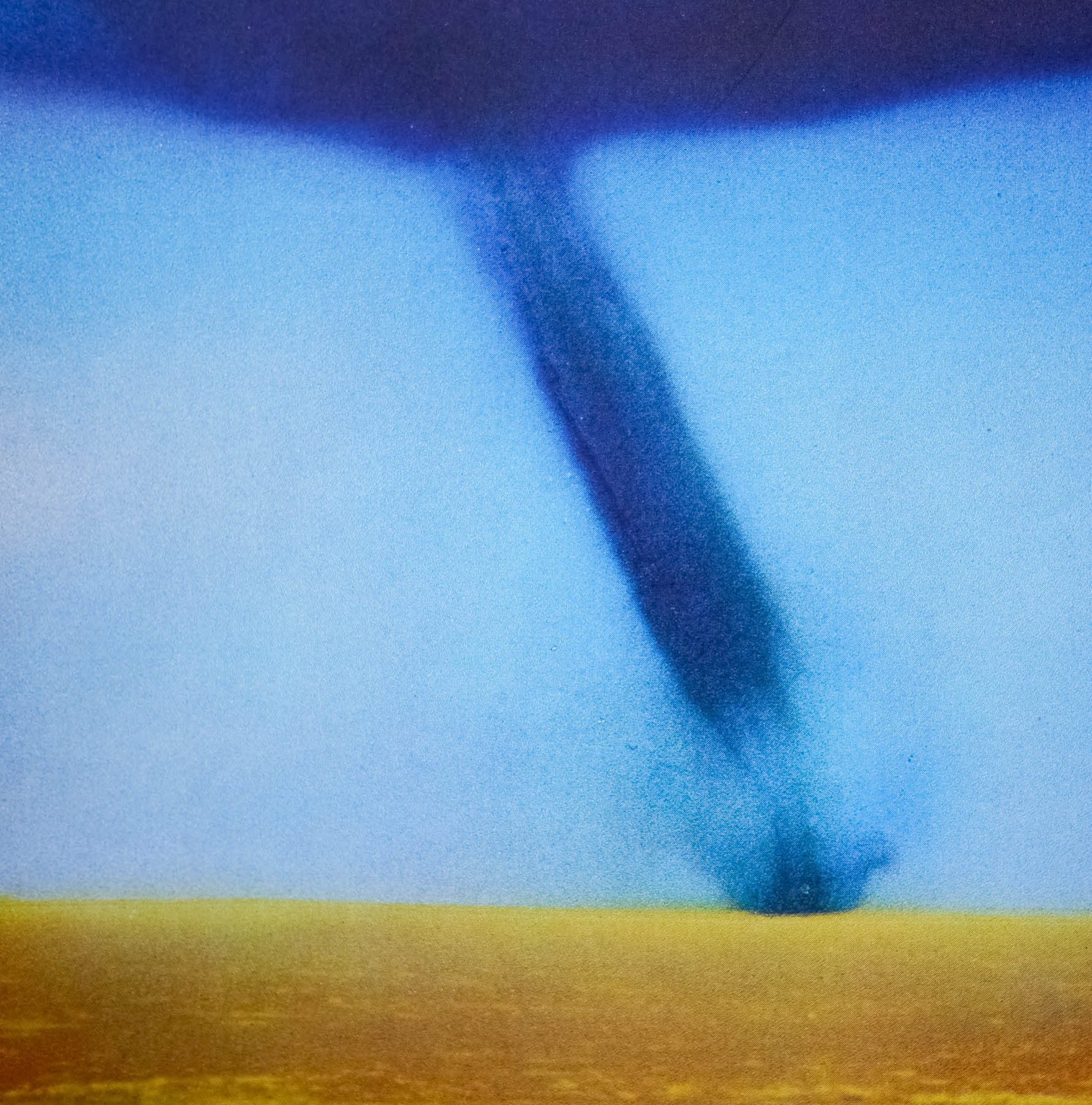
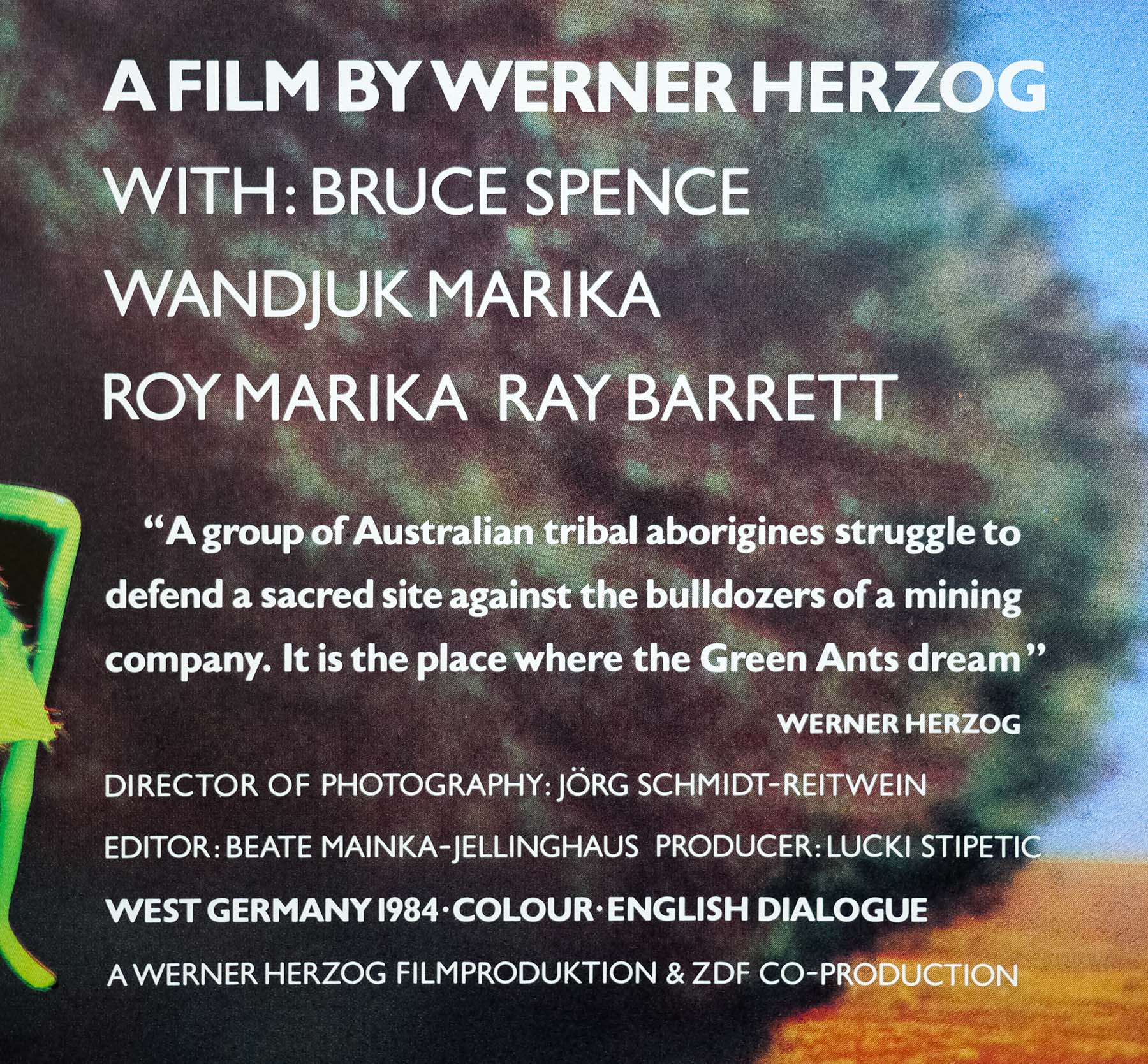
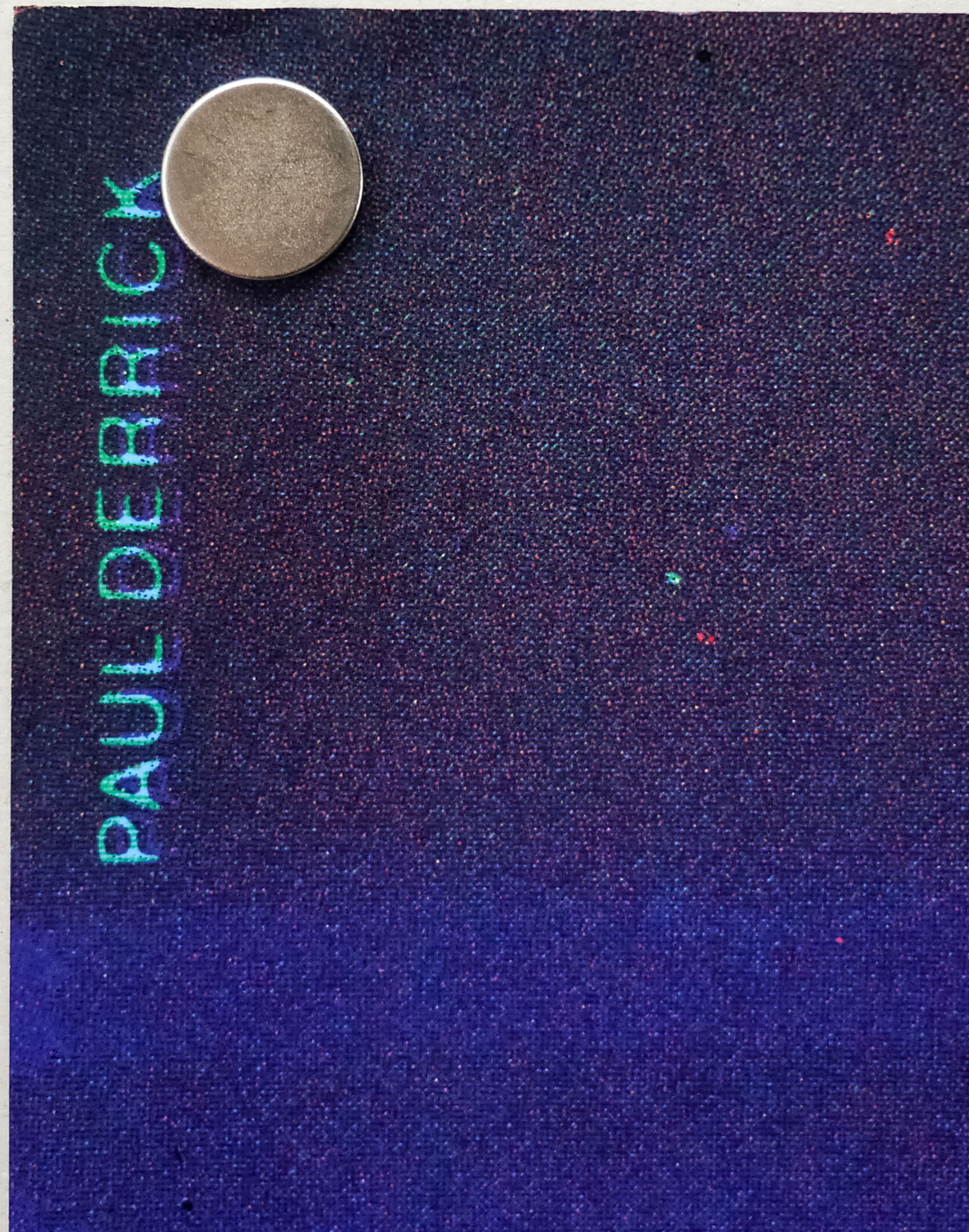
A striking image by the British designer Paul Derrick features on this UK quad for the release of maverick director Werner Herzog‘s 1984 drama Where the Green Ants Dream. The film was the directorial follow up to what many consider to be Herzog’s masterpiece, Fitzcarraldo, and is set in the Australian outback. Co-written with the Australian screenwriter Bob Ellis, the film deals with the contentious issue of aboriginal land rights that has existed ever since the British established a settlement there in the 18th Century. A mix of facts and fiction, the film features a number of aboriginal activists who had been involved in a real-life court case

Bruce Spence, who is best known as the Gyro Captain from Mad Max 2, plays Lance Hackett, a geologist working for a mining company that is carrying out a series of tests on some land that they intend to mine for Uranium. The title refers to the insects that the aborigines believe to be sacred and they fear will be disturbed by the blasting and drilling. One of the tribal elders, as featured on this poster, explains that this disturbance could bring about the end of the world. Lance is instructed to spend time with the activists and try and work out a deal with them so that the mining company can carry on their testing. When that eventually fails, even after they are given a large army plane as part of an attempted deal, the case goes to the courts. 

Paul Derrick’s official website can be viewed here and, according to the short biography on the site, he has been working for many years on publishing and visual identity projects for a wide range of clients, including arts and educational organisations as well as government clients. He also says that he is ‘experienced in undertaking, and art directing, documentary photography to create visual narratives and storytelling.’ There are a few examples of posters he worked on and the British distribution company Artificial Eye is listed in the projects section.

Legend / quad / UK

10.10.16

Poster Poster
Title
Legend
AKA
--
Year of Film
1985
Director
Ridley Scott
Starring
Tom Cruise, Mia Sara, Tim Curry, David Bennent, Alice Playten, Billy Barty, Cork Hubbert, Peter O'Farrell, Kiran Shah, Annabelle Lanyon, Robert Picardo
Origin of Film
USA | UK
Genre(s) of Film
Tom Cruise, Mia Sara, Tim Curry, David Bennent, Alice Playten, Billy Barty, Cork Hubbert, Peter O'Farrell, Kiran Shah, Annabelle Lanyon, Robert Picardo,
Type of Poster
Quad
Style of Poster
--
Origin of Poster
UK
Year of Poster
1985
Designer
Unknown
Artist
John Alvin
Size (inches)
30 1/16" x 40"
SS or DS
SS
NSS #
--
Tagline
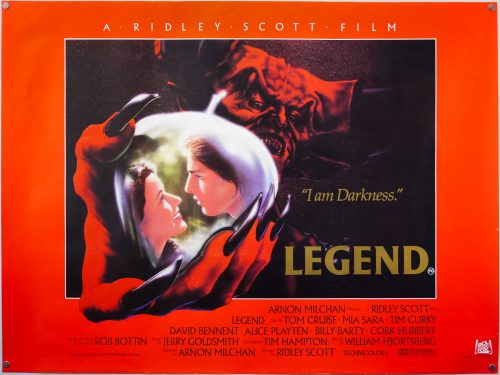
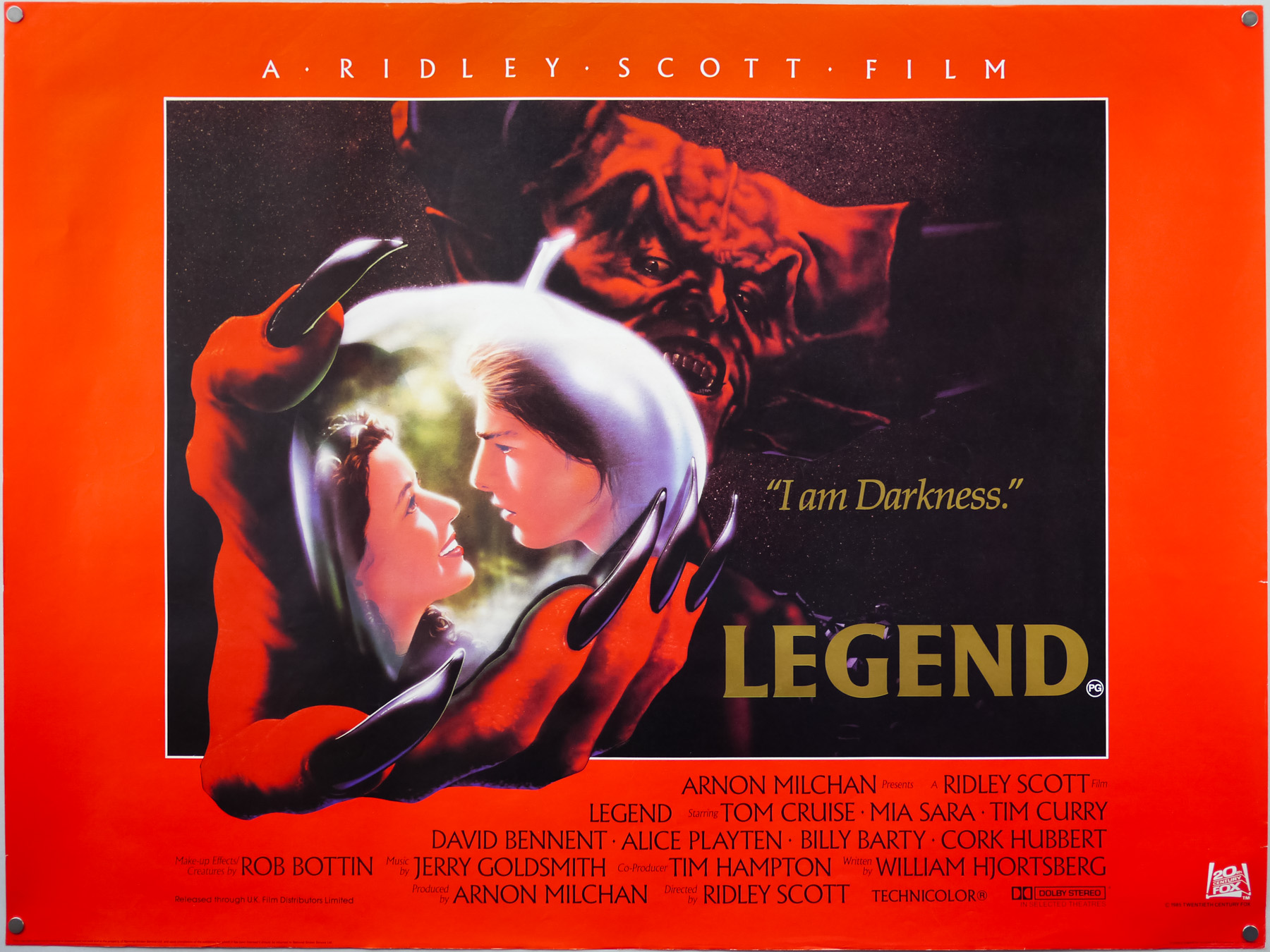
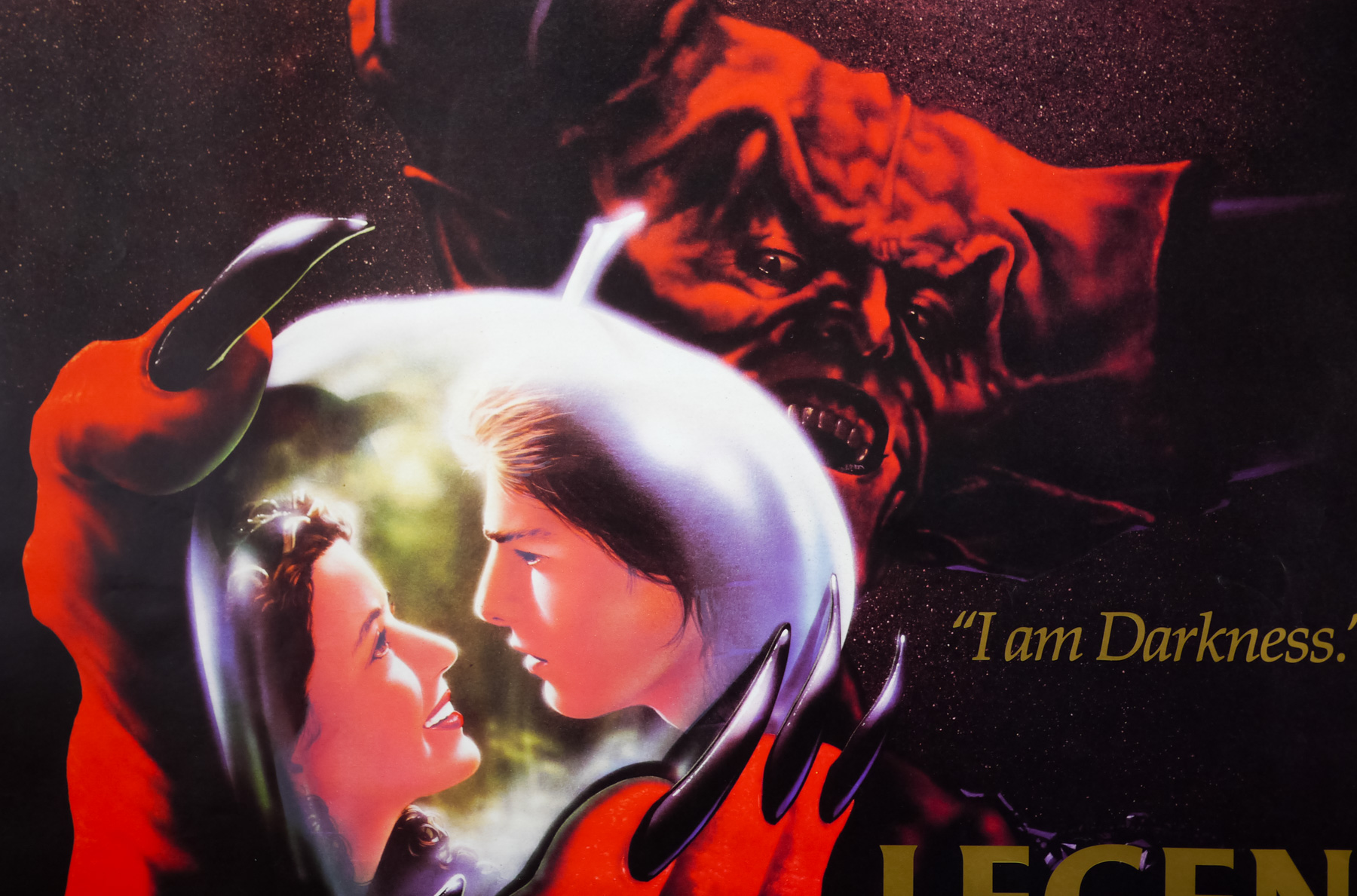
"I am Darkness"

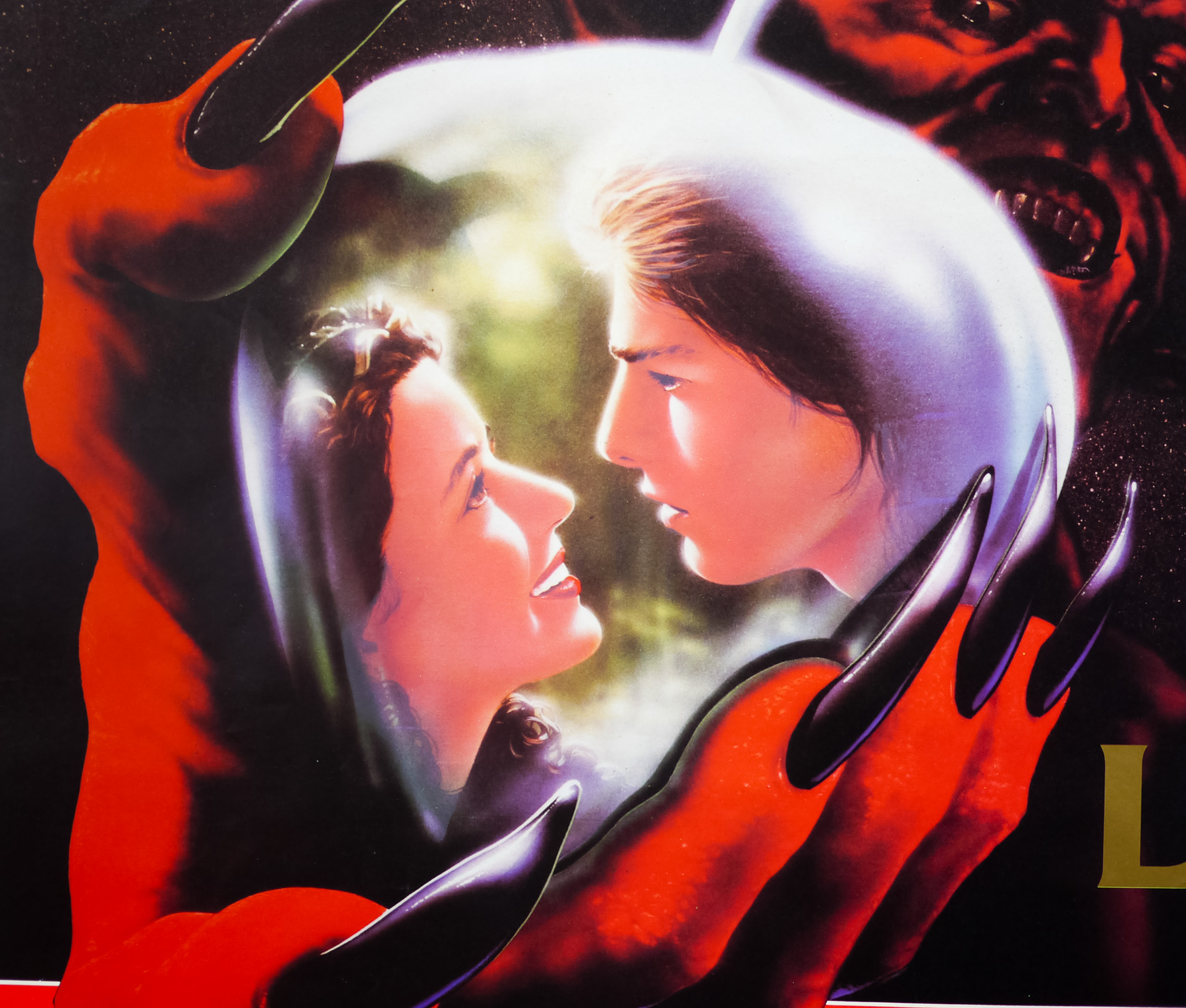
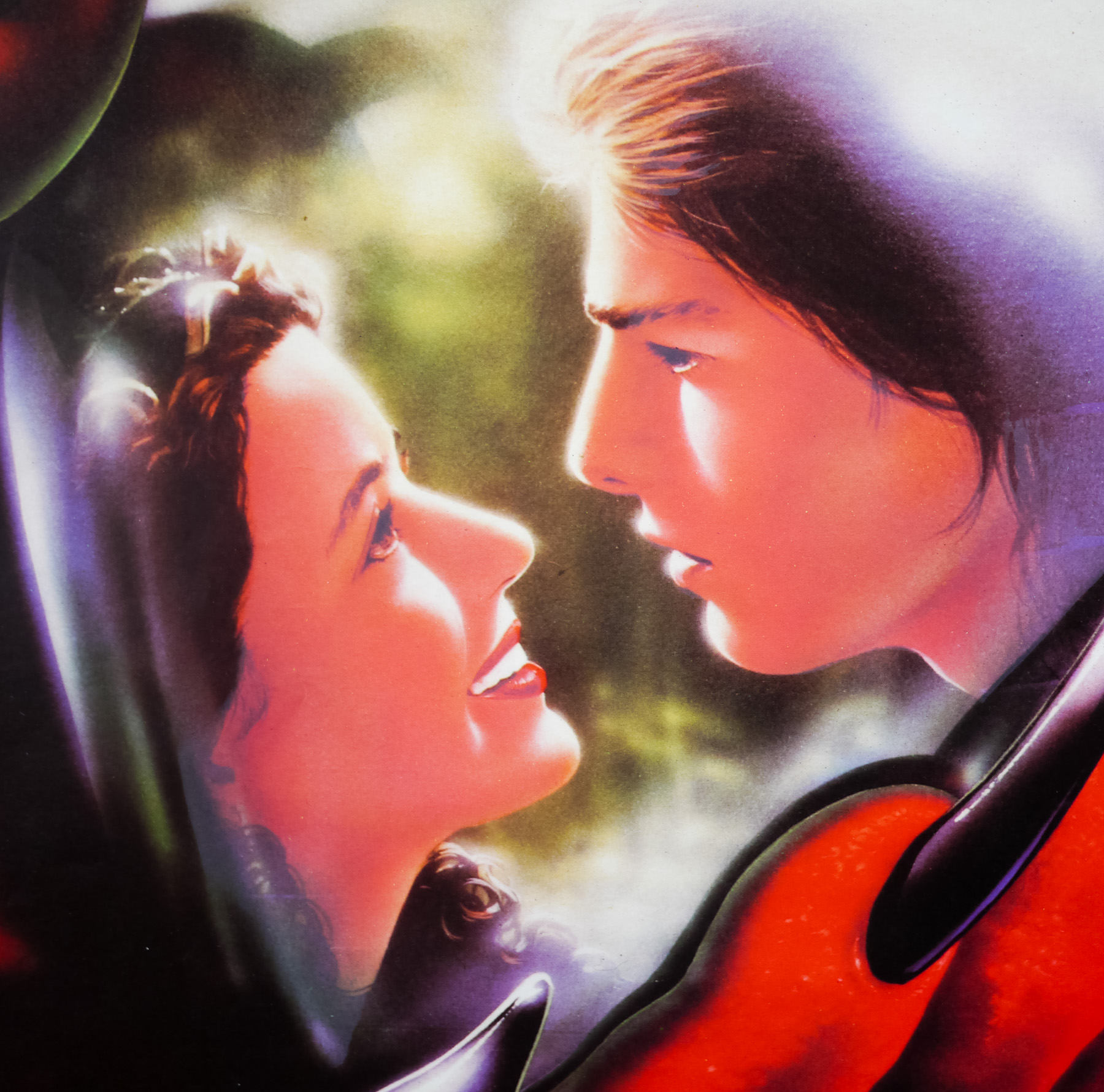
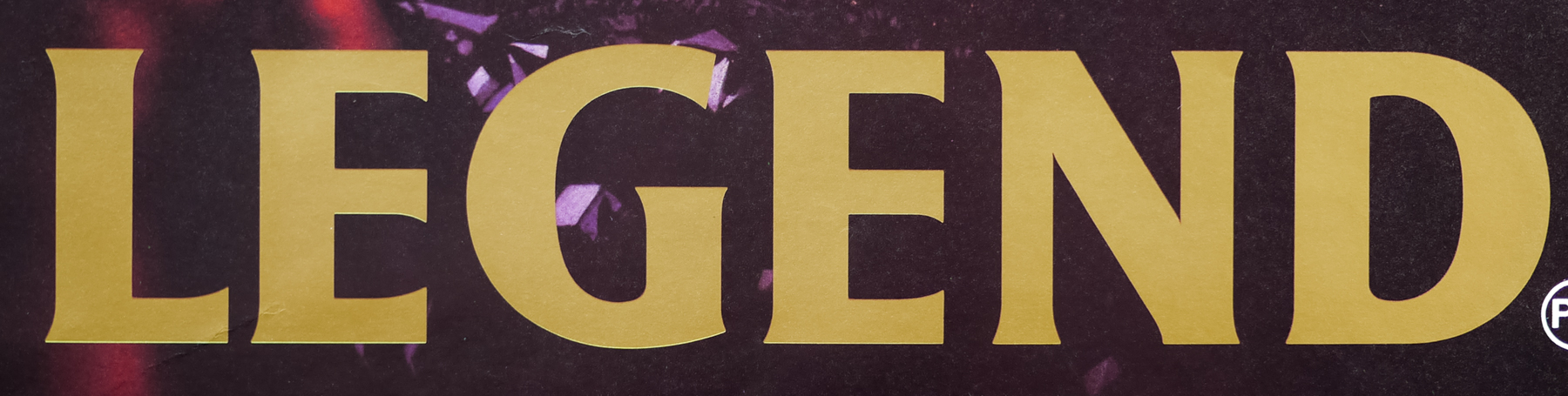
John Alvin artwork features on this British quad for the release of director Ridley Scott‘s 1985 fantasy oddity, Legend. It’s a film that is often scrubbed from both Scott and star Tom Cruise’s filmography whenever their previous films are discussed. There are a number of reasons for this, not least the fact that it had a troubled production as well as a fairly brutal critical mauling. Cruise’s performance is a shadow of what the actor brought to Tony Scott’s seminal Top Gun only a year later. part of the blame for this has to be down to the way the film was extensively edited by both Scott and the studio prior to release. Scott’s first version ran 125 minutes and this was then cut down to 113 minutes following some test screenings. The final UK (European?) release was 95 minutes and US audiences had another 6 minutes removed for their version.

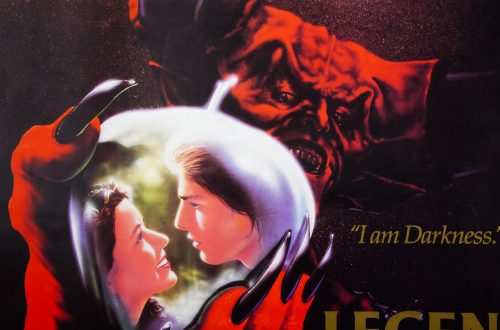
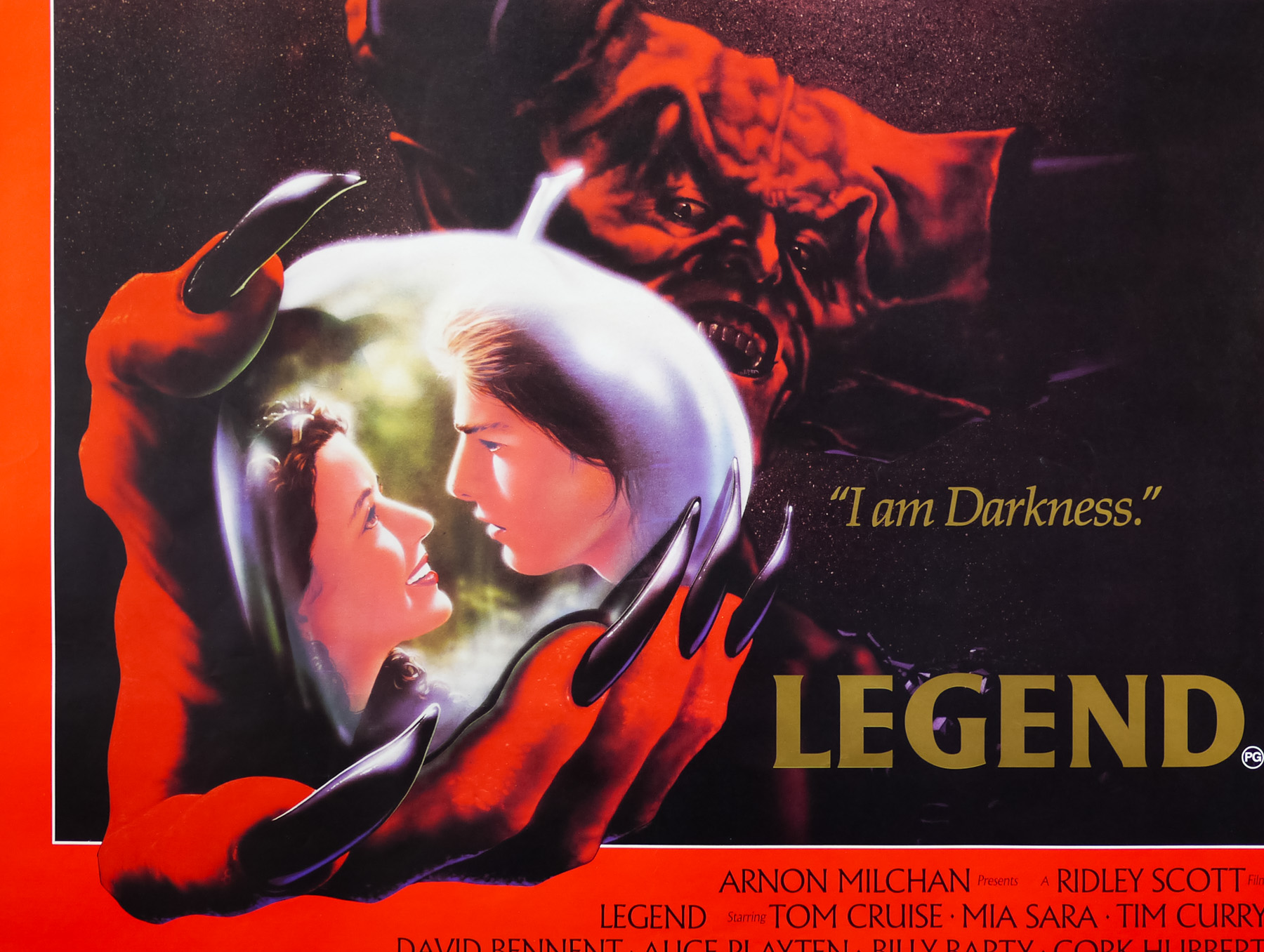
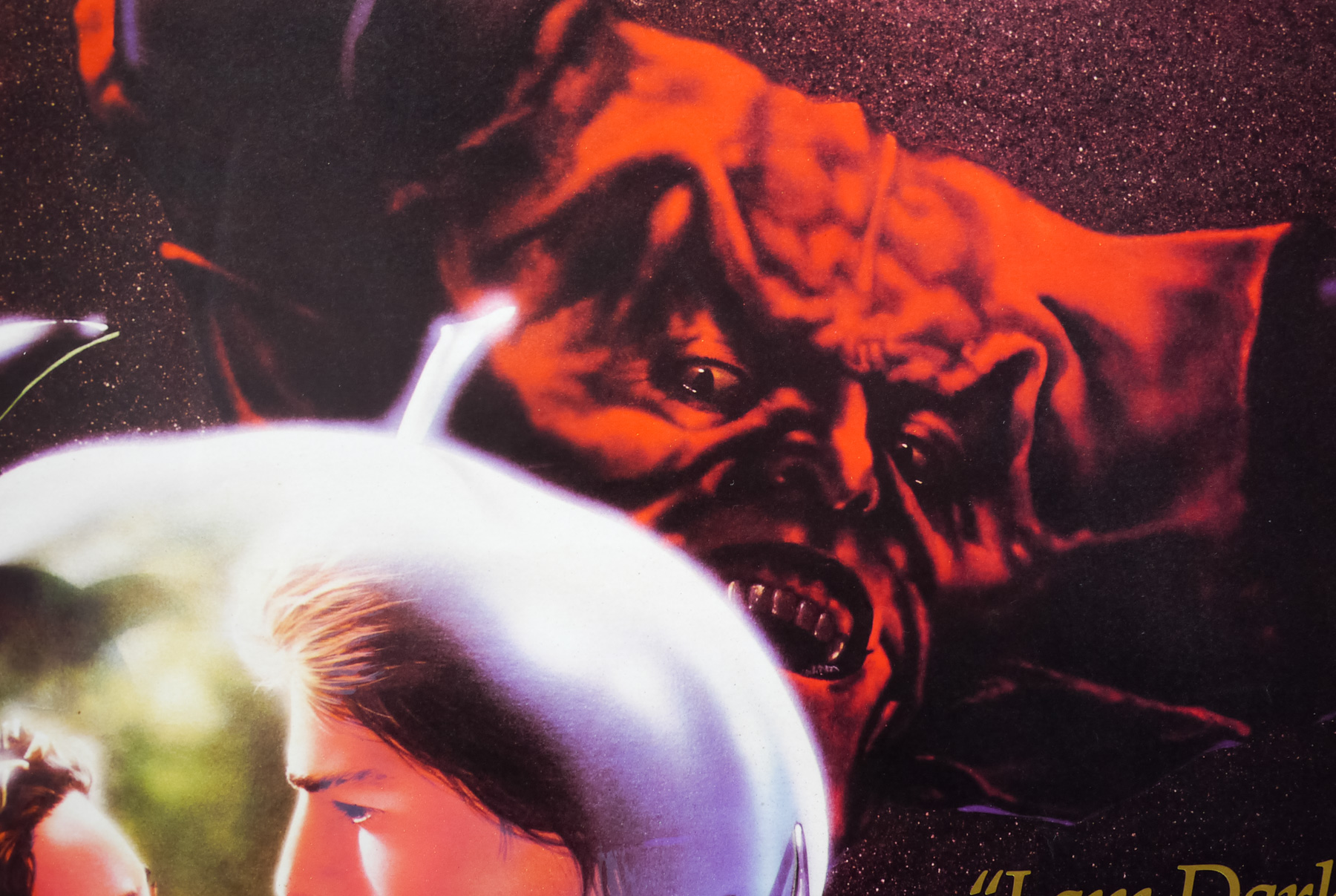
There are things to admire about the film, including the production and set design which created some memorable environments in which the action takes place. Tim Curry is near unrecognisable as the evil Darkness (as featured on this poster) and the make-up effects, created by Rob Bottin and his team, are incredible. Mia Sara also impresses as Lili and it’s hard to believe she was just 16 at the time of filming. Whilst it failed to recoup its budget on initial release, the film has definitely gained something of a cult following in the years since, particularly with those coming of age around the time of its release on home video. 

The late American designer and artist John Alvin was responsible for over 135 film poster designs over a thirty year period. Alvin painted many unforgettable pieces of artwork, including Blade Runner and E.T. The Extra Terrestrial, and this image he created for Legend was used around the globe to promote the film, including in multiple European countries and on the international one sheet. Alvin sadly passed away too early, just shy of his 6oth birthday (in 2008), but his fantastic designs will live on for generations to come.

To see the posters I’ve collected by Alvin click here.

Gothic / quad / UK

03.11.16

Poster Poster
Title
Gothic
AKA
--
Year of Film
1986
Director
Ken Russell
Starring
Gabriel Byrne, Julian Sands, Natasha Richardson, Myriam Cyr, Timothy Spall, Alec Mango, Andreas Wisniewski, Dexter Fletcher, Pascal King
Origin of Film
UK
Genre(s) of Film
Gabriel Byrne, Julian Sands, Natasha Richardson, Myriam Cyr, Timothy Spall, Alec Mango, Andreas Wisniewski, Dexter Fletcher, Pascal King,
Type of Poster
Quad
Style of Poster
--
Origin of Poster
UK
Year of Poster
1986
Designer
Unknown
Artist
Paul Dufficey
Size (inches)
30 2/16" x 39 15/16"
SS or DS
SS
Tagline
"Conjure up your deepest darkest fear. Then call that fear to life."

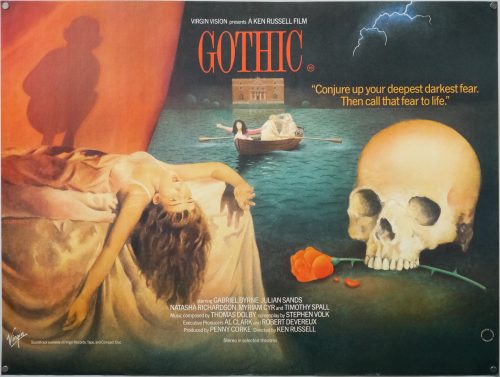
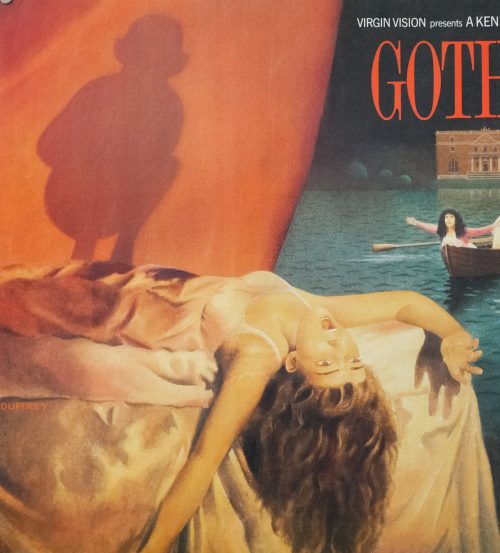
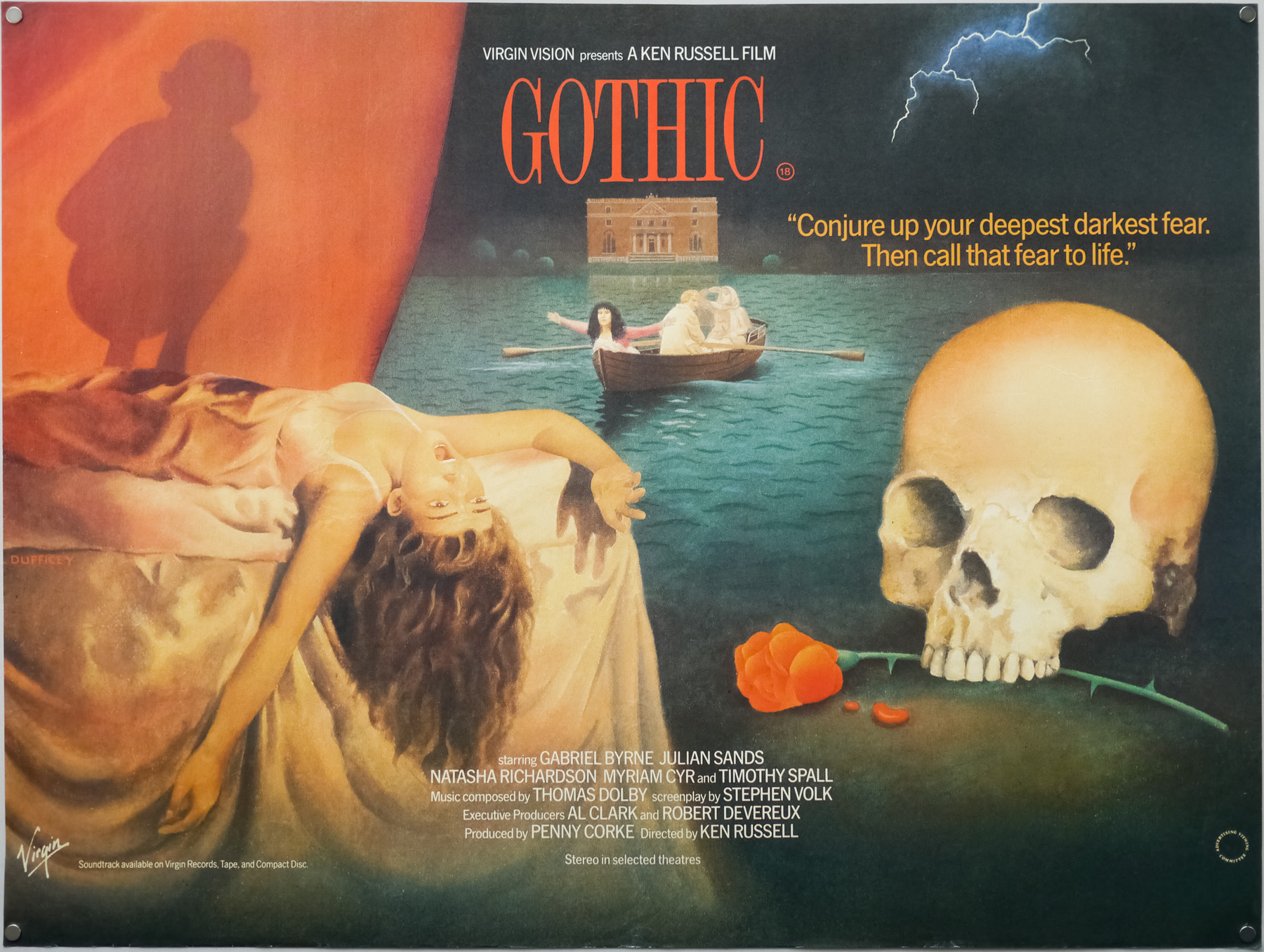
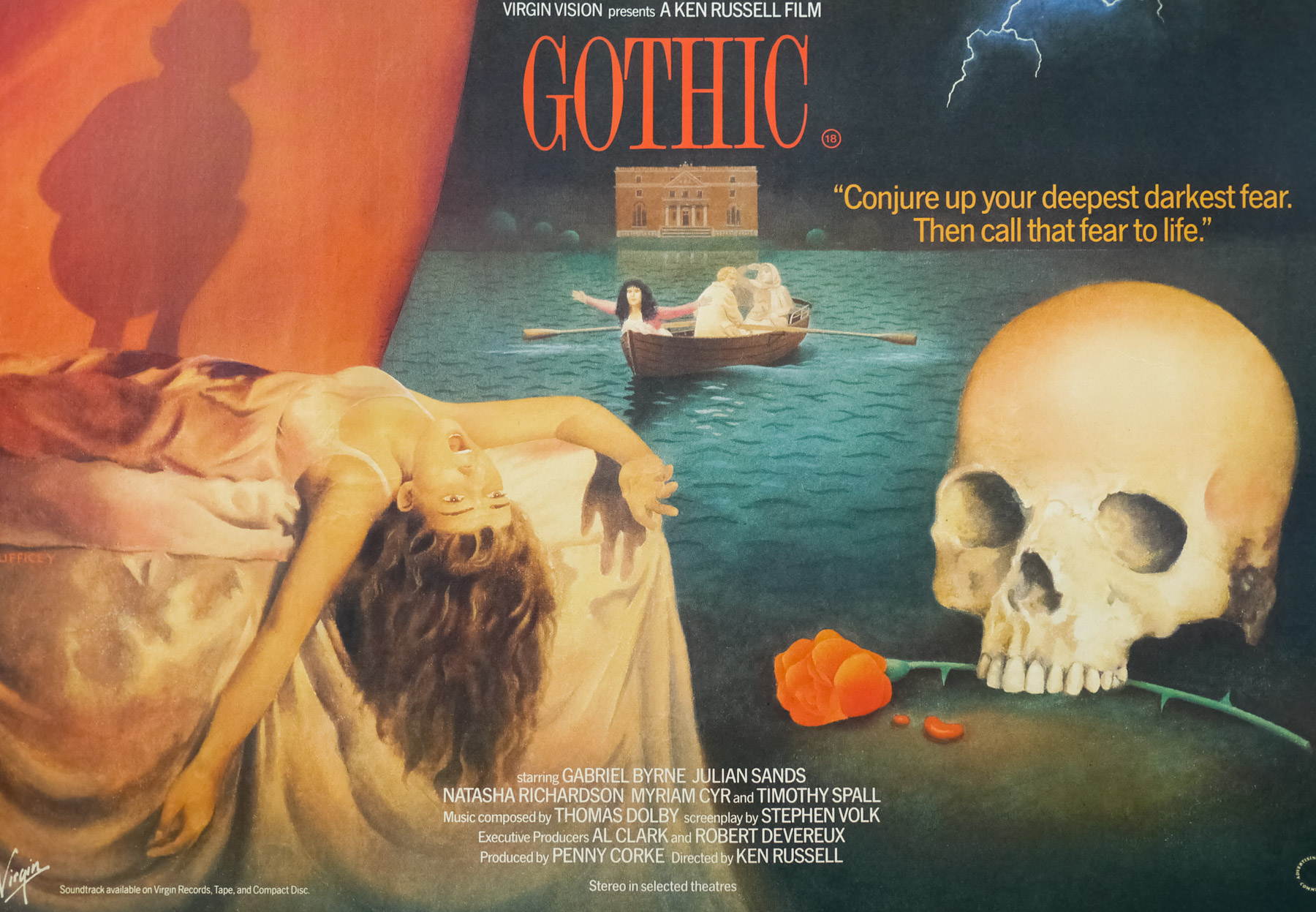
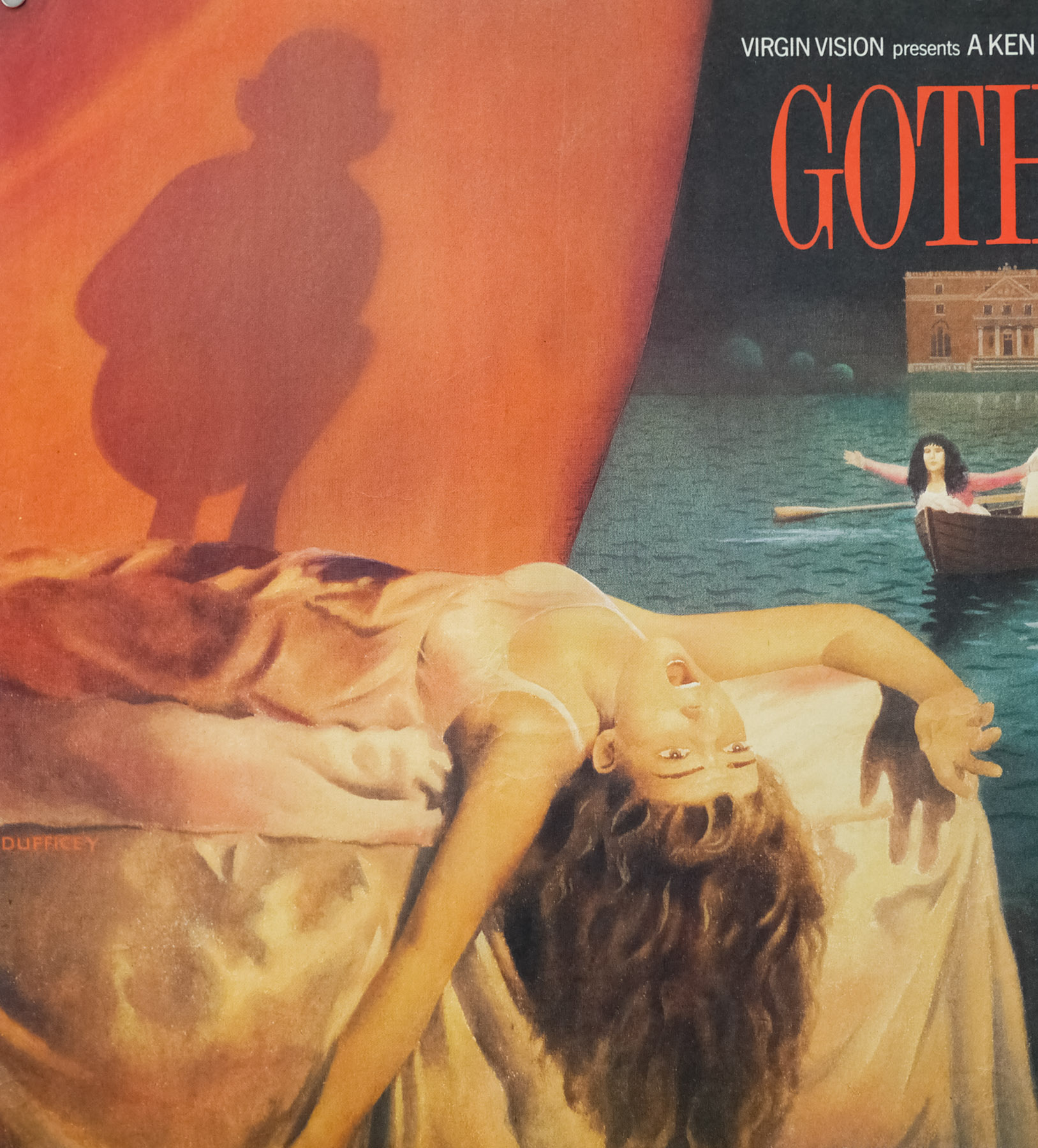
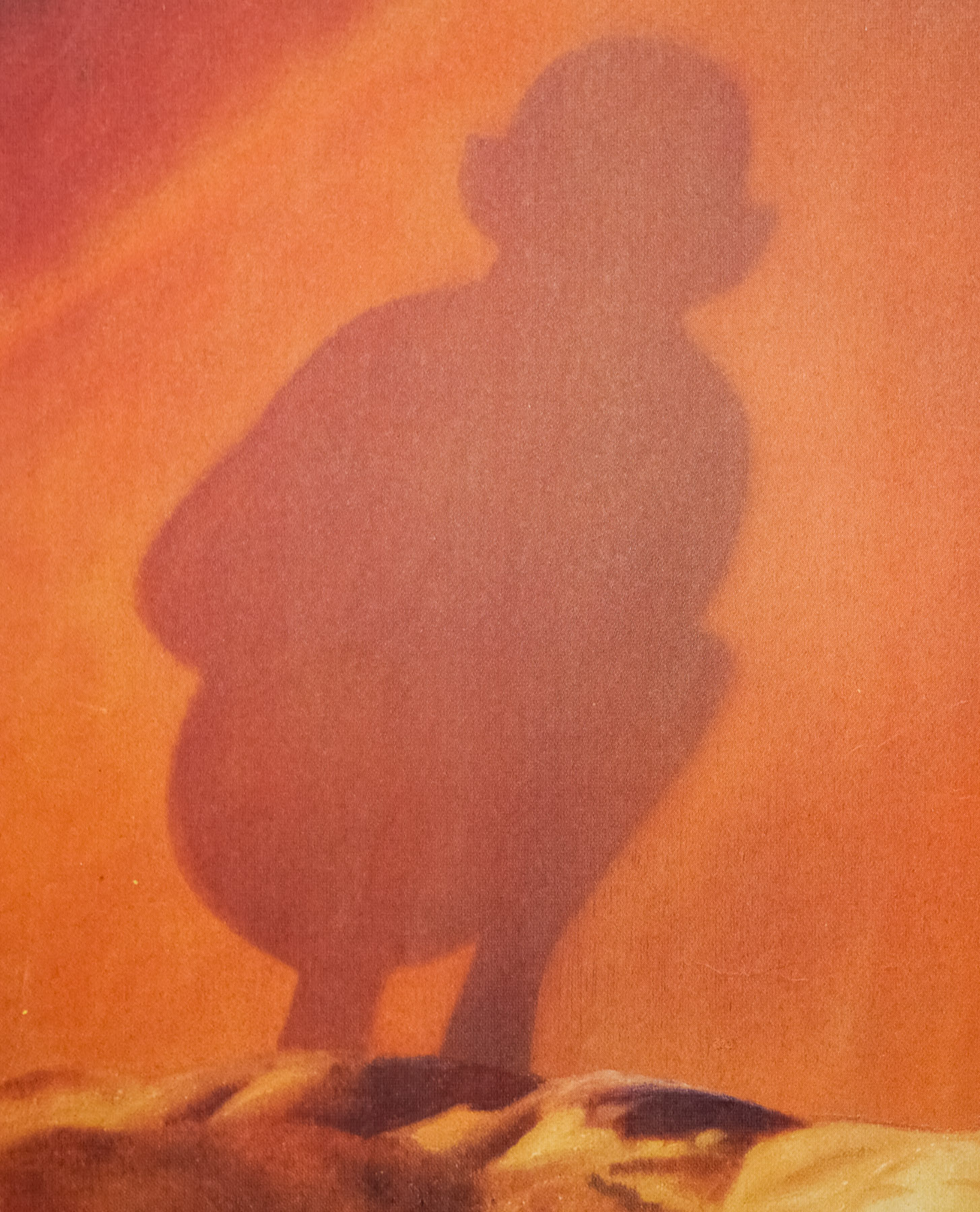
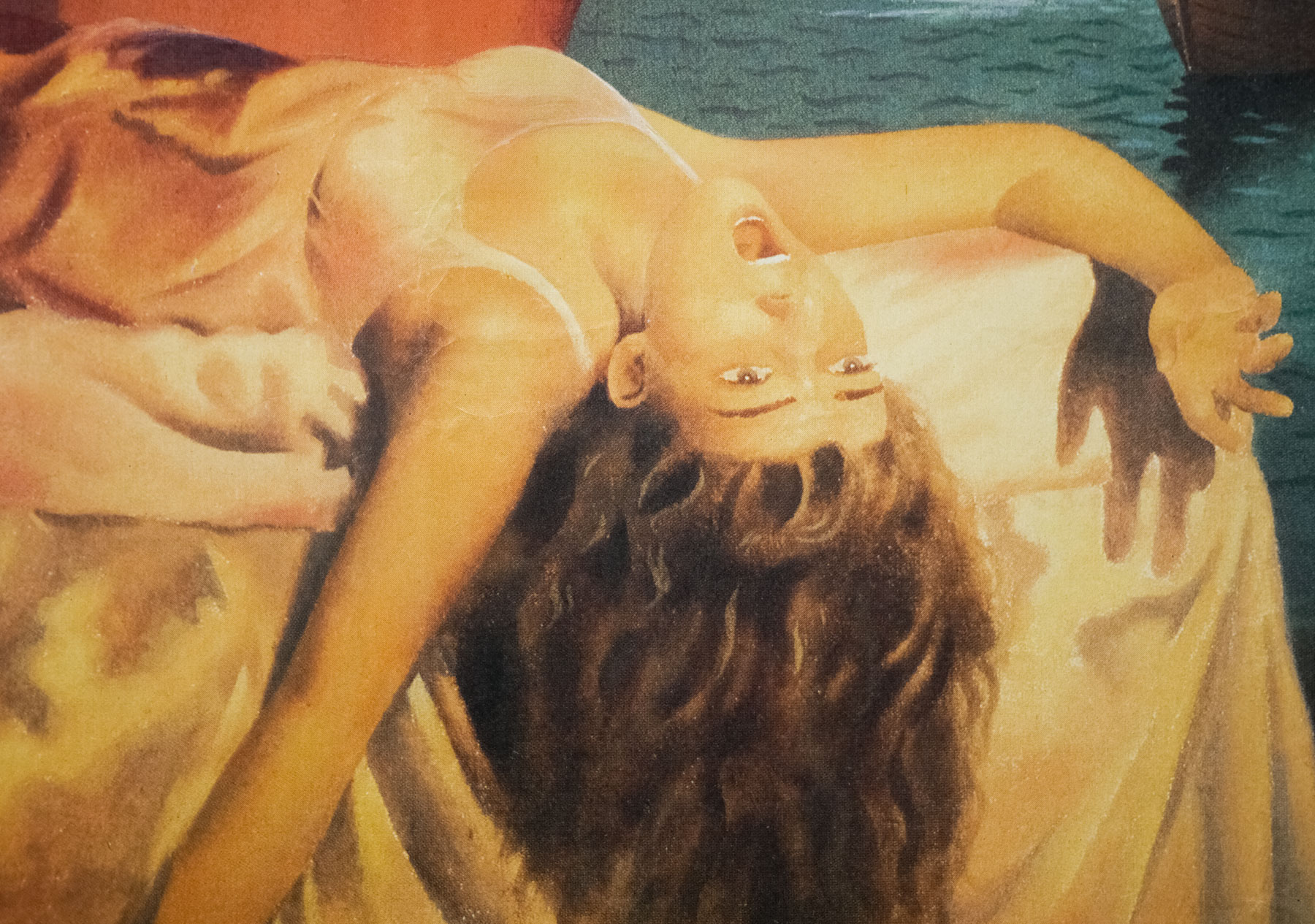
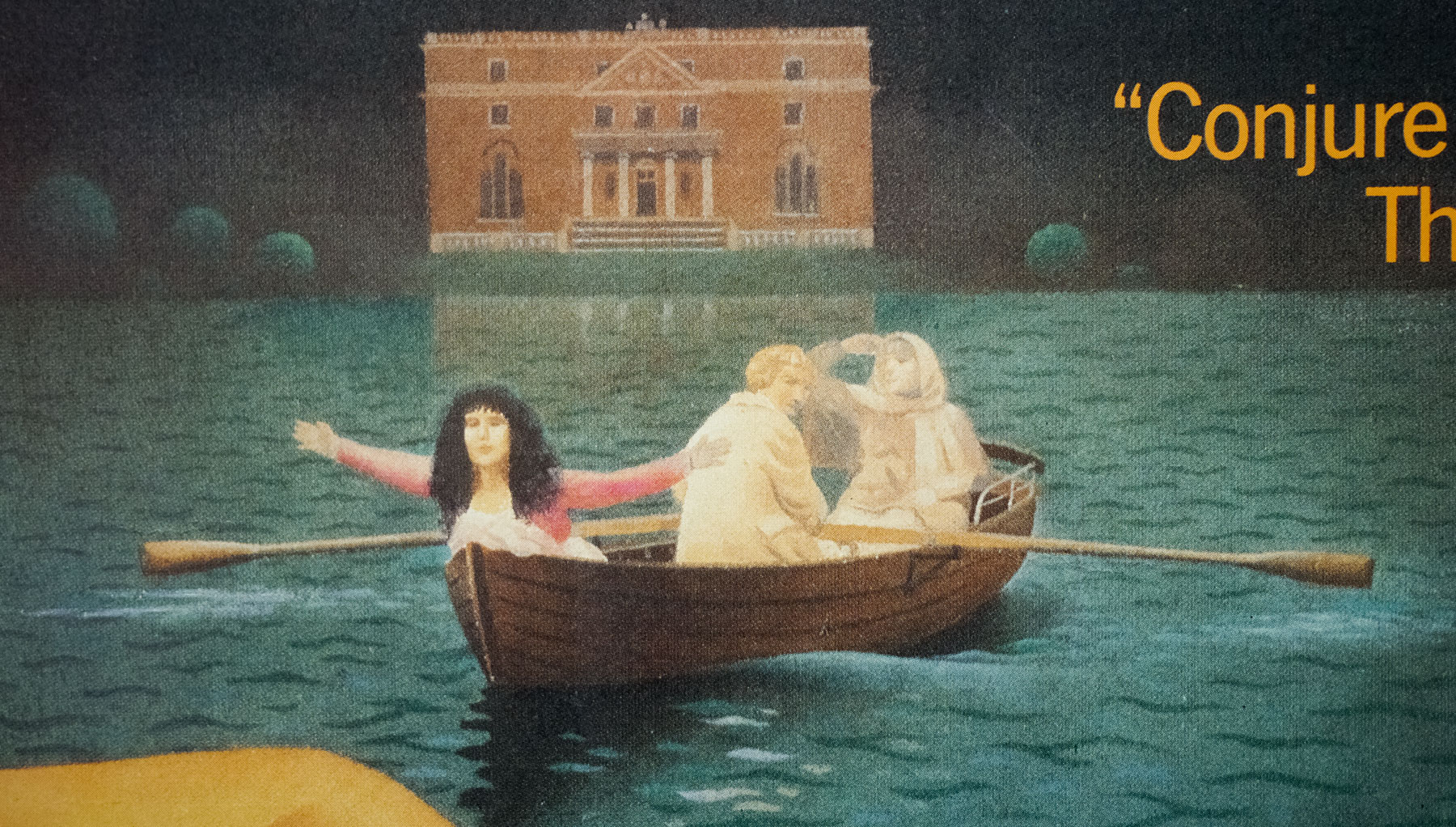
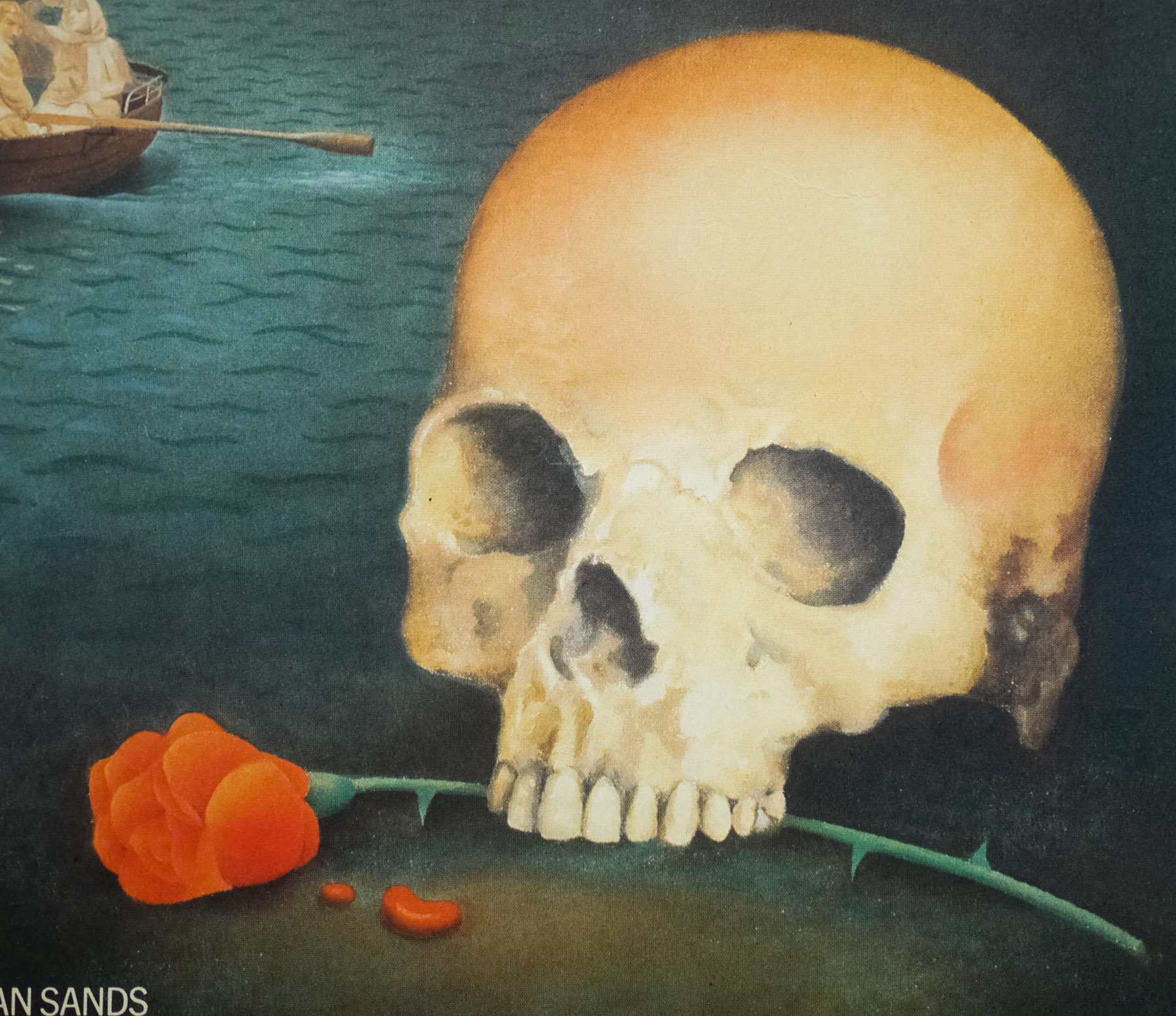
This British quad for Ken Russell‘s 1986 horror film Gothic features artwork by Paul Dufficey. From what I can gather the artist was a long-time collaborator with the late director and had worked on four of his previous films, including Tommy. It appears from his IMDb profile that he worked as a production and set designer and for Gothic he created ‘portraits’, which presumably included the work on this posters.

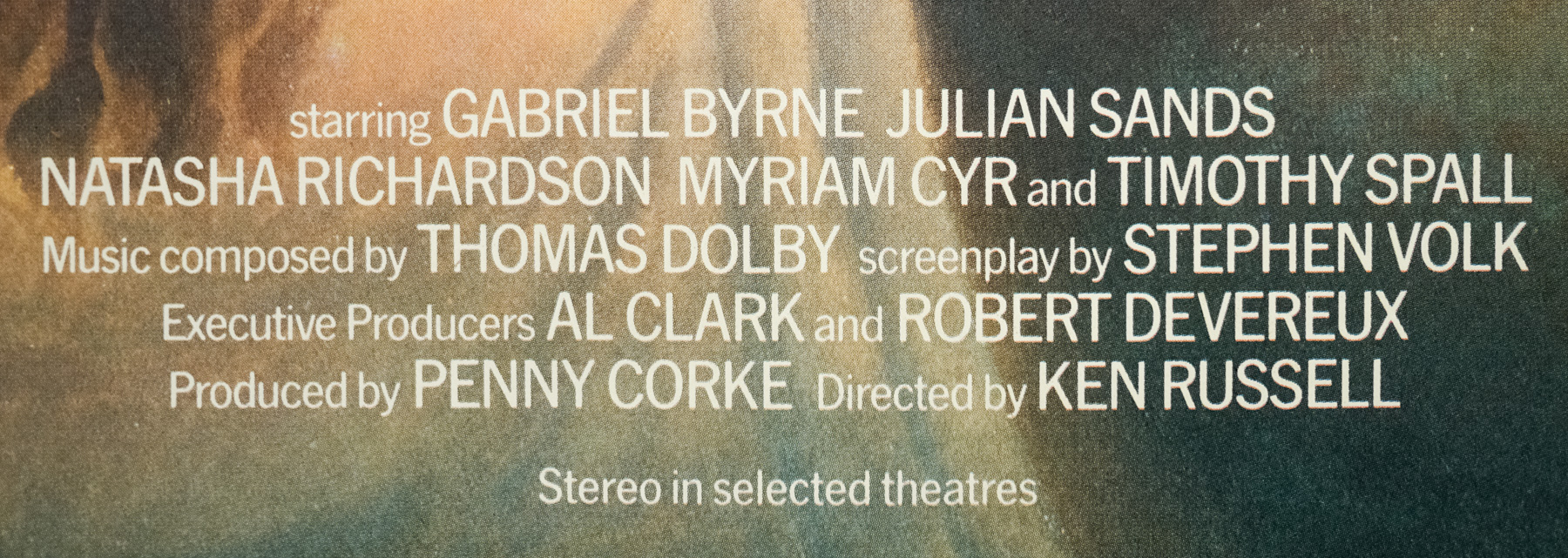
Russell’s film was written by Stephen Volk and is a fictionalised retelling of the visit by Percy Shelley (Julian Sands) and his later wife Mary (Natasha Richardson in her first film role) to the Swiss villa of Lord Byron (Gabriel Byrne). There they also meet Byron’s friend, the physician Dr. John Polidori (Timothy Spall) One evening, whilst a storm rages outside, the group tell each other horror stories and reveal intimate secrets about themselves. This meeting was apparently the inspiration for Mary Shelley to write Frankenstein and for Polidori to pen The Vampyre, both of which were groundbreaking novels in the horror genre.

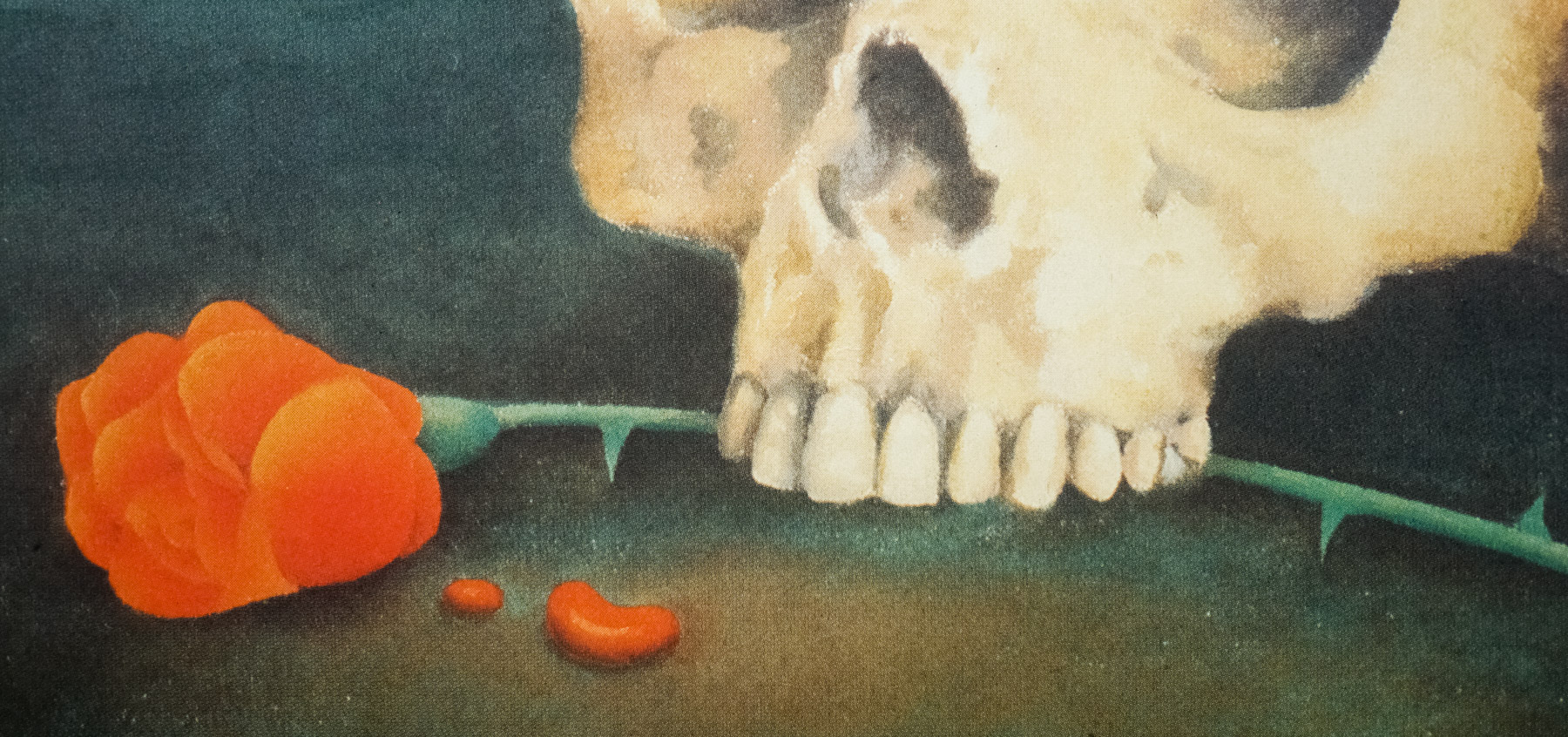
The images on this poster are clearly inspired by classic gothic artwork, particularly the woman splayed across a bed. This references a painting called The Nightmare by the Anglo-Swiss artist Henry Fuseli which was painted in 1781. It depicts a creepy imp sitting on top of a sleeping woman and this same imagery features in Gothic. The imp is played by Kiran Shah, a dwarf actor and stuntman who has featured in several blockbusters such as Raiders of the Lost Ark and was a stuntman on all three of the Hobbit films.

Apparently the film was not much of a success at the box office but was popular on home video. I’m certain it has something to do with the distributor using a creepy photo of Shah on top of a woman, which must have enticed a fair few punters to rent the film. I doubt it met the expectations of all out horror that the cover suggested for many though!

Something Wicked This Way Comes / quad / UK

01.02.17

Poster Poster
Title
Something Wicked This Way Comes
AKA
--
Year of Film
1983
Director
Jack Clayton
Starring
Jason Robards, Jonathan Pryce, Diane Ladd, Royal Dano, Vidal Peterson, Shawn Carson, Mary Grace Canfield, Richard Davalos, Jake Dengel, Jack Dodson
Origin of Film
USA
Genre(s) of Film
Jason Robards, Jonathan Pryce, Diane Ladd, Royal Dano, Vidal Peterson, Shawn Carson, Mary Grace Canfield, Richard Davalos, Jake Dengel, Jack Dodson,
Type of Poster
Quad
Style of Poster
--
Origin of Poster
UK
Year of Poster
1983
Designer
Unknown
Artist
David Grove
Size (inches)
30" x 39 13/16"
SS or DS
SS
Tagline
Don't whisper your dreams, someone may be listening.

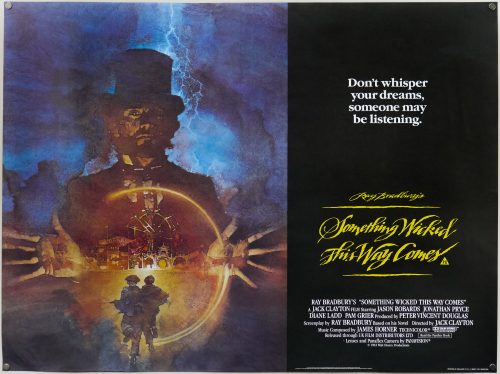
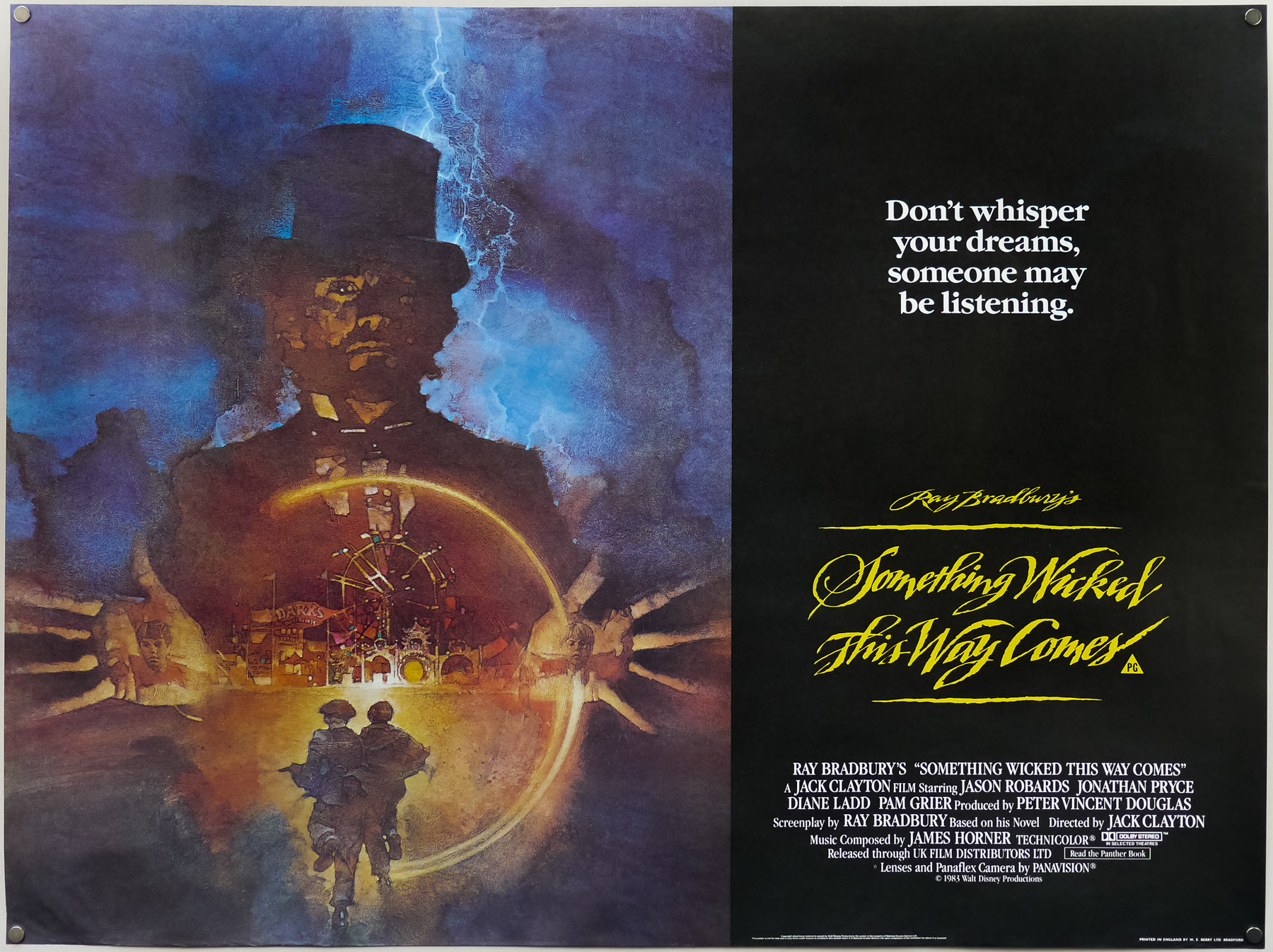
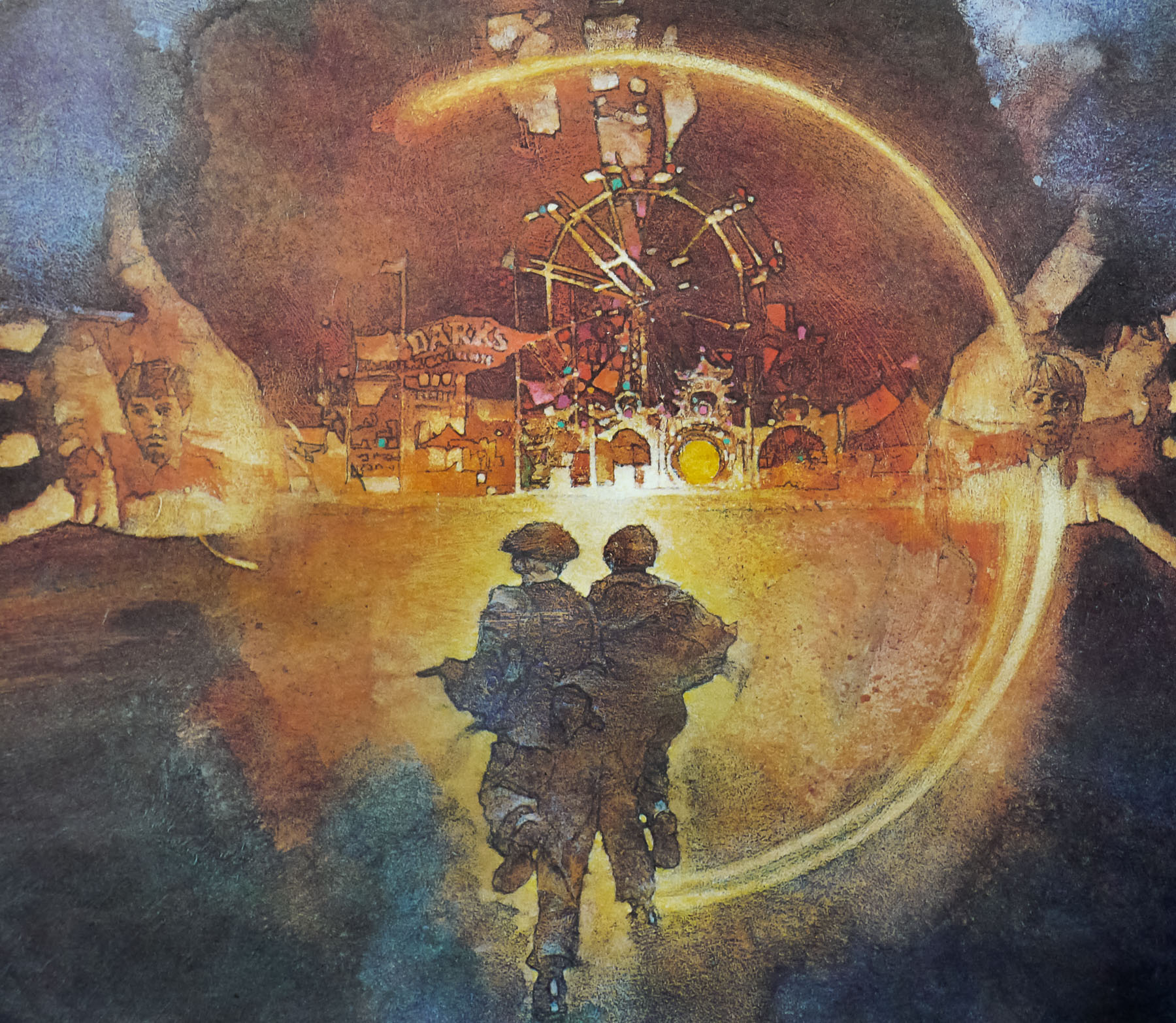
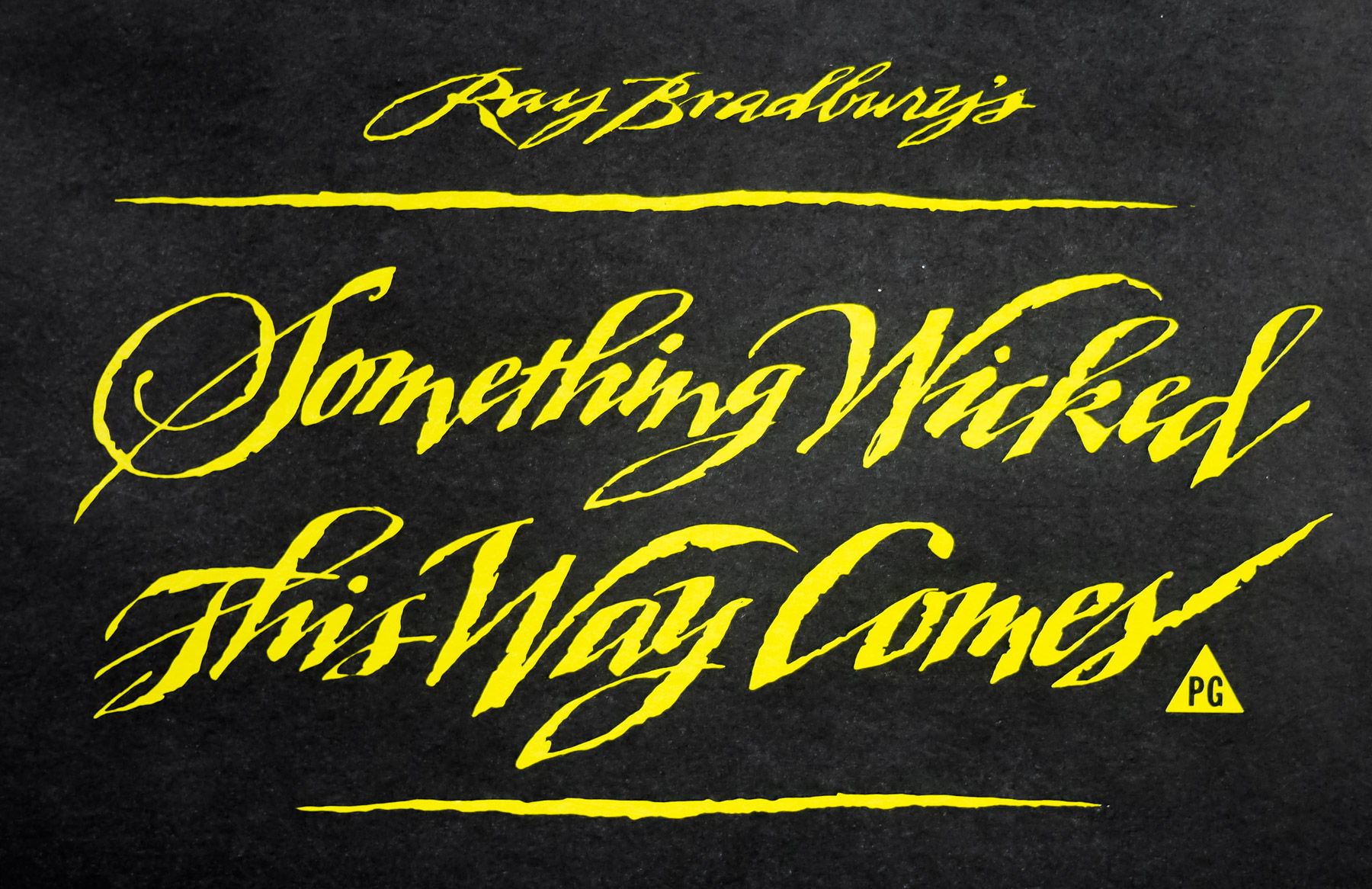
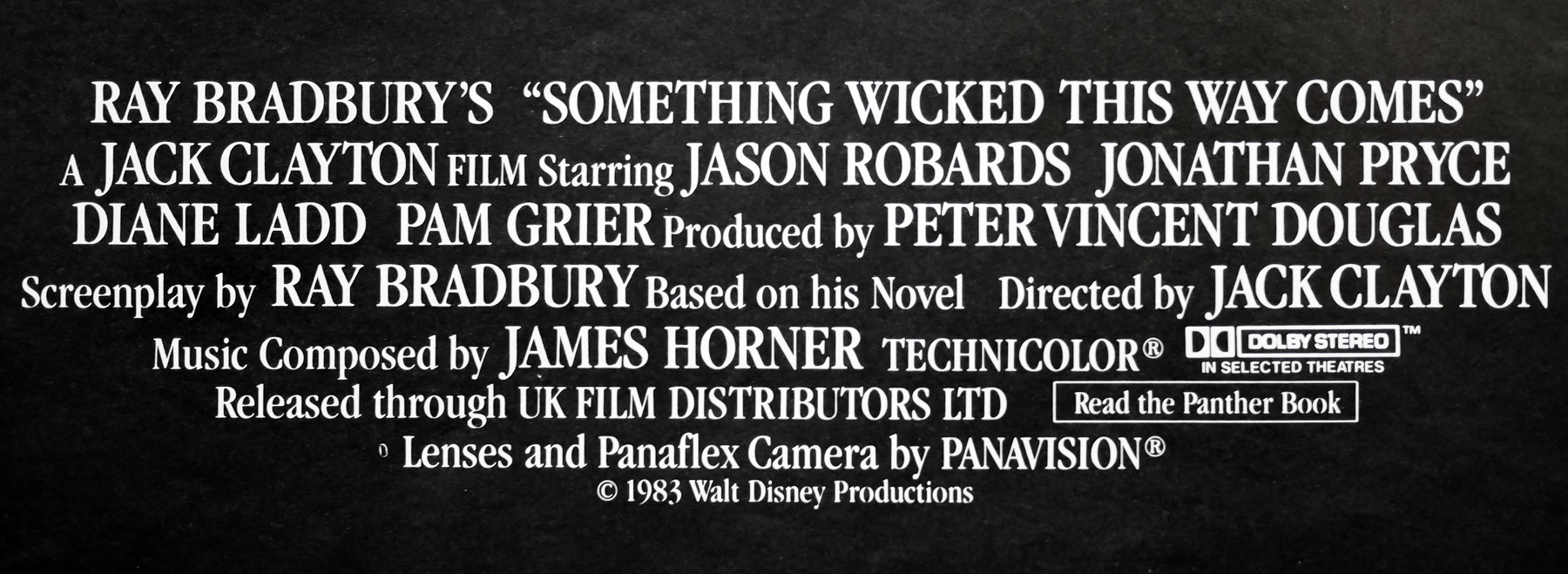
Something Wicked This Way Comes is a 1983 live-action Disney film that’s based on the Ray Bradbury horror novel of the same name. It was helmed by the late British director Jack Clayton (best known for the 1961 horror The Innocents) The film is notorious for its production woes and extensive reshoots that were done without the input of Clayton or Bradbury, who also wrote the screenplay. After production had wrapped, Disney were concerned about its length and commercial appeal and spent a year (and millions of dollars) replacing entire scenes and extensive special effects sequences with material shot by another director. The film’s Wikipedia page details the problems and also notes that the film was a commercial flop.

The plot is described thusly on IMDb:

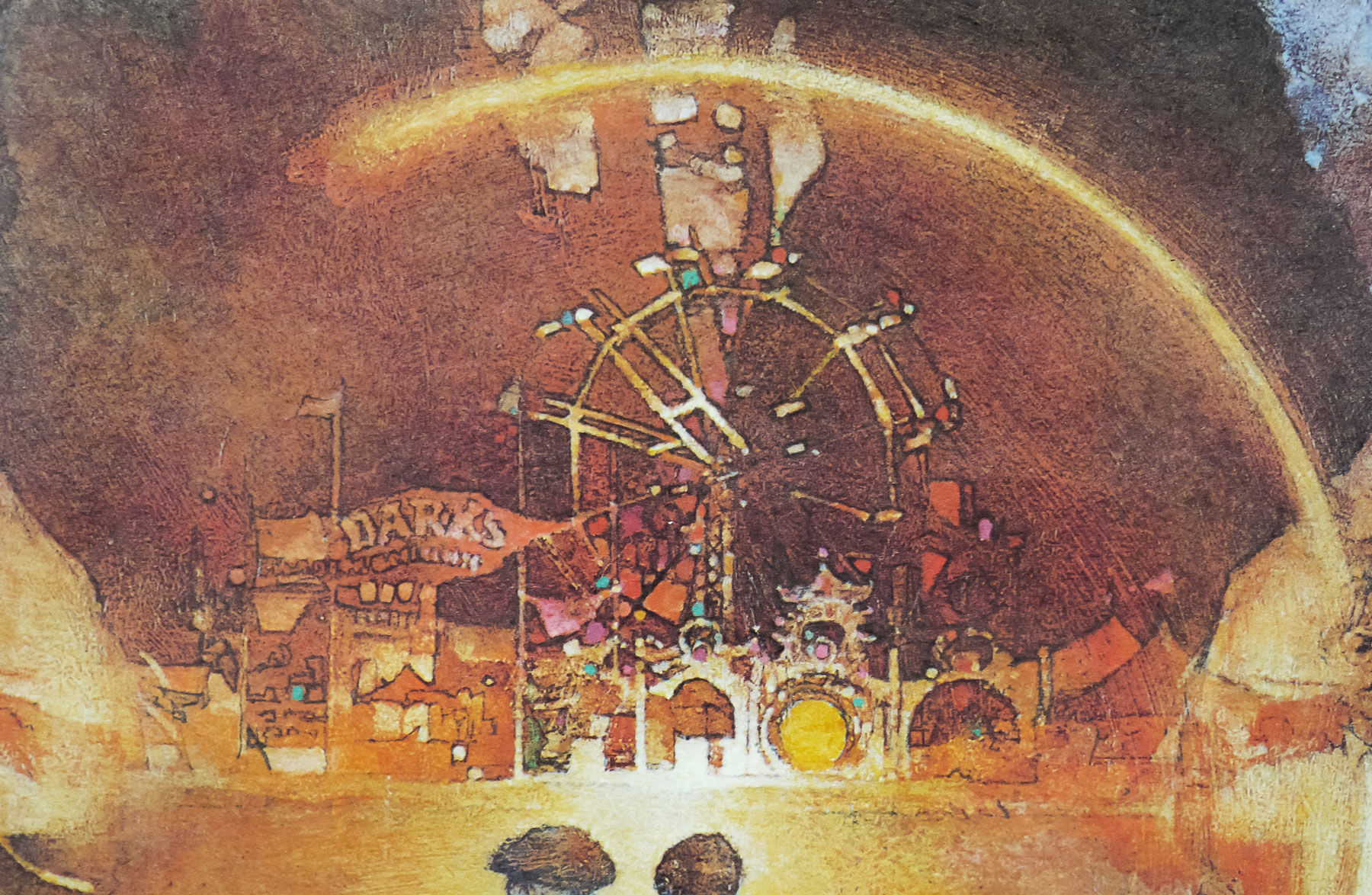
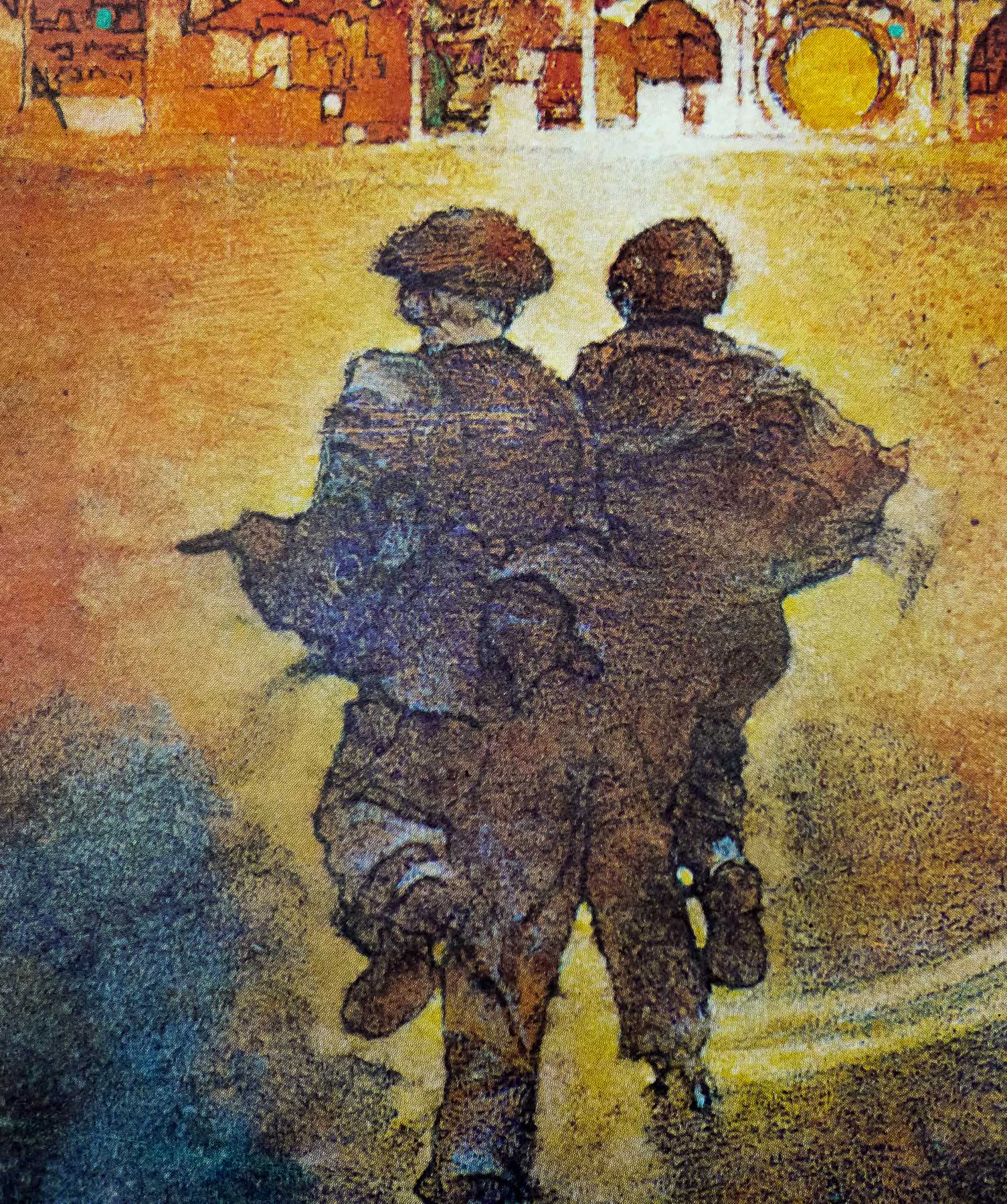
In a small anywhere town in any state in America, two young boys- quiet Will Halloway and somewhat rebellious Jim Nightshade-enjoy the ever-shortening days of autumn. When the boys hear about a strange traveling carnival from a lightning rod salesman, they decide to see what it is all about-but Will is fearful, as most carnivals end their tours after Labor Day. When the ominous Mr. Dark, the Illustrated Man, rides into town on a dark midnight, setting up his massive carnival in a matter of seconds, the boys are both thrilled and terrified. It seems to be just another carnival at first, but it is not before long that the forces of darkness themselves are manifesting from the haunting melodies of the carousel-which can change your age depending on which way you ride it-and the glaring Mirror Maze. With his collection of freaks and oddities, such as the Fat Man, Mr. Electro, and the blind Dust Witch, Dark intends to take control of the town and seize more innocent souls to damn.

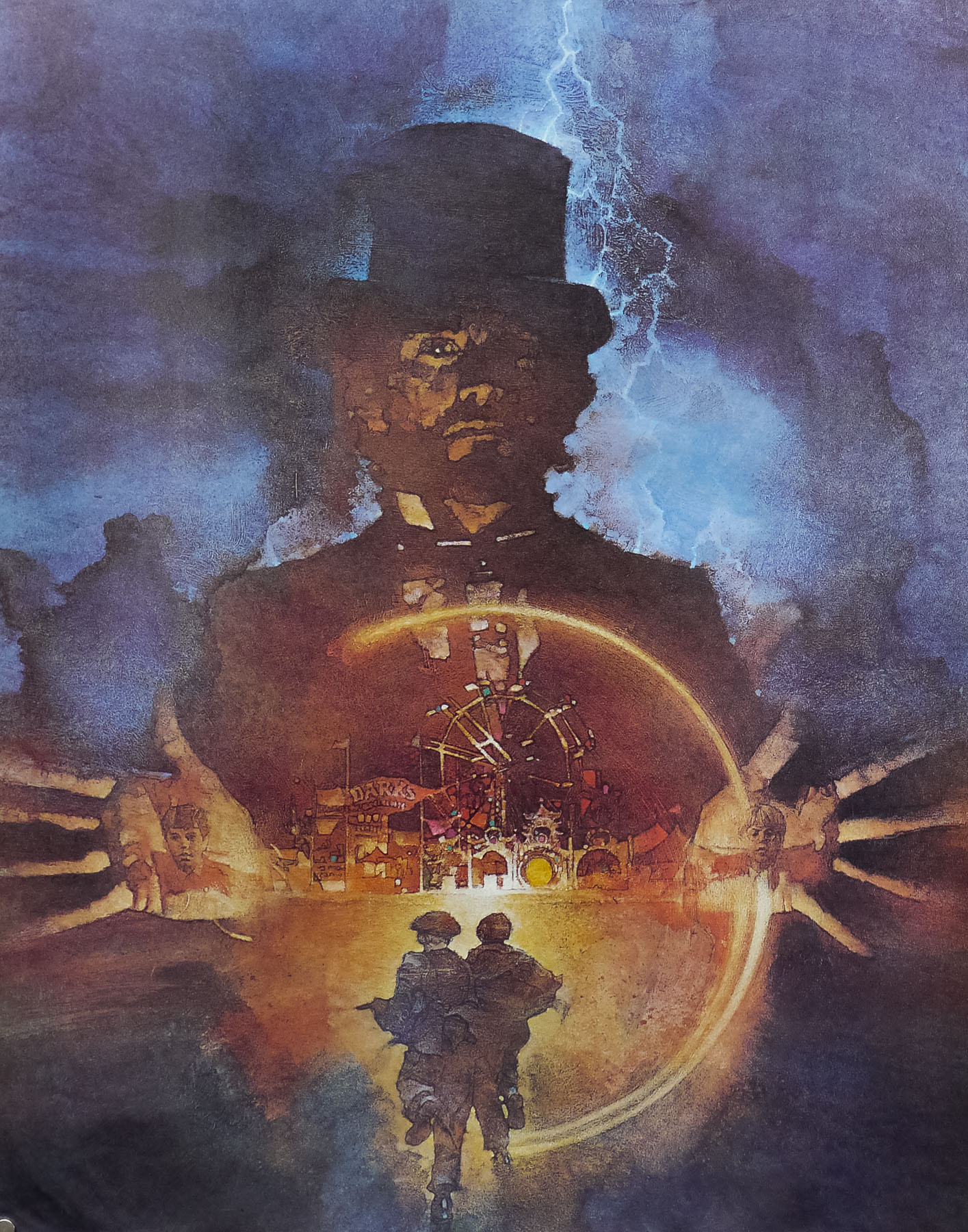
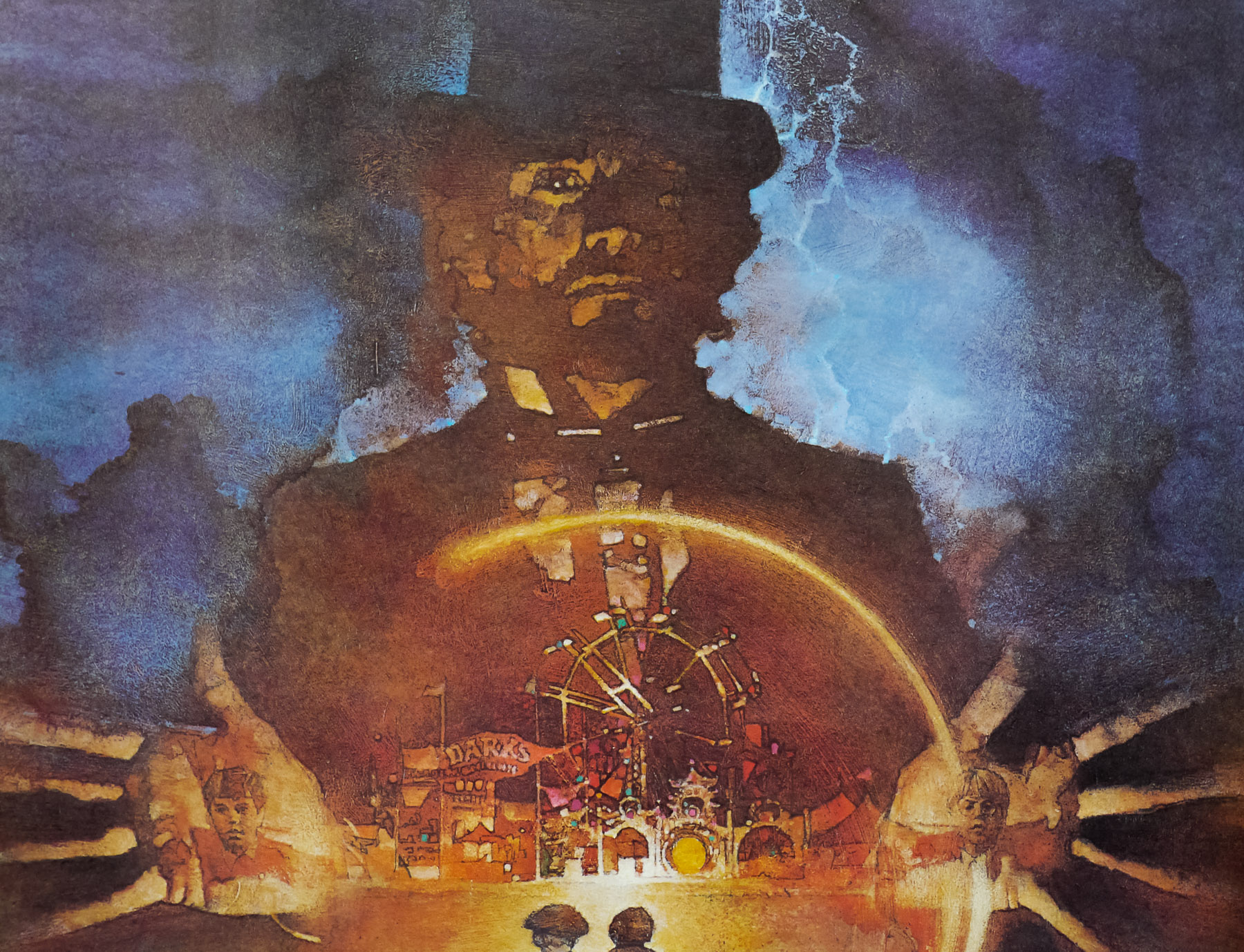
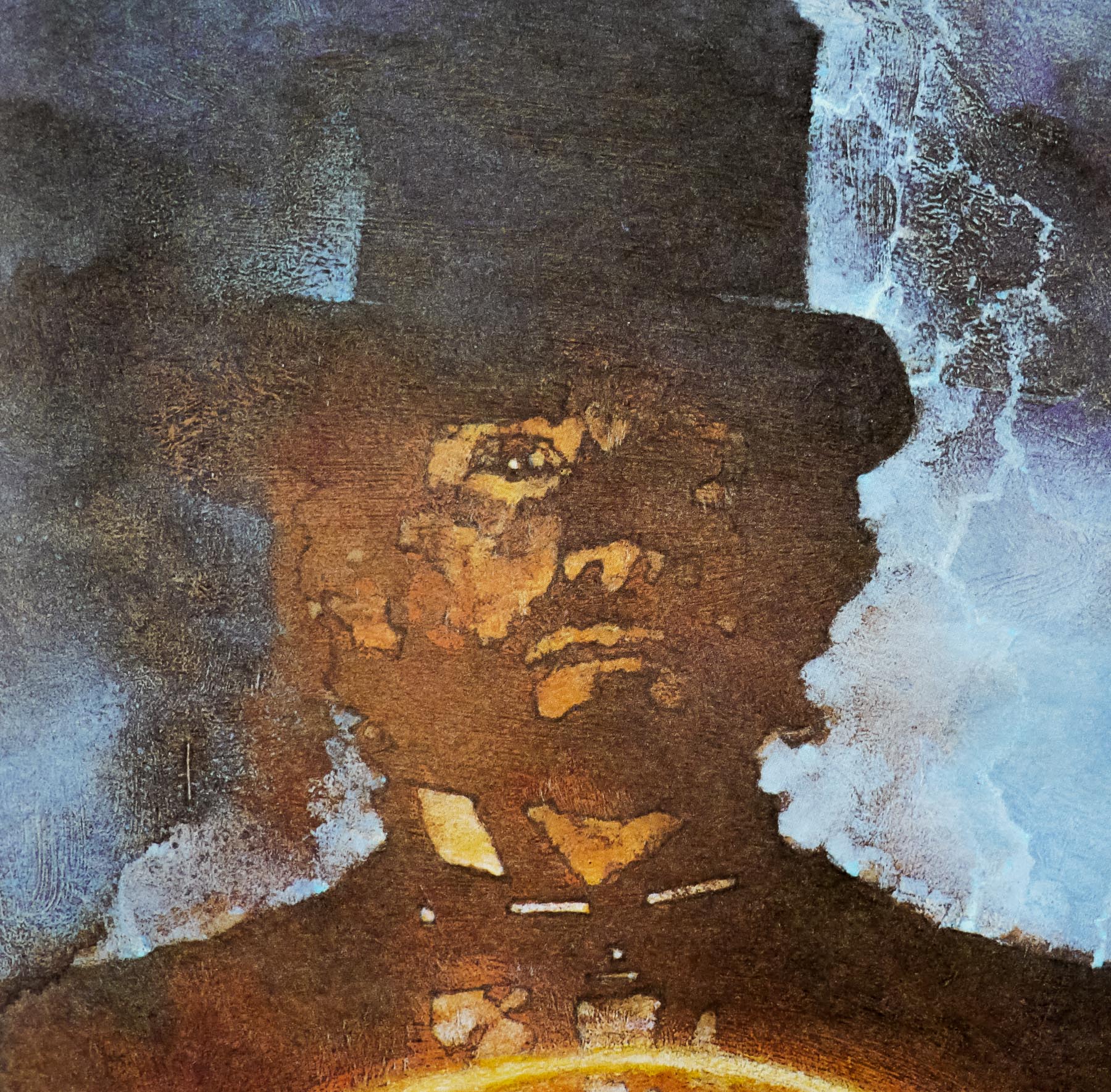
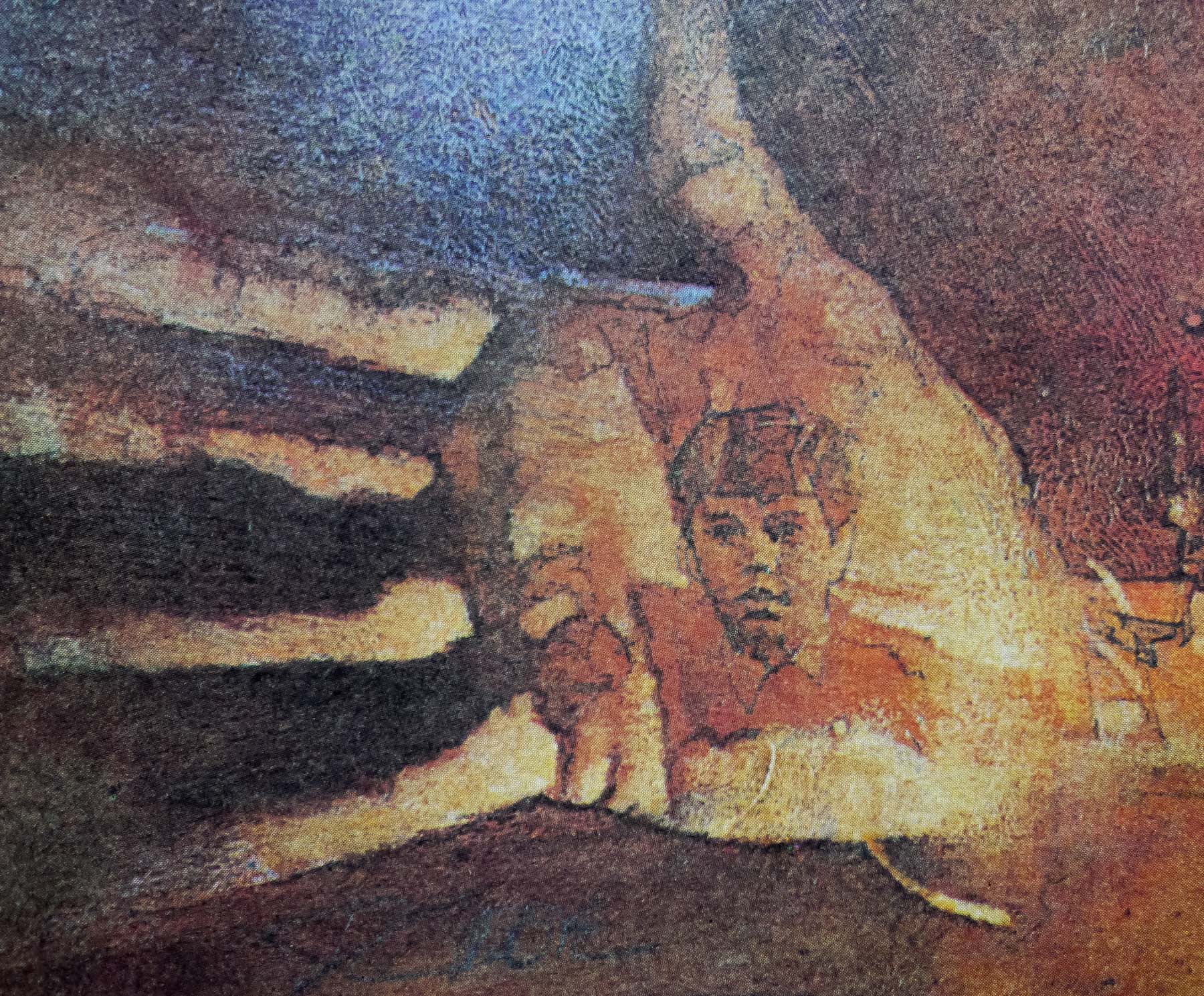
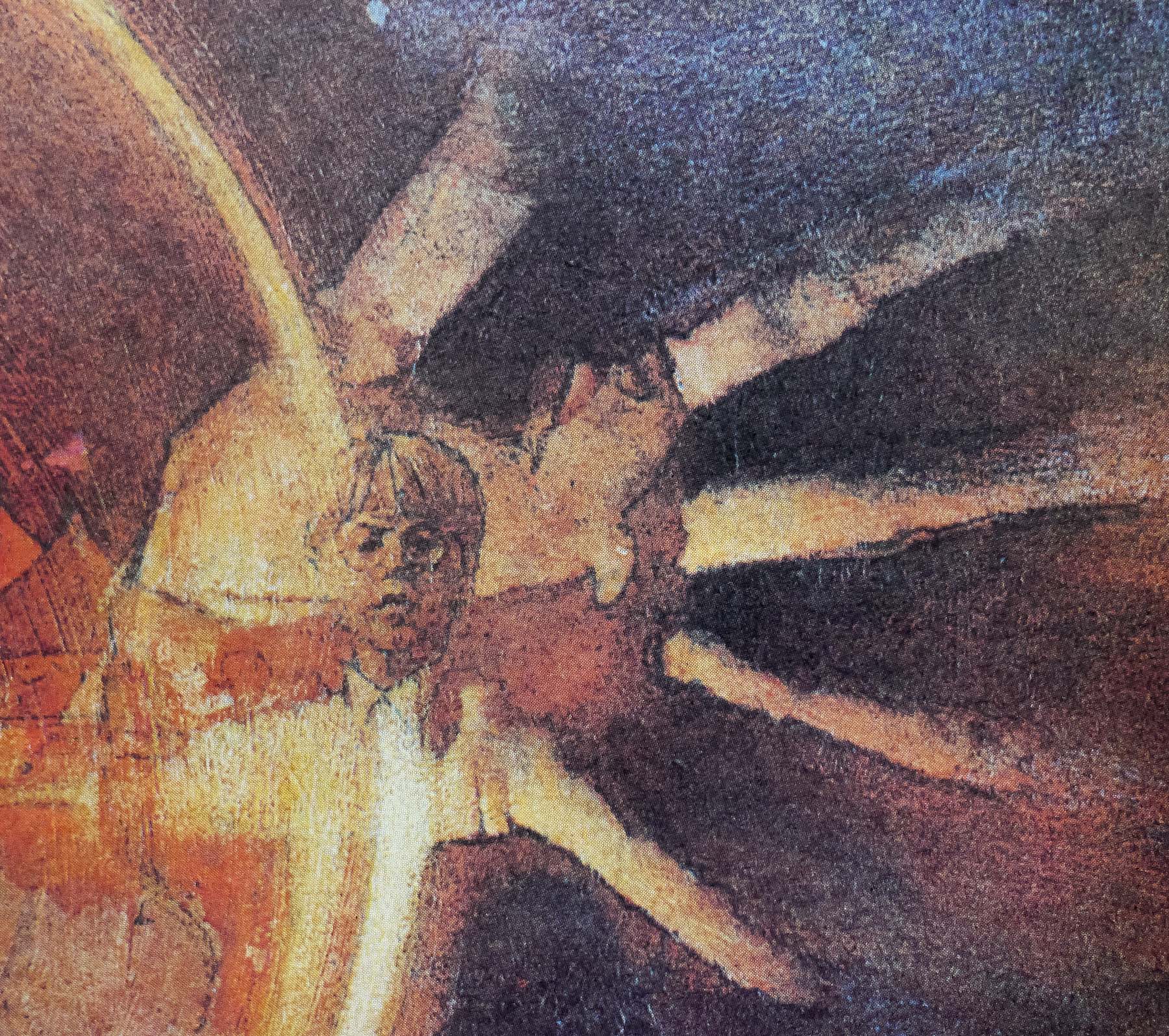
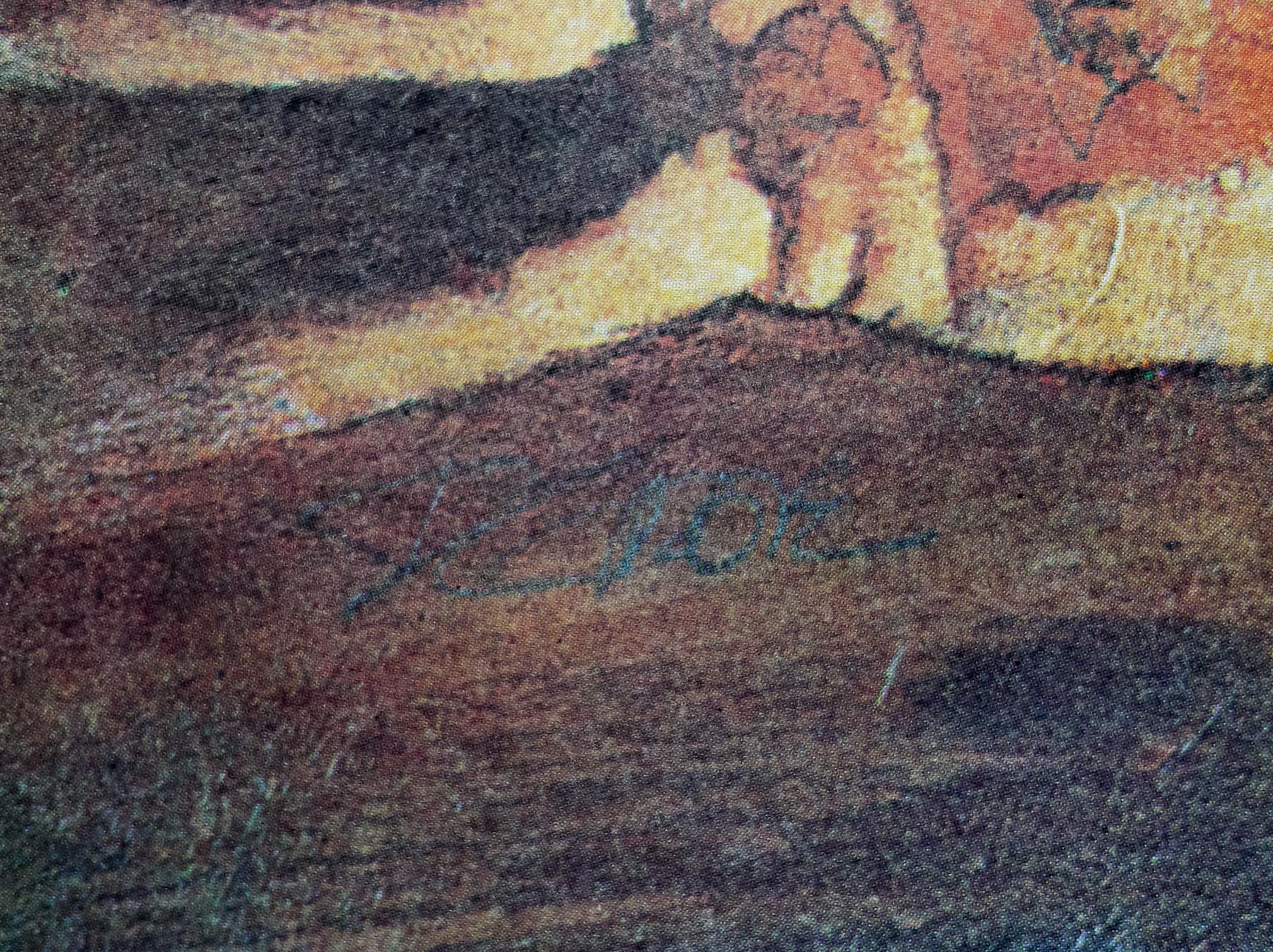
The artwork on this quad, which also featured on the American and French posters, is by the American illustrator David Grove who worked on several film posters, including the brilliant international one sheet for Pale Rider and the striking poster for Steven Seagal’s Nico. Grove had an incredible skill at using gouache and acrylic paints to create striking, stylised images of his subjects, which are full of energy and feature brilliant use of colour washes, shading and clever brush strokes.

Grove sadly passed away in October 2012 and the website of Artist Partners London (where he apparently worked for a while in the 1960s) features a gallery and information on him, including an obituary that was originally printed in the San Francisco Chronicle. Greg Newbold’s Life Needs Art blog features a great piece on Grove, which includes several images of his other film posters.

Spaced Invaders / quad / teaser / UK

22.05.17

Poster Poster
Title
Spaced Invaders
AKA
--
Year of Film
1990
Director
Patrick Read Johnson
Starring
Douglas Barr, Royal Dano, Ariana Richards, J.J. Anderson, Gregg Berger, Wayne Alexander, Fred Applegate, Patrika Darbo, Tonya Williams
Origin of Film
USA
Genre(s) of Film
Douglas Barr, Royal Dano, Ariana Richards, J.J. Anderson, Gregg Berger, Wayne Alexander, Fred Applegate, Patrika Darbo, Tonya Williams,
Type of Poster
Quad
Style of Poster
Teaser
Origin of Poster
UK
Year of Poster
1990
Designer
Unknown
Artist
Renato Casaro
Size (inches)
30 1/16" x 40"
SS or DS
SS
Tagline
Crash landing here soon

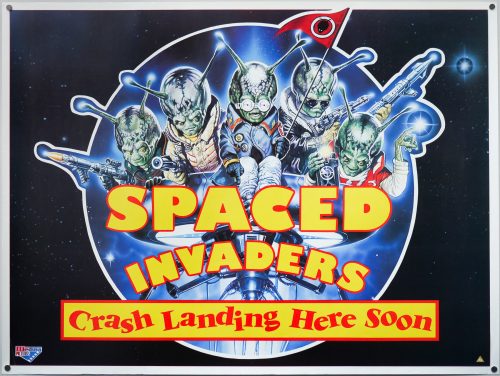
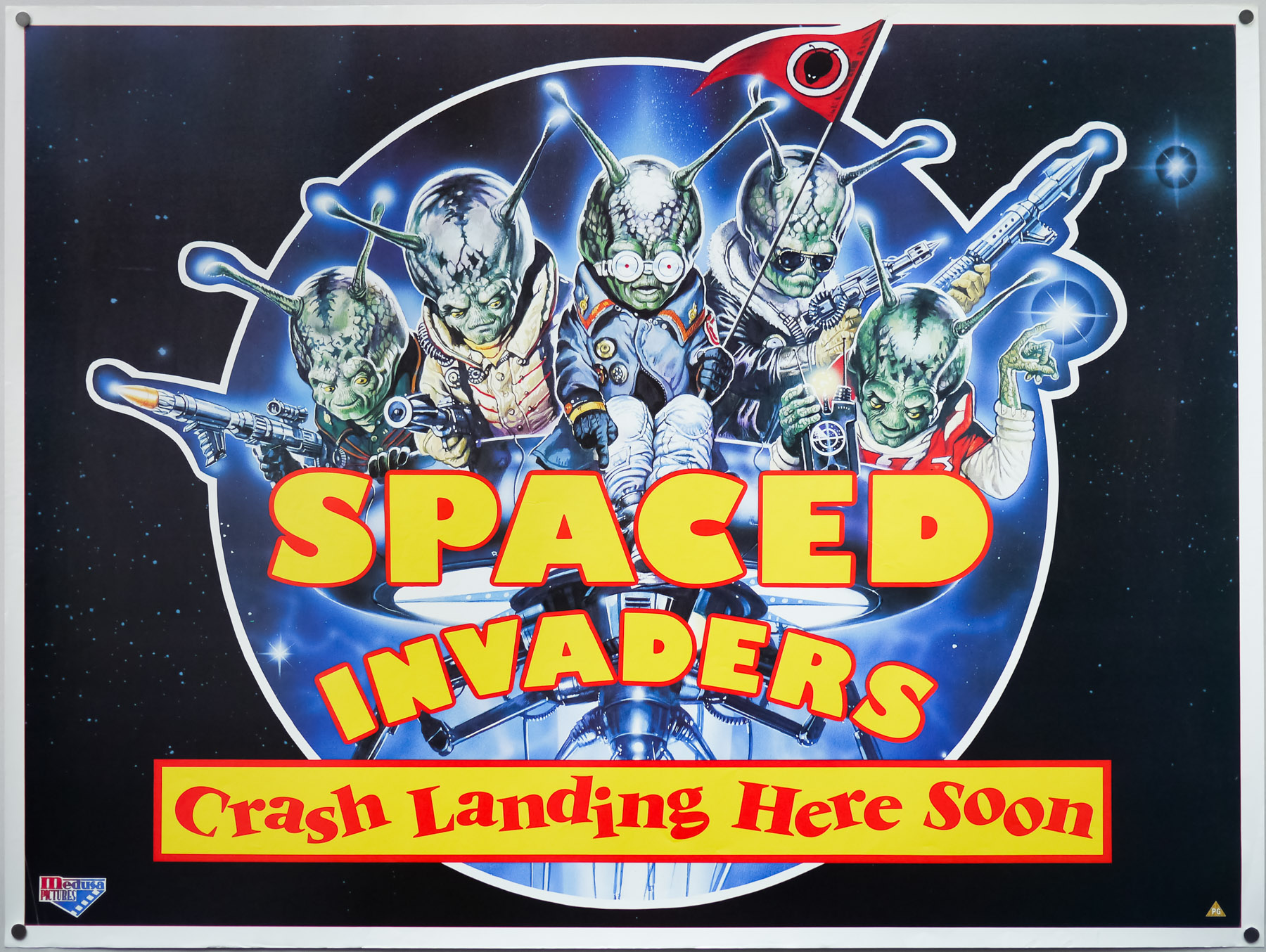
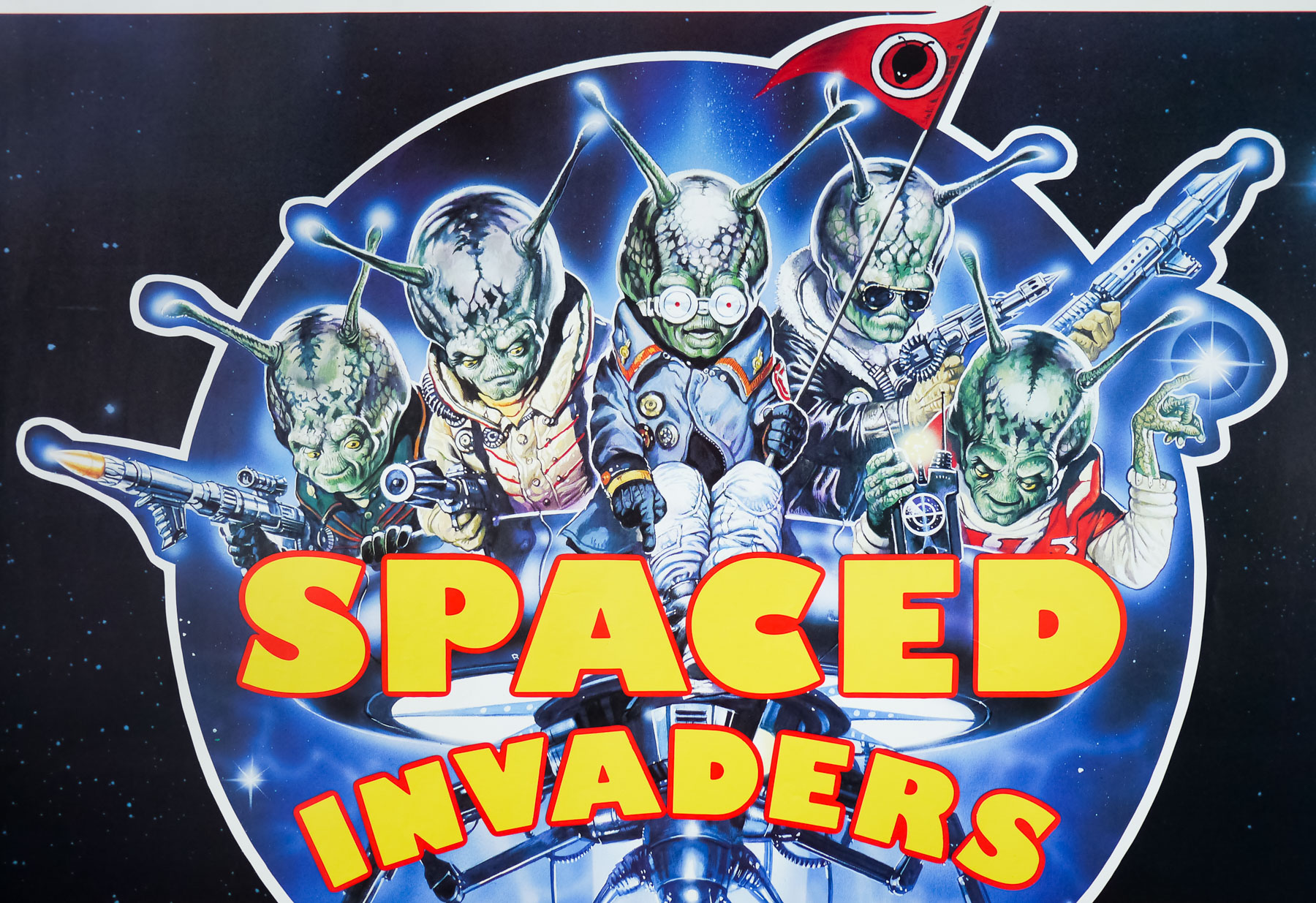
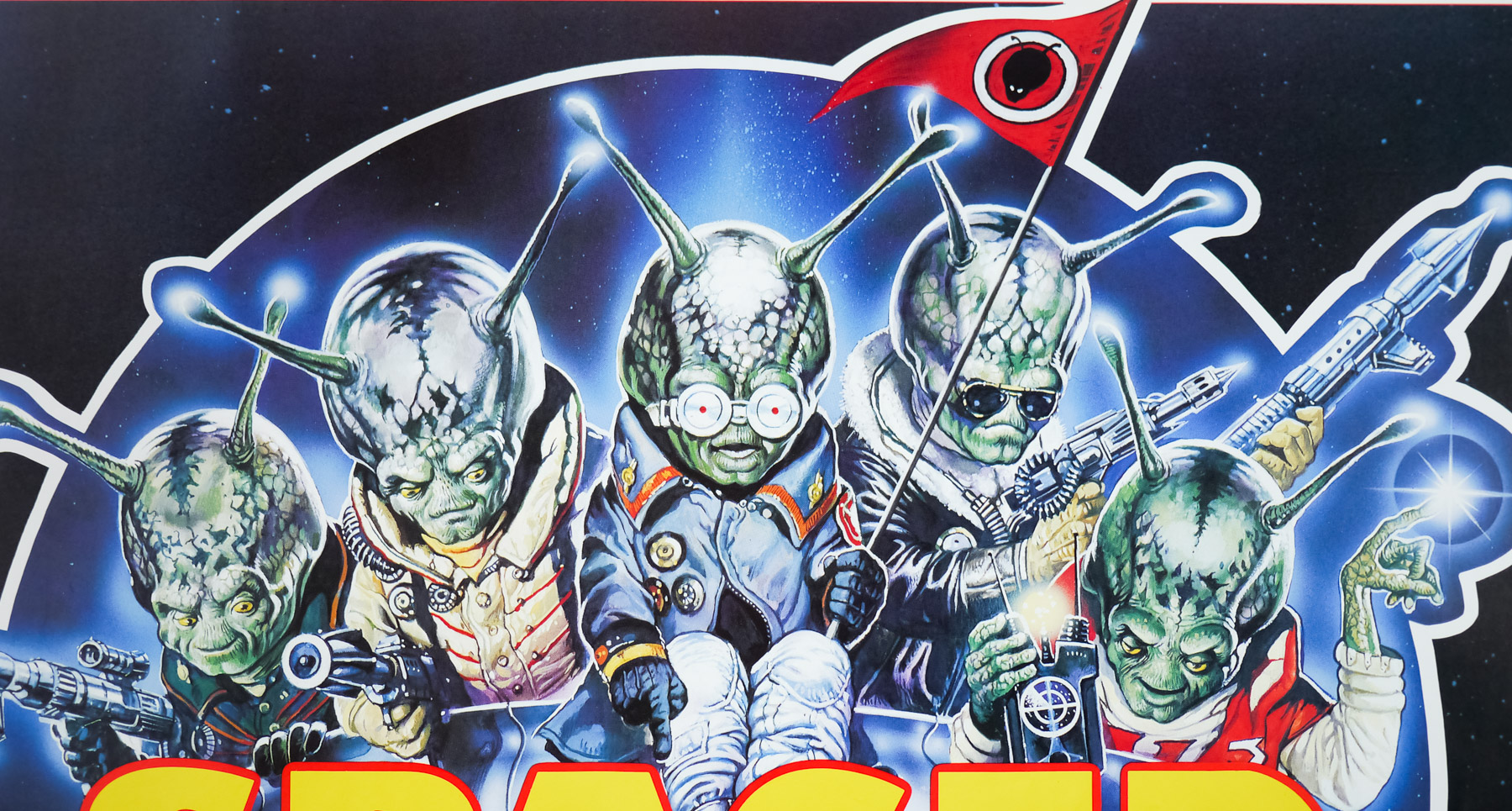
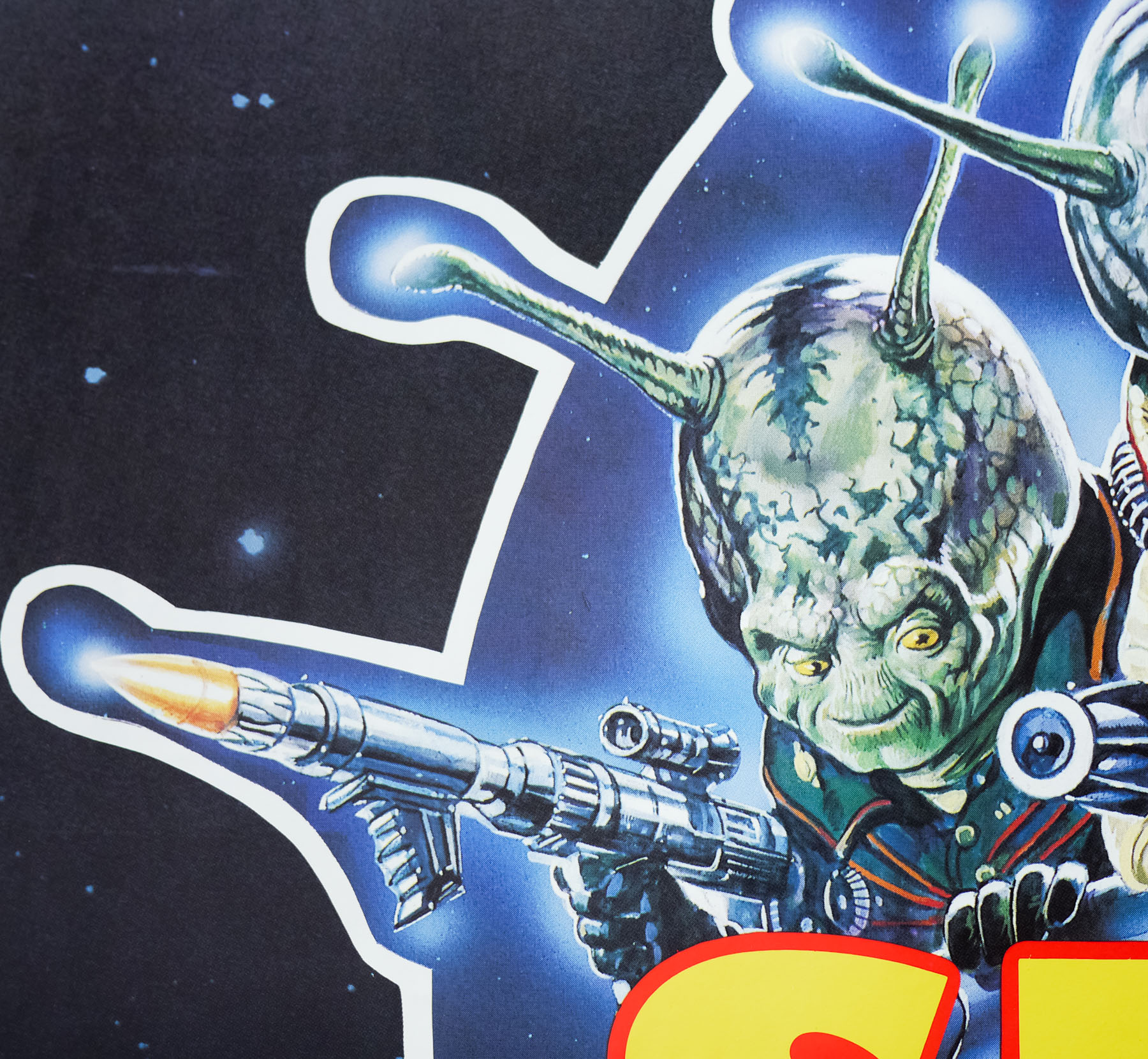
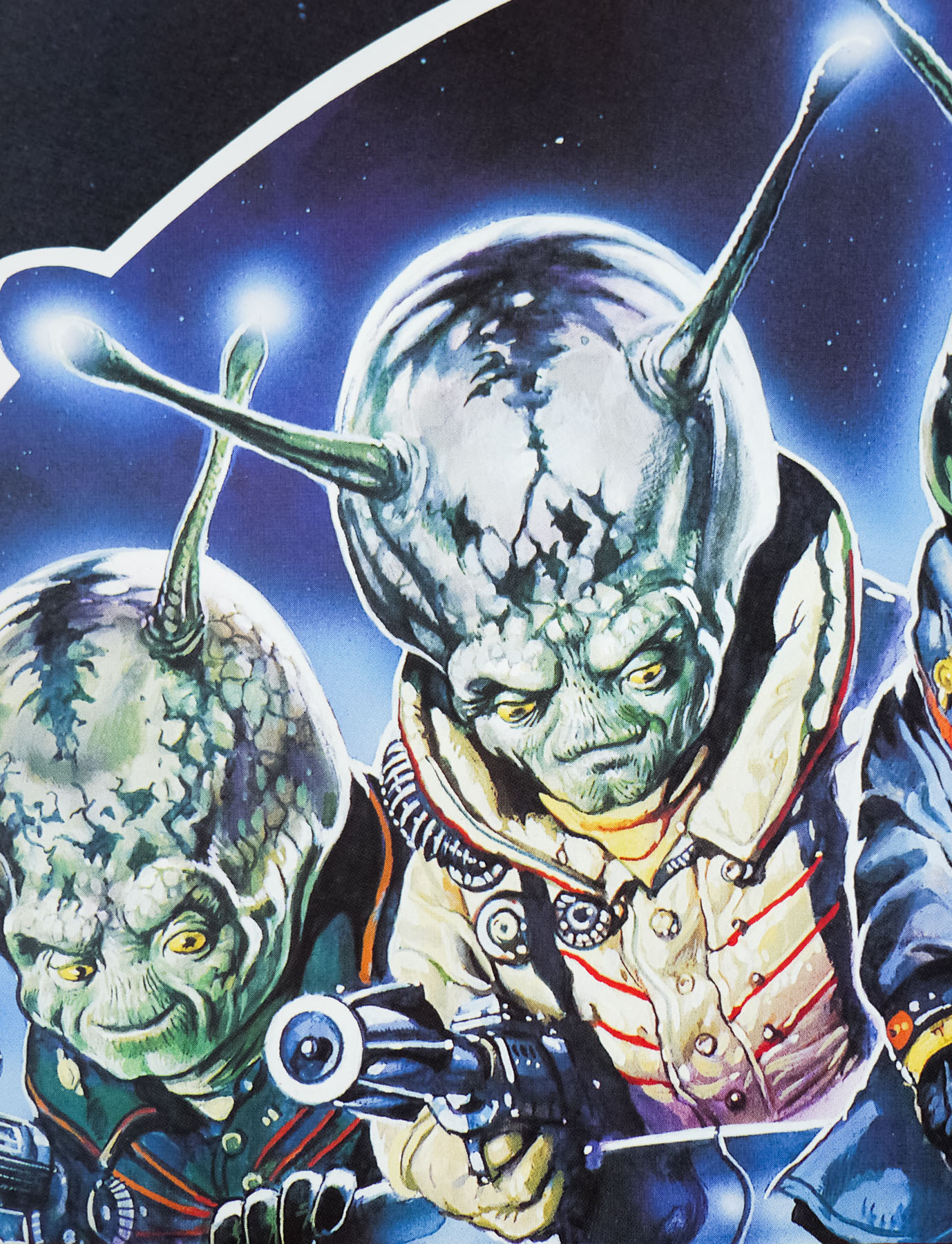
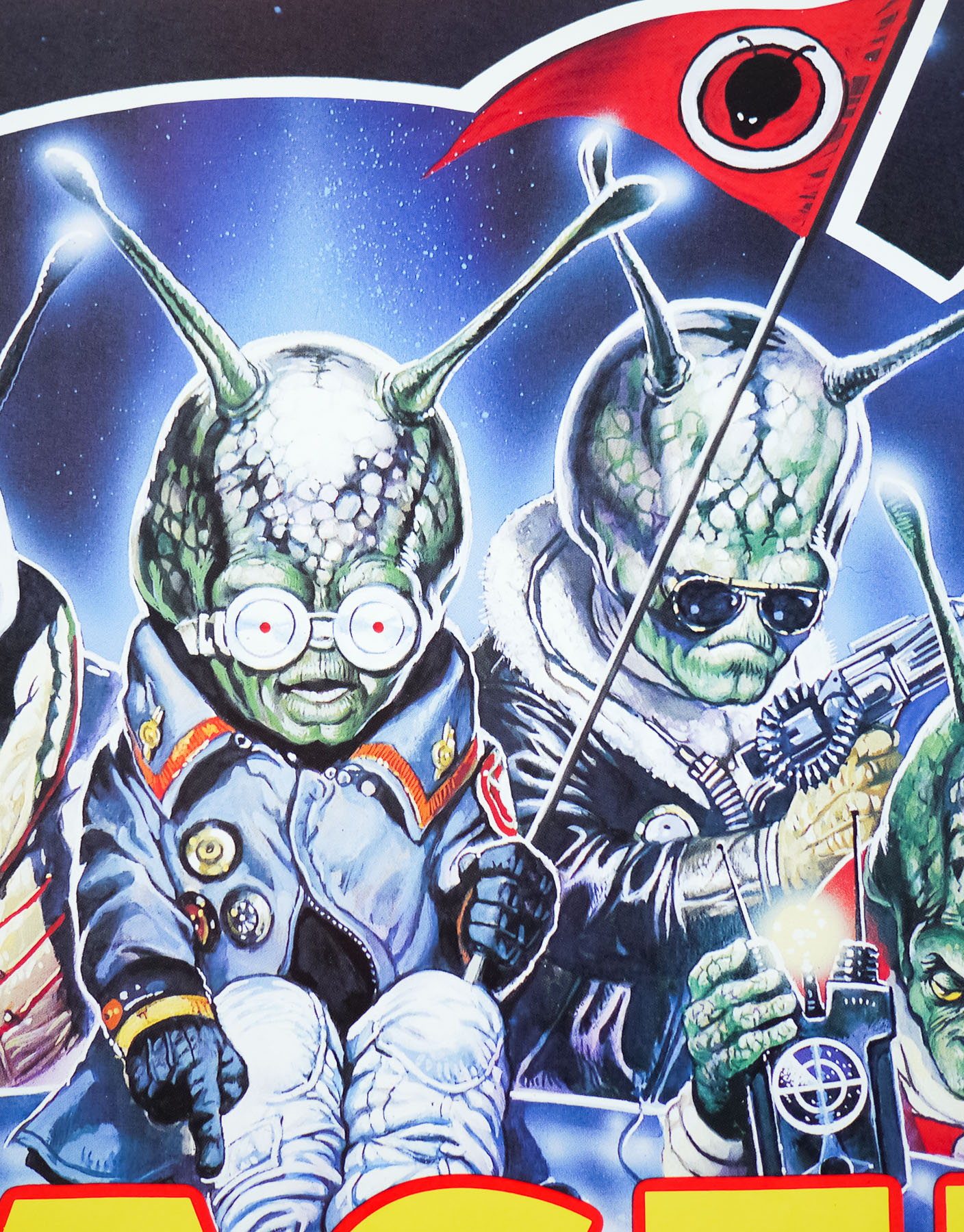
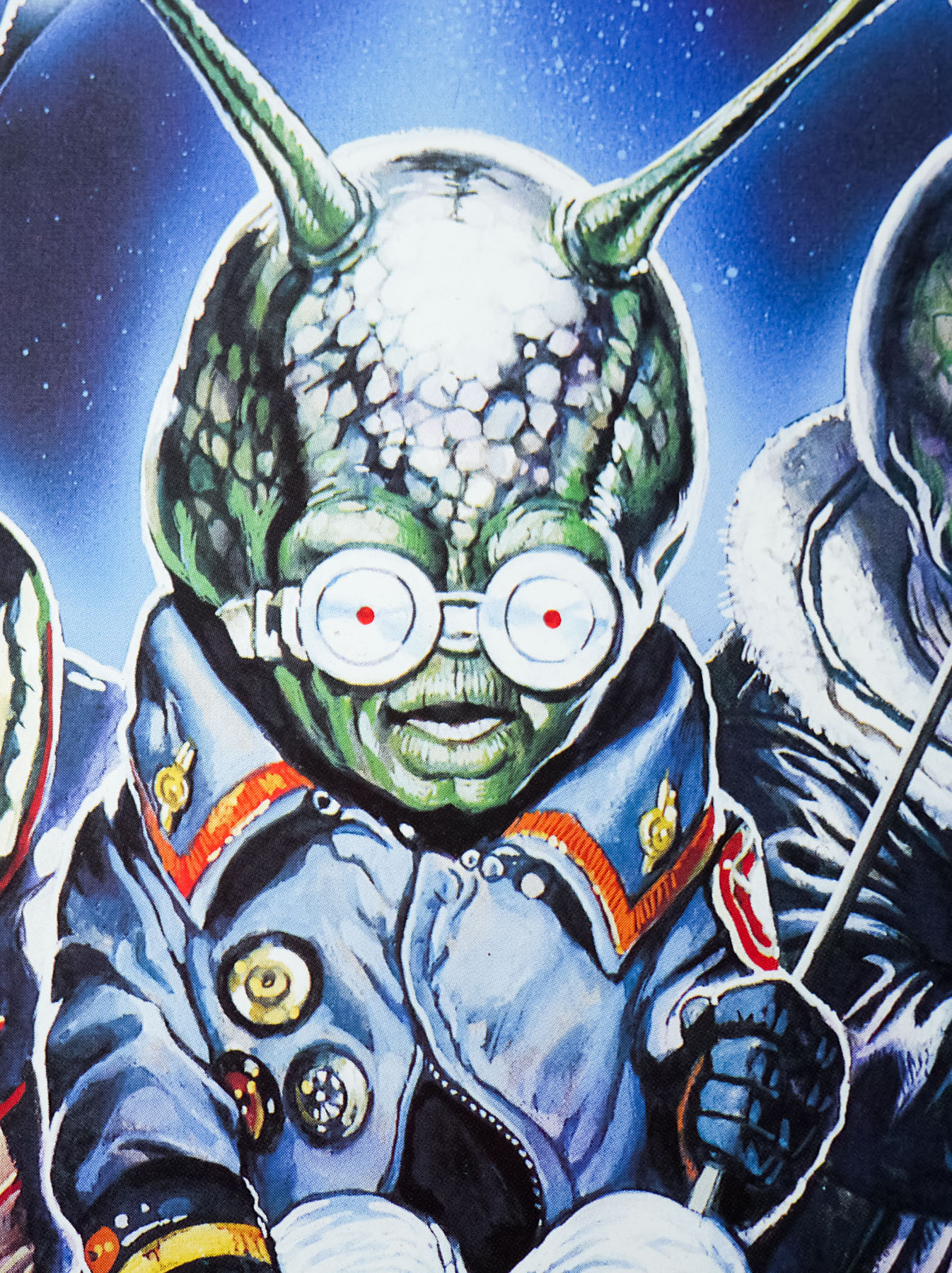
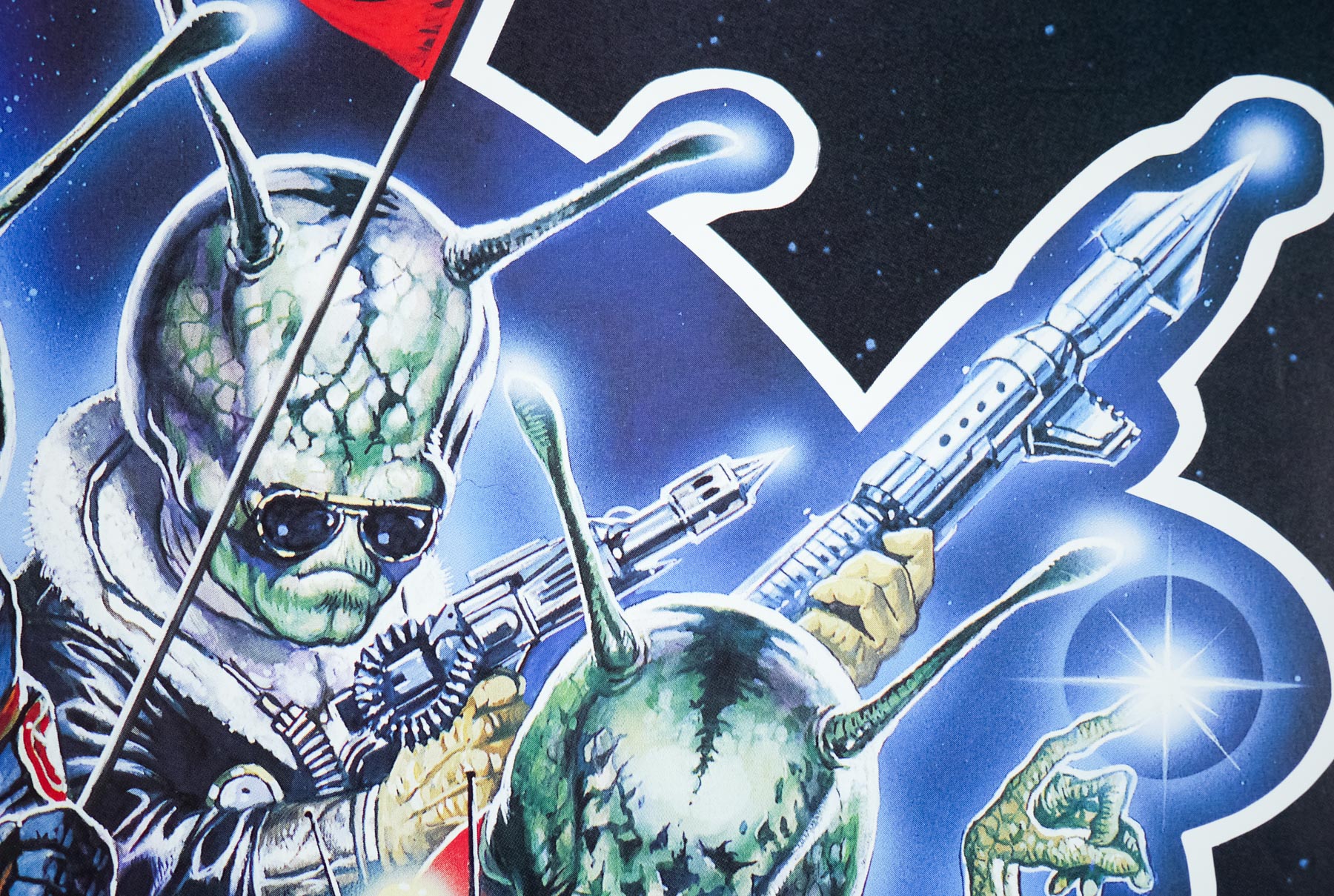
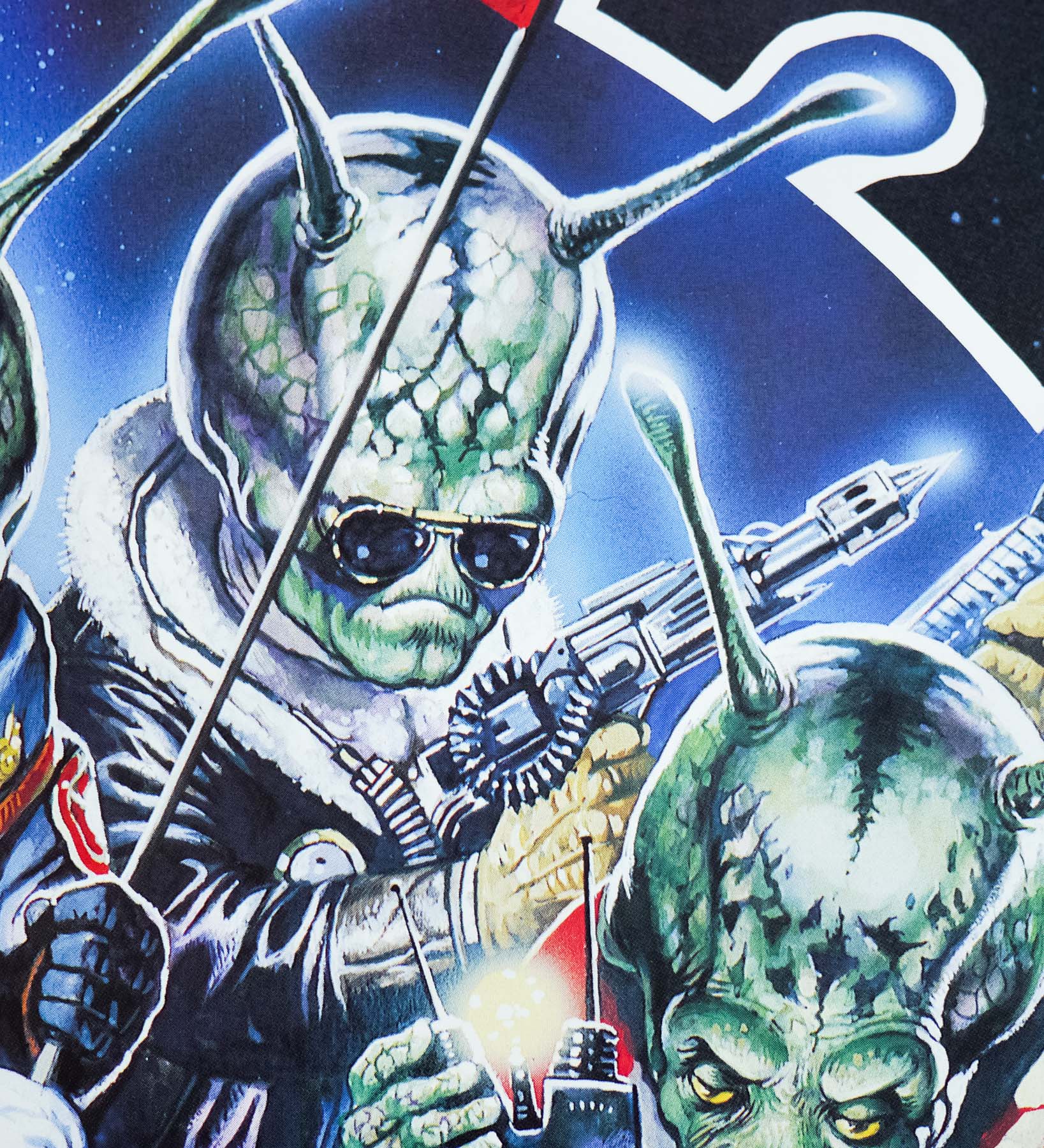
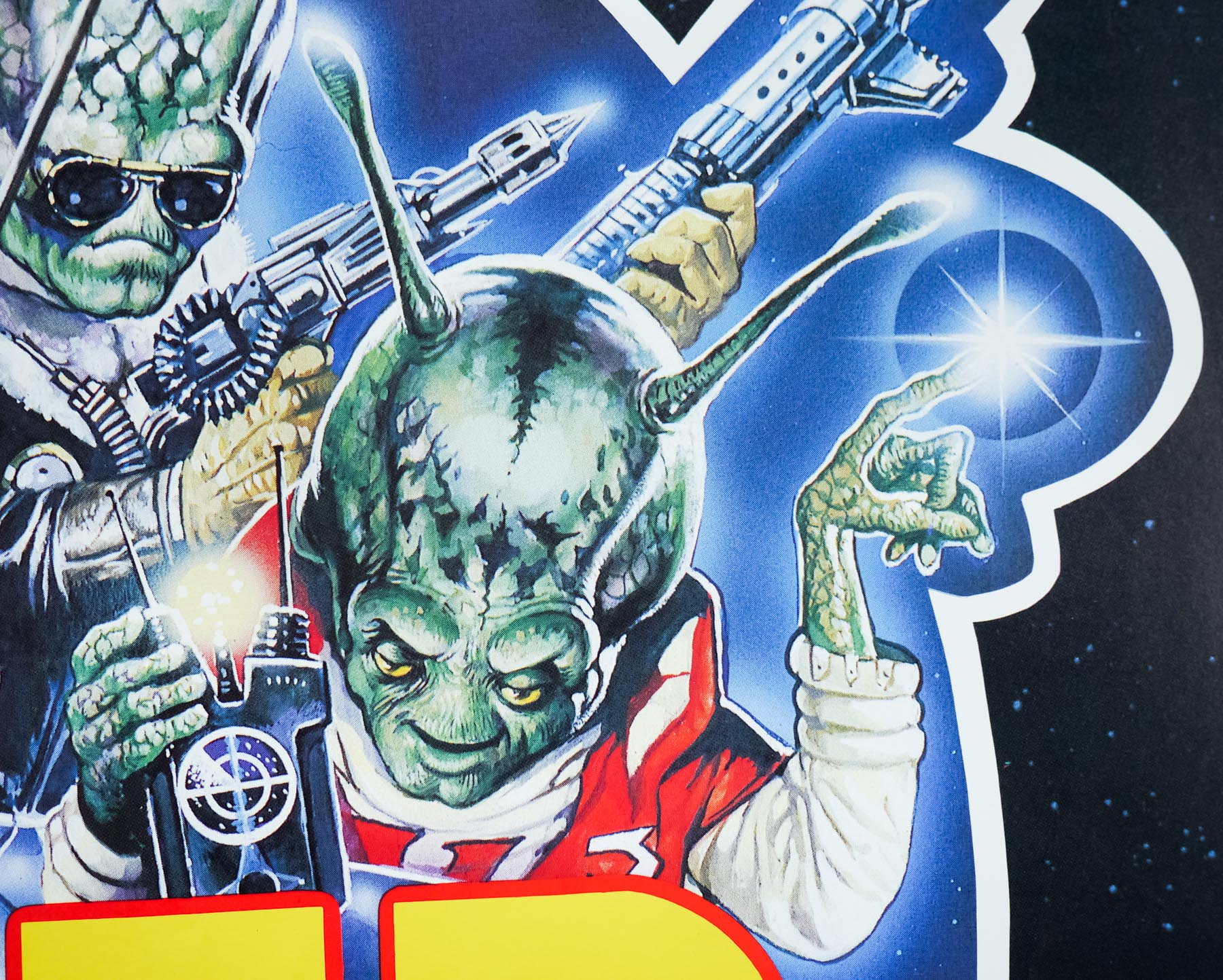
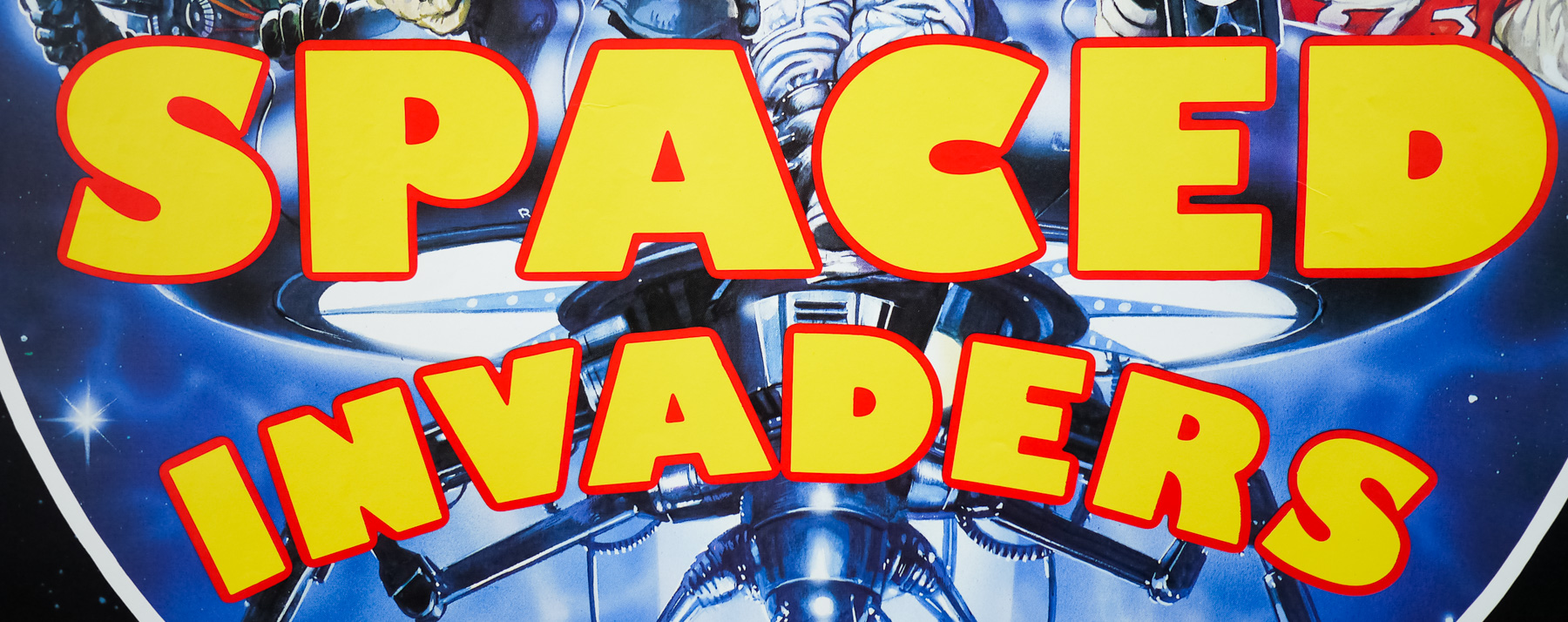
Colourful artwork by the artist Renato Casaro features on this UK quad for the release of the 1990 sci-fi comedy Spaced Invaders. It was one of a number of kid-friendly sci-fi films made in the wake of the release of Spielberg’s E.T. the Extra Terrestrial, such as ‘Flight of the Navigator’ and ‘Mac and Me’. The film was the directorial debut of Patrick Read Johnson who would later direct Baby’s Day Out (1994) and Angus (1995), as well as provide the story for the Sean Connery-starring fantasy Dragonheart.

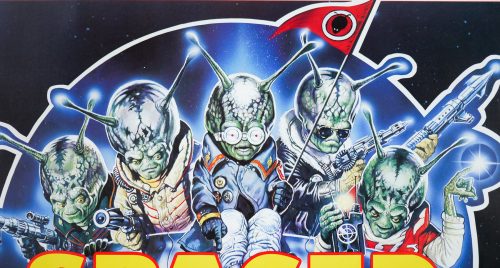
The wafer thin plot sees a spaceship full of diminutive Martians, who all inexplicably speak English in a variety of ‘hilarious’ accents and dress like characters from distinct human tropes (nerd, jock, fighter pilot), mistakenly head to earth after they intercept a small-town radio station’s transmission of Orson Welles’ famous War of the Worlds radio play. After they crash land in a barn the bumbling crew declare their intention to be the advance attack party of the Martian fleet. Unfortunately they’ve timed their attack with Halloween and are instantly mistaken for children in trick or treat costumes.

Despite their attempts to be taken seriously, they fail to intimidate the local populace. Two children, Kathy (Ariana Richards of Jurassic Park fame) and Brian (J.J. Anderson) realise that they really are Martian invaders. After initially attempting to expose them to the other townspeople, the pair soon realise the Martians need help to escape from the commands of the enforcer droid that traveled to Earth with them. The film just about hangs together but the genuine laughs are few and far between and the ‘wacky’ Martians quickly begin to grate. The special effects and production design are at least decent enough for the time, but it’s a largely forgettable affair.

One of my favourite artists, Renato Casaro is an Italian with a prolific movie poster output that lasted over 35 years. He began his career in 1953, aged 19, at the famous Studio Favalli in Rome and would go on to design and paint posters for many of the biggest directors in the world. His skill at accurately portraying actors and his brilliant use of colour and composition saw him much in demand from studios and actors alike. His artwork has featured on posters used in multiple countries, including Japan, Germany, USA as well as in his native Italy.

Check out the incredible amount of work on his official website here, which also features a biography of the artist. In March 2014 I published an exclusive interview with Renato and it can be read by clicking here. The other posters I’ve collected by Renato Casaro are here.

Note that Casaro’s signature is just visible under the ‘A’ of Spaced – only the R of ‘R. Casaro’ can be seen.

Naked Lunch / quad / UK

22.06.17

Poster Poster
Title
Naked Lunch
AKA
Hadaka no lunch (Japan)
Year of Film
1991
Director
David Cronenberg
Starring
Peter Weller, Judy Davis, Ian Holm, Julian Sands, Roy Scheider, Monique Mercure, Nicholas Campbell, Michael Zelniker
Origin of Film
Canada | UK | Japan
Genre(s) of Film
Peter Weller, Judy Davis, Ian Holm, Julian Sands, Roy Scheider, Monique Mercure, Nicholas Campbell, Michael Zelniker,
Type of Poster
Quad
Style of Poster
--
Origin of Poster
UK
Year of Poster
1991
Designer
Unknown
Artist
--
Size (inches)
30 1/16" x 40"
SS or DS
SS
NSS #
--
Tagline
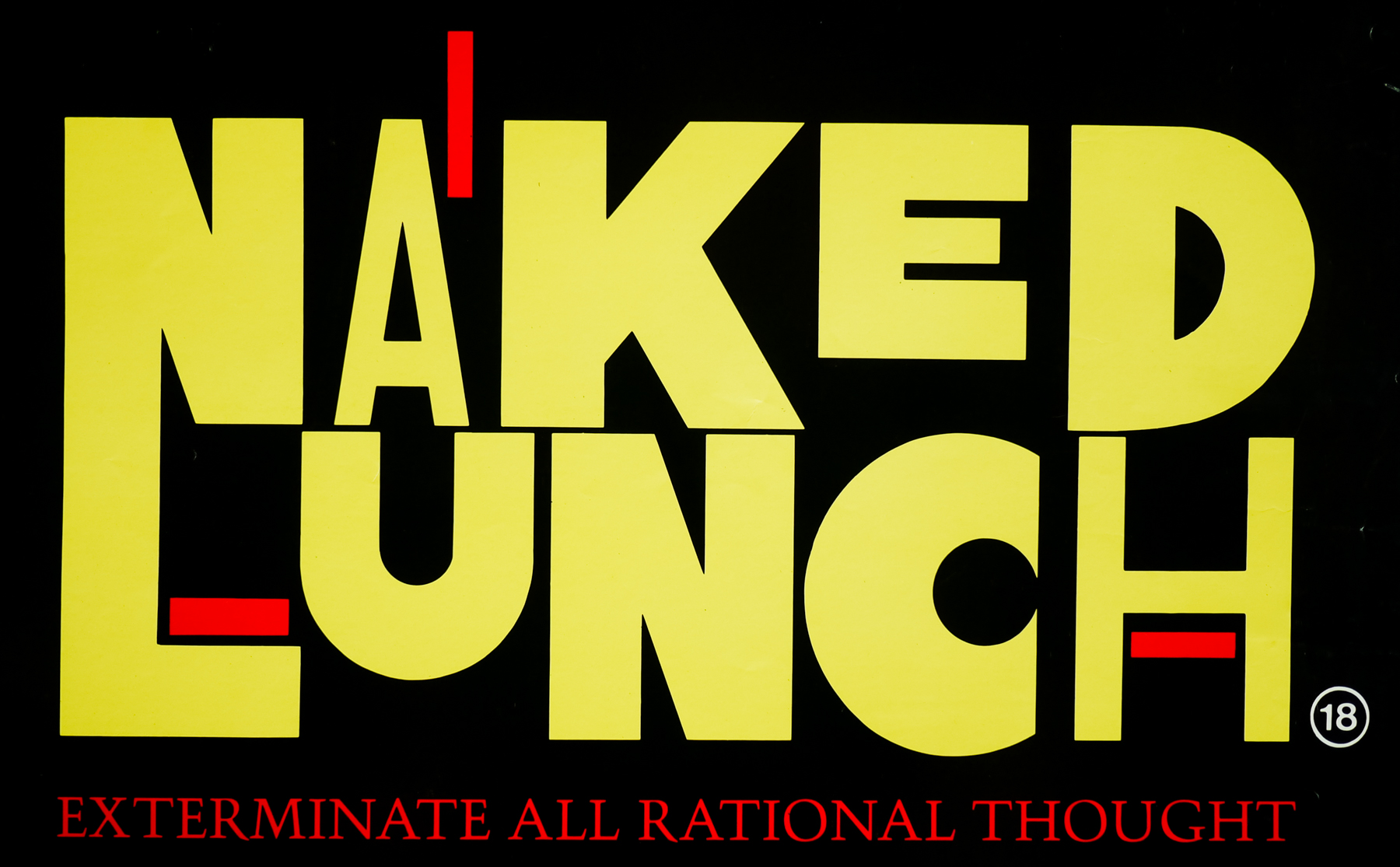
Exterminate all rational thought

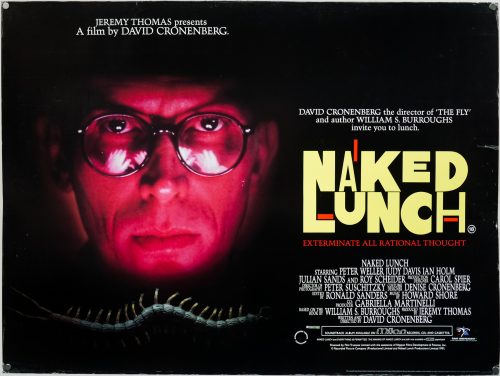
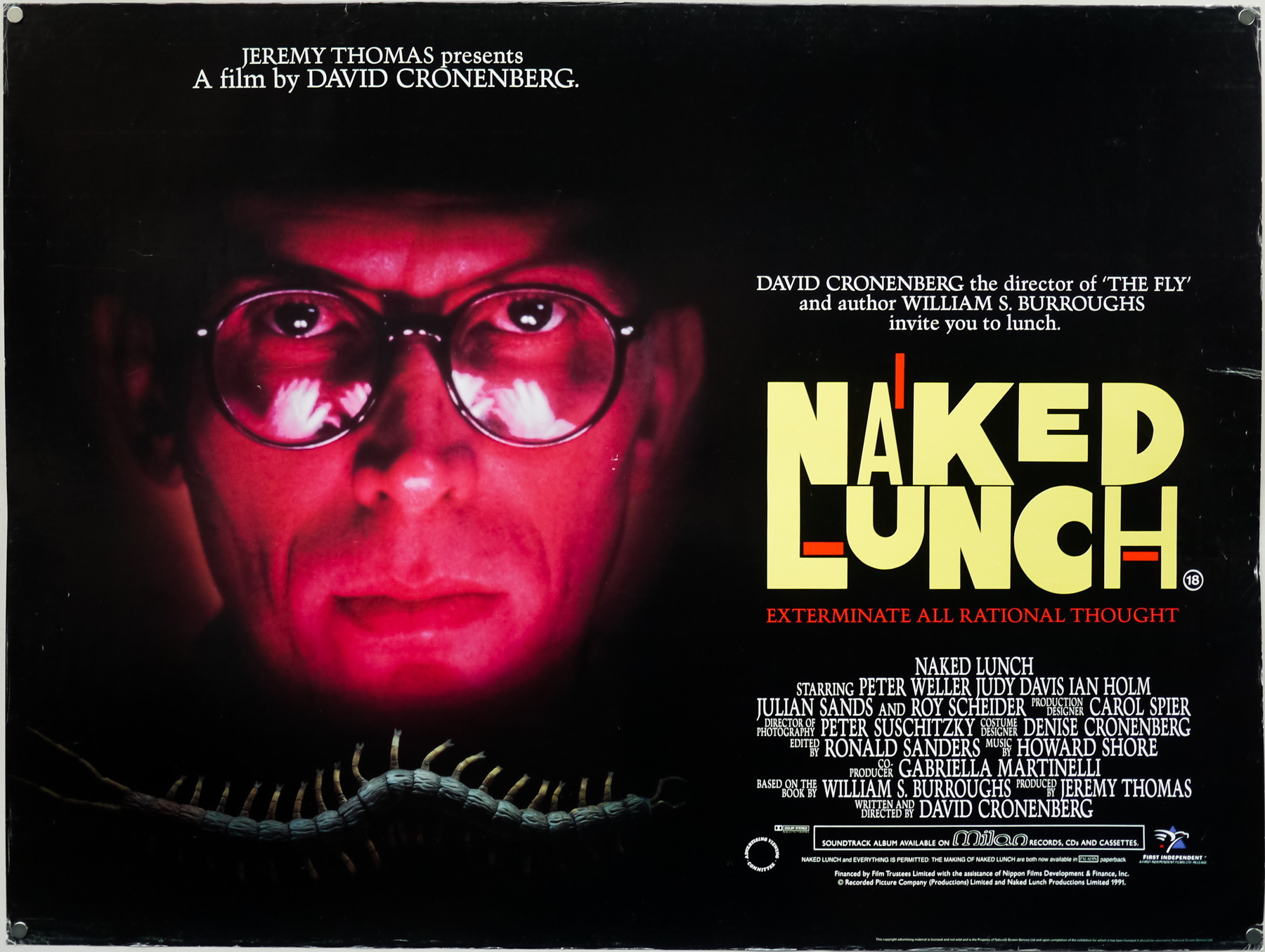
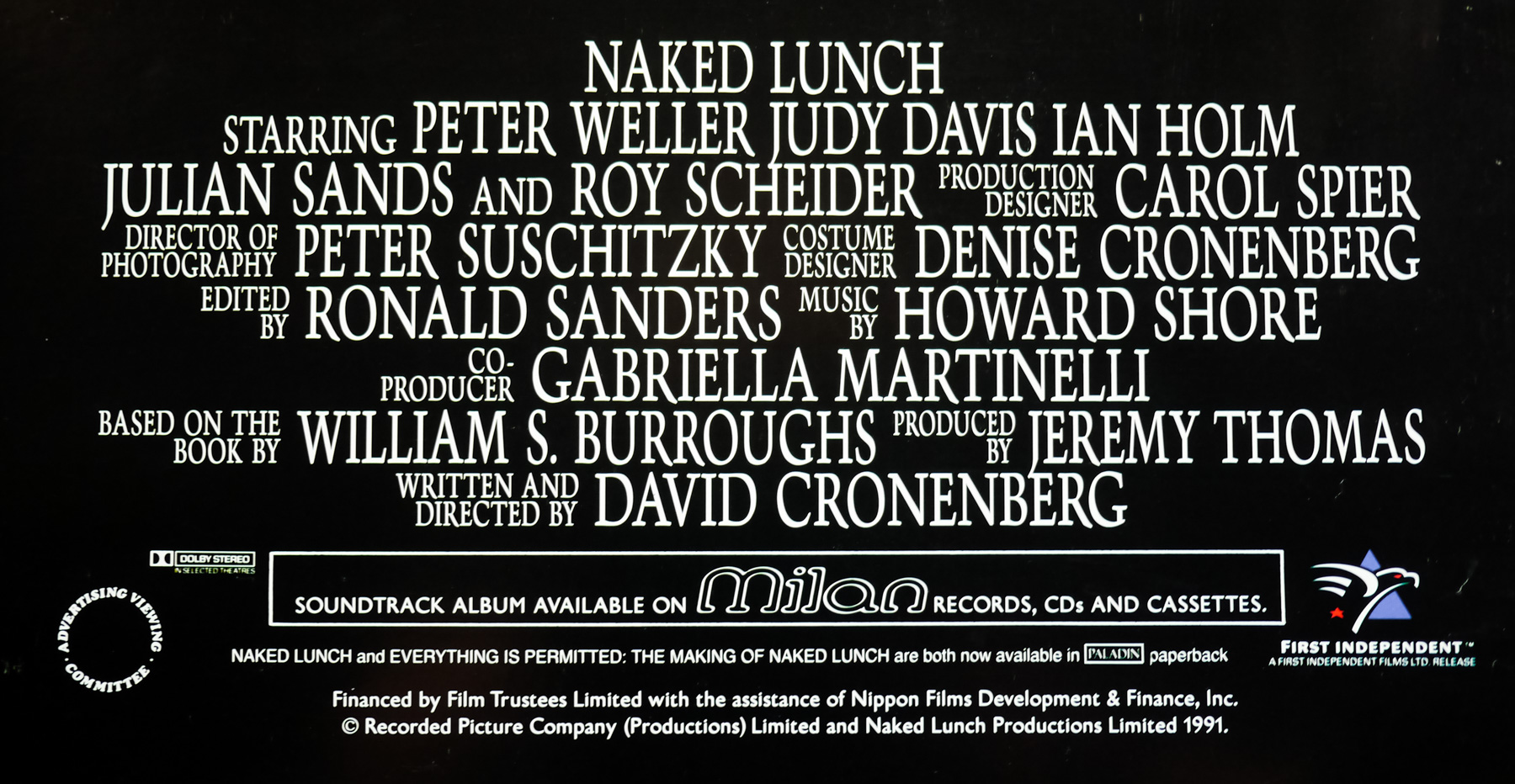
Naked Lunch is cult Canadian director David Cronenberg‘s semi-adaptation of the celebrated American writer William S. Burroughsnovel of the same name. The book, which is a collection of vignettes with little in the way of connecting narrative, was written in 1959 and several attempts had been made over the years to try and adapt it for the screen. The structure of the book meant crafting a coherent plot was a tall order for any screenwriter, so Cronenberg decided to try a slightly different approach. The resultant film features scenes and characters from the vignettes but blends them with a semi-biographical look at the process Burroughs went through to write the original book, and includes incidents and characters (albeit renamed) from his experiences during the Beat Generation literary movement of the 1950s.

The resultant film, despite having more of a connecting narrative, is no less batshit crazy for it. Peter Weller plays Burroughs as William Lee (a sometime pen name of the author) who is working as a bug exterminator and whose wife Joan Lee (Judy Davis) has become addicted to the powder he uses to kill the critters. He is also a heroin addict and is arrested by the police for possession. Whilst in custody he begins to hallucinate and sees a giant bug who tells him he is being recruited as a secret agent and that his mission is to kill Joan who may or not be a shape-shifting agent working for a shady organisation. Disbelieving, he smashes the bug and escapes from custody, returning home to find Joan having sex with one of his friends. Soon afterwards he accidentally kills Joan by shooting her in the head after attempting to shoot a glass off her head, William Tell-style (this mirrors a real incident in which Burroughs killed his then partner Joan Vollmer in Mexico).

On the run from the police, he’s introduced to a bipedal alien called a Mugwump in a bar who gives him a travel ticket to get to Interzone (an area of a North African country) where he can lie low and carry out missions for his ‘handlers’. There he meets a whole host of odd characters, including Tom Frost (Ian Holm) and his wife Joan who bears a striking relation to his deceased wife. He continues to write reports for his imaginary handlers, with his typewriter soon morphing into another talking bug. Things continue to get progressively weirder as he is told to search out the mysterious Dr Benway, the source of a drug that is swamping the Interzone.

The above description makes the film sound vaguely conventional when it is anything but and there’s no doubt that it’s a marmite film for many who watch it. The film had a botched release in North America which saw it only recouping a small percentage of its original budget due to a limited number of screenings. Nevertheless it was largely lauded by critics and has since garnered something of a cult following.

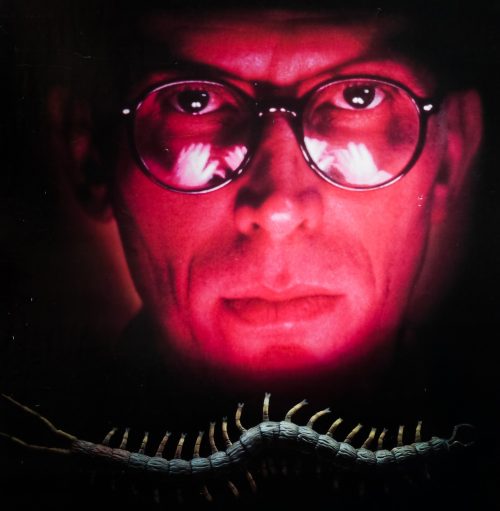
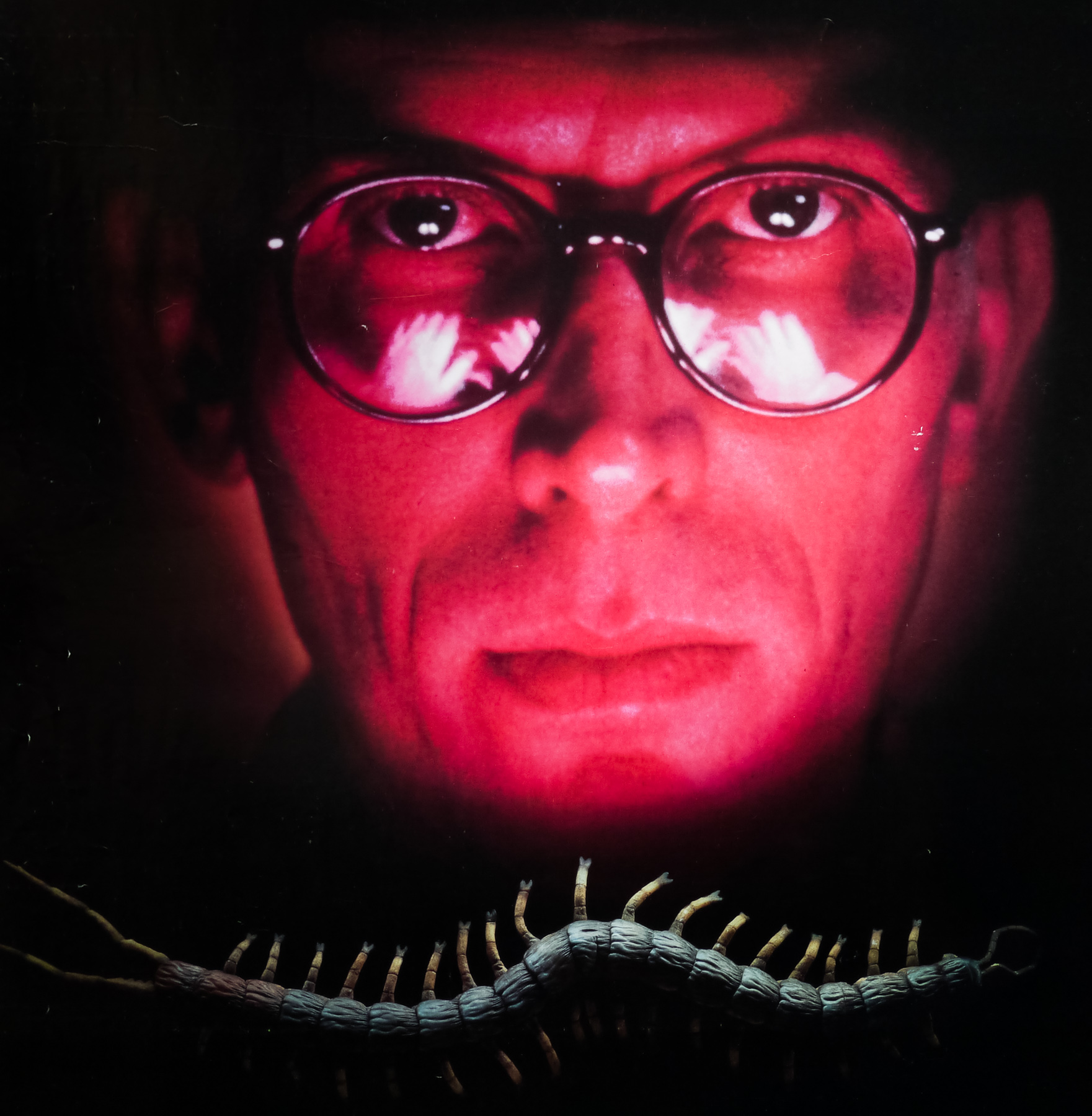
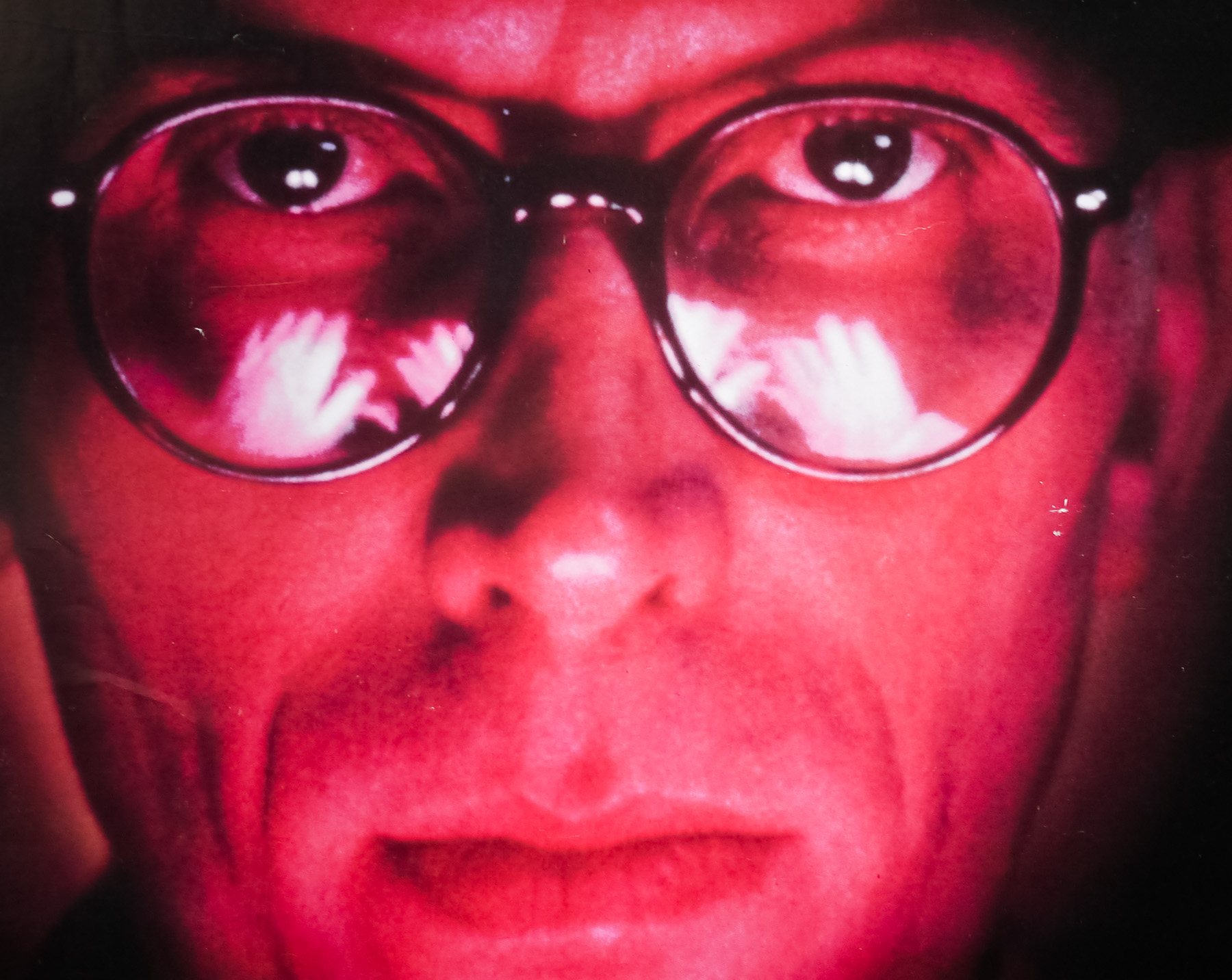
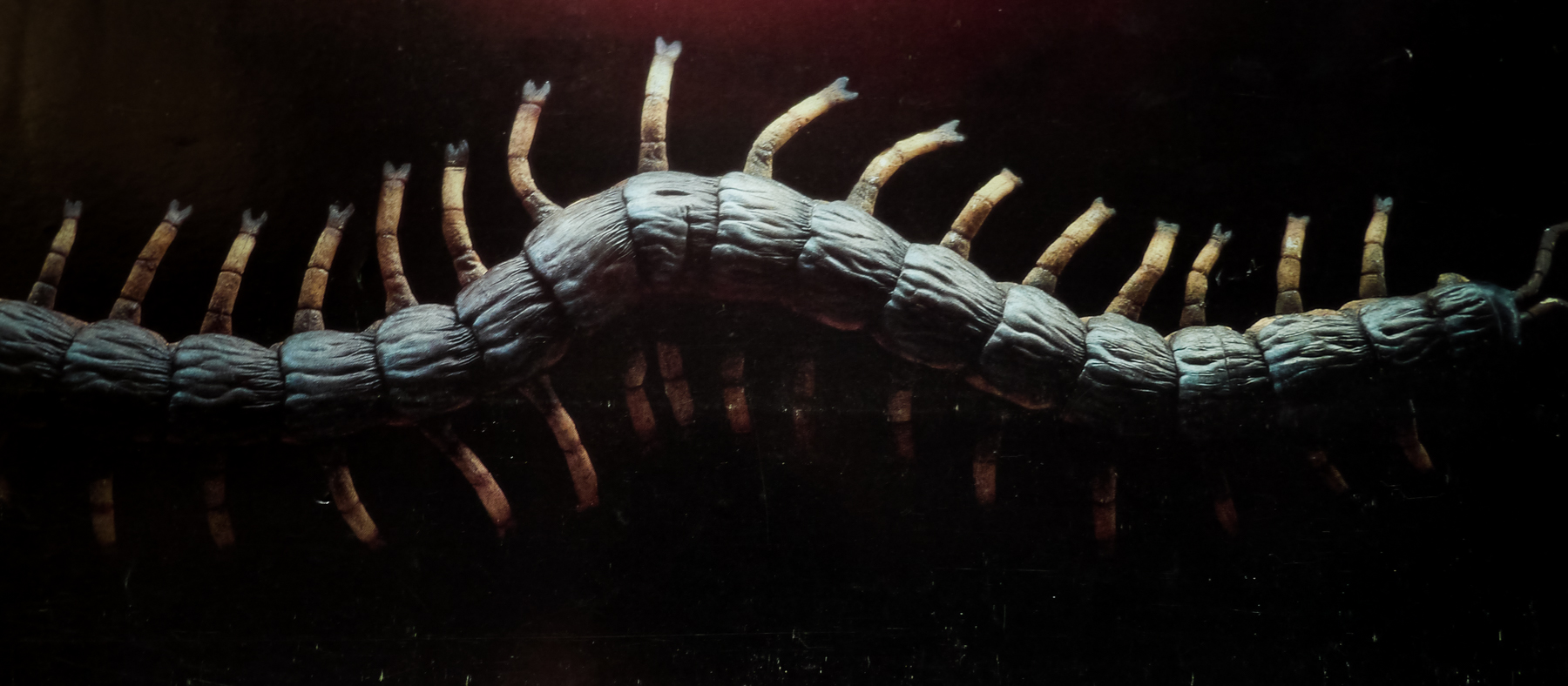
This British quad features a unique design that includes a close-up photograph of Weller’s William Lee above a centipede. The film had a range of poster designs across the globe, with little repetition in the designs. The US one sheet is memorable but by far my favourite is the incredible Japanese ‘bug’-style poster that features a freaky illustration by H Sorayama.

I Bought a Vampire Motorcycle / quad / UK

31.07.17

Poster Poster
Title
I Bought a Vampire Motorcycle
AKA
Iron Thunder (Germany)
Year of Film
1990
Director
Dirk Campbell
Starring
Neil Morrissey, Amanda Noar, Michael Elphick, Anthony Daniels, Andrew Powell, George Rossi, Daniel Peacock, Midge Taylor, David Daker, Burt Kwouk, Brendan Donnison
Origin of Film
UK
Genre(s) of Film
Neil Morrissey, Amanda Noar, Michael Elphick, Anthony Daniels, Andrew Powell, George Rossi, Daniel Peacock, Midge Taylor, David Daker, Burt Kwouk, Brendan Donnison,
Type of Poster
Quad
Style of Poster
--
Origin of Poster
UK
Year of Poster
1990
Designer
Unknown
Artist
Unknown
Size (inches)
30 1/16" x 39 15/16"
SS or DS
SS
Tagline
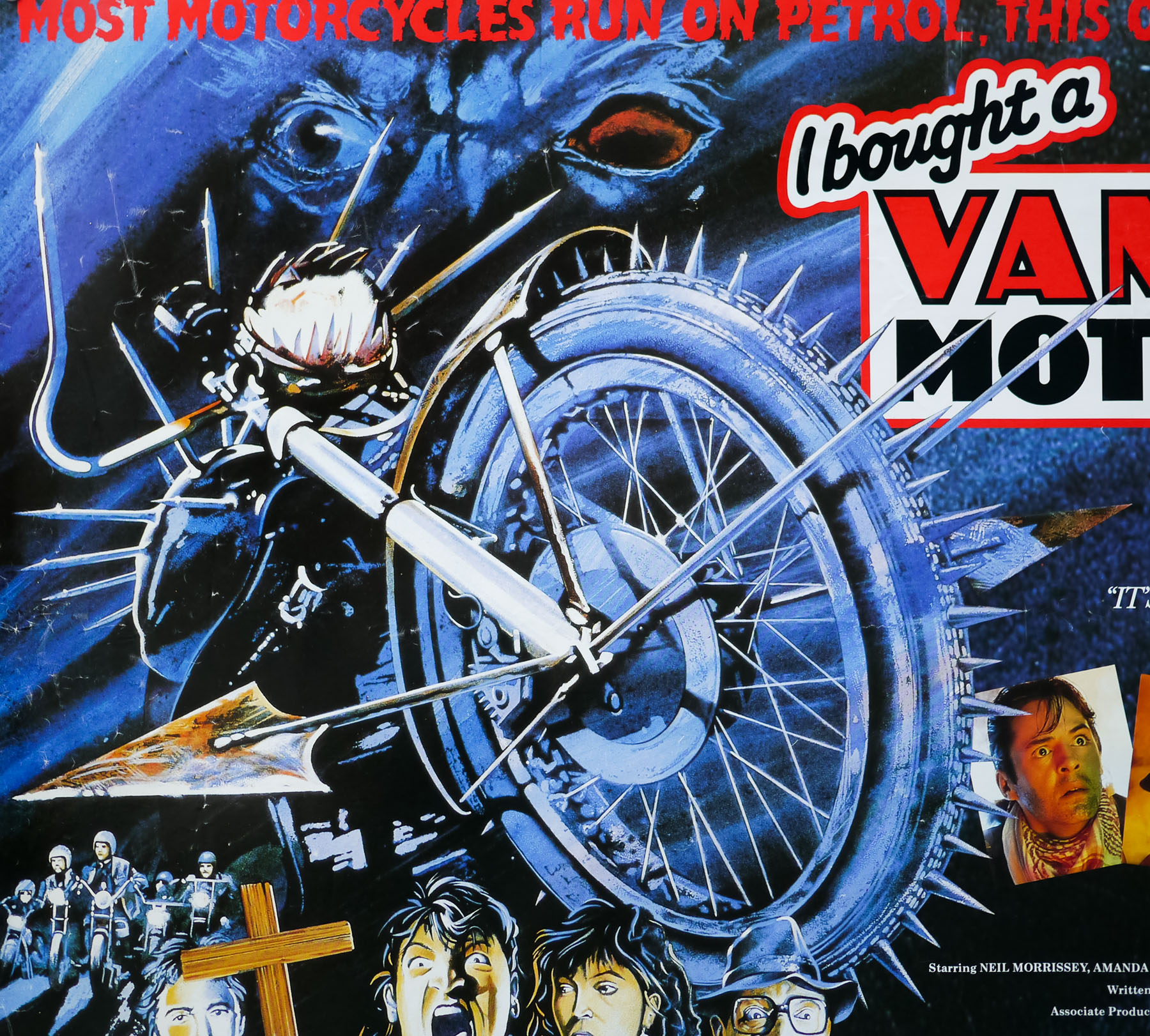
Most motorcycles run on petrol, this one runs on blood!

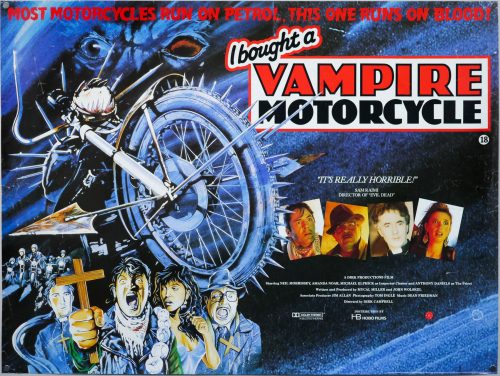
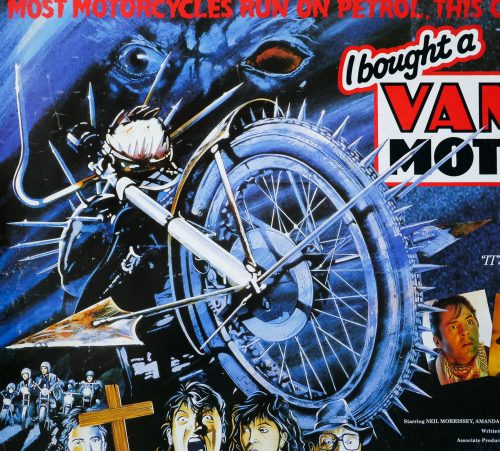
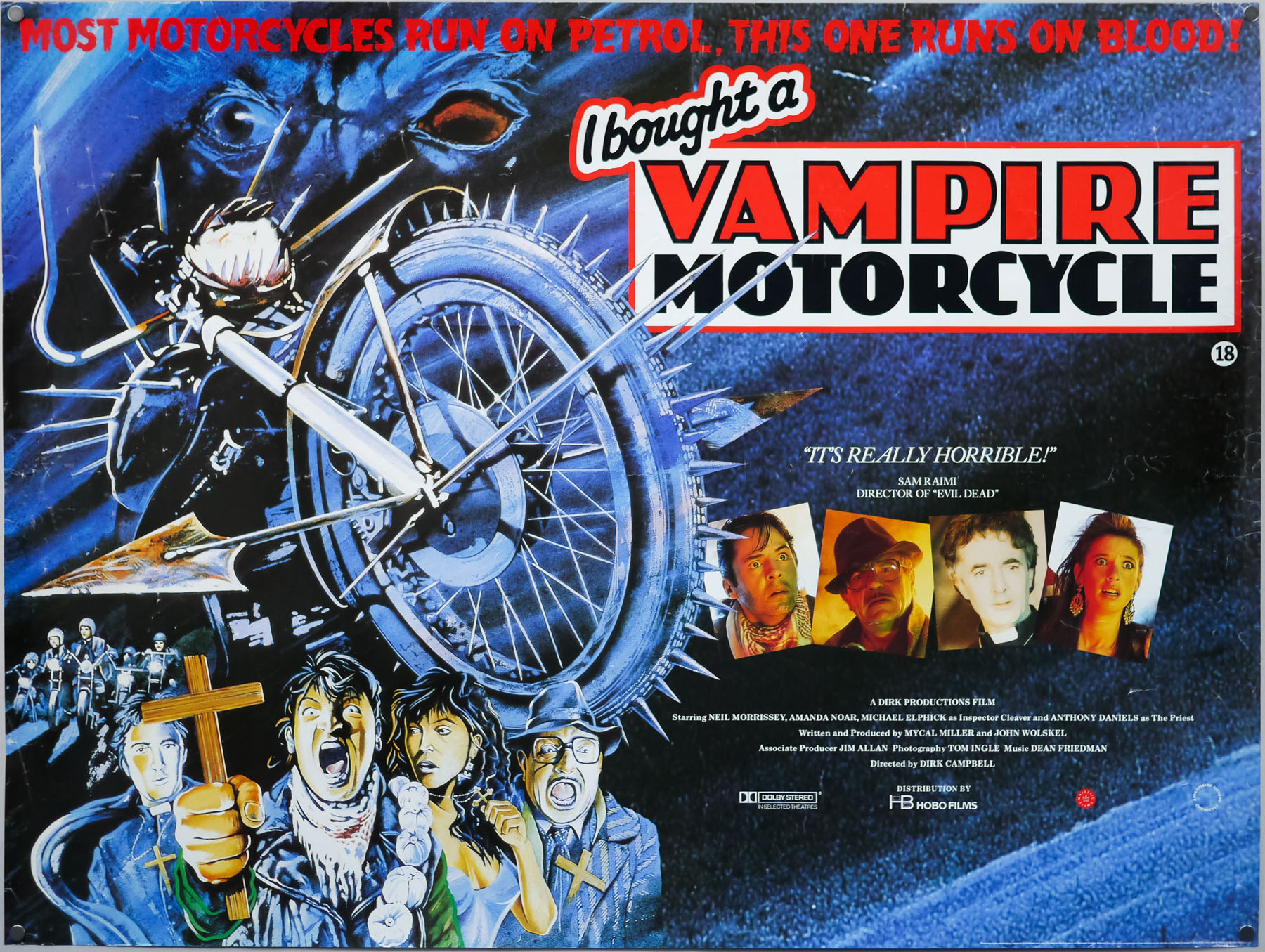
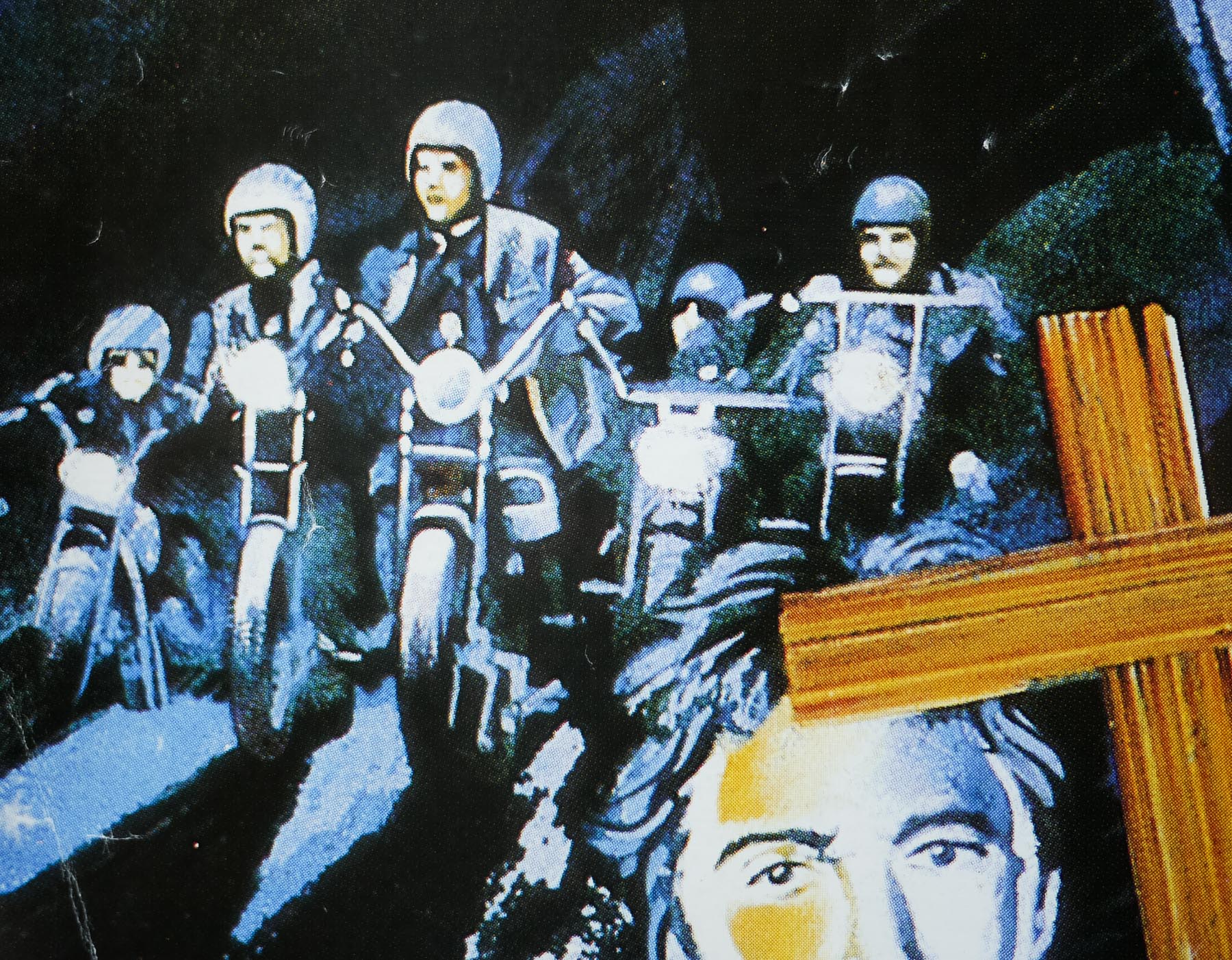
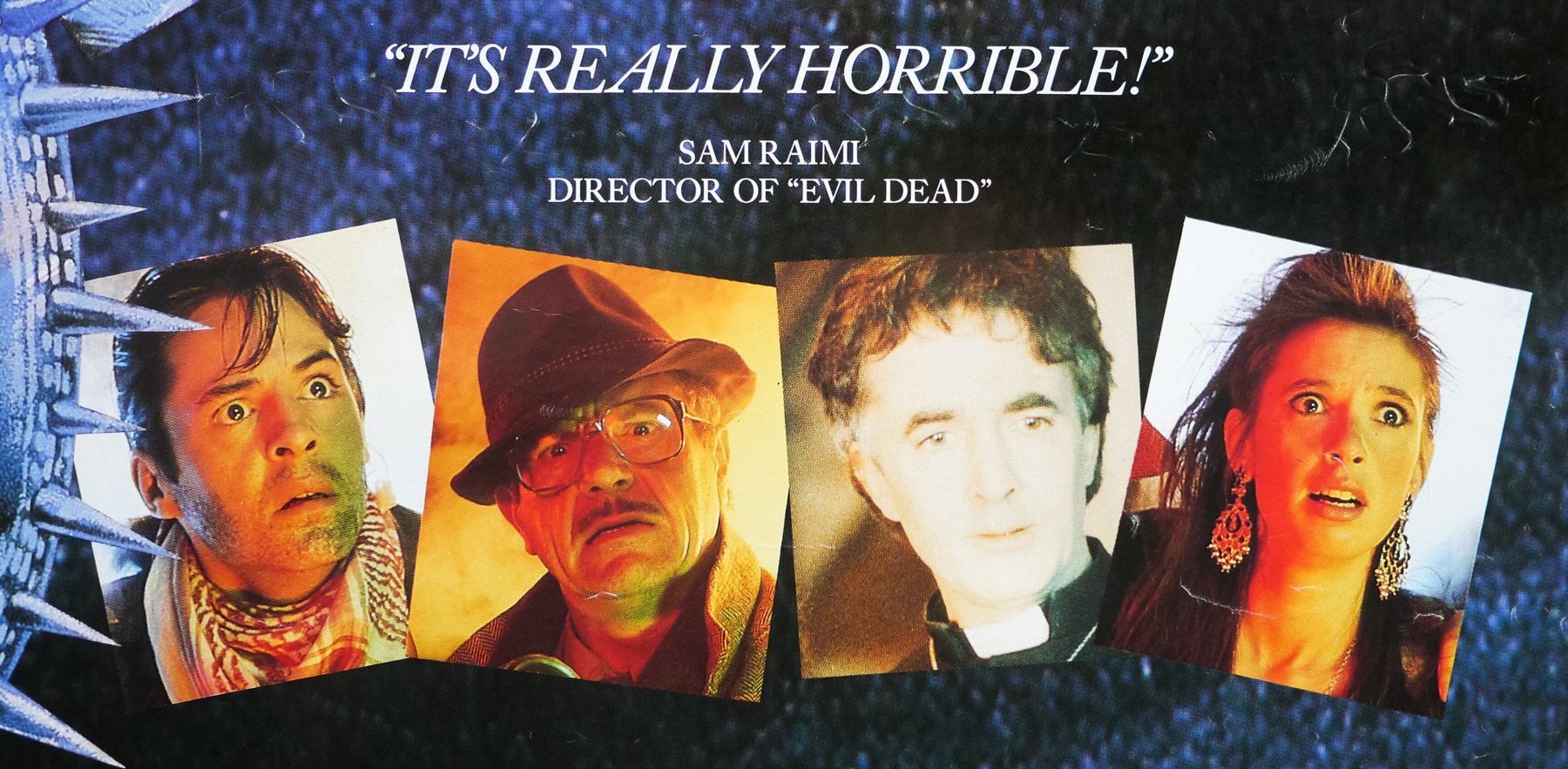
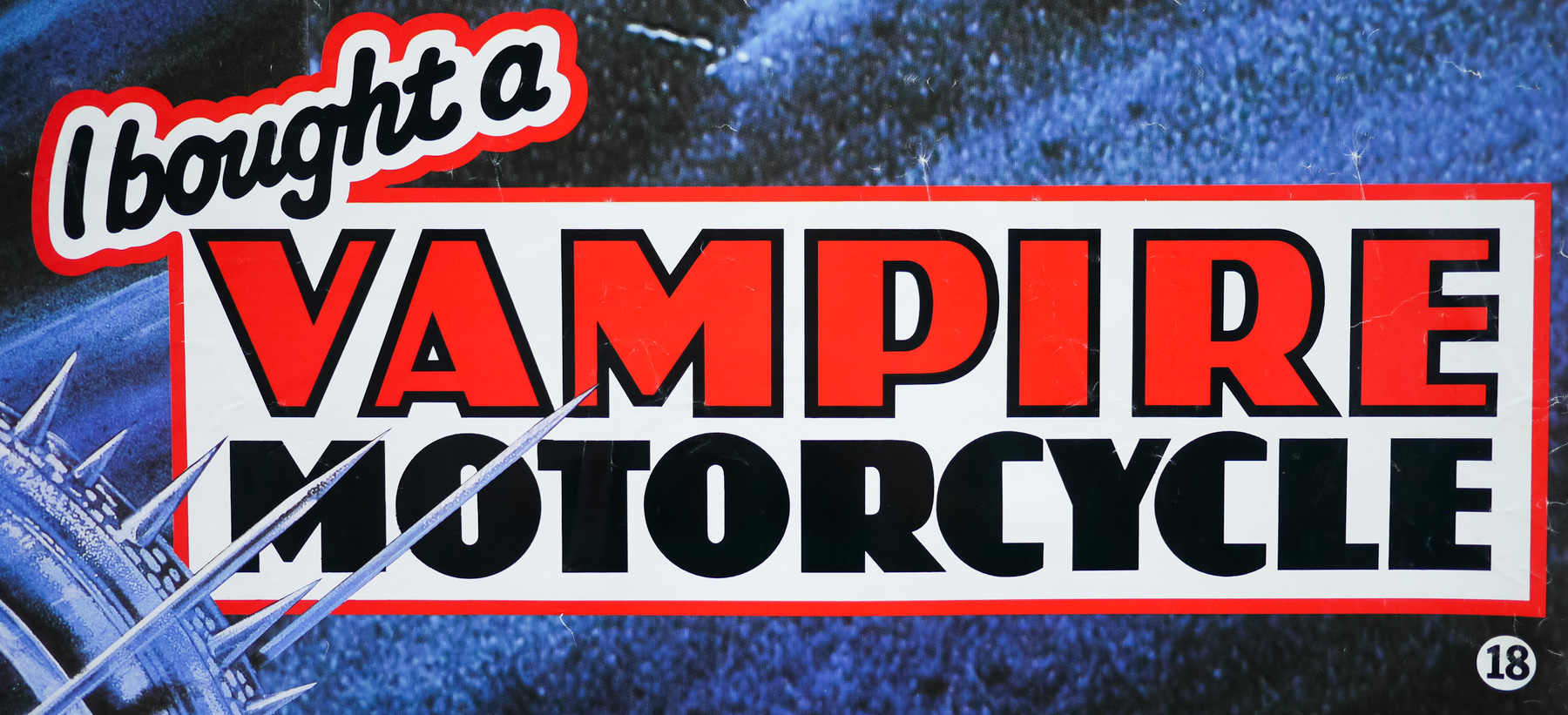
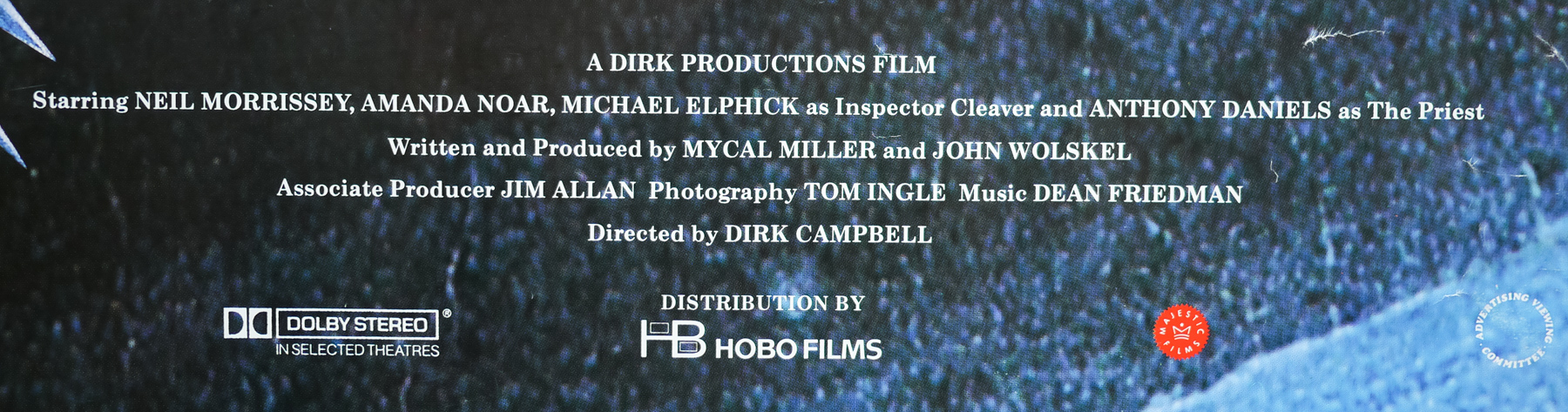
Colourful artwork features on this UK quad for the release of the 1990 ultra l0w budget horror-comedy, I Bought a Vampire Motorcycle. The film remains the sole feature film credit for the director Dirk Campbell who appears to have spent most of his career in television. The majority of the cast are also from TV backgrounds, including lead Neil Morrissey (‘Men Behaving Badly’, ‘Line of Duty’) and the late Michael Elphick. The latter is perhaps best known for playing the titular lead in Boon, which ran for 93 episodes and also starred Morrissey. The production of the film apparently utilised the sets of Boon without the TV company being aware and several other members of the cast and crew were involved.

Set in and around Birmingham, the film opens with a demonic ritual being performed by a biker gang at night. Just as the ceremony is about to be completed they are attacked and murdered by a rival gang led by Roach (Andrew Powell). During the mayhem, the demon is shown to have been summoned and it quickly enters the body of the lead occultist. After Roach’s gang have fled the scene, the demonic presence reanimates the dead body and then drips its blood into the petrol tank of the occultist’s motorbike.

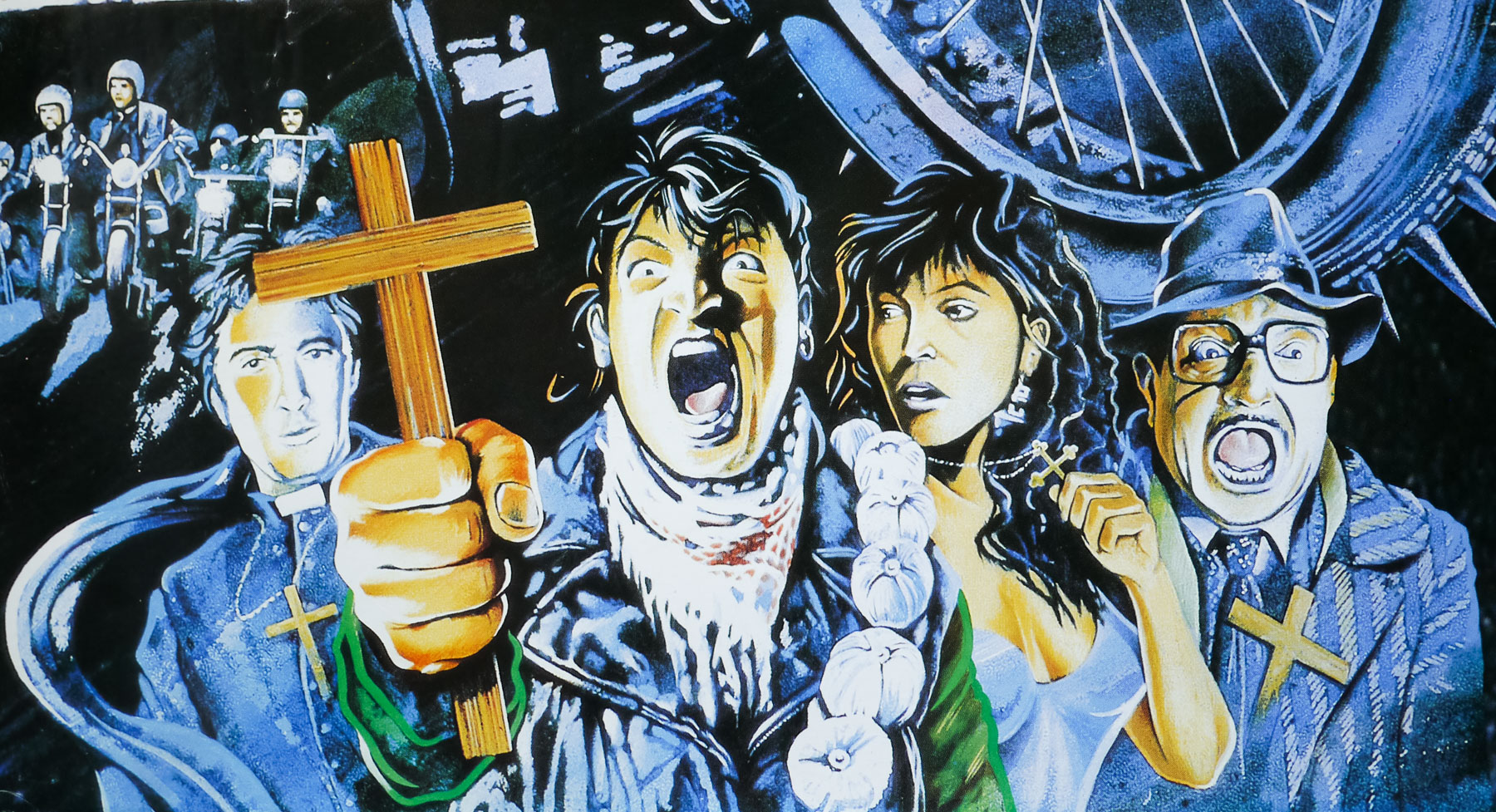
The next day, motorcycle courier Noddy (Morrissey) meets with a mechanic who has taken ownership of the demonic bike and is selling it without realising what is inside. Although everything seems normal to begin with, Noddy and his partner Kim (Amanda Noar) gradually realise that the bike is no ordinary machine, especially when their mechanic is brutally murdered at home, with blood and tire treads found all over the walls. Inspector Cleaver (Elphick) becomes involved in the case, bodies begin piling up, and soon Noddy is turning to a biker/priest (Anthony Daniels) to help exorcise the killer demon.

Despite its low-budget origins, the film is a fun watch and the script has some genuinely hilarious lines in it. There are also some inventive action scenes and the killer machine itself is well handled. There’s also one of the most surreal/gross scenes involving a dream sequence and the contents of a toilet bowl ever committed to celluloid. The film is surprisingly gory and doesn’t skimp on violence – most of the special effects are well done. I’m not saying it’s a classic, far from it, but it’s certainly worth a watch!

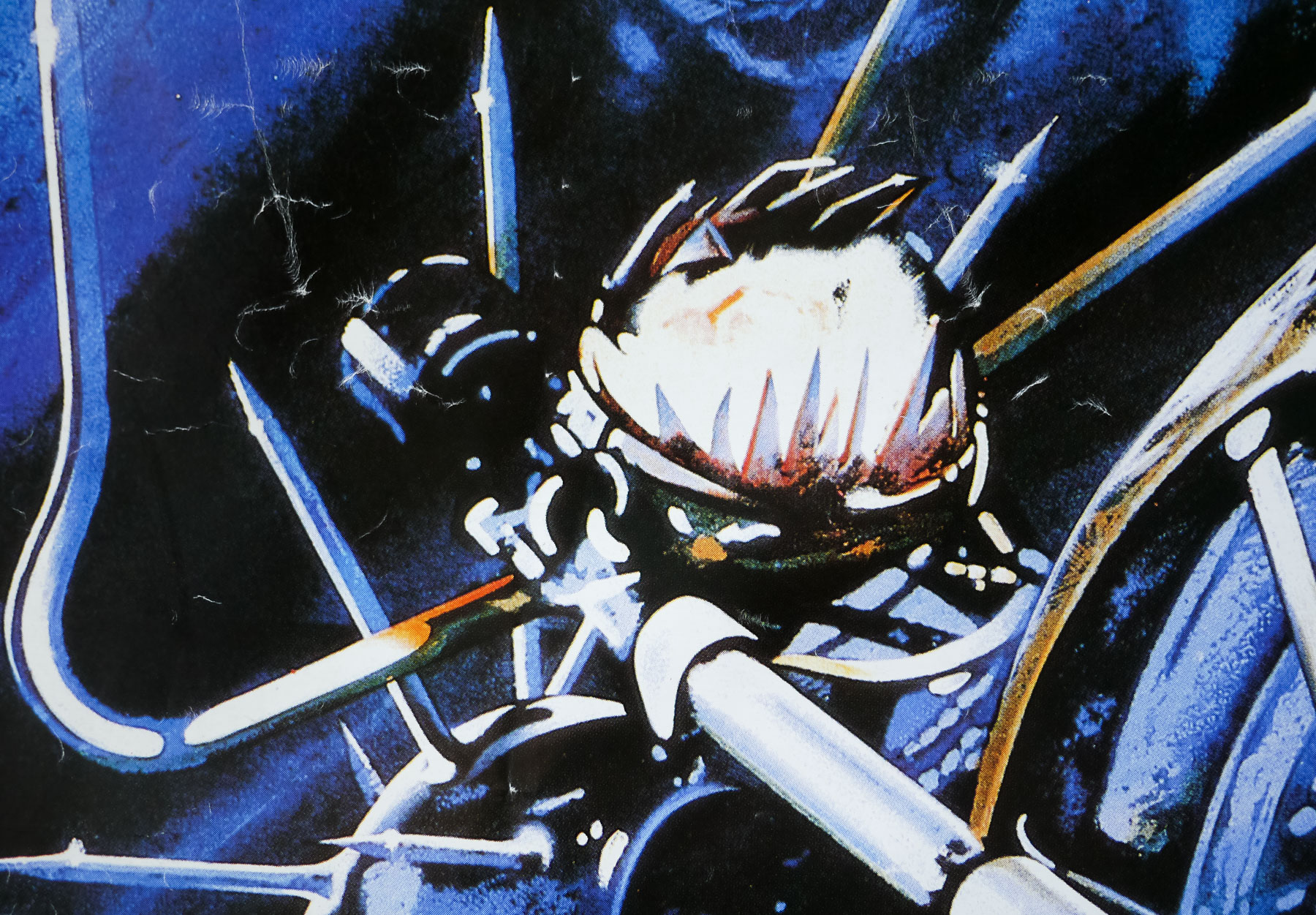
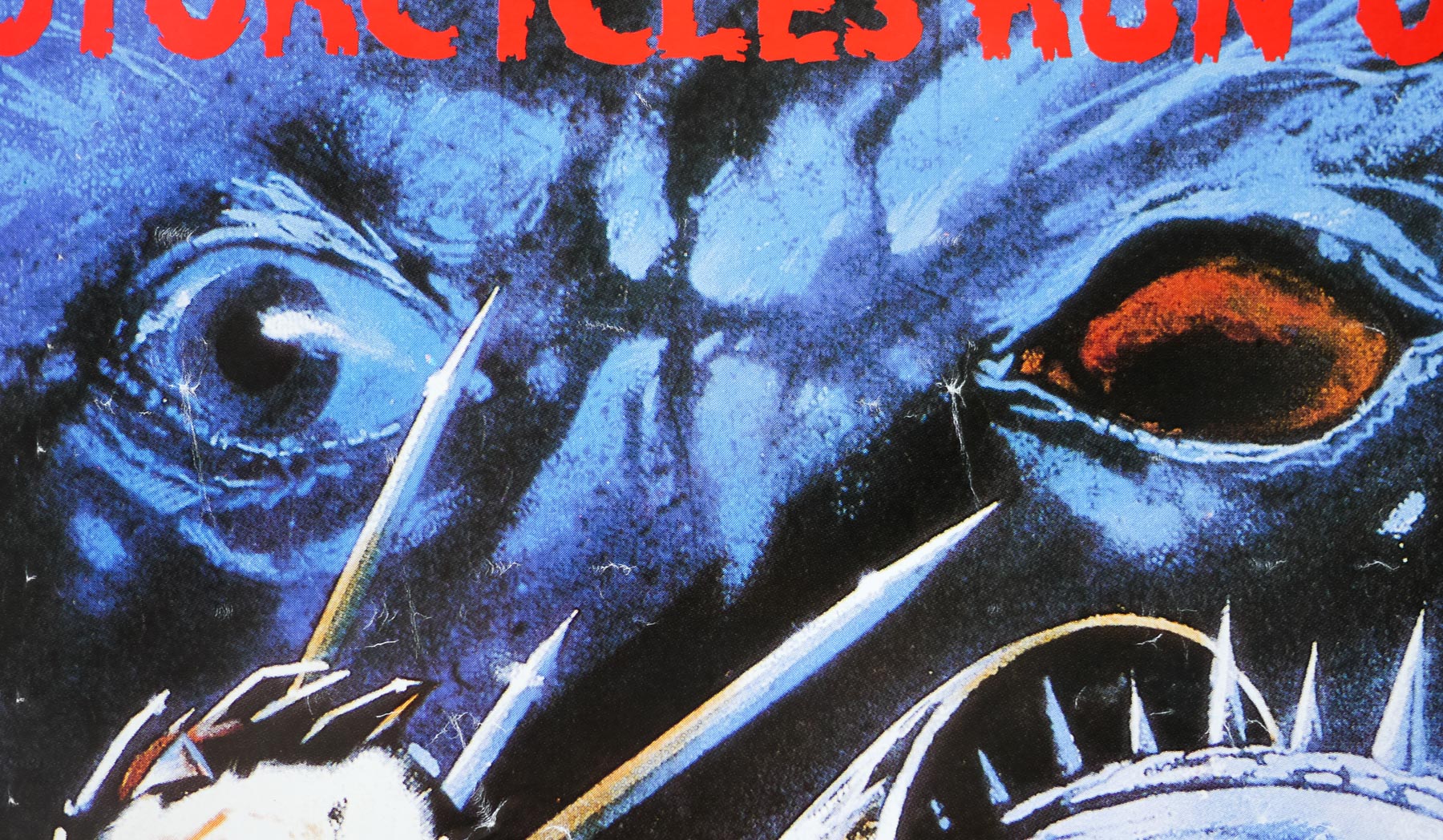
Frustratingly, I’ve struggled to find out who was responsible for the artwork on this country of origin poster. I am certain that it’s not the work of Graham Humphreys as I had this confirmed to me in an email from the man himself. If anyone has any ideas please get in touch. Note the rather brilliant quote from Sam Raimi (Evil Dead)!

The Man Who Fell to Earth / quad / UK

18.08.11

Poster Poster

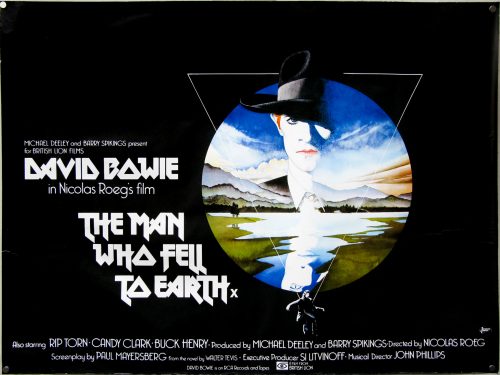
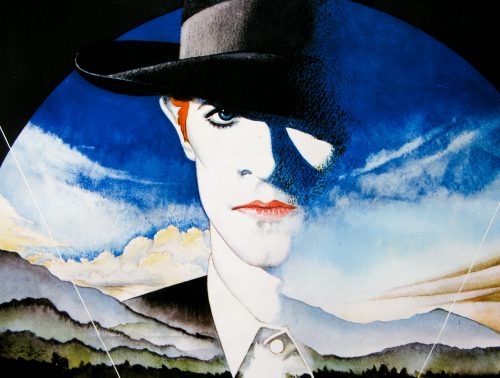
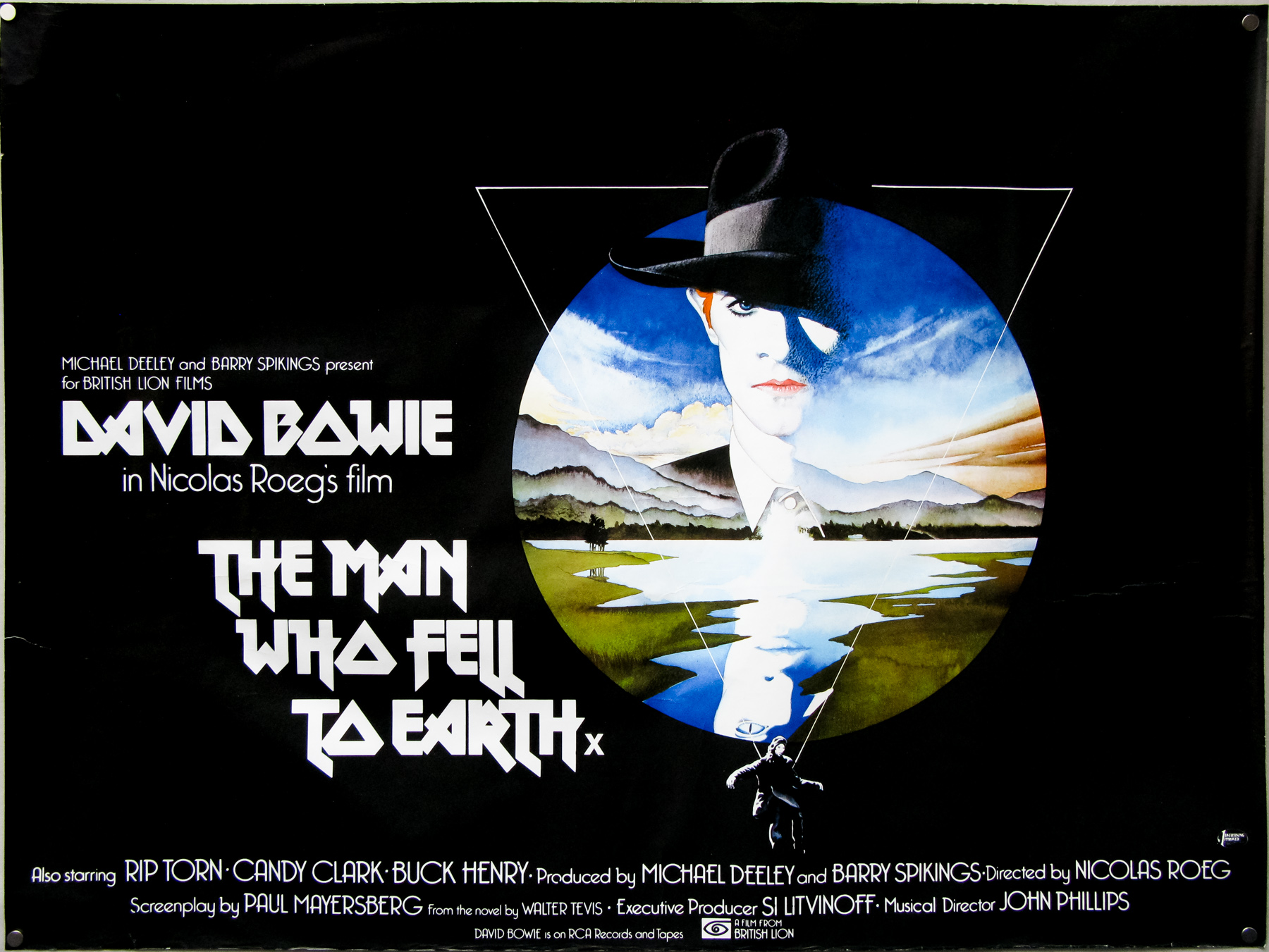
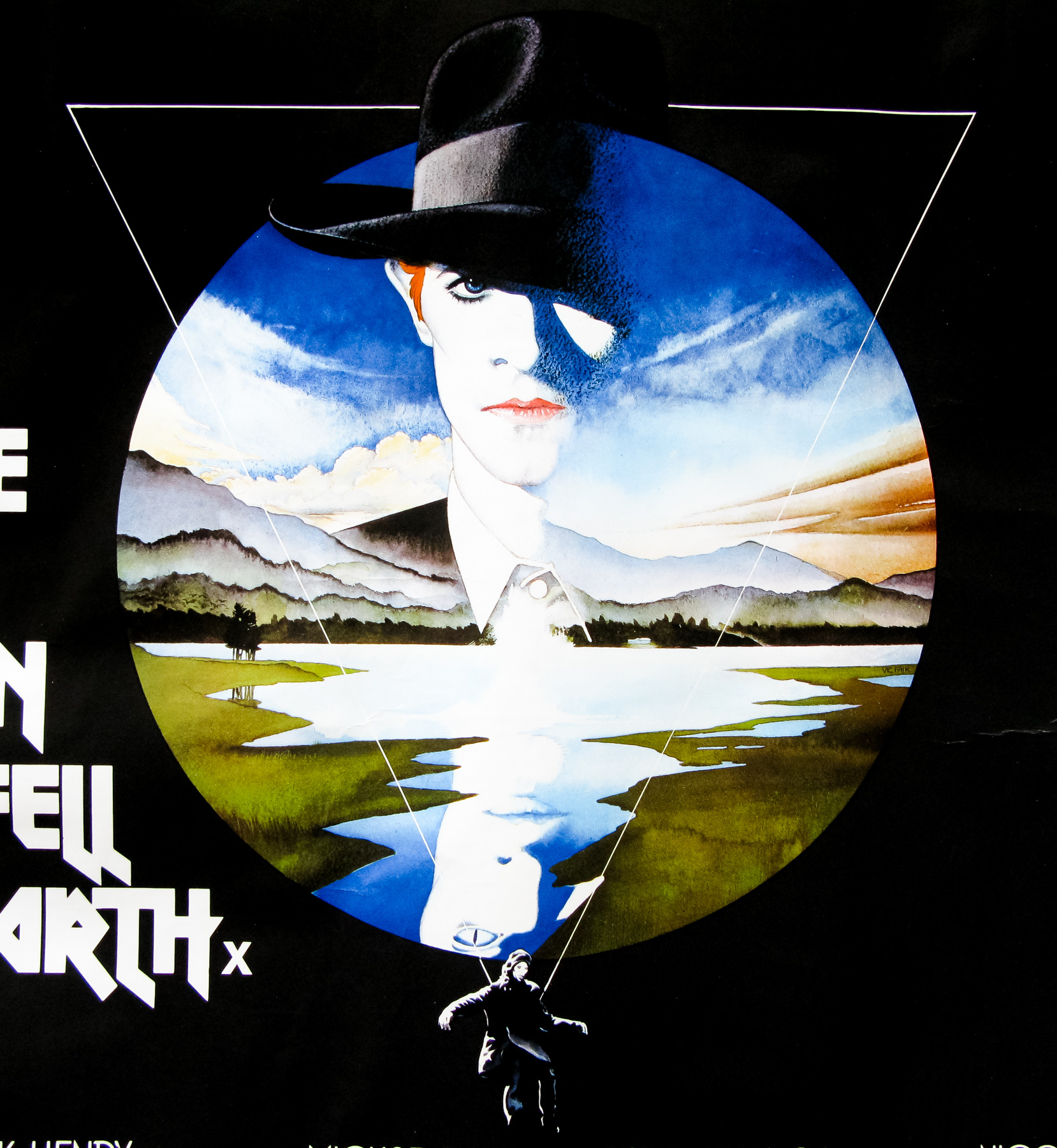
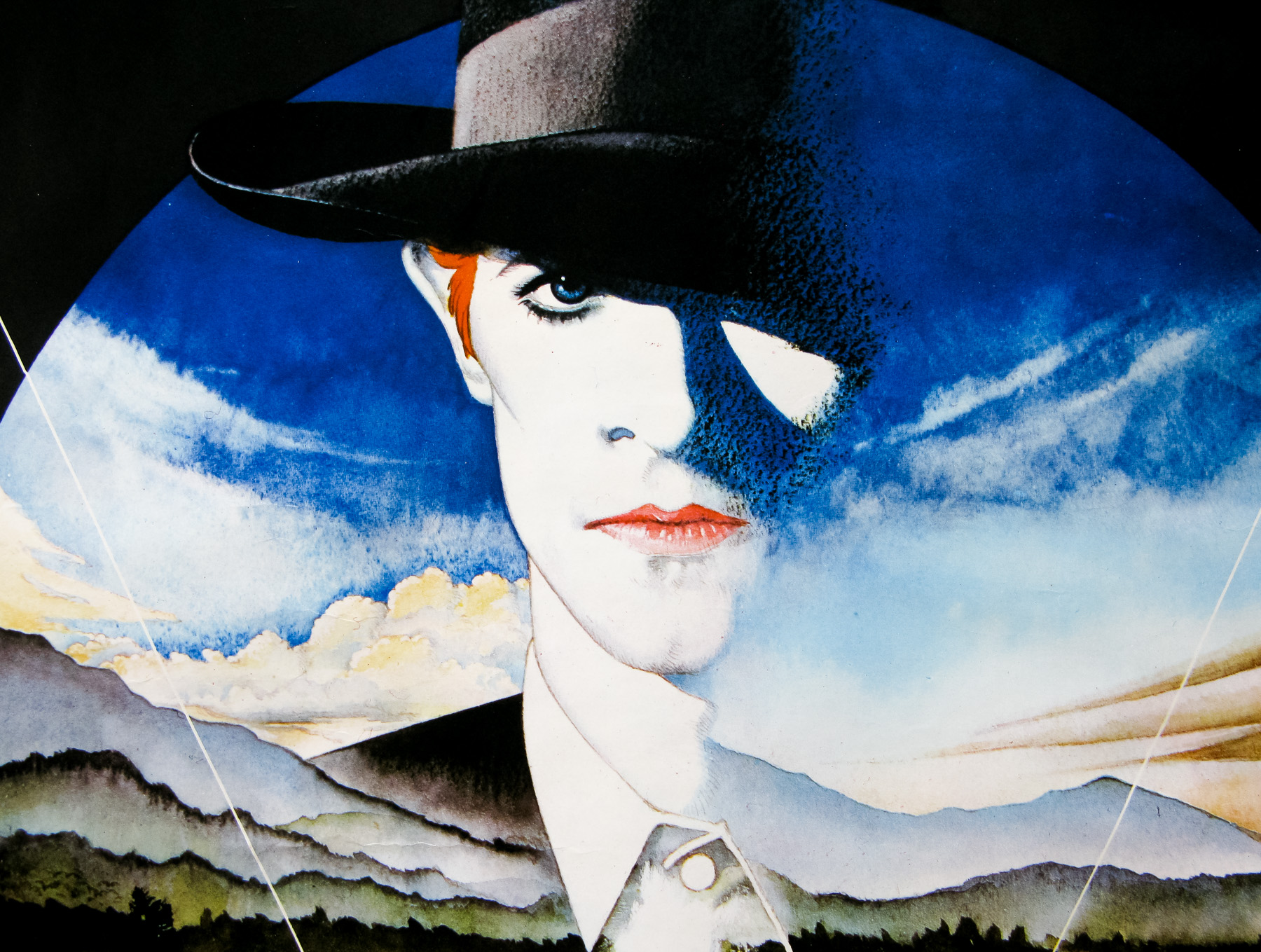
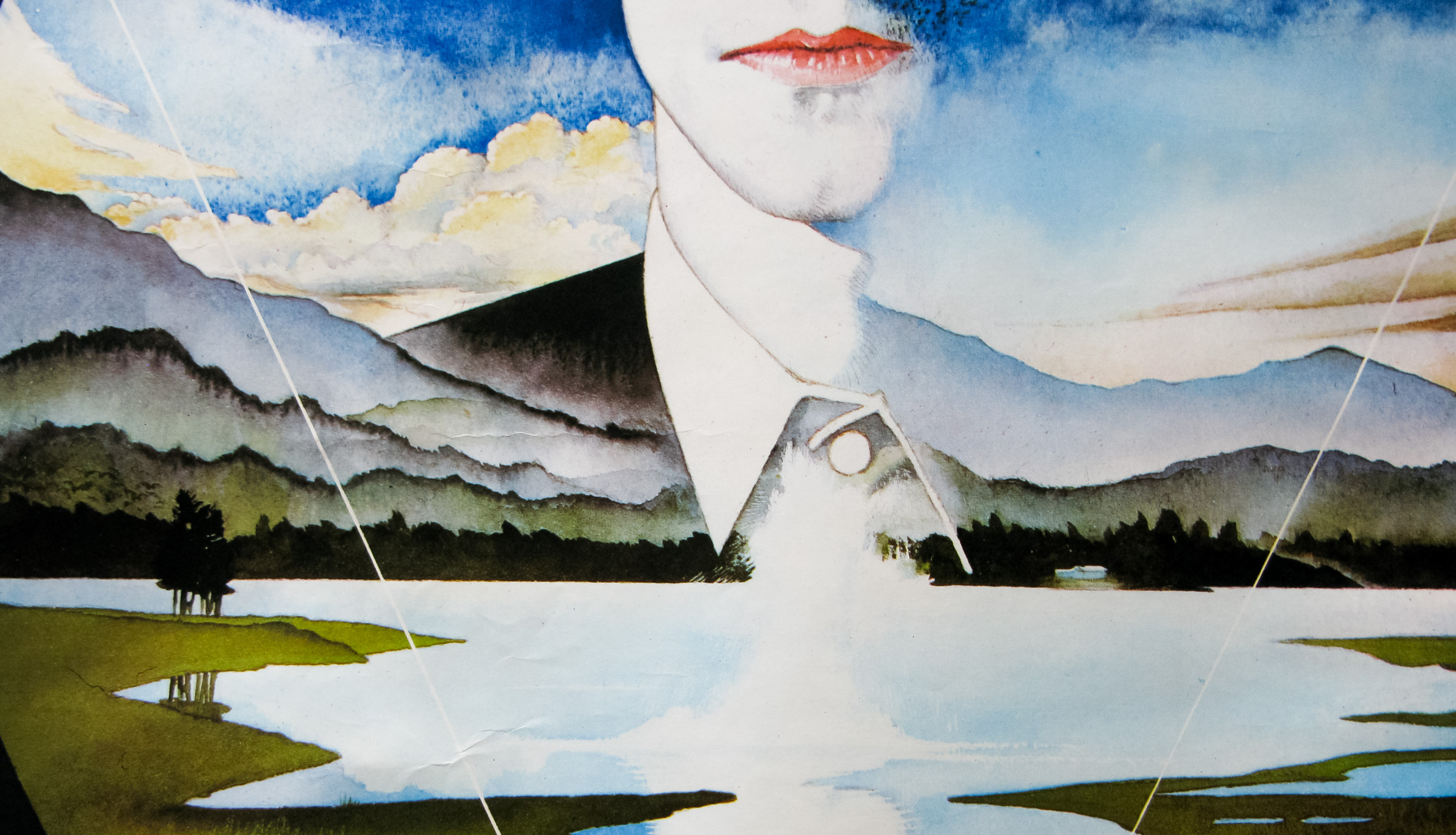
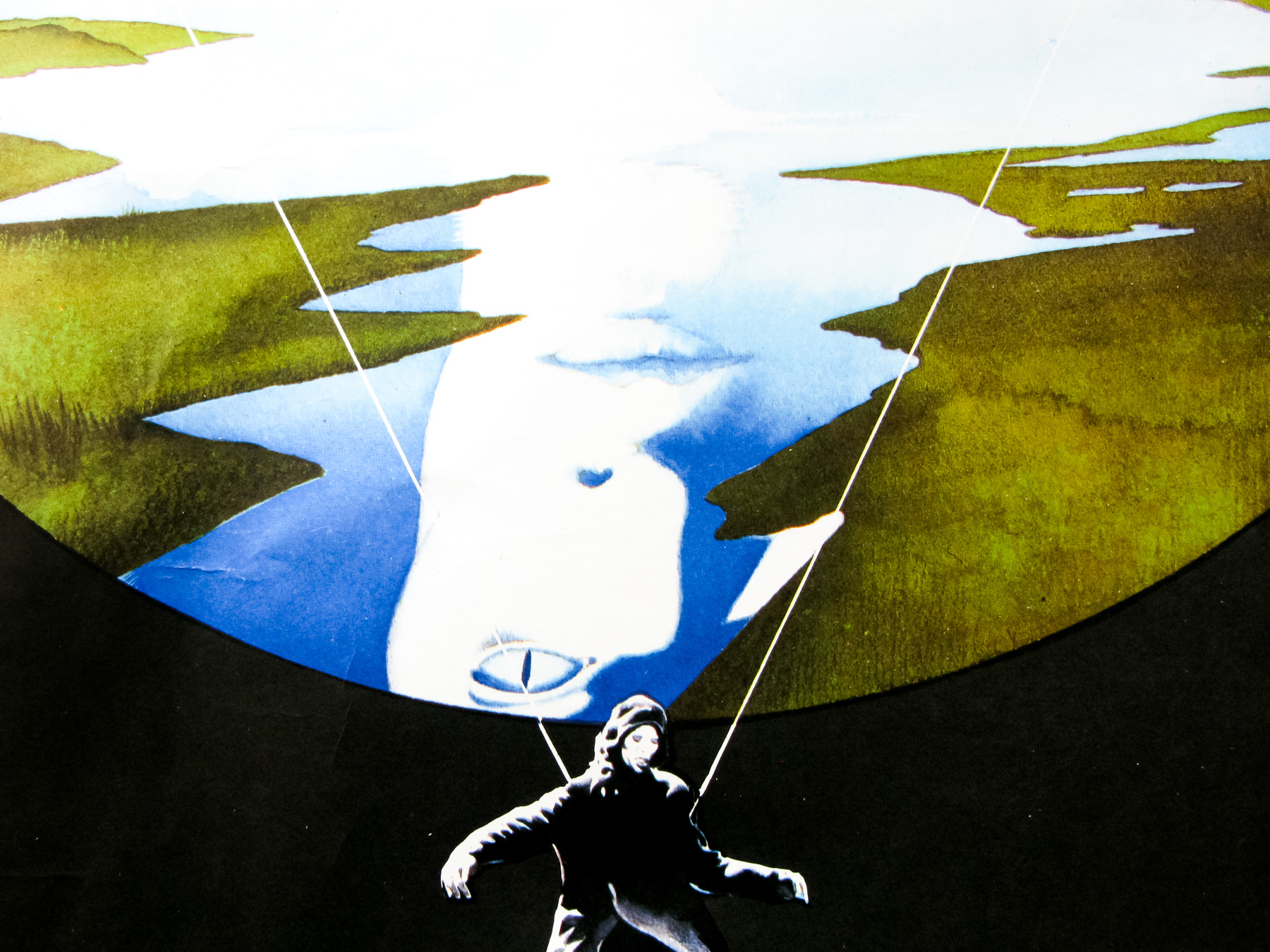
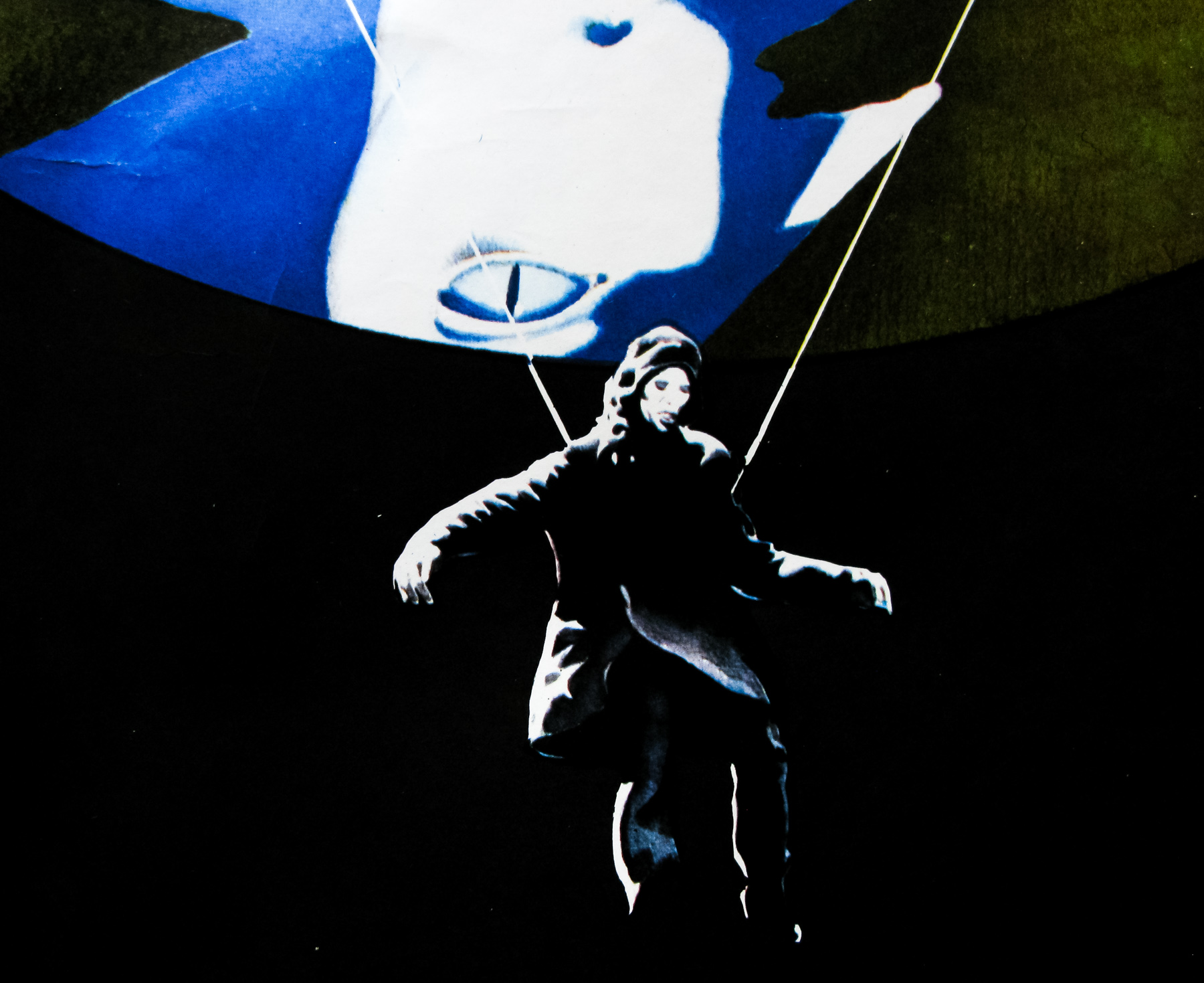
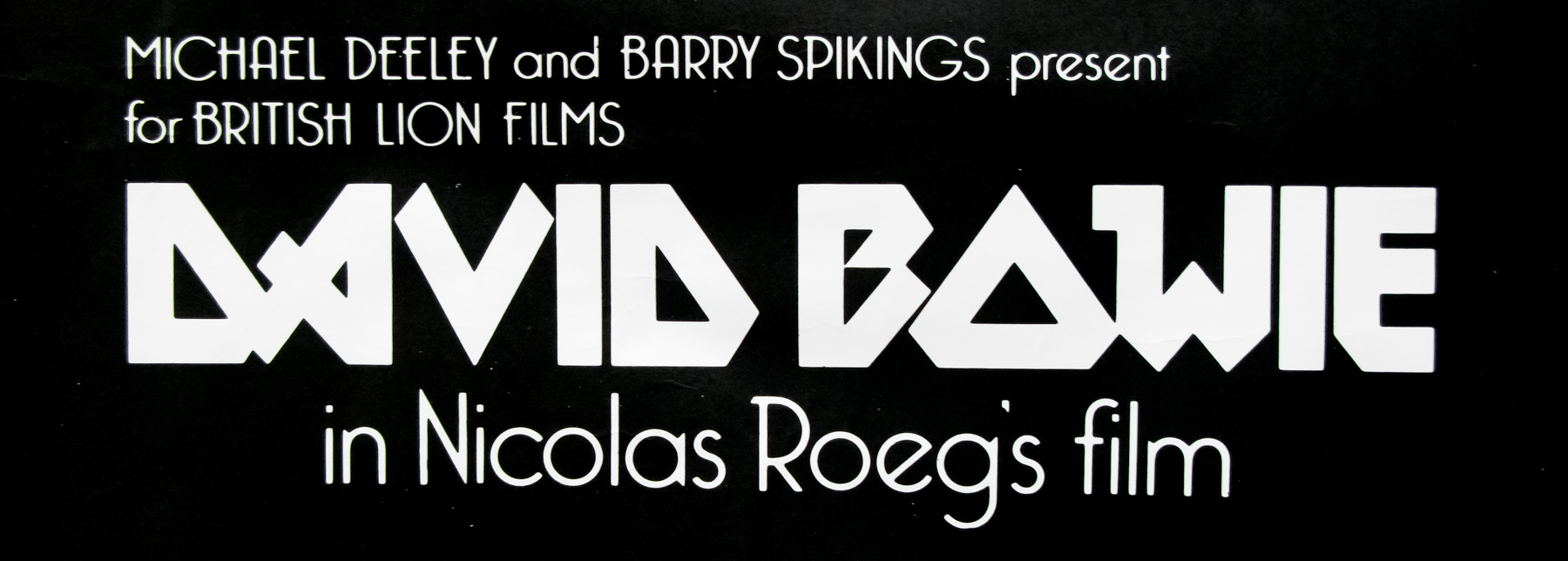
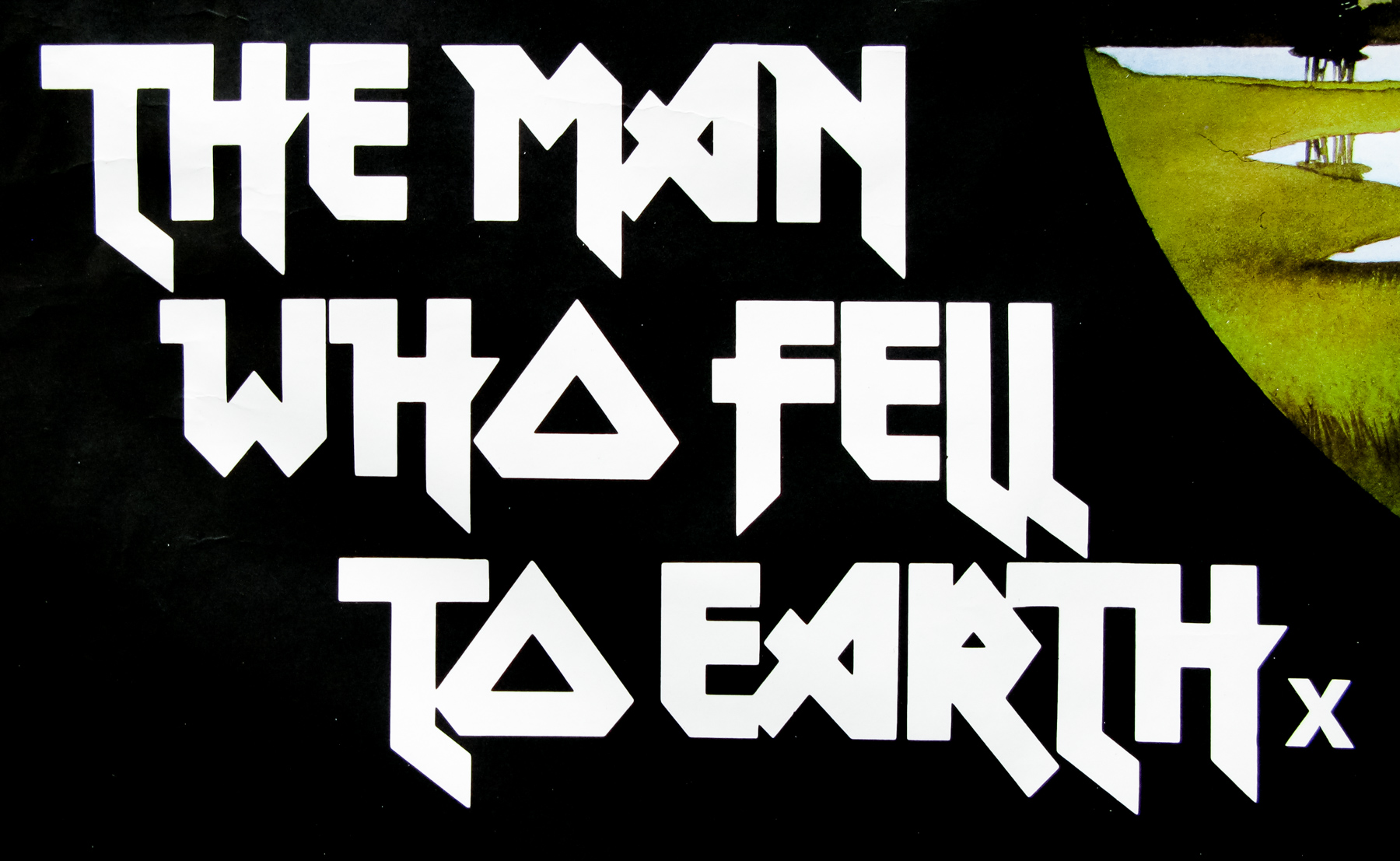
An absolutely superb design by British artist Vic Fair for Nic Roeg’s seminal sci-fi film The Man Who Fell to Earth. The typography alone is a thing of beauty, particularly that of the main title – I’m not sure who designed it but it’s an undoubted classic. The rock band Iron Maiden later used it for their own band logo.

This is perhaps the best known of Vic Fair’s designs, though he is responsible for many other great posters from the sixties, seventies and eighties, including several for Hammer Horror, Lisztomania and quads for the infamous ‘Confessions…’ series of films. I plan to post another of his best designs in the next few weeks.

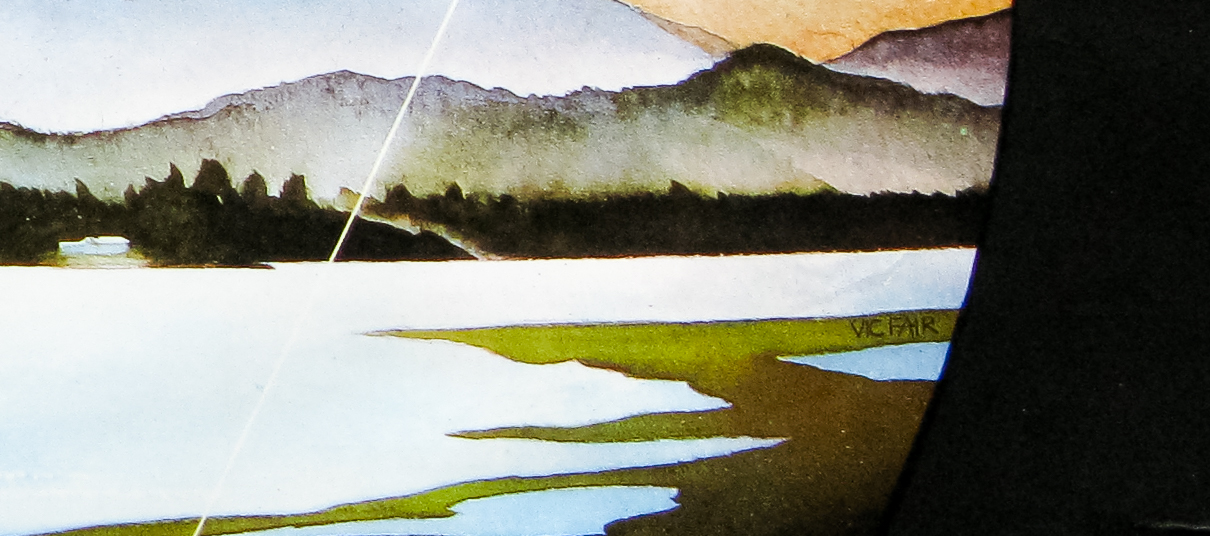
This poster is featured in Sim Branaghan’s superb ‘British Film Posters: An Illustrated History’ and he notes:

Probably the best known of Fair’s posters, and the only one regularly credited to him, since he liked it so much at the time he actually signed it.

I personally think this is David Bowie’s finest starring role and no one else could have portrayed the oddity that is Thomas Newton quite as well as him. It’s not my favourite of Nic Roeg’s films though (that would be Don’t Look Now).

The brilliantly nuts original US trailer can be seen on YouTube.


The House of Exorcism / quad / UK

02.06.14

Poster Poster
Title
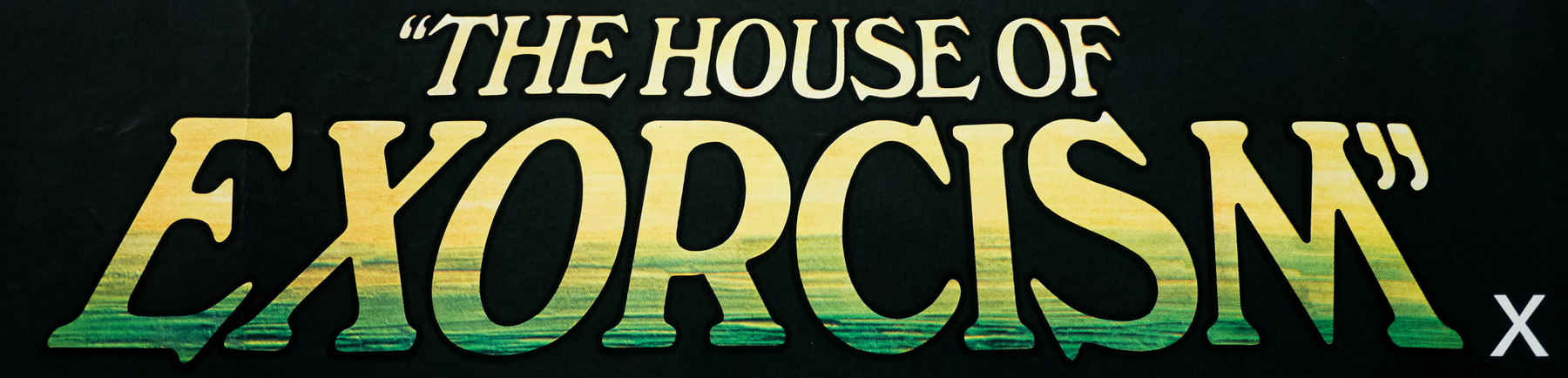
The House of Exorcism
AKA
Lisa and the Devil (original cut)
Year of Film
1975
Director
Mario Bava (as Mickey Lion)
Starring
Telly Savalas, Elke Sommer, Robert Alda, Sylva Koscina, Eduardo Fajardo, Alessio Orano, Alida Valli, Gabriele Tinti
Origin of Film
Italy
Genre(s) of Film
Telly Savalas, Elke Sommer, Robert Alda, Sylva Koscina, Eduardo Fajardo, Alessio Orano, Alida Valli, Gabriele Tinti,
Type of Poster
Quad
Style of Poster
--
Origin of Poster
UK
Year of Poster
1977
Designer
Vic Fair
Artist
Vic Fair
Size (inches)
30" x 39 15/16"
SS or DS
SS
Tagline
A terrifying journey into the SUPERNATURAL

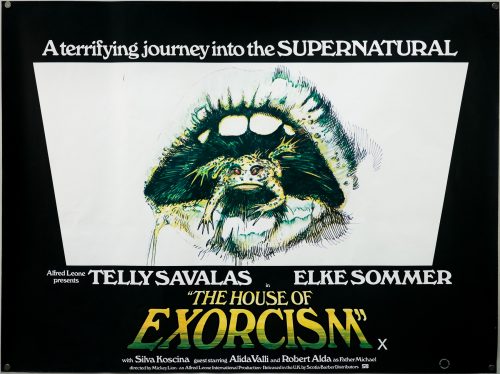
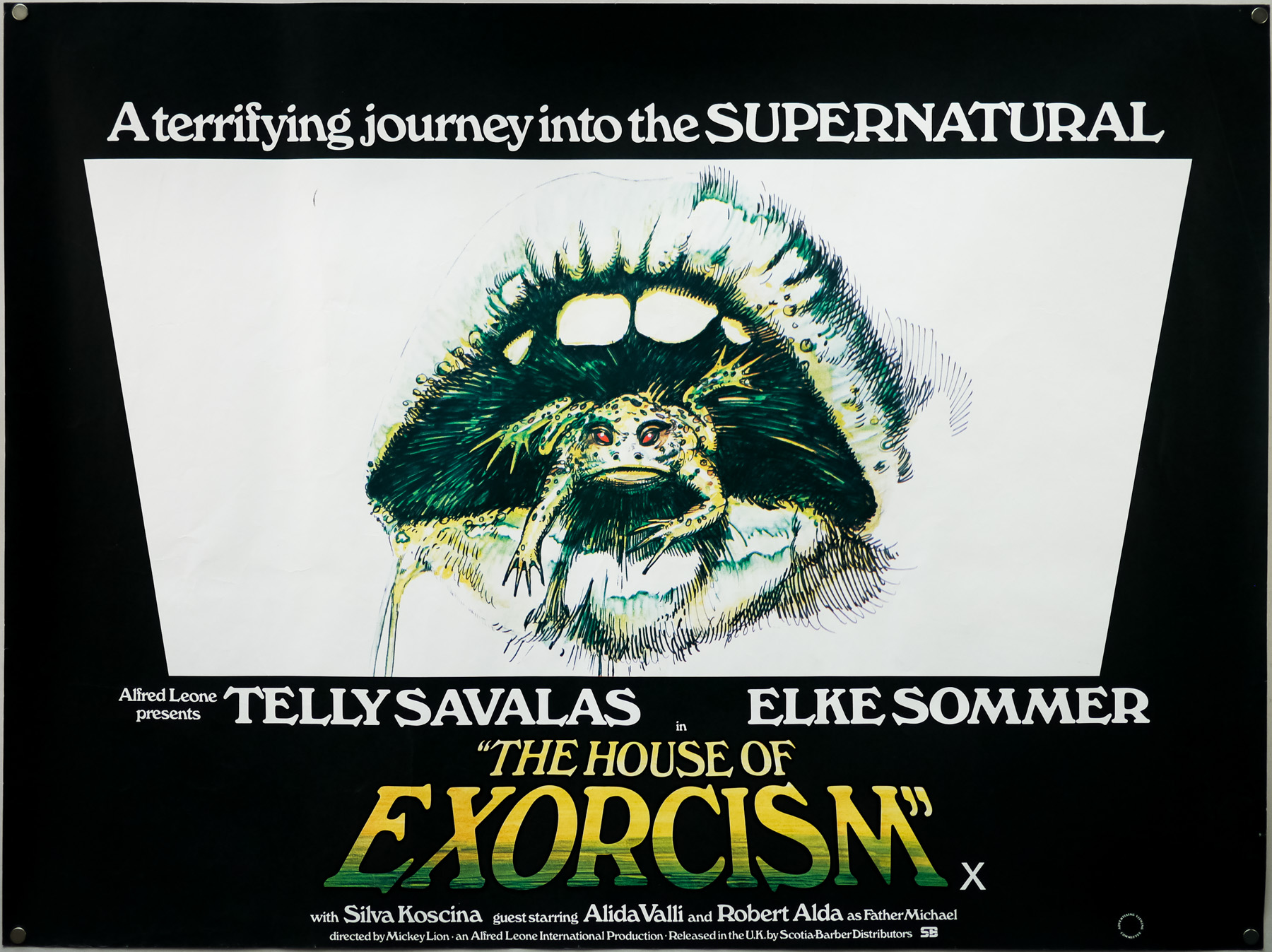
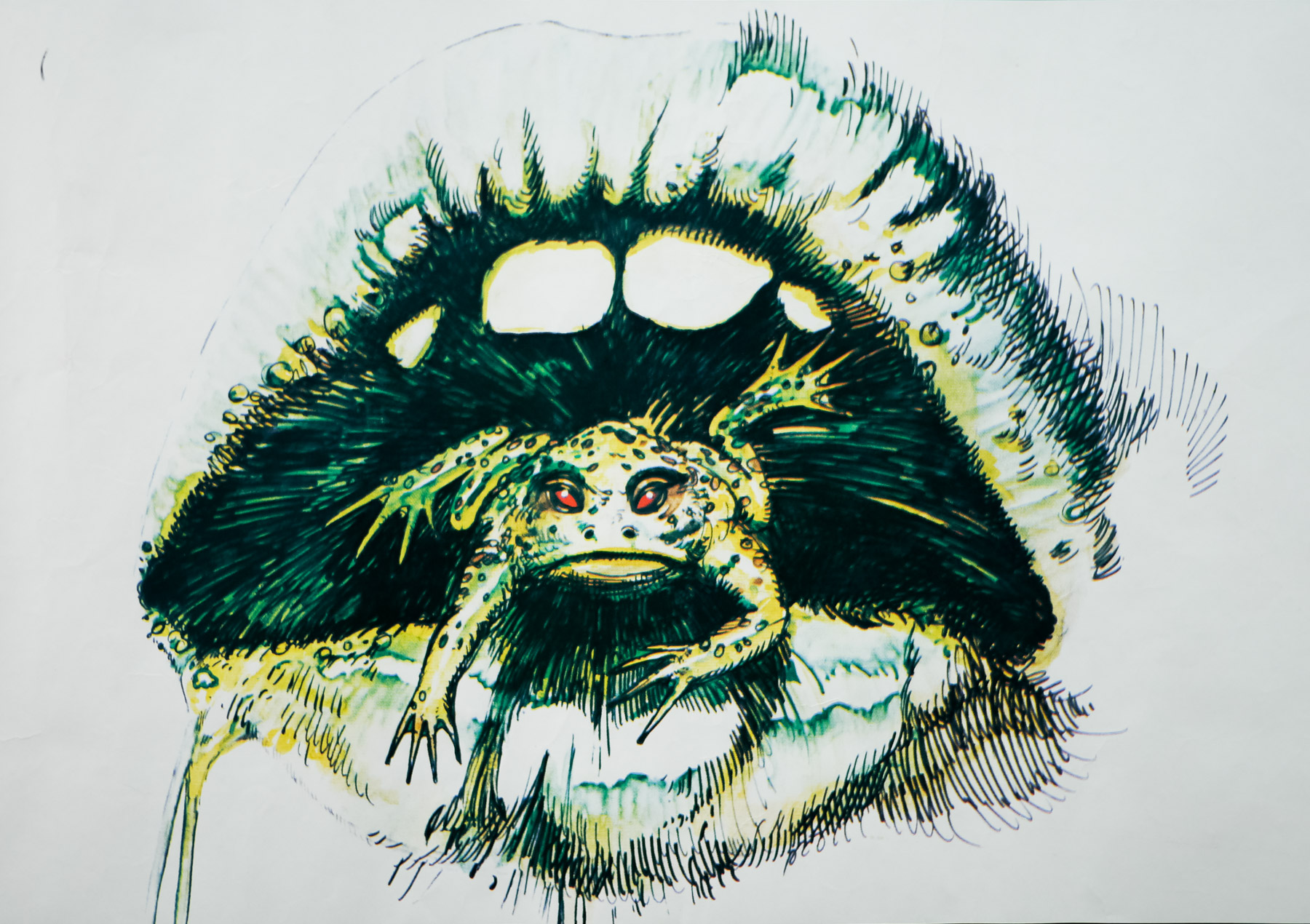
Over the years a number of films have been subjected to various cuts and re-edits that alter the filmmakers’ original vision for both good and bad. This has included Apocalypse Now with its ‘Redux‘ cut in 2001, the multiple versions of Blade Runner that culminated with 2003’s ‘Final Cut’ and the strange case of Superman II. None of these revisions were quite as ill-judged as the fate that befell Italian director Mario Bava‘s 1974 horror Lisa and the Devil when it flopped at the European box-office.

An entertaining if somewhat bizarre horror set in Spain, the original film focused on Lisa (Elke Sommer) a tourist in Toledo who becomes separated from her group and winds up at a crumbling old mansion on the edge of town. There she meets the eccentric inhabitants and becomes embroiled in a series of strange and often murderous situations involving the family and the house’s mysterious butler (Telly Savalas in one of his more quirky roles).

When the film failed to perform in Italy and the few other European countries in which it was released, the producer Alfredo Leone convinced Bava to retool the film as an Exorcist clone to capitalise on the success of the then recently released American classic. New scenes were shot featuring a demonically possessed Elke Sommer and a priest played by Robert Alda, and the original film was heavily edited so these new flashback scenes could be incorporated.

Leone and Bava clashed heavily over the style of the new scenes and the latter eventually walked away from the project (the director was credited as the fictional Mickey Lion, the surname being English for Leone), which was released in the UK and US as The House of Exorcism to instant critical derision (many reviewers calling it an Exorcist rip-off) and poor commercial performance. All in all the project was a total waste of time for all concerned. Recently the UK video label released Lisa and the Devil on blu-ray in its original version and included the House of Exorcism on the same disc.

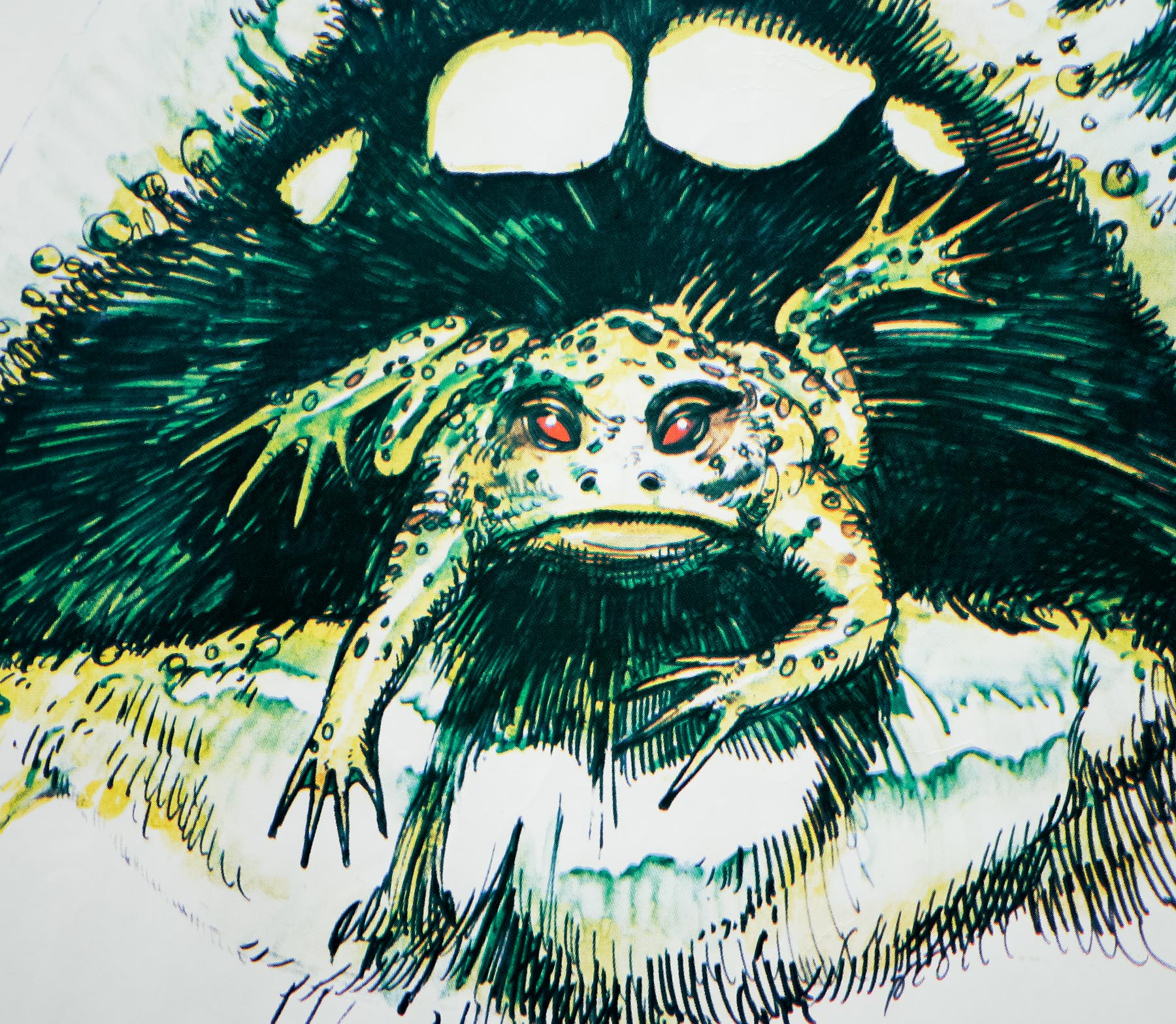
As of 2026, it is believed this poster is the work of the late, great Vic Fair who was one the most important characters ever to work in British film marketing. He was responsible for several iconic posters, including The Man Who Fell To Earth, posters for Hammer horrors like Vampire Circus, and the withdrawn advance one sheet for A View to a Kill. I interviewed Vic for this site and that article can be viewed by clicking here

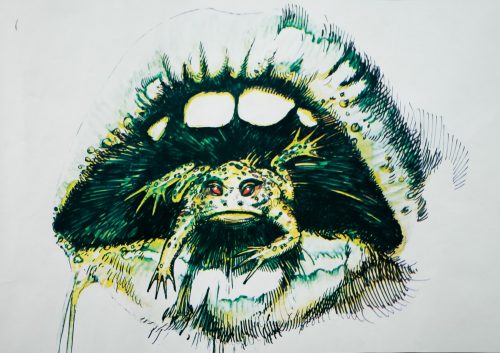
I previously thought it may have been the work of British artist Mike Vaughan but Sim Branaghan, author of British Film Posters: An Illustrated History, believes it’s likely to be Vic’s work, or possibly that of his contemporary and colleague Eddie Paul. The noted poster dealer Mike Bloomfield is currently (as of January 2026) selling a print of the concept artwork for the poster which mirrors this design and came from the archive of Vic Fair. This further lends credence to Sim and Mike’s belief that the final design is by Fair.

Star Wars / quad / UK

25.11.14

Poster Poster
Title
Star Wars
AKA
Star Wars: Episode IV - A New Hope (full title) | La guerre des étoiles (Canada - French title / France)
Year of Film
1977
Director
George Lucas
Starring
Mark Hamill, Harrison Ford, Carrie Fisher, David Prowse, Peter Cushing, Alec Guinness, Anthony Daniels, Kenny Baker, Peter Mayhew
Origin of Film
USA
Genre(s) of Film
Mark Hamill, Harrison Ford, Carrie Fisher, David Prowse, Peter Cushing, Alec Guinness, Anthony Daniels, Kenny Baker, Peter Mayhew,
Type of Poster
Quad
Style of Poster
First printing
Origin of Poster
UK
Year of Poster
1977
Designer
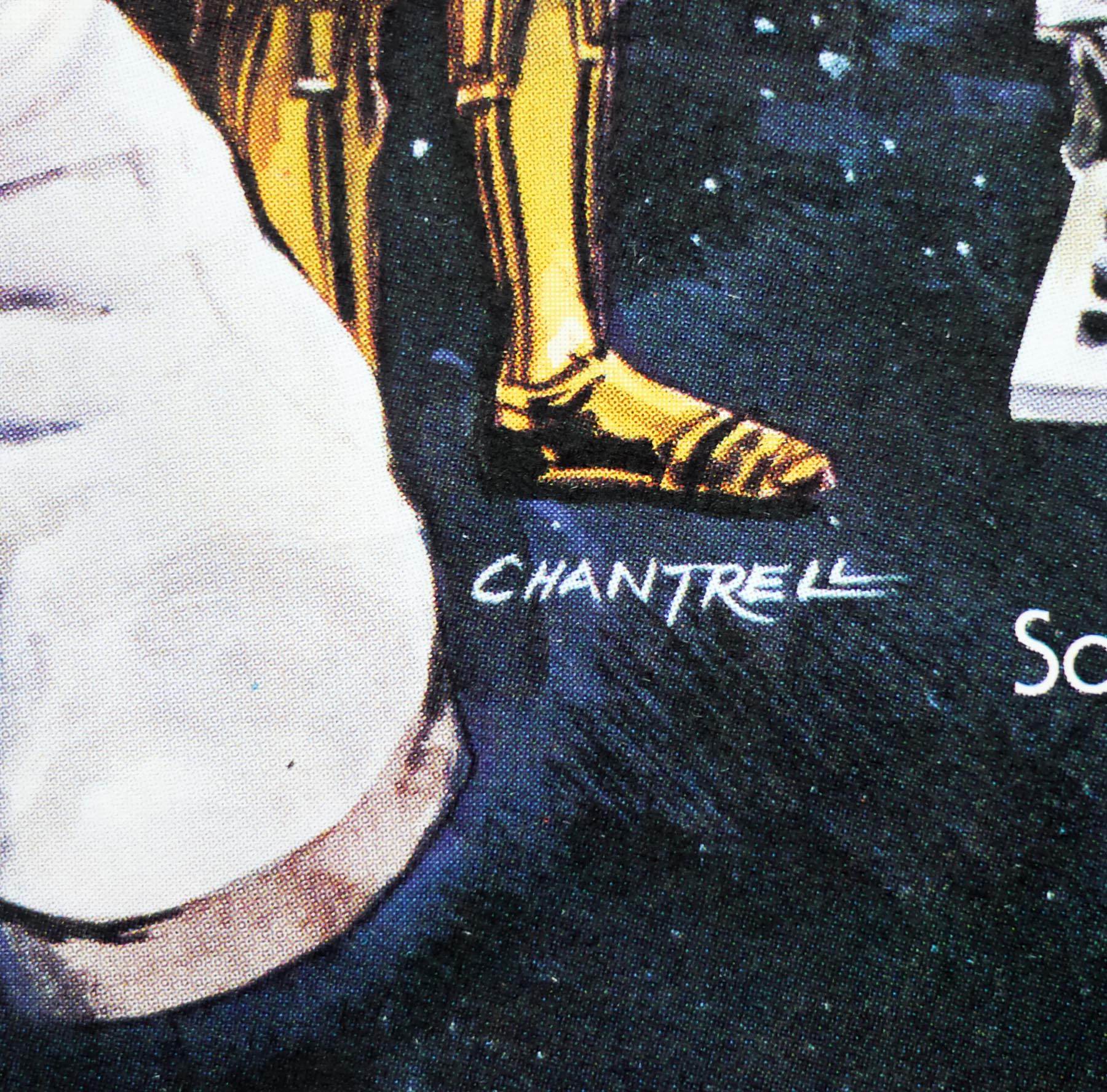
Tom Chantrell
Artist
Tom Chantrell
Size (inches)
30" x 39 14/16"
SS or DS
SS
Tagline
May the force be with you

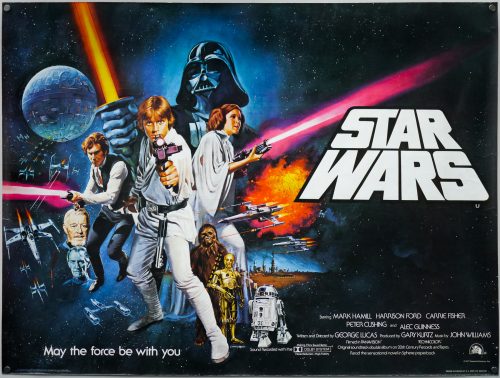
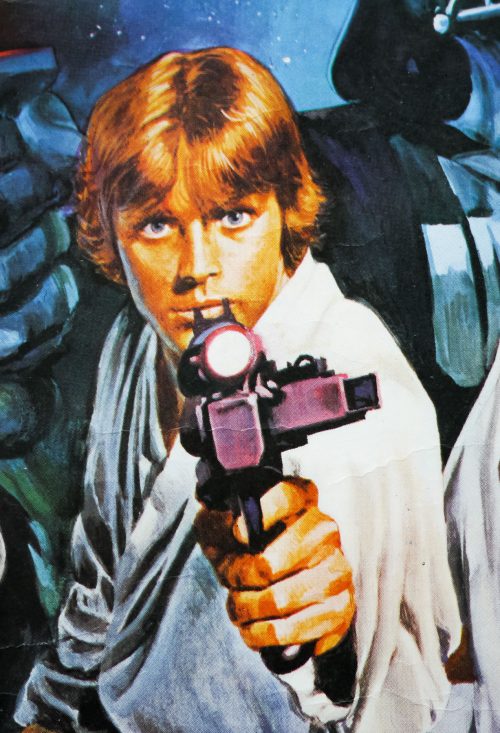
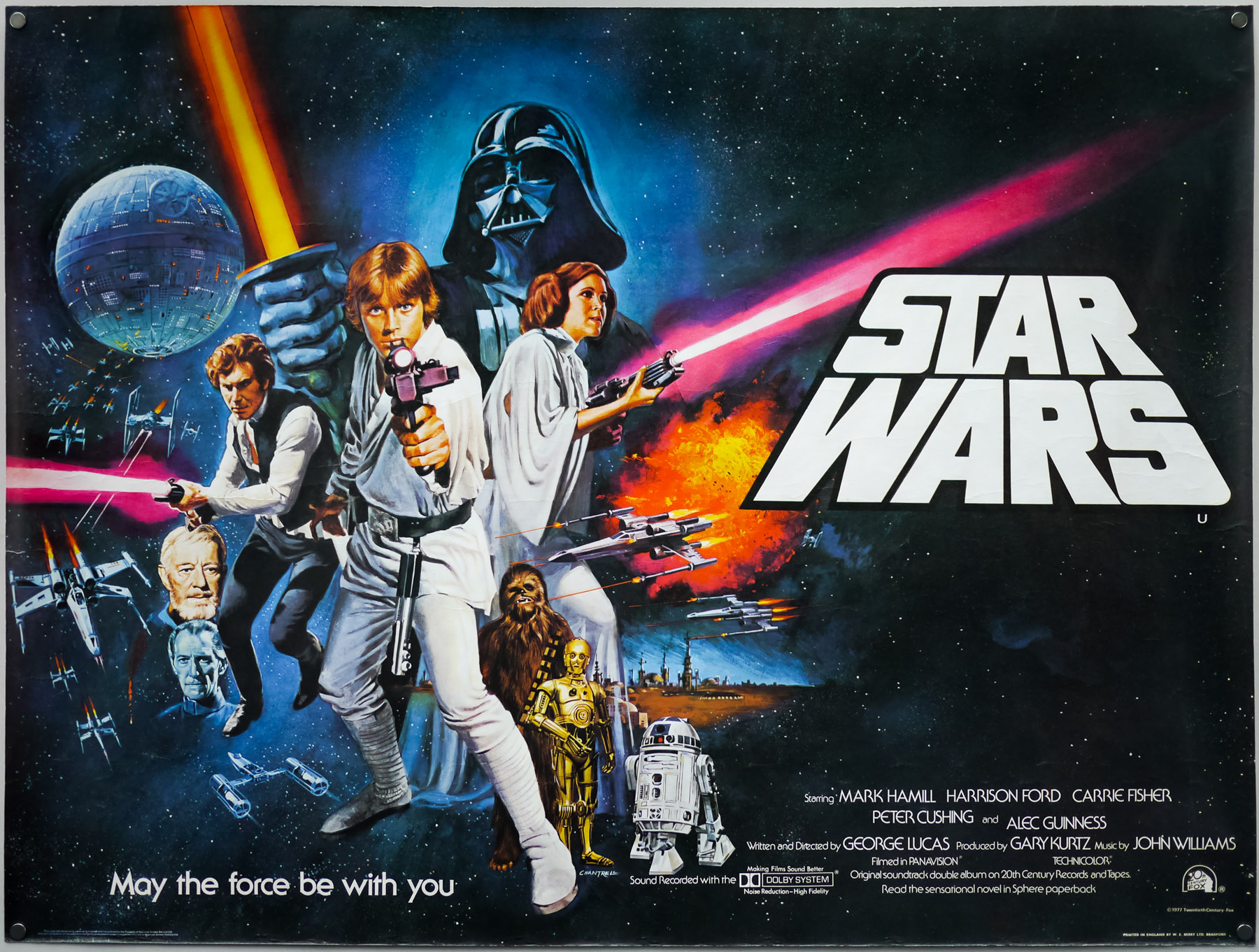
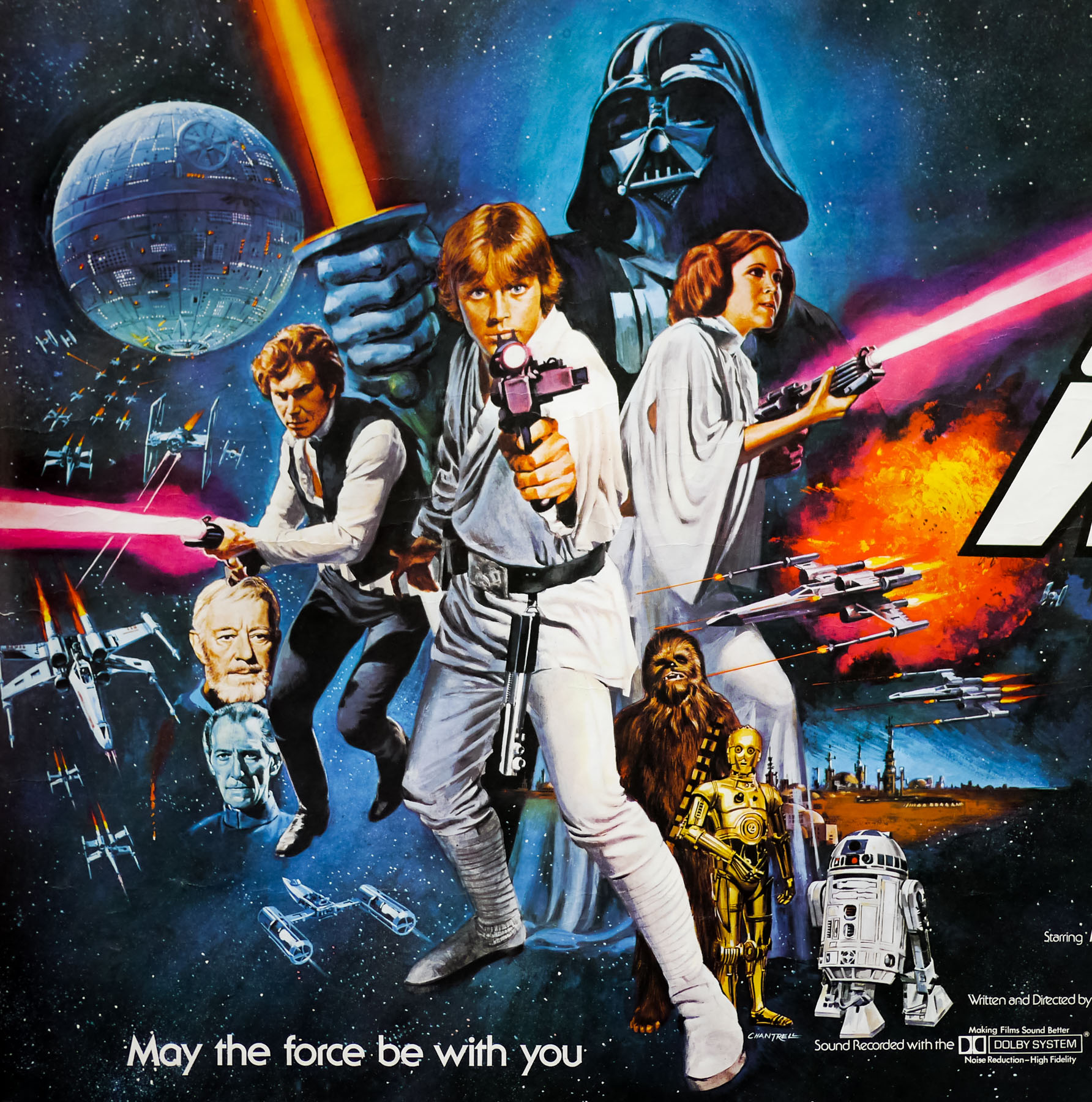
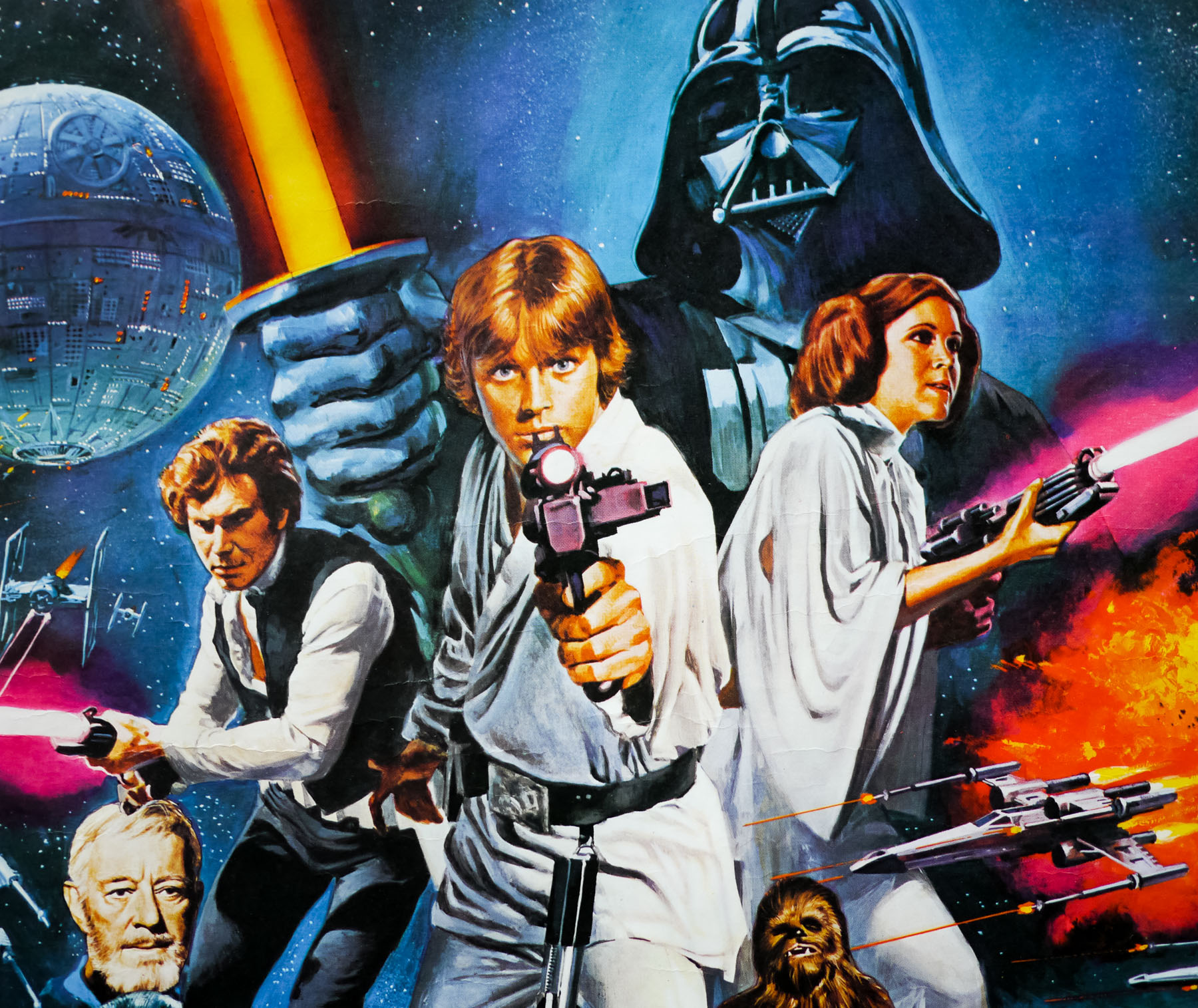
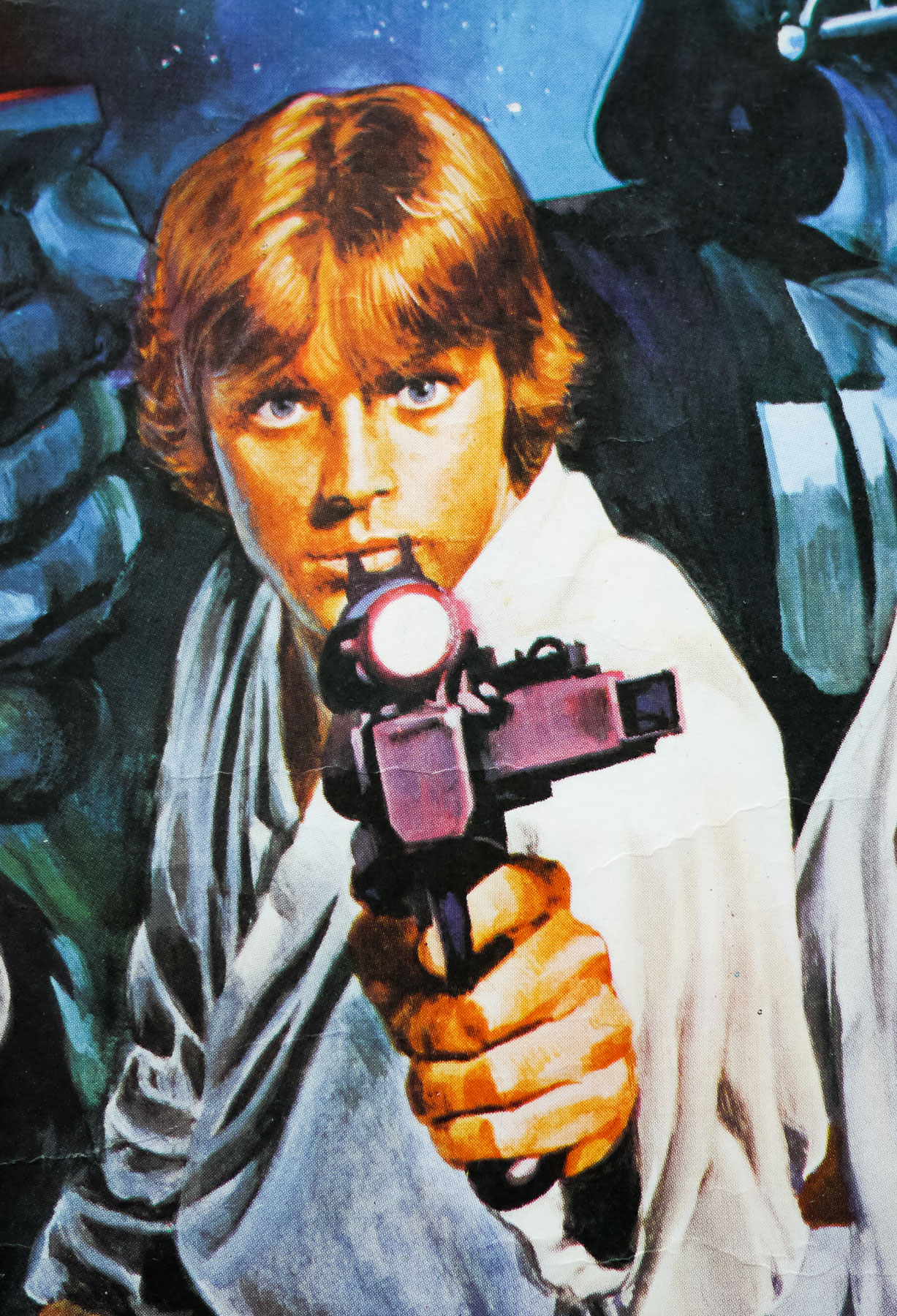
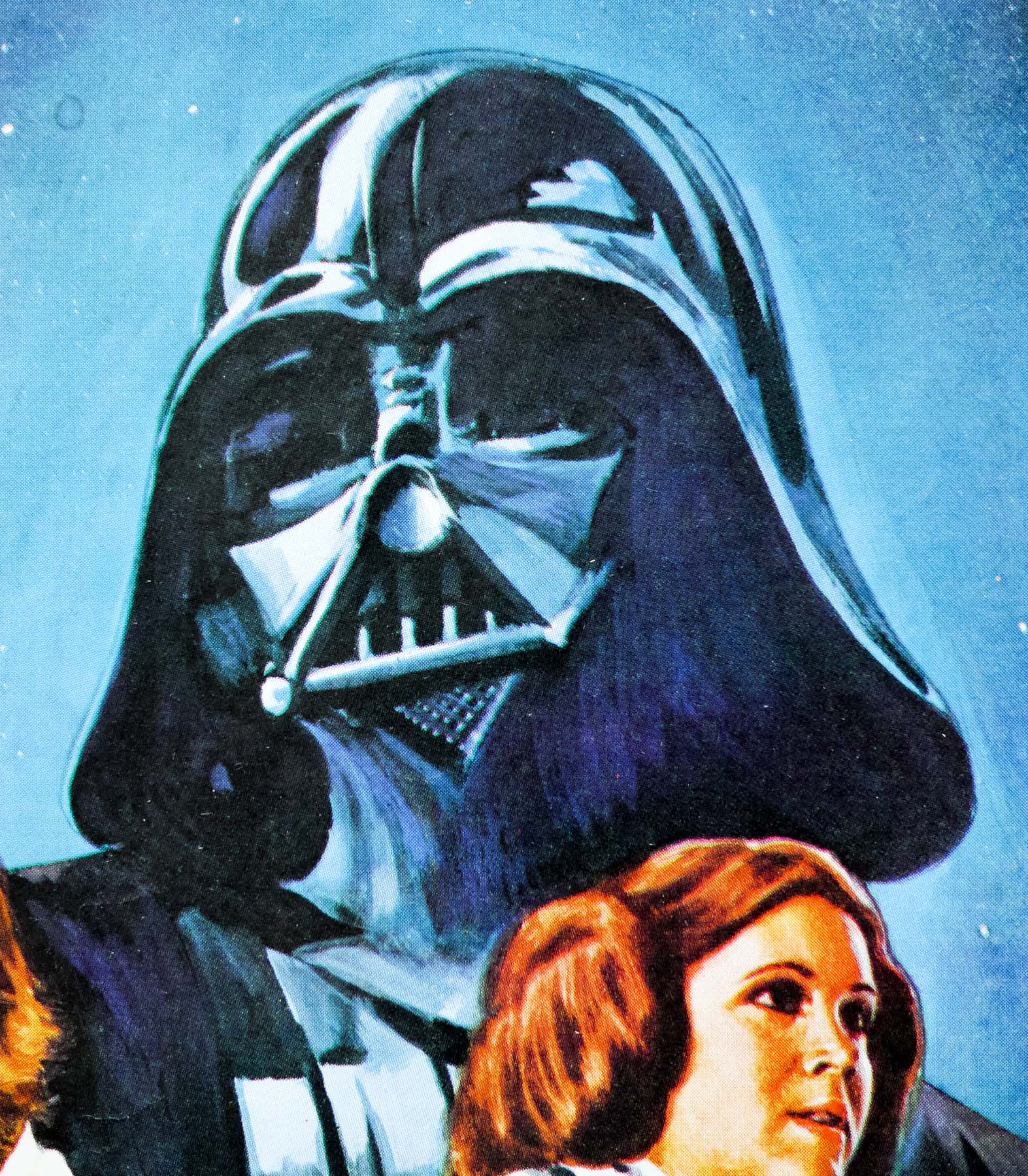
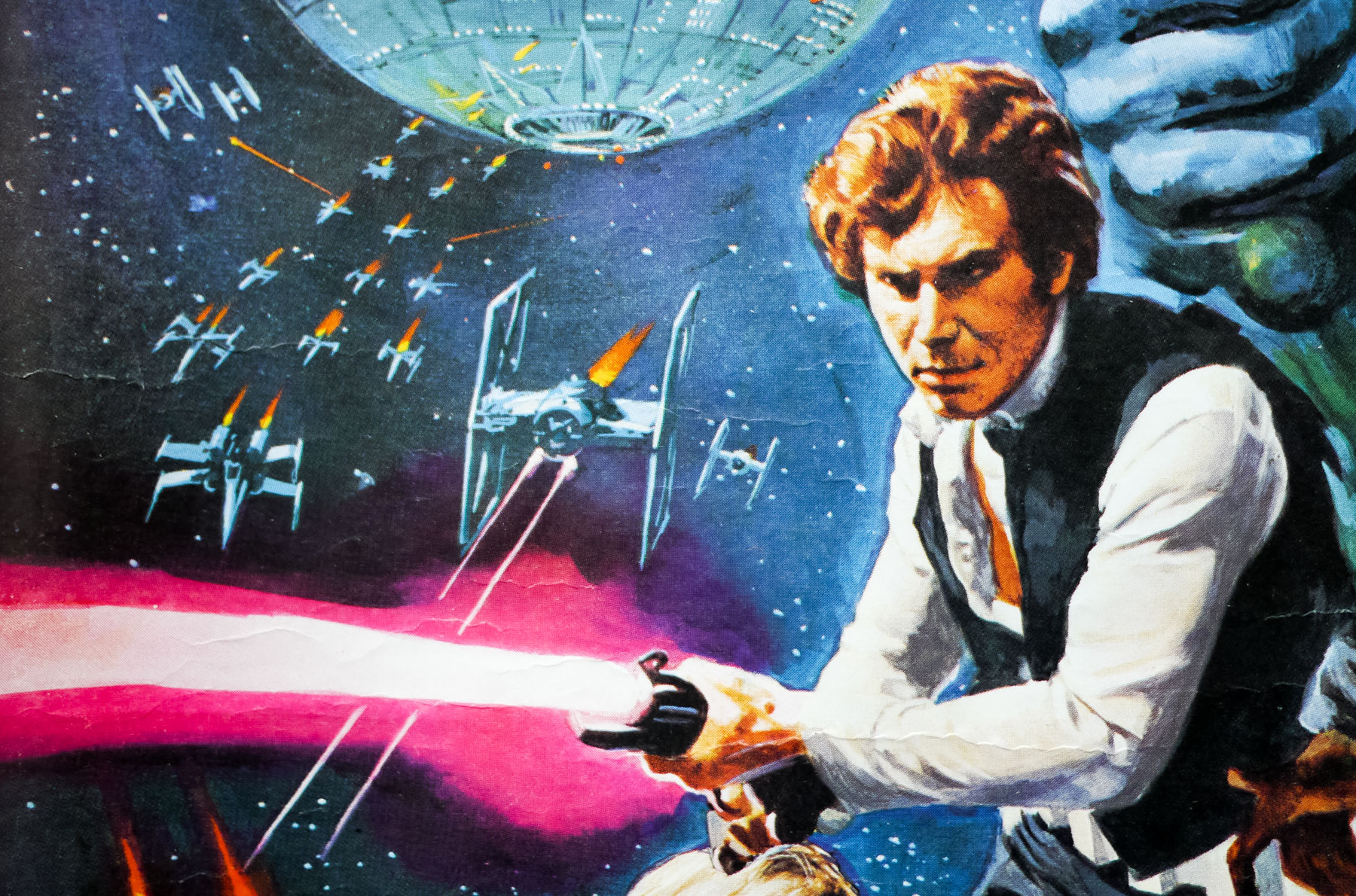
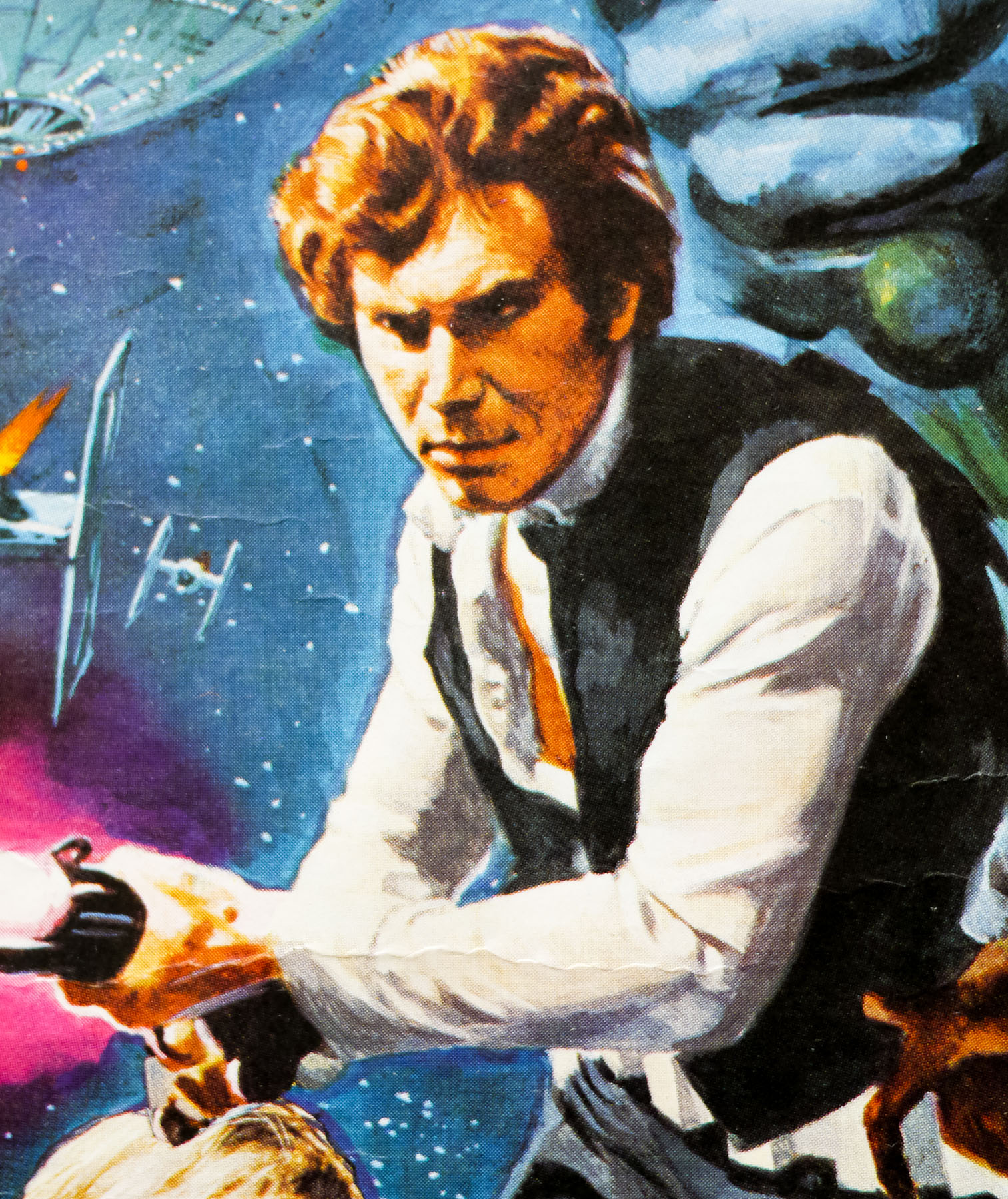
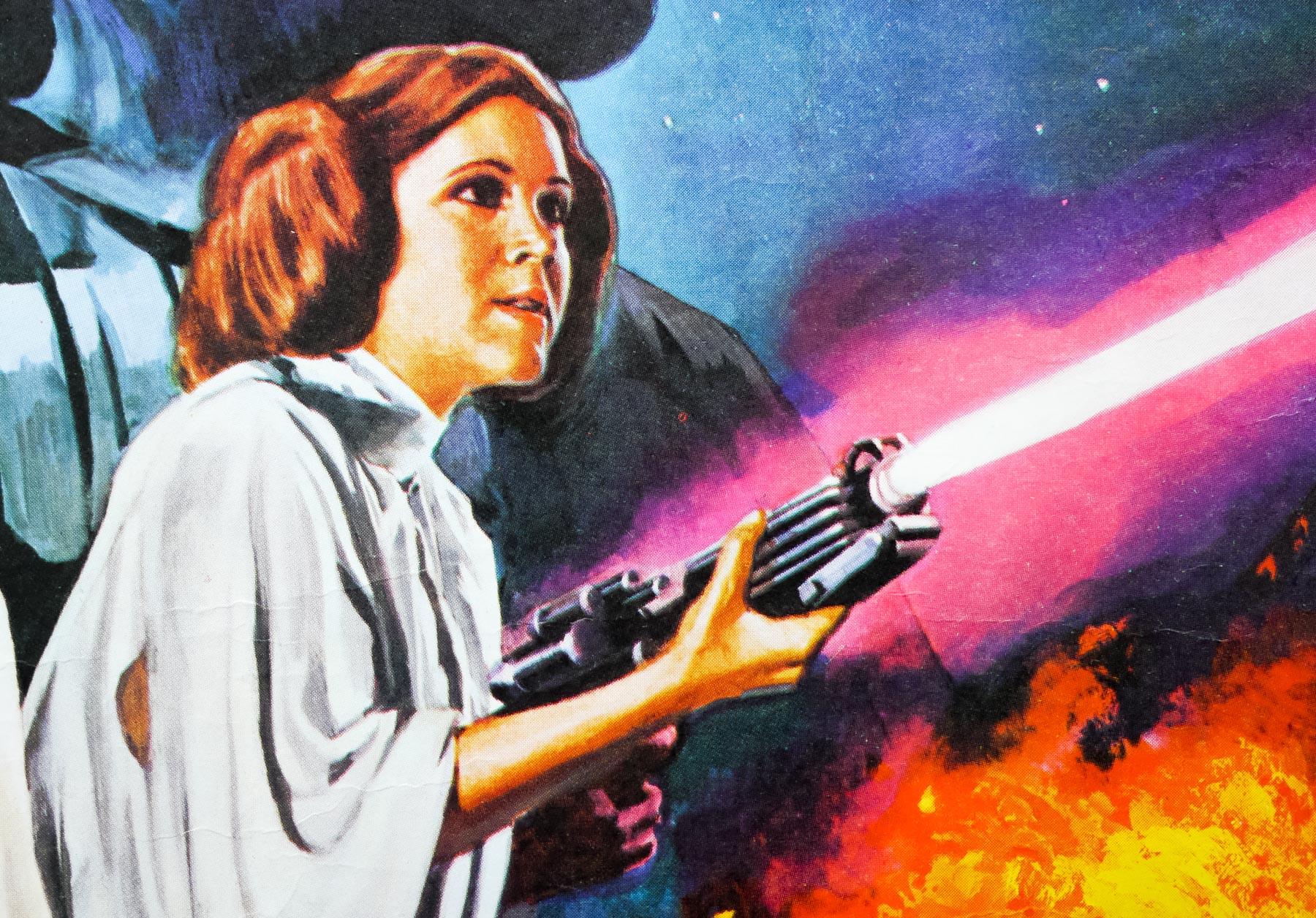
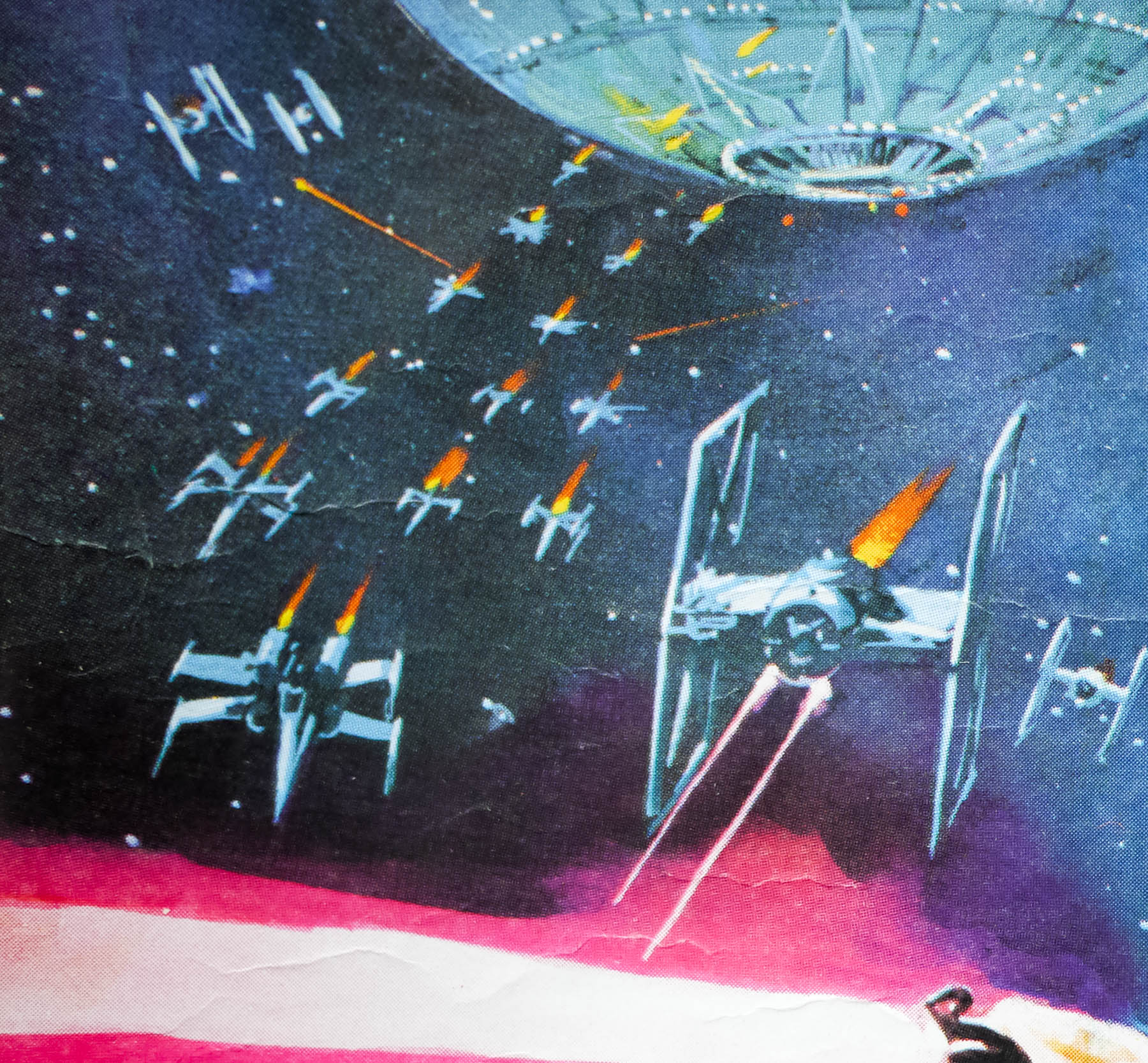
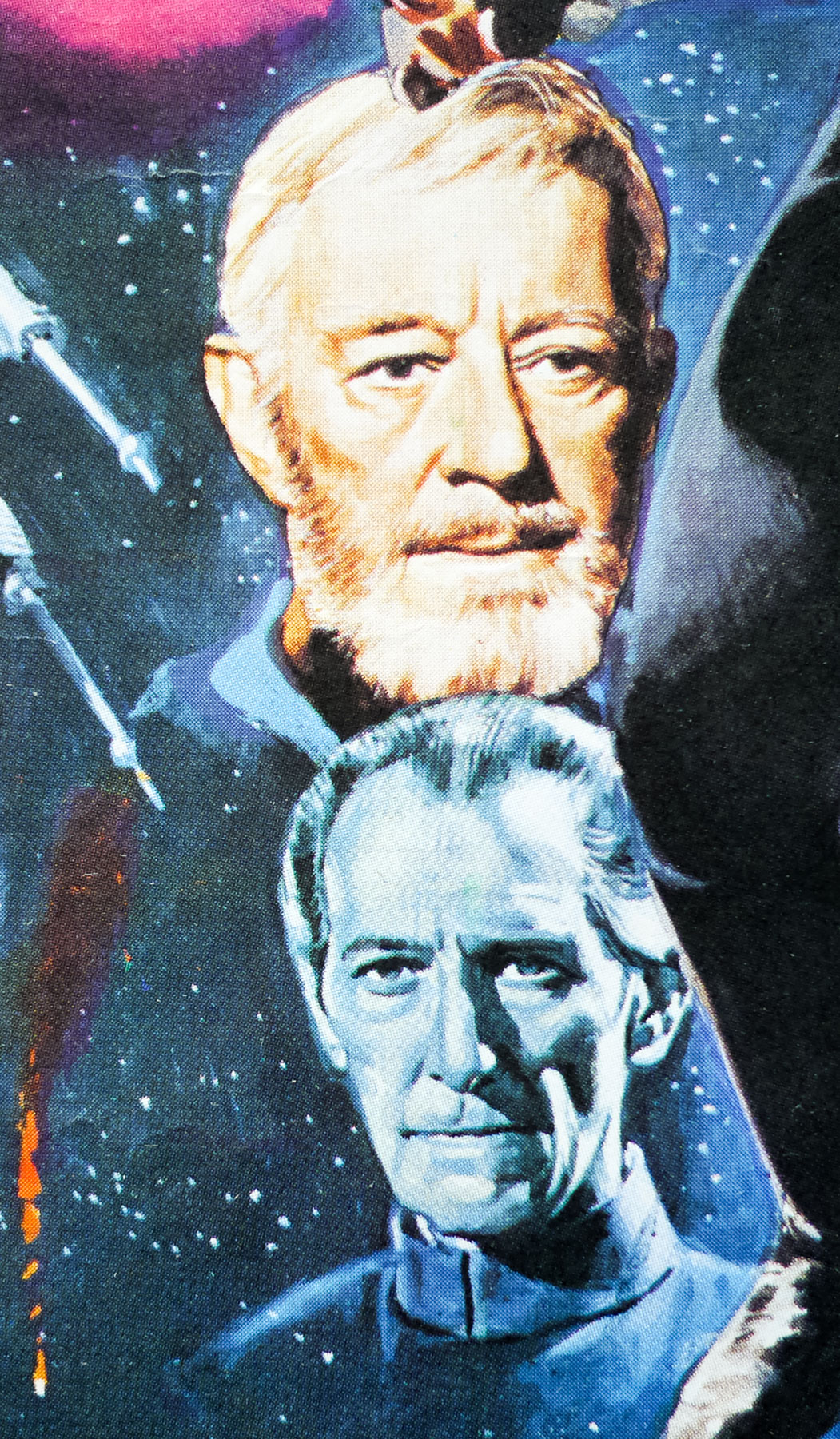
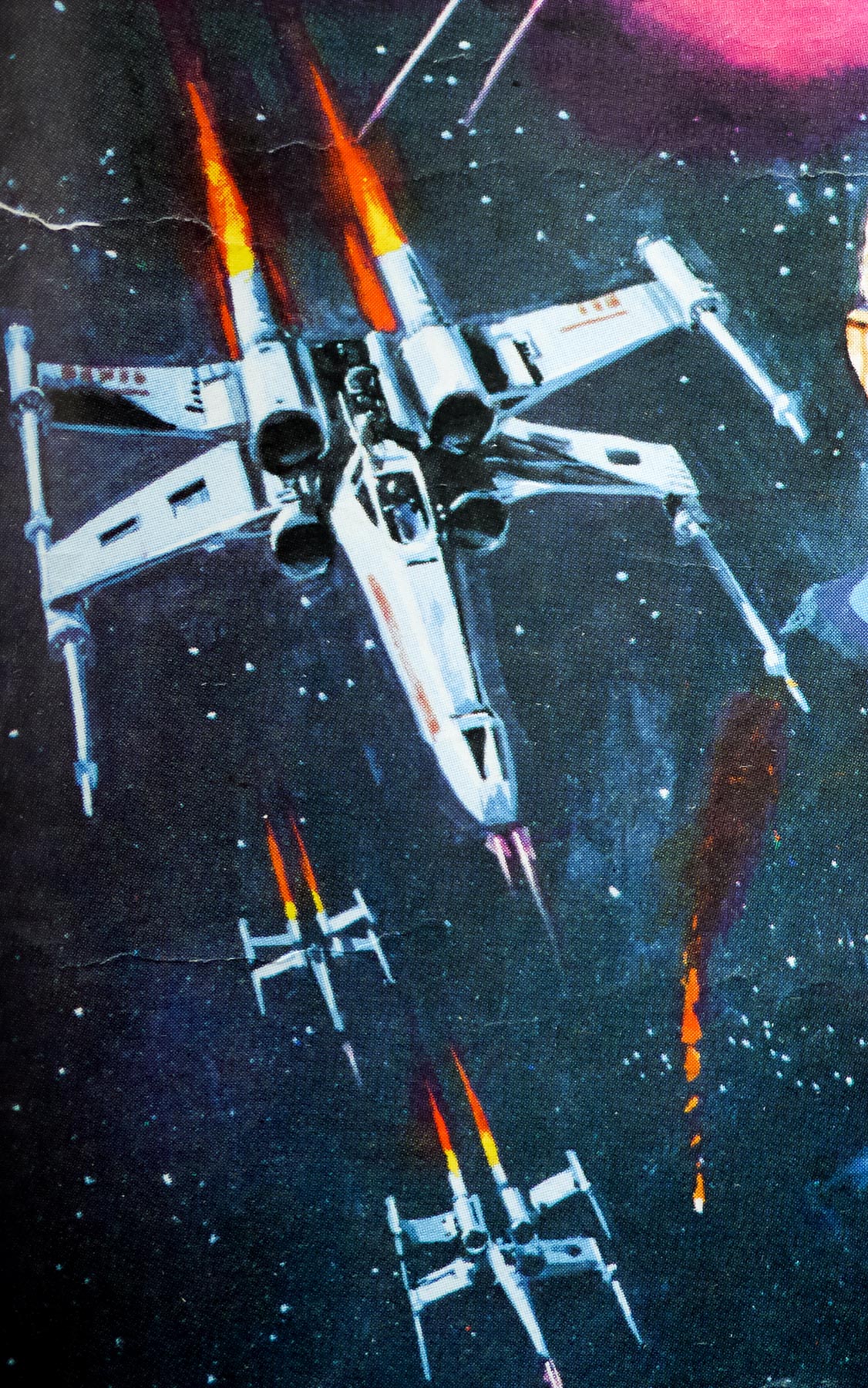
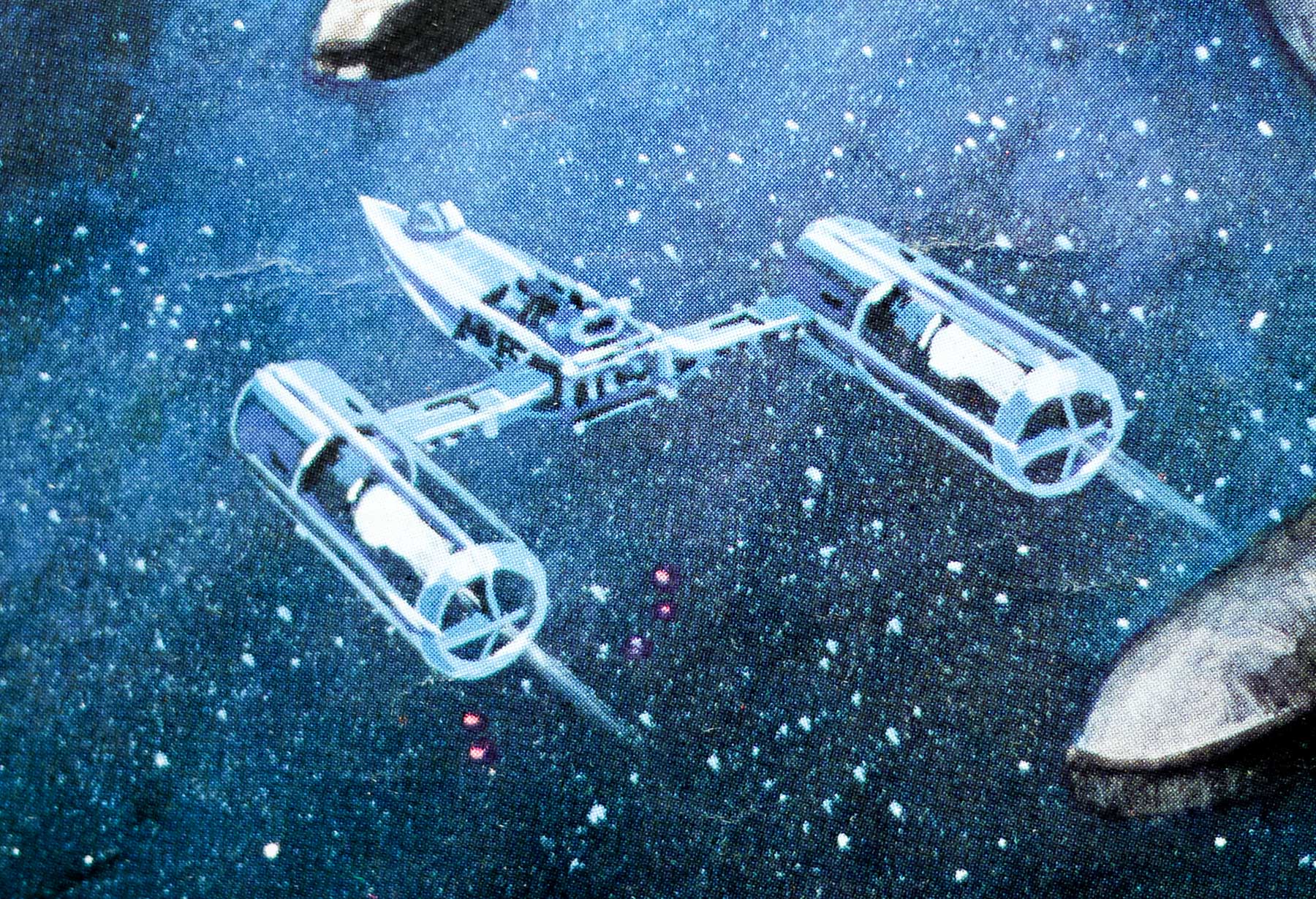
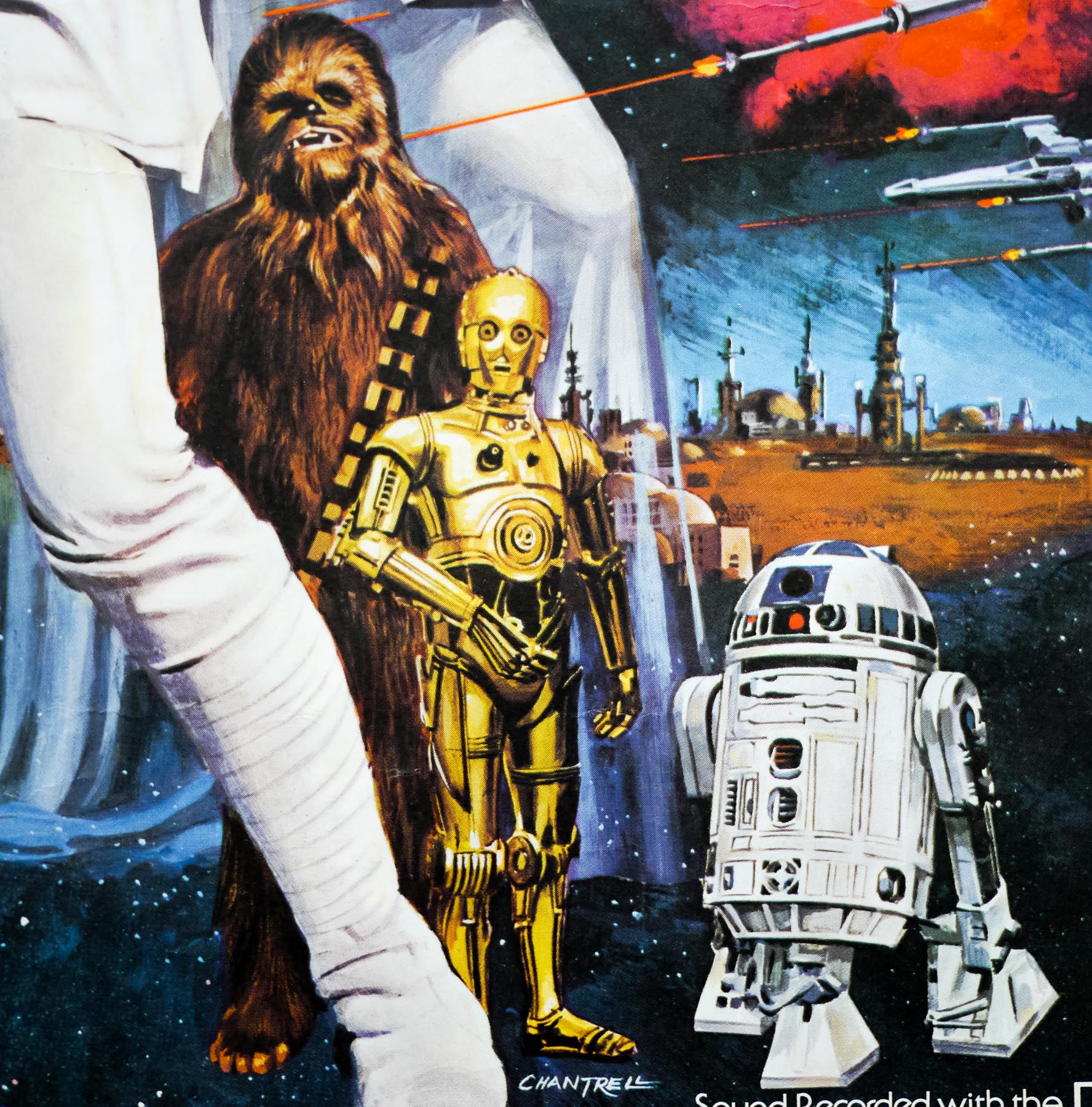
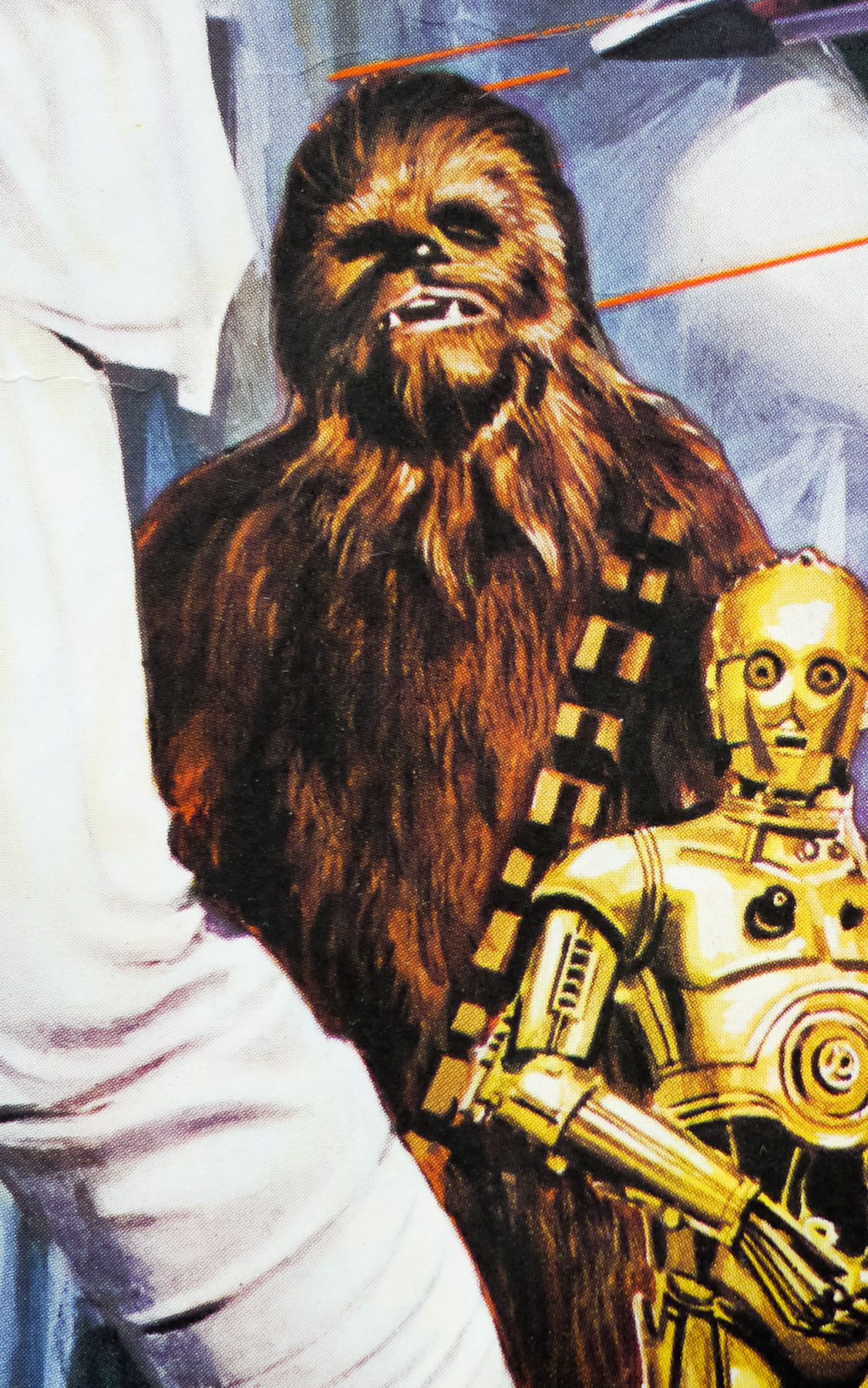
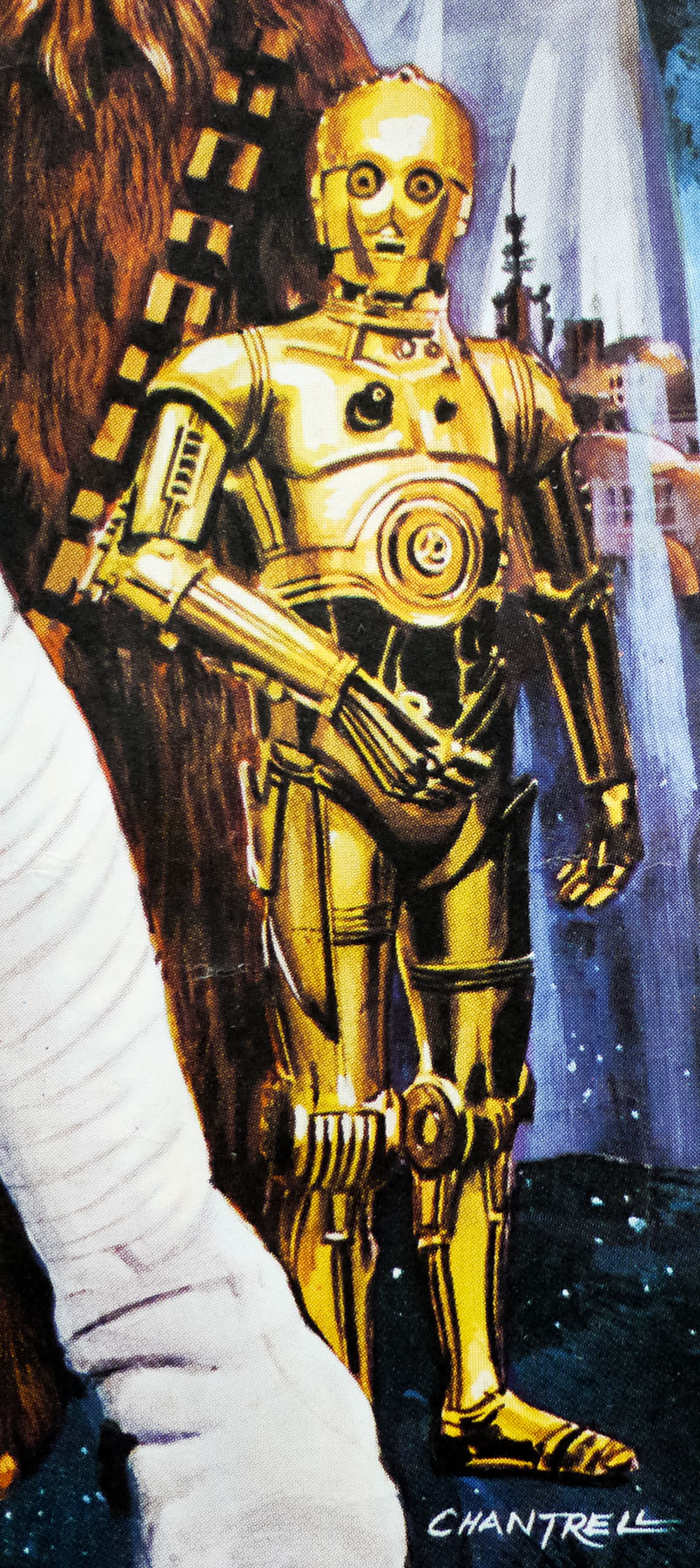
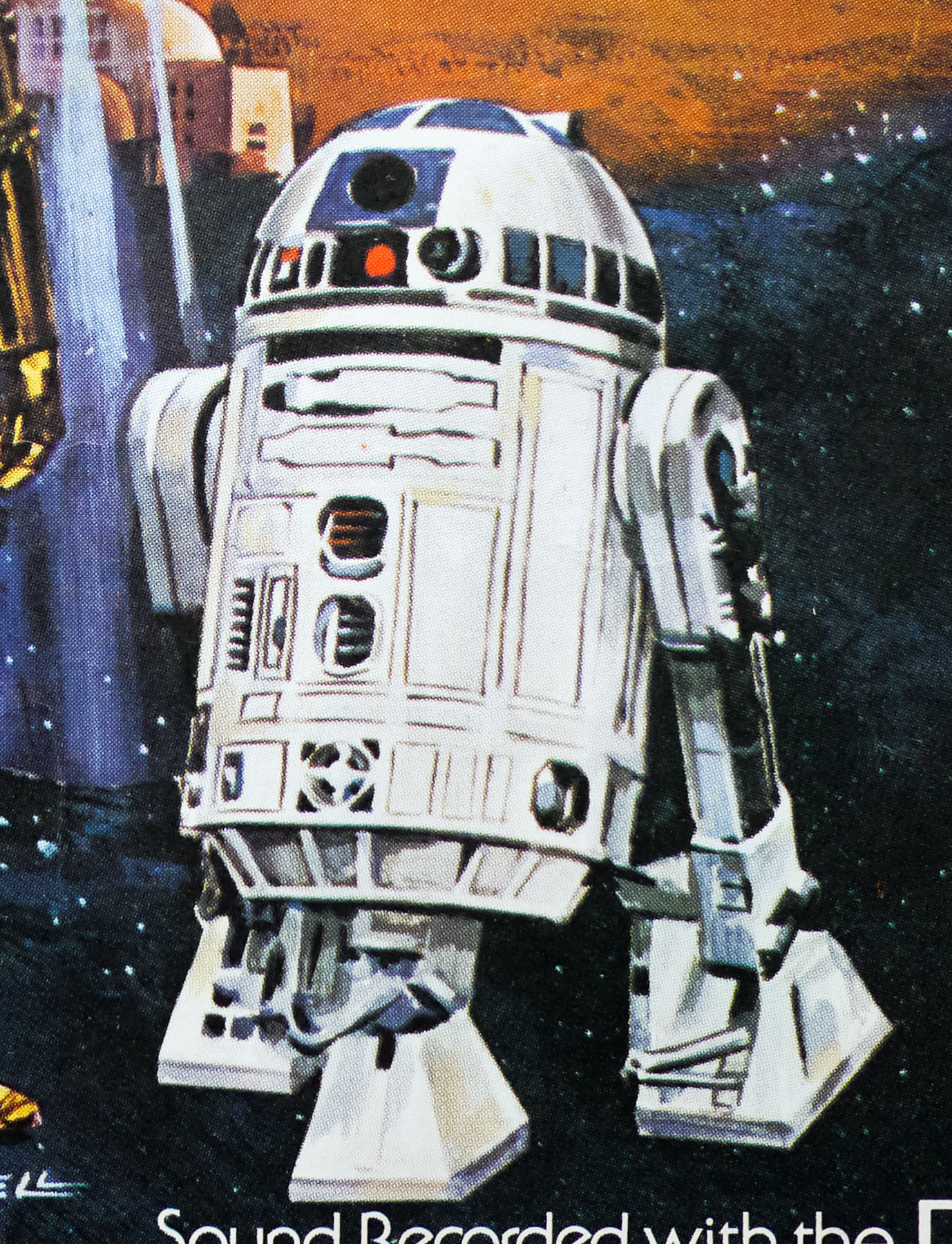
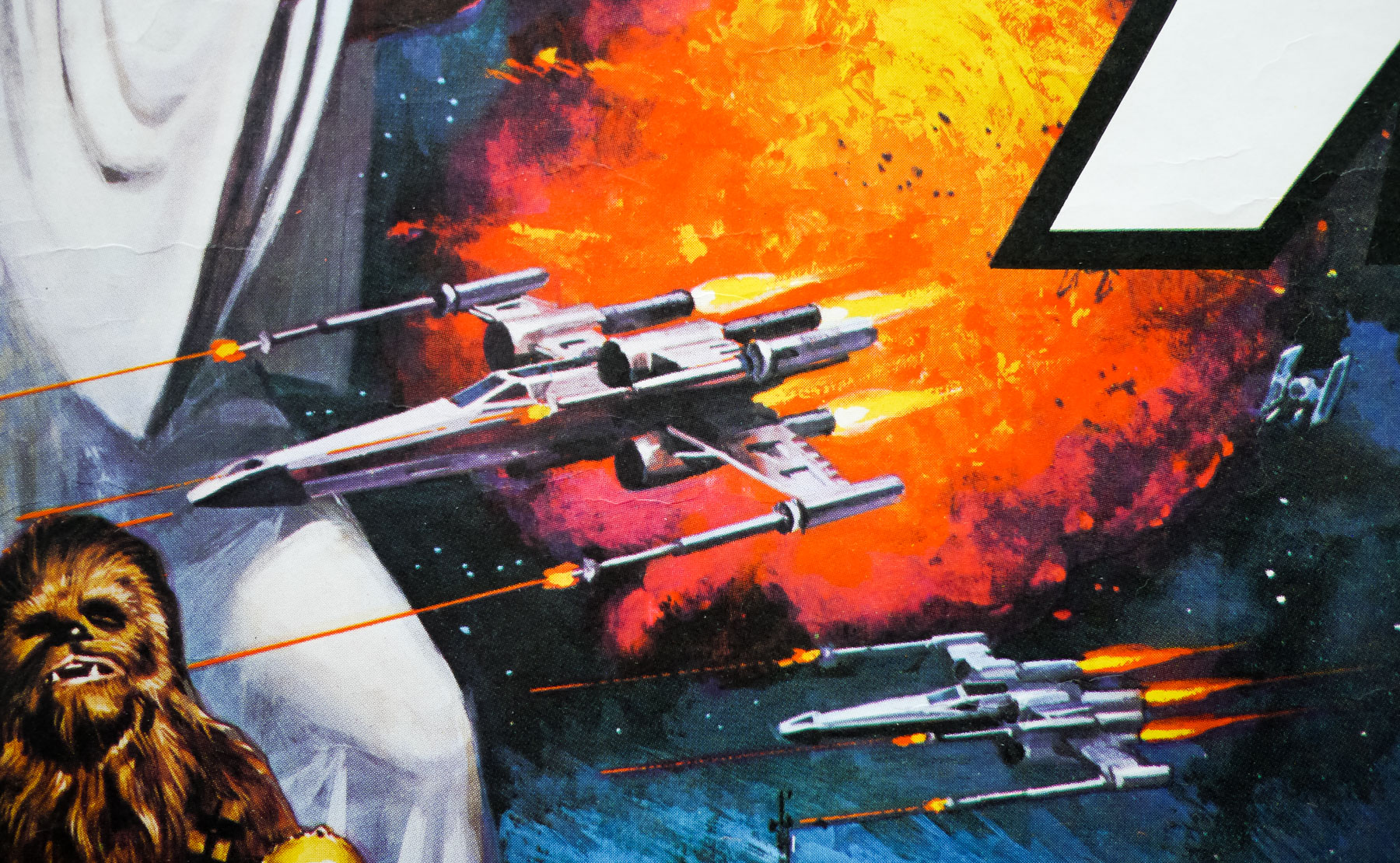
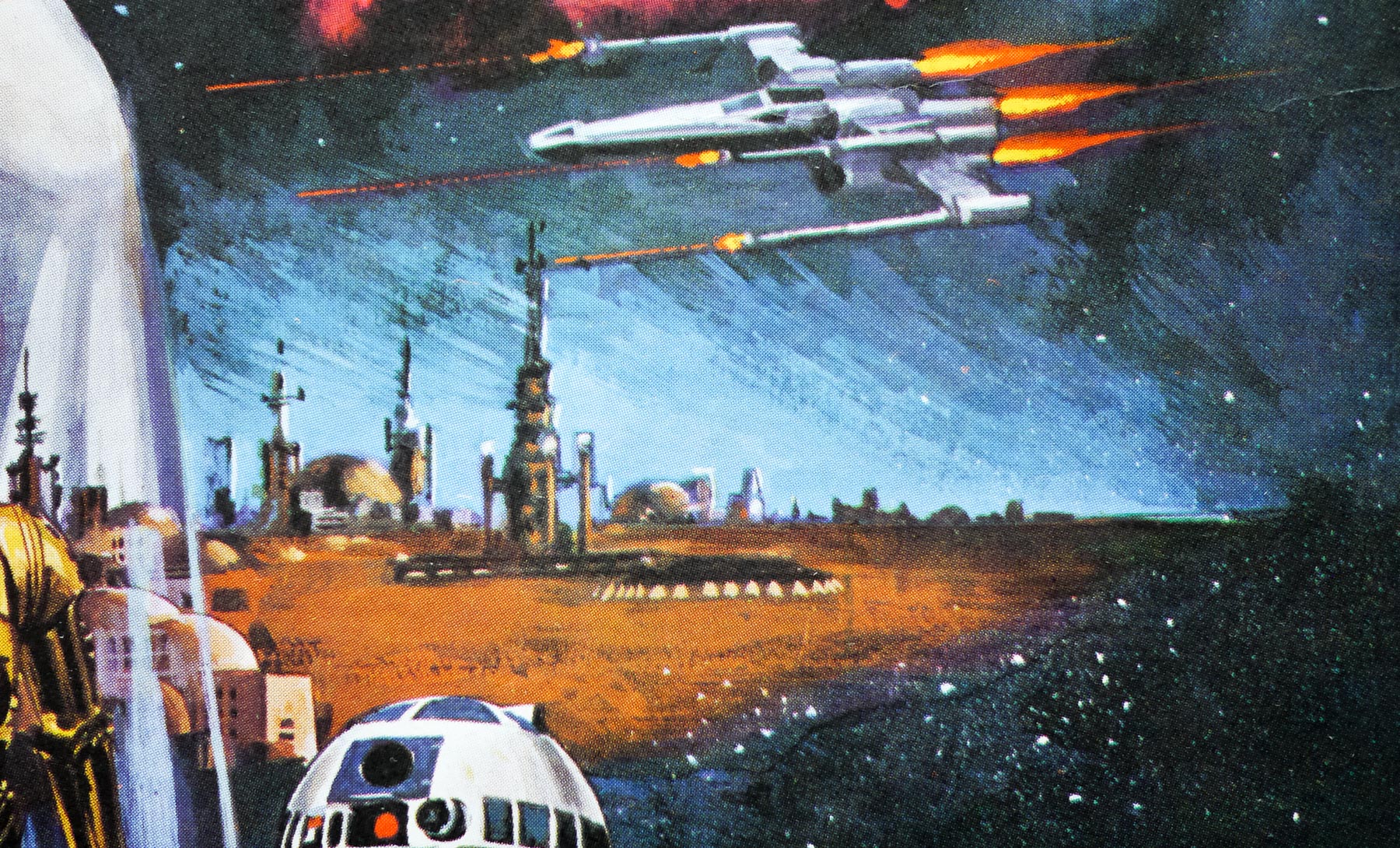
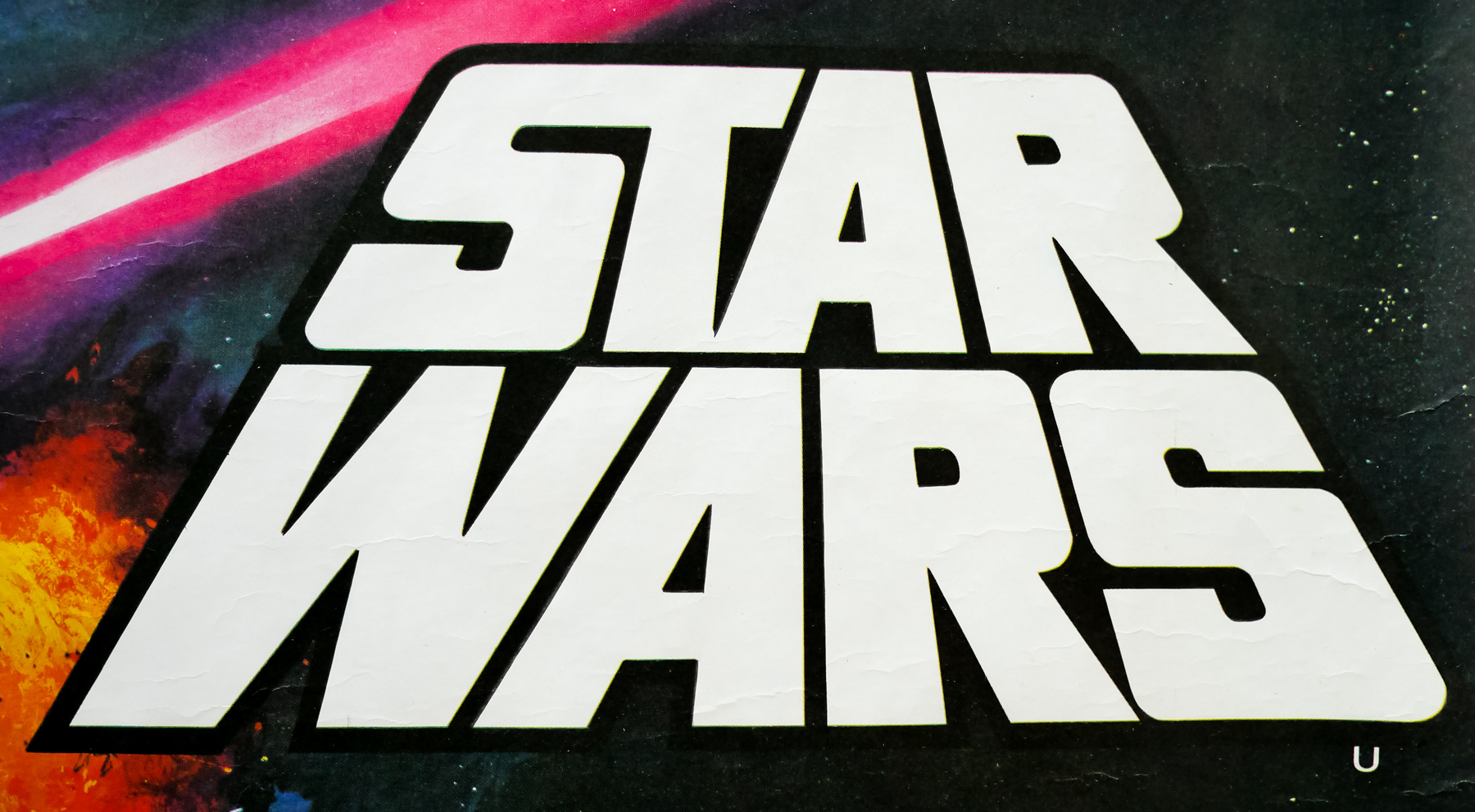
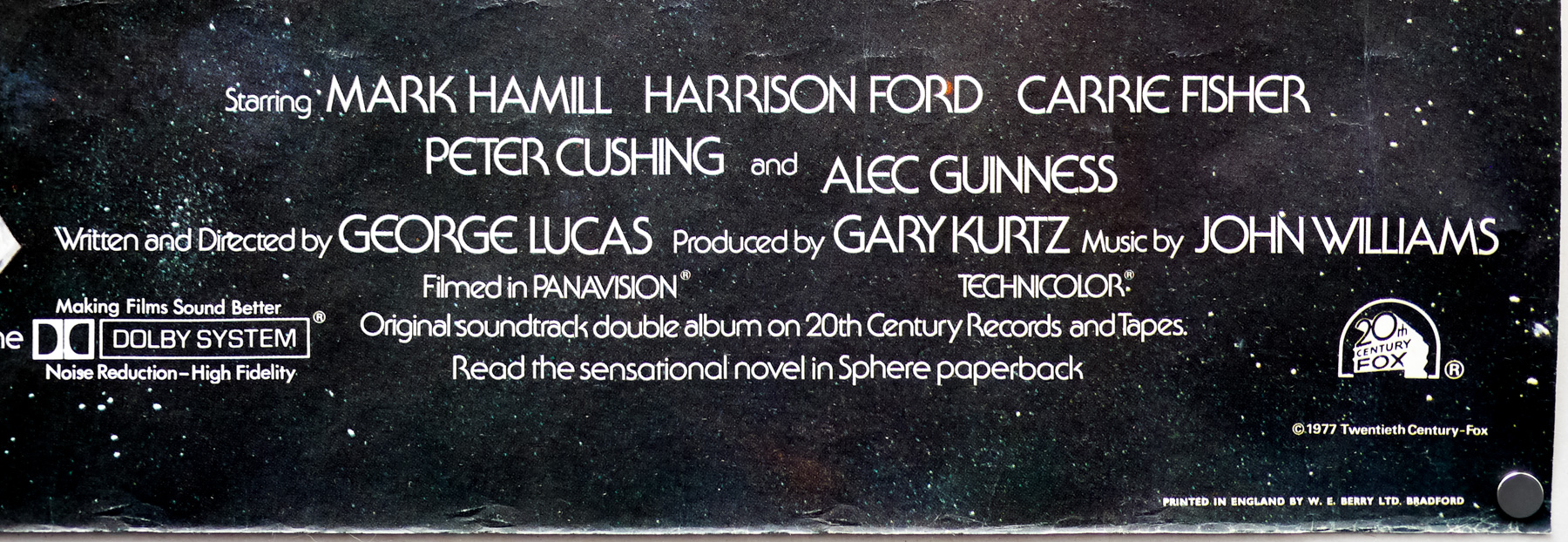
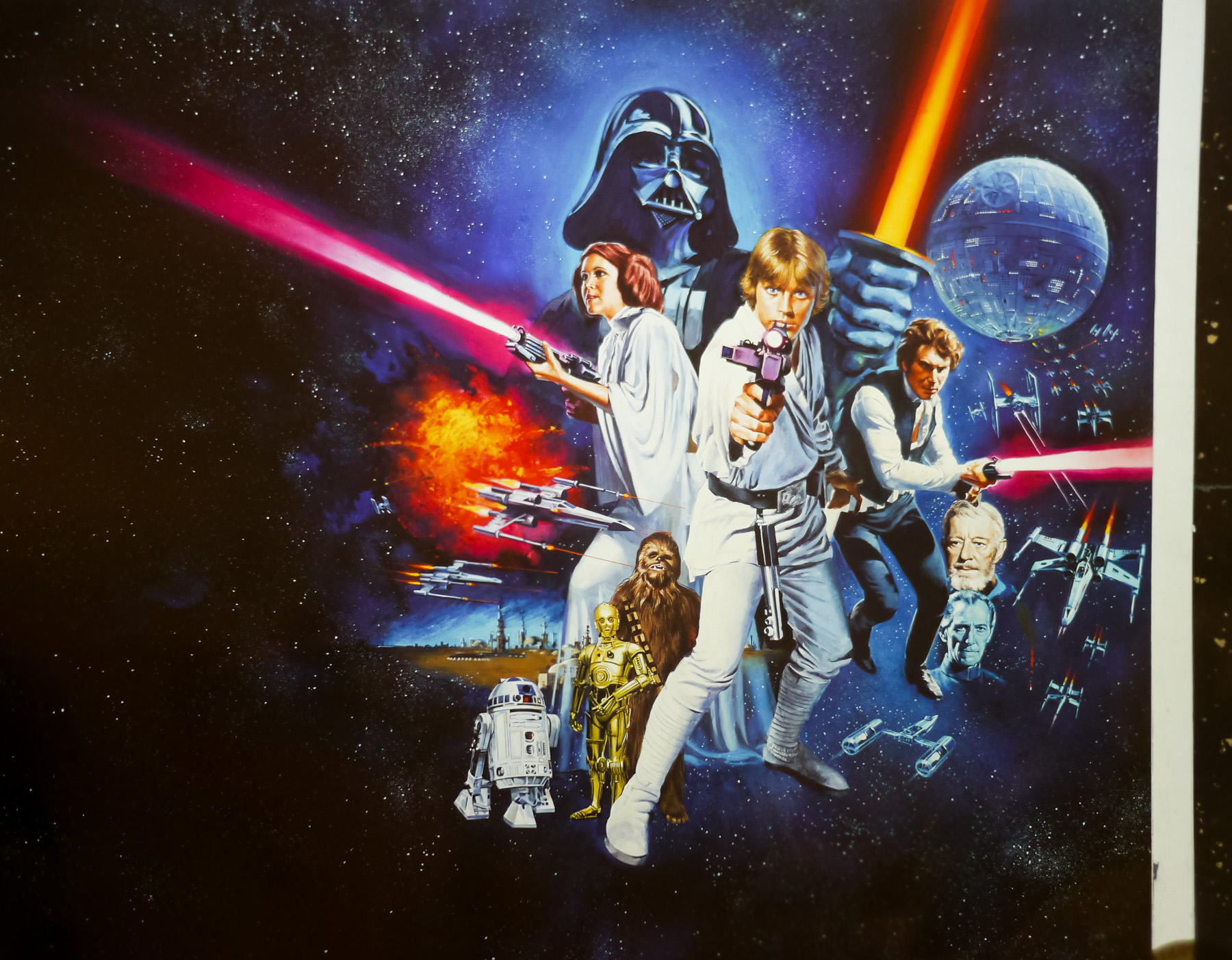
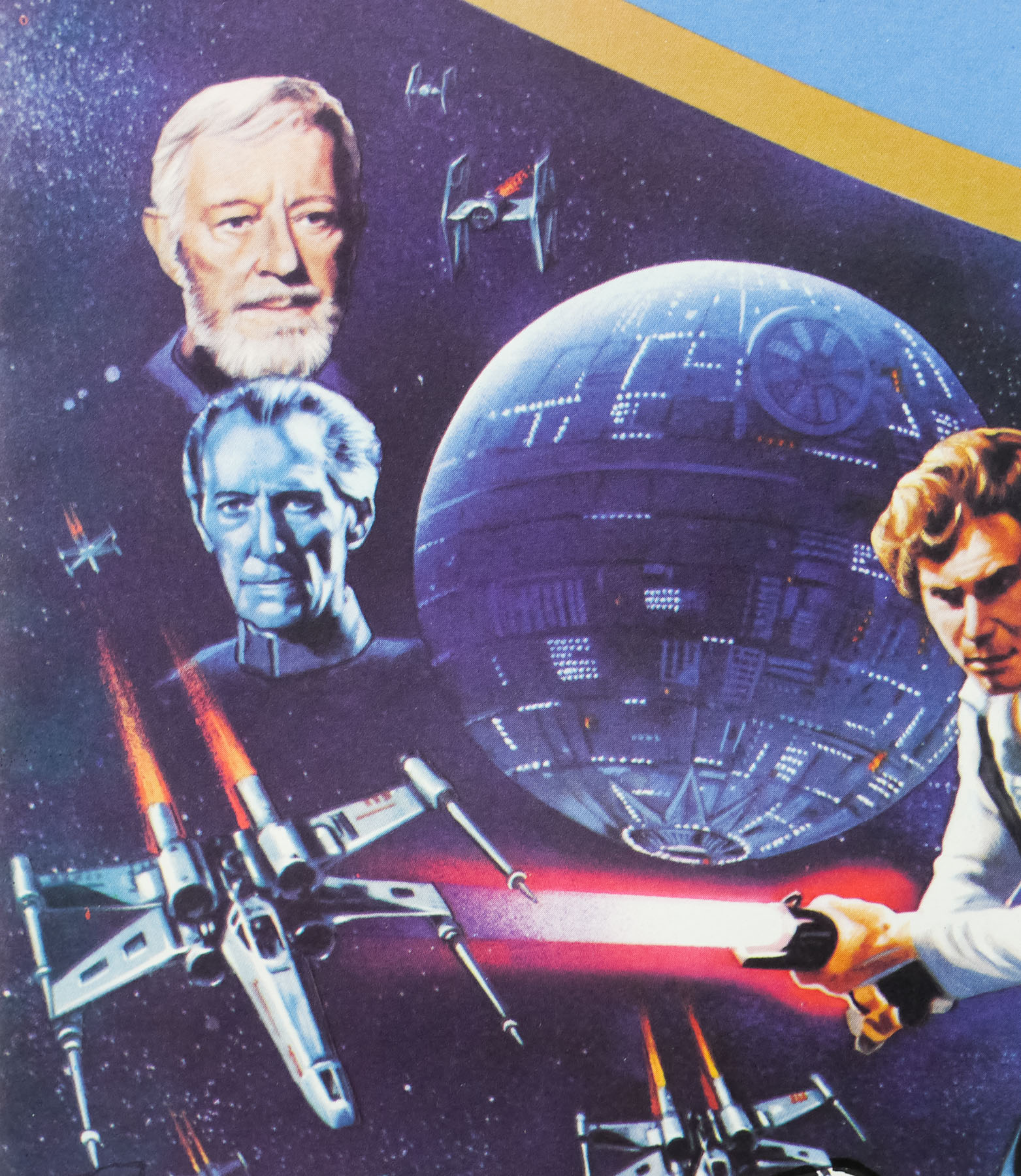
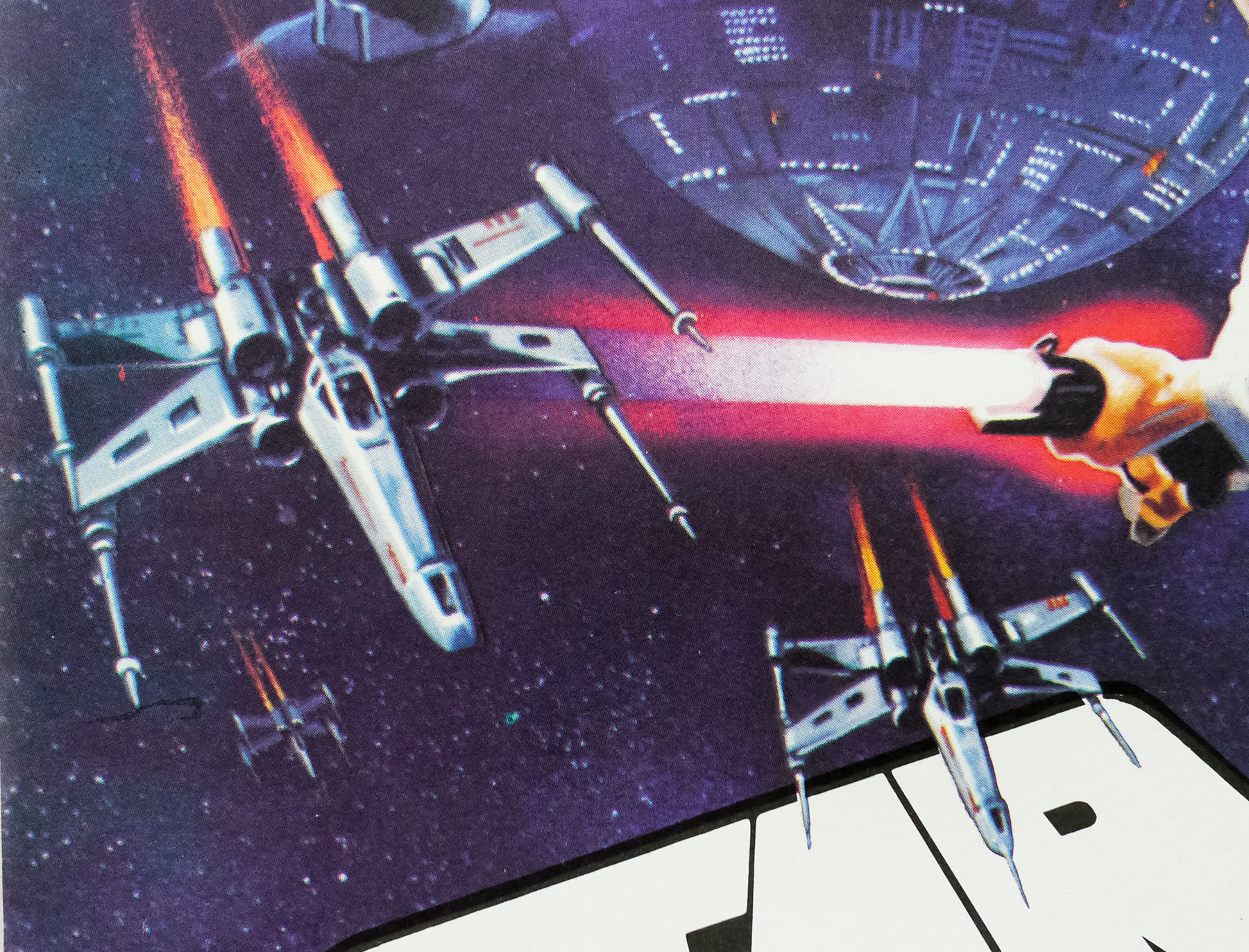
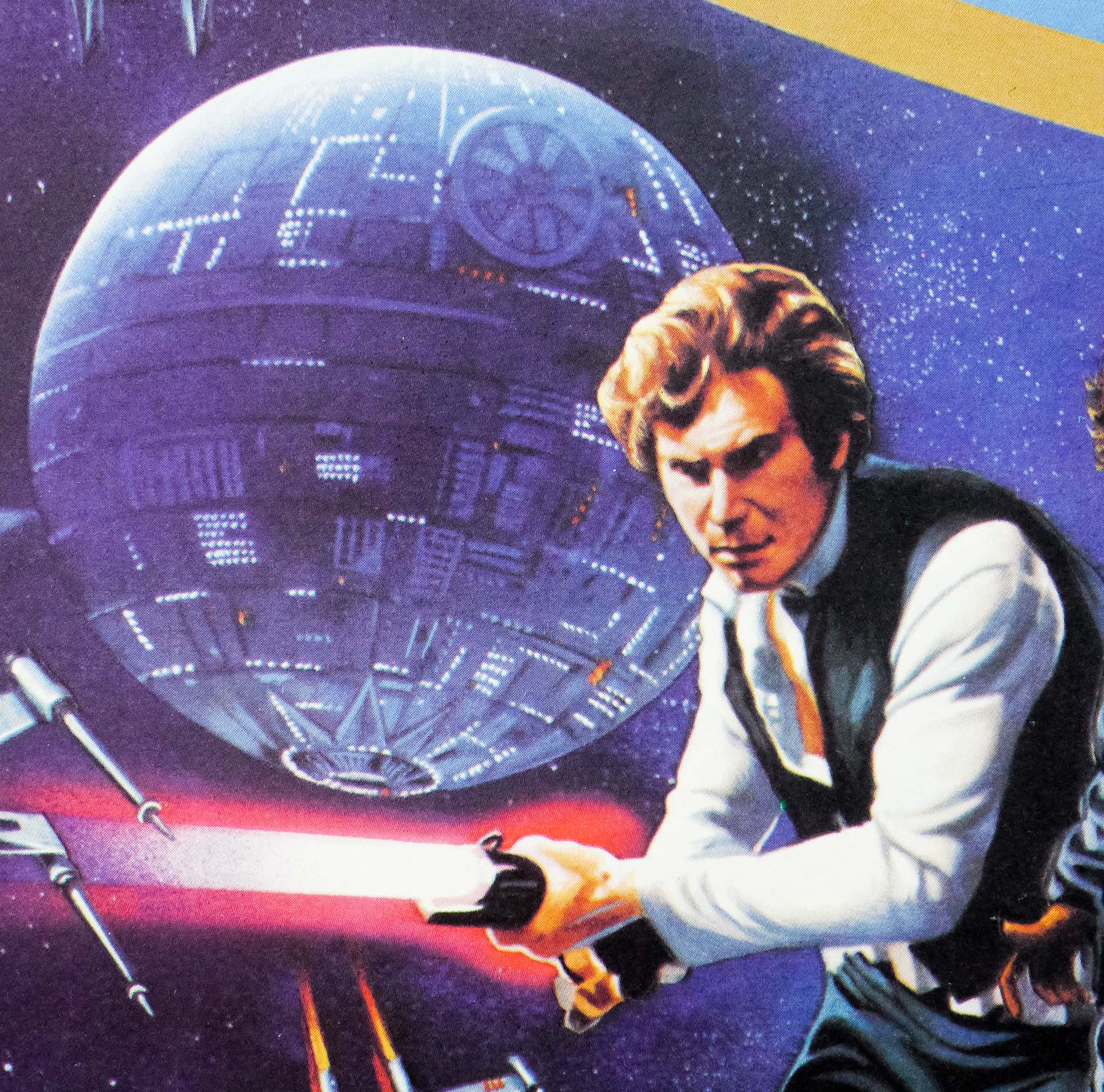
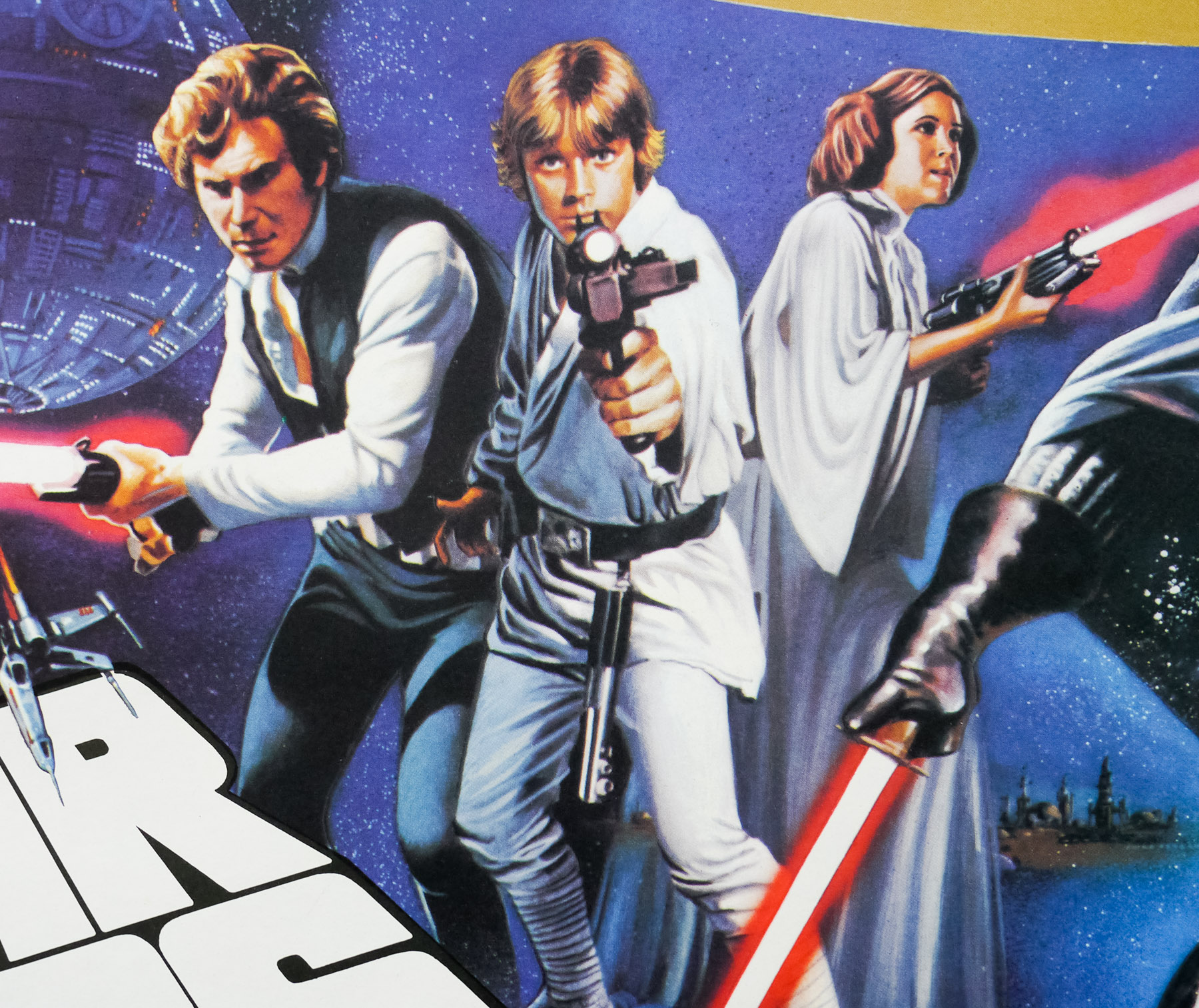
Not only is this probably the best poster artwork for the film that started the biggest sci-fi franchise of all, it’s also considered by many to be the greatest work by the late, great British artist Tom Chantrell. Declaring it so is not an easy decision to make since Chantrell illustrated thousands of posters during his long career and there are many classic designs to choose from, including several Hammer posters and a brilliant design for ‘One Million Years B.C.’. I have a number of other posters by him on this site for you to peruse.

In 2013 I interviewed Chantrell’s widow Shirley about their life together and she recalled how Tom would often ask her to pose so he could capture the correct stance for female characters appearing on his posters. Shirley recalls how the project came about for Tom:

Tom was given an invite to the premier showing and we all went along as a family. As soon as he’d seen the film he had the synopsis, the 10” x 8” press stills and then he started to think about how he was going to tackle the project. From beginning to end it took one month, which is a lot of work for one poster. He’d never taken that long before and I don’t think he did again.

Shirley once again posed for Tom and this time she was his Princess Leia. She not only still has the reference photos taken that day but also still has the same dress she wore.

This poster perfectly captures the excitement and adventure of the seminal sci-fi blockbuster and, although originally intended just to be used for the UK market, the art was liked so much by Lucasfilm that the decision was made to use it for a style C one sheet as well as for other posters around the world. George Lucas himself would later purchase the original artwork for his archives and I like to imagine it’s hanging on a wall in Skywalker Ranch.

This particular style of the poster is the first printing of the poster for the initial 1977 release in cinemas and this can be distinguished from the later printing known as the ‘Oscars version’, so called because it was printed once the film had won a handful of Academy Awards a few months after the original UK release. The ongoing success and phenomenon of the film meant that many more copies of the second version were printed as it was shown around the UK. The Oscars version is also in the Film on Paper collection and can be viewed here.

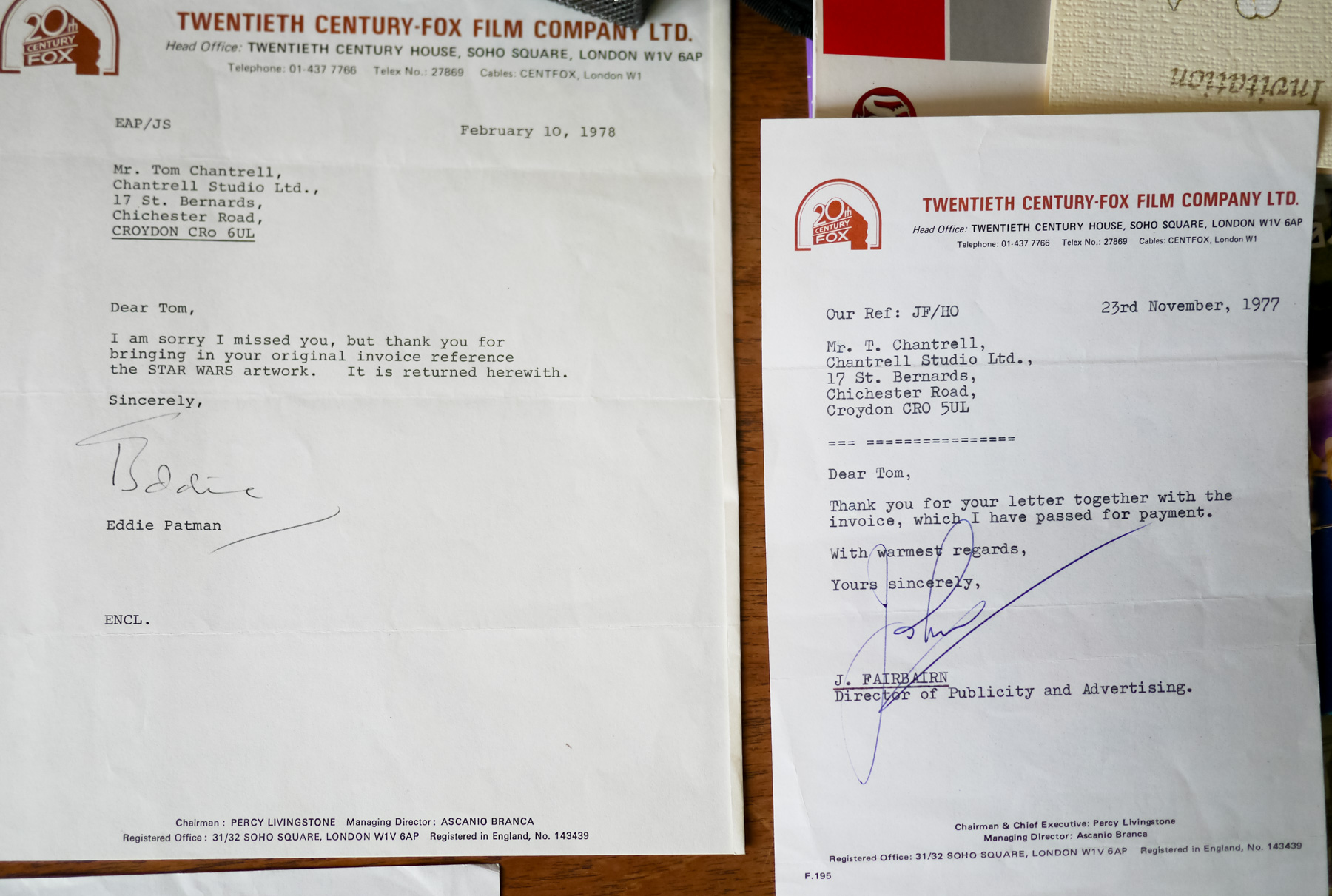
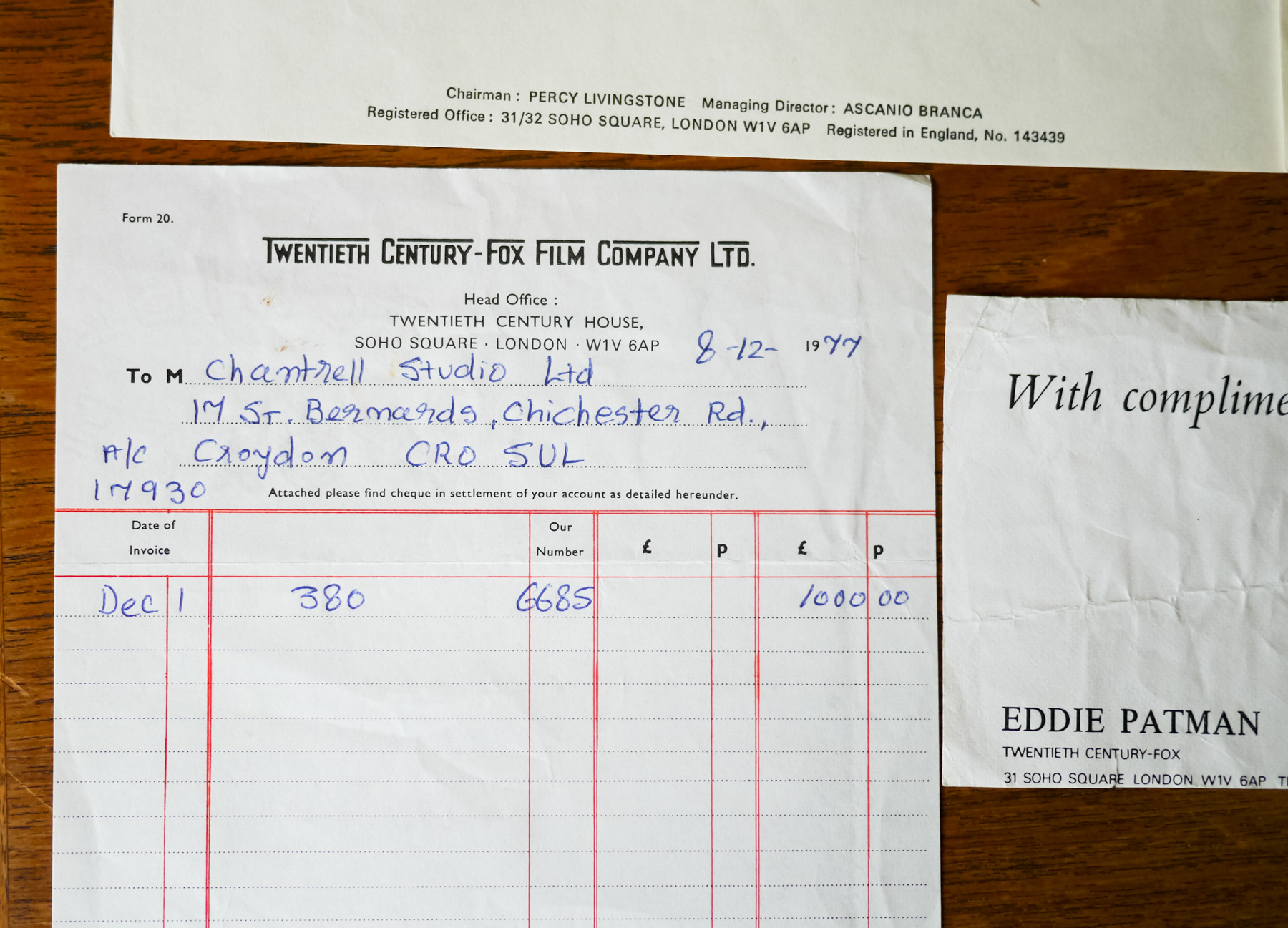
During the time I spent with Shirley we browsed through several boxes of the plentiful material she has kept from the days that Tom was working on film posters. I was amazed to see that he had retained the original invoice that he had sent to 20th Century Fox (Star Wars’ UK distributors) and some letters from Fox relating to the invoice, which confirmed that he had been paid the sum of £1000 for his original work on the art. These can be viewed by accessing picture thumbnails 28 and 29.

Sadly, Tom Chantrell passed away in 2001 and my friend, and author of the must own British Film Posters: An Illustrated History, Sim Branaghan wrote his obituary for the Guardian. He may no longer be with us but Tom Chantrell’s classic artworks have stood the test of time and continue to impress decades later.

Swiss Family Robinson / quad / 1976 re-release / UK

10.08.15

Poster Poster

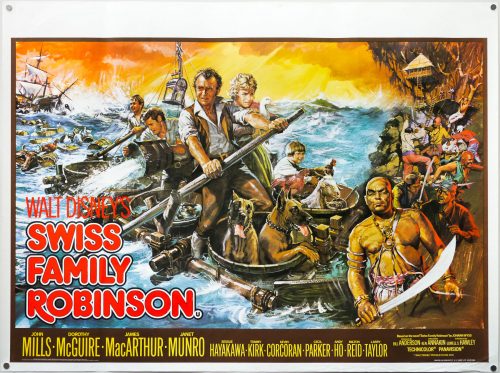
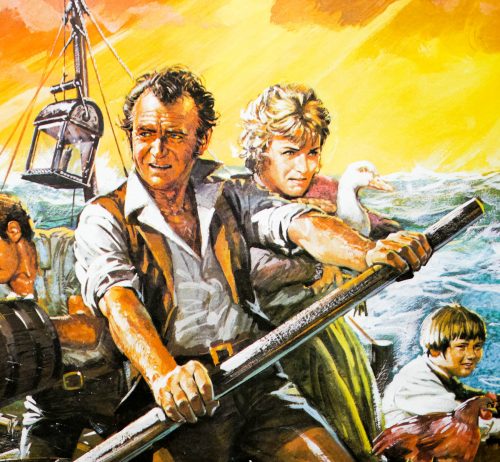
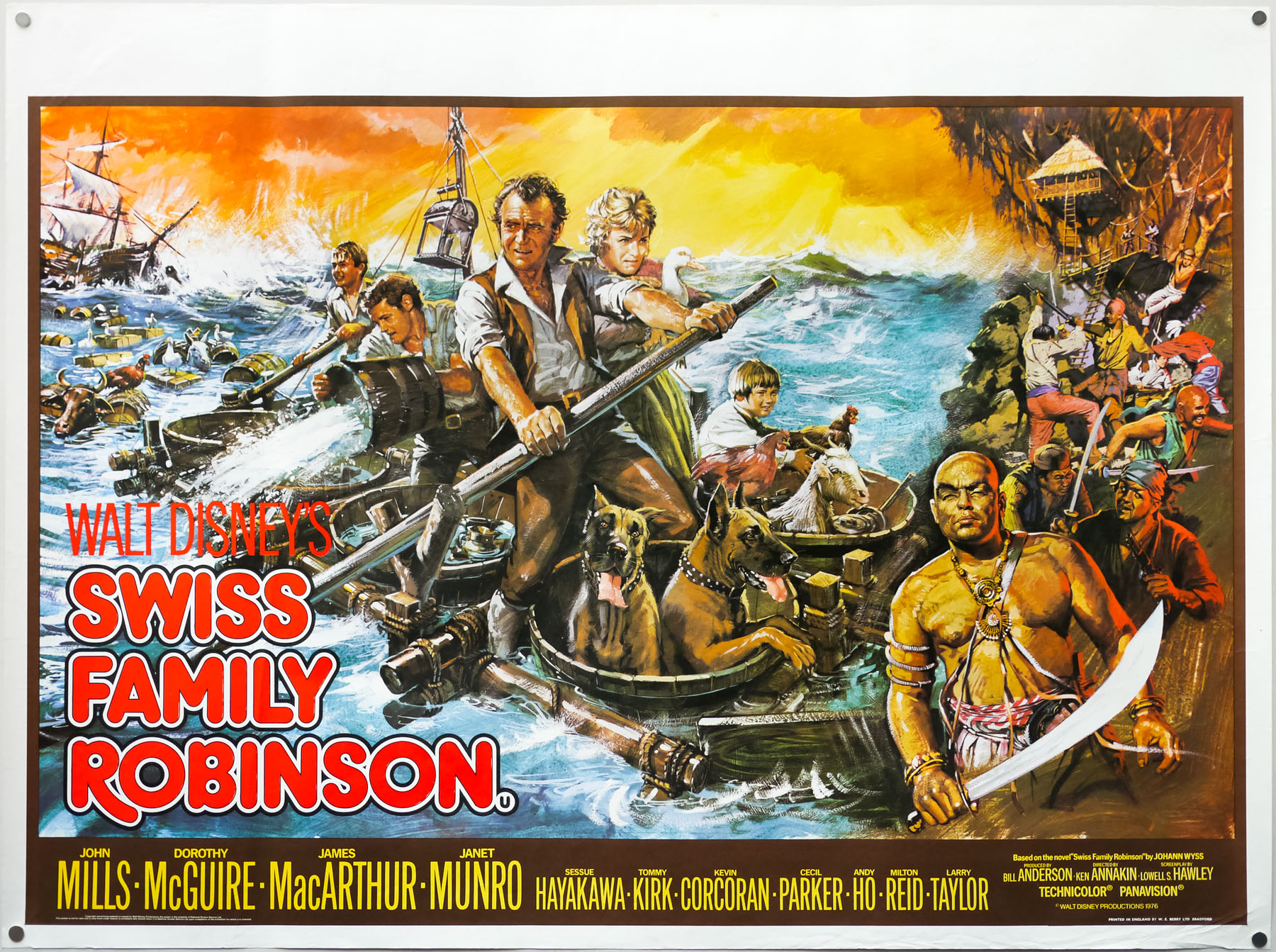
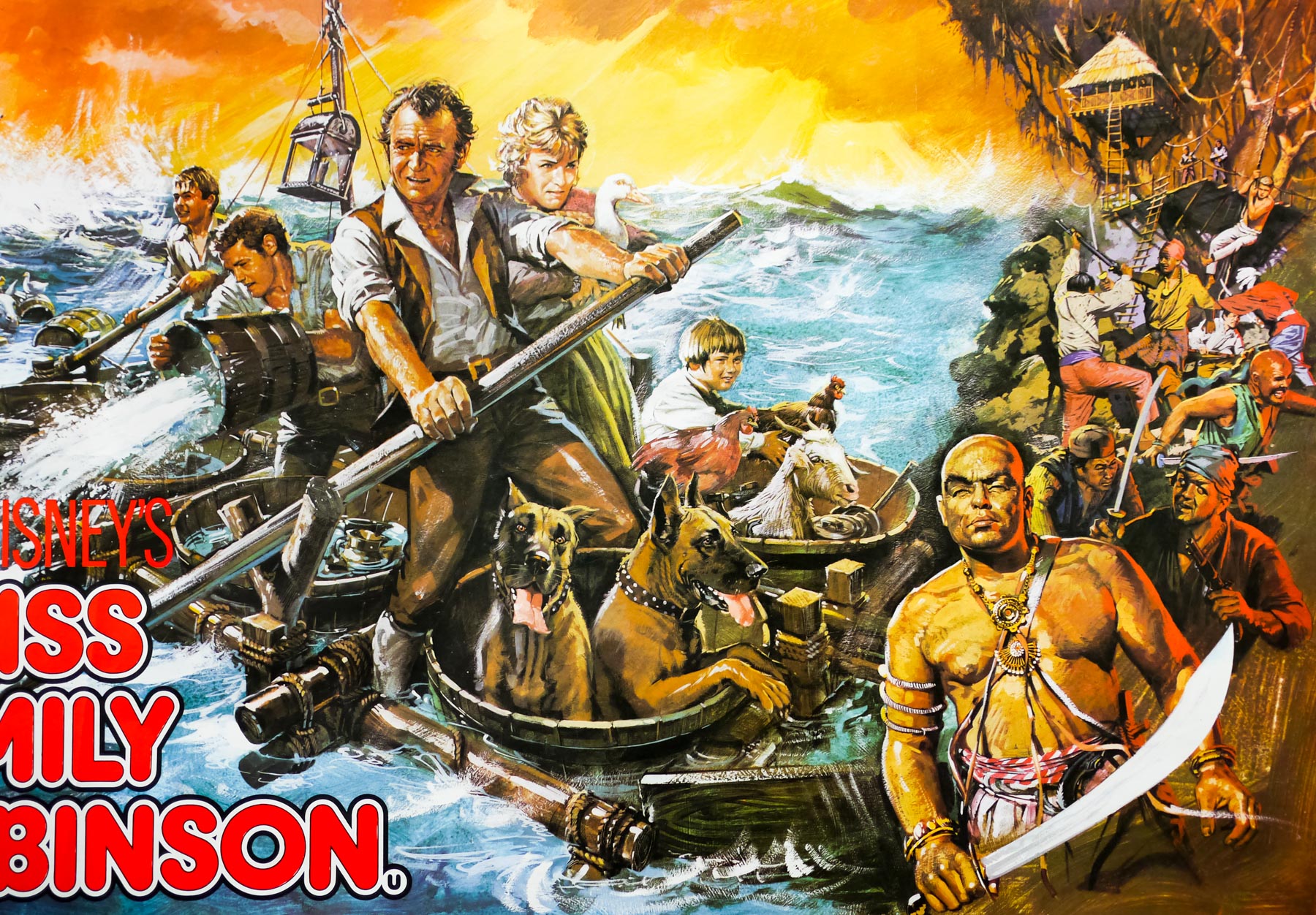
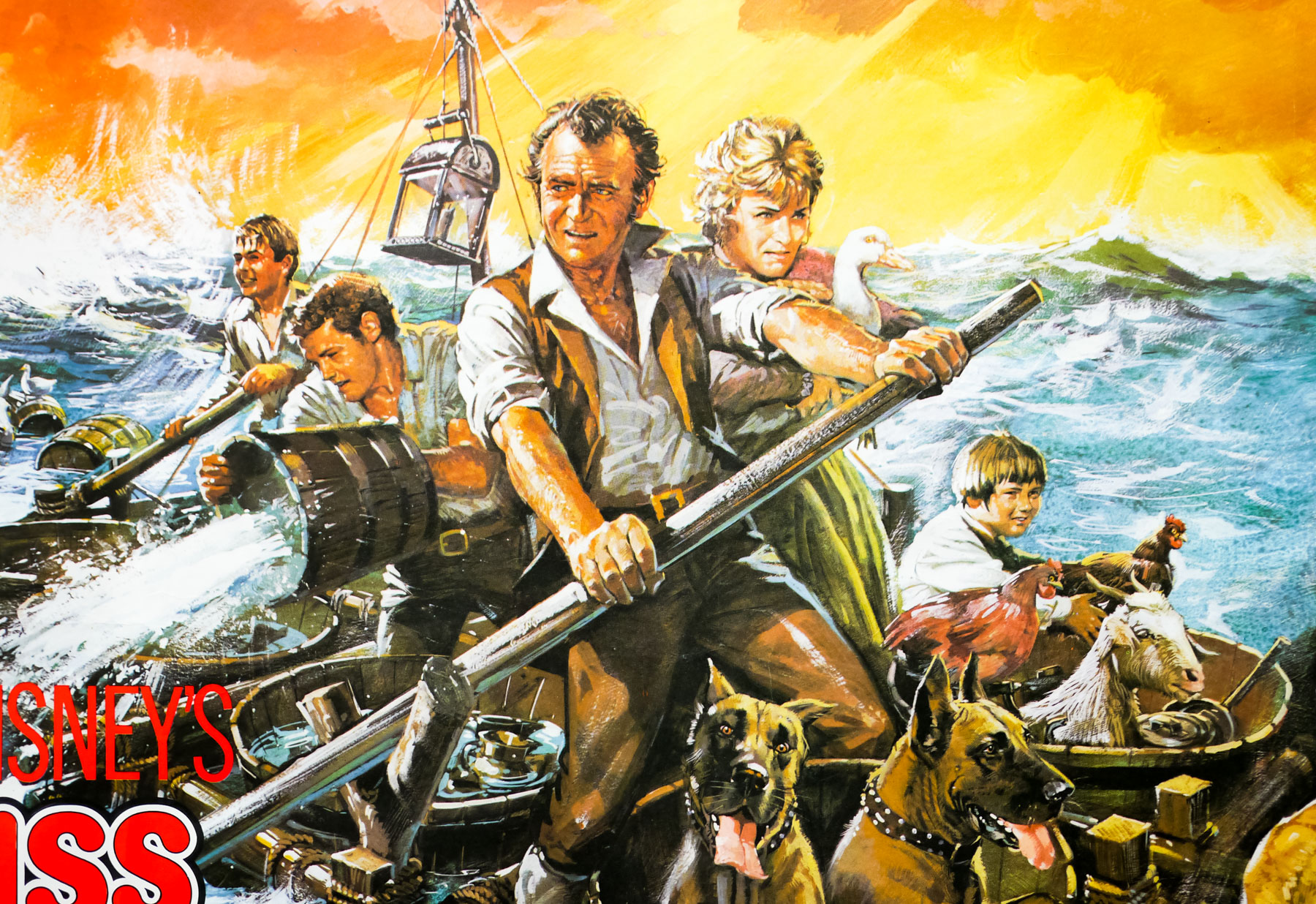
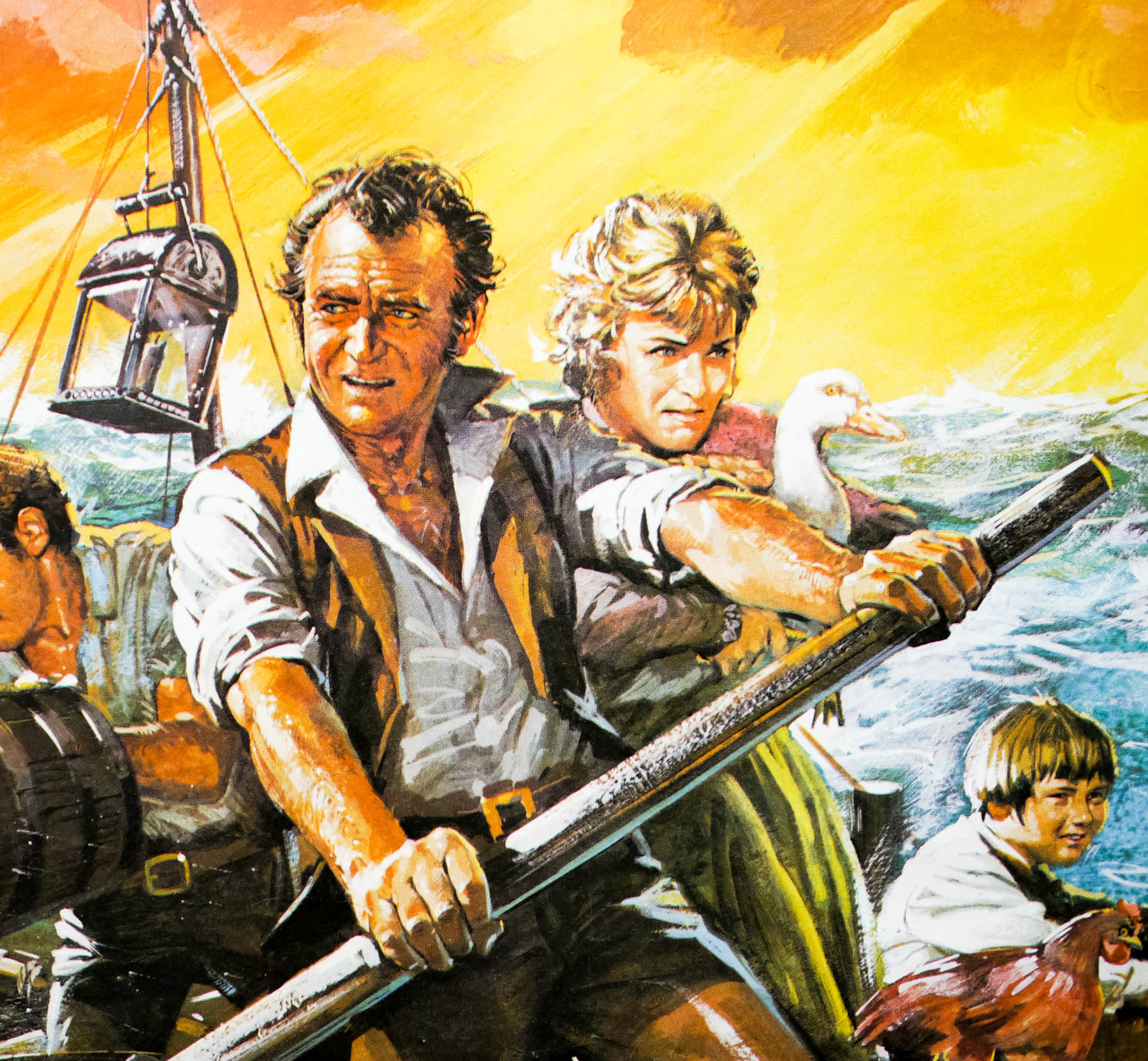
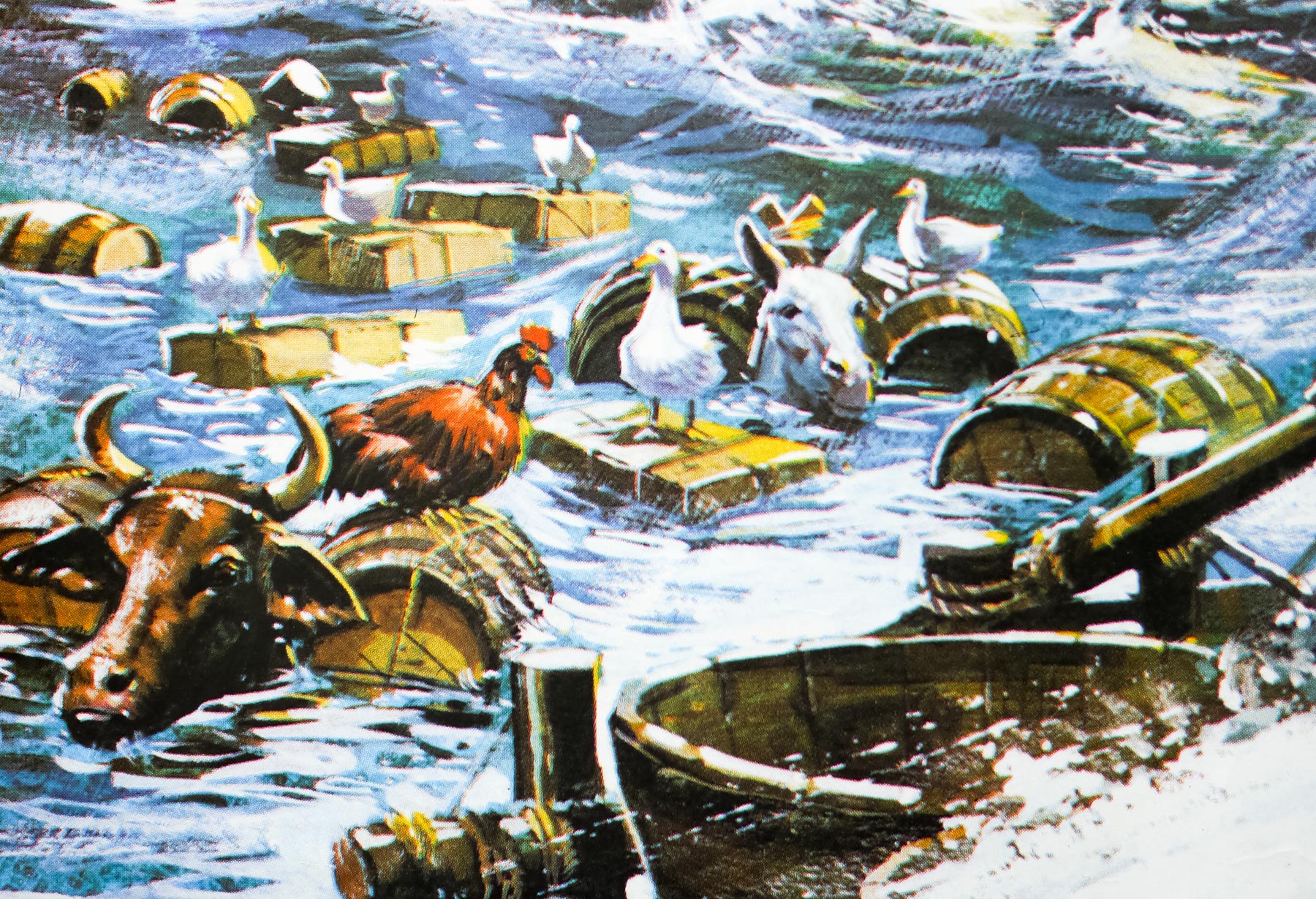
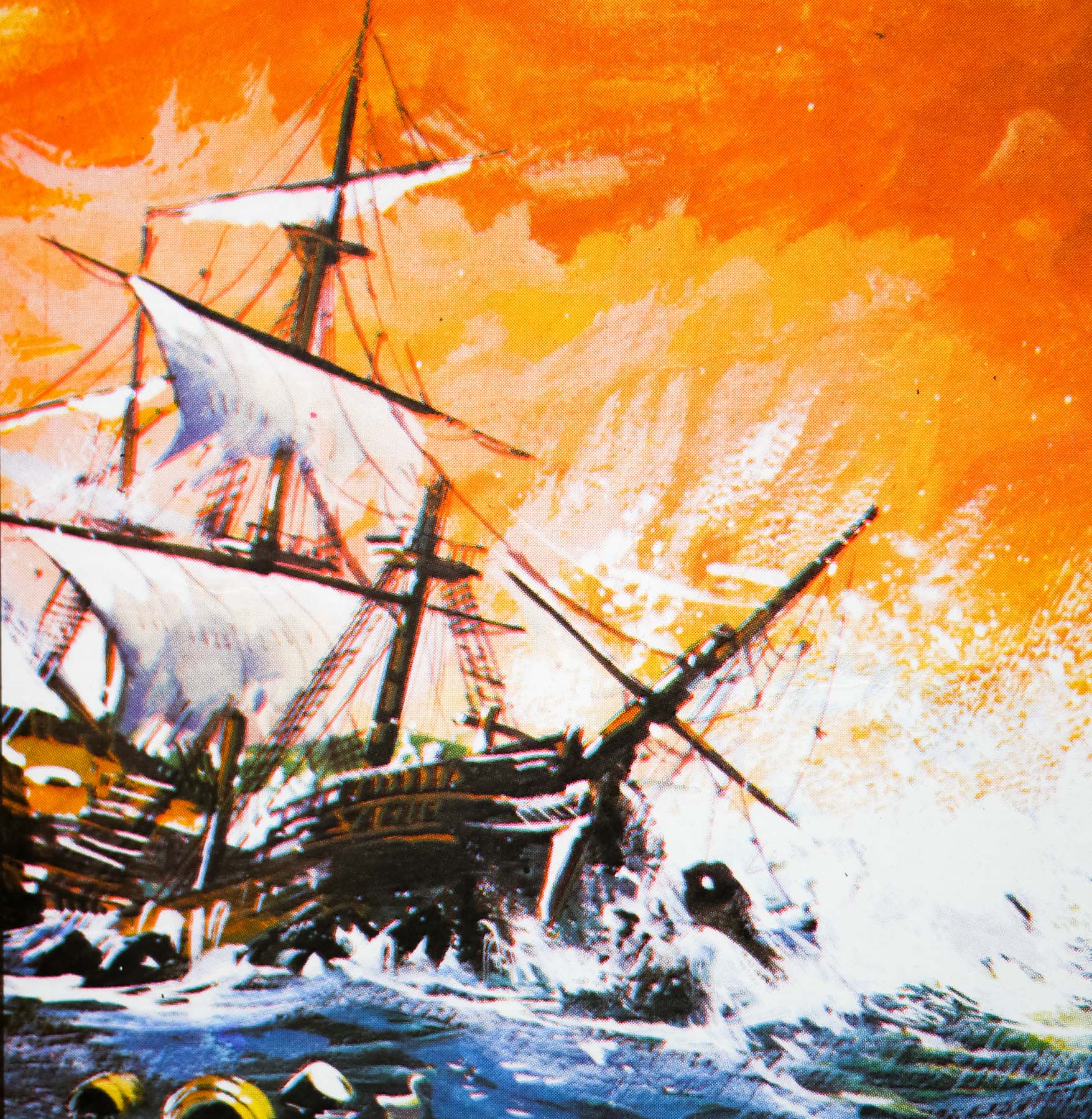
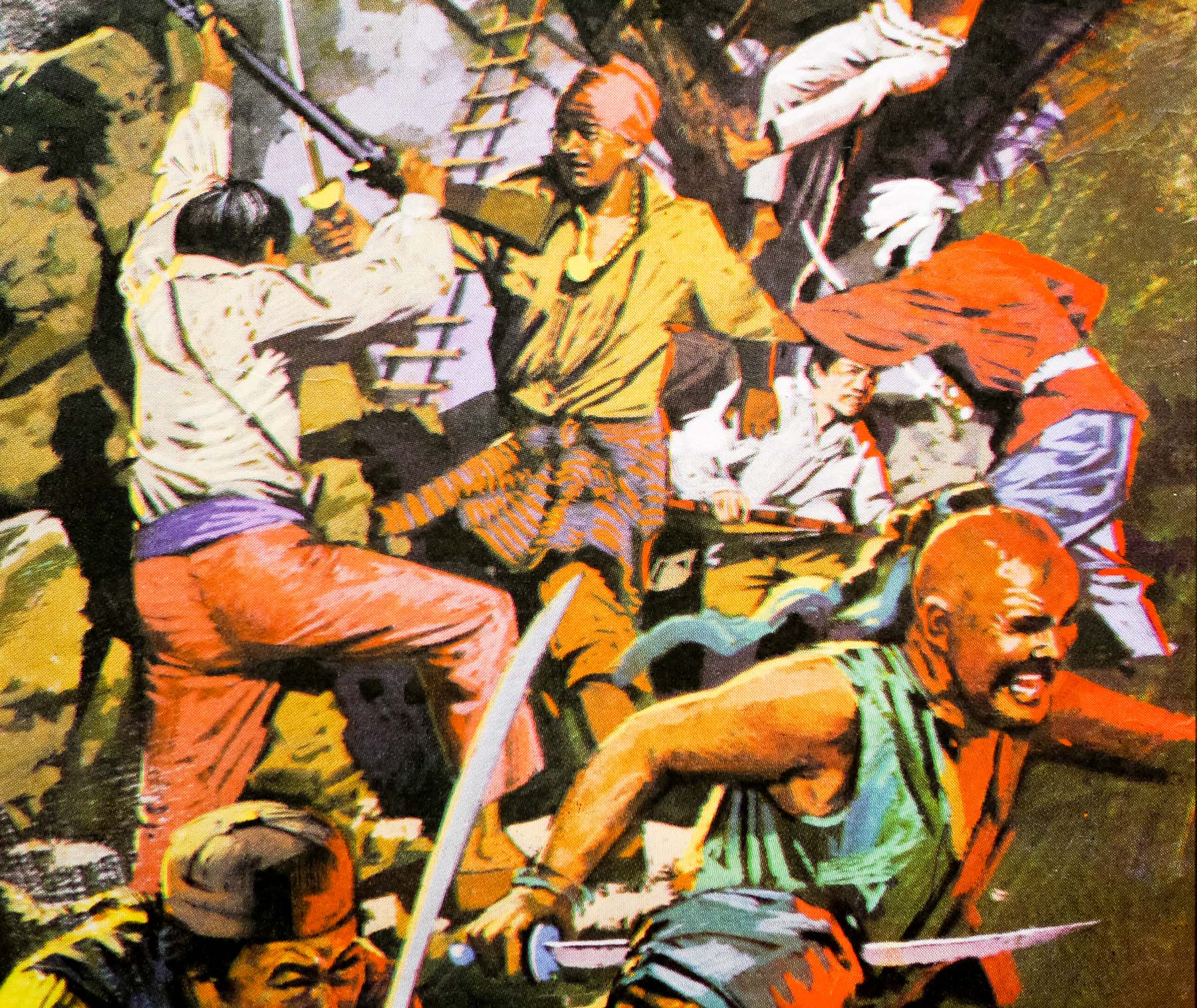
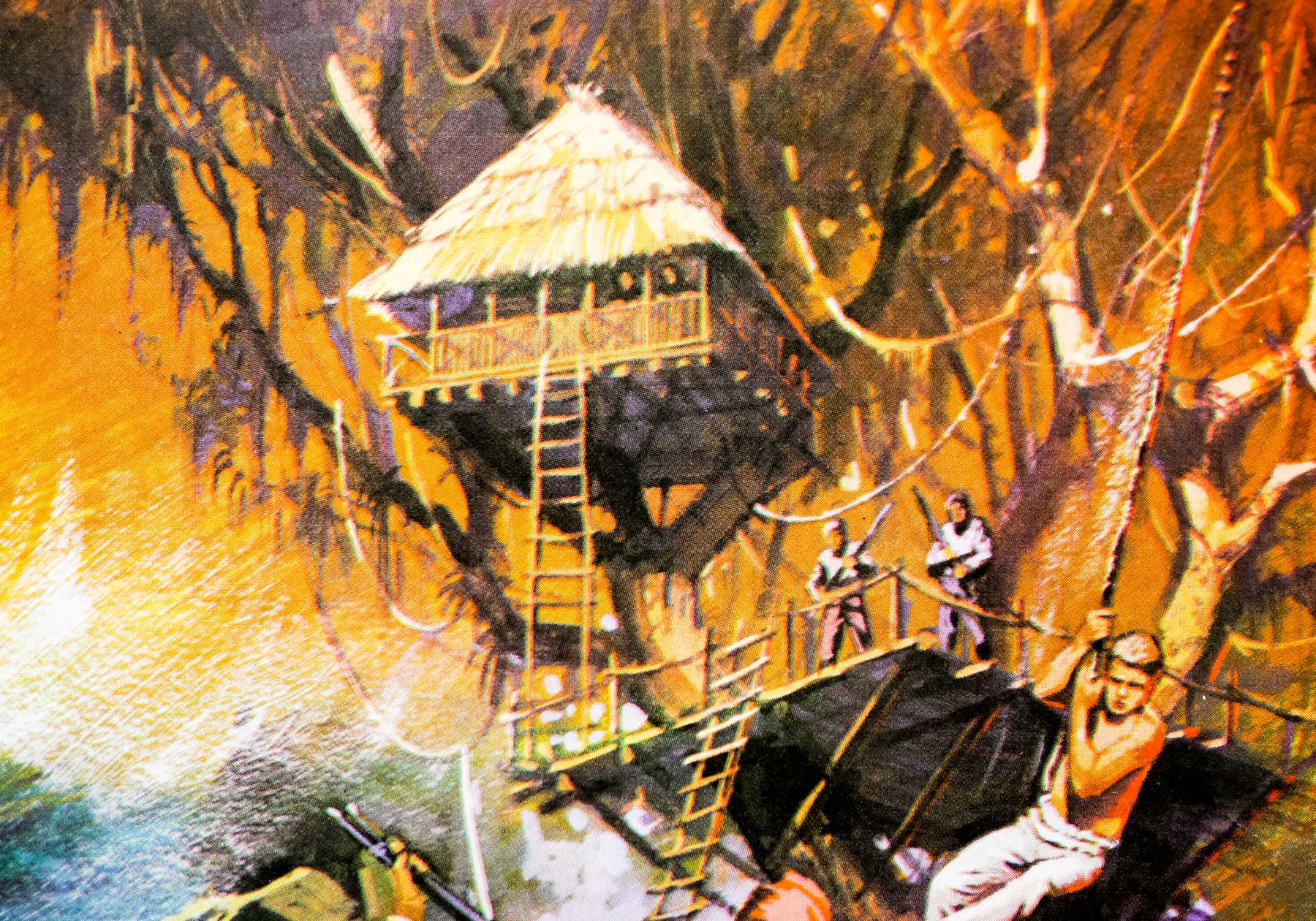
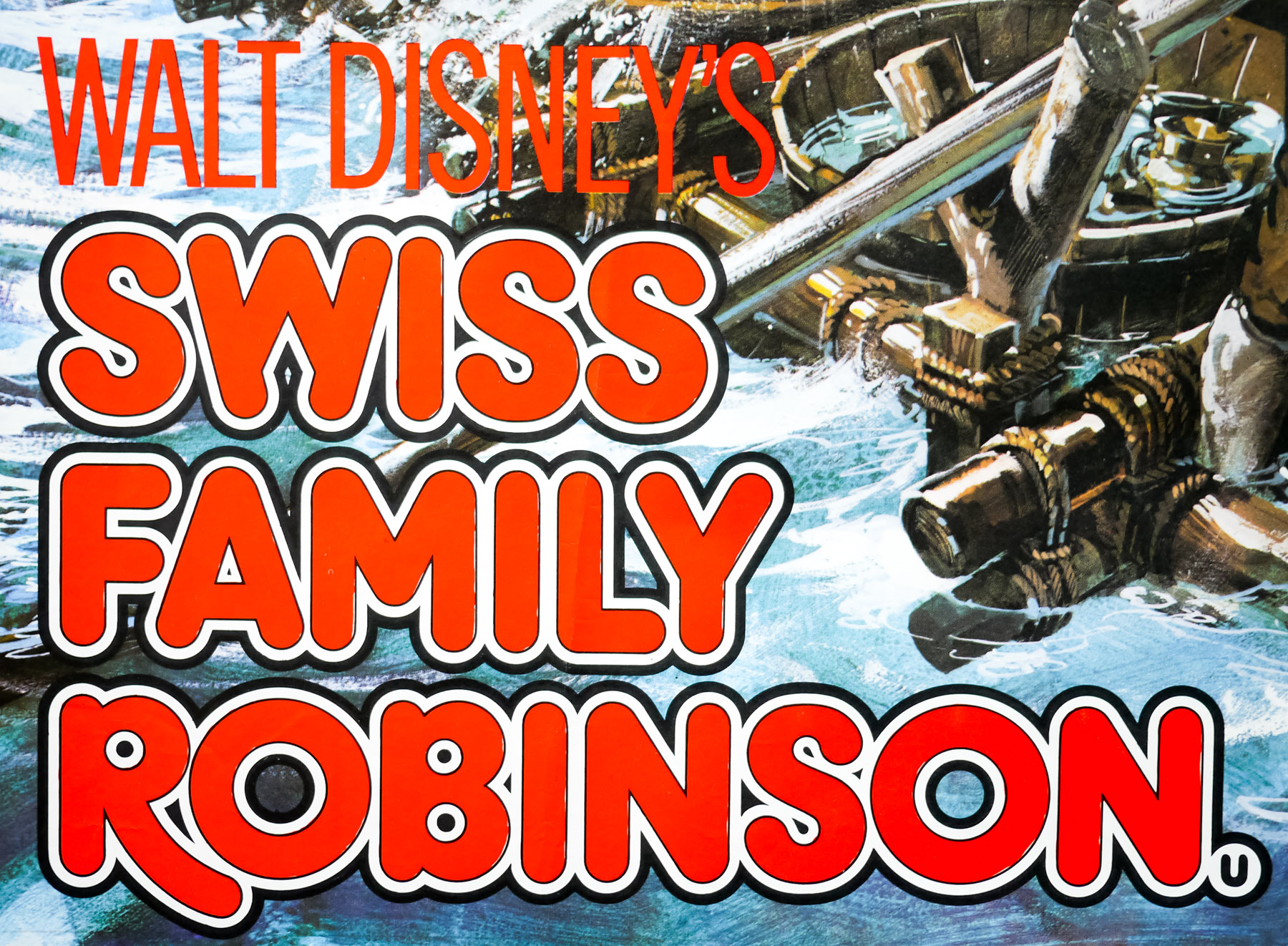
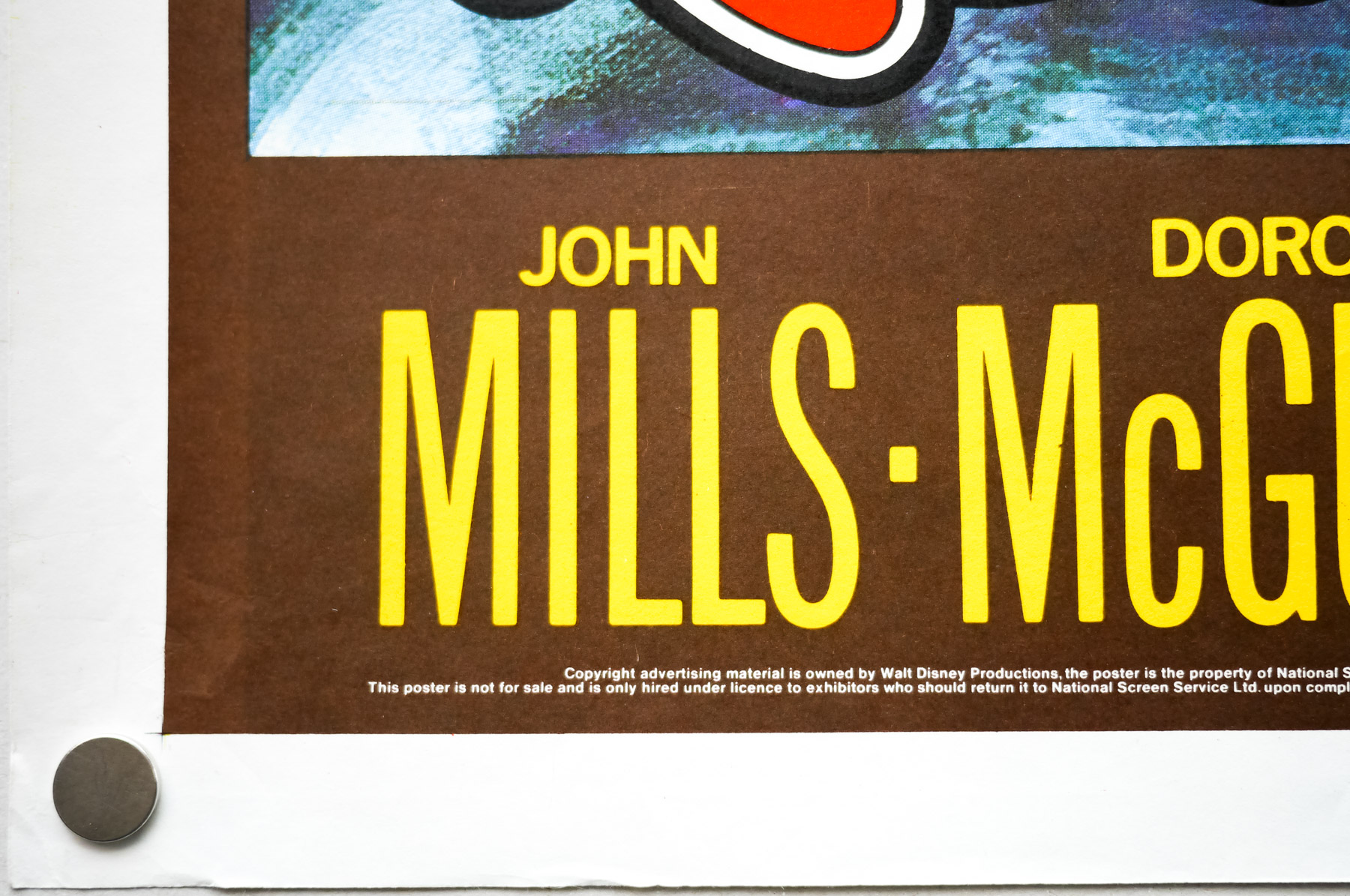
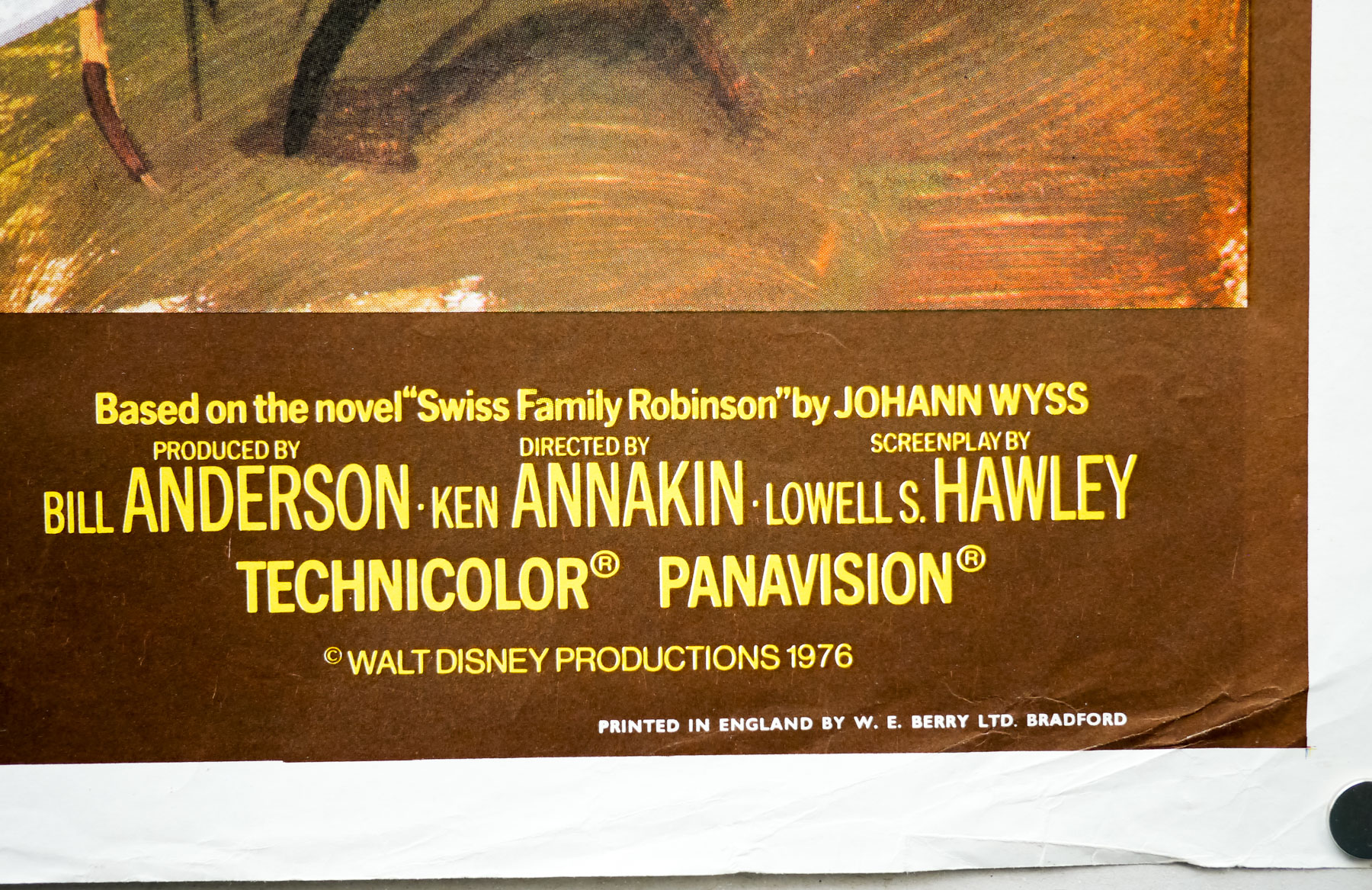
A typically detailed and action-packed illustration by Brian Byouth on this 1976 re-release poster for the 1960 Disney adaptation of the 1812 novel The Swiss Robinson by Johann David Wyss. The story had already been filmed once by RKO pictures in 1940 and was a commercial success so another adaptation was considered a sure bet. Filmed on location in Tobago as well as at Pinewood studios in the UK, the film was directed by the late British director Ken Annakin who worked with Disney on a number of pictures. Legendary Brit actor John Mills plays the father of a family that is shipwrecked on a remote tropical island whilst en-route to New Guinea and the film deals with their adventures as they make a new home and try to cope with marauding pirates who are roaming the waters around the island and are causing havoc for ships that enter its waters.

The film differs significantly from the novel and the changes are detailed on the Wikiepdia page for the film. Happily for all involved it was well received by critics and audiences and went on to be the highest earning film of 1960 (beating Hitchcock’s Psycho and Kubrick’s Spartacus). Adjusted for inflation the film made over $427 million which makes it one of the biggest hits of all time. 

British artist Brian Bysouth worked on many Disney posters during the 1970s and early 1980s, including several for re-releases of earlier films from the 1950s and 60s like this one. Brian is one of my favourite artists and worked on many classic posters from the 1960s to the 1980s, including the final painted poster for a James Bond film, The Living Daylights. In 2012 I was fortunate to meet and interview Brian for this site and the article can be read here. The other posters I’ve collected by Brian can be seen by clicking here.

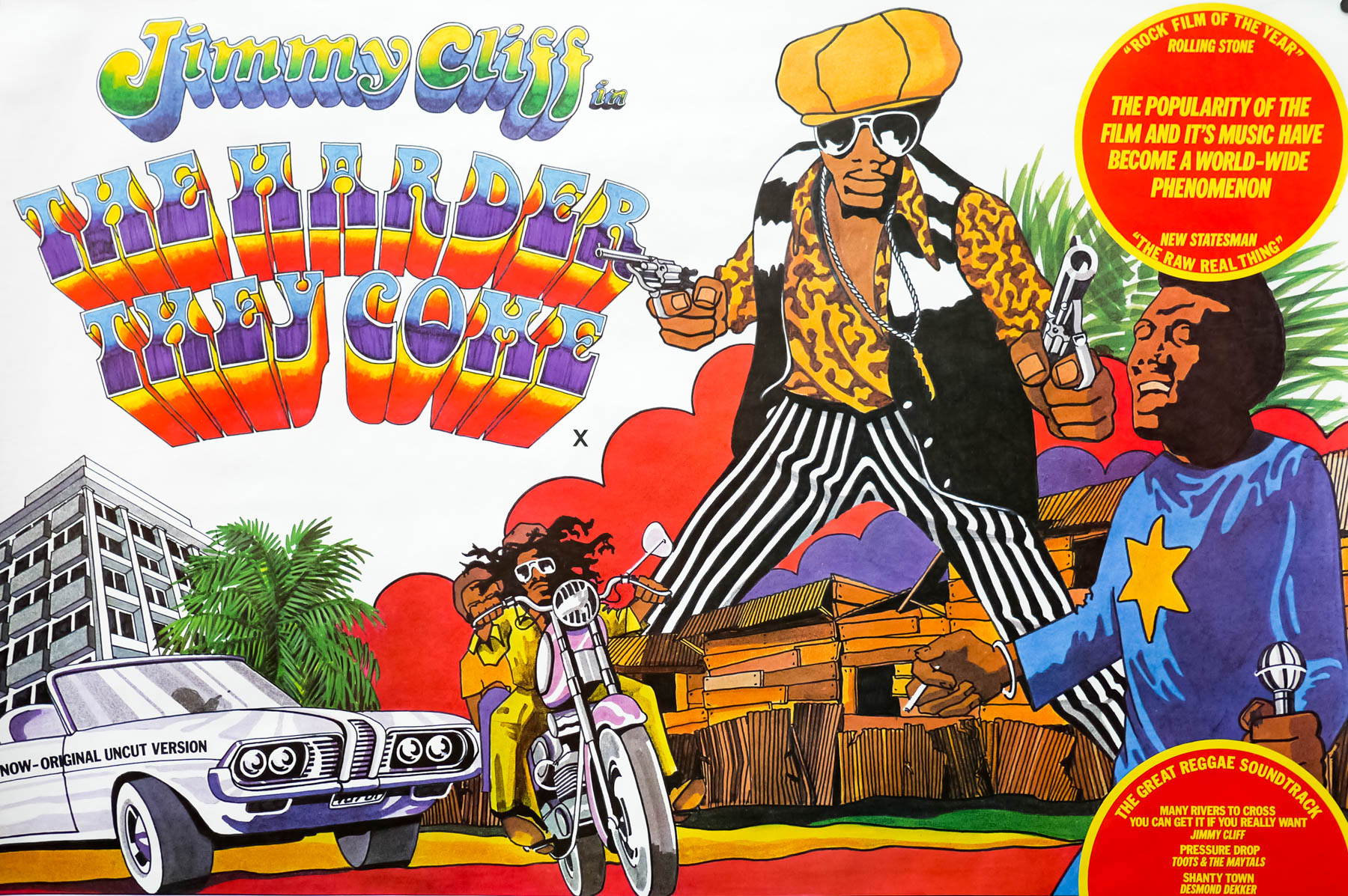
The Harder They Come / quad / 1977 re-release / UK

30.03.13

Poster Poster

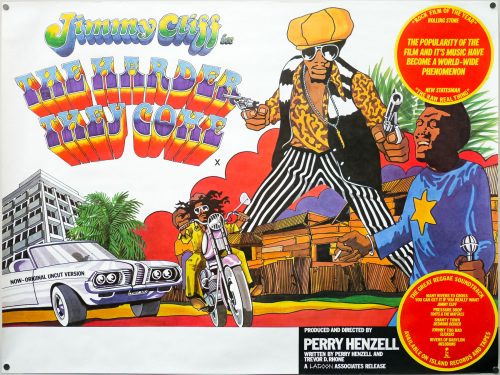
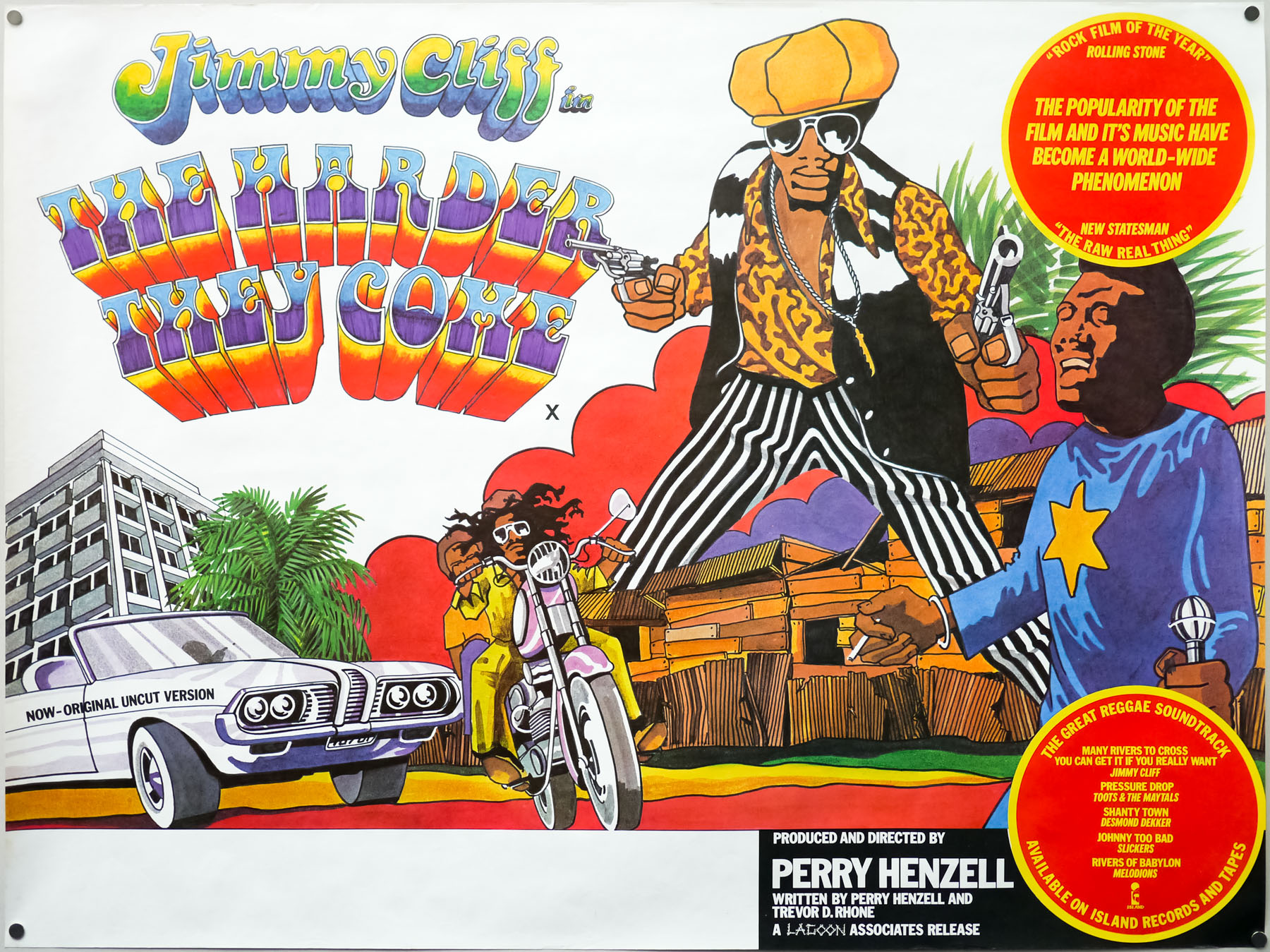
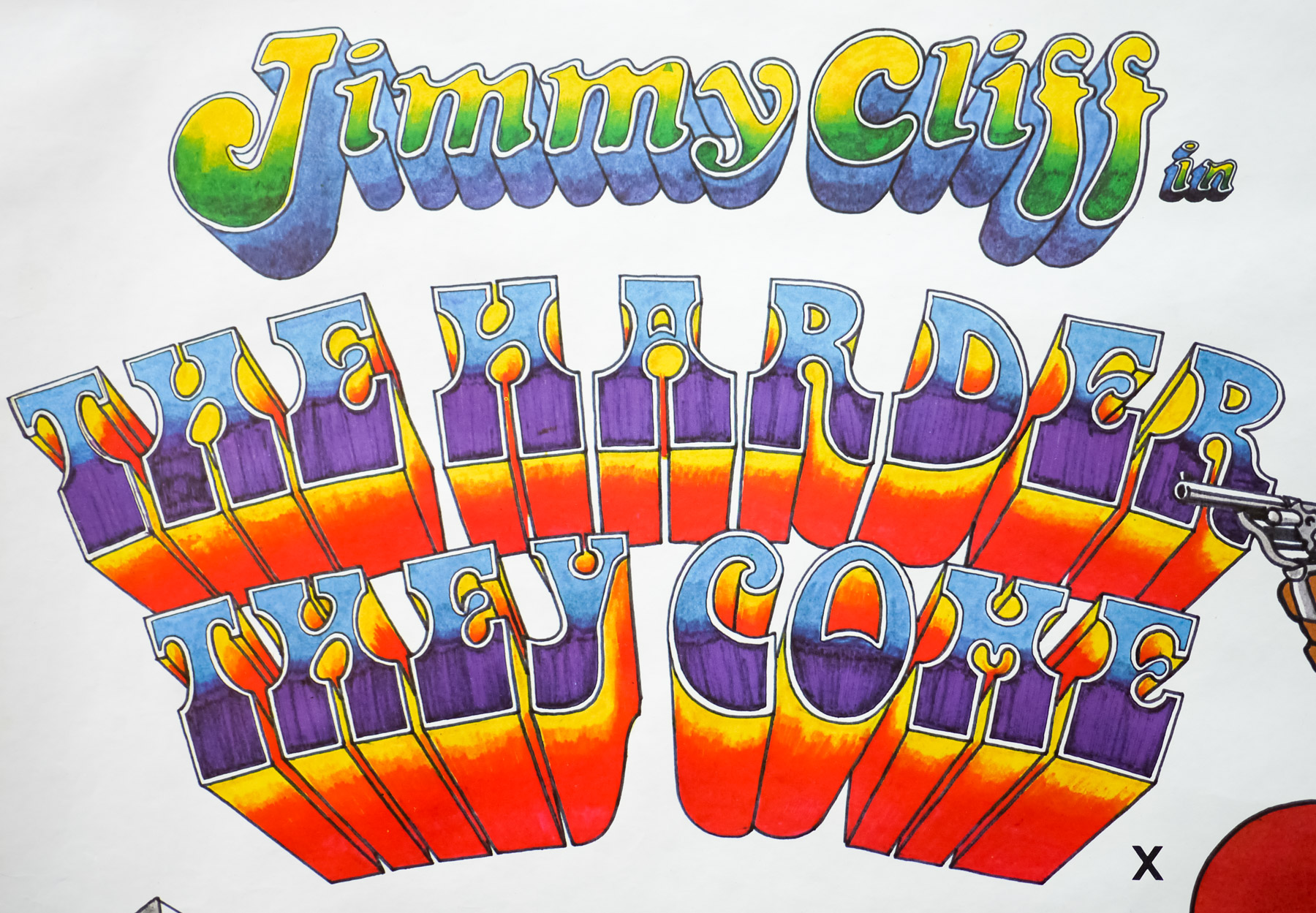
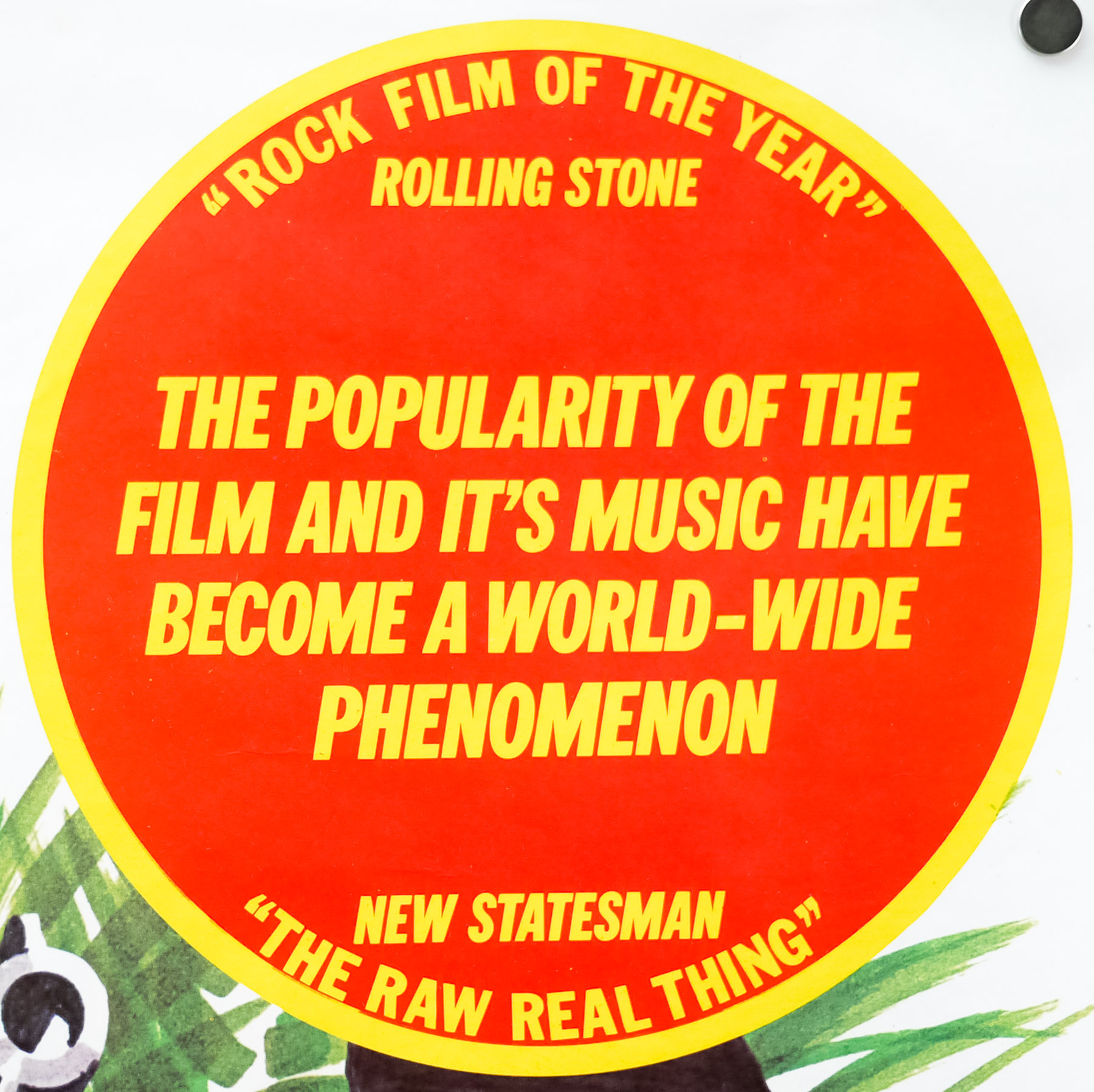
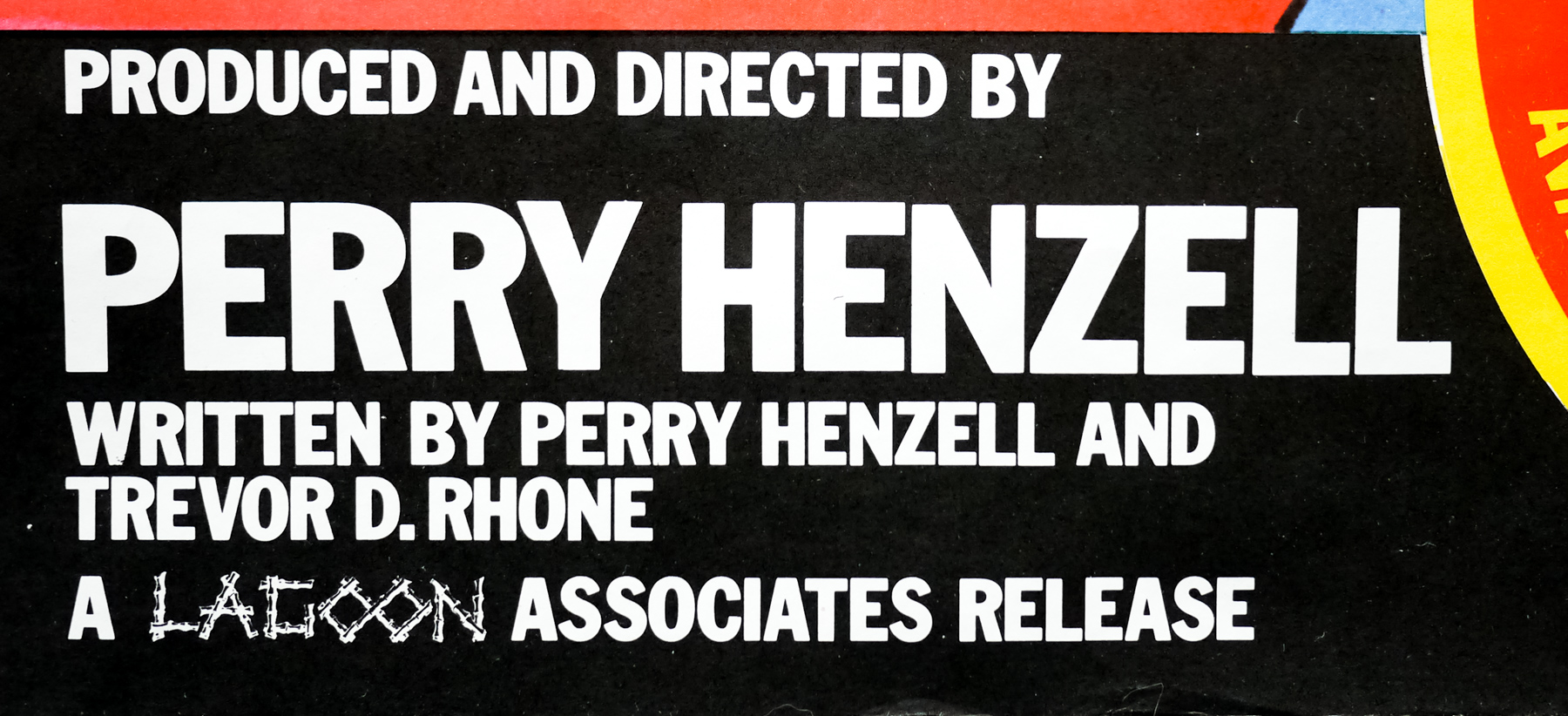
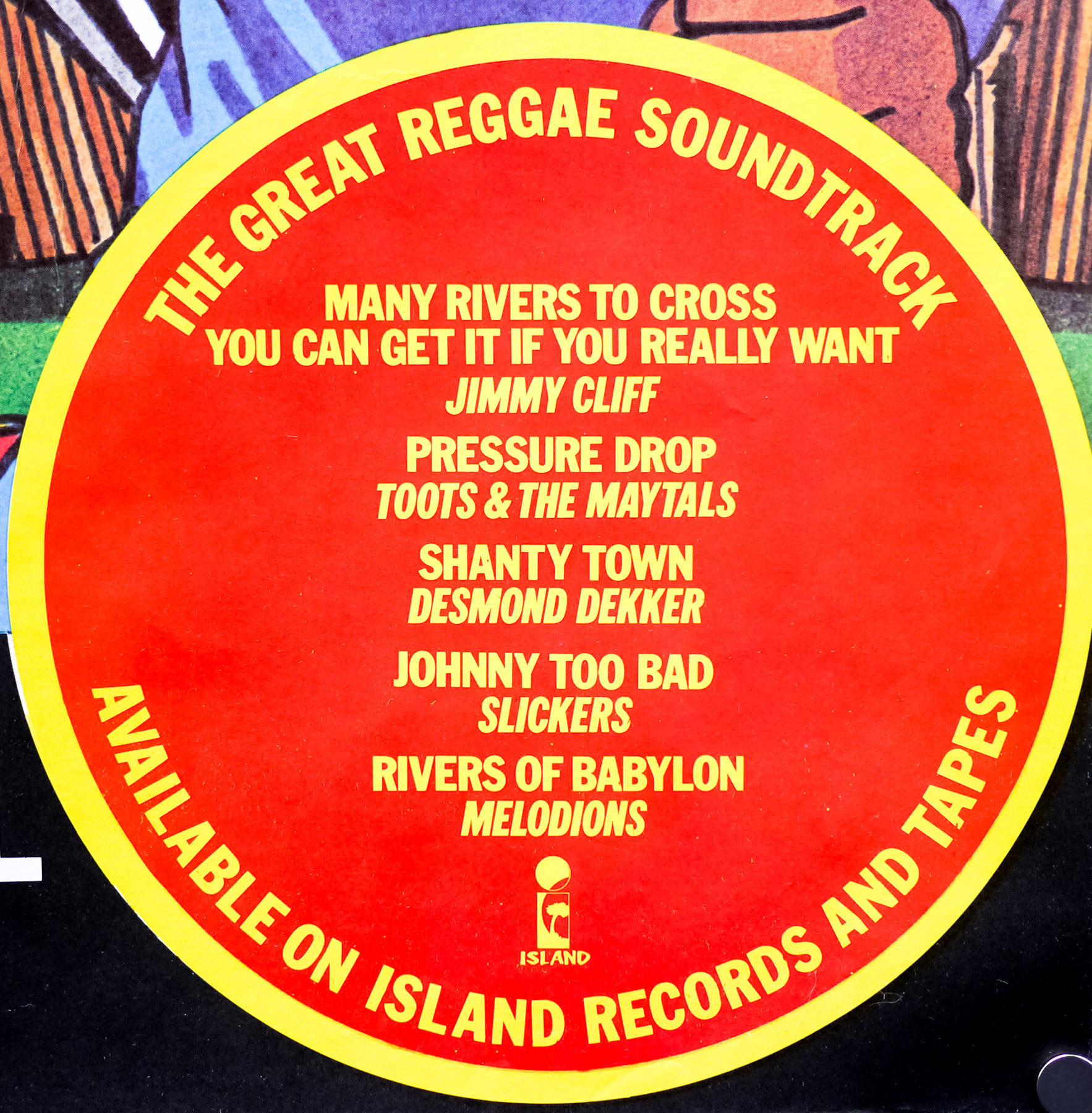
Jamaica’s first feature film They Harder They Come is often credited with introducing the rest of the world to reggae music, released as it was before Jamaican artists like Bob Marley had achieved much recognition outside of the country. The film was directed by Jamaican native Perry Henzell, who also produced and co-wrote the script, and is partially based on the true story of Ivanhoe ‘Rhyging‘ Martin. Often called the ‘original rude boy’, Martin was a Jamaican outlaw who escaped from prison and managed to evade the police for several years with the help of the Jamaican public, before a final showdown on Lime Cay in 1948. The soundtrack to the film is absolutely integral to its success and features tracks from some of Jamaica’s best reggae artists, including Desmond Dekker, Toots & the Maytals and singer Jimmy Cliff. Released on Jamaica’s own Island Records, the album went on to sell millions of copies and continues to be one of the label’s biggest sellers.

Jimmy Cliff stars as Ivan Martin and was chosen for the role after Perry Henzell saw photos of him on the packaging for one of his earlier albums. Ivan is a country boy who travels to Kingston with empty pockets and a dream of becoming a singer. After being taken in by a preacher he meets a ruthless music studio owner who eventually allows him to record a tune (the titular The Harder They Come), but is then persuaded to sign away the rights for a pittance. Realising that his dream may be over, Ivan accepts an offer from a friend to begin dealing marijuana and, although things go smoothly for a while, it’s not long before he is betrayed and set on a path of destruction after killing a policeman sent to arrest him. Ivan ends up as an outlaw on the run, helped by the people he lived amongst, but a failed attempt to escape by boat to Cuba sees him washed up on a sandy beach with the police hard on his tail.

The Harder They Come depicts the kind of life that many Jamaicans experienced in the sprawling migrant settlements of Kingston and it made no attempt to try and romanticise life on the island. In addition, little concession was made to those not used to hearing the unique Jamaican Patois spoken by the majority of the characters in the film and prints were often subtitled when projected in other countries. The film was phenomenally successful in Jamaica with the premiere at the old Carib theatre in Kingston attracting thousands of locals eager to get into the auditorium. Its popularity soon spread to other countries such as the UK and eventually to the USA. The distribution over there was eventually handled by Perry Henzell himself who personally sold the film to cinema managers in several big cities and it apparently ended up playing in one Boston cinema for eight years straight.

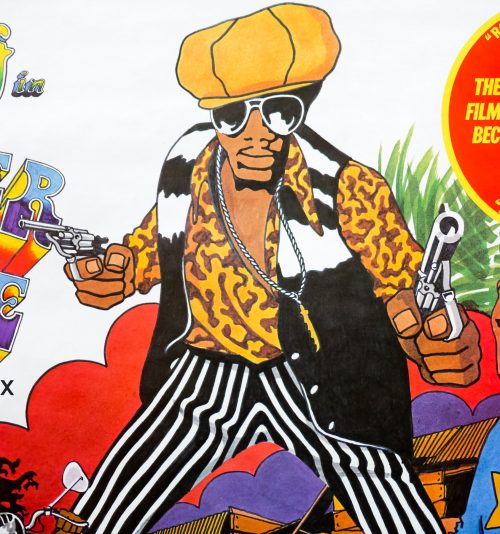
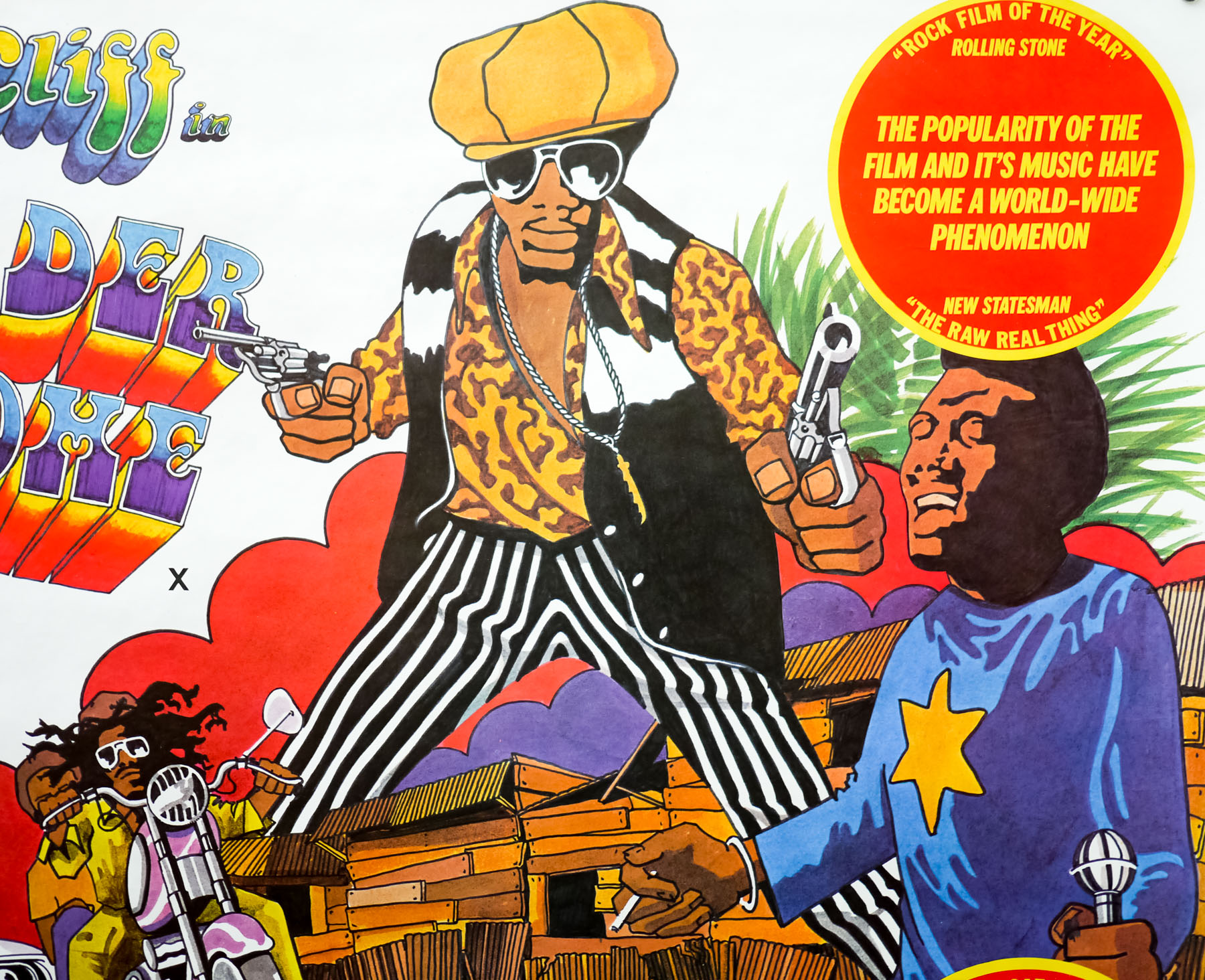
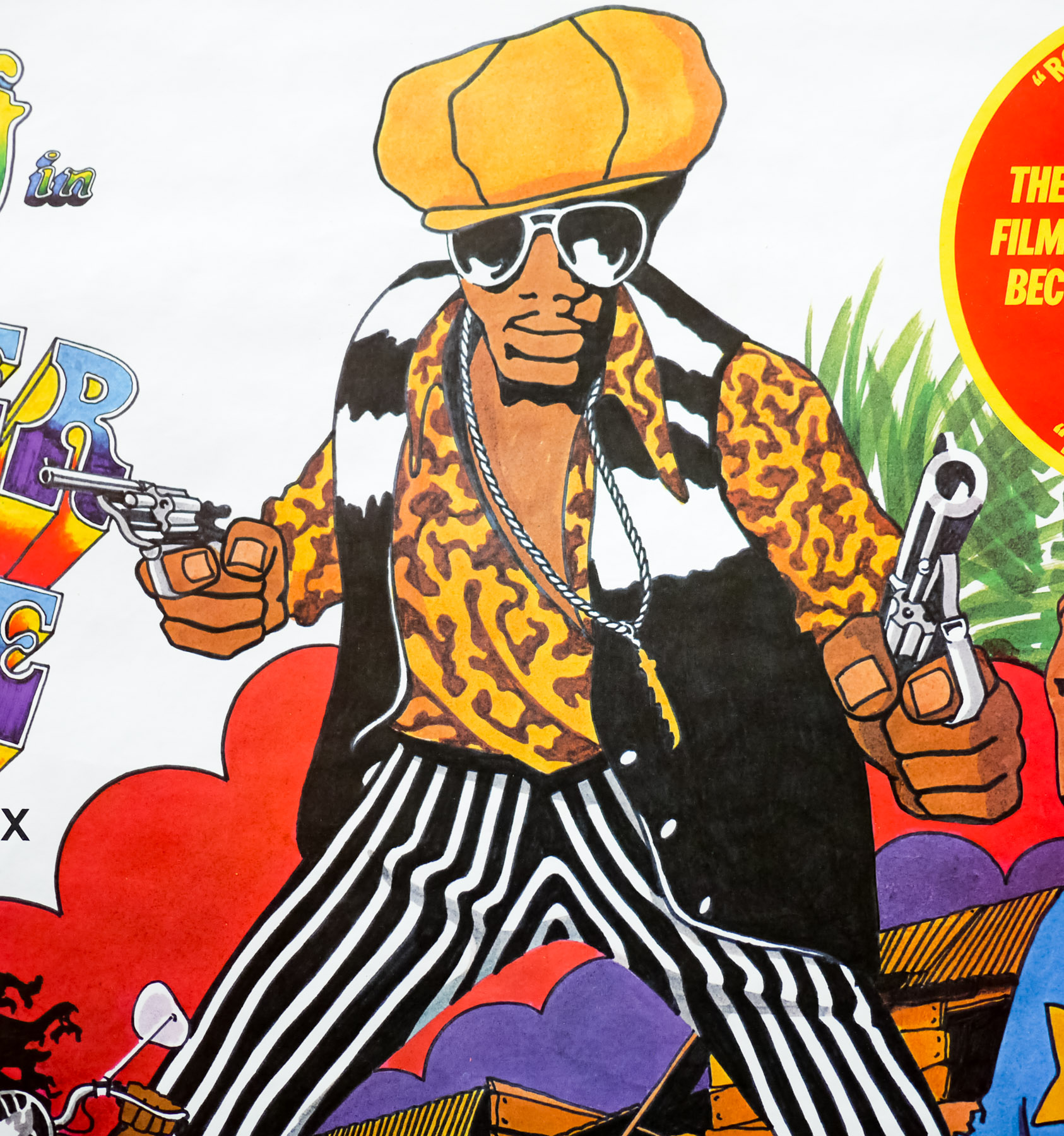
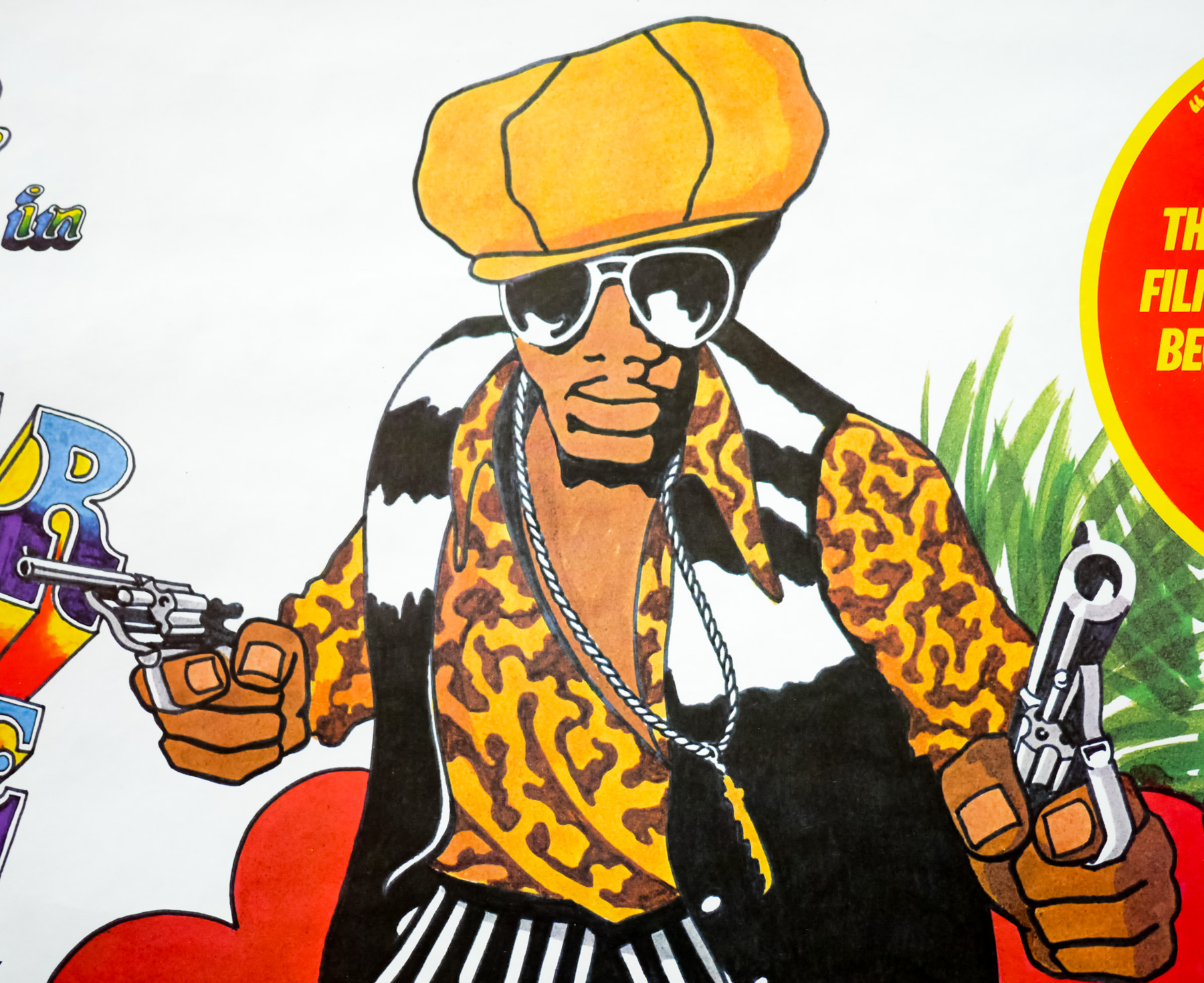
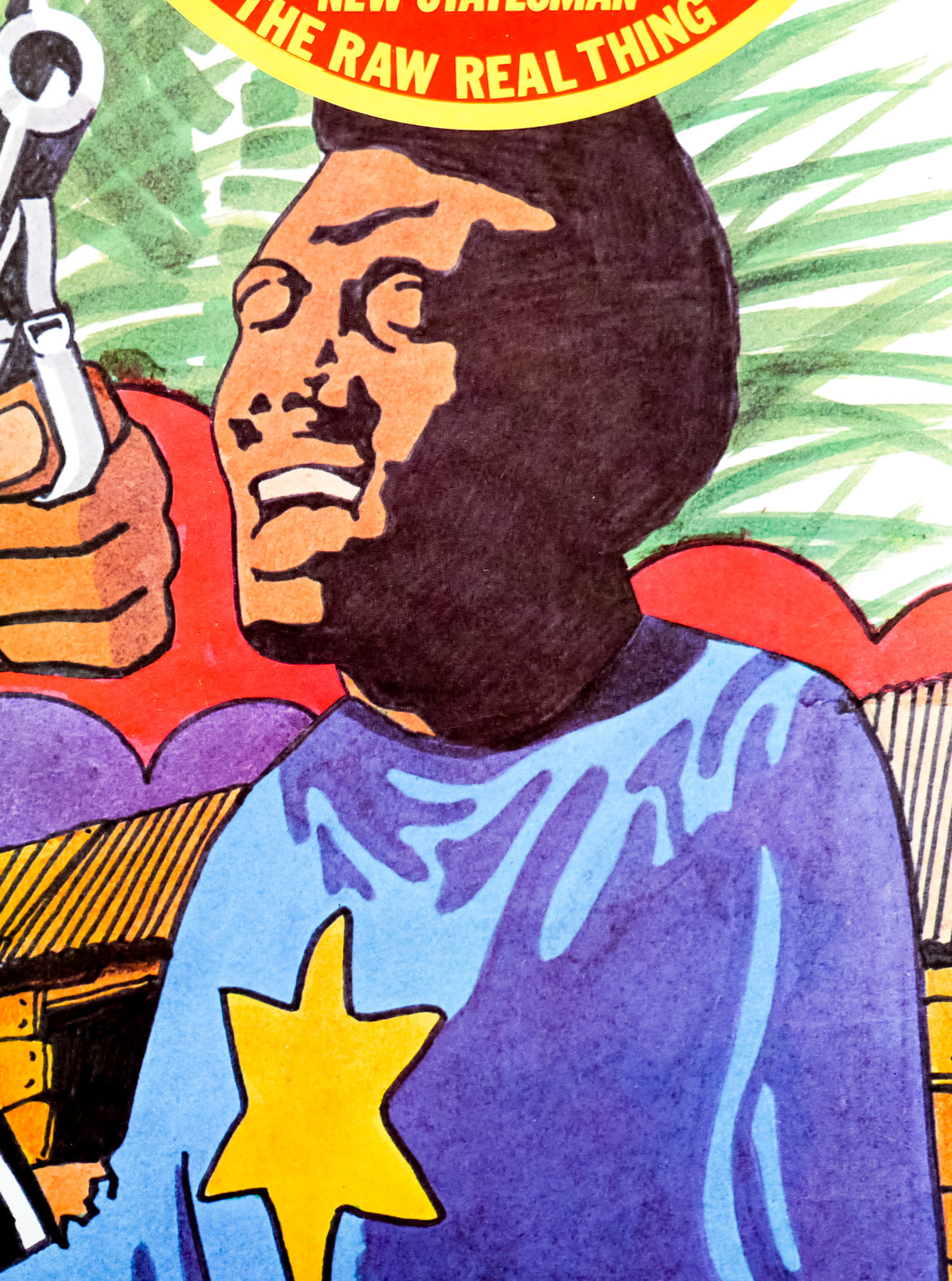
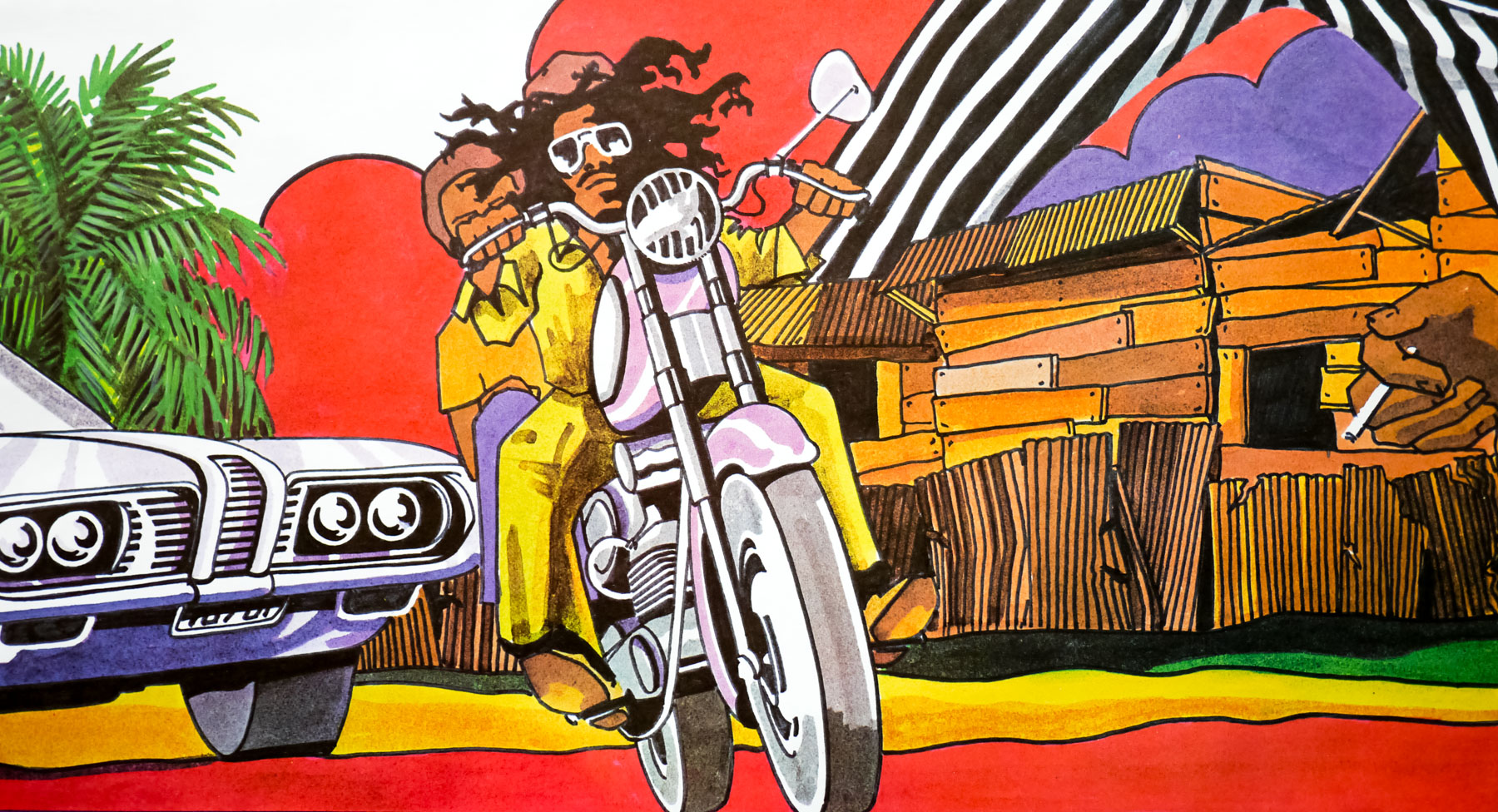
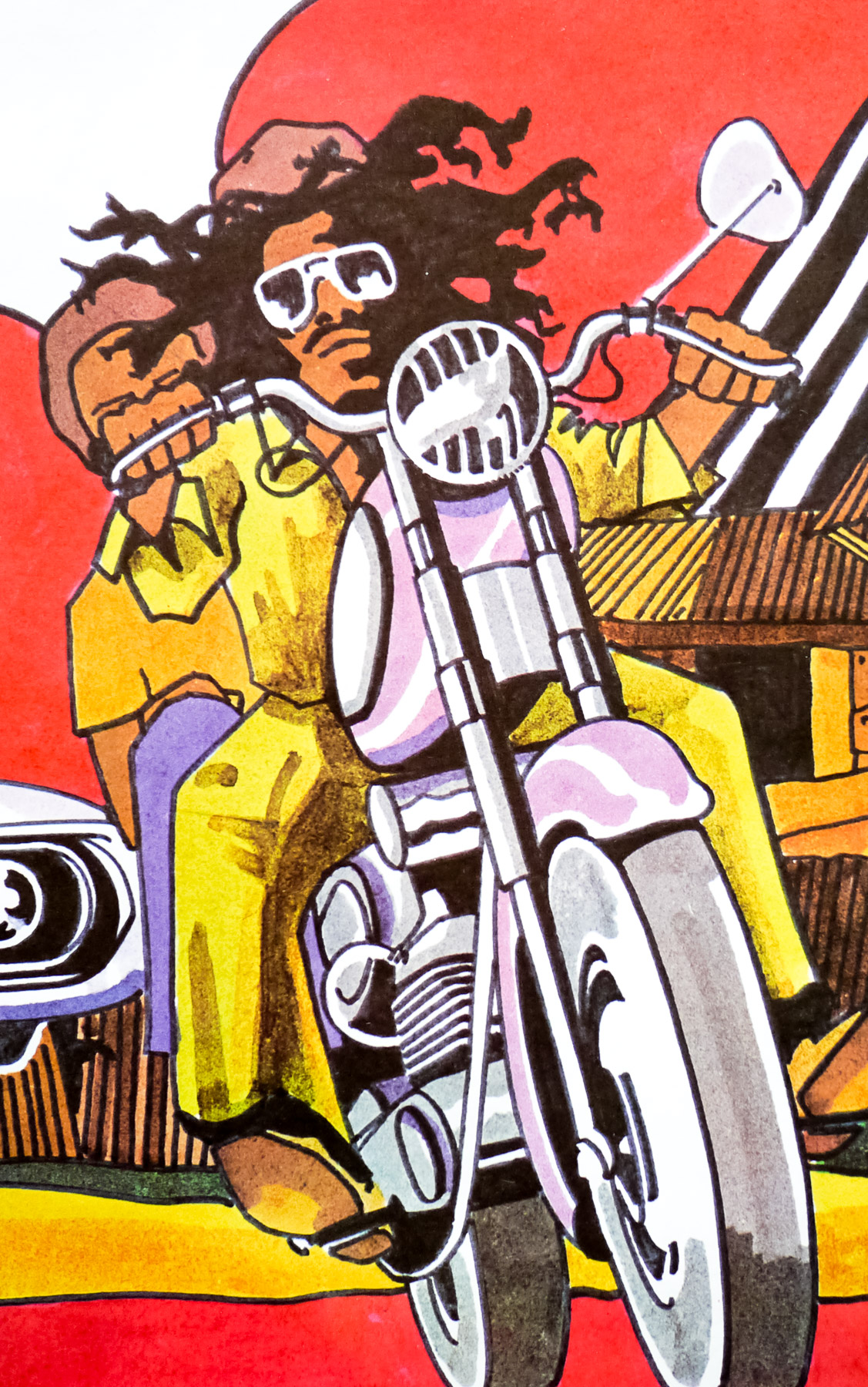
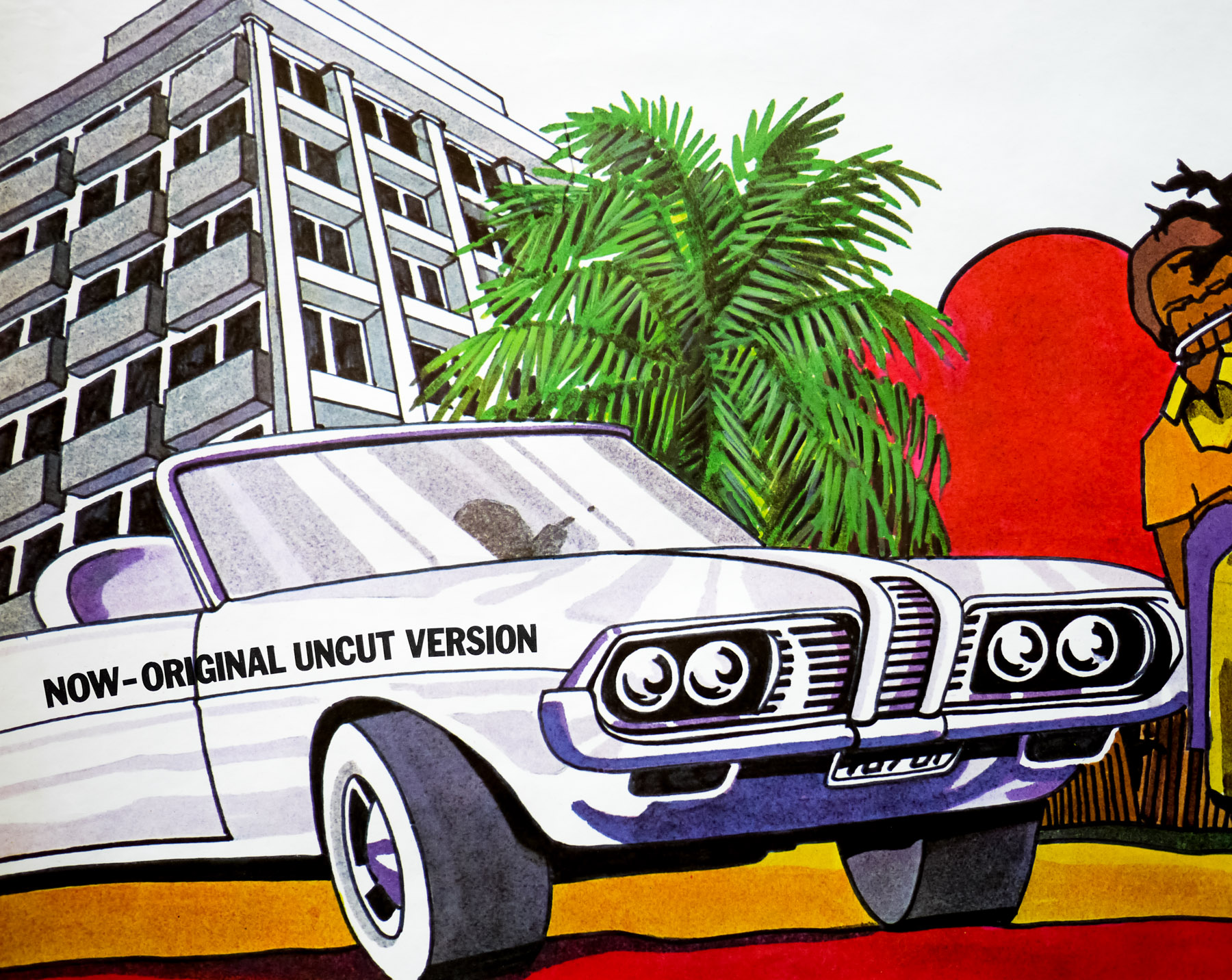
This quad is actually for the 1977 re-release of the film but I have never seen an original 1973 release quad of the film. It features the same artwork as seen on the soundtrack album, which is by a designer and artist called John Bryant about whom I’ve been unable to discover any details. The classic image of Jimmy Cliff with the two guns also features in a great sequence in the film when Ivan has his photo taken to send to newspapers in an attempt to cement his image as a bad boy outlaw. It appears that Bryant himself got in touch with the US auction house emovieposter.com to let them know a bit more about the poster and this information has been included in the auction details when this quad has been sold in the past:

‘Note that the person who originally designed this poster tells us that it was made for the late 1970s re-release of the film (the designer says likely between 1977 and 1979, and the BBFC states 1977) from the original British quad’s design, adding their company logo of “Lagoon” and the tagline at left, “Now-Original Uncut Version.’

The first release quad is unquestionably scarce but, as per the information above, must look almost identical to this poster.

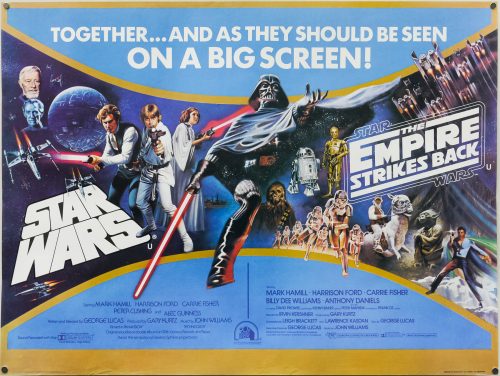
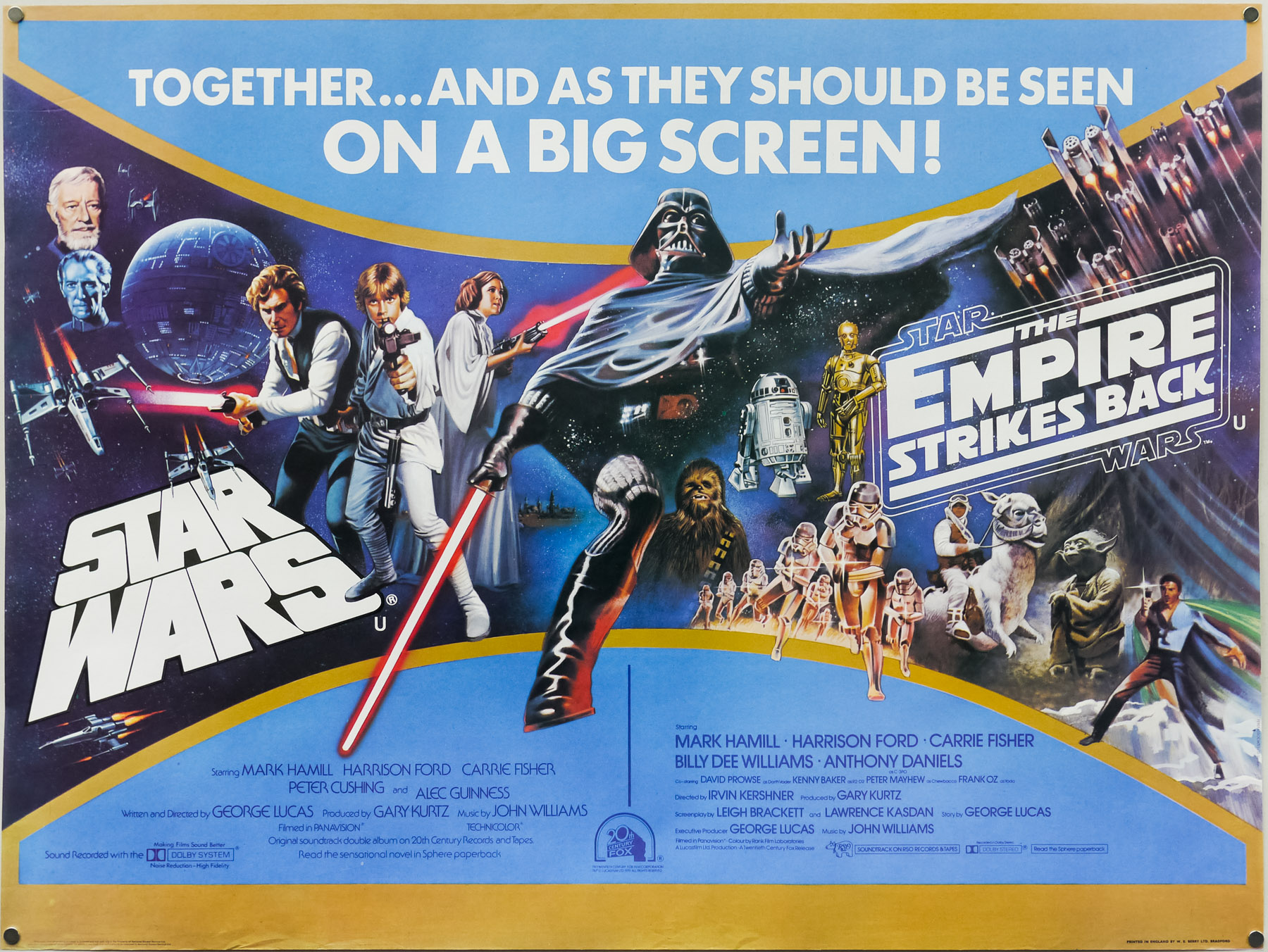
Star Wars and Empire Strikes Back / double bill / quad / UK

02.09.14

Poster Poster

Following the unprecedented success of the original Star Wars, released in 1977 to worldwide audience acclaim, expectations were high for the sequel which was put into production a few months after its release. Three years later, The Empire Strikes Back arrived in cinemas and was met with huge audience and critical acclaim, firmly cementing the series’ place in the hearts of millions of fans across the globe. A less well-received third part of the original trilogy, Return of the Jedi, and a lacklustre set of prequel films failed to dampen audience enthusiasm for the franchise and a new film adventure is set to be released at the end of 2015.

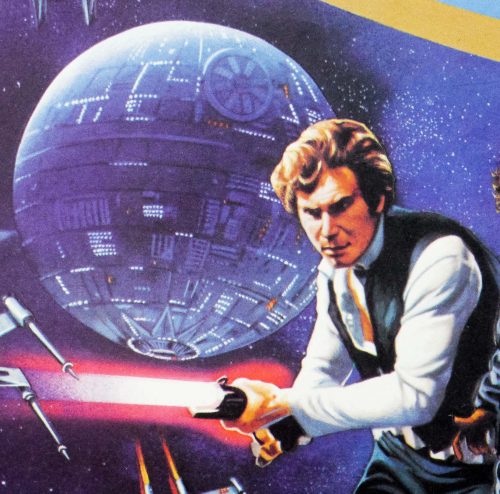
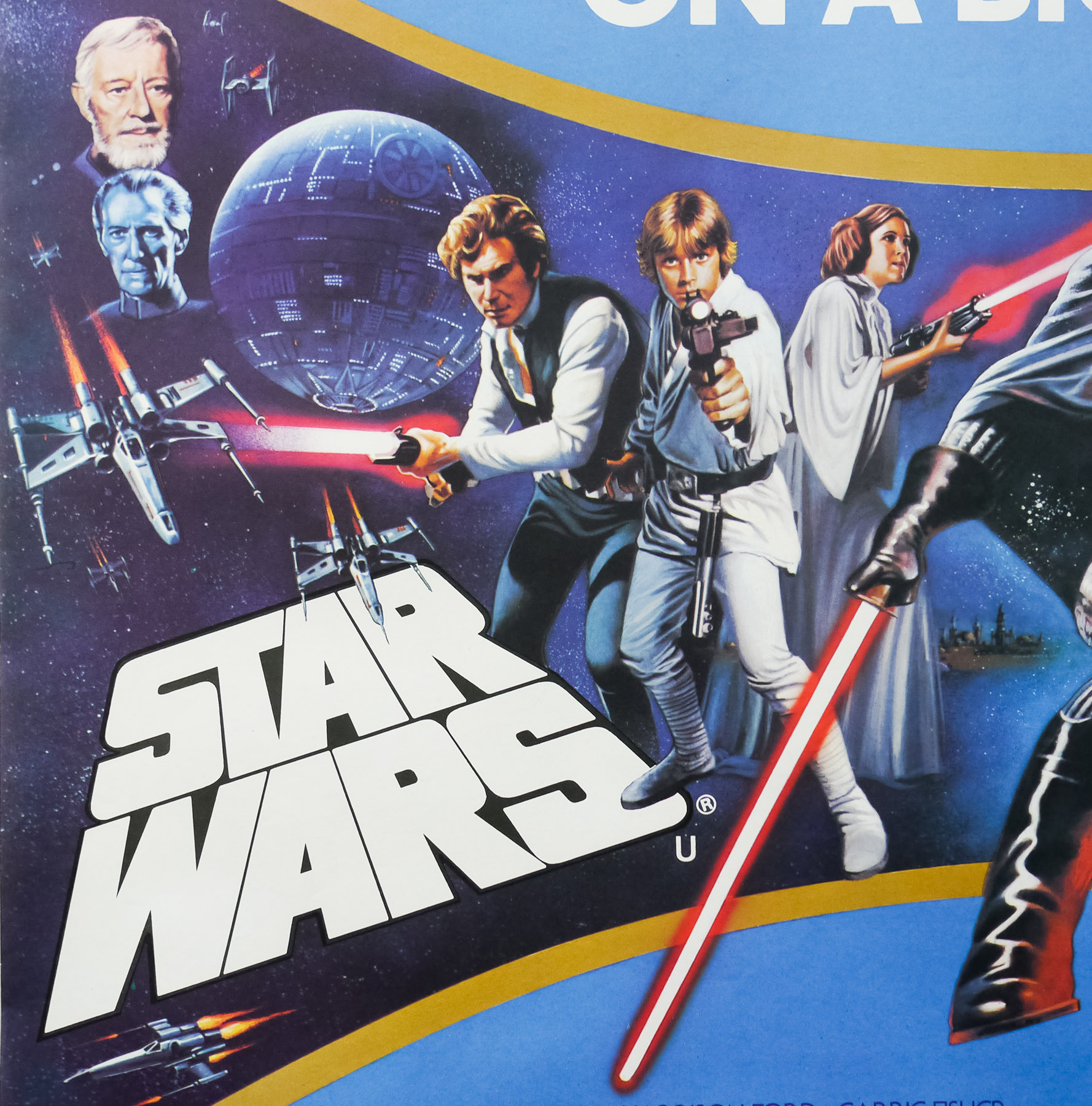
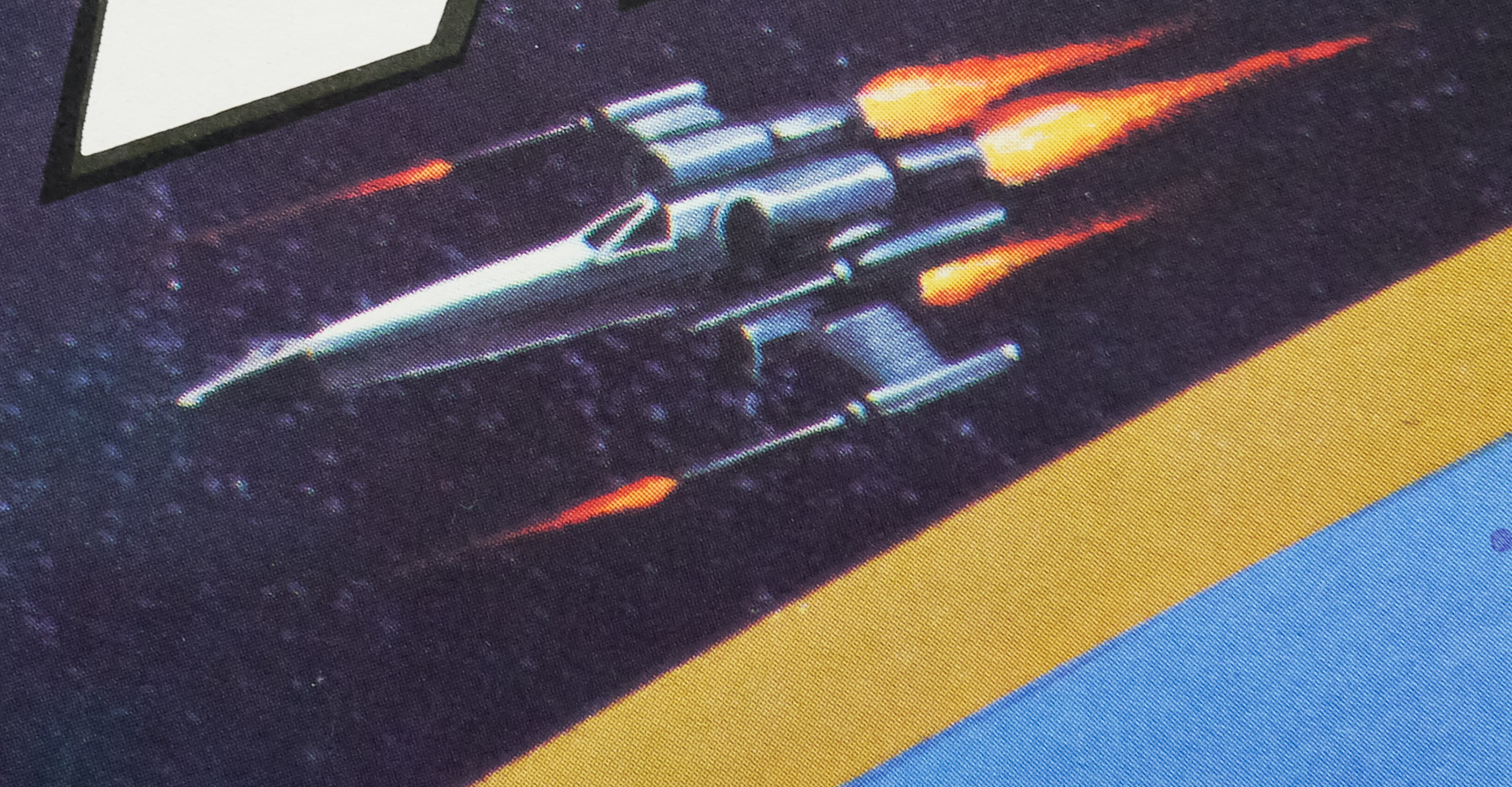
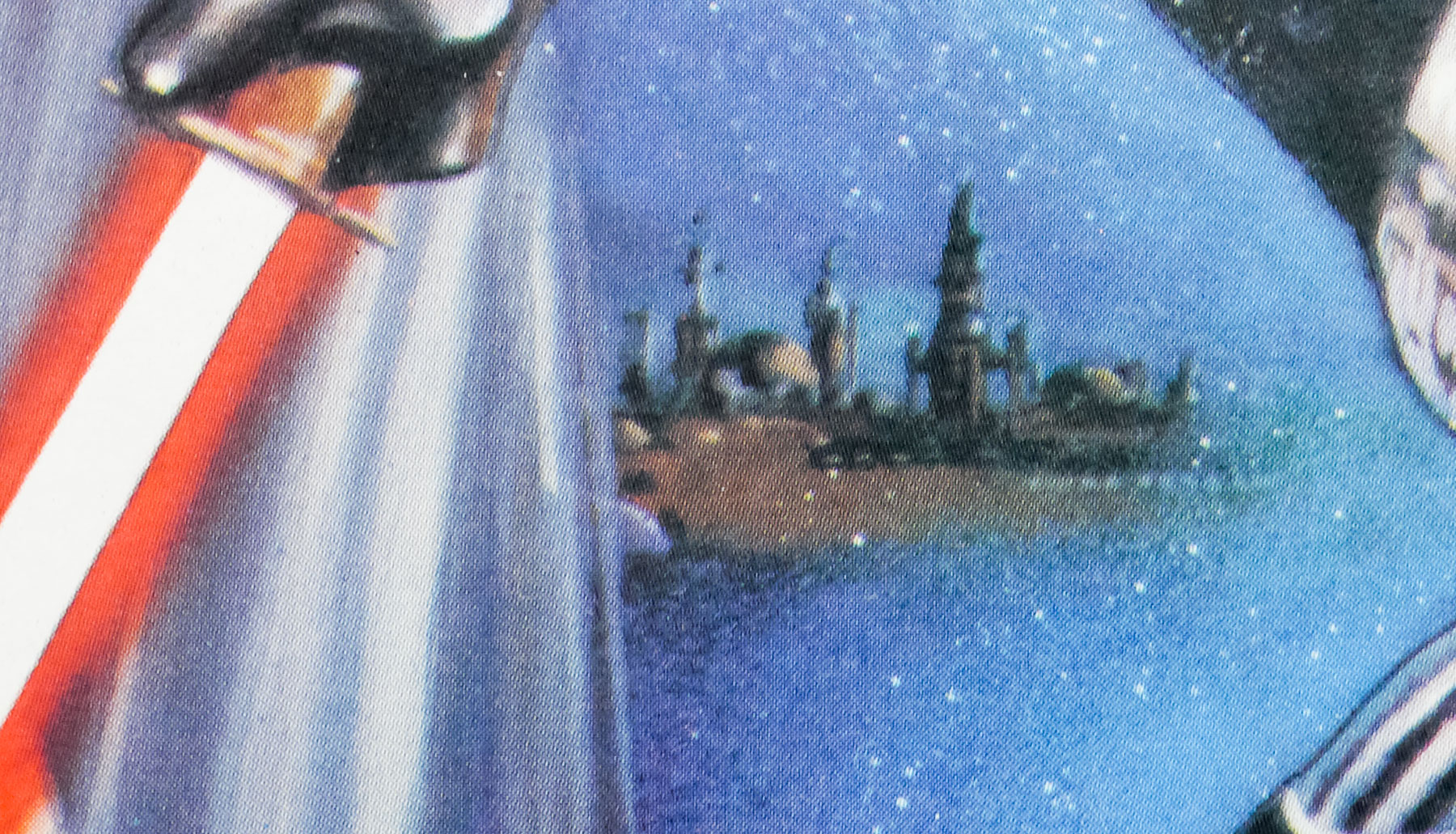
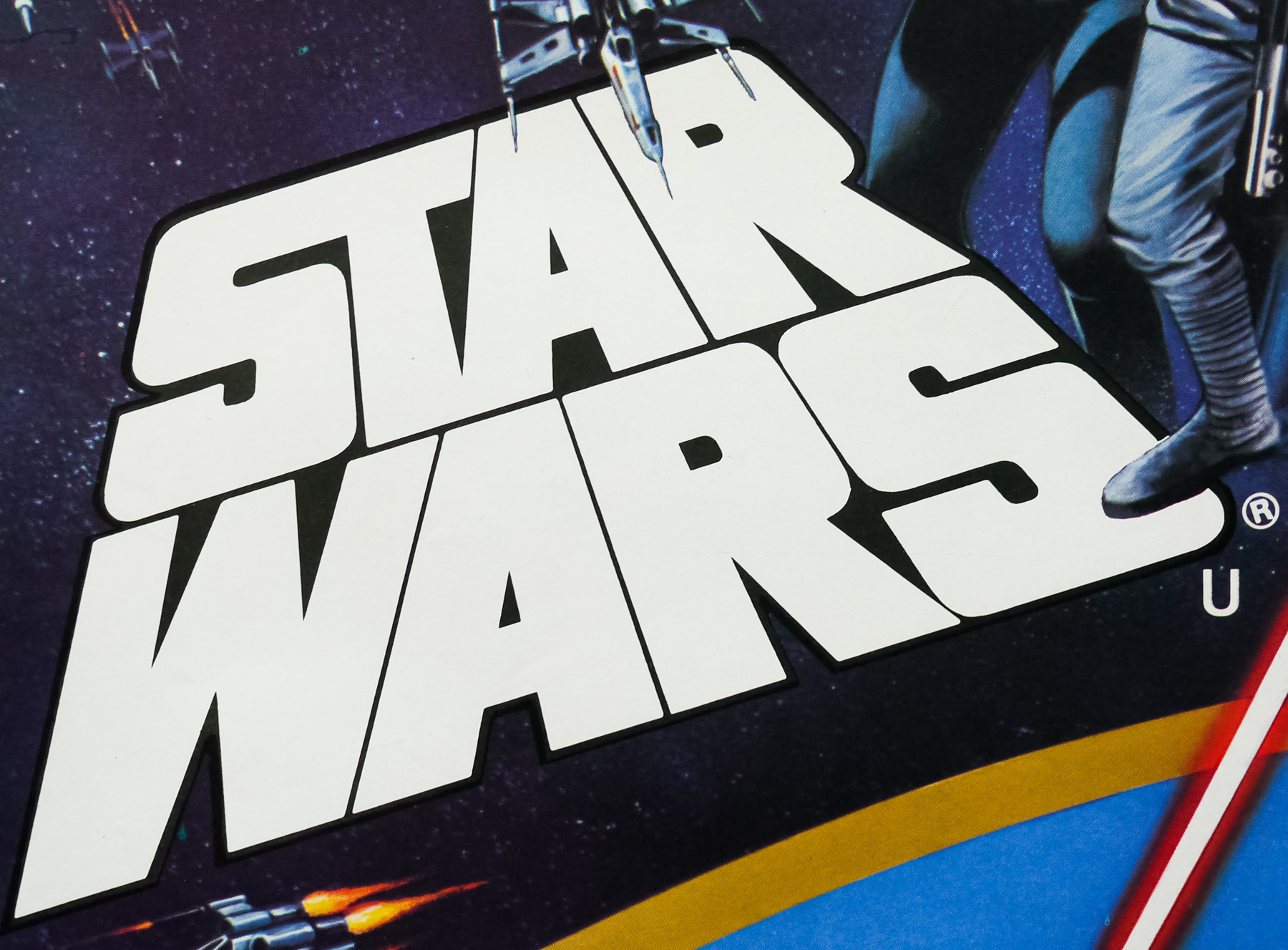
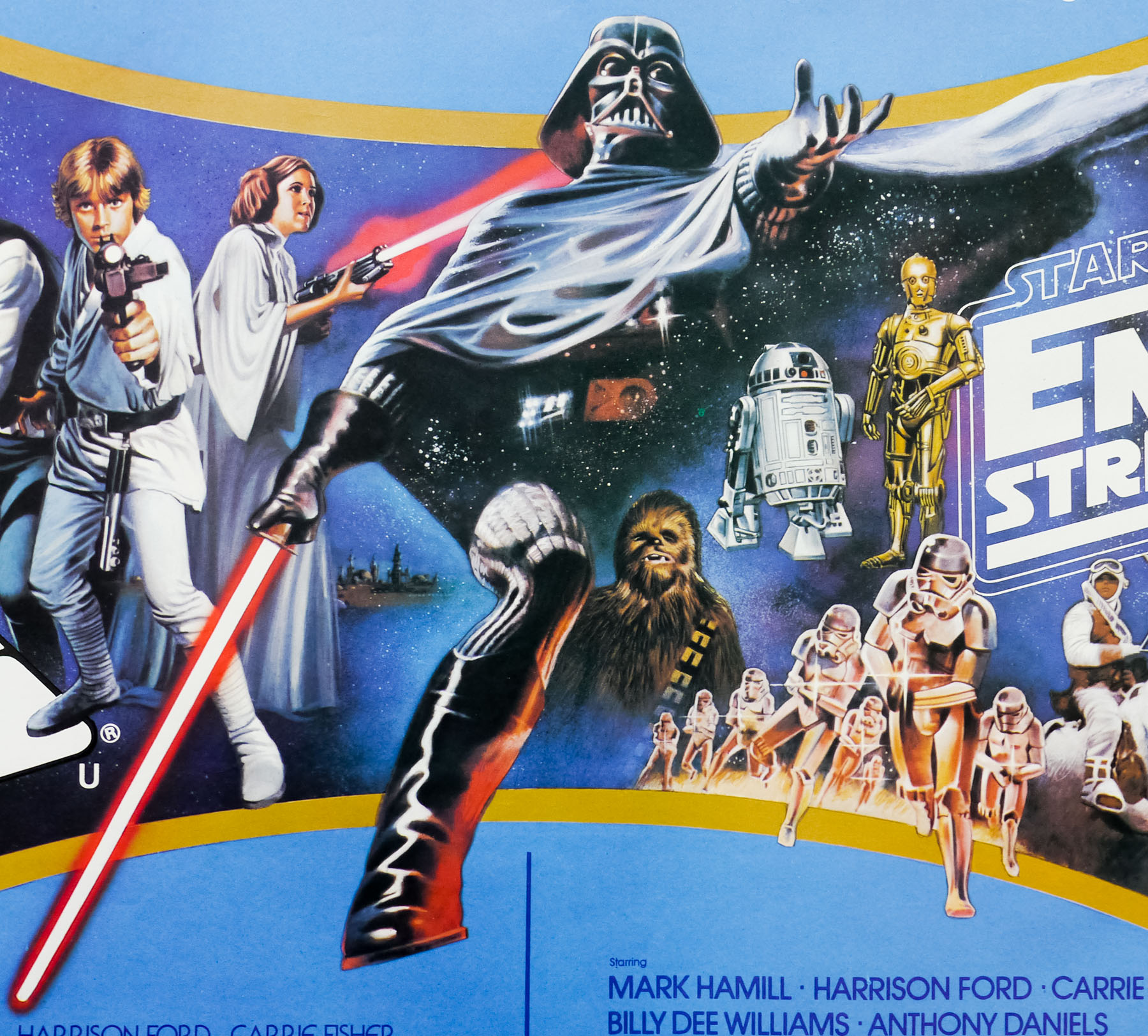
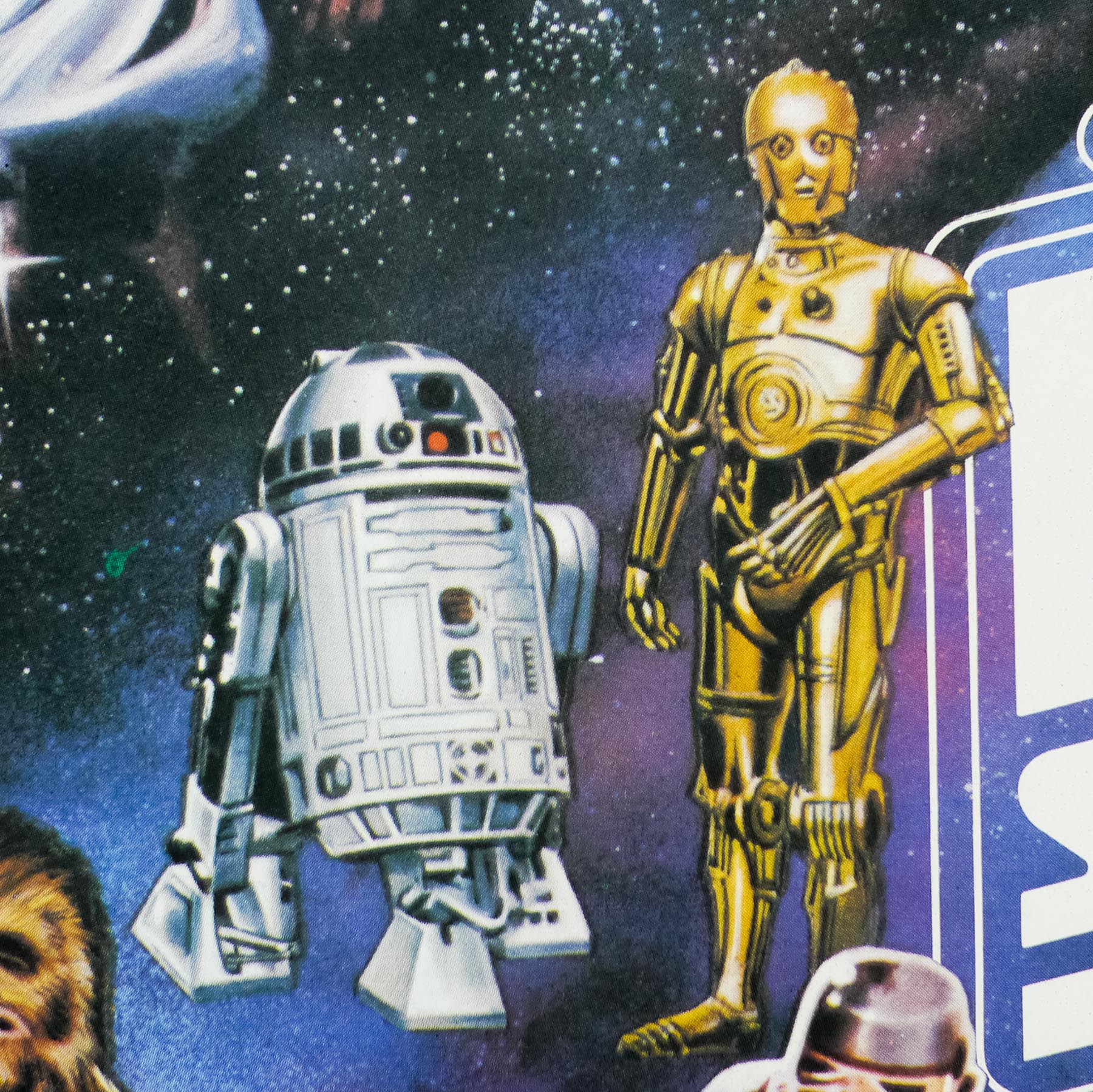
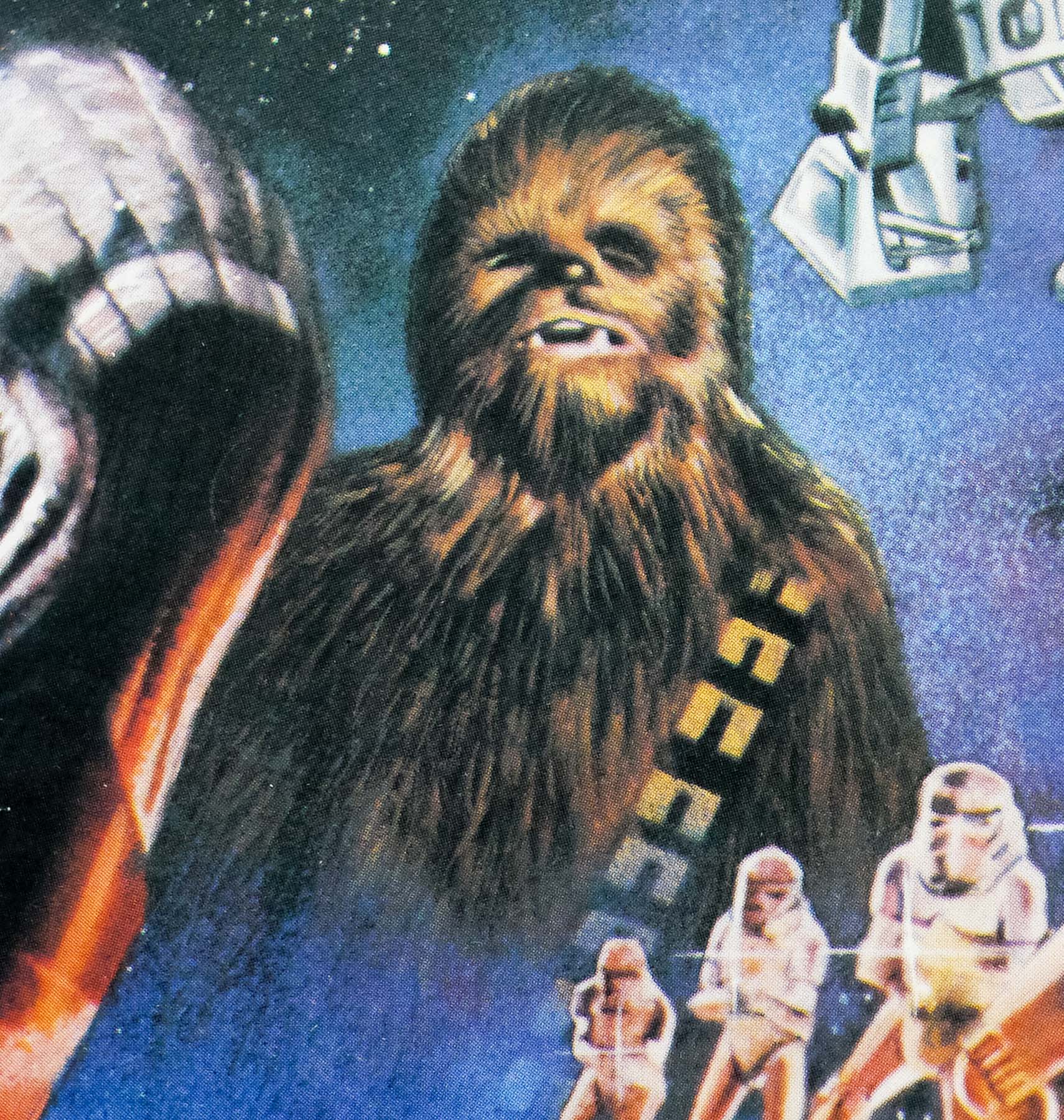
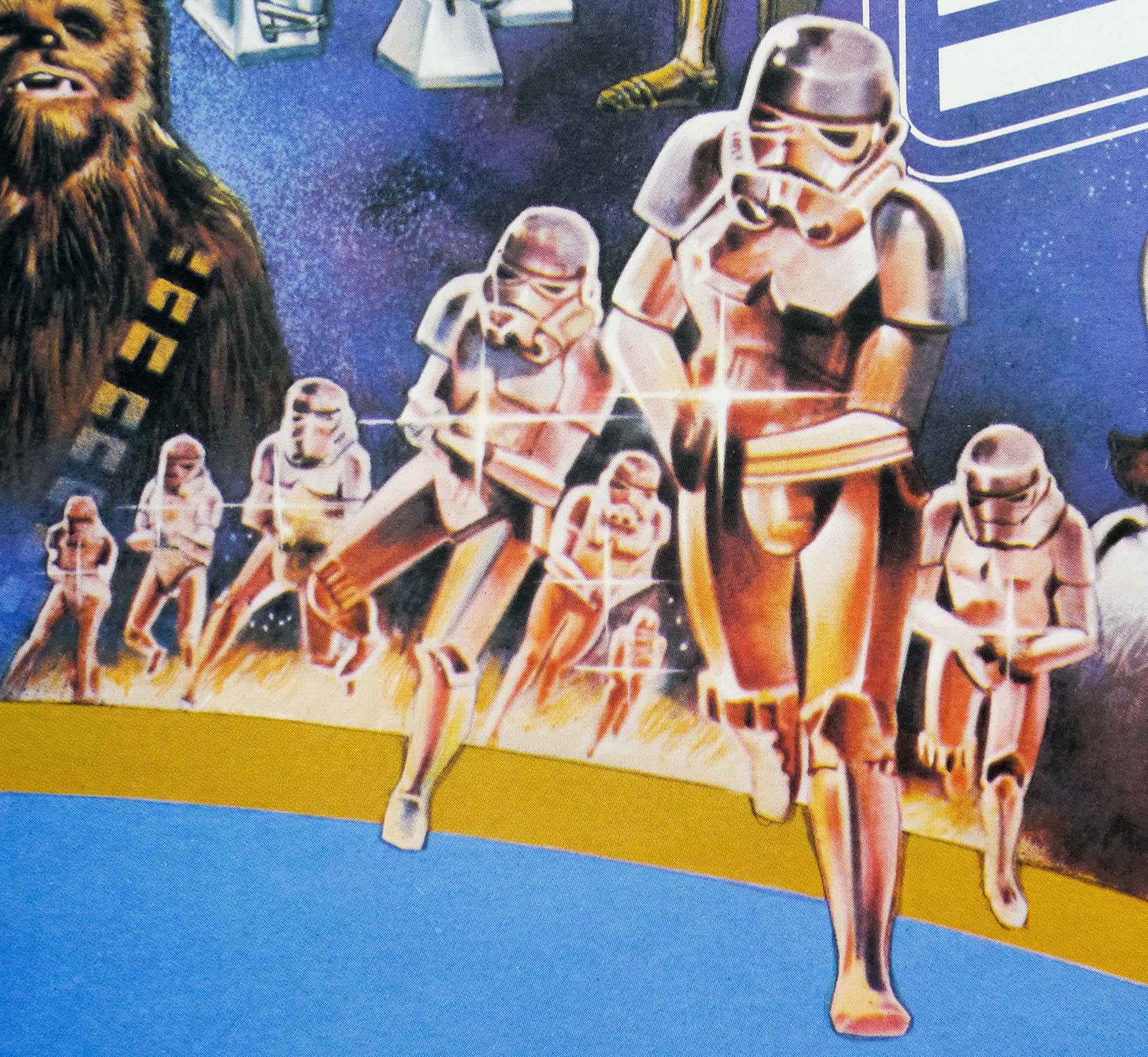
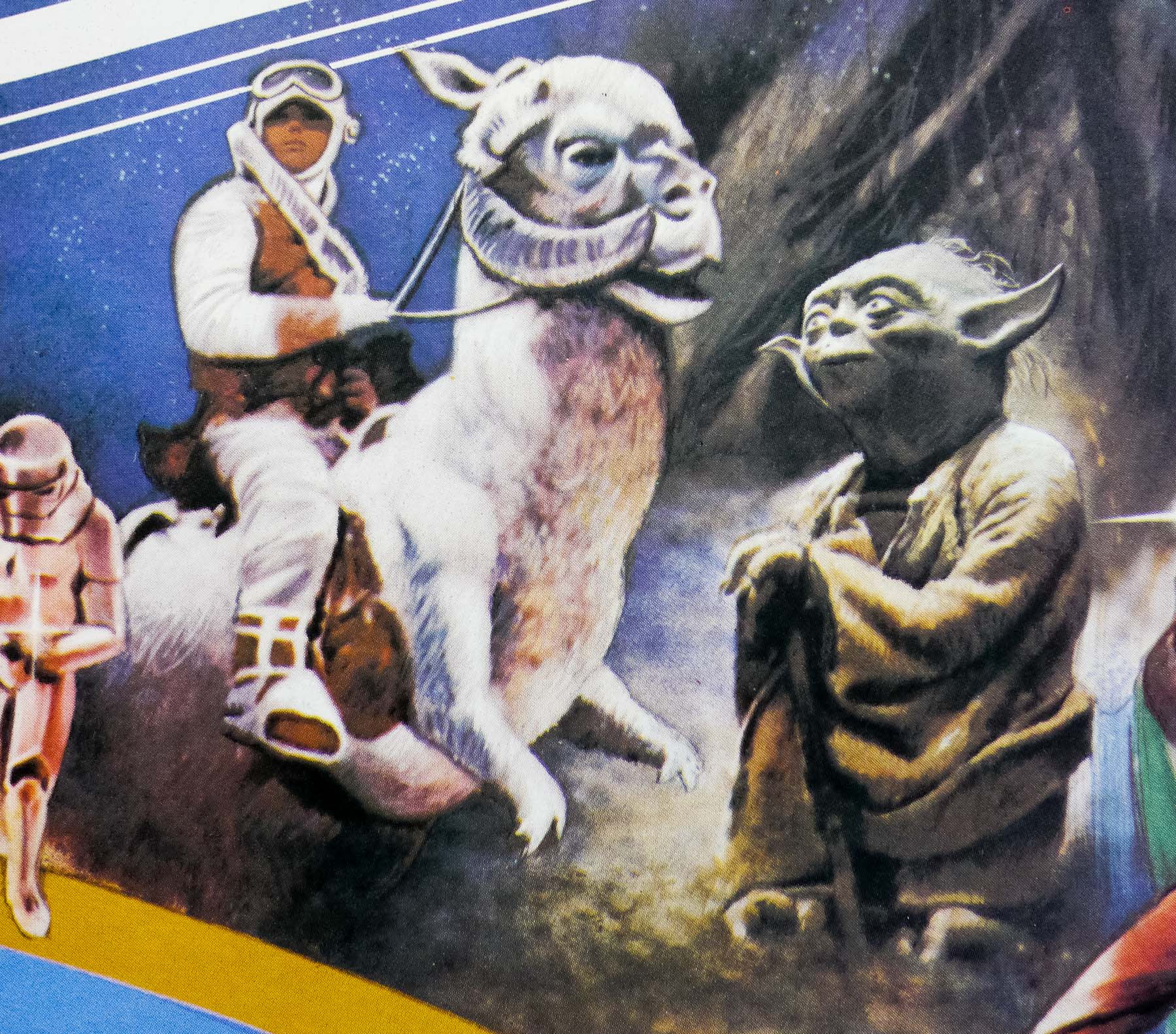
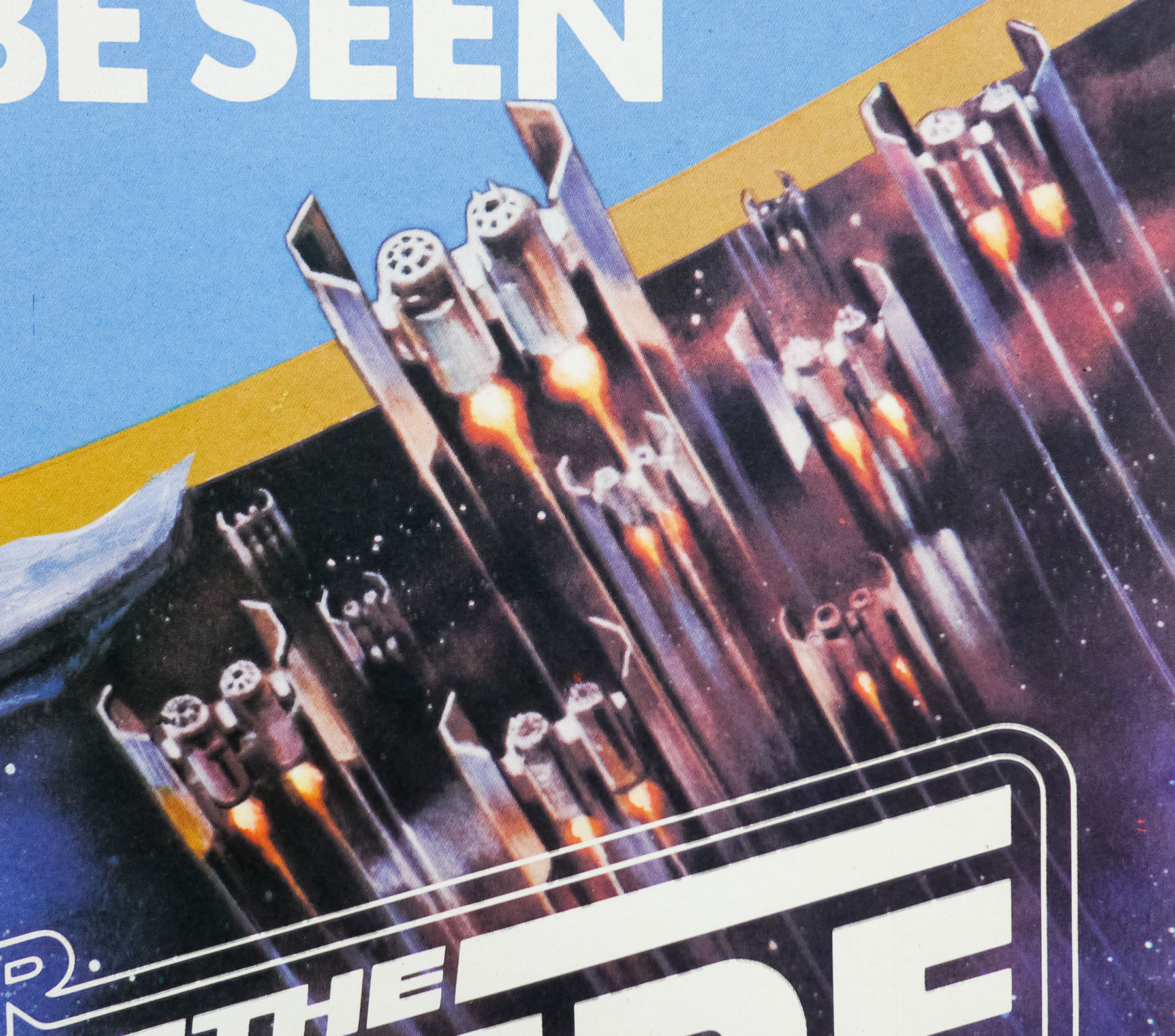
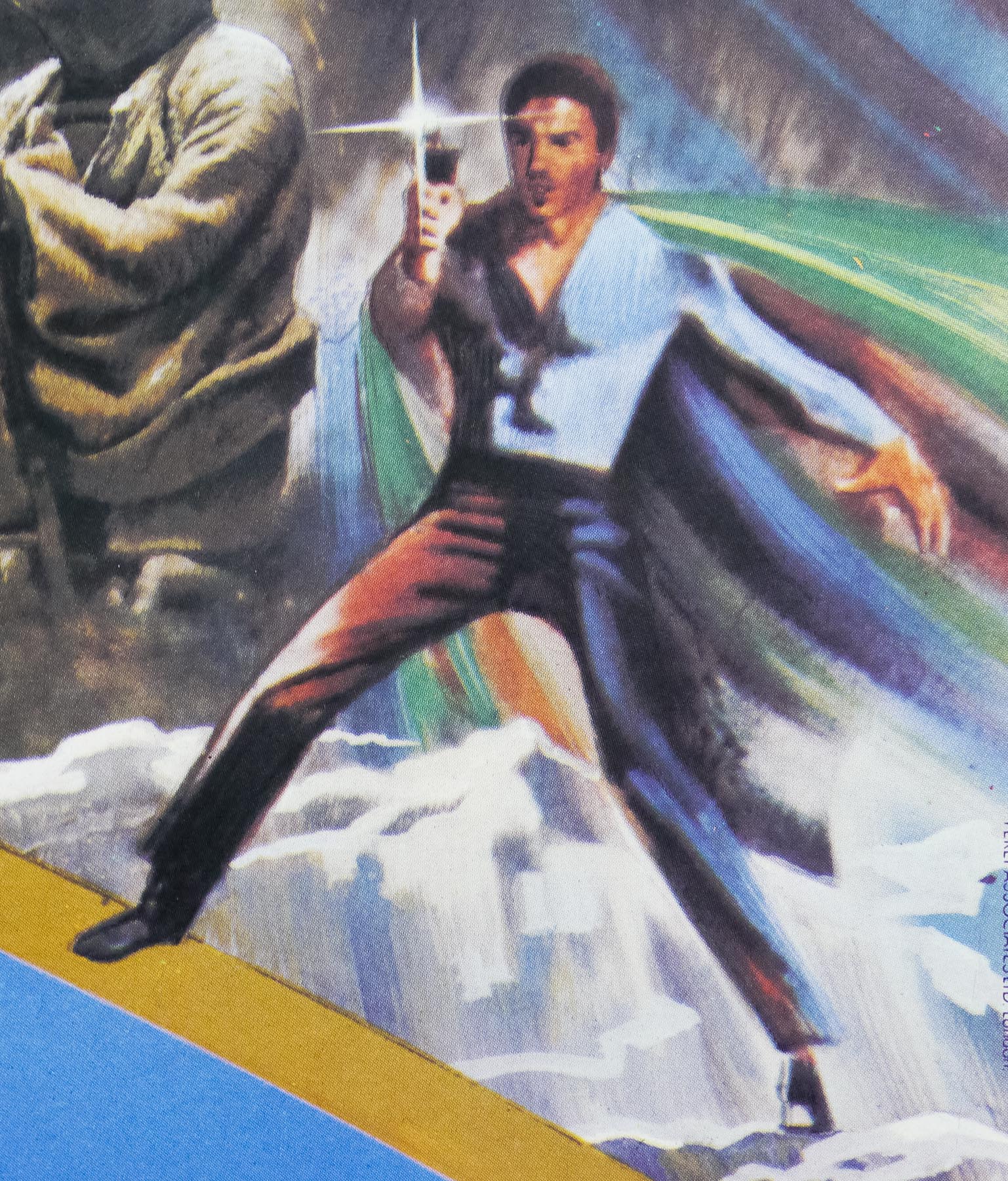
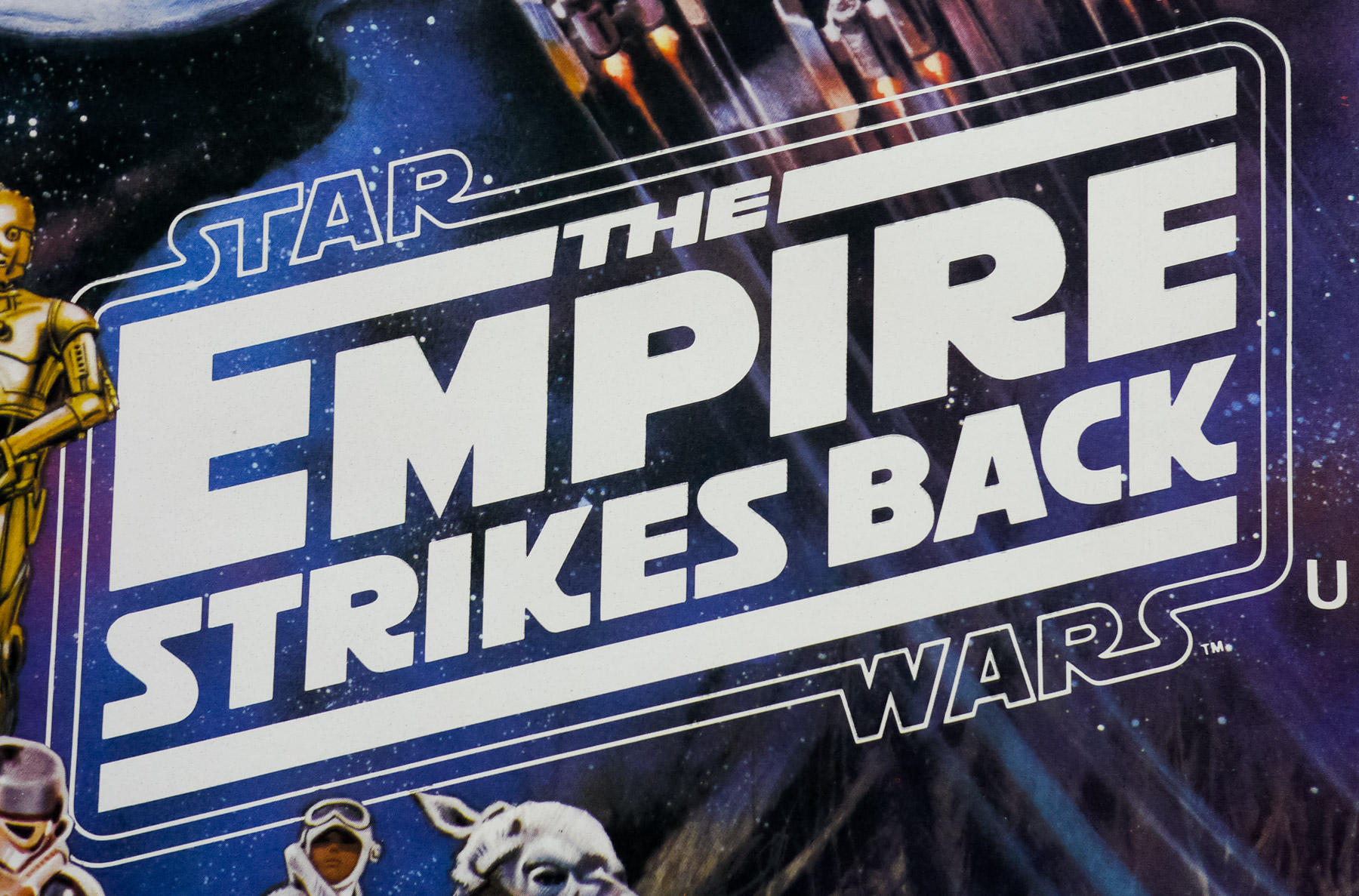
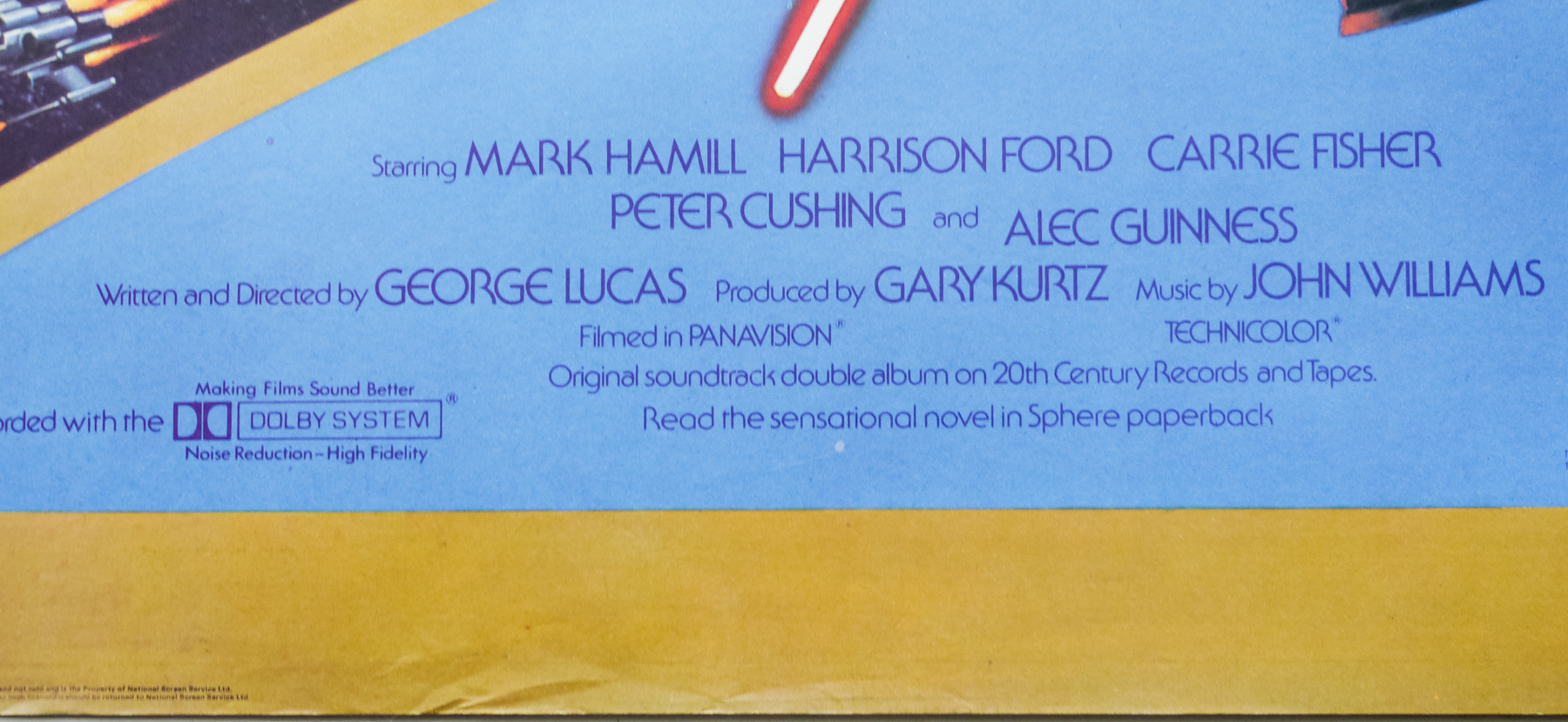
To capitalise on the successful release of the films, particularly before home video was a reality, distributor 20th Century Fox decided to release a double-bill of both Star Wars and Empire Strikes Back in to cinemas towards the end of 1980. This event was repeated across the world but this British quad is unique to this country and is the result of the amalgamation of the original quads for both films, plus an extra photographic element not included on either in the figure of Jedi master Yoda, which was probably added due to the characters’ popularity.

The original Star Wars quad was designed and illustrated by the late, great British artist Tom Chantrell whose dynamic and colourful work featured on hundreds of posters over a forty year period. The artist sadly passed away in 2001 but last year his widow Shirley launched his official website, which showcases his work and features a great biography written by Sim Branaghan, author of the must-own book British Film Posters. Chantrell illustrated many classic poster designs, including several Hammer posters such as the brilliant quad for ‘One Million Years B.C.’, and he was also responsible for many other pieces of iconic poster artwork. I have a number of other designs by Chantrell on this site and you can read an exclusive interview with Shirley by clicking here.

The Empire Strikes Back quad features the artwork painted for the US style B one sheetwhich was by the American artist Tom Jung, perhaps best known for his iconic ‘style A’ one sheet that he painted for the release of the original Star Wars. Jung was a prolific designer and illustrator for film campaigns from the 1950s through to the 1980s. IMPAwards features a gallery of his work and his Wikipedia article has a selected list of the posters he worked on. The other posters I’ve collected by him can be seen here.
Another special quad was put together for a triple-bill event after the release of Return of the Jedi, which again featured elements of the artwork from all three separate release quads. Note that this poster can be found undersized at around 28″ x 40″ and this was because several hundred copies were machine trimmed to be used in special frames on the London Underground, a fate which befell a number of posters around the end of the 1970s and early 1980s.


The Hills Have Eyes / quad / UK

03.10.14

Poster Poster

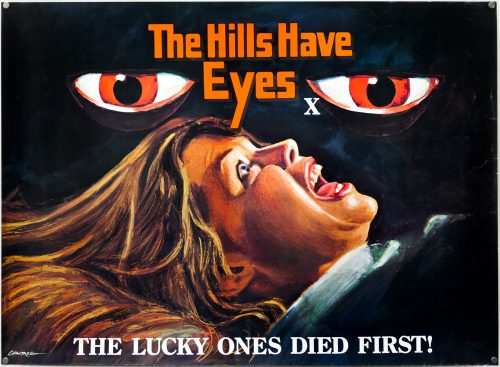
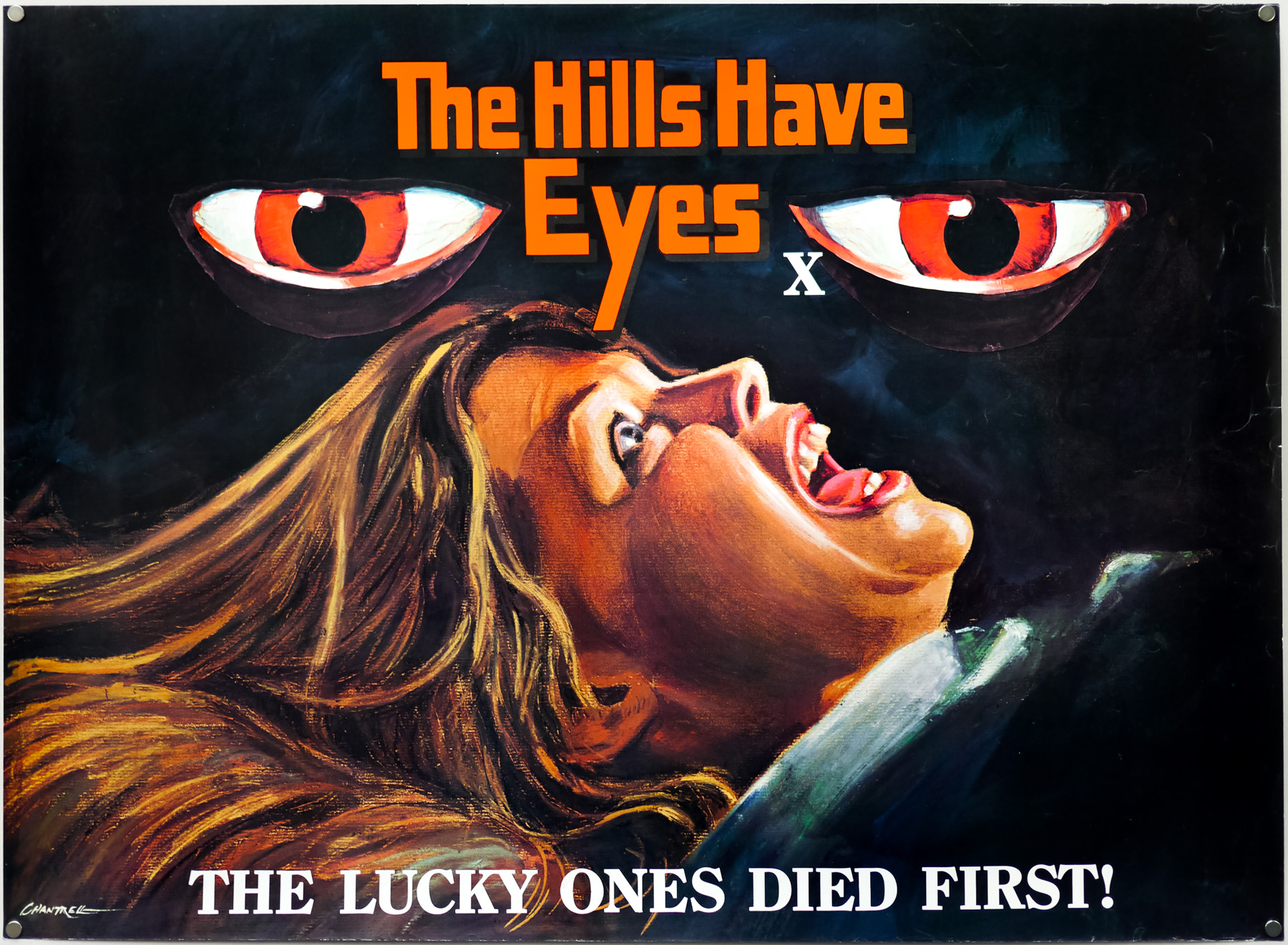
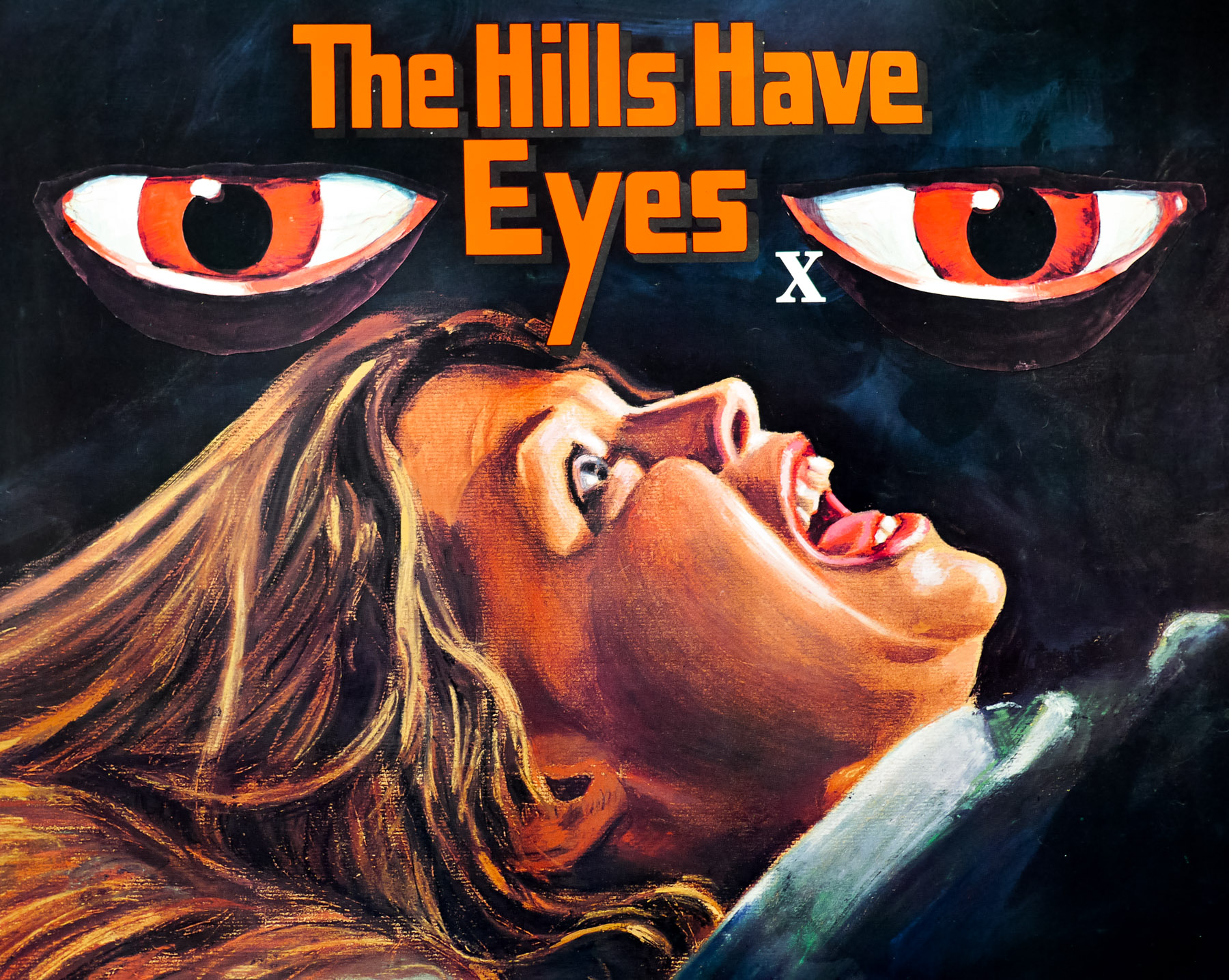
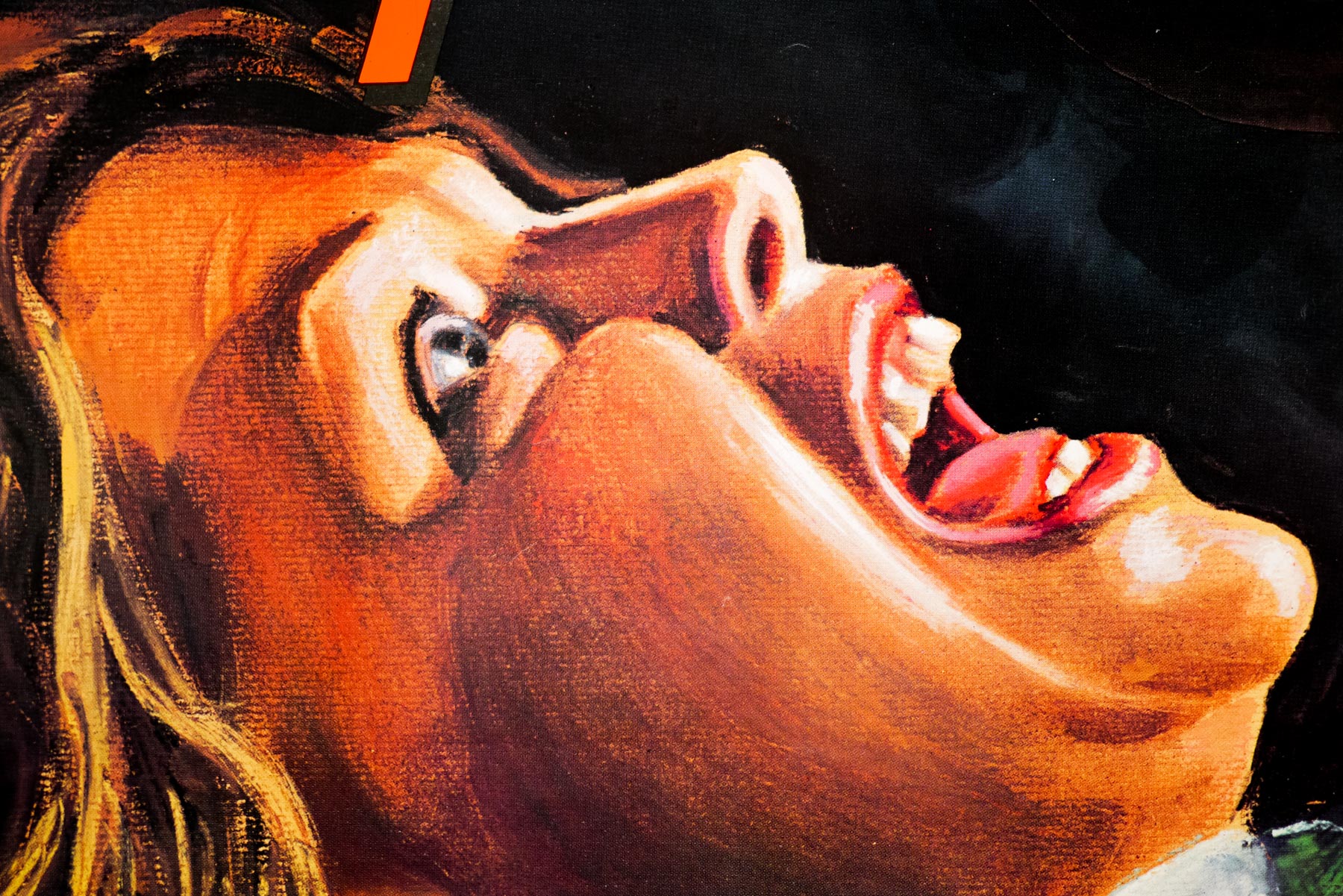
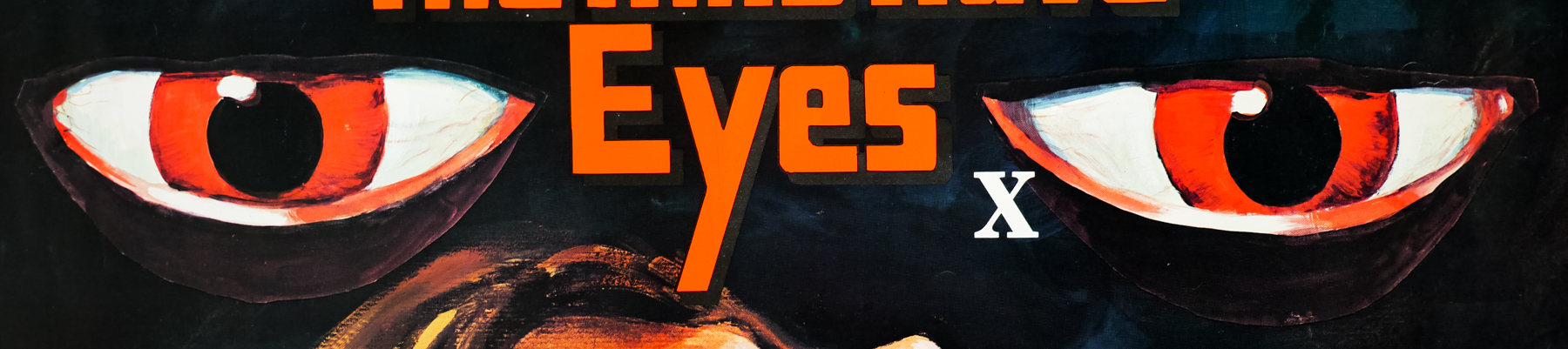
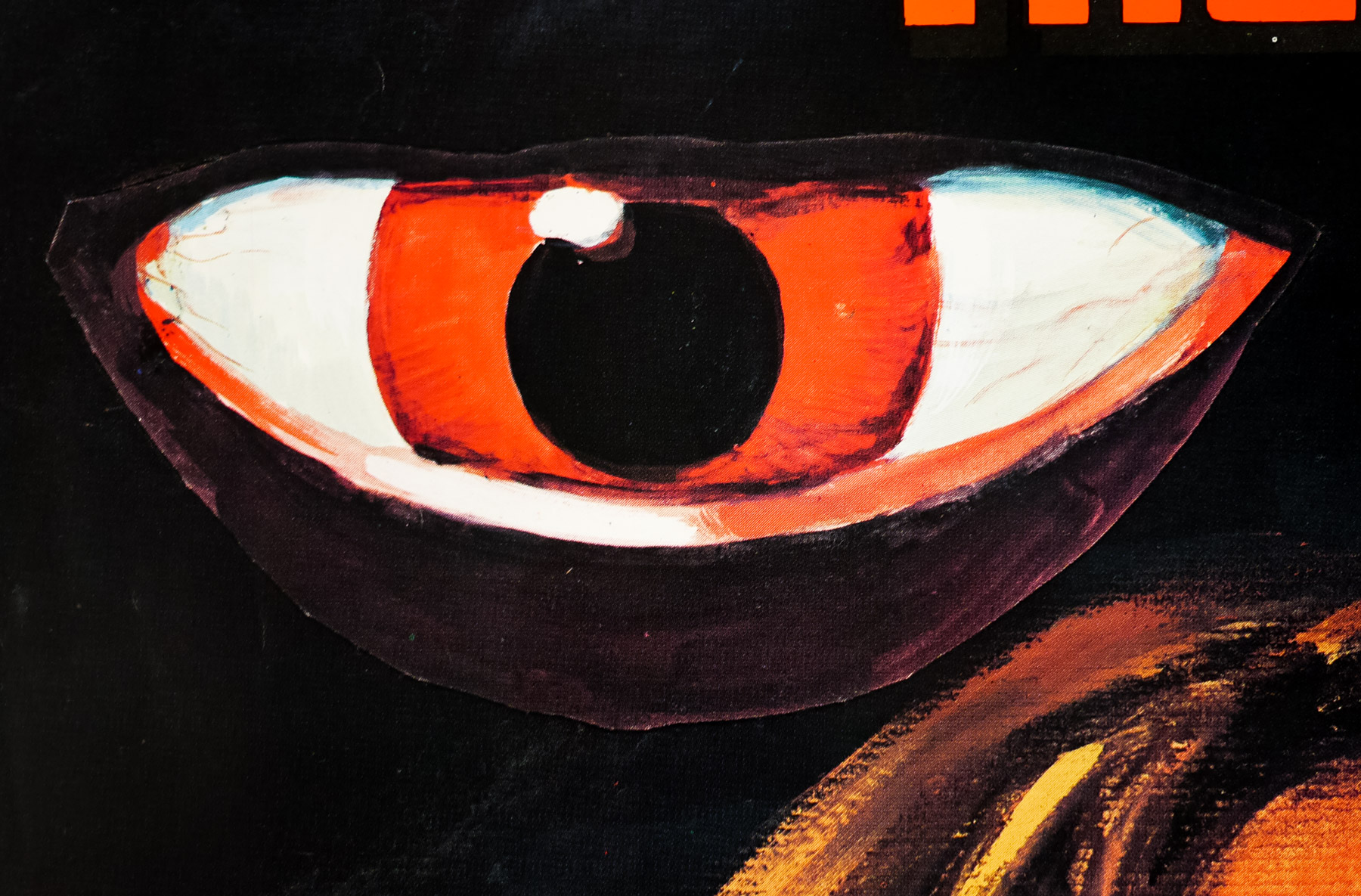
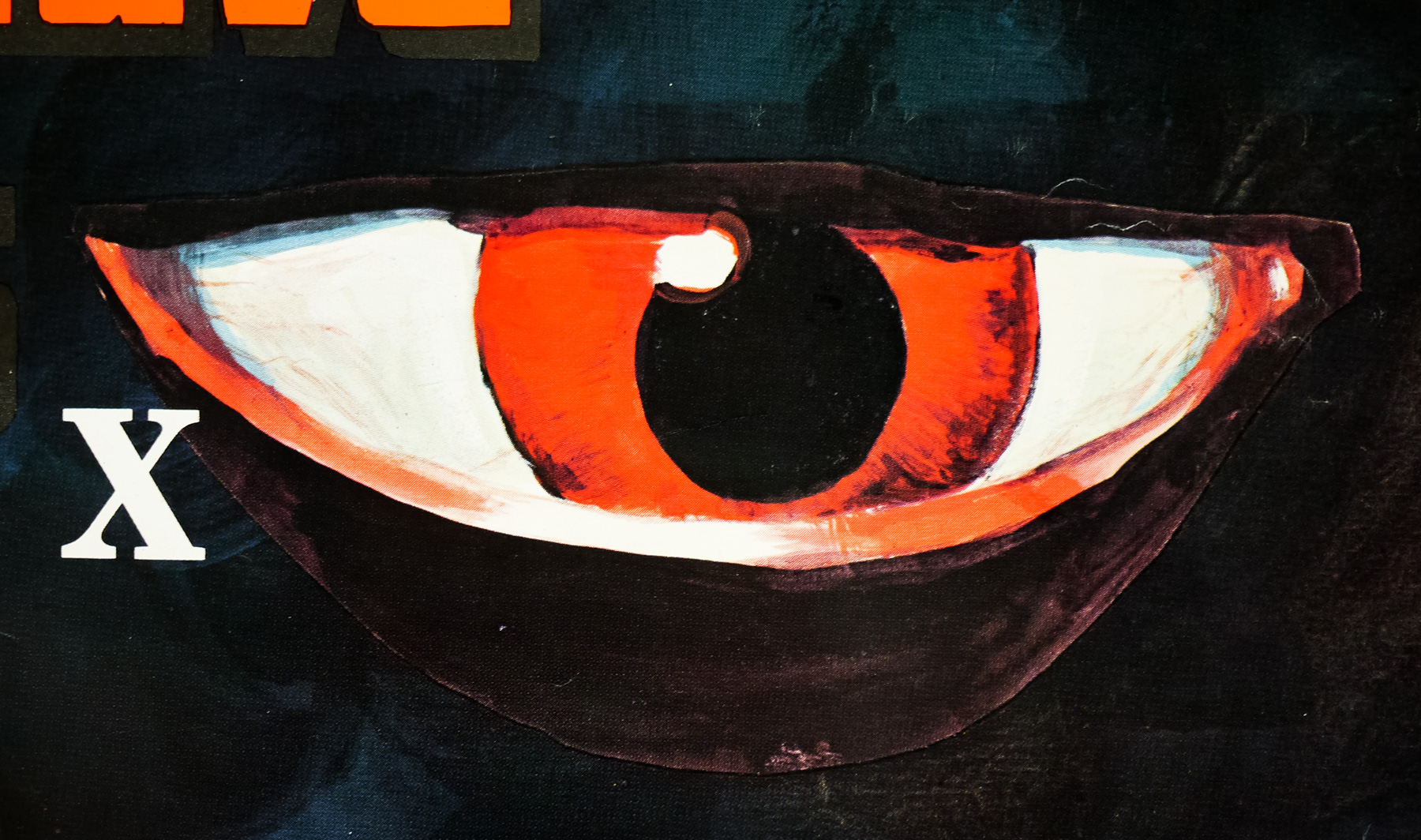
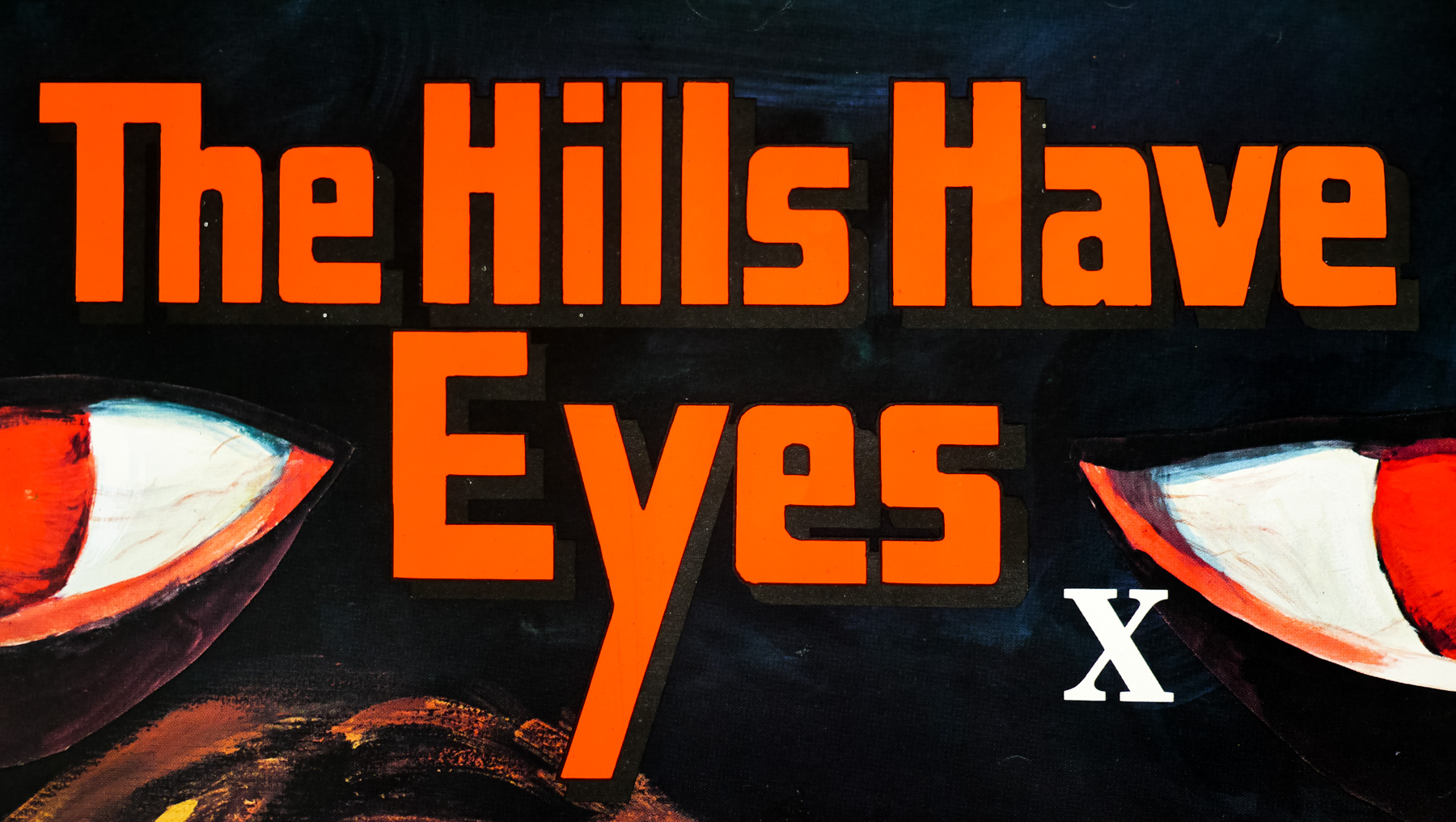
Striking artwork on this UK quad for the release of The Hills Have Eyes, which was director Wes Craven‘s third film, following his notorious breakout horror The Last House on the Left (1972) and the little seen adult drama The Fireworks Woman (1975). Written by Craven himself, the film is an exploitation horror that follows events when a family heading to California with a caravan crash in a remote part of the Nevada desert. Unluckily for them, the area used to be a nuclear testing site and there are a pack of feral, deformed cannibal freaks living in the nearby hills who subject the Carter family to a sustained series of brutal attacks.

The film was reasonably well received at the time of original release but went on to gain a cult following and is today regarded as one of the director’s best films. I watched it again recently and it retains its power to shock, with some of the attacks being particularly brutal. A remake was released in 2006 which was at least stylistically interesting, if nothing else.

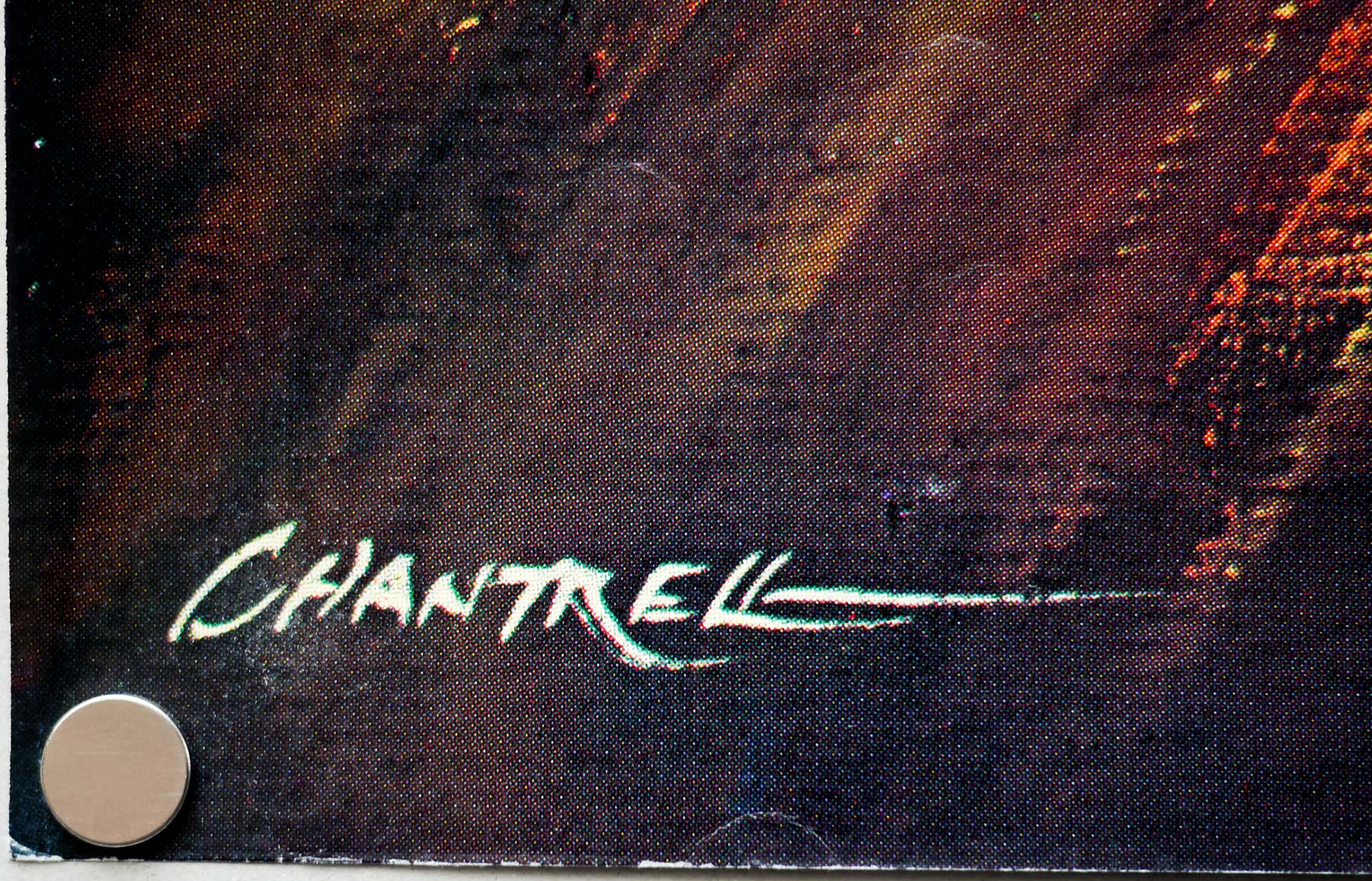
This UK quad is unusual in that it has no credits block or distributor information and features only the signature of the artist, Tom Chantrell. The only other British poster for the film that I’ve seen is a double-bill quad and I don’t think this one could be considered a teaser or advance (despite featuring little detail).

Tom Chantrell’s dynamic and colourful work featured on hundreds of posters over a forty year period. His official website features a great biography written by Sim Branaghan, author of the must-own British Film Posters. Chantrell illustrated many classic poster designs, including several Hammer posters such as the brilliant quad for ‘One Million Years B.C.’, and was also responsible for the iconic Star Wars quad, the artwork of which ended up being used around the globe. I have a handful of other designs by him on this site.

The Spy Who Loved Me / quad / 2008 re-release / UK

12.11.14

Poster Poster
Title
The Spy Who Loved Me
AKA
--
Year of Film
1977
Director
Lewis Gilbert
Starring
Roger Moore, Barbara Bach, Curt Jürgens, Richard Kiel, Caroline Munro, Walter Gotell, Bernard Lee, Desmond Llewelyn, Lois Maxwell, Geoffrey Keen, George Baker, Edward de Souza
Origin of Film
UK
Genre(s) of Film
Roger Moore, Barbara Bach, Curt Jürgens, Richard Kiel, Caroline Munro, Walter Gotell, Bernard Lee, Desmond Llewelyn, Lois Maxwell, Geoffrey Keen, George Baker, Edward de Souza,
Type of Poster
Quad
Style of Poster
Re-release
Origin of Poster
UK
Year of Poster
2008
Designer
Unknown
Artist
Bob Peak
Size (inches)
30" x 39 14/16"
SS or DS
DS
Tagline
Digitally restored and remastered. It's Bond. And Beyond.

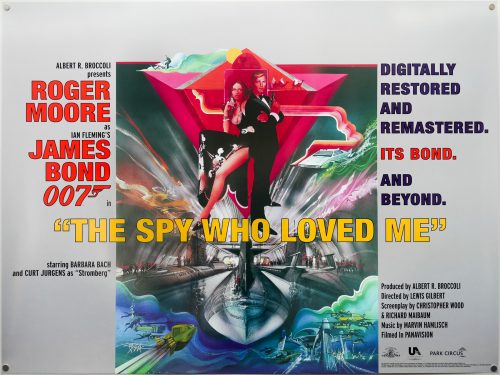
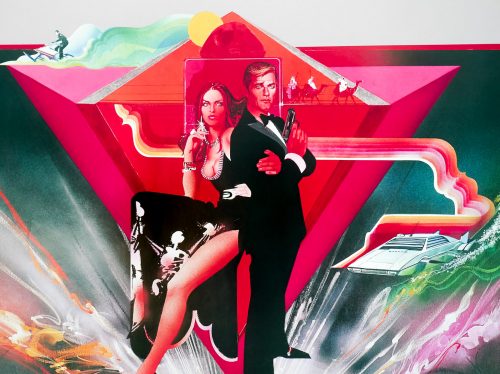
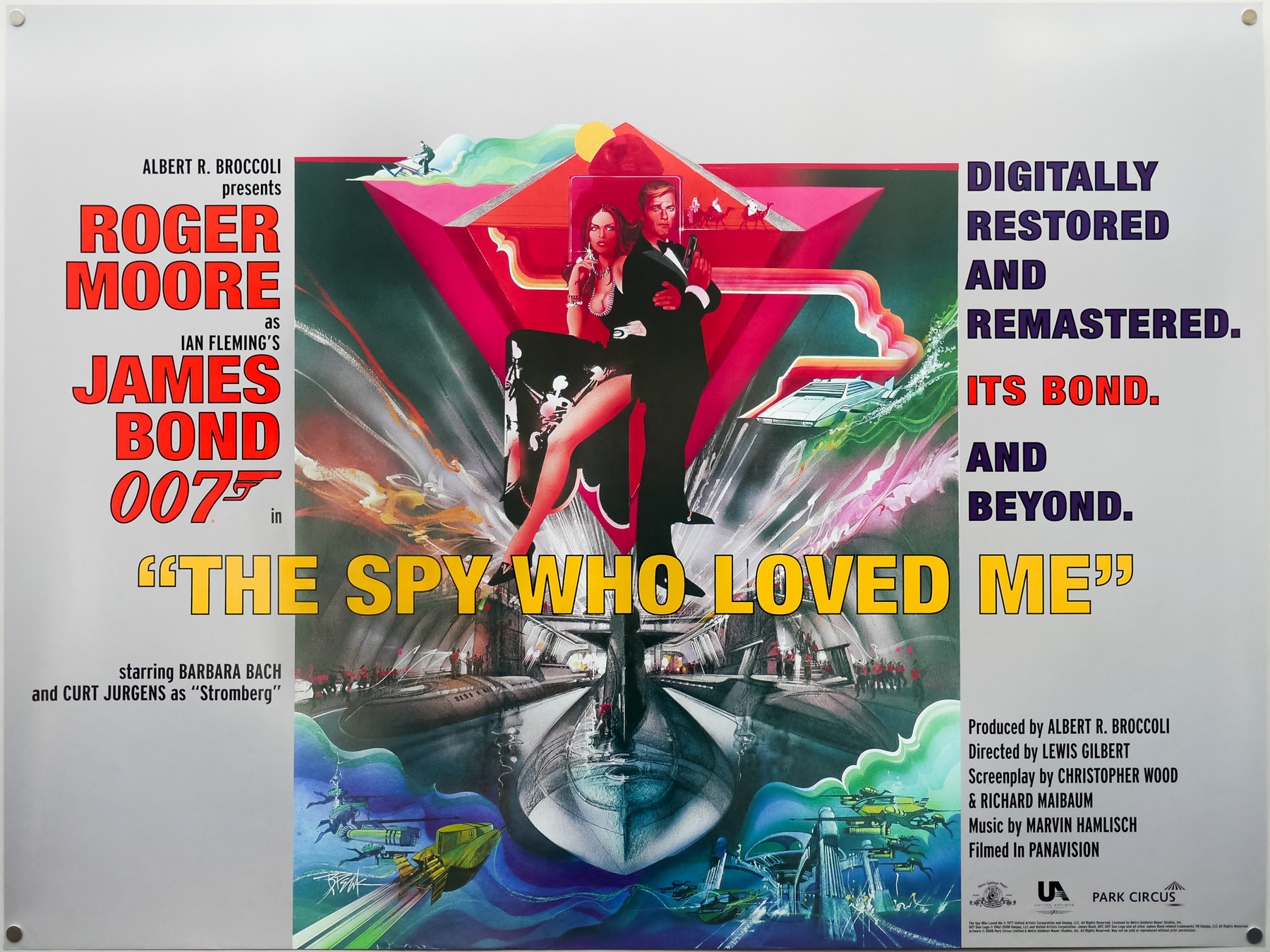
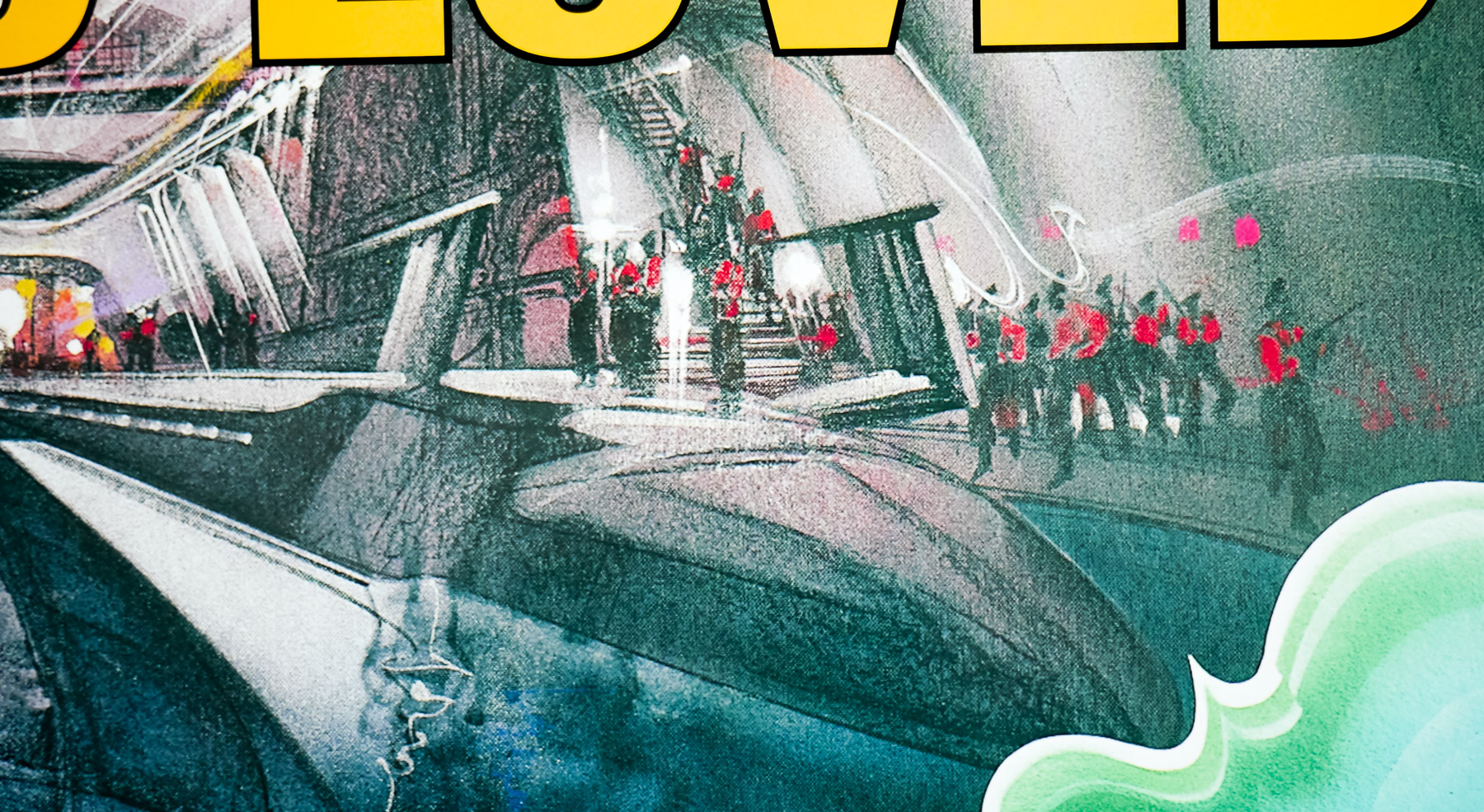
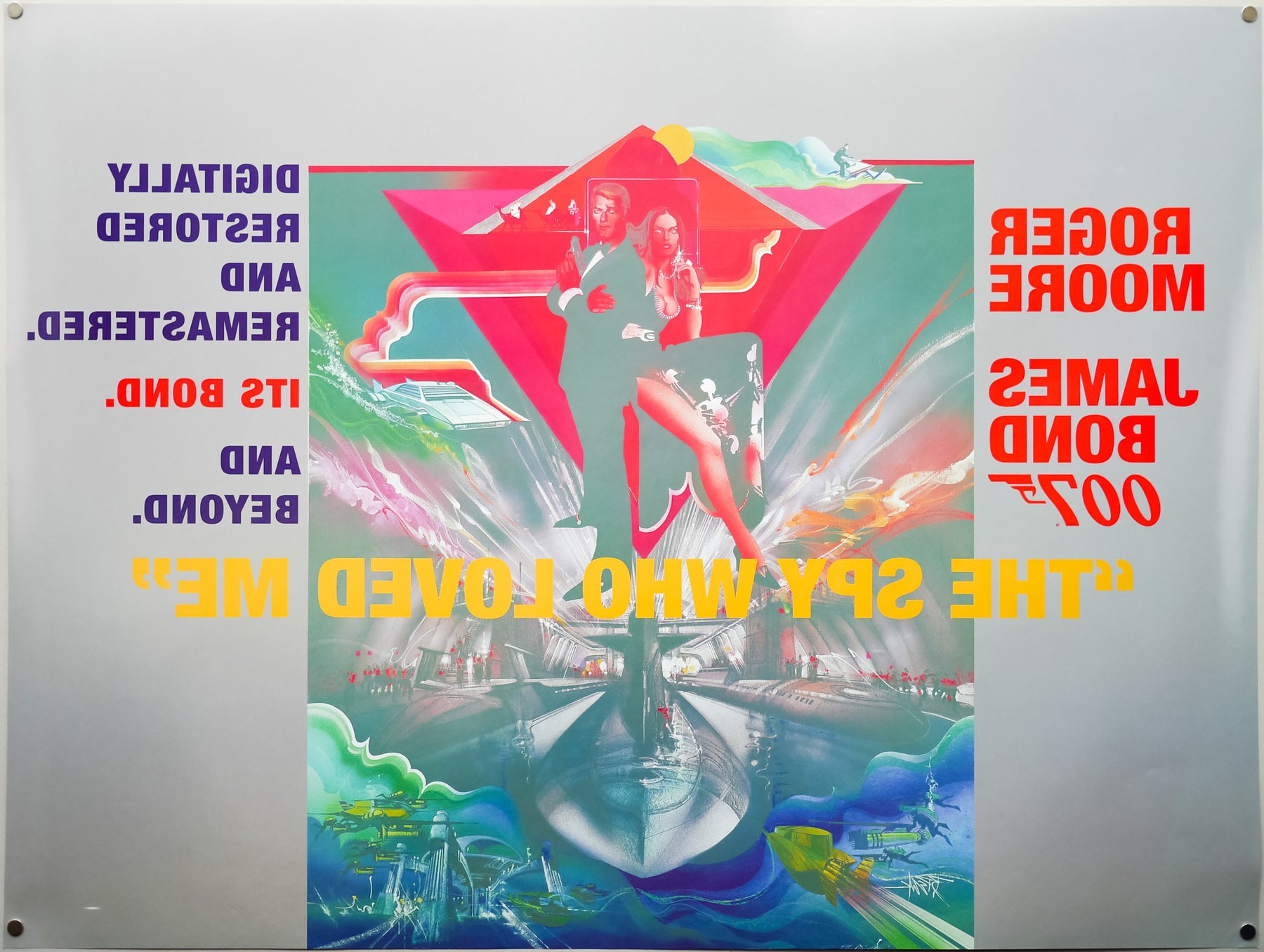
This is the UK quad for a 2008 digital re-release of The Spy Who Loved Me, which was the tenth James Bond adventure and the third to star Sir Roger Moore as the legendary spy. Felt by many to be the best Moore era film, it shares only the title with Ian Fleming’s original novel (at the author’s request) and the screenplay was written by Christopher Wood and Bond regular Richard Maibaum. When Russian and British submarines mysteriously disappear whilst on patrol, each country sends their top spies to discover who is responsible. The trail leads Bond to Egypt where he discovers that the plans for a submarine tracking device are on sale to the highest bidder.

Whilst in Egypt, Bond encounters his Russian rival, the KGB Agent Triple X (!) Major Anya Amasova (played by the beautiful Barbara Bach) and after a few initial hostile encounters the pair agree to team up to track down the plans and deal with the mute but deadly assassin Jaws (the late Richard Kiel‘s first appearance as the fan-favourite baddy). The pair identify shipping tycoon and scientist Karl Stromberg (Curd Jürgens) as the man behind the device and travel to Sardinia on his trail. There they visit Stromberg’s underwater base, Atlantis, posing as husband and wife scientists but their cover is soon blown and Bond’s infamous Lotus Esprit-cum-submarine makes an appearance. Eventually Bond and Anya are onboard a submarine captured by Stromberg’s submarine-swallowing supertanker and a final showdown takes place.

The Spy Who Loved Me opens with arguably the best pre-credits sequence of any Bond film that apparently even had Prince Charles on his feet applauding at the Royal Premiere back in 1977. The locations, sets and special effects work (particularly the models) are all first rate and you really feel that the budget was well spent. The ridiculous camp humour of later Moore outings is thankfully restrained too. The film was very well received by both critics and audiences and raked in healthy worldwide box-office takings.

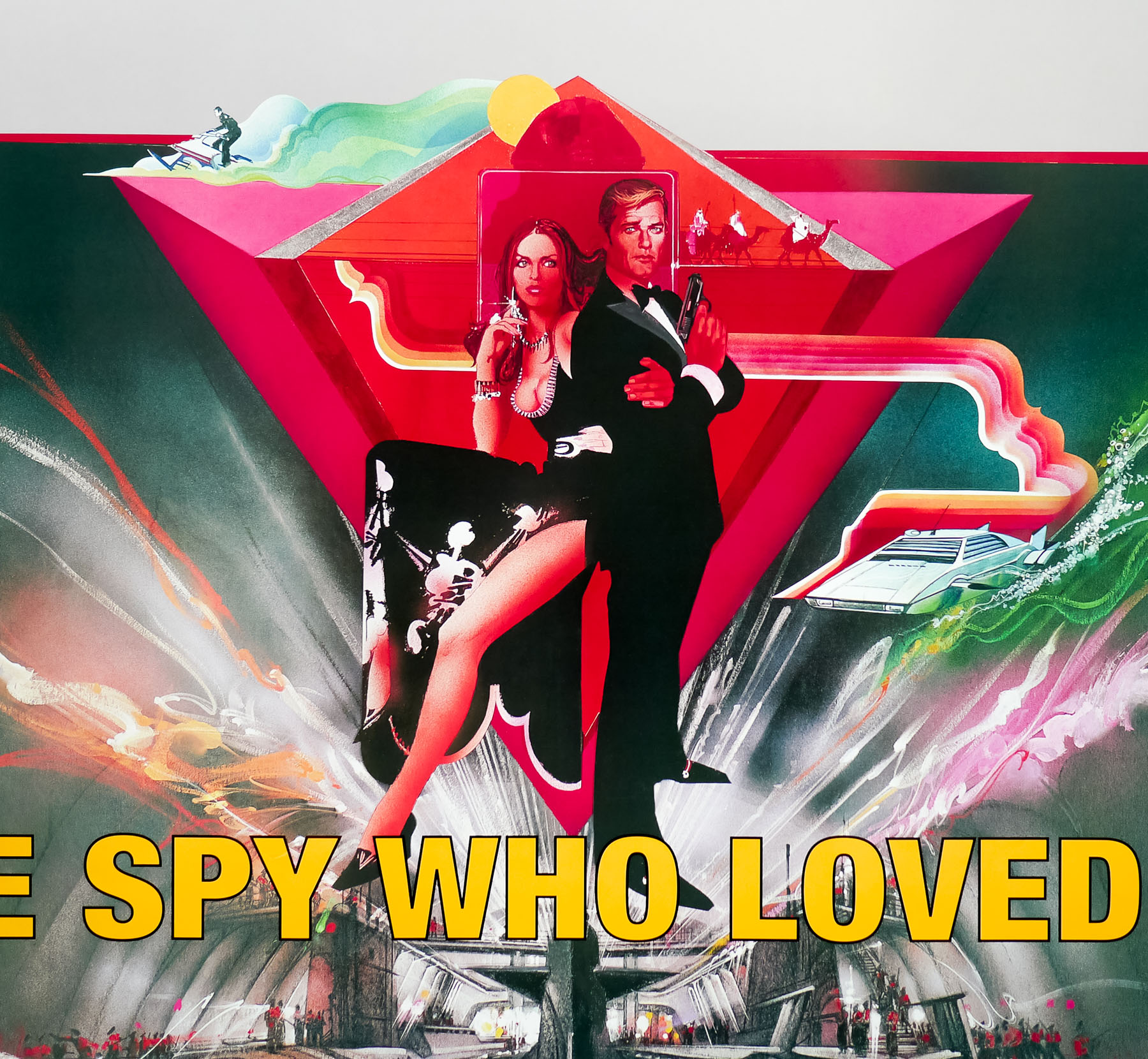
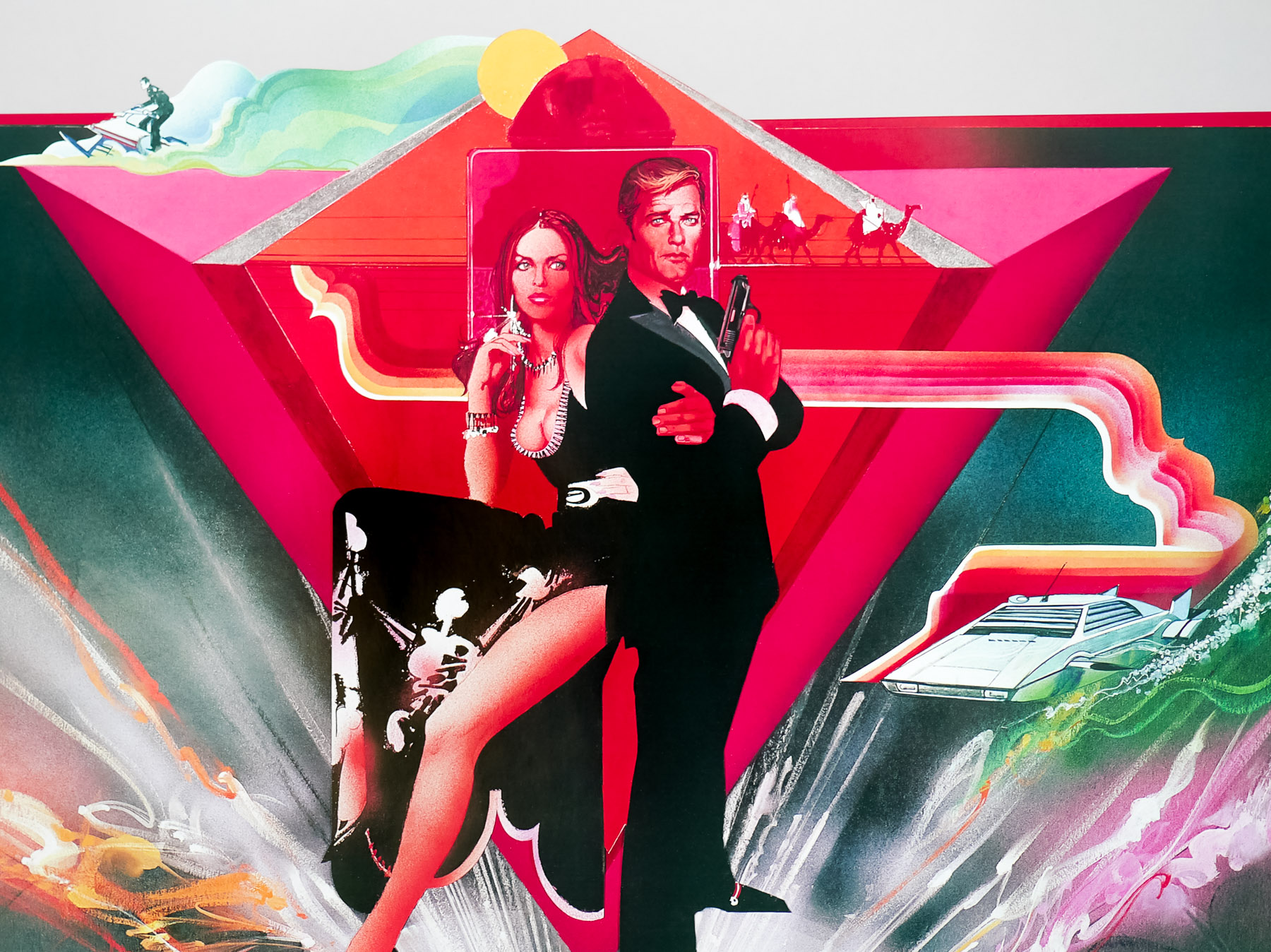
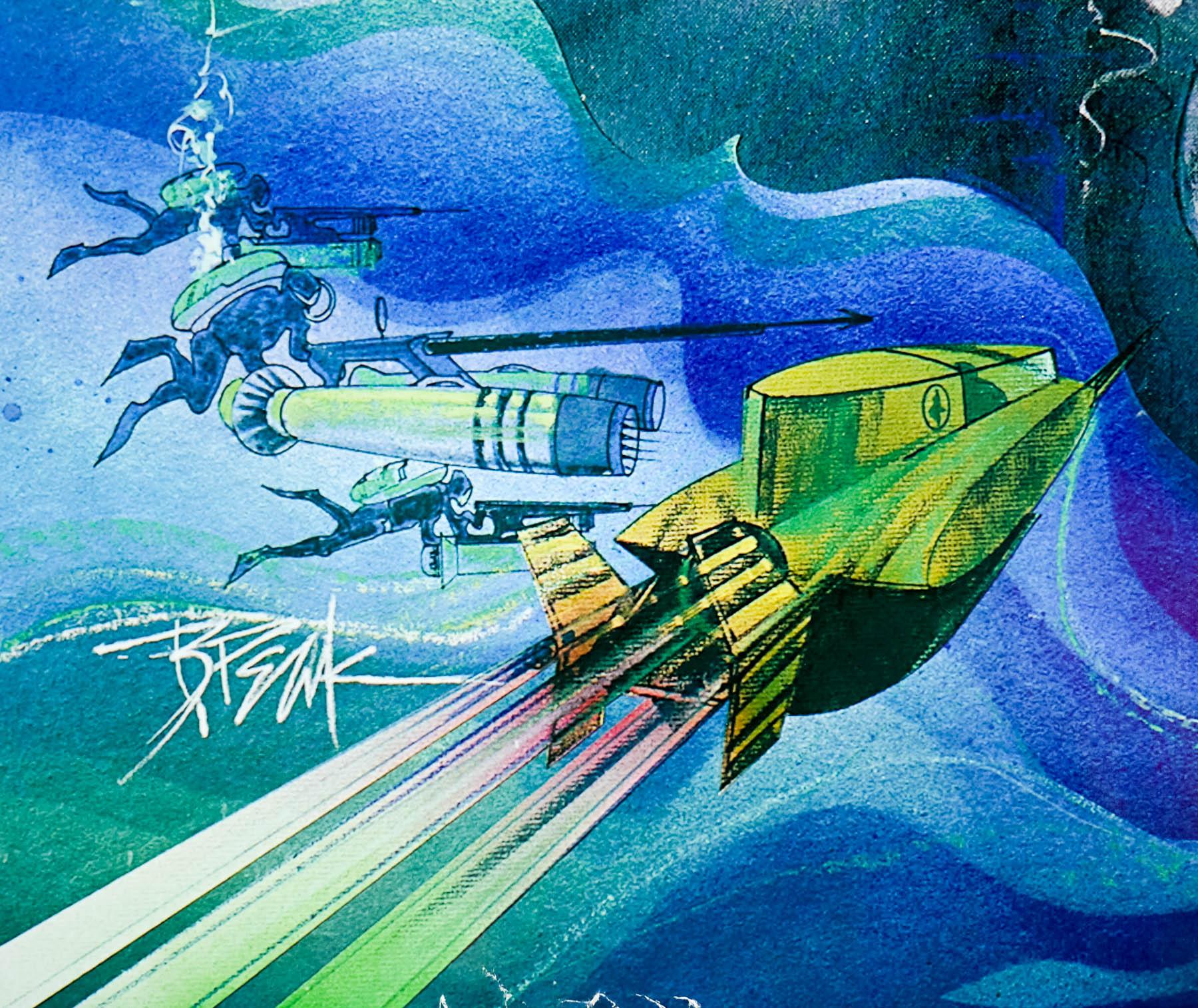
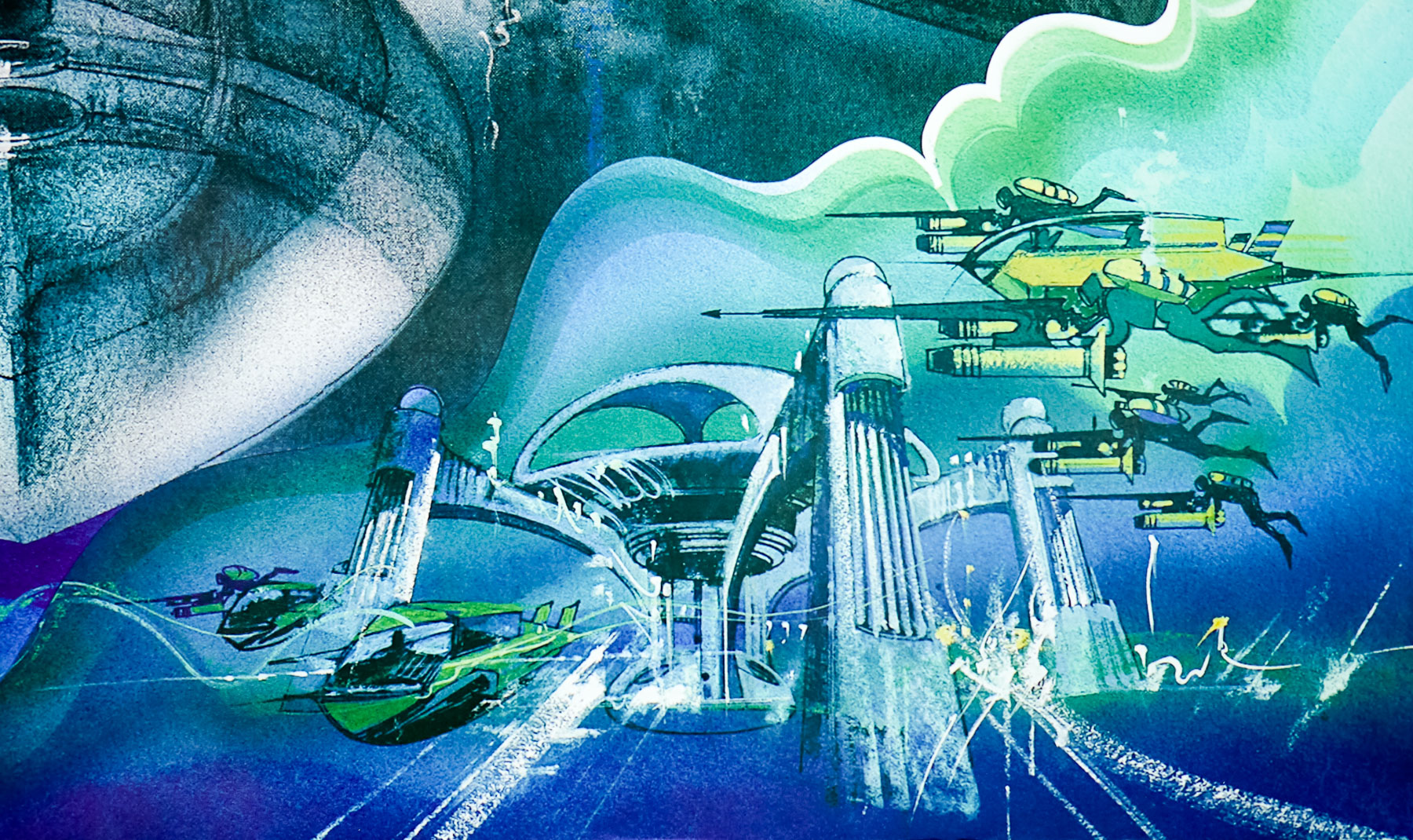
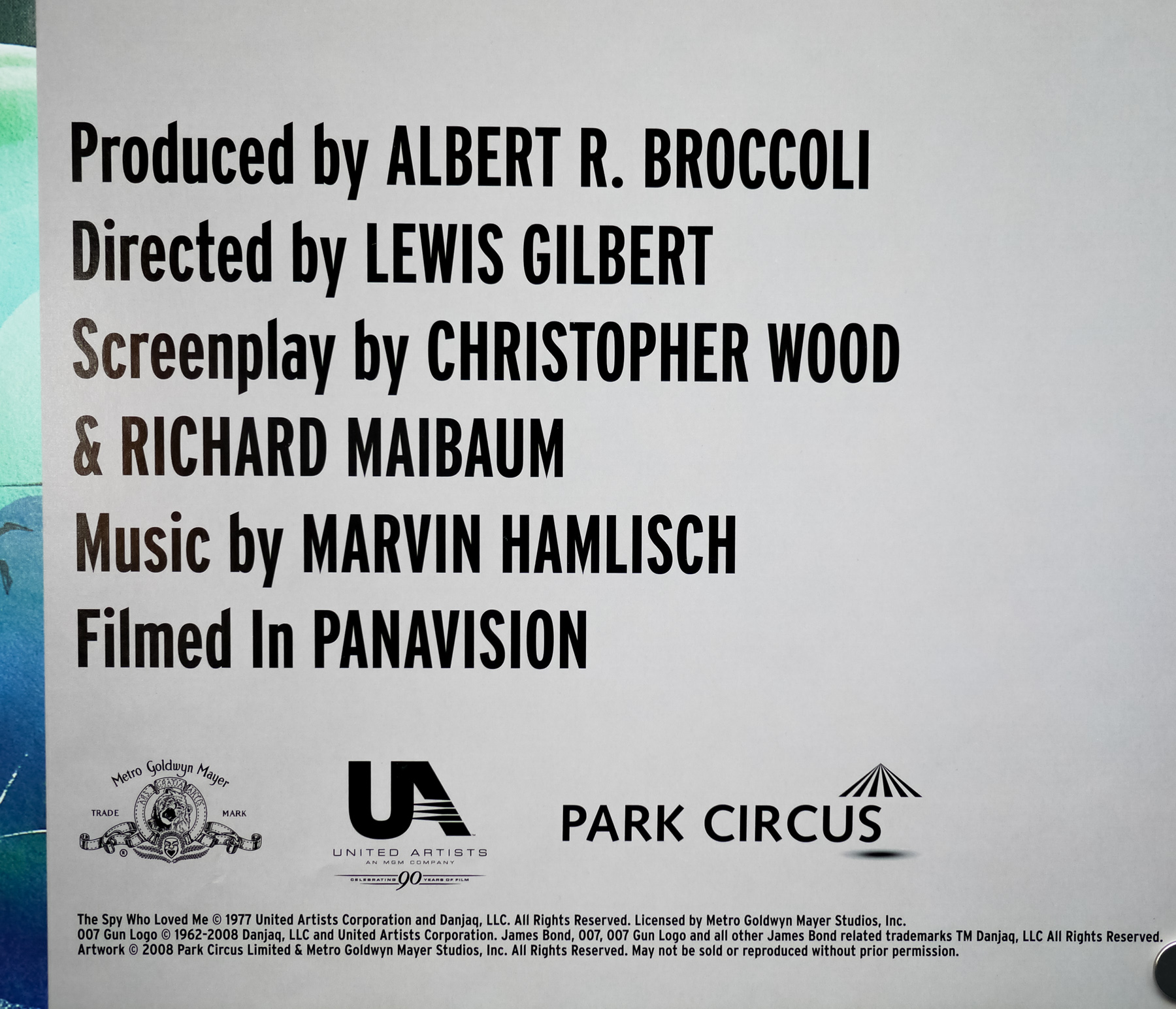
The UK distributor Park Circus was responsible for organising the digital re-release and this quad was printed in very limited numbers. It’s near enough identical to the original quad and features American artist Bob Peak‘s brilliant artwork that featured on posters around the world, including the US one sheet. The original quad was printed on paper with a silver metallic sheen and this quad is glossy and printed double-sided (see the last picture and note that the credits text is missing on the back).

Bob Peak was born in 1927 in Denver, Colorado and grew up in Wichita, Kansas before heading off to serve in the military during the Korean War. Upon his return Peak enrolled in the Los Angeles-based Art Center College of Design where he began to hone his craft as an artist, moving to New York after graduation where he began his career as a commercial illustrator, first working on a campaign for Old Hickory Whiskey. For the next few years the artist worked on a string of successful advertising campaigns, magazine editorials and more, but it was when United Artists hired Peak to work on their campaign for the release of West Side Story in 1961 that he began what would prove to be a fruitful and almost unrivalled career in film poster creation.

Peak’s immediately recognisable style was soon much in demand and his painting appeared on posters for films such as My Fair Lady (1964) and Camelot (1967), but it was his work in the area of sci-fi and fantasy for which Peak is perhaps best known, with the iconic design for the first Superman film (1978), the classic image he created for Rollerball (1975) and the colourful poster for Star Trek: The Motion Picture (1979), amongst several classics of the genre he was responsible for. His paintings for Apocalypse Now, however, arguably saw the artist working at the top of his game and in the recently published must-own bookThe Art of Bob Peak (put together by one of his sons), he is quoted as saying, “Of all my movie work, it is my work on Apocalypse Now that I am most proud of.”

To see the other posters in the Film on Paper collection that were painted by Bob Peak click here.
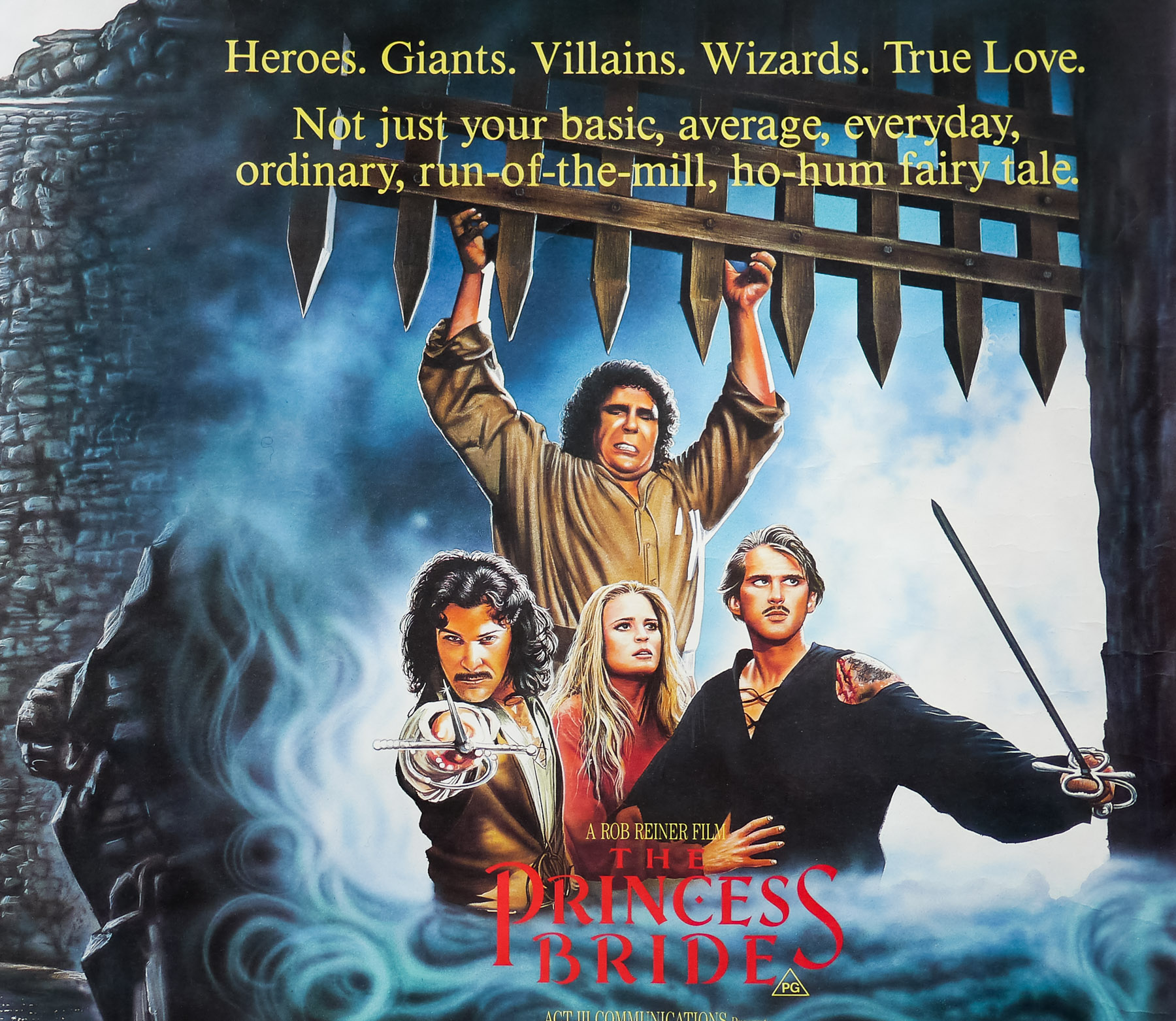
At the Earth’s Core / quad / style B / UK

08.07.15

Poster Poster
Title
At the Earth's Core
AKA
--
Year of Film
1976
Director
Kevin Connor
Starring
Doug McClure, Peter Cushing, Caroline Munro, Cy Grant, Godfrey James, Sean Lynch, Keith Barron, Helen Gill, Anthony Verner
Origin of Film
UK | USA
Genre(s) of Film
Doug McClure, Peter Cushing, Caroline Munro, Cy Grant, Godfrey James, Sean Lynch, Keith Barron, Helen Gill, Anthony Verner,
Type of Poster
Quad
Style of Poster
Style B
Origin of Poster
UK
Year of Poster
1976
Designer
Tom Chantrell
Artist
Tom Chantrell
Size (inches)
30" x 38 14/16"
SS or DS
SS
Tagline
From the creator of 'The Land That Time Forgot'

At the Earth’s Core was the first entry in a series of British sci-fi/fantasy b-movies that were directed by Kevin Connor and starred the prolific American actor Doug McClure, known for his hammy leading man performances (McClure was one of the inspirations for The Simpsons’Troy ‘You may remember me from…’ McClure). The series began with The Land That Time Forgot (1975), was followed by The People That Time Forgot (1977) and ended with Warlords of Atlantis (1978). The initial three were shepherded through production by Max Rosenberg and Milton Subotsky’s Amicus Productions, which was based at Shepperton studios and is perhaps best remembered for its series of portmanteau horror films. By the time Warlords of Atlantis was released the company was almost defunct and so EMI Films stepped in and produced it, utilising many of the same cast and crew as the previous films.

Like the first three films in the series, At the Earth’s Core is based on a novel by the American author Edgar Rice Burroughs, creator of Tarzan and prolific creator of adventure and sci-fi tales. First published in 1914, the story introduced the author’s creation of Pellucidar, which is the idea that Earth is a hollow shell with another land 500 miles beneath the crust. Pellucidar featured in a number of other Burroughs stories and Tarzan even visited it in a 1929 story.

Set in Victorian Britain, the film features McClure playing David Innes, an American financier working with scientist Dr. Abner Perry (Peter Cushing) who has built a giant drilling machine nicknamed the Iron Mole. The idea of the machine is to make the creation of tunnels much easier and the pair have decided to first test it on a Welsh mountain. After launch, the Mole takes an unexpected turn and they find themselves in a strange land with a pink sky and giant unidentified fauna. Suddenly they are attacked by a giant dinosaur-like creature with a beak-like face, but are eventually rescued by an aggressive group of pig-faced cavemen who add them to a gang of primitive humans they have enslaved, including Dia (the stunning Caroline Munro). Soon they are taken to a city ruled over by the evil, pterodactyl-like creatures called The Mahar who, they are horrified to discover, eat human sacrifices. It’s up to David to find a way of escaping from their enslavement and put an end to the Mahar’s reign of terror.
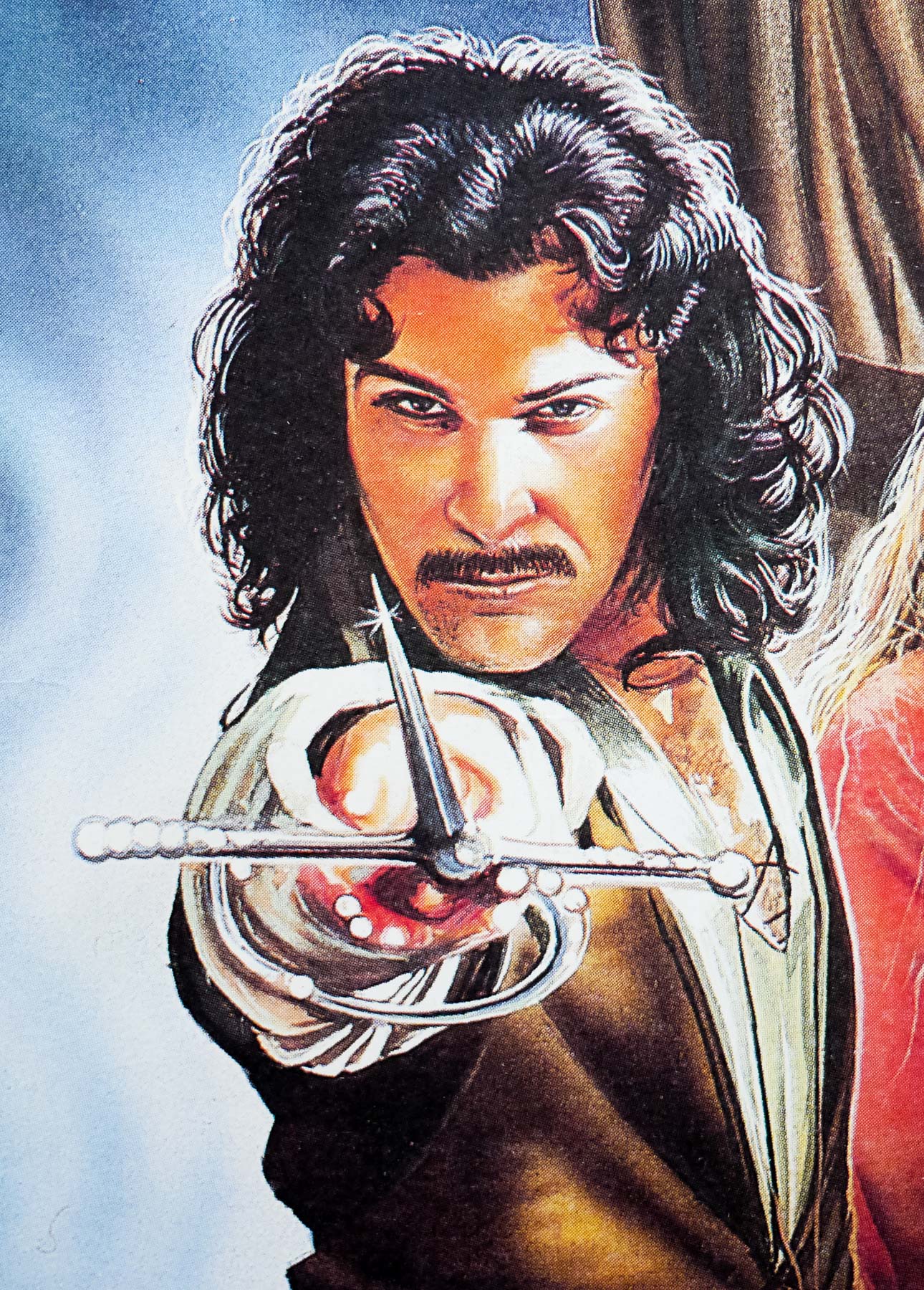
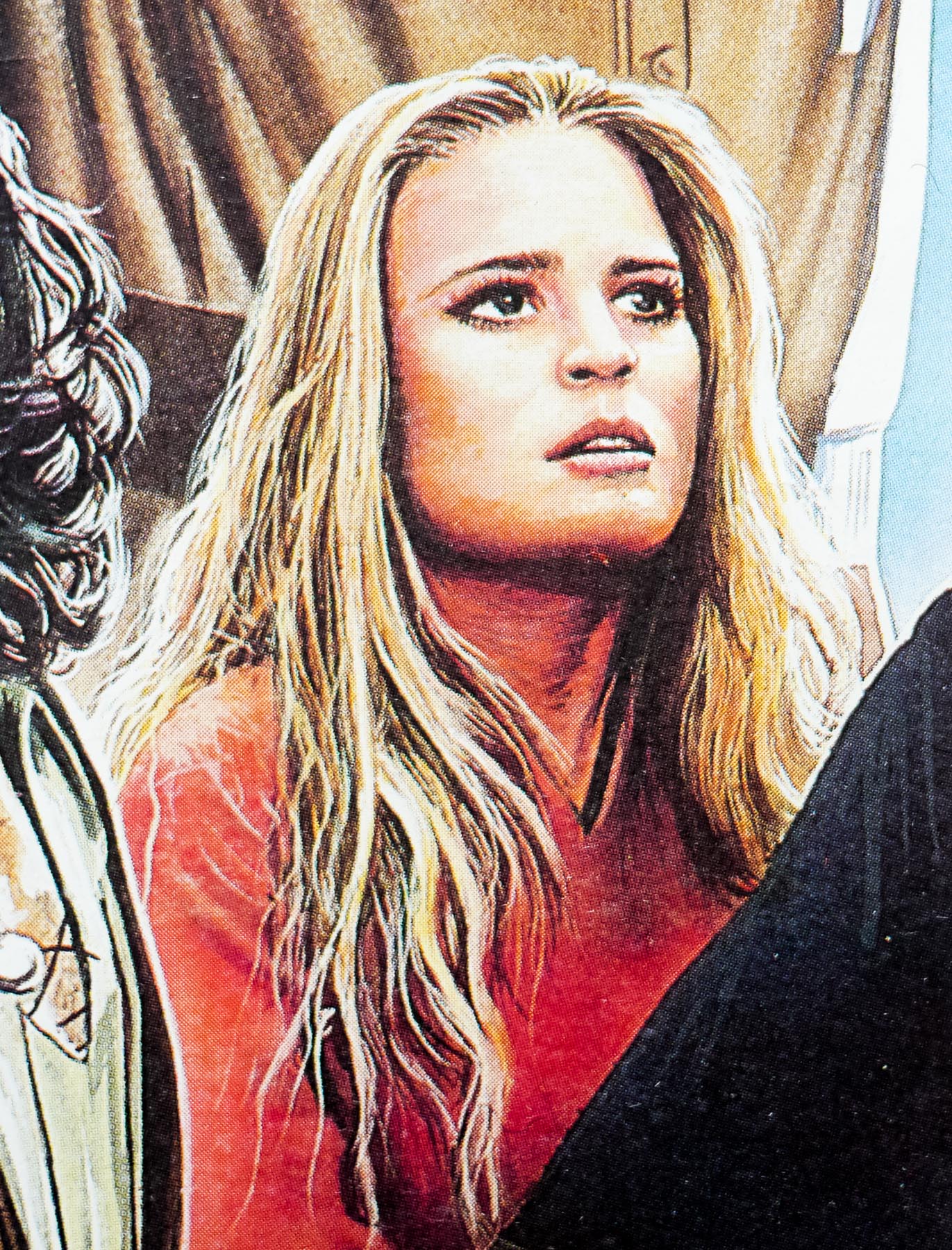
The film has aged pretty badly, not least in the area of the special effects with the creatures looking particularly hokey. The production team decided not to use the stop-motion style of the previous film and instead went for stuntmen in suits for most of the creatures. It’s safe to say that, whilst it may have wowed audiences of the time, it now looks extremely hokey. The production design is otherwise excellent, with some superb sets and lots of effort put into props like the Iron Mole. McClure is his usual ebullient self and Cushing gives it plenty of gusto, although the strange high-pitched voice he affects gets very grating after a while. The score by Michael Vickers is notably decent.
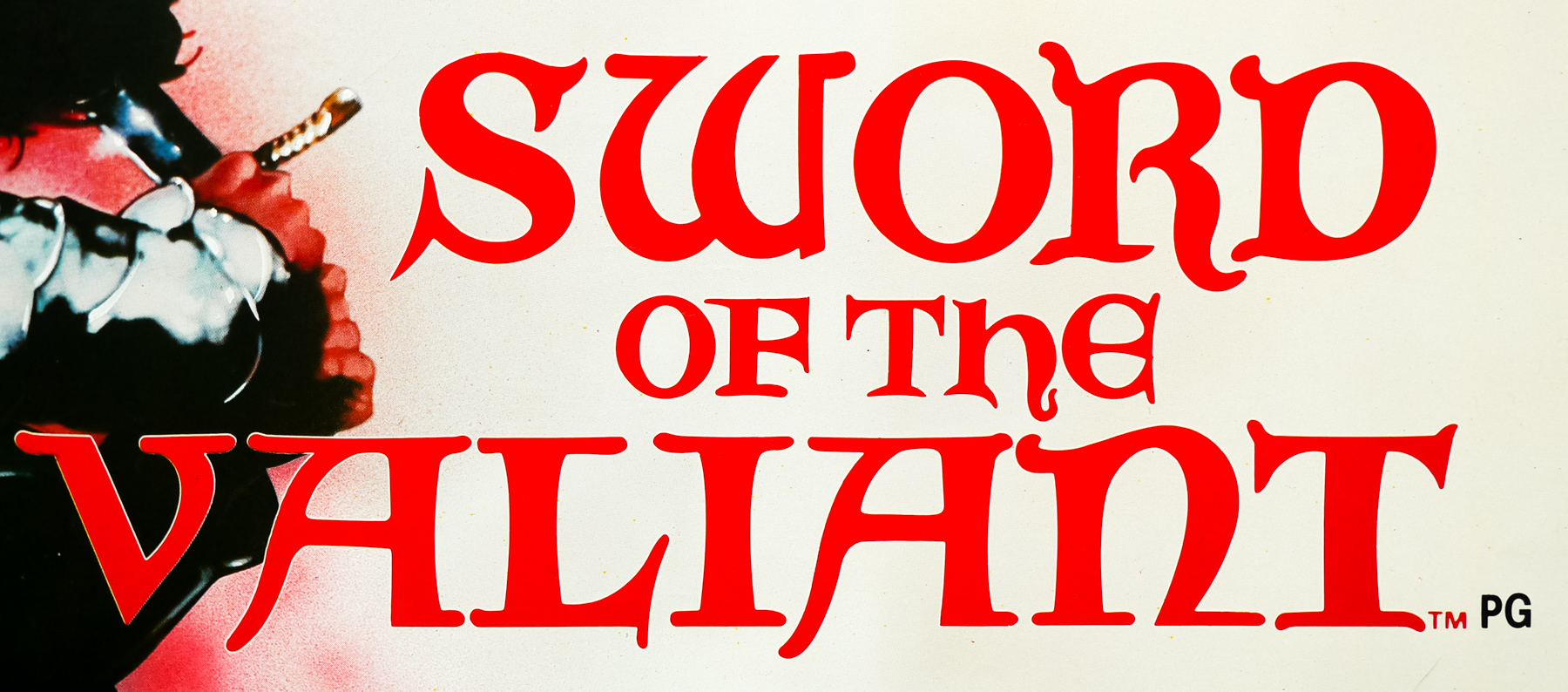
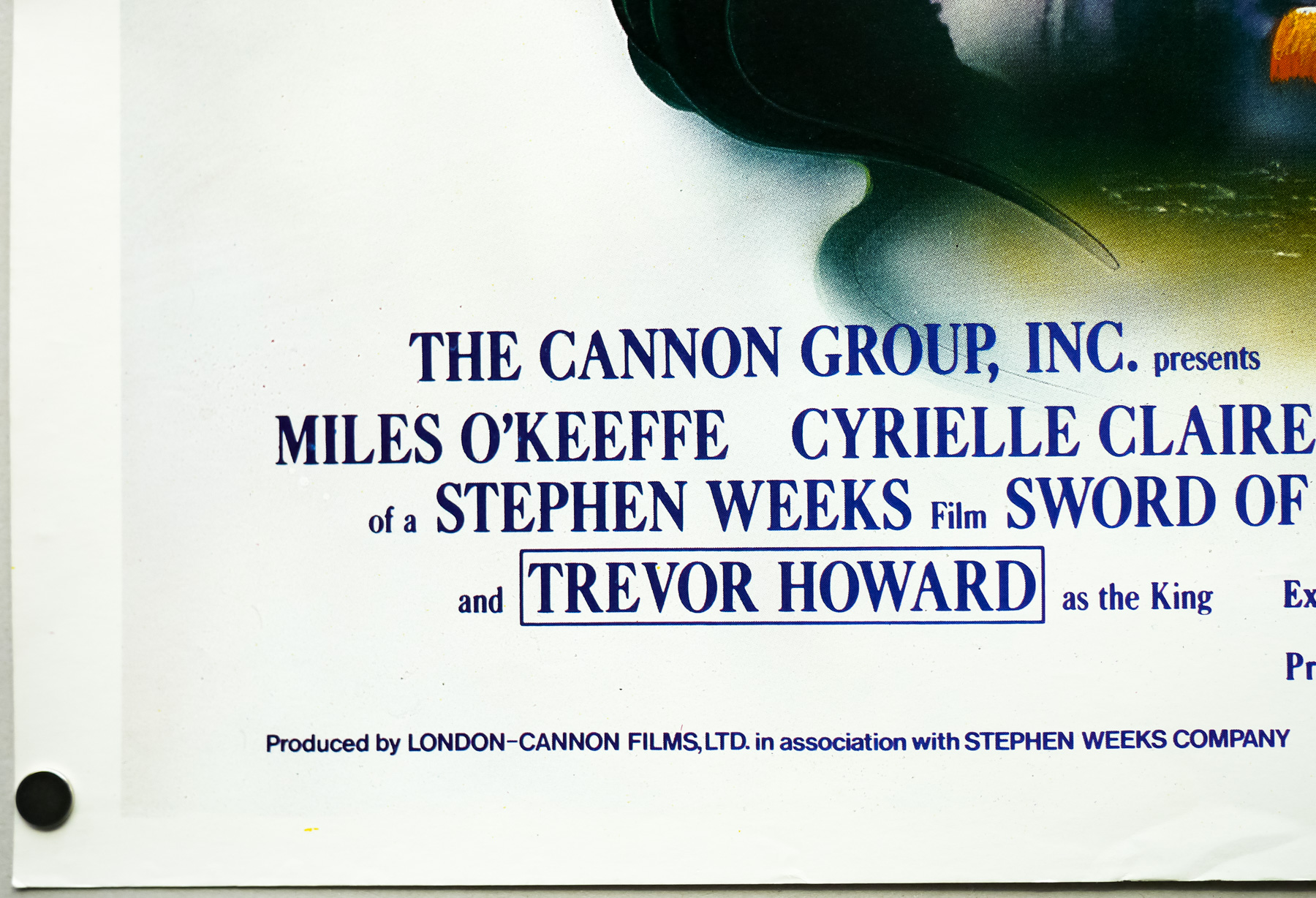
The brilliant artwork on this quad, featuring a similarly chunky title treatment as seen on the quad for the first film in the series, is by Tom Chantrell, the celebrated British artist whose dynamic and colourful work featured on hundreds of posters over a forty year period. His official website features a great biography written by Sim Branaghan, author of the must-own British Film Posters. Chantrell illustrated many classic poster designs, including several Hammer posters such as the brilliant quad for ‘One Million Years B.C.’, and was also responsible for the iconic Star Wars quad, the artwork of which ended up being used around the globe. I have a number of other designs by him on this site.

Note that there are two styles of the UK quad and I’ve called this one style 2. The more common style 1 (see this picture) is fairly similar but features a bit more artwork at the bottom of the poster. Note the extra vegetation on style 1 and the alternate placement of the credits block, with style 2’s covering over part of the fire-breathing frog. I’m not sure why there are two versions of the poster and the answer is sadly likely to be lost to time, with Chantrell having passed away in 2001. This poster is also undersized widthways but I don’t believe it has been trimmed.